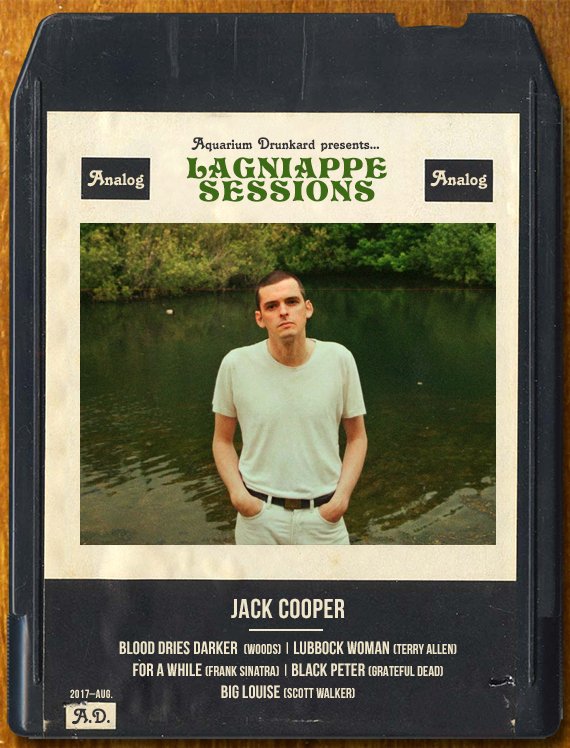
Lagniappe (la·gniappe) noun ˈlan-ˌyap,’ – 1. An extra or unexpected gift or benefit. 2. Something given or obtained as a gratuity or bonus.

Earlier this year Ultimate Painting’s Jack Cooper slid us an early version of his new solo album, “Sandgrown”. At nine tracks we were immediately drawn to its sparse, tranquil, yet personal offerings inspired by his hometown of Blackpool off the coast of England. The effort finds Cooper waxing nostalgic about his time growing up on the Fylde Coast and the cast of characters that come with living and working in a seasonal resort town. Often compared to the Velvets, Sandgrown finds Cooper acknowledging other influences including Terry Allen and The Grateful Dead, mixing them with the experimental textures of John Cale and Robert Wyatt.

Jack Cooper :: Blood Dries Darker (Woods)

Woods have a special place in my heart because my wife and I are both big fans and we always listen to them together. I first saw them in 2008 in Manchester and it’s been a pleasure seeing them so many times since then. This is my favourite song of theirs and although they never really play it, Jarvis dedicated it to my wife and I last time they played London. It’s a pretty perfect song.

Jack Cooper :: Lubbock Woman (Terry Allen)

Terry Allen’s Lubbock (On Everything) was a big influence in this solo album of mine. The framework of writing about a town or place opens up a world of possibilities. I’ve been writing about Blackpool since I lived there but the idea to do something centered on that was really inspired by this record and Watertown by Frank Sinatra. The words and the delivery is all about Terry, so it felt weird singing them. I scrapped the idea 4 or 5 times, before thinking ‘fuck it’… it’s a great song.

Jack Cooper :: For A While (Frank Sinatra)

Frank Sinatra’s Watertown is just the most melancholic, downbeat, comforting record I’ve ever heard. It’s his best album and his finest acting performance. Again…the delivery and words are all about him but I gave it a good shot. My friend Phil Anderson recorded some piano for me…it’s blown out and weird.

Jack Cooper :: Black Peter (Grateful Dead)

I’m not too sure why I chose this apart from being a huge fan of the Grateful Dead. Robert Hunter was on fire around this time…such rich, interesting imagery and narratives. I really can’t think of a better lyricist, and around this time in particular.

Jack Cooper :: Big Louise (Scott Walker)

Most of these songs I’ll class as misses, in that they’re all so hard to do justice too. The vocalists are way too singular and this one in particular I’ve included just for the hell of it. The phrasing and way he sings is so incredibly complicated. I couldn’t even begin to get right. I’ve listened back to all of these at some point and become to self conscious about even submitting them (laughs). I guess there’s something liberating about taking a shot at something and just going with it.

The Bridges to Babylon Tour

According to Mick Jagger, “The title came from looking at the stage. Because it was going to be the name of the tour as well as the record—it all had to fit together. We were looking at the stage one day and trying to find where we were with it. What does this design say to us? I came up with the ‘Bridges’ idea and a friend of mine came up with the Babylon thing. The bridge to the B-stage worked perfectly most nights, except when it was too cold or too hot, and then it had to be sort of manually got together. It was always my worry that it wasn’t gonna actually open.”

The Bridges To Babylon tour was announced in a press conference held underneath the Brooklyn Bridge in New York City and began on 9th September 1997 with a warm up show in Toronto, Canada, followed by another at The Double Door In Chicago. It officially began on 23rd September at Chicago’s Soldier Field followed by 55 more shows in North America, nine shows in South America, six shows in Japan and thirty-seven shows in Europe.

The production was designed by Mark Fisher, Charlie Watts, Mick Jagger and Patrick Woodroffe and opened with a circular central screen exploding with fireworks, from which guitarist Keith Richards emerged playing the riff to “(I Can’t Get No) Satisfaction”.

This was the first tour on which the B-stage featured at almost every gig; the stage design included a 46 m (150 ft) long telescoping cantilever bridge that extended from the main stage to a ‘B’ stage in the centre of the stadiums. The only issue according to Keith was the fact that out door shows had the unpredictability of the weather to contend with.

“There’s another guy that joins the band on outdoor stages: God. Either he’s benign or he can come at you with wind from the wrong direction and the sound is swept out of the park. The weather normally comes good around show time… but not always.’ Keith

Keith also pointed out that, “The bigger shows are harder to play, even though that’s what we do most of the time, because we are so locked into lighting systems and computers: the more constructed you have to be, because of the size of the operation. When we play on the B-stage or at a club venue, for us it’s just like coming back home—sweating it up a bit.”

Babylon oslo

All in all this was another massive step forward in terms of the number of people who came watched The Stones perform: 4.8 million at 108 shows in 25 countries.

It concluded on 19th September 1998 in Istanbul, Turkey. Five shows were cancelled (in Marseilles, Paris, Lyon, Bilbao and Gijón), and five more were postponed (in Italy, Ireland and Great Britain).

As the ’90s wore on, Jagger became concerned with keeping the Rolling Stones fresh. That led directly to some of the dated experimentation on Bridges to Babylon, released on September. 23rd, 1997.

“There is a great danger when you’ve done all these albums … that you think you know how to make a record,” Jagger said in 1997. “Someone writes a song and there is something in the song that you recognize: ‘Oh, I know what that is. I’ll get my slide guitar.’ I don’t want to do that first thing that comes to mind.”

Over-worried about sounding too much like themselves after succumbing to a kind of easy classicism on 1994’s Voodoo Lounge, the Rolling Stones ended up going too far the other way. That meant bringing in then-hip producers John King and Mike Simpson. Known professionally as the Dust Brothers, they’d most recently been working with Beck.

“Anybody Seen My Baby,” the lead-off single, was doomed to parody by their decision to include a sample of Biz Markie‘s 1986 track “One Two.” Deep cuts like “Might as Well Get Juiced” suffered too, as its generically electronic backing track felt somehow both relentless and largely without detail. Hiding somewhere within this tune is something that could have harkened back to the edgy smack-laced danger of 1972’s Exile on Main St. The loop-driven “Saint of Me,” written in tribute to their late long-time sideman Billy Preston, suffers a similar fate. It’s a pretty good Stones song lost in a maze of studio tricks.

Jagger even brought in the sleek R&B producer Babyface to work on “Already Over Me” at one point, before discarding the tapes. “It’s full of fance – that’s funk and dance put together,” guitarist Ron Wood enthused in a 1997 . Fans were less enthusiastic, as the album became the Rolling Stones’ first ever – including 1986’s lightly regarded Dirty Work – to finish outside the U.K. Top 5. Bridges to Babylon ended up selling a million copies, but that was far less than the multi-platinum sales of their two most recent studio projects.

You could hardly blame Keith Richards. Favoring an abandoned back-to-basics approach, he ended up contributing some of his strongest material, and simply stayed well away from the more modernized stuff. Waddy Wachtel, the ace Los Angeles session guitarist, sat in on “Anybody Seen My Baby,” which was rumored to have been about actress Mary Badham of To Kill a Mockingbird fame. Richards doesn’t even appear on “Saint of Me.”

He claimed there were no hard feelings, despite early reports of tensions in the studio. “You always have to deal with other people’s preconceptions of what their version of the Stones is – and we can’t be everything to everybody,” said Richards “All we can do is be true to ourselves as much as possible, and say, ‘This is us now, take it or leave it.’”

Richards collaborated exclusively with stalwart Stones producer Don Was on the reggae-inflected “You Don’t Have to Mean It,” the soul-drenched “Thief in the Night” and his devastatingly sad album-closing “How Can I Stop.” All of them would have sounded more at home on one of Richard’s then-recent solo projects, For his part, Richards argued that while Bridges to Babylon may not have always worked, it had at least been interesting.

Image may contain: 3 people, people standing

There are very few EPs whose titles we agree with more than the latest effort from UK fuzz-rockers False Advertising – I Would Be So Much Happier If I Just Stopped Caring.EP , Yet the Manchester-based three-piece provide a host of reasons to pay attention, not least the guitar work of Tele-wielding Jen Hingley – the niece of Inspiral Carpets frontman Tom Hingley, no less – who delivers the kind of riffs that will have fans of ’90s alt-rock digging plaid shirts back out of wardrobes.

Ahead of the band’s upcoming UK tour, we caught up with Jen to hear all about her priceless guitars, Big Muff love and the dangers of swapping instruments mid-gig…“If you know anything about False Advertising, you’ll probably know that Chris [Warr] and I switch places between drums and guitar. I was drumming my part of the set this weekend at a festival in Hull, and mid-song, hit the end of my left index finger against a drum. The pain and amount of blood was so bad that when we switched back to me being on guitar I actually couldn’t play, then had to return to finish the set back on the drums. Not before being escorted to the first aid tent. Not my finest moment – I still can’t bend my finger, actually.”

Not My Fault is the new single from False Advertising.

Image result for snapped ankles

Now settled in fertile east London, Snapped Ankles maintain the feral energy of the forest. Fight or flight. Primal motorik rhythms, the rush of white noise and post-punk angles; an aural onslaught played out on homemade log synths, electrified guitars and sticks beating hell on taut animal skin.

Snapped Ankles have flourished in the sub-tropical climes of warehouse and squat parties, moving onto performance art collaborations with filmmakers and shows in unlikely locations such as barber shops, games arcades and the forests they once called home. They plough a singular furrow at improbable angles. The woodwose have discovered electricity and they’re not afraid to use it.

‘Hanging With The Moon’ is taken from the album Come Play The Trees.

Anna Tivel

For Portland, Oregon songwriter Anna Tivel, the open road is more than a way to bring her songs to new places, it’s also a near-endless source of stories. On her new album, “Small Believer” (out September, 29th on Fluff & Gravy) Tivel taps into the stories she hears every night, after every show. “When you’re touring,” Tivel explains, “you’re naked onstage each time. You’re doing this vulnerable thing in front of strangers and it encourages people to open up themselves.” You’ll see it after one of Tivel’s shows, a young woman who steels up the courage to go up and speak to her. Something in a song has touched this person and her story comes tumbling out, tears streaming down her face. It’s powerful to watch, and a testament to the intimate connection between the songwriter and the audience. For Tivel, herself a naturally soft-spoken introvert, perhaps people see in her the struggle they see in themselves to be heard in such a noisy world.

http://


The songs on Small Believer were written while Tivel was touring, but also in-between shifts at the odd waitressing job, or driving Meals on Wheels in her spare time. She has an extraordinarily keen eye for recasting the images she sees into song, so that a homeless man drawing comfort each day while sitting and watching a building go up, brick by brick, becomes the song “Riverside Hotel.” A chance conversation with a neighbour, also a waitress, who makes an empty promise becomes “Last Cigarette.” Each image or moment that burned itself into Tivel’s memories become a launching pad for a larger story that she spins into song. And each song of Tivel’s is full of blazing moments that go on to implant themselves into her audience, touching each person. It’s a turning cycle, a spinning wheel of time, movement, and stories that define Tivel’s passage.

To make Small Believer, Anna Tivel drew on her close community of friends and collaborators in Portland, starting with Austin Nevins (Josh Ritter, Della Mae), who produced the album. Nevins shared a deep love for the kind of quiet stories Tivel loves to tell. Nevins brought together Portland collaborators to make the understated accompaniment that pervades the album: slow-driving fiddles, accordions, electric guitars moving beneath and supporting Tivel’s soft words. Released on Fluff & Gravy Records, label-head John Shepski has long championed Anna’s music along with other great, unheralded Northwest songwriters across genres.

Even in Americana as a genre today, people tend to forget that the best songwriters are great storytellers, and the best storytellers source their material from what they observe around themselves. The best songs don’t need to be complex or virtuosic, they just need to mean something to someone. That’s how they last.

Small Believer is out September 29th via Fluff & Gravy

POND – ” Colder Than Ice “

Posted: September 24, 2017 in MUSIC
Tags: , ,

POND

POND aren’t a band who need any extra help when it comes to exuding sheer weirdo cool, but we’re never going to complain about too much of a good thing, so their new clip with Kirin J Callinan is about everything we could rightly ask for.

Fresh off his own clip that, thanks to the impeccable use of a Jimmy Barnes cameo, is already a lock for best of the year, Callinan wanders onto Pond’s set for the glorious throwback tune ‘Colder Than Ice’ – taken from their new Kevin Parker-produced album The Weather – proving the ideal man to complement its perfectly-weighted ’80s pastiche. Callinan is just the crouton in this synth-driven salad, though, drenched as it is in delicious synth bass and echoed wink-and-a-nod vocals – one of the warmer moments on a record that, belying its falsetto theatrics and synth sheen, often shows the band at their darkest.


‘Colder Than Ice’ isn’t just a palate cleanser between the more melancholy moments, though; it’s one of the tracks that, along with singles like ‘Sweep Me Off My Feet’, most clearly illustrates Pond’s perfectly-executed shift from their beginnings as a straight-faced psych-rock band to the multi-faceted gem they’ve become, with The Weather yet another big step along a path that already delivered us the brilliant Man It Feels Like Space Again just two years back.

Appropriately enough, The Clientele return to the fold with a brand-new album on the first day of autumn. Music for the Age of Miracles marks the band’s first new album in seven years.

The Clientele have always provided a serene sense of atmosphere in their music, with Alasdair MacLean’s vocals rarely having the tendency to ascend beyond a lush accompaniment through gorgeous arrangements fitted with strings and guitars at the forefront. For me at least, they’ve always exuded the sound of autumn. Having not released a full-length since 2009’s Bonfires on the Heath, it was worth wondering if the band would maintain the consistency of prior releases. Fortunately, Music for the Age of Miracles finds the band without hesitation, their hiatus ultimately resulting in my favorite album from the London-based act yet. Anthony Harmer contributes his skill of numerous non-Western stringed instruments (like santur and saz), working alongside MacLean to result in 12 strong tracks.

The combination of these string instruments and MacLean’s tendency for fluttering, serene guitar arpeggios results in a dreamy listening experience throughout. In essence, this very much sounds like classic The Clientele, though with more effective songwriting and instrumentation than ever their norm. The standouts are numerous. “Falling Asleep” chronicles the ascent of MacLean’s vocals, amidst prancing guitars throughout and riveting strings during the chorus. “Everything You See Tonight Is Different From Itself”, the following effort, injects brass into the fold over trickling guitars with precision, while “Everyone You Meet” serves as a great example of the band’s overall warmness. Music for the Age of Miracles seems to almost have a healing-like tendency, ideal for turning listeners in need of a stress ball into those content to stretch out and enjoy the beauty, ideally on an autumn day

This time around, Anthony Harmer joins the line-up of Alasdair MacLean (vocals, guitar), James Hornsey (bass), and Mark Keen (drums, piano, percussion), contributing string and brass arrangements as well as guitars, vocals, keyboards, saz, and Santoor.

Image result for VERONICA BIANQUI - " Victim "

There is so much to dig about the songwriter, where do we begin? The Los Angeles touring artist has made a name for herself in her band The Blank Tapes and we have a feeling she will explode into a larger musical consciousness with her debut solo album due out next year. She seamlessly weaves in and out of garage rock, dipping into ‘60’s pop, and even shows a small jazz sparkle that together, forms one of the hippest and most intriguing sounds we have heard this year. Sonically speaking, “Victim” transports us to a sun-drenched beach, but lyrically there is a personal meaning behind it. With the current state of the opioid epidemic and the recent death of her sister who struggled with addiction,

Bianqui felt compelled to write the track and donate 100% of proceeds to Harm Reduction Coalition. “I wrote this song when I started discovering how being emotionally co-dependent has negatively affected my life by creating a pattern of self-victimization. Now, to me, it represents the hope for addicts to escape from their cycle of addiction. I hope it serves as inspiration for addicts and their loved ones around the world that you can put your foot down and change—that you don’t have to be a victim, like my sister—and so many millions of others.

http://


Depeche Moe, 2017

Depeche Mode has been performing a cover of David Bowie’s “Heroes” on its Global Spirit Tour for the past several months, and today the group released a music video for a studio version of the cut in honor of the iconic song’s 40th anniversary. Tomorrow marks 40 years since Bowie released the title track from “Heroes” – the second in his acclaimed and so-called ‘Berlin Trilogy’. Having made their rendition a staple highlight of their ‘immaculate’ recent live sets, Depeche Mode have honoured the song with an official cover and video recorded from the ‘Highline Sessions’ and directed by Tim Saccenti.

Of the song, frontman Dave Gahan says:
’Heroes’ is the most special song to me at the moment. Bowie is the one artist who I’ve stuck with since I was in my early teens. His albums are always my go-to on tour and covering ‘Heroes’ is paying homage to Bowie.”

Music video by Depeche Mode performing Heroes. (C) 2017 Venusnote Ltd., under exclusive license to Columbia Records,

Nearly four decades’ worth of singles — both A-sides and their accompanying B-sides — by the assorted lineups of Mark E. Smith’s pioneering post-punk outfit The Fall will be collected on a new 7-disc, 117-track box set from Cherry Red Records this November.

The collection, christened The Singles 1978-2016, is due to be released November. 24th in both a full 7-disc set and a slimmed-down 3-disc set that just presents the A-sides, without the four CDs worth of B-sides.  Both versions of the forthcoming box set can be pre-ordered via the label’s website.

No automatic alt text available.

According to Cherry Red, this collection — remastered by Fall engineer Andy Pearce — is the first to bring together The Fall output released across a swath of different labels, including Step Forward, Rough Trade, Kamera, Beggars Banquet, Cog Sinister, Permanent, Artful, Action and Cherry Red itself.

The collection spans music released on The Fall’s 1978 debut EP Bingo-Master’s Break-Out! through 2016’s Wise Ol’ Man EP, and countless singles, and their B-sides, in between (though not anything from New Facts Emerge, the band’s 32nd studio album, which was released this past July).

The box set includes a full illustrated discography from Fall expert Conway Paton.