From their just released, Steve Albini-produced album Strange Peace’ (September 22nd via SubPop Records), Toronto noise punks Metz reveal the video to the record’s first single cut ‘Cellophane’.
Directed by Shayn Ehman, who describes the clip as a venture where “consciousness is split, and a world of contrast unfolds.” All customers who pre-order the LP version of ‘Strange Peace’ from the Sub Pop Mega Mart will receive the album on Loser Edition colored vinyl,
The band head to the UK later this year. Live dates in November
22 London The Garage
23 Bristol The Fleece
24 Leeds Brudenell Social Club
25 Brighton The Haunt
Get on your raggiest shoes, scruffiest jacket and head down to the dirtiest bar you know. Then plug your headphones in and stroll out right into the middle of the room and put this rocking gem from Sweaty Palms in your ears and let the music take your body wherever it needs to go.‘Queer Fatwa’, is the debut single from Glaswegian upstarts Sweaty Palms, named after a phrase lifted from author Jon Ronson’s investigative novel on extremist organisations, ‘Them’. In the section, an Islamist Militant leader attempts to put a ‘queer fatwa’ on Ronson. “The phrase is hysterical, it’s just not two words you imagine to see together,” say Sweaty Palms. “The rest of the song is loosely based around extremism, from Islamist militants to the dirty gringos of the western world.”It is to be released through RIP Records Introduces Volume 1:7
Here you’ve got music that’s primal, honest and one hell of a mess. And it’s brilliant. It smashes more violently than a rampaging bull ,more powerfully than the swirling hurricanes hitting the Virgin Isles a cacophony of sound .
Hold on to your hats because things are about to get pretty vicious up in here and there are sure to be boots flying at all kinds of unreasonable heights until well into the early hours. Utter, utter chaos.
“Läther” released OnThisDay in 1996. The recordings for the album were originally delivered to Warner Bros. in 1977 as a quadruple box set, but Warner Bros. refused to release it in this format. Contractual obligations stipulated that Zappa deliver four albums for release on DiscReet Records, which eventually resulted in much of the material on Läther being released on four separate albums: Zappa in New York (1977), Studio Tan (1978), Sleep Dirt (1979), and Orchestral Favorites (1979), only the first of which was produced with Zappa’s oversight.
However, bootlegs of the original recording had existed for years before the album’s official release as a result of Frank Zappa broadcasting it over the radio in 1977 and encouraging listeners to make tape recordings of it. The album was reissued released posthumously as a triple album on Rykodisc in 1996. in 2012 through Universal with cover art Frank Zappa originally considered for the album.
This was Official Release number 65.
Gail Zappa has confirmed that the 2-track masters for the planned original album were located while producing the 1996 version. While the official CD version of Läther released is reportedly identical to the test-pressings for the original quadruple album, four bonus tracks were added to the 1996 release and the title of the song, “One More Time for the World” was changed to “The Ocean is the Ultimate Solution”, the title under which the same song appears on the album Sleep Dirt. The album does not include “Baby Snakes”, a song which was originally planned for the album. A version of the song served as the title of the film from the same era.
The Swirlies‘ first full-length album melds noisy guitars, samples, and sweet girl-boy vocals into a disheveled take on dream pop. Where so many dreamy bands polish their sound into pristine oblivion, the Swirlies create a hazy atmosphere that is evocative and unpretentious. Blonder Tongue Audio Baton — named after a vintage tube equalizer — combines the elements of the band’s early work with more complexity. Songs like “Bell” and “VigilantAlways” juxtapose gentle and brash moments for a spontaneous feel, while “His Life of Artistic Freedom” expands on the Swirlies’ noisy, experimental side. The group also shows off their accessible fuzz-pop on the album’s centerpiece, “Pancake.” The combination of Seana Carmody’s demure vocals, big guitars, and burbling Mellotrons makes for one of Boston’s most memorable pop moments since the Pixies’ “Gigantic.” The crunchy rhythms of “Tree Chopped Down” and “Wrong Tube” complement Damon Tuntunjian and Carmody’s limpid vocals beautifully, and the sweetly noisy “Wait Forever” sums up the Swirlies’ homemade noise pop aesthetic. A mainstay of early-’90s indie music, Blonder Tongue Audio Baton still sounds fresh today.
A rare American voice in an otherwise UK-dominated shoegaze scene, Swirlies’ Blonder Tongue AudioBaton is a noisy, often overlooked, lo-fi gem. Named after a vintage graphic equalizer the band used during tracking, the title hints at the album’s tactile, scrounged-together feel, more like a handmade collage than a polished studio record.
Fuzzy guitars, mangled samples, tape hiss, and dreamy vocal layers bleed together across songs that toe the line between indie pop sweetness and full-blown sonic detonation. Hooks emerge through the haze, but the band rarely sits still. Every track feels like it’s been warped, frayed, or repurposed in some unexpected way. By the time it ends with a whispered ballad and spoken word snippet about moths and vaccines, Blonder Tongue has fully embraced its off-kilter logic.
The album pretty much stopped me in my tracks when i first heard it. So delicate! So beautiful! Find a quiet space and play the single follow my voice. After spending years on the road performing as part of a fiercely independent DIY music community, Julie Byrne stayed put in New York City and coalesced the thoughts and experiences of her past few transient trips around the sun into this unnervingly beautiful album. Not Even Happiness is a stunning combination of strong lyricism and technical skill. Byrne fingerpicks a guitar she inherited from her father and pours every ounce of herself into these compositions, laying her innermost feelings completely bare in the process.
The album has had huge support from radio already with RRR and FBI making it album of the week and Double J adding the first single. Pitchfork recently made it Best New Music! “Here is something special” ***** The Times
“Byrne paints sublime, awestruck moments when simple things become overwhelming.” Pitchfork, Best New Music
“there’s so much to love about Not Even Happiness: the lightness of the finger-picked acoustic guitar patterns, the flute and string interludes, the plaintive timbre in Byrne’s voice recalling fellow outsider folk figures Anne Briggs and Karen Dalton.” **** MOJO
“the voice is a balm” **** The Observer
“with Not Even Happiness she’s spreading her wings musically” Album of the Week, The Line Of Best Fit
“otherworldy and other-timely… for all its dreaminess, it never seems fey or contrived… stunning.” The Guardian “one of the albums of the year” NME
A trans-American folk singer (and former park ranger) travels far and wide, only to return to the comforts of her childhood home to record a stunning, stripped-down sophomore effort.
Given Julie Byrne’s extensive record of following wherever the wind takes her, it’s tempting to read Not Even Happiness as an acoustic travelogue of the United States, or rather, her United States. It helps that the album invokes an intoxicating sequence of visual imagery that spans the continent from the Redwood Forest to the Gulf Stream waters, Byrne’s voice splashing watercolors across Big Sky country in the touring ballad “Natural Blue” before literally dissolving into the ocean on “Sea as It Glides”. But just as often this record turns inward, probing the depths of a twentysomething soul as it transitions from wary to wistful to weary. Each of the nine songs on Not Even Happiness is its own vast landscape, lurching and zig-zagging far more often than Byrne’s steady, delicate finger picking might suggest. Whether those landscapes turn inward or explode outward depends, one imagines, on what the listener brings to the table
In 2006, Matthew Sweet and Susanna Hoffs, recording as Sid and Susie, released “Under the Covers, Vol. 1,” a collection of performances of their favorite songs from the nineteen-sixties that included heavy-rotation classics such as the Beatles’ “And Your Bird Can Sing” and the Beach Boys’ “The Warmth of the Sun” alongside less familiar relics like the Marmalade’s “I See the Rain” and the Left Banke’s “She May Call You Up Tonight.” Three years later, Sweet and Hoffs returned to take a crack at the seventies with a double disc that ranged from power pop (the Raspberries’ “Go All the Way”) to proto-punk (Television’s “Marquee Moon”). Trading lead vocals, accompanied by meticulous recreations of the original music—the effect was like an unimaginably skilled karaoke party.
And now, like slightly slow clockwork, the pair has arrived where they were always destined to go: the nineteen-eighties. It’s the decade, of course, in which Hoffs rose to stardom with the Bangles (they released their first album in 1984 but dominated airwaves in 1986, with “Different Light”) and Sweet began to take steps toward his own power-pop reign (he released “Inside” in 1986 and “Earth” in 1989 before breaking big with 1991’s “Girlfriend”).
This installment of “Under the Covers,” like the ones that came before it, has relatively modest aims. It’s not attempting to reinterpret the songs in a manner that makes listeners forget the original versions. It’s not trying to show off instrumental chops or vocal pyrotechnics. It’s only trying to point out some stars in the sky by which Hoffs and Sweet navigated their journey to becoming singers and songwriters. Those looking for sharp spikes of energy or bracingly innovative arrangements won’t find them.
The set opens with R.E.M.’s “Standing Still.” The “Under the Covers” players—anchored by the drummer RicMenck and the guitarist Dennis Taylor, both of whom play with Sweet’s band—do a fine job of capturing the swampy sense of the unknown central to any remaking of early R.E.M., while Sweet, singing lead, emphasizes the lack of understanding central to the band’s lyrical mystery.
later in the set, when Hoffs sings lead on a cover of the Go-Go’s “Our Lips Are Sealed,” at once the most sensible and the most audacious choice in the bunch. The Go-Go’s, of course, dominated the early part of the decade with their first two albums, “Beauty and the Beat” and “Vacation,” and in the process launched a thousand high-energy all-female rock-and-roll groups, the Bangles among them. Here, the liner notes are short and to the point: “This Bangle loves to Go-Go! Susie was awed pre-Bangles. Sid was awed aged 15. He may or may not have had their bubble bath poster in his room.”
Even when there aren’t direct lines of inspiration, Hoffs and Sweet do right by their source material. Their cover of “Girls Talk” (already sort of a cover, as most people know the Dave Edmunds version rather than the Elvis Costello original) navigates the intricate wordplay and rockabilly beat. And Hoffs’s plaintive reading of Kirsty MacColl’s “They Don’t Know” (also re-covered—the original came out in 1979, but it was made famous again by Tracey Ullman in 1983) is not only the strongest performance here but one of the strongest in the entire series. Yet, not every track succeeds. The version of the Smiths’ “How Soon Is Now” has great instrumental backing, but it suffers, like every Smiths cover, from an absence of Morrissey. And the cover of Roxy Music’s “More Than This,” which reverses gender by letting Hoffs sing Bryan Ferry’s lead part, retains the beauty of the original but not its hypnotic power.
Part of the credit for the album’s success should go to the nineteen-eighties. While the guitar-heavy, lightly psychedelic rock and roll that both artists favor was born in the sixties and mixed into a broader stew in the seventies, the eighties represents a pinnacle for a certain type of pop music. R.E.M. helped spearhead the birth of college radio (also represented here by the dB’s “Big Brown Eyes” and the Bongos’ “The Bulrushes”). The Go-Go’s helped grow MTV into the single biggest force in American music (the duo covers Tom Petty’s “FreeFallin’,” one of the dominant videos of the late eighties). The eighties had good arena rock, which may seem like an oxymoron. In its attempt to take a measure of the sprawling seventies, Vol. 2 had sixteen songs, and another dozen found their way out via bonus tracks and online exclusives. Here, the main album has only fourteen selections, and the diversity of styles can sometimes make the album sound scattershot. XTC’s “Towers of London,” jittery and brainy, sits right next to Echo and the Bunnymen’s majestic, cinematic “The Killing Moon.” If you approach the album as a radio station, it’s not necessarily a problem. If you approach it as a musical biography or autobiography,
UNDER THE COVERS VOLUME 1
Record Store Day 2016 Release. Now available separately on different coloured vinyl, on these three 2 LP sets Matthew Sweet and Susanna Hoffs deliver perfect cover versions of their favourite songs from the 60s, the 70s and the 80s. 2 LP blue vinyl.
UNDER THE COVERS VOLUME 2
Record Store Day 2016 Release. Now available separately on different coloured vinyl, on these three 2 LP sets Matthew Sweet and Susanna Hoffs deliver perfect cover versions of their favourite songs from the 60s, the 70s and the 80s. 2 LP yellow vinyl.
UNDER THE COVERS VOLUME 3
Record Store Day 2016 Release. Now available separately on different coloured vinyl, on these three 2 LP sets Matthew Sweet and Susanna Hoffs deliver perfect cover versions of their favourite songs from the 60s, the 70s and the 80s. 2 LP purple vinyl.
The Replacements were always going to be a risk for any label to sign in the mid eighties. The band’s reputation for sloppy live shows, drunken interviews and overall contempt for anything resembling self promotion was already legendary. Not that any of this ever worried the band, when Sire eventually signed the Mat’s in 1986 they seemed more concerned with keeping up with their local rivals Husker Du (who had just signed to Warners) than proving any doubters wrong.
Paul Westerberg always seemed to understand that for the kind of band he was going to run, danger was a part of deal. Indeed, the Replacements seemed to revel in it. One of their very first songs was a tribute to Westerberg’s great hero and soon-to-be inevitable heroin casualty Johnny Thunders. On “Johnny’s Gonna Die,” Westerberg sings with an offhand casualness: “Johnny always takes more then he needs / knows a couple chords / knows a couple leads / and Johnny’s gonna die.” The sentiment is decidedly not, “Hey, we should probably do something before Thunders finally kicks it!” It’s more like he’s noting the weather outside, an absolutely prosaic dispatch. Westerberg even ends the song with a sort of cheerful refrain of “bye, bye” — it was 10 years before Thunders would finally leave the building, but the Replacements had already skipped ahead to the eulogy.
For all of the tremendous hilarity surrounding the band’s legendary antics, the Replacements’ story is far more tragedy then comedy. The band wasn’t a suicide pact, but they were a sort of four-man Russian Roulette game. Excess bordered on mandatory. A much-repeated (and unconfirmed) story tells of Westerberg confronting the deeply troubled and dependent founding lead guitarist Bob Stinson before a show when Stinson had just finished 30 days in a detox clinic. Westerberg brings him a bottle of champagne and tells him: “Either take a drink, motherfucker, or get off my stage.” It doesn’t matter so much if this is true or not, simply because it is plausible. Being wasted was Bob Stinson’s brief in the Replacements — he really wasn’t good enough a technical player to keep around sober and levelheaded. The fact that he was eventually fired for being overly erratic is an unamusing irony.
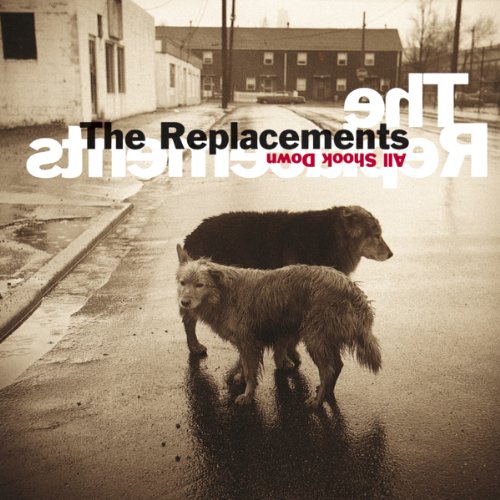
‘All Shook Down’ (1990)
The band’s final LP gets punished for what it’s not – a real Replacements record. Paul Westerberg began ‘All Shook Down’ as a solo effort and only shifted to include his bandmates during sessions. On its own merits, and stripped of ‘Don’t Tell a Soul’’s misguided bombast, the album is pleasant. It is fine. The steady “Merry-Go-Round” has a nice hook and Paul’s sleeve-hearted storytelling is solid – even if, as he looks back, Westerberg takes his band’s legacy more seriously than the boys did in the moment). But middling tempos and hushed shuffles make ‘All Shook Down’ the audio equivalent of beige. Stuck between being a Replacements record and a solo debut, the album doesn’t satisfy in either way. Westerberg’s pen is typically astute and nimble here, noting the soon-to-be-disastrous marriage depicted in “Nobody” and the fractious future of an unsettled newborn in “Sadly Beautiful.” It’s an album reckoning with the consequences of all that has come before. On the final track the band would ever release, “The Last,” Westerberg ruefully acknowledges: “It’s too late to run like hell.”
Rhino Records announced it will release a live double album recorded by the beloved original lineup of TheReplacements, a fabled February 1986 show at Maxwell’s in Hoboken, N.J., that found the band blasting through a 29-song set of album tracks, B-sides and covers.
The release, For Sale: Live at Maxwell’s 1986, had been hinted at on the band’s Facebook page . The album will be released October. 6th as a 2CD and 2LP set, as well as digital download and streaming. It’s the band’s first live album since 1985’s cassette-only The Shit Hits the Fans.
According to Rhino’s announcement of the album:
The show at Maxwell’s would prove to be one of the last great performances by the four original members of the Replacements, a much beloved line-up including Bob Stinson on guitar, before his departure from the band in 1986. The songs they played spanned the band’s entire history while giving prominence to new material from Tim, including “Bastards Of Young,” “Left Of The Dial” and “Kiss Me On The Bus.” Mixed in were favorites like “I Will Dare” from Let It Be (1984) and “ColorMe Impressed” from Hootenanny (1983). But it was songs from the band’s first album — Sorry Ma, Forgot To Take Out The Trash (1981) — that seemed to summon their best on furious versions of “Takin’ A Ride” and “I’m In Trouble.”
The show was recorded on a 24-track mobile studio at the time, but never released. The master tapes sat in WarnerMusic’s vaults until 2007, when they were given a “proper mix,” though it would take another 10 years before the live set would see release.
Replacements biographer Bob Mehr writes in the album’s liner notes:
“Now, a decade later, and more than 30 years after the original concert, Replacements For Salefinally offers high-fidelity proof of the peculiar alchemy and unadulterated majesty of one of rock and roll’s greatest bands.”
Tracklist: The Replacements,For Sale: Live at Maxwell’s 1986
Disc 1
1. “Hayday”
2. “Color Me Impressed”
3. “Dose Of Thunder”
4. “Fox On The Run”
5. “Hold My Life”
6. “I Will Dare”
7. “Favorite Thing”
8. “Unsatisfied”
9. “Can’t Hardly Wait”
10. “Tommy Gets His Tonsils Out”
11. “Takin’ A Ride”
12. “Bastards Of Young”
13. “Kiss Me On The Bus”
14. “Black Diamond”
Disc 2
1. “Johnny’s Gonna Die”
2. “Otto”
3. “I’m In Trouble”
4. “Left Of The Dial”
5. “God Damn Job”
6. “Answering Machine”
7. “Waitress In The Sky”
8. “Take Me Down To The Hospital”
9. “Gary’s Got A Boner”
10. “If Only You Were Lonely”
11. “Baby Strange”
12. “Hitchin’ A Ride”
13. “Nowhere Man”
14. “Go”
15. “Fuck School”
Cherry Red Records are preparing a 5-disc box set that will chronicle the U.K. post-punk scene from 1977 to 1981, collecting more than 100 songs from artists including Wire, The Slits, Joy Division, The Fall, Gang of Four,The Pop Group and many, many more.
“To the Outside of Everything: A Story of U.K. Post-Punk 1977-1981” is due in early December, and is being assembled by the same team that put together the label’s Manchester North of England, Silhouettes and Statues and Scared to Get Happy box sets, as well as the C86, C87 and C88 collections.
The post-punk set features big names from the scene, like those mentioned above, as well as Echo & The Bunnymen, New Order, Public Image Ltd. and Killing Joke, plus many lesser-known acts, including Glaxo Babies, The Deep Freeze Mice, Family Fodder and Spöön Fazer.
‘To The Outside Of Everything – A Story Of UK Post-Punk 1977-1981’ our new Cherry Red Records deluxe 5CD Box Set. This brand new 5CD anthology (that’s no fewer than 111 tracks by the way) includes landmark singles by Joy Division, PiL, Wire, Gang Of Four, The Slits, Killing Joke, Echo And The Bunnymen, Scritti Politti, The Pop Group, Human League, The Fall, Alternative T.V., Tubeway Army, Adam And The Ants, Josef K, The Teardrop Explodes, Throbbing Gristle, The Psychedelic Furs, Theatre Of Hate, The Birthday Party, The Associates, Fire Engines, and Ultravox. Find out more here – https://www.cherryred.co.uk/introducing-outside-everything…/
The 1990’s revival is so popular right now that it’s probably already over, but one act channeling the actually good bits of that damned decade are Manchester via Oxford DIY trio, False Advertising. The band are set to release a new EP, I Would Be So Much Happier If I Just Stopped Caring, next month, and have this week share their riotous new single, Hey You.
Hey You, described by the band as, “a rallying cry against gender stereotyping”, is built around ferocious, almost Pavement like guitar work, and pounding drums, but it’s singer Jen’s howling, visceral vocal that’s the star. There’s a touch of Shirley Manson, with the attitude and noise of early PJ Harvey, and as she repeats the tracks key line, “I am no figurine”, we’d dare anyone to suggest she’s anything but a rock star. Raucous, accessible and with plenty to say, False Advertising are more than worthy of their hype.
The track is taken from the forthcoming EP ‘I Would Be So Much Happier If I Just Stopped Caring’, released 27/10 and available to pre-order on Bandcamp.
Here’s a new track ‘It’s Been A While (So Sick)’ alongside a video pieced together from our time in America at SXSW (which was indeed ‘So Sick’). The song is part of the Three Minute Heroes #HearMeOut album, a compilation released by The Warren Youth Project which saw artists put young people’s lyrics to music.
‘Hey You’ the new single from False Advertising is out now.