Activity are an avant four-piece featuring Travis Johnson, and drummer Steve Levine, both from the band Grooms, bassist Zoë Browne from Field Mouse, and guitarist Jess Rees from Russian Baths. Produced by engineer Jeff Berner of Psychic TV, their debut forms a casually menacing framework for lyrical themes of paranoia, exposed character flaws, and the broader human capacity for growth when an ugly truth is laid bare.
Lead single “Calls Your Name,” establishes the record’s spectral aura with nauseated electronic bells, and a relentless Geoff Barrow-esque drum beat beneath a half-sung, half-spoken lyrics inspired by C.S. Lewis’s 1945 novel The Great Divorce. In the novel, characters stuck in a grey, joyless conception of hell repeatedly deny opportunities to be taken into heaven, instead making excuses as to why they should remain in their embittered purgatory states. Allegorically, this speaks to the kind of opportunity for metamorphosis and positive change that’s possible when the depths of disillusionment are reached, an idea which permeates much of the album. Despite recurrent aches of discontentment, each track glows with radiant waves of catharsis while elegantly evoking jubilation and anguish within the same breadth, showing that the two are always around the corner from one another.
Heart Of The City’ is the first of a series of newly-digitised Elvis Costello videos which will be rolled out on Tuesdays and Fridays over the next coming weeks. For further information, visit the artist’s official YouTube channel.
‘Heart Of The City’ first appeared on the flipside of Nick Lowe’s ‘So It Goes’, the first single released by UK independent label, Stiff Records, in August 1976. In the summer of that same year, Lowe’s manager Jake Riviera borrowed £400 from Dr. Feelgood’s Lee Brilleaux and rock photographer Keith Morris and along with Dave Robinson -who managed Lowe’s previous band Brinsley Schwartz – formed the Stiff imprint.
Elvis Costello’s live version of ‘Heart Of The City’ appeared on the 2012 box set Return Of The Spectacular Spinning Songbook. The title’s concept referred to a previous Costello tour when the singer-songwriter dressed up as a fictitious game show host of the same name, offering up a giant wheel for fans to spin to determine the next song he would play.
That tour took place in 1986, when Costello and his original band, The Attractions, took his album King of America out on the road with The’ Spectacular Spinning Songbook’, which featured the aforementioned giant wheel spun by fans to pick the next song to be played – hits, rarities, covers, it had it all. Each night, Costello would play the role of purposefully gaudy game show host Napoleon Dynamite.
Costello and the Imposters revisited that era for two concerts at Los Angeles’ Wiltern Theater in May of 2011, and those shows were documented on Return Of The Spectacular Spinning Songbook.
Austin, Texas-based songwriter Christelle Bofale will be the first to tell you the importance of family roots and mental health, considering how much those things aided her own self-discovery. Being the first American born in her family, the rich heritage of the Congo is deeply rooted in her upbringing and relationship with sounds.From singing and dancing with her mother as a child, to praying to Congolese music with her grandmother, to her father, a soukous guitar player and musical director for the Congregation at his church, Bofale’s journey as a musician has been defined in tiny intervals throughout the course of her life. As a songwriter, she infuses hints of the Congo into various aspects of her music, bridging the musical influences of the diaspora with juxtaposed elements of indie rock, soul and jazz respectively.
Weightless guitar tangents and lush, aquatic soundscapes are a vital part of what embodies Swim Team, her debut EP that serves a powerful introduction to Bofale’s budding artistry. Somewhere between influences like Joni Mitchell and Alex G, Bofale has found a sweet spot for her sound that lives between both harsh and gentle terrain, achieving a relaxing, yet rugged tonality.Each track pictured on Swim Team is brushed vividly with colors that illuminate the fear of being honest and doing that much needed personal work. Bofale’s earnest and bravery is a snapshot of black mental health and the nuance it carries. Being real isn’t easy, but it’s crucial in cultivating spaces for healthy discussion and giving other black women like Bofale a platform to do the same.
Single out today, my cover of Margo Guryan’s “The Hum”. I’ve been a fan of MG for a while but only recently absorbed the lyrics to The Hum. Though it was written about the Nixon administration, it’s poignant how much of it rings true today. We tracked this earlier but if this pandemic has confirmed anything, it’s that some people devote their lives to government simply to destroy it from the inside, to shrink its accountability for its citizens. Today we find ourselves living a perfect example of why we need a strong centralized office, one that’s capable of responding swiftly to a crisis. Instead we have someone who dissolved the pandemic response team in 2018. Instead we have a health crisis that’s causing everyone to LOSE their health insurance, another thing for which government refuses to take responsibility. I digress… Margo’s cutting wit is something to admire. Please enjoy such gems as “The rich save money and the poor save gas, we vote for an elephant and get an ass, he hires and he fires, he appoints and sacks, but HE CANT FIGURE OUT HIS INCOME TAX.”.
Nick Cave and co. have launched a continuous stream of music videos, interviews, live performances, unseen footage and other gems from their illustrious career, which you can tune into right now on YouTube. Nick Cave & The Bad Seeds launch broadcast streaming gigs, videos and rarities 24 hours a day.
‘It’s 10.30 Wednesday evening, and if the world wasn’t in lockdown, I’d be onstage in Toulouse, France singing my heart out with The Bad Seeds,’ Cave said on his Instagram post announcing Bad Seed TeeVee. ‘But I’m not. I’m doing the next best thing – sitting at home watching Bad Seed TeeVee. Pure non-stop joy!’
The channel will continue streaming for the forseeable future, so drop by whenever suits and indulge in some Bad Seeds melancholy. And once you’ve had your fill, go and check out Cave’s blog The Red Hand Files, where he waxes lyrical about everything from his COVID-19 plans, to his text exchanges with Bobby Gillespie.
The channel will broadcast footage that includes promo videos, interviews, live footage, outtakes and other exclusive unseen footage from the band’s archives that will be played on a continuous random shuffle.
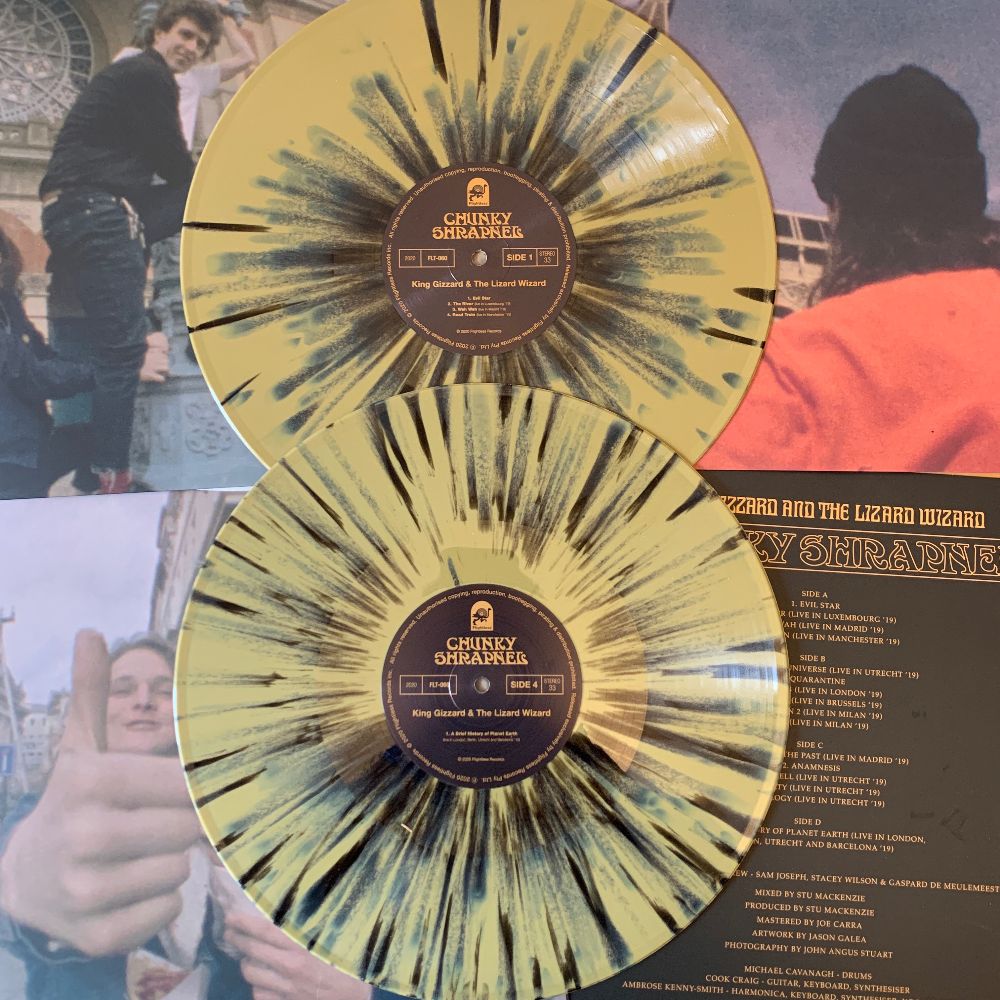
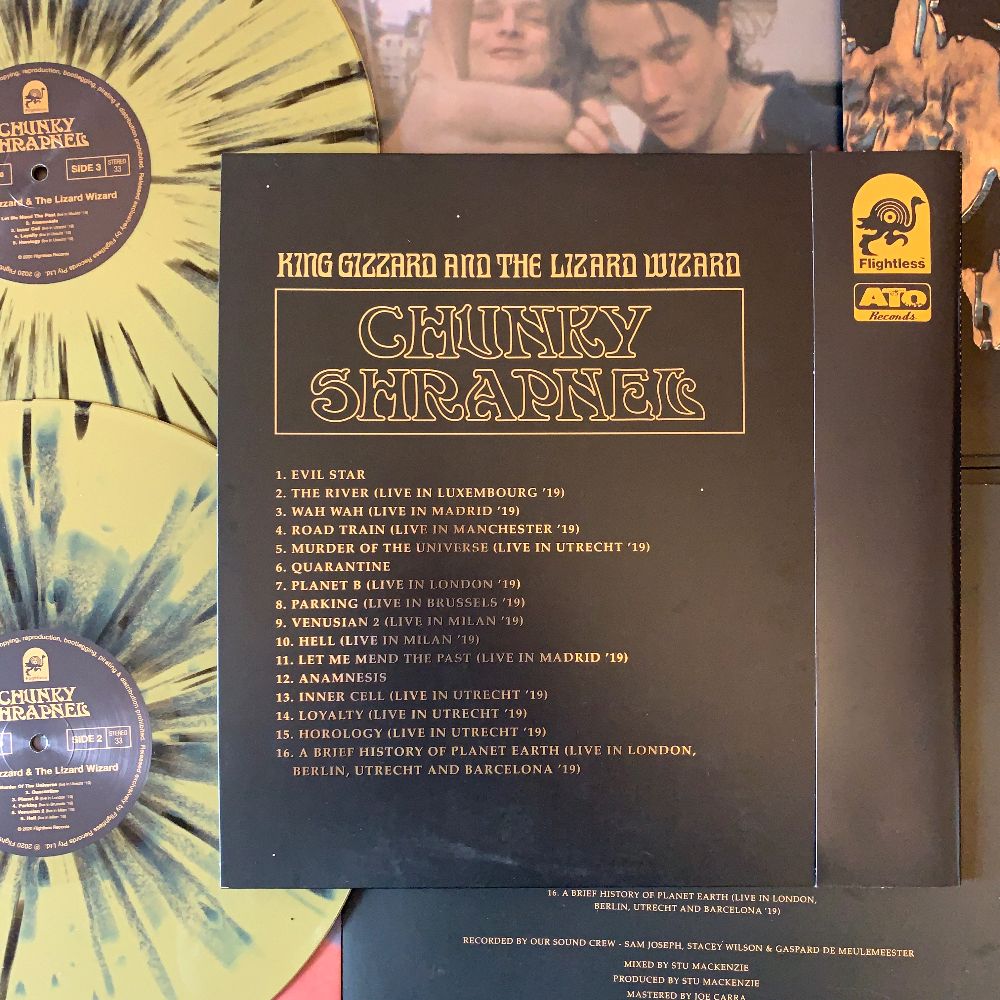
Much to the excitement of myself and ‘Gizzheads’ around the world, King Gizzard and The Lizard Wizard’s first ever feature-length music documentary is finally here. Bought to you by PHC Films and Flightless Records, “Chunky Shrapnal” is a ‘musical road movie dipped in turpentine’ filmed during the band’s 2019 tour across Europe and the UK.
Concerned about the self-congratulatory behaviour around creating a ‘behind the scenes’ film centred on themselves, the band were initially hesitant. Luckily for their humble souls, having their dear friend John Angus Stewart direct Chunky Shrapnal assured the film was authentic Gizz from start to finish. Having worked closely with the band on music videos for ‘Planet B’, ‘Self Immmolate’ and ‘Organ Farmer’, John says the film was a natural evolution of their work together, and I was lucky enough to ask ask him some questions about shooting the film entirely on 16mm, picking perfect moments, and more.
The Movie Chunky Shrapnel, It’s from a lyric from the Gizzard song, ‘Murder of the Universe’. It means vomit.reminded me why I love the band so much; The atmosphere at their concerts. the awesome community and of course the excellent music! . There is nothing quite like 16mm. First of all, I knew I wanted certain types of colours and highlights that are impossible to achieve digitally. Another reason was the practical restrictions. There’s a far better atmosphere backstage when you can’t shoot forever, you gotta pick the right moments. It’s like playing Russian roulette but you want the bullet. And having a single camera was also an import call for us. The normal four-camera set up thing for live music just doesn’t work for Gizz. You have to be on stage with them, it’s the only way. And plus, normal on stage coverage is like watching paint dry.
This album is the phenomenal soundtrack to it. No Paper Maché, sadly, they did record a few songs at the show in Cologne but they’re absent from the album.
Los Angeles was a much different place when X released its debut album, Los Angeles, named for the city that the band had adopted. Forty years ago, Los Angeles still had a reliably seedy link to its noir roots, which was catnip to people like John Doe, who fled the East Coast for L.A.’s sunny days and debauched nights. Doe found kindred spirits in Exene Cervenka, Billy Zoom and D.J. Bonebrake, and with X they helped establish the West Coast’s punk scene. With 1980’s Los Angeles, they became a nationally recognized leading voice on the scene.
They were a motley bunch. Doe and Cervenka were writers and poets. Zoom was a session guitarist who had trained as an electronics repairman and played a dozen instruments, fluent in both big band jazz and Gene Vincent. Bonebrake had studied classical music and played a mean jazz vibraphone as well as he drummed. All except Bonebrake were from somewhere else.
But in the sordid backwash of Hollywood and the near-nuclear fallout of the Ramones and Sex Pistols, they transformed into X. As we celebrate the 40th birthday of the band’s debut album, Los Angeles has lost none of its power, fury or artfulness, and remains a showcase for how the spirit of punk can be filtered through the familiar lens of rock and roll that had come before.
The heart of “Los Angeles” is clearly punk; Zoom’s lethally precise power chords and Bonebrake’s metronome-on-steroids drums propel the songs at a breakneck pace while Cervenka’s unhinged vocals speak to one of punk’s central tenets: Anyone can do it. But there’s a higher level of musicianship at work here. Zoom is an encyclopedia of roots-rock guitar and he tosses in echoes of Chuck Berry and Scotty Moore. Doe is the Paul McCartney of punk bassists, always finding inventive ways to melodically underpin the songs without losing intensity, and his smoked honey of a voice in harmony with Cervenka’s squall is one of the band’s signature sounds.
Doe and Cervenka filled Los Angeles with lyrics straight out of a poetry workshop — elliptical, evocative, blunt, beautiful and violent, like if Dashiell Hammett did slam poetry — and the combination of bohemia, musicianship and aggression made Los Angeles soar. And if Ray Manzarek seems an unlikely producer, consider that The Doors were legends in L.A. and he had considerable street cred.
X begins with a triple shot of “Your Phone’s Off the Hook, But You’re Not,” “Johny Hit and Run Paulene” and a cover of the Doors’ “Soul Kitchen.” Of the three, “Johny Hit and Run Paulene” is quintessential X, a seamy narrative about drugs, rape and possibly (probably?) murder.
“Sex and Dying in High Society” reads like a film noir treatment about a woman who has sold herself for the security of a connected marriage. Not an incredibly original premise, but the details are what make it work, especially the bit where the woman makes her maid use a curling iron to burn her back just to feel something. Manzarek spices the song with a perfectly placed flourish of synthesizer. “The Unheard Music” is an efficient summation of punk culture, ominously set to a dirge-like metal riff. “Friends warehouse pain/Attack their own kind/A thousand kids bury their parents” conjures the desperate physical release of a mosh pit, teenagers cutting themselves loose from families they don’t want to be with the family that they choose.
“The World’s a Mess; It’s in My Kiss,” besides being a rare example of the proper use of a semi-colon, is also a love song that doesn’t back down from how terror and wonderment walk hand in hand when two people try to make a life together. It comes off as an update of 1950s teeny-bopper love songs with Zoom busting out his best Berry licks behind Cervenka and Doe’s anti-harmonies.
The album’s best-known song is the muscular title track, which is intoxicating in its ferocity and concision. As political correctness has grown into a casual hobby, there have been efforts to paint the song as racist, which is at best a ridiculous argument. It’s clearly about a racist, not to mention a homophobe, and the song’s impact and meaning would be neutered by euphemisms that dance around the truth. That truth is what makes the song so powerful, as well as the sledgehammer authority with which Zoom, Bonebrake and Doe attack every second of the brief 2:25 it lasts.
The album’s overall effect and impact is visceral, literary and uncompromising. X went on to make six more studio albums, embracing more of the band’s folk, country and rockabilly roots as the years passed. The first four albums are considered classics, but “Los Angeles” remains the gold standard.
Clean original Slash pressings of Los Angeles have been climbing in price but the record has been remastered and reissued several times by Rhino, Porterhouse, Music On Vinyl and most recently Fat Possum; other than the acclaimed Porterhouse pressings, the consensus seems to be that they’re all roughly equivalent to an original.
Whichever one you track down, you need to own it — assuming you have a thing for punk, or just good music — as it’s a touchstone of the genre and a keeper for any well-curated collection.
The band recognized the significance of Los Angeles with the surprise release of a new album, Alphabetland, nearly 40 years to the day after their debut. It’s the band’s first studio album since 1985 to feature the original quartet, which was fractured when Zoom left following Ain’t Love Grand. His return brings X full circle as Alphabetland is classic Los Angeles-era X: hard, fast, uncompromising.
2020 became the year Ramonda Hammer graduated from being the Los Angeles grunge scene’s best-kept secret to the songwriters of network TV’s angstiest title theme when the band’s single “Hoax” was picked to soundtrack the intro to Bill Burr’s Comedy Central program The Ringers. The recognition was well-deserved—the single comes from their powerhouse debut released last year, which feels like the beginning of a momentous career.
The band is keeping that momentum going today with their latest one-off single, “Big Hands,” which was produced by Illuminati Hotties’ Sarah Tudzin. It’s an earnest hard-rock ballad split between soft verses and heavy choruses, detailing vocalist Devin Davis’ recent relationship woes.
“I wrote ‘Big Hands’ during a time when I thought I was losing the love of my life,” shares Davis. “It’s a desperate apology. But It’s the kind of apology where you can’t find the words to say you’re sorry, so you make an offering, a token of affection that can’t undo what’s been done, but it’s the best you can do at the time. The song repeats several times: ‘It’s the thought that counts,’ and thoughtfulness has to mean something, right? It’s about working on emotional intelligence. Not condoning bad behavior, but it’s pointing out all the good that comes with the bad.”
It’s 4:20 p.m., Central Time, and Brendan Benson is a little nervous. He’s been practicing and is about to go live for whoever will listen. When the COVID-19 pandemic hit, Benson was preparing to release his seventh album, “Dear Life”. Instead, he’s home in Nashville, Coincidentally, Benson does feel like he’s trapped in some sort of illusory, encapsulated dream, but “Boy in a Bubble” is the moniker for his Instagram Live series, an essential reprieve from the coronavirus lockdown.
“It’s something to do every day and something to prepare for,” says Benson. “A lot of times, I have to pick the song and learn it, and I get nervous, so it’s a kind of whole arc to my day. It’s a great way to break up the day and the monotony. If I didn’t have this, I think I’d be going fucking crazy.”
Benson, founding guitarist and co-writer for the Jack White–led troupe The Raconteurs, hasn’t gone stir crazy (yet) thanks to IG live—broadcasting with special guests or just going solo—but being home with his seven-year-old daughter Adeline and nine-year-old son Declan has its challenges. He’s living through what most parents are facing during the shut-in. “The rest of my family are going crazy,” says Benson. “Kids need your attention twenty-four hours a day from the second you wake up—like, before you wake up. We’re doing OK, though. It’s a good chance for us to get closer.”
Playing tracks off Dear Life, as well as older songs—even leaving his 1996 debut One Mississippi open for more exploration—Benson is just warming up for when life gets back to normal and he can tour again. His first release since 2013’s You Were Right, Dear Life is Benson’s transfixion on domestic life, relationships, and the realization of his mortality. For nearly five years, Benson was hanging on to Dear Life since he started writing it. Then, The Raconteurs had regrouped, and he stepped back into the band’s third album and first in eleven years Help Us Stranger in 2019. “I stopped, I did The Raconteurs album, but I was really anxious to get this record out,” says Benson. “Then, this fucking virus hits.”
The road leading to the album has had its U-turns and swerves. It was even birthed from a complete upheaval of Benson’s Readymade Studios, which he started in 2012. When he was forced to vacate the studio after the building where it was housed was sold and converted into a parking lot, Benson was forced to pack up all of his equipment and put it in storage. Left without a place to record, he created a makeshift studio in his home, at first experimenting without guitar and drums and more software and drum machines, which all have their place on Dear Life, dusted over sharp riffs and penetrating lyrics on the knowns and unknowns in life.
Sequenced by Jack White, Dear Life drives down a winding road of reflection—good and bad, fear or moments of tranquility—that only Benson could steer, from frenetic opener “I Can If You Want Me To” to the more elevated “Good to Be Alive.”
Reflecting on family life, “Richest Man,” which received an animated video treatment by New York cartoonist Michael Wartella, Benson confronts his fear of dying as matter-of-factly as he can singing “I gave you your name, but you gave me my life … And after I’m gone, you’ll carry on / And then you’ll have a family of your own.” Exploring domesticity and the delicacy of life, Benson covers all corners of emotion, gently crooning the title track through airy “Baby’s Eyes,” the latter the only Dear Life track that features a co-writer and outside musicians, including Dynamites drummer Jon Radford, and on to a more enraged “Freak Out.”
Opening up about family, life, and death is also something new for Benson, but it’s been lingering on his mind more since having children. “I don’t think I ever thought much about my mortality, so it’s kind of come as a shock I guess,” he says. “When my kids were born, I think, is when I started to fear death. I started getting afraid of leaving them. I was just confronted all of a sudden with, ‘Holy shit, I’m not going to be here forever.’ Your kids keep growing up and they keep getting older. I’m seeing it and I’m like, ‘Stop!’”
He jokes that he’s aging slowly, but there’s still a nostalgia as he gets older. It’s something Benson, now 49, just can’t shake. “When you have a family, you start thinking about life and death and what happens when you leave,” he says. “I think it’s something that I’m still thinking about. It’s something that is new to me as well.”
Departing from the core subjects, “Evil Eyes” confronts a plethora of toxic relationships. “Let’s just say it’s a composite,” says Benson. “Maybe it’s different people—not necessarily all female, or a girlfriend, either.” On “I Quit,” Benson borrows from Peggy Lee’s melancholy 1969 hit “Is That All There Is?” “It’s sort of an homage, but otherwise it’s just one of those songs that kind of came out exactly as you hear it,” says Benson. “There are no chord changes. It’s just, like, three chords over and over, and lyrics that are sort of improv or freestyle, and impromptu.” Generally, songs evolve over time for Benson since he says he’s not fully cognizant when he’s writing. “I think I’m half conscious when I’m writing songs,” he says. “It’s not like consciousness. It’s like I’m speaking in tongues. It’s not some sort of, like, meditative state where I’m channeling or tapping into my deepest feelings, and I understand it, and I can sort of transcribe it in this poetic way. It’s mostly meandering thoughts.”
Song meanings tend to come later on. It’s as if he’s unconsciously confessing or revealing things as he goes along. “What’s interesting about this record is that when I look back on it, having been so out of it while writing it, it’s all really kind of focused,” says Benson. “It turns out it’s a lot about life and death and family, you know, so I did it sort of unconsciously.”
Writing for himself is one thing. He’s acclimated to his own, internal cacophony of fragmented words and melodies. Unconscious or not, it’s his own sinuous process. He’s tried working the Nashville co-writing thing but says he’s not that good at it. “I don’t think people are using producers really anymore, so it just doesn’t pay the bills,” says Benson. “I kind of screwed myself, because I left my solo career by the wayside.”
Writing for The Raconteurs is another thing. “We’re meant to write together,” says Benson. “It’s easy. We don’t talk about it. We don’t analyze it. We just know what sounds good, or cool, like, ‘Oh yeah, that sounds like it belongs in the song.’ [Jack] understands when I go meandering, and he gets it.” Now, Benson has a record he wants everyone to hear. “I’m having to start over,” he says. “The Raconteurs helps a little, but it doesn’t help as much as people think, because people don’t know me from The Raconteurs. They know Jack. Brendan Benson is not a household name.”
It’s also Benson’s first album on Third Man Recordings, which he says was a “no-brainer.” He’s not sure why he never worked with White’s label prior to Dear Life, but admits he may have been too proud to ask. “I didn’t want to ride his coattails, but it just makes sense now, because there are no labels left,” says Benson. “And he’s really good at it.”
Benson is ready for Dear Life, and admits that he hasn’t felt this proud of one of his albums since 2002’s Lapalco. “I think I made it for all the right reasons,” he says. “Those reasons were just for the fun of it, and the enjoyment of it, and the therapy of it—not because I had to contractually, or because it was expected, or that it’s been too long since my last record. It just comes straight from the heart.”
In the meantime, as he waits for the world to open back up, he’ll remain a Boy in a Bubble.
“It keeps me sharp,” says Benson of his ongoing IG Live sessions. “Usually when I go on tour I have to learn a bunch of new songs, or ones that I’ve forgotten. This way, I’m kind of just keeping them fresh. When we get out of this, whenever this is over, or when things open up and we get out of jail five years from now, I’ll be ready.”
April 28th, 1980: Joy Division are in a disused T.J.Davidson rehearsal studio in Manchester filming their video for “Love Will Tear Us Apart.”
On this day, 40 years ago, Peter Hook, Bernard Sumner and Stephen Morris entered TJ Davidson’s Studios and turned on the cameras for the recording of “Love Will Tear Us Apart”, the only promotion video Joy Division ever recorded.
The clip was recorded by the band themselves during a rehearsal at T.J. Davidson’s studio on Little Peter Street in Manchester. The T.J. Davidson studios had already housed the band’s rehearsals at the beginning of their career.
The curiosities remain: In the intro to the video the door that opens and shuts has ‘Ian C’ carved into it; reportedly this was the beginning of an abusive message (the rest later erased) carved into the door by a spurned ex-girlfriend of Curtis’ during the band’s earlier work at the studio.
The video is browned out at points, unintentionally, but nevertheless a fitting aesthetic — along with the omission of Curtis’ trademark dancing, which instead is replaced with the frontman strumming on a Vox Phantom VI six string british guitar.
Official video for Love Will Tear Us Apart by Joy Division