Bodega’s debut single “How Did This Happen” is packed with driving guitars and droll lyricism. After appearing at SXSW in Austin this March and supporting Franz Ferdinand in the U.S., they’re set to release their debut LP, Endless Scroll, via What’s Your Rupture. (The album was produced by Parquet Courts’ Austin Brown.) The quintet’s experimental, fluid sound includes a bit of everything from post-punk and pop to hip-hop and krautrock.
Brooklyn’s finest release their fantastic debut album. With wild minimalism and sharp wit, they revitalize the rock and roll vocabulary under the influence of post punk, contemporary pop, hip-hop, kraut rock, and folk-derived narrative songwriting. it’s itchy, scratchy perfect pop that makes you want to sing along..even without knowing the words. Bodega’s debut LP Endless Scroll is a collective dialogue with the machine and the public. Ping-ponging vocals are set to Ben’s deconstructed guitar, Nikki’s samples of old and new technology, the driving minimalism of standing drummer Montana Simone (IDIO Gallery), the angular spasms of lead guitar Madison Velding-Vandam (The Wants) and the tight, hypnotic bass lines of Heather Elle (Please No Radio). The LP’s fourteen songs offer a high-energy, humorous but earnest thirty-four minutes. For fans of Parquet Courts, The Fall and Wire.
Band Members
Ben Hozie,
Nikki Belfiglio,
Montana Simone,
Heather Elle,
Madison Velding-VanDam,
The Lord Huron song “The Night We Met” found its way into the massively popular, albeit oft-maudlin, series, 13 Reasons Why with a new take on their hit song featuring the noir-ish indie songstress Phoebe Bridgers.
“The Night We Met” is a track from Lord Huron’s 2015 release, the spacey indie-folk travel log “Strange Trails”. Bridgers’ vocal contribution expands the song’s already-haunting melody to encompass a deeper sense of melancholia, something she also comfortably emits on her critically adored 2017 LP Stranger in the Alps. Lord Huron’s Ben Schneider and Bridgers are likely collaborators, too: Each have traversed the spectrum of indie-folk sounds, though Bridgers says she isn’t yet committed to a confined style.
Lyrically, her gorgeous 2017 debut album Stranger in the Alps – which she recorded independently before being signed to the Dead Oceans label – grapples a lot with death. The late Lemmy from Motörhead and David Bowie are both referred to, while the song Funeral was inspired by a boy Bridgers knew who died of a heroin overdose. “Jesus Christ, I’m so blue all the time and that’s just how I feel, always have and always will,” she sings, the mournful mood recalling the late American miserabilist Elliott Smith. Yet, in person, Bridgers could hardly be sunnier. “I didn’t realise there was such a heavy theme on the record until I started recording the album.
The standout single from Stranger in the Alps, was “Motion Sickness” it has amassed more than half-a-million views on YouTube and is an exquisite evisceration of a former lover. “I faked it every time,” she sings, before landing another blow to the solar plexus: “And why do you sing with an English accent?/ I guess it’s too late to change it now.”
The song, she tells me, is about the Grammy-nominated singer- songwriter Ryan Adams, whom she met in 2015. “A mutual friend in LA was like, ‘Ryan would like you’. He really was just trying to get me recording and trying to get Ryan to hear me, but Ryan was like, ‘Let me see a picture of her’.” Bridgers says that she and Adams “ended up hanging out all night and recording a song together called Killer. Then, a couple of weeks later, he was suddenly trying to hook up with me. I was super-down and had just broken up with my high-school boyfriend. We slept together on his 40th birthday and I’d just turned 20.”
She wrote Motion Sickness after they broke up. What did he think of it? “We were back on good terms by then but after I sent him the song he didn’t talk to me for 24 hours. Then he sent me a sweet text saying ‘it’s a great song’,” she says. “Yes, interesting character…”
Bridgers wrote “Smoke Signals” in a cabin outside Ketchum, Idaho, last spring. It finds her somberly emoting against a backdrop of guitar chords and orchestral swells. Sometimes her words are poetic: “I wanna live at a Holiday Inn where somebody else makes the bed/ We’ll watch TV while the lights on the street put all the stars to death.” Other times she’s more straightforward but just as powerful: “All of our problems, I’m gonna solve them/ With you riding shotgun, speeding ’cause fuck the cops.” References to Bowie, the Smiths, and Motörhead might capture your attention, but the recurring image of trash burning on the beach is what will linger with you.
The Ninth studio album In honor of their 20th anniversary, the psych veterans The Asteroid No. 4 return with eight new songs merging paisley vibes with fluid shoegaze moves and dots and dashes of ’60s-style psychedelia.
The Asteroid No.4 are an American psychedelic band based in the San Francisco Bay Area. Originating from Philadelphia in the latter half of the 1990s, the band began their relocation to the west coast in 2011.
Since forming, the band has endured several lineup changes. Over the last ten years, however, they have consistently included Scott Vitt (vocals, guitar), Eric Harms (guitar), Adam Weaver (drums, vocals), Matty Rhodes (bass, vocals), Ryan Carlson van Kriedt (guitars, vocals), and most recently, Nick Castro (keys, guitars, vocals).
The band is known for their dynamic live act, integrating multi-textured guitars and reverb-drenched vocal harmonies over an unwavering rhythm section. However, it’s been their prolific recording output, including what will soon be their ninth full-length album, that’s helped build their dedicated fan base within the flourishing underground psychedelic scene. With well over a dozen compilation appearances, digital-only rarity releases, and multiple singles and EPs, the band is said to improve with each release.
The Asteroid No.4’s sound has been called a “hypnotic hybrid of several different genres filtered through the kaleidoscope of all things psychedelic.” Whether it be “Krautrock”, “shoegaze”, folkrock, or even the occasional dabbling in “Cosmic” countryrock, the band have never shied away from wearing their influences squarely on their sleeves.
Guy Clark, one of the most beloved and influential country songwriters of all time, Songwriter, poet, guitarist, husband, troubadour, craftsman, “patron saint of an entire generation of bohemian pickers” as writer Robert K. Oermann once put it, Clark was for nearly five decades one of America’s most important fixtures of country songwriting, a man revered in equal parts by his contemporaries — artists like Emmylou Harris, Willie Nelson, JohnPrine, Lyle Lovett, Townes Van Zandt, and Kris Kristofferson — and by several younger generations of literary-minded country songwriters — artists like Jason Isbell, Steve Earle, Todd Snider, Ashley Monroe and Andrew Combs — all of whom viewed Clark’s songwriting, which combined dark wit, romantic optimism, and weary skepticism — as the highest form of popular lyric.
Born in Monahans, Texas in November 1941, Guy Clark was raised in his family’s shotgun hotel, where he learned about music and life from men like Jack Prigg, the well driller who would later become the subject of one of Clark’s most famous songs, “Desperadoes Waiting on a Train.” The Clark family moved to Rockport Texas, where Clark came of age before joining the Peace Corps as a young man.
After the Peace Corps, Clark eventually settled in Houston, where he would soon become a fixture in the city’s growing songwriter community alongside young artists like Townes Van Zandt and Jerry Jeff Walker. TownesVan Zandt would become one of Clark’s closest friends and greatest contemporaries in later years, with Clark covering songs like “To Live is to Fly’ throughout his entire career. “Townes Van Zandt is one of the reasons I started writing songs,” Clark said in 1982.
Before long, Clark had met his future wife, Susannah Clark, with whom he’d stay married until her passing in 2012. The two moved to Nashville in 1971, where they would live the rest of their lives. A few years later, Clark released his first two albums for RCA, 1975’s Old No. 1 and, a year later, Texas Cookin.’ Those two records — with their stark talking blues, lonesome tales of a fading America, and rambling travelogues of departures and arrivals — were full of the type of hard-earned wisdom unprecedented for a songwriter releasing his debut album.
But Clark, who was already in his mid 30s when he first became a recording artist, had been amassing material for years, and his first two albums contained songs like “LA Freeway,” “Anyhow, I Love You,” “That Old Time Feeling,” and “Let Him Roll,” compositions that would become some of Clark’s most beloved material.
“Most of the really good songs are dead true,” Clark said in 2011. “You couldn’t make up ‘Desperadoes Waiting for a Train’ or any of that stuff. It had to have happened to have the song be there.”
Clark would continue writing his songs inspired by real life for the next four decades, and in addition to releasing genre-defining albums like 1978’s Guy Clark, 1983’s Better Days, and 1995’s Dublin Blues, Clark’s songs also became touchstones throughout the extended country music world, with artists ranging from Kenny Chesney to Johnny Cash to George Strait to Rodney Crowell all recording his songs over the years.
“Real, poetic, unique, visual, powerful and tough are a few descriptions when describing Guy,” says Scott Robinson, founder of Dualtone Records, Clark’s label at the time of his passing. “He was one of the best in so many ways.”
Throughout his entire career, Clark was also a social focal point of the songwriting community in Nashville, from the drug and booze-fueled song pulls famously depicted in the 1976 documentary Heartworn Highways, to recent years, where getting an invite to write, smoke and hang out with Clark in his notorious basement workshop was just about the highest honor a young songwriter in town could receive.
“I can’t think of anything I would rather have set up than a guitar shop and a table to write in the same room,” Clark said in 2011.
In 2011, dozens of Guy’s closest friends and musical contemporaries joined together for This One’s For Him, a moving 30-song tribute to Clark’s music ended up winning Album of the Year at the Americana Music Awards in 2012. The record’s producer, Tamara Saviano, is also at work on a forthcoming documentary on Clark’s life and music.
Clark’s wife, Susannah Clark, was Guy’s closest collaborator and partner, and after his wife’s passing in 2012, he dedicated his final album to her with his moving 2013 collection My Favorite Picture of You.
Guy Clark was a tireless, meticulous songwriter, an avid self-editor who demanded the highest integrity of his own craft and remained his own toughest critic until the very end. During an interview promoting My Favorite Picture of You in 2013, Clark spent a good portion of the discussion, frustrated, explaining why he should have ended up cutting the third, final verse of one of his new songs, “Romance in Durango.”
Lumerians, those psychedelic druids of the trans-dimensional extra-terrestrial motorik realms are returning. The genre-hopping mind-benders of uninhabited deep space are known for incorporating anything and everything into their futuristic sonic gumbo pulsating krautrock, noise, free jazz, drone and dub. It will come as no surprise that after a four year hiatus they’re still experimenting sonically on their upcoming album, Call of the Void.
Vocalist Jason Miller explains: “If Transmalinnia represented the exploration of an alien world and The High Frontier a voyage through space, Call of the Void is a penetrative exploration of Earth through an alien gaze gone native.
Their third “official” album—not counting two collections of improvised compositions called Transmission from Tellos III & IV—Call of the Void, will be released on June 22nd on the London-based indie label Fuzz Club Records. The album is dedicated to the memory of Barrett Clark, Lumerians’ long-time friend, sound engineer and collaborator who passed away in 2016 during the tragic Ghost Ship warehouse fire. Recorded mostly at their own New Telos Sound studio built in the site of a former church in Oakland, California and at Hyde Street Studios—formerly known as Wally Heider Studios.
To announce the album the band have shared the lead single “Silver Trash” a song about both “a very memorable camping trip us and some friends took in Big Sur or an encounter with inter-dimensional beings in the Redwoods of the Pacific Northwest.”
The core founding members of Lumerians are Chris Musgrave (drums/percussion), Jason Miller (vocals, synth, organ, guitar), Marc Melzer (vocals, bass, synth) and Tyler Green (guitar, synth). The intensely interlocked rhythm section of Musgrave and bassist Melzer undergirds what the rest of them do, putting me in mind of Can, Hawkwind, Neu! and Soft Machine at once, but I still can’t help thinking of them as The Ventures of this era.
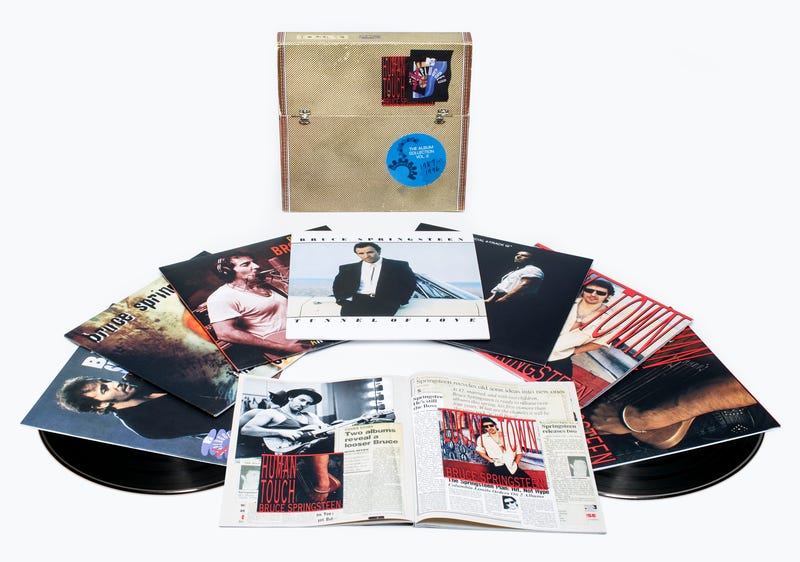
The new remasters collection Bruce Springsteen: The Album Collection Vol. 2, 1987-1996 makes a strong case for the artistic value of Springsteen’s E Street-less, mid-period output. Starting with 1987’s Tunnel Of Love, it was no longer really Bruce Springsteen & The E Street Band. Despite the occasional presence of various bandmates on the album and subsequent tour, the signs were already there for his creative restlessness and decision to separate from the group to pursue different avenues of making music. (He made the split official in 1989.) And to hear tell of it in various biographies and assessments of his career through the years, Springsteen spent most of the next decade wandering the artistically frustrated desert, on albums and tours that lacked the passion and vision of his earlier work. The limited-edition release Bruce Springsteen: The Album Collection Vol. 2, 1987-1996 probably isn’t going to convince anyone that the Boss was better off without his once and future band than with it, but what it does do is make a cohesive and convincing argument for the merit of his work during this creatively searching era—yes, even the stuff with the really crappy production values.
When Springsteen published his memoir Born To Runin 2016, it was clear he didn’t want to talk much more than he already had in interviews about the hiatus of the E Street Band or the interpersonal and creative tensions that led to his decision. He barely spends two pages on it, admitting his own role in the issues, but seems to summarize it with, “I felt I’d become not just a friend and employer for some, but also banker and daddy.” The recording of the simultaneously released Human Touch and Lucky Town is omitted entirely, and aside from discussions about his personal life, much of these years is dismissed by him as his “mid-’90s drift.” It’s too bad he glosses over it, because as is made clear by the engrossing 60-page book of photos, press clippings, and interviews accompanying this new collection, there’s a lot to be said about what he was trying to achieve with each of these albums.
Tunnel Of Love is perhaps the most contentious of these records. Hailed as a masterwork of a newly mature artist upon its initial release, it was subsequently criticized for its production and lack of consistent E Street input, with Springsteen playing many of the instruments himself. (The only thing he never attempted was drums, with MaxWeinberg providing the sporadic percussion.) But while the cheesy keyboards and digitally fussy drums do indeed make some of the songs harder to listen to with fresh ears, one of the best elements of the newly remastered edition of this long-out-of-print vinyl is the very deliberate minimization of the hokier instrumentation, and teasing out the guitars wherever possible. Even “Brilliant Disguise,” an excellent song that became a hit for a reason, sounds a little crisper and less late-’80s smooth. But to take the time to study Tunnel Of Love closely is to again marvel at some of the finest lyrics of Springsteen’s career. From the solo vocal performance that kicks off “Ain’t Got You” to the muted angst of “Valentine’s Day,” the subtlety and depth of these songs about complicated adult love shine. It’s a strange beast for a record from the Boss, but it’s a hell of a successful one-off experiment.
From there, things admittedly get a little muddled. Human Touch and Lucky Town are the twin pillars of his respective artistic tactics: the former an agonized and fussed-over result of several years of obsessive workaday grind, the latter a three-week burst of raw and loose inspiration. Lucky Town is undeniably the superior of the two simultaneous releases, suggesting Springsteen was indeed at loose ends over the direction his music should take, finding more success in the fuck-it attitude of just unleashing some rock and hoping it worked. It’s the sound of him trying to genuinely create the feeling of rock ’n’ roll as a revivalist celebration, chasing that near-religious fervor his concerts are often credited with having. Hence the three backing female singers, shouting out refrains like they were gospel—he wanted it to sound like the gospel of rock. At the time it mustn’t have been clear he was pushing this angle too hard, chasing it too blatantly, as opposed to the vibe arriving organically from the music. The bluesy American roots rock that pops up is solid, but too often harnessed to his church-hymnal instincts. (“Souls Of The Departed” is just a hair’s breadth away from being an all-time killer rock song.) It’s a good album that should’ve been great.
Human Touch, by contrast, does many of the same things as Lucky Town, only milder and with less success. While some of it can be chalked up to his insistence on playing so many of the parts himself, thereby denying himself superior musicianship on the instruments, his session players did him no real favors either, especially Randy Jackson’s uninspired bass. Similarly, the songs often sound like the result of a guy in an echo chamber, demoing to a 4/4 beat on a drum machine and then not being pushed to vary those beats in the rhythm section. Great songs intermittently appear—“Gloria’s Eyes” cooks, and “I Wish I Were Blind” overcomes its generic-ballad orchestration to deliver a moving elegy—but it’s not enough to overcome dreck like “57 Channels (And Nothin’ On).”Human Touch, as he discusses in the lengthy Rolling Stoneinterview functioning as the accompanying book’s centerpiece, was who he was in the wake of his post-Tunnel divorce; Lucky Town was the direction he was moving. It was clearly the better direction to go.
But even with the albums being this uneven, the accompanying live record and EP demonstrate Springsteen’s power remained largely undimmed. 1993’s In Concert: MTV Plugged is an hour straight of killer live music, showing how even weaker studio tracks like “Man’s Job” get a rush of energy and power from the Boss in full onstage swagger. Plus, it provides previously unreleased tracks “Red Headed Woman” and the spectacular “Light Of Day,” long a set-closer during the era. But it also showcases what people don’t like about this era of Springsteen: He basically cedes lead instrument duties to keyboardist Roy Bittan, the keys taking pride of place in mixing and songwriting, never more apparent than in the full-band version of “Atlantic City.” It’s a hell of a show, but it does minimize Springsteen’s ax work far too much. The EP Chimes Of Freedom (from the Amnesty International charity tour in ’88) features four killer performances, one of them a cover of Bob Dylan’s title tune.
The Ghost Of Tom Joad stubbornly resists alteration in remastering. The record is an odd admixture of spare Nebraska-style minimalism (even more so, really, with the acoustic guitar barely audible at times) and the swooning high-gloss production that has always been his weakness. It’s a two-pronged strategy that would find better synthesis—if uneven results—on Devils & Dust, but that nonetheless contains some moments as good as anything he’s done. Songs like “Highway 29” and the title track find a fusion of wordy poetry and sparse melodism that elevate the material, but it’s occasionally too flat musically to really land, stripped-down folktales easier to admire than enjoy. Still, it stands as a coda to this era of Bruce’s wandering muse, finding meaning in the stories of the Mexican-American borderlands that feel more relevant than ever.
Blood Brothers(his much-vaunted E Street reunion to provide new tracks for the Greatest Hits release) is a superb five-song blitz, even if it now looks like little more than a tease for the reunited greatness to come. Still, taken as a whole, these records function as a kind of musical travelogue that saw the guy who made the world-conquering Born In The U.S.A. spend a creatively frustrating decade reinventing himself into the again-master songwriter and bandleader that would see the 2000s deliver on the promise of his former excellence. The path to get there was rocky, but filled with enough magic to make it worthy of appreciation in its own right.
The Album Collection Vol 2. This release spans the period of 1987-1996, picking up where Volume 1 – released back in November 2014 – left off. It’s due on May 18th from Columbia Records and Legacy Recordings on vinyl only. Unlike the previous box set, no CD release has been announced.
Volume 2 contains four studio albums, one live album, and two EPs on 10 vinyl LPs – all remastered by BobLudwig and Toby Scott from the original analogue masters. The set chronicles Springsteen’s adventurous, experimental period during and following the dissolution of The E Street Band. While the band’s members are all present in guest spots on 1987’s Tunnel of Love(and the band would tour the album) it was a mostly solo, introspective affair highlighted by such standout tracks as “Brilliant Disguise,” “Tougher than the Rest,” “One StepUp,” and the title track. Tunnel Of Love is followed by the pair of albums released by Springsteen on the same day, March 31, 1992: Human Touch and Lucky Town. Though Roy Bittan was on board as a musician and co-producer, the only other E Streeters to make an appearance on Human Touch were Patti Scialfa and former member David Sancious.
The album instead welcomed studio veterans like Jeff Porcaro and Randy Jackson as well as background vocals from Sam Moore of Sam and Dave and Bobby Hatfield of The Righteous Brothers. Human Touch scored hits with its title song and “57 Channels (And Nothin’ On).” Lucky Town employed a sparer sound and seemingly a more personal approach than Human Touch. Bittan and Scialfa were on hand, along with drummer Gary Mallaber, Randy Jackson, The Faces’ Ian McLagan, and future E Street touring member Soozie Tyrell. The album yielded favorites such as “Better Days” and “If I Should Fall Behind.”
The box continues with 1993’s live album In Concert/MTV Plugged (featuring Bittan, Scialfa, and Bruce’s touring band) and then with 1995’s The Ghost of Tom Joad, a dark, stripped-down spiritual sequel to Nebraska that was hailed by many as his best album in years, and certainly his most adventurous. Garry Tallent, Danny Federici, Scialfa, and Tyrell all contributed to the album. Two EPs round out the box’s contents. 1988’s Chimes of Freedom was released in support of Amnesty International’s Human Rights Now! tour. Anchored by a cover of Bob Dylan’s title song, it also featured live versions of “Tougher than the Rest,” “Born to Run,” and the rare B-side “Be True.”Blood Brothers, the second EP, was originally released in 1996 to coincide with a film of the same name chronicling The E Street Band’s temporary reunion to record additional tracks for Springsteen’s Greatest HitsLP (which isn’t included in this box set but will be released on vinyl for Record Store Day on April 21). Blood Brothers has five tracks from the reunited band – four from the studio sessions and one (“Murder Incorporated”) live, as heard in the song’s music video.
In Concert/MTV Plugged makes its U.S. vinyl debut in this box set, while Blood Brothers is a worldwide vinyl premiere. A 60-page book featuring memorabilia, photos, and period press clippings is included with the set.
Look forThe Album Collection Vol. 2, 1987-1996 from Columbia/Legacy on May 18th.
Bruce Springsteen, The Album Collection Vol. 2, 1987-1996 (Columbia/Legacy, 2018) (Amazon U.S. / Amazon U.K. / Amazon Canada Links TBD)
LPs 1-2: Tunnel of Love (Columbia OC 40999, 1987) LPs 3-4: Human Touch (Columbia C 53000, 1992) LP 5: Lucky Town (Columbia C 53001, 1992) LPs 6-7: In Concert/MTV Plugged (Columbia CK 68730, 1993) ** LP 8: The Ghost of Tom Joad (Columbia C 67484, 1995) LP 9: Chimes of Freedom (Columbia 4C 44445, 1988) LP 10: Blood Brothers (Columbia CSK 8879, 1996) *
Hilang Child is a name that could well be familiar to you. A songwriter and producer of remarkable depth, his work has progressed and evolved, a gradual transition that has been beautiful to watch.
Working with Bella Union Records, Hilang Child – real name Ed Riman – is now ready to tackle his first full length project. ‘Years’ will be released on August 17th, with the songwriter able to share bewitching, engrossing, wholly fascinating new song ‘I Wrote A Letter Home’.
It’s a song that gradually washes over you, and it emerged at a key point in the album process. “I was playing this live as a solo piano thing for a while, but realised I wanted a bit more from the song,” he said. “I demoed it with my friend Sam Delves (who plays Microkorg on it) in his flat, we added some drums and it came alive into something completely new.”
“So I took it away to rethink the final version and eventually built it into something bigger and more energetic than most of what I’d written previously. In terms of sound, I think what it eventually became then dictated what I decided wanted to do with the rest of the album.”
He continues: “Lyrically ‘I Wrote A Letter Home’ is written from the perspective of someone feeling totally lost and overwhelmed at the prospect of navigating the big wide world alone. It’s a reflective letter, accepting that on the road to this point he didn’t appreciate what he had and so is yearning to be back home with those he held dear.”
A beautiful new song, Hilang Child seems to approach ‘I Wrote A Letter Home’ with remarkable openness, combined with a beautiful sense of assurance.
Atlanta garage punks The Coathangers are releasing their first-ever live album, simply titled LIVE, on June 1st via Suicide SqueezeRecords. It was recorded across two nights at Alex’s Bar in Long Beach last November, which were free shows “replete with magicians, tarot card readings, burlesque dancers, palm readers, and a giant paper mache rabbit for photo-ops.” It’s a career-spanning collection of songs, from their 2007 self-titled debut through 2017’s Parasite EP. “It’s like our anthology… our entire career in 38 minutes,” said guitarist/vocalist Julia Kugel. The show was recorded by Dylan Ely and front-of-house engineer Eric Huff, and Kugel’s husband Scott Montoya mixed it in their new home studio.
Along with the album’s release, The Coathangers are also putting out some live videos from those Alex’s Bar shows, and we’re premiering the one for “Hurricane” from 2011’s Larceny & Old Lace. “This song is based on a friend of ours from New Orleans who was similar to a lot of our friends, and us, at the time. Just full of crazy energy and strong, and sometimes dangerous in ways. Yet still empowering! It’s one of my favorite songs because it’s so creepy and sort of evil, yet still really fun to sing,” said drummer/vocalist Stephanie Luke.
The Coathangers recently wrapped up a run supporting their labelmates Minus the Bear’s Planet of Ice 10th anniversary,
When Jess Williamson fell in love, the heavens parted. Cosmic Wink, is the Austin-based singer-songwriter’s third record, looks to the skies, but also turns inward. The album details a series of personal changes in Williamson’s life, including a new relationship, a move to Los Angeles, and the death of her beloved dog, Frankie. Produced by her boyfriend and collaborator Shane Renfro of the band RF Shannon, Cosmic Wink is a stellar rumination on time; the present, the future, and what happens when it finally runs out.
Williamson recently brought the lush, other-wordly sounds of Cosmic Wink for a studio session, playing three songs: “White Bird,” “I See The White,” and “Love on the Piano.” The album’s first single, “I See the White,” is a hazy and captivating reflection on Frankie’s passing. “I see the white all around her eyes,” Williamson sings, referencing the graying of Frankie’s fur.
“Seeing [Frankie] grow older was sort of this physical manifestation of the passing of time,” Williamson explained. “[I was] thinking about love and time and death and life, and everything in between.”
Cosmic Wink was created in close collaboration with Renfro, and it makes perfect sense that the couple would complement each other as writing partners. “I always thought that Shane was the best and most talented musician I knew,” Williamson gushed. “I just felt really lucky that he wanted to have such a heavy hand in making this album. It felt really natural.”
It’s no surprise that themes of sex and love permeate Cosmic Wink, but Williamson clarified that the record’s closing track, “Love on the Piano,” is not, in fact, meant to be literal. “My mom thought that this song was about having sex in various locations,” she laughed. “It’s not about that.”
1. White Bird 2. I See the White 3. Love on the Piano Watch Jess Williamson live @ Paste Studio NYC
Breezy Detroit rockers Bonny Doon, who will release their second full-length, Longwave, on March 23rd, make the sort of effortless, lo-fi indie that both you and your dad can love.
For their second full-length (and debut on Woodsist Records), the Detroit folk-rock quartet stopped thinking too much and just went to the beach instead. Last month, we dug their earnest “A Lotta Things” single, and now they’re sharing a pastoral new video for their record’s title track. When Bonny Doon began sketching out a strategy to follow up their self-titled debut, they knew they wanted to do things differently. “I think everything’s always a reaction to how you did it the last time and what’s exciting you at the moment,” says Bobby Colombo, who splits vocal and guitar duties in the band with Bill Lennox. While their first record was a strong arrival, Colombo and Lennox characterize its creation as long and arduous. So the band snuck away from their native Detroit and rented a house on the beach in Northern Michigan, recording their next album in just five days, aiming for a looser, more instinct-driven process. “We were just thinking, ‘First thought, best thought’ with this one,” Colombo explains.
The result is Longwave, an album Bonny Doon might still have made if they weren’t holed up on a beach house, but probably not. Delicate and contemplative, the ten new songs feel very much like a product of their recording process—while Bonny Doon weren’t necessarily intent on tearing up the playbook, this record is still a totally different beast from its predecessor. Longwave embraces the stylings of Bonny Doon folk rock with some alt-country sprinklings but the band’s more spontaneous approach lends it a scrappiness that feels fresh. Rather than rein these songs in to the point of suffocation, the band allows them to breathe, rambling and untangling themselves in unexpected ways.
The homemade, found-footage vibe of “Long Wave” is rustic, charming, and the perfect visual accompaniment for the track’s calming influence. BRB, finding a hilltop in nature to roll down this weekend. in fact, Bonny Doon sound like they’re gunning to be spiritual successors to Silver Jews and Neil Young, with a pinch of Summerteeth-era Wilco thrown in. It’s because of this mood that the record never comes across as overly self-serious. The title track, which opens the album, ends in a knowing refrain, zen-like in its conviction: “You are who you’re supposed to be.” It’s delivered with the confidence of a band that believes it, and is comfortable enough in their skin to act accordingly.
The paradigm of live music is so old and stagnant, Colombo laments. “We’re interested in and would like to figure out ways to push us further… We have sort of an unhinged live show sometimes. We play the songs almost like they’re falling apart, but they never really do.” Bonny Doon’s Longwave is out March 23 via Woodsist.
The Band:
Bobby Colombo (guitar/vocals), Bill Lennox (guitar/vocals), Joshua Brooks (bass), and Jake Kmiecik (drums)
Bonny Doon’s Longwave is out March 23rd via Woodsist Records.