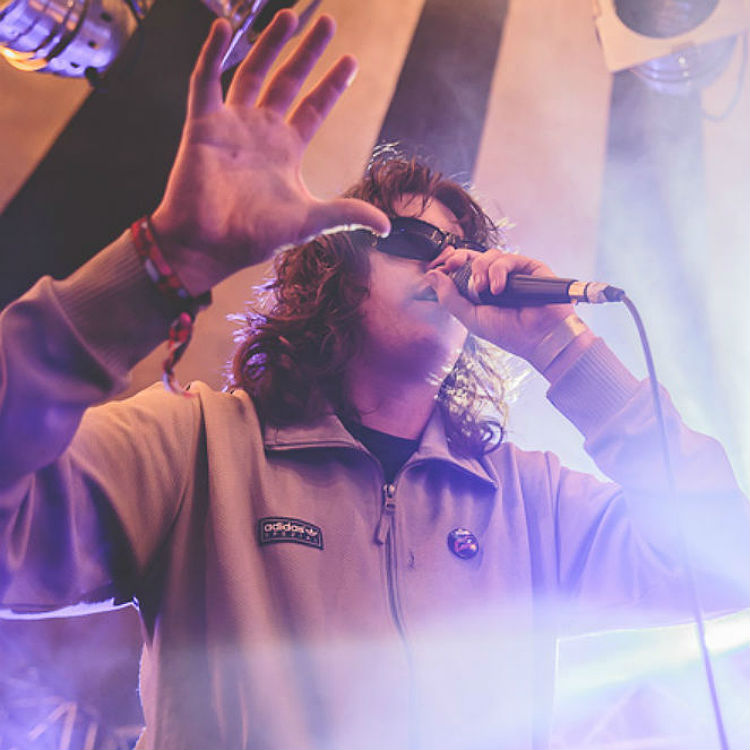
Fuzz Club Records 2016 In Fuzz and Psychedelia

Fuzz Club Records have had the pleasure of putting out a crazy number of records too. Starting the year with represses and reissues from The Underground Youth and Dead Rabbits which was shortly followed by the cinematic post-rock/psych of The Flow In Between by Tales Of Murder and Dust, a colossal split single with White Hills and RMFTM, a master-class in experimental music in the form of One Unique Signal’s Hoopsnake, a lucid and smoky garage-rock LP from The Third Sound Gospels of Degeneration, the incredible Live In Berlin LP from Dead Skeletons, RMFTM’sindustrial psych/acid-house monster Subversive II and the brooding post-punk of The Cult of Dom Keller’s Goodbye To The Light.

We released the fourth volume of The Reverb Conspiracy, boasting Ulrika Spacek, Josefin Ohrn and The Liberation, Giobia, Soft Walls and The Madcaps to name a few. This was shortly followed by Dead Rabbits brilliant third LP Everything Is A Lie and Tau’s mystical and droning Tau Tau Tau LP.  The Underground Youth‘s A LoFi Cinematic Landscape got the vinyl treatment, The Wands’ Faces offered a cosmic, 60s-esque garage and Austin psych-beat producer Al Lover paid homage to seminal outfits, Neu! and Suicide, on the Neuicide! 10”.

We released an industrial, goth-tinged split-single between 10,000 Russos and The Oscillation, the ethereal motorik shoegaze of My Invisible Friend’s self-titled EP,  we reissued Sonic Jesus’ first EP and Tales Of Murder And Dust‘s Hallucination Of Beauty, and, as previously mentioned, we kicked off the Fuzz Club Session series with the white-knuckle R&B of Night Beats.

Although you’ll have to wait until next year to hear them in full we also announced new LPs from The Underground Youth and Singapore Sling, and from two new additions to the Fuzz Club family; The Gluts and Has a Shadow. We’ve been keeping busy during the holiday so look out for some more announcements over new year!

So yeah, 2016 has been pretty amazing in many ways and we’re ridiculously excited to show you what we’ve got planned for next year – you haven’t seen anything yet! Huge thanks to all our artists, friends, promoters, anyone that bought a record, came to a show or done anything to help make it such a cool year for us and everyone who loves music. We couldn’t do what we do without you.

It looks like 2017 will be our busiest year so far. We already have releases by 10 000 Russos, Sonic Jesus, The Entrance Band, Holy Wave, The Black Ryder and The Oscillation in production to name a few. We’ve also signed some great new bands that you will be seeing more of later in the year.

We just got some new release up for pre-order from our favourites The Brian Jonestown Massacre and Rocket Recording.

The Brian Jonestown Massacre – Open Minds Now Close
Available on white coloured vinyl 180 grm 12” . Open Minds Now Close is the second of 3 singles from the forthcoming album “Don’t Get Lost” released in February 2017.

The Brian Jonestown Massacre – Dropping Bombs On The Sun (UFO Paycheck)
Dropping Bombs On The Sun (UFO Paycheck) is the final & third of 3 singles from the forthcoming album “Don’t Get Lost” released in February 2017.

We also got a collaboration going with Little Cloud Records from Portland, OR who has some great releases coming. At the moment we have their Magic Shoppe – Wonderland available in our store.

Here is a list of what we have coming out over the next couple of months:
– Has A Shadow – Sorrow Tomorrow – January 18th
– Singapore Sling – Kill Kill Kill (Songs About Nothing) – February 2nd


– 10 000 Russos – Fuzz Club Session – January 22nd (looks like it will be a couple of weeks delayed)
– The Underground Youth – What Kind Of Dystopian Hellhole Is This? – February 15th
– The Underground Youth – Delirium (Repress) – February 15th
– The Underground Youth – Voltage – February 15th
– The Underground Youth – Morally Barren – February 15th

Image result

Two lookalike freaky kids who made one of the most lush, organic songs of the year in 2015, the mesmerising track Deep Six Textbook. Their music is as icy as PJ Harvey and as random as Bjork or Dean Blunt, arriving complete with coordinated handclaps, sax solos, wilfully obscure lyrics and jaw-dropping harmonies. There’s something a bit creepy about Let’s Eat Grandma. Their name, for starters. But their eerie childlike vocals matched with a quirky psych tinged, folk sound but with hints of electronica, shouldn’t really work. Yet it does. And the result of I, Gemini is one of the most catchy new records of the year. The teenage Norwich duo are instantly likeable and the ideas involved in their debut record hint at a very bright future.

That Let’s Eat Grandma’s debut album I, Gemini should feature on our favourites of the year list should come as no surprise to regular readers. We’ve been fans and supporters since way back when and their appearance on Jools Holland was one of our personal music highlights of 2016.

Their music isn’t for everyone but the best thing is, we really don’t think they care. In fact, we’d wager that all the critics, bloggers and armchair opinioners take it all a lot more seriously than Rosa and Jenny do. Their sound is inventive, imaginative and entirely different to pretty much anything else out there right now. They make music for themselves, please themselves and to entertain themselves. It’s not really commercial – it’s not pop by numbers, it’s not landfill indie, it’s not even punk (though some will say it is) – it is simply the imagination and musicality of two incredibly talented teenagers left to run wild, and the results are magnificent.

Many of the tunes are pretty much the same as they were a couple of years ago, before the industry was aware of them and before their debut Latitude appearance (on the tiny Inbetweeners stage) became a thing of legend. A tip of the hat to Transgressive then for letting the pair be themselves and not trying to add significant amounts of polish or control to a sound that is at its best when it is left to just be whatever the girls want it to be.

Daughter - Not to Disappear

London trio Daughter’s debut album If You Leave was an excellent, tender, delicate record and, on the strength of the first taste of the new album, The single Doing The Right Thing – they’ve retained their sense of melancholy and added some steel to it too.

A few listens in, not long after its release in January, we thought to ourselves If “Not to Disappear” is not in our end of year list, it will have been an incredible year for music’. As it turned out, 2016 was a pretty decent year for new music releases but Daughter’s second album remained a high, and powerful, point.

“Doing the Right Thing” continues to provoke tears when listening. Its anguished take on dementia, told from a sufferer’s point of view, not so much tugging at heartstrings as wrenching them out by the handful while making you chop onions for hours. It is one of the saddest, most emotive tracks we’ve heard in years and its power does not diminish the more familiar you are with it.

By contrast “No Care” is powered by a visceral dissection of a less than pleasant sexual liaison. Here there is anger and disgust but the rawness and honesty remains. Indeed, Not to Disappear is startling in its openness, poignancy, accessibility and beauty. For our money it shows a real evolution and maturity from a band who have always sounded gorgeous, and now seem to have a lot more to say within it.

‘Doing The Right Thing’ was the first single to be taken from Daughter’s new album ‘Not To Disappear’, released on the 15th January 2016

Singer Lee Broadbent, who in addition to being a phenomenal frontman, is a highly thoughtful, intellectual young man . He’s intent on using his platform in the band to call out the most cancerous ideologies in our society and will walk through fire to get his point across. You can’t suppress Cabbage’s uncensored outlook and you can’t deny their power as a live band. 2017 needs Cabbage it we’re to help heal the poison of 2016.

Cabbage band Manchester tickets

Think the Roses’ spirit, Super Furries creativity, The Clash’s bollocks and you’re somewhere close to Cabbage. The most exciting and ferocious new live act on the planet.

“With songs about North Korea and Donald Trump, Cabbage would run the risk of being pigeon-holed as a political band… if it wasn’t for their filthy sense of humour.

On the song Dinner Lady, singer and lyricist Joe Martin darkly recalls his real-life experiences of serving school meals over a slinky riff: “I got so bored and idle / Served enough sausage rolls to make me suicidal.”

“We think it’s such a waste that bands have a platform to say things and just don’t” says Martin, whose poetry is inspired by “the bard of Salford”, John Cooper Clark”.

Spilt Milk is the latest album from indie auteur Pete Astor, previously of The Loft, The Weather Prophets, and other esteemed acts. It was recorded onto ½ inch tape at the home studio of James Hoare of Ultimate Painting, The Proper Ornaments and Veronica Falls, with James playing guitar, bass, drums, keyboards and singing backing vocals. “He was”, says Astor, “an amazing band.” Other contributions came from members of Astor’s live band, with Pam Berry (Black Tambourine, Withered Hand) supplying vocals, Jack Hayter (Hefner) on pedal steel, Alison Cotton (The Left Outsides) on viola, and Robin Christian (Male Bonding) and Susan Milanovic (Feathers) on drums.

The album has all the hallmarks of a future Pete Astor classic, drawing together key strands and tributaries of his work over the years, blending intuitive songwriting, acute lyrics and incisive melodies. After many years making more experimental, electronic music Astor has come full circle to the sound that made his name. He explains, “I’m back to being myself, bringing together sounds that I’ve used over time to make a record that sounds more like me than me!”

From the opening track “Really Something” to the recent single “Mr Music” (a favourite of Marc Riley and Gideon Coe on BBC 6 music) the album’s re-connects Astor’s bespoke guitar pop with his long-standing embrace of The Velvet Underground’s musical DNA. Other standout tracks include “My Right Hand”, a hymn to everyone’s best friend, with guest appearances from Tony Hancock, Marvin Gaye, Philip Larkin and a host of ex-girlfriends; the slow burning drama of “The Getting There” recalling the atmospheres of Astor’s 80s kindred spirits, The Go-Betweens. Also, there is the wry drive of “Very Good Lock”, summed up by Astor as “a description of an injurious medical condition that often affects the male of the species”. Elsewhere there are the gorgeous harmonies of the grown up country lament “Good Enough”, which wouldn’t be out of place on one of George Jones’ most heartbroken albums.

Spilt Milk is part of a continuum: from Astor’s beginnings with The Loft and The Weather Prophets on Creation Records in the 1980s, via his solo work through the 1990s and his more left field albums with The Wisdom of Harry and Ellis Island Sound on Matador Records, Heavenly and Peacefrog, through to his return to solo work with the Songbox album in 2012. As well as this ongoing musical activity, Astor is also Senior Lecturer at the University of Westminster, where he teaches, researches and writes about music; 2014 saw the publication of his study of Richard Hell and the Voidoids’ Blank Generation as part of Bloomsbury’s 33 1/3 Series.

Astor remains in touch, engaged and vital in a way that is rare with someone with such longevity. The album continues the story of one of one of England’s most respected and significant songwriters. As Astor says, “time passes, shit happens; some losses, some gains.

There’s something great about a three-piece – think The Cocteau Twins, The Clean, Galaxie 500 – and the way that irreducible nucleus takes its strength from its limitations, making a virtue of its purity. So it is with London trio Flowers, returning with their second album “Everybody’s Dying To Meet You”. Over the course of ten intensely thrilling pop songs, singer Rachel Kenedy’s ethereal vocals and Sam Ayres textured guitar are backed by the powerful, metronomic beat of drummer Jordan Hockley.

For Everybody’s Dying to Meet You the band retreated to Bark Studios in Walthamstow to work with producer Brian O’Shaughnessey (The Clientele, Primal Scream, My Bloody Valentine), a return home for Sam, who was born and spent most of his life in the area. It proved to be the perfect fit for Flowers, the sessions enabling them to capture the essence of both their dynamic live sound and their distortion-laden home demos. Effortlessly blending pop songs with noise while leaving space for more stripped back elements, the recordings strike a perfect balance between the sweetness of Rachel’s voice and Sam’s abrasive guitar stylings. Their musical inspirations, from shoegaze, C86 and New Zealand’s Flying Nun label, are now evident.

Armed with a youthful intensity and determination that shows in their songs, Flowers have succeeded in harnessing their singular magic. Exuberant and electrifying, Everybody’s Dying To Meet You crackles with confidence.

Flowers are heading to a rock venue near you soon.

25 February – MANCHESTER – Fallow Café
26 February – COVENTRY – Kasbah
27 February – LIVERPOOL – Leaf Tea Shop
28 February – GLASGOW – Broadcast
02 March – NOTTINGHAM – Rough Trade
03 March – READING – Oakford Social Club
04 March – CARDIFF – The Moon Club
05 March – PENRYN – Stuart Stephens Memorial Hall
11 March – LONDON – Sebright Arms
09 April – LEICESTER – Leicester Indiepop Alldayer

On January. 1st, 1977, Joe Strummer took center stage at London’s burgeoning punk rock refuge, the Roxy. As if presciently ordaining himself the harbinger of what was in store for the pivotal year, “1977” was scrawled boldly across the frontman’s tattered white collared shirt as he and his fellow band members The Clash stormed through two back-to-back sets, officiating both the launch of the Roxy as a cultural touchstone and the explosion of the U.K. punk movement as a whole. The Roxy was a fashionable nightclub located at 41-43 Neal Street in London Covent Garden known for hosting the flowering British Punk Music scene in its infancy. The premises had formerly been used as a warehouse to serve the Covent Garden wholesale fruit and vegetable market.

After an unsuccessful run as an “alternative” nightclub called Chaguaramas, situated in the Covent Garden neighborhood of London, Andrew Czezowski, who was then manager of the Damned and the bands Chelsea, Generation X, took ownership of the building. Initially intended as a place for his client acts to rehearse, he along with partners Barry Jones and Susan Carrington pawned a number of their personal possessions, furnished the venue, and stocked the bar, reviving the haunt as the Roxy, hoping to do for London’s punk scene what CBGB did for New York. By the time the club opened Chelsea had split with members Idol and James and Towe forming Generation X and it was they who played on closely followed by the Heartbreakers fresh off the aborted Anarchy Tour.

Don Letts was the resident DJ at the club and he was instrumental in encouraging punk rockers to embrace reggae.

The music scene within which the Clash had been slowly ingratiating themselves had begun years before the fabled New Year’s gig, but it had been trammeled by censorship, and poor luck. 1976’s Anarchy Tour, wherein the band, accompanied by Johnny Thunders’ Heartbreakers, supported the Sex Pistols on a string of ill-fated dates, the majority of booked appearances had been canceled due the pressure of local political interests or the volume of protest demonstrators. By the time the tour had dissolved in scandal on Christmas Eve, as retold in Nick Crossley’s Networks of Sound, Style and Subversion: The Punk and Post-Punk Worlds of Manchester, London, Liverpool and Sheffield, 1975-80, almost two-thirds of the 20-odd scheduled dates were cancelled before a note had been played.

The ill-repute earned by the failed Anarchy Tour mostly plagued the Sex Pistols, however, as they headlined the bill while the Clash occupied the most modest slot, below that of the Heartbreakers. With hardly a reputation visible enough to damage, they were best positioned to recover. Sex Pistols documentarian Julian Temple, whose forgotten footage of the Roxy evening was finally unearthed for the 2015 BBC Four documentary, The Clash: New Year’s Day ’77, told the network at the time of the release, “The Clash weren’t known at all outside a very small circle, but I thought they were an incredible band in the making.”

Armed with a sharpened assortment of politically militant punk anthems-in-waiting, most of which would eventually appear on their eponymous debut three months following the Roxy gala, Temple recorded subterranean Clash rehearsals, capturing now-familiar numbers in their embryonic form. Where the Sex Pistols expressed their subversive proclivities with sneering confrontation and a manic public image (and in a sense, establishing the “punker” archetype), the Clash honed more melodic and informed song structures and envisaged a more focused and clear-cut ideological vision.

Image result for the clash roxy new year

But it wasn’t the Clash’s brand of more organized and presentable subversion that was originally slated to break in the newly rebranded Roxy. As Marcus Gray put it, in his book The Clash: Return of the Last Gang in Town, “The Clash agreed to headline the 1st January 1977 Roxy opening night, thus beginning the new year with a highly symbolic act.

It was the Pistols manager Malcolm McLaren, in his characteristically mercurial fashion, who pulled his clients out of the gig at the last minute as a result of the fallout following the Pistols infamous TV appearance on the Today show. Still, the symbolism of the turn of events is not exaggerated. The memorably turbulent, not to mention capacity-defying, performance was the first of a series of overtures that would propel the Clash past the perpetually embattled Sex Pistols as the U.K. punk rock hierarchy.


The Roxy’s reign, on the other hand, would be tragically short-lived: it shuttered its doors in April 1978, little over a year after its grand opening. But not before cementing its legacy by cycling through the gambit of prominent English punk acts of the era, from street-punk squatters like Crass and Slaughter and the Dogs to art-school post-punks Wire and Siouxsie and the Banshees . Despite the brevity of the Roxy’s run, the bands it hosted and movement it helped launch proved bigger and more lastingly influential than the Clash and their contemporaries could have ever predicted.

thanks to the diffusser

The Roxy Club London WC2

On the day (October. 17th) in 1973: The Rolling Stones performed two shows at Forest Nationale in Brussels, Belgium, as part of a tour of the UK & Europe; sax player Bobby Keys didn’t show up for the concert, which resulted in him being banned by Mick Jagger from future Rolling Stones tours until 1982, with occasional exceptions; according to legend, Bobby missed the gig due to him filling a hotel bathtub with Dom Perignon champagne & drinking most of it…(Bobby ‘left the building’ for the last time on December. 2nd, 2014…)

October 17, 1973. 1st show: Brown Sugar / Gimme Shelter / Happy / Tumbling Dice / Dancing With Mr D / Angie / You Can’t Always Get What You Want / Midnight Rambler / Honky Tonk Women / All Down The Line / Rip This Joint / Jumping Jack Flash / Street Fighting Man

What an beautiful, elegant blues player Mick Taylor is during this period… using the same old scales that most all that most of us play.His solo on Angie is the most perfect, no wasted notes statement this side of George Harrison, but as w/ the rest of this set played on the sweet verge of feedback.The perfect foil for Keef who also needless to say is at the height of his powers hereand besides what group needs 2 of the same on the guitar front?No offence to R.W. whom I love w/ the Faces but he seems to have stopped practising (or something… ) upon entering the Stones.

YCAGWYW is so beautiful here it damm near had me tearing up, Keith and Mick Taylor can only be described as sublime on this version, they play off one another perfectly…and da sax just knocks it outta the fuckin’ park…never heard a better live effort of this song, its like they sold their souls for this one…

Mick Taylor, what an amazing guitar player ! I think, the Rolling Stones songs bring him up to this level. He also plays great on his solo albums, but its never the magic like with the Stones.Mick Taylor without the Stones is not same. And of course he plays better the Ronnie Wood. But playing fantastic performances makes the band not surviving for so long. It’s Ronnies character and personality who is a part off, that the Stones still play this days… So thanks all of them for such great music they gave and still give to us !

The Brussels Affair

Units made: 173
Limited-Edition Book, numbered and hand-signed by Mick Jagger, Michael Putland and Nick Kent.
Limited-Edition Tour Litho of 173 pieces, hand-signed by Mick Jagger.
Album: 180-gram Triple-Vinyl Set of the Brussels concert.
Watch: ’70s-era “Tongue & Lips” Watch—Japan Seiko movement and stainless steel face with brass dial.
History: In 1973, the government of France banned the Rolling Stones from entering French territory because of various run-ins with the law most of them occurring during summer of 1971, while the band members were in the South of France, recording one of their masterpieces, Exile on Main St. This was a blow to the Stones’ hordes of French fans, who would be shut out from experiencing the Greatest Rock ‘n’ Roll Band In The World on their 1973 European Tour in support of the newly released Goats Head Soup. That October, the band organized a concert across the Belgian border in Brussels, and a local radio station chartered a bus to transport French fans to the now-historic gig.

All the sights and sounds from this historic show and tour have now been amassed for the first time in The Brussels Affair, the inaugural release from the Stones Archive. The package features an 180-gram triple-vinyl album and rare photographs from the Brussels show by Claude Gassian, as well a book documenting the entire 1973 European tour, with exclusive photographs from Michael Putland and a newly written text by acclaimed NME scribe Nick Kent.
Contributors: Michael Putland, Nick Kent, Claude Gassian