In the late 1960s, the Doors, and particularly their frontman Jim Morrison, were one of the most unpredictable live acts on the planet. You simply didn’t know what they were going to do or how long they were going to do it for. Just two weeks after the Fillmore East opened, Bill Graham booked the Southern California psych rockers to play four sets of music spread across two nights. The final set on the second evening was the one to catch.
That night, the Doors played their regular collection of material but apparently enjoyed themselves so much that they came back after most of the crowd had thinned out and played again for nearly an hour. It was an incredible showing, and left a tremendous impression on one audience member in particular: future punk poetess Patti Smith. Her boyfriend, photographer Robert Mapplethorpe, was working as an usher at the venue and managed to get her a free pass to the show. It was a galvanizing experience, as she explained in her autobiography Just Kids. “I felt, watching Jim Morrison, that I could do that,” Smith wrote.
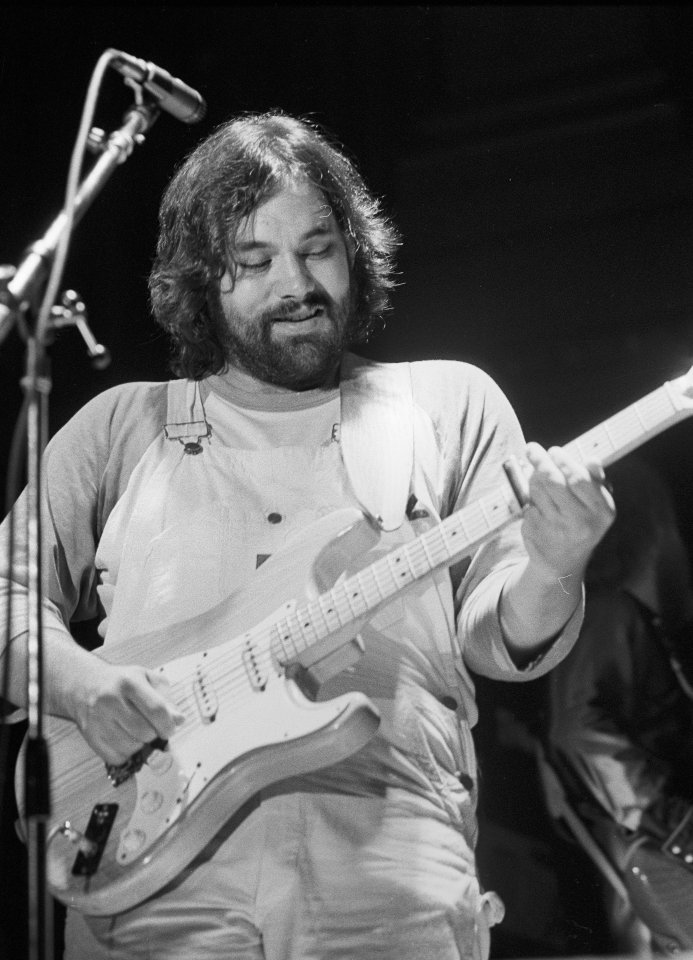
Today we are remembering the late Lowell George. The Little Feat guitarist would have turned 73 years old this year. Lowell initially funded his first band by the sale of his grandfather’s stock in 1965 and released at least one single on the Uni label, “Smile, Let Your Life Begin” (co-written by George). Members included future Little Feat drummer Richie Hayward (who replaced Dallas Taylor in September 1966), Martin Kibbee (a.k.a. Fred Martin) who would later co-write several Little Feat songs with George (including “Dixie Chicken” and “Rock & Roll Doctor”), and Warren Klein on guitar. Frank Zappa produced two tracks for the band, but they weren’t released until 1993 on the album Lightning-Rod Man, billed as Lowell George and The Factory.
The band made an appearance on the 1960s sitcom F Troop as “The Bed Bugs”. They were also featured in an episode of Gomer Pyle, U.S.M.C., “Lost, the Colonel’s Daughter” (season 3 episode 27). Although not visible in the scene inside the A Go-Go club, their music can be heard playing loudly. They received credits at the end of the episode as “‘The Factory’ Lowell-Warren-Martin-Rich, Courtesy of Universal Records”.
Following the disbanding of The Factory, George briefly joined The Standells. In November 1968, George joined Zappa’s Mothers of Invention as rhythm guitarist and nominal lead vocalist; he can be heard on both Weasels Ripped My Flesh and the first disc of You Can’t Do That on Stage Anymore, Vol. 5. During this period, he would absorb Zappa’s autocratic leadership style and avant garde-influenced conceptual/procedural-oriented compositional methods. He earned his first production credit, in conjunction with Zappa and Russ Titelman, on Permanent Damage, an album recorded by “groupie group” The GTOs. George later asserted that “he performed no real function in the band” and left the group in May 1969 under nebulous circumstances. GTOs member PamelaDes Barres has claimed that George was fired by the abstemious Zappa for smoking marijuana, while he claimed at a 1975 Little Feat concert that he was fired because he “wrote a song [“Willin'”] about dope.” On the contrary, biographer Mark Brend asserts that Zappa “liked the song” but “thought there was no place for it in the Mothers’ set”; George himself alternatively claimed that “it was decided that I should leave and form a band” by mutual agreement.
On June 15, 1979, George began a tour in support of his solo album. On June 29th, 1979, the morning after an appearance at Washington, DC’s Lisner Auditorium where the bulk of Little Feat’s seminal live album Waiting for Columbus had been recorded, George collapsed and died in his Arlington, Virginia hotel room.
Lowell George from Little Feat’s 1970’s Fender Stratocaster. This is one his last ones, apparently he got so many guitars stolen during his career that he only played on modern Strats that was easy and cheap to replace. Most of them did look the same since he favoured light wood coloured big headed Strats with maple necks. He always installed a Telecaster bridge pickup and volume knob and used an 11/16 socket wrench as a slide. Don’t ask me what’s going on with the input jack but he changed that on all his guitars too. Notice his dungarees behind the guitar.George struggled quite a lot in life and was addicted to cocaine and hamburgers but he was a helluva slide player. Little Feat, the best kept secret of the Seventies.
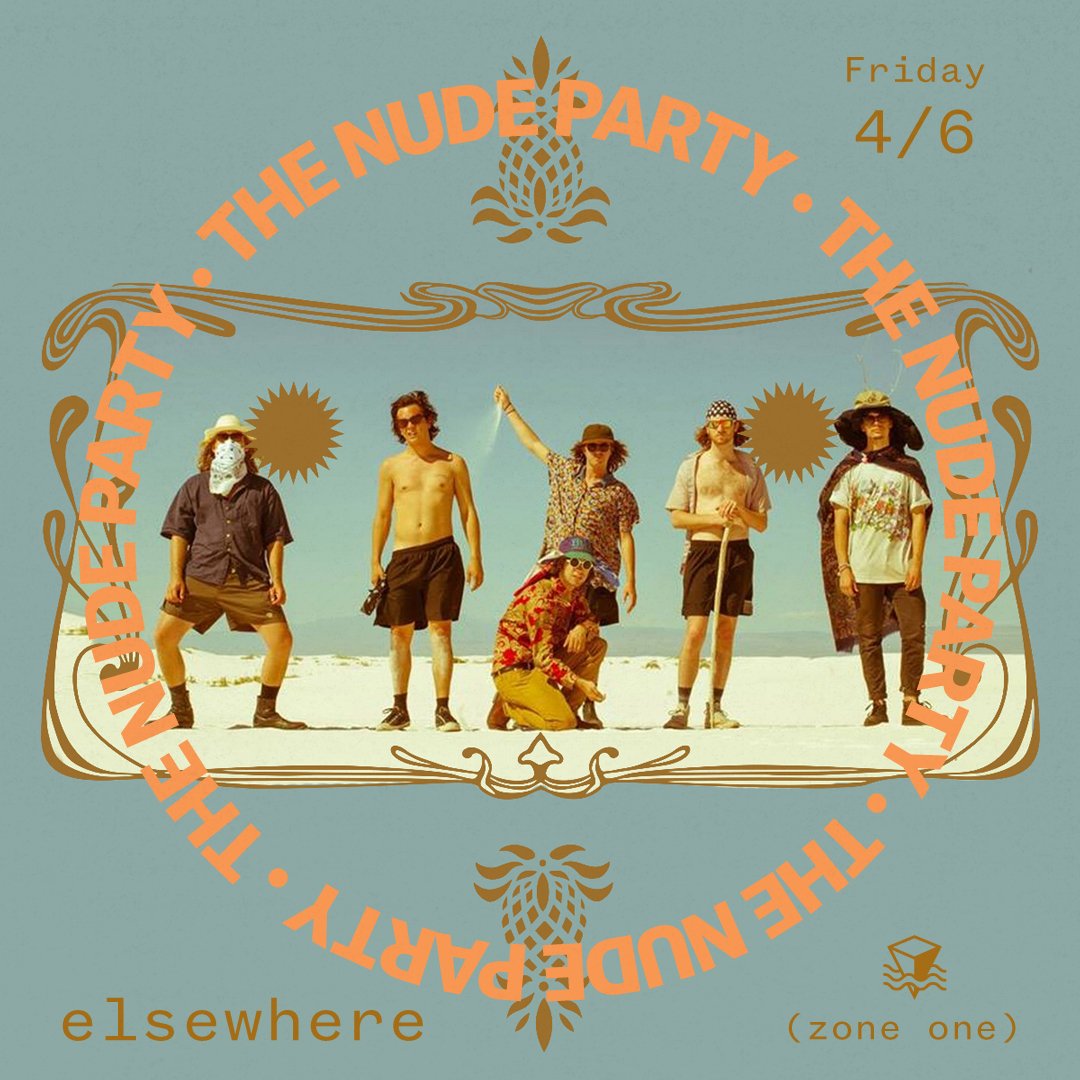
The Nude Party are a six-piece from North Carolina . The fine folks at New West Records will be releasing their debut LP on June 8th. While you wait, check out how they came up with such a unique moniker.
The members of The Nude Party first came together in the freshman dormitories of Boone, North Carolina’s Appalachian State University in 2012. Patton Magee, and later Austin Brose, linked up with childhood friends Connor Mikita & Alec Castillo and stepbrothers Shaun Couture & Don Merrill. The following summer, the young men moved into a lake house outside of town to begin learning their respective instruments and jamming on rudimentary riffs. Friends came by the lake house to swim and party and soon there developed a group obsession with performing in the nude.
They quickly gained a following as the house band at a notorious Boone party palace referred to as the 505 House, and the bare honesty of their performances was so contagious that their audience also started partying au naturel. While these traditions may appear risqué to the casual observer, the band explains, “These weren’t orgies, they weren’t sexual even. It was just kind of a wild exhibitionism that we felt gave us freedom.” Best known around campus as “the naked party band,” this informal aggregation of musicians became a defined unit and chose to call their group simply “The Nude Party.”
Miss June was formed in Auckland by Annabel Liddell (Guitar, Vox), when Tom Leggett (Drums, Backing Vox), Chris Marshall (Bass, loud noises) and Jun Park (Guitar, the image of the band) met up for a jam to help Annabel out for her solo show at Bloodfest. Originally Annabel asked only Tom and Chris to join. However, during the jam they felt they lacked beauty and a graceful front figure. Disappointed, they almost cancelled the show until Jun walked into the room; they then begged him to join due to his handsome looks.
Miss June have a sound similiar to Bikini Kill and the Pixies who had an illegal love child. Or Anger with a kiss of sadness.
Kevin Krauter is a member of the band Hoops, who released a their debut album last year. Now he’s setting out on his own solo voyage with the debut album Toss Up arriving via Bayonet Records in June 15th.
The first cut to be previewed from Toss Up is the utterly charming ‘Rollerskate’, a song that glides on simplistic dreamy indie guitars and drums, then takes an uptick towards the sky on subtle synth melodies towards its conclusion. Through this dreamy haze, Kevin Krauter relays a tale of relinquishing anger in favour of peace – even though there are trigger points all around him as he makes his way through the day. But Krauter is determined to stay equanimous; ‘Toss Up’ builds on the sonic worlds of Krauters’ first releases, conveying a similar mood with a greater array of instruments and influences. An insightful songwriter with a lyrical style that is both economical and evocative, Krauter crafts unique soundscapes that scramble a range of influences
“As I slowly rollerskate through a wall of hate/ I was trying to save my soul/ but what’s it for?” Although Krauter often feels overwhelmed by life’s many tribulations, big and small, he still comes out of the other end with a tranquil mindset. Overall, ‘Rollerskate’ is a perfect vessel for this lightheartedness in times of trouble, as it’s absolutely impossible not to feel like you’re swimming through sunshine as you listen to the glistening melodies and Krauter’s playful lyrics like “feel like every single say is a piece of cake/ I was trying to take some home.”
Steve Shiffman & The Land Of No is a rock and roll band based in NYC. Hailing originally from Toronto,Canada, Steve began his recording career auspiciously by completing a class project while attending college in London, ON. The resulting 5-song EP credited as Boatman received regular airplay on local college radio station CHRW and ended up cracking the top 20 on the national college radio chart. Seeking a fully-realized band, Steve put together indie-rock trio 4-Star Movie. The Toronto-based band enjoyed more college radio airplay.
After the first and then second permutations of 4-Star Movie, Steve moved down to NYC and began playing at open mics around the city, slowly piecing together the Land Of No. The first incarnation was a guitar-and-drums duo along with longtime Figgs’ drummer Pete Hayes. Over time they added Kent Heine (The Holy Ghost) on bass, and guitarists Dave Hollinghurst (Small 23, Nicole Atkins) and Alec Ferrell (The Holy Ghost, The All-Things, Skeleton Key). Their eponymous 1st record, recorded at Brooklyn’s famed Seaside Lounge and released on Tiny Beast Records, garnered strong reviews. The band then welcomed drummer Dan Mintzer (Moonraker, Nicole Atkins) into the fold.
The group’s second record “Mon Dieu” was recorded and mixed largely at their own Sunset 7 Studio with guitarist Dave Hollinghurst as engineer. The full-length record was released on vinyl through the band’s own Later Records.
Steve Shiffman & The Land Of No’s third full-length record “Double Life”, also recorded and mixed at Sunset 7 Studio, will be released on Friday February 2nd as a joint release on Later/Clearly Records.
Upon being informed that the title of Steve Shiffman & The Land Of No’s new record is “Double Life” most people have an immediate reaction that seems to leap out before the person catches it; a knowing nod or smile. Apparently, everyone has a double life. While expanding on the themes of mortality and madness found on their previous records, “Double Life” has a more divided feel to it; more immediate, yet more stark.
‘Double Life’ is their first full length album recording and it’s one that makes you sit up and take notice right from the start. Sitting somewhere between Indie & Art rock the band’s sound is one of jangly guitars and strident drums; at times dissonant and sometimes even discordant, it’s an album that challenges and fascinates almost in equal measure. Perhaps the track that best sums up the album is the second track in, ‘We’re A Mess’, based on a heavily distorted guitar sound and lines like “Strung out in a Hotel room on stuff. That’s a lie but at least that’s what it feels like”it perfectly sums up the mood of the album and the music of this band.
El Tee is Lauren Tarver, an American born musician residing in Melbourne. Tarver started performing solo in 2013, simultaneously playing in post-punk goth band, Parisian post-punk band Gomme and most recently in jangly grungers, Club Med. Having grown up in the punk scene, El Tee applies that foundational musical grit while delivering songs via reverberated melodies and emotionally steered lyrics, capturing a ethereal-yet-dark style.
Although now accompanied by a backing band when playing live, the El Tee sound is often pretty minimal, just Lauren’s soaring vocal, country-tinged vocal and gently, strummed electric guitar.
Although originally from Northern California, El Tee now calls Melbourne home. Australia’s second largest city, Melbourne well established as the countries cultural capital, and one of the world’s finest musical cities, with more music venues per head than even Austin, Texas. Arguably the city’s most famous musical offspring is the irrefutably brilliant Nick Cave, although Kylie Minogue has probably sold more records. In recent years the city has seen something of a boom with acts like Gabriella Cohen, King Gizzard And The Lizard Wizard and Alex Lahey all making waves both in Australia and overseas.
Lauren has been performing solo since around 2013, but only released the first El Tee offering, Rough Light, in February this year, a collection of demos of songs written throughout 2017. Lauren recently showcased something more polished sounding in the shape of new two track EP, Radio Silence, which was released at the back end of March. The latest in a string of excellent, alt-country indebted songwriters emerging from Australia in recent years, El Tee wouldn’t sound out of place alongside the likes of Julia Jacklin, Gabriella Cohen. Thankfully though, all easy comparisons aside there’s plenty about Lauren’s songwriting to make her stand out, even from that impressive crowd.
Take Radio Silence’s lead track, Hold On; a throb of bass and gentle, barely there drum beat aside, it’s just Lauren to the fore. Her lightly strummed, warm electric guitar meanders gently around the fret board, as her vocal, distant and echoing carries much of the melodic weight. The quiet simplicity of the music allows the track to ebb and flow with the passion of the voice, and allows the lyrics to shine out, as Lauren spells out a story of finding failure through freezing in the face of possible success, as she sings, “are you here? Are you waiting for the moment to arise?”
Although in terms of instrumentation it is even more stripped bare than Hold On, the EP’s other track, Inside, is a darker, more brooding beast. Recalling the same over-driven guitar meets soaring vocal combination Magana used so memorably, Inside is an emotional and almost insular piece of songwriting. Lauren has suggested it is a study of loneliness even in the presence of others, how we can all at times become engulfed by the safety-net that our internal monologue can provide.
Radio Silence is a hugely promising introduction, but it is just that an introduction. The next step, a debut album is already in the works, will be the moment of truth. If Radio Silence is anything to go by, it could be spectacular.
In 1972, Stephen Stills formed a new band called ‘Manassas’ and on April 12th they released their debut double LP of the same name.
The album debuted on the Top LP’s chart for the week ending April 29th, 1972 and eventually peaked at #4 in June. Stills‘ album shared the Top 10 with an album by David Crosby and Graham Nash(Graham Nash David Crosby) and an album by Neil Young (Harvest), and as you know, all were members of the quartet Crosby, Stills, Nash & Young.
Manassas marked a critical comeback for Stills, calling it a “sprawling masterpiece” and Rolling Stone saying it was “reassuring to know that Stills has some good music still inside him”.
By 1972, what we call classic rock was pretty much peaking—though nobody at the time knew it. Except maybe Stephen Stills. The band and double-album he piloted and released that year—both named Manassas—now seem pivotal. Manassas brilliantly summed up the remarkable 1960s creative surge that revitalized rock’s roots and encouraged experimentation just when it was at its crest.
The top-flight outfit Stills assembled in late 1971 and named for a bloody two-part Civil War battle (the album’s cover shot was taken on that battlefield) could nimbly navigate damn near every polyglot style rock was evolving– from blues “Jet Set” to bluegrass “Fallen Eagle”, country rock “Don’t Look At My Shadow” to Caribbean beats “Medley”, folk-rock “Johnny’s Garden” to metal “Right Now”. Jamming out complex, textured arrangements in the studio, they successfully translated them to stages in Europe and the US. But Stills always felt that Manassas struggled for recognition because his handlers wanted him back in the gold rush that Crosby Stills and Nash (and sometimes Young) generated.
So it all begn when Hillman and Stills accidentally crossed paths in Cleveland, they both glimpsed opportunity. Stills’ bounteous talents and fierce competitive drive almost ensured he would overshadow nearly any setting he was in, but he was discouraged by his solo ventures. He needed a creative ally he respected, someone who’d push back but not combust or split.
A few weeks later, Stills called Hillman and invited him down to Miami’s famed Criteria Studios, where engineer-producer Tom Dowd had shepherded Derek and the Dominos‘ monumental jam-fuelled Layla sessions the year before. As it happens, the producers for what would become Manassas worked on it too.
The stage was set to replace the sterile studio feel Stills hated with the onstage improvising looseness he loved. He had his co-pilot.
Chris Hillman, who may be rock history’s best-ever second banana after dealing with McGuinn and Parsons were hard-to-beat baptisms of fire was secure enough in his own creativity to deliver. He would co-write two songs for Manassas (Both of Us, It Doesn’t Matter), help Stills wrangle others into shape, and supply his subtle, pure-toned harmonies throughout.
As StephenStills explained, “I basically wanted a partner, somebody who had a sense of songs. Chris invented the phrase ‘lyric police,’ and was a tremendous help. But I was still on that real powerful, energetic ‘Let’s go, I know what I’m doing’ kinda thing. Chris realized it was my band, and that was OK for him.”
From the shambling Burritos came two key talents.
Violinist Byron Berline was a bluegrass vet who’d clocked time with stars like Bill Monroe and Dillard and Clark. Fallen Eagle, a breakneck bluegrass protest song against ranchers killing our endangered national symbol, puts his dazzling, keening fiddle and Hillman’s virtuoso mandolin in the forefront.
Al Perkins learned to play Hawaiian steel guitar at nine, mastered the dobro and pedal steel, performed with country and western bands, then shifted gears to tour his native west Texas as a rock guitar slinger. He supports or duels with Stills on all his axes. On Jesus Gave Love Away For Free, his aching steel solos swell and sigh; on Don’t Look at My Shadow, they glide with glee. On “Jet Set,” he plugs into effects to go grungy and deliver slashing, whiplash blues in Duane Allman fashion to counter Stills‘ gurgling wah-wah. He plays both steel and guitar on Song of Love.
Perkins, Stills, and Hillman take their guitar army acoustic for “Johnny’s Garden”, where their loosely braided, ever-shifting lines gently nudge Stills‘ yearning vocal.
The rest of the cast came from Stills‘ solo albums and tours.
Bassist Calvin “Fuzzy” Samuels brought the Caribbean feels Stills craved, as the burbling line on “Song of Love” demonstrates. But he could nail the bottom hard on blues-rockers like “Jet Set.”
Keyboardist Paul Harris, a session vet, could play almost any style; with Hillman’s adept rhythm guitar, his keys became the session’s sonic glue. Latin percussionist Joe Lala co-founded Blues Image (Ride Captain Ride) and sang with gritty, soulful conviction. He vocally challenges Stills on Cuban Bluegrass, and delivers the pulsating Latin rhythms Stills adored throughout.
Drummer Dallas Taylor was Stills’ running buddy—and a wild card. He played on CSN’s first two albums and tours; they fired him because his substance abuse rivaled the Grievous Angel’s. But this bad boy had exactly what Stills wanted on drums: he could float, dance, or slam it home.
What was slated to be Stills’ third solo album had morphed completely. The band’s chemistry clicked almost instantly, and its boundless energy and chops meshed with Stills’ vision and discipline. A few weeks of jamming out arrangements fused the wildly diverse material and sounds into a sum greater than its parts. They came out of it as a fierce, tuned machine.
No wonder Bill Wyman, who co-wrote Love Gangster with Stills and played bass for the track, said he’d leave the Stones to join Manassas. Hillman understood why: “We were always more of a band than people thought. Stills wouldn’t have been the same without us, that’s for sure. Manassas was the best band Stills ever played in.”
The album ends with a final stark jolt. Blues Man finds Stills alone with an acoustic guitar, like the host of a wild party sitting amid the wreckage after it’s over. He channels everything he ever absorbed from his revered blues masters into his gritty, anguished vocal and nimble fingerpicking to sketch a raw, painfully dark elegy for three of his friends. Jimi Hendrix, Al Wilson (Canned Heat), and Duane Allman had all recently died.
On stage, Manassas gained fame for its nearly three-hour shows opening with an opening rock set, followed by Stills playing solo acoustic, Hillman and Perkins playing bluegrass, and the band then returning for country, more rock and an acoustic finish. After touring, Hillman took several weeks away to record a reunion album with the Byrds, his pre-Burritos band.
“Juicy Socks” is Cherry Glazerr’s first release since last year’s Apocalipstick, their second album and first for Secretly Canadian. On that record, the Californian trio made their foray into guitar-heavy, psychedelic punk. The new single is heavier and certainly more beholden to ’90s alt rock (think the Breeders or Plumtree). But ClemCreevy doesn’t stray too far from her goofy Burger Record roots, maintaining a healthy dose of self-deprecation and humor in the song and accompanying visuals. plus new changes this year to the bands lineup @sasamiashworth is moving on from the band to pursue her own music. She has brought so much light and love and spark to CG and these past few years have been so full of joy. We love her to death and will miss her dearly (especially the dad jokes) but we are also crazy excited to go back to performing as a three piece for now.
Directed by Jessica Nicole Collins, the “Juicy Socks” video is all pleather, chains, and disturbing plastic masks. In it, Creevy gazes down on us, clad in fishnets and floral, until the video erupts into a neon-lit, hedonistic brawl, all taking place on a party bus.
Speaking about the video, Creevy says, “‘Juicy Socks’ is about vocalization. Using one’s voice as a strong weapon and needing to be heard in order to not feel like shit. Oh also, it’s about wanting to smash Donald Trump’s orange fuckin’ head into a brick wall!”