You will know Jasamine from her eight-years (and counting) stint as a founding member and principal songwriter of Canadian shoegaze/noise-pop band No Joy. And Pete Kember is Sonic Boom, of Spacemen 3, Spectrum, and E.A.R.
While neither can accurately recollect how they met, the pair first touched on the idea of working together in an exchange of emails during the fall of 2015. No Joy had just finished touring on the back of LP More Faithful(their third full-length on the Mexican Summer imprint, and their heaviest to date), and Jasamine was eager to walk a new path. “No Joy functioned as a four-piece ‘rock band’ for so long,” she says. “I wanted to pursue something solo where I collaborated with someone else who could help me approach my songs from a completely different angle. Pete is a legend and someone I’ve admired for a long time. Being able to work with him on this was incredible.”
What started as a sonic exploration between two friends—passing songs back and forth intercontinentally, with Jasamine writing and producing songs in Montreal and Pete writing, arranging, and producing in Portugal—soon grew into a project of substance, the result being four glistening tracks that dance along the lines of electronica, trip-hop and experimental noise.
“I wrote some songs that were intended for a full band and handed them off to Pete, who helped transform them. I barely knew how to use MIDI so I was just throwing him these experiments I was working on and he fine-tuned my ideas. There are barely any guitars on this album, because I was focused on trying to find new ways to create sounds.”
The EP begins with the 11+ minute epic “Obsession,” a disco-y dream trance jam that ebbs and flows, before “Slorb” slinks in, casting its seductive spell. “Triangle Probably” rings triumphant, an industrial beat thumping below, the track interwoven with Jasamine’s silvery vocals. “Teenage Panic” begins in celebration, brimming with hope and excitement, and then—a full stop—before striking back in the form of a droning loop that gathers more and more layers as it spins out into the infinite void.
No Joy / Sonic Boom is an experiment in testing boundaries and stepping out of comfort zones gone cosmically right.
Liverpool psych-pop five-piece The Vryll Society have released a new single, “Andrei Rublev.”
The band are currently working on their debut album, and have released a series of singles and an EP titled Pangea through famed Liverpool indie label Deltasonic Records (The Coral, The Zutons, White Room). The band recently supported The Kooks, Blossoms and The Coral in the U.K., and they also made an appearance at last year’s SXSW festival in Austin.
Their stunningly beautiful new song, “Andrei Rublev” is as mellowing as it is hypnotic, with frontman Mike Ellis’ calming lead vocals, their kraut-rock rhythm section, lush synth soundscapes and intricate psych guitar lines. The song’s raw power sneaks up on listeners with its trotting bass line and shimmering Procol Harum-esque keyboards before it erupts with euphoric sonic textures and biting guitar solos.
The Vryll Society’s new track’s title refers to a 1966 Soviet historical drama of the same name, directed by Andrei Tarkovsky. The band is due to play Brighton’s Great Escape Festival in May and Liverpool International Music Festival in July.
Batts is the moniker for the mesmerising and melancholic Melbourne based musician Tanya Batt. Citing musical influences such as Sigur Ros, Bon Iver and Stevie Nicks, it’s no surprise that BATTS’ music is both emotional and powerfully executed. Inspired heavily by Space, her love for 60’s music and the influence of being raised in the UK during the 90’s shines through creating a familiar yet current sound.
Shame is a song inspired by Batts’ love of 60’s music and the influence of being raised in the UK during the 90’s. The song covers many topics and Batts voices her want for a positive change to humankind and to all the negative things currently happening.
Rising London-based three-piece Our Girl have shared new single ‘I Really Like It’.
It’s been a busy few months for the band, touring with Pale Waves, The Magic Gang, and more. ‘I Really Like It’ contains their precocious live energy, a raw recording that allows their heartfelt songwriting to rise unhindered to the surface. That nagging chorus will stay lodged in your cranium for days – it’s aptly named, for sure. Singer Soph Nathan explains:
“It’s one of our newest songs. I was initially quite nervous to share it because it feels quite different to the others. I’d never written about love in this way before. It has the inevitable moments of craziness and longing that can come with falling in love, but mainly it’s just a really happy song.”
Emma McGrath is an 18 year old singer-songwriter heralding from Harpenden, North London. Writing her own material since the age of 12, Emma self released her first EP, The Judgement, in November 2014. This was followed up in December 2015 with the self released single Sit With Me, which caught the attention of key media including BBC Introducing who awarded it ‘Track Of The Week’ twice and Radio 2 where it received plays from both Dermot O’Leary and Bob Harris. Topping off a great 2015, Emma was awarded The PRS Foundation’s Lynsey de Paul prize.
Over the past 18 months Emma has been working hard building up a close network of writers who have helped to develop her craft and hone her sound. Recognising this The PRS Foundation recently awarded Emma a Women Make Music grant for the development and subsequent release of a mini album. She is now recording with several highly qualified and exciting producers .
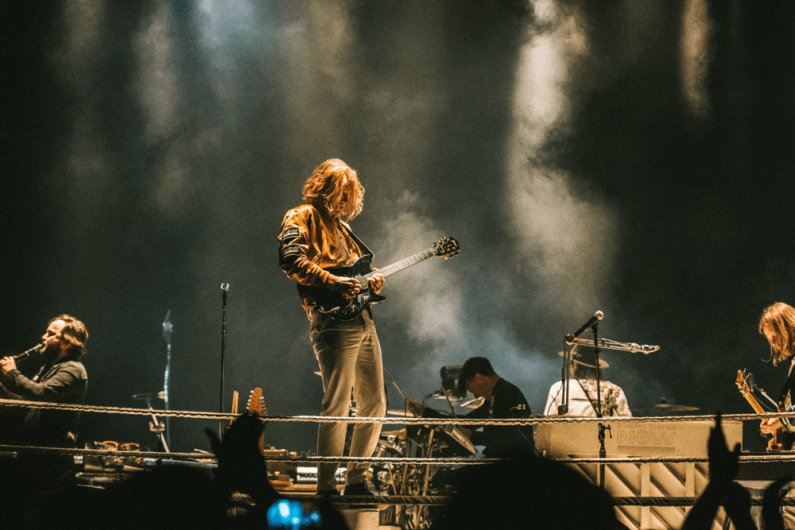
Surrounding this tour and the release of the 2017 album Everything Now is a wide-ranging conceit intended to satirise the tawdry commercial machine driving contemporary culture. Some will no doubt find irony in the fact that a band signed to Sony and selling tickets for £55 a pop are trying to position themselves as outsiders and mere onlookers, while others may sigh at the array of pretend adverts and general sense of information overload evoked before the show. The good news though is that this all done away with pretty much the moment the band step in to the venue. They do in a manner showing their ascent to their lofty status has come at no cost to their idiosyncratic and oddball charm. This tour is presented in the round, with the stage at the centre of the auditorium and resembling, at least at first, a boxing ring. The band stride in through the crowd ,big-fight style, while an announcer declares their various achievements and accolades. It’s amusing and endearing, self-mocking without being overly self-conscious. They clamber over the ropes, band member Regine Chassagne rings a bell, and there begins a set which shows why they’ve got to where they’ve got to. Proceedings start with Everything Now, which came out last year but already feels like it’s existed forever. The keyboard riff soars, but with a tinge of melancholy; it’s Arcade Fire summed up in 22 notes.
Their song’s are anthemic in the best way, big-hearted arms-aloft singalong material with wit and bite and imagination. It’s hard to imagine anything they subsequently come up with bettering it as set-opener. Indeed, one the features of the night is just how good the most recent songs sound: last year’s album, also called Everything Now, which at the time was treated with derision by many critics, which seems appallingly unfair for a record containing songs like the exquisitely shimmering Electric Blue, the driving and desperate Put Your Money on Me and the pulverising and snarling Creature Comfort, which are all among the highlights of the night.
Not that there’s any shortage of treats for fans of their earlier material. From their 2004 debut album Funeral, the pounding Rebellion (Lies) gets a suitably shouty airing two songs in, Neighborhood #1 (Tunnels) has retained all its urgent longing and Neighborhood #3 (Power Out) closes the main set in suitably cataclysmic style. The tender yet eerie title track from 2007’s Neon Bible is a smartphone-light moment, while The Suburbs, from the 2010 album of the same name, blends the jaunty with the keening. Rococo is elegantly malevolent, while Ready to Start has a nagging, jittery grandeur; all are met with wild acclaim from the crowd.
But the key track tonight, and arguably one of the most significant their career, is Sprawl II (Mountains Beyond Mountains). It’s astonishing now to consider that some regarded this as a misstep when it released on The Suburbs. Blending the infectiousness of Blondie’s Heart of Glass with a sense of euphoric defiance, it was their first properly ‘danceable’ song and led the way to the deeper, darker grooves of their 2013 album Reflektor. Tonight, Regine, sounding better than ever, belts it out in utterly thrilling fashion, waving streamers about with abandon and bringing smiles to every face. Fittingly, it’s followed by Reflektor’s title track, still an epic beast of a song. The show is brought to an end with the deafening ‘aaah-aaahh’s of Wake Up, the musicians augmented by the Preservation Hall Jazz Band, a good-time New Orleans jazz ensemble who gave a hugely likeable turn as support act. Arcade Fire make their exit through the crowd, the arena shaking with unaccompanied singing, the echo of which is probably still resounding.
Arcade Fire have come a long way as a live band. They have always been a captivating spectacle: so many musicians, doing so much all the time, yet creating this coherent, luminous sound. They have always possessed a manic energy; and despite not being a band of musos, they’re almost embarrassingly gifted, able to swap instruments seemingly at will. But since Reflektor, they have added new dimensions of colour and sound; less neurotic and earnest and more, well, fun. Win Butler has never looked more at ease as a frontman, Regine has never been more captivating a stage presence, the band have never sounded better. The show is conceived brilliantly for venues like this, too, with no one feeling removed from the action and visuals to rival those of any band.
Arcade Fire played the following:
Everything Now , Rebellion (Lies), Here Comes the Night Time, No Cars Go, Electric Blue, Put Your Money on Me, Neon Bible, Rococo, Normal Person, Neighborhood #1 (Tunnels), The Suburbs, Ready to Start (Damien Taylor Remix outro) Sprawl II (Mountains Beyond Mountains) Reflektor, Afterlife ,Creature Comfort, Neighborhood #3 (Power Out) (with ‘I Give You Power’ snippet) Encore: We Don’t Deserve Love Everything Now (Continued) (with Preservation Hall Jazz Band) Wake Up (with Preservation Hall Jazz Band) Wake Up Chorus (with Preservation Hall Jazz Band)
Juanita Stein, the Howling Bells frontwoman turned solo artist, will release a brand new single, Forgiver on 13th April. (impacts 1 June). The single was co-written and produced by Brandon Flowers while Juanita was on tour with The Killers in Northern Europe this February.
Forgiver is the first taster of Stein’s upcoming second album, Until The Lights Fade, which will be released by Nude Records on 31st August. Says Stein of the song, “I remember wanting it to feel swaggering and wise, just like she is in the song. She a knowing seductress and he an endearing fool, completely at her mercy. It’s only once we get to the chorus that she shows any kind of vulnerability.”
“I’d written the bones of the song a while ago and began working on it again on the EU leg of the Killers tour. I’d managed to get Brandon to hear the song as was, with the intention of seeing if he could maybe help take it somewhere, and he ended up not only co-writing, but also producing the track, which we were able to record backstage during those last few days on the road. I loved the spontaneity of the recording. As with the album itself, everything unfolded very instinctively.”
The follow-up to Jenny Hval’s acclaimed 2016 album Blood Bitch is The Long Sleep, an adventurous new EP that sees the Norwegian multidisciplinary artist embracing an instinctive, even subconscious, approach to creating meaning. In contrast to Hval’s more explicitly conceptual work, The Long Sleep foregrounds the act of composition itself, letting the melodies and structures reveal the other elements of the songs. All of the songs on the EP recycle the same compositional motives, but manipulate them into very different shapes that take them further and further out of their original, “life-like” context.
Hval recorded The Long Sleep with longtime collaborator Håvard Volden and producer Lasse Marhaug, along with an ace new supporting cast of talented players from the jazz world — Kyrre Laastad on percussion, Anja Lauvdal on piano, Espen Reinertsen on saxophone, and Eivind Lønning on trumpet. Hval calls them some of her favorite contemporary musicians, and their musical background helps to give the songs on The Long Sleep their intuitive, improvised feel.
In the late 1960s, the Doors, and particularly their frontman Jim Morrison, were one of the most unpredictable live acts on the planet. You simply didn’t know what they were going to do or how long they were going to do it for. Just two weeks after the Fillmore East opened, Bill Graham booked the Southern California psych rockers to play four sets of music spread across two nights. The final set on the second evening was the one to catch.
That night, the Doors played their regular collection of material but apparently enjoyed themselves so much that they came back after most of the crowd had thinned out and played again for nearly an hour. It was an incredible showing, and left a tremendous impression on one audience member in particular: future punk poetess Patti Smith. Her boyfriend, photographer Robert Mapplethorpe, was working as an usher at the venue and managed to get her a free pass to the show. It was a galvanizing experience, as she explained in her autobiography Just Kids. “I felt, watching Jim Morrison, that I could do that,” Smith wrote.
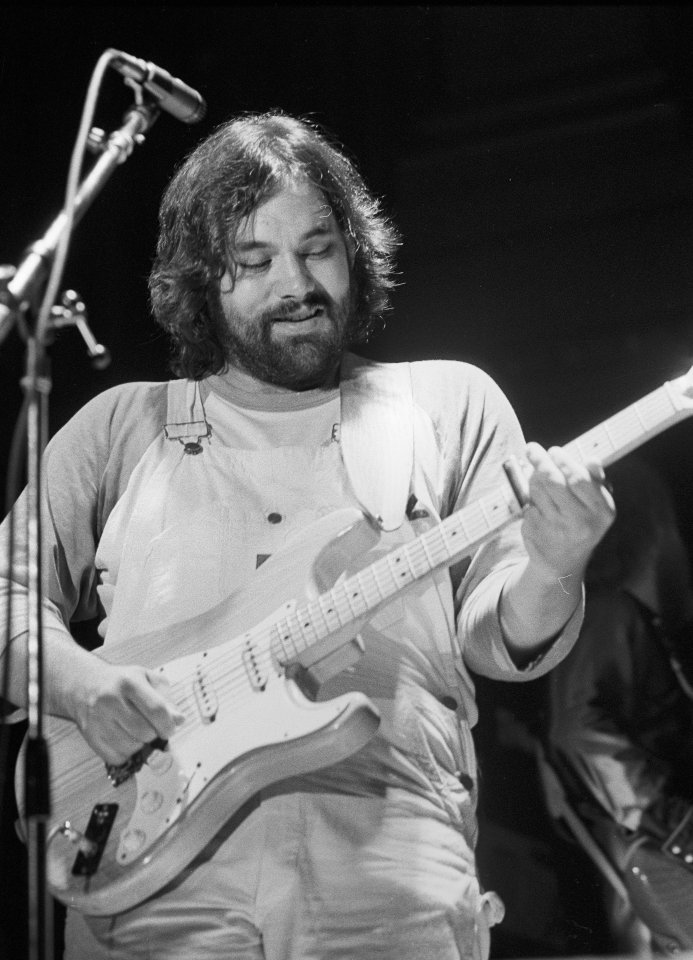
Today we are remembering the late Lowell George. The Little Feat guitarist would have turned 73 years old this year. Lowell initially funded his first band by the sale of his grandfather’s stock in 1965 and released at least one single on the Uni label, “Smile, Let Your Life Begin” (co-written by George). Members included future Little Feat drummer Richie Hayward (who replaced Dallas Taylor in September 1966), Martin Kibbee (a.k.a. Fred Martin) who would later co-write several Little Feat songs with George (including “Dixie Chicken” and “Rock & Roll Doctor”), and Warren Klein on guitar. Frank Zappa produced two tracks for the band, but they weren’t released until 1993 on the album Lightning-Rod Man, billed as Lowell George and The Factory.
The band made an appearance on the 1960s sitcom F Troop as “The Bed Bugs”. They were also featured in an episode of Gomer Pyle, U.S.M.C., “Lost, the Colonel’s Daughter” (season 3 episode 27). Although not visible in the scene inside the A Go-Go club, their music can be heard playing loudly. They received credits at the end of the episode as “‘The Factory’ Lowell-Warren-Martin-Rich, Courtesy of Universal Records”.
Following the disbanding of The Factory, George briefly joined The Standells. In November 1968, George joined Zappa’s Mothers of Invention as rhythm guitarist and nominal lead vocalist; he can be heard on both Weasels Ripped My Flesh and the first disc of You Can’t Do That on Stage Anymore, Vol. 5. During this period, he would absorb Zappa’s autocratic leadership style and avant garde-influenced conceptual/procedural-oriented compositional methods. He earned his first production credit, in conjunction with Zappa and Russ Titelman, on Permanent Damage, an album recorded by “groupie group” The GTOs. George later asserted that “he performed no real function in the band” and left the group in May 1969 under nebulous circumstances. GTOs member PamelaDes Barres has claimed that George was fired by the abstemious Zappa for smoking marijuana, while he claimed at a 1975 Little Feat concert that he was fired because he “wrote a song [“Willin'”] about dope.” On the contrary, biographer Mark Brend asserts that Zappa “liked the song” but “thought there was no place for it in the Mothers’ set”; George himself alternatively claimed that “it was decided that I should leave and form a band” by mutual agreement.
On June 15, 1979, George began a tour in support of his solo album. On June 29th, 1979, the morning after an appearance at Washington, DC’s Lisner Auditorium where the bulk of Little Feat’s seminal live album Waiting for Columbus had been recorded, George collapsed and died in his Arlington, Virginia hotel room.
Lowell George from Little Feat’s 1970’s Fender Stratocaster. This is one his last ones, apparently he got so many guitars stolen during his career that he only played on modern Strats that was easy and cheap to replace. Most of them did look the same since he favoured light wood coloured big headed Strats with maple necks. He always installed a Telecaster bridge pickup and volume knob and used an 11/16 socket wrench as a slide. Don’t ask me what’s going on with the input jack but he changed that on all his guitars too. Notice his dungarees behind the guitar.George struggled quite a lot in life and was addicted to cocaine and hamburgers but he was a helluva slide player. Little Feat, the best kept secret of the Seventies.