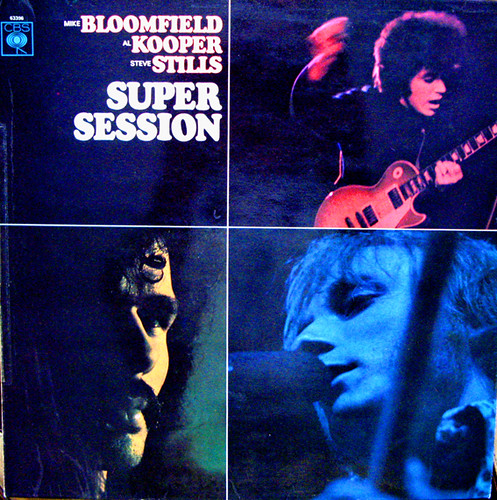
From the “Supersession,” album in 1968 comes arguably Mike Bloomfield’s finest moment in his legendary career. The jam will send a jolt to your synapses, as Bloomfield’s inspired, fluid playing from the intro is so assured and soulful, it will make a true believer of you. With Al Kooper on organ, Harvey Brooks on bass, Barry Goldberg on electric piano, and Eddie Hoh on drums, “Albert’s Shuffle, the groups homage to Albert King, does the band and the Blues legend proud. It is an enduring masterpiece. Bloomfield’s playing with the Butterfield Blues Band on their first two albums is astonishing. He was one of the greatest players of all time. Sadly I don’t believe he received the recognition he deserved and it is us of a certain age who recall his inimitable skill. “Super Session” – the musically adventurous mid-1968 collaboration between the unlikely triumvirate of multi-instrumentalist Al Kooper, Chicago-blues ace Michael Bloomfield and Buffalo Springfield guitar player Stephen Stills – is cited as a different type of milestone: the capturing of itinerant rock musicians coming together briefly for a one-off jam, in the same way as jazz musicians had previously done. It can lay claim, almost by accident, to being the impetus for a whole branch of rock’s family tree.
The project was masterminded by well-travelled multi-instrumentalist Al Kooper, and Super Session was at least partially borne out of Kooper’s frustration that no producer had been able to properly showcase the formidable talents of his friend, blues guitarist Mike Bloomfield.Kooper and Bloomfield led parallel musical lives, both eventually playing in brass-driven bands; the former in Blood, Sweat & Tears, the latter in The Electric Flag. Both had recently left these acts at the time of Super Session; Stephen Stills, who joins the story later, was in the process of leaving Buffalo Springfield. Kooper, had taken a job as an A&R man at Columbia,
“Albert’s Shuffle” written by Al Kooper and Mike Bloomfield is from the classic Columbia album, Super Session, recorded in May 1968 by guitarist Michael Bloomfield, multi-instrumentalist Al Kooper, keyboardist Barry Goldberg, and bassist Harvey Brooks. This version is from the Sony CD reissue and features the original track before the horns were added on the final mix.
“Super Session” (1968) was conceived by Al Kooper and features the work of guitarists Mike Bloomfield and Stephen Stills(originally printed on the sleeve as Steve Stills). Kooper and Bloomfield had previously worked together on the sessions for the ground-breaking classic Highway 61 Revisited by Bob Dylan. The success of this record opened the door for the “supergroup” concept of the late 1960s and 1970s.
Kooper recalled in his book Backstage Passes And Backstabbing Bastards: “[Bloomfield] commenced to play some of the most incredible guitar I’d ever heard… And he was just warming up! I was in over my head. I embarrassedly unplugged, packed up, went into the control room, and sat there pretending to be a reporter from Sing Out! magazine.” Kooper still seized his chance to be part of the recording, by playing the Hammond – the first time in his life he’d ever sat behind the instrument. The pair were in also in Dylan’s band for his electrified 1965 Newport Folk Festival set.
The album’s title – thought up after it was recorded – is almost a misnomer, since its two star guitarists didn’t actually play together during it. Instead, Side One is the result of a nine-hour Kooper-Bloomfield session; Side Two features Kooper-Stills, with both sessions backed by Electric Flag members Barry Goldberg on keys and Harvey Brooks on bass, plus consummately talented session drummer ‘Fast’ Eddie Hoh – horns and Kooper’s extra guitar parts were overdubbed later.


 Genesis has spent over three years collecting an extensive text of more than 96,000 words from 48 contributors. It is a story told entirely by its key protagonists – the musicians, artists, label executives, friends and hangers-on – a text rich in personal anecdotes and observations, fascinating and frank first-hand accounts of the stories behind the photographs, the music, the times, the beliefs, hopes, disappointments and dreams of a generation. Above all it describes how some profound qualities of time and place nurtured a musical movement with an identifiable sound. ‘James Taylor was one of the first signings to the Apple label with Derek Taylor – I’m a huge fan.’ Gerry Beckley ‘I didn’t like Jimi setting his guitar on fire, or smashing his instruments, I was late in appreciating what he was doing.’ Michelle Phillips ‘Mama Cass had become friendly with Eric, who didn’t really know anyone in town. Being the earth-mother type she was, she said, ‘Well come over, and I’ll invite some friends round’.’ Henry Diltz ‘I think California had a huge influence on the pop music scene, all the surfing, girls and cars were so idyllic – the Beach Boys weren’t writing about some fantasy – this was real.’ Dewey Bunnell The California Dreaming story begins in 1966 as Henry Diltz discovers the wonders of the photographic image and begins a life-long love affair with his camera. As a folk musician living in Laurel Canyon and a friend to the musician elite, Henry was party to the burgeoning LA music scene and was able to capture the magic of a brief and bright moment in the history of rock music. ‘Henry Diltz always seemed to be in the right place at the right time.’ Robby Kreiger He had unprecedented access to every one of his subjects, and his photographs, which include seminal album covers such as The Doors’ Morrison Hotel and Crosby, Stills and Nash’s eponymous debut, have come to define the era.