Archive for the ‘CLASSIC ALBUMS’ Category

darksideofthemoon

On this day March. 10th  in 1973: Pink Floyd released their 8th studio album, ‘The Dark Side Of The Moon’, on Harvest Records; it would remain on the American charts for 741 non-continuous weeks between 1973-88, longer than any other album in history; after moving to the Billboard Top Pop Catalog Chart, the album notched up a further 759 weeks, reaching a total of over 1,500 weeks on the combined charts by May 2006; with an estimated 45 million copies sold, it is the group’s most commercially successful album & one of the best-selling albums worldwide… Originally released in 1973, The Dark Side of The Moon became Pink Floyd’s first number one album in the US, The Dark Side of The Moon also introduced the iconic album cover artwork by Hipgnosis, after a request for a ‘simple and bold’ design. The new Discovery version presents the original studio album, digitally remastered by James Guthrie and reissued with newly designed Digipak and a new 12 page booklet designed by Storm Thorgerson. The band members spent three minutes deciding on the front cover. Designer Storm Thorgerson brought seven designs into the Abbey Road studio where they were still recording. “The band trooped in, swept their gaze across the designs, looked at each other, nodded, and said ‘That one,’ pointing at the prism. Took all of three minutes,” Thorgerson recalled in liner notes for the 2011 deluxe box. In an 2003 interview, the designer elaborated, “No amount of cajoling would get them to consider any other contender, nor endure further explanation of the prism, or how exactly it might look. ‘That’s it,’ they said in unison, ‘we’ve got to get back to real work,’ and returned forthwith to the studio upstairs.” 

“Money” was influenced by… Booker T and the MGs? Though the basis of the song is a blues progression written by Waters, Gilmour has said he brought an R&B influence to the song’s instrumental breaks. “I was a big Booker T fan,” said Gilmour. “I had the Green Onions album when I was a teenager. And in my previous band… we played ‘Green Onions’ onstage… It was something I thought we could incorporate into our sound without anyone spotting where the influence had come from. And to me, it worked. The opening “song,” “Speak to Me,” is credited solely to drummer Nick Mason, something Waters has insisted was an act of charity.

“Us and Them” was originally written and submitted three years earlier for the soundtrack of the film Zabriskie Point. Antonioni’s loss was Dark Side’s gain. “We wanted to put it on Zabriskie Point, on the sequence where they’re having the riots and the police beating heads on UCLA campus; the counterpoint between that slow, rather beautiful music and this violence going on was great,” said Gilmour.

“Breathe” emerged from a song of the same name that Waters wrote for the soundtrack of a documentary called The Body, also three years earlier.

https://www.youtube.com/watch?v=jL5SEBdG5RQ&t=24

Torry’s main direction: sing for several minutes, and don’t sing any words. Waters recalled, “Clare came into the studio one day, and we said, ‘There’s no lyrics. It’s about dying—have a bit of a sing on that, girl.’ I think she only did one take. And we all said, ‘Wow, that’s that done. Here’s your 60 quid.’” (By Torry’s recollection, it was two and a half takes, and 30 quid.) It was engineer Alan Parsons’ idea to bring Torry in for the “Gig” vocal. Parsons claims he heard her singing a cover of “Light My Fire”—although she disputes that, claiming she never sang the Doors’ song in her life. At the time she got the call, the only Pink Floyd song she knew was “See Emily Play,” “and that didn’t really hit the spot with me,” she said. “They weren’t my favorite band. If it had been the Kinks, I’d have been over the moon.”

In 2005, the classic lineup reunited for one mini-set at Live 8. This one-time gig included three songs from “Dark Side (“Speak to Me,” “Breathe,” and “Money”) as well as two later choices (“Comfortably Numb,” “Wish You Were Here”). Shall we say this was a landmark album?

It is one of the best-selling albums of all time. The album has had numerous full-length cover versions. Phish and Dream Theater are among the bands who’ve covered the album in its entirety in concert, and the Flaming Lips released a studio version of their take on the album. There have been bluegrass, a cappella, and string-quartet album versions, not to mention the notorious, reggae-died Dub Side of the Moon.

http://

May be an image of 1 person

On this day (March 6th) in 1978: Elvis Costello closed out his second North American tour with two nights at the El Mocambo in Toronto, Canada. All the stops were pulled as The Attractions tore through a set of old Costello favorites & new material from the forthcoming album ‘This Year’s Model’. The concert was also broadcast by Toronto’s CHUM-FM. The concert was released only as a Canadian promotional album in the same year, but was heavily bootlegged.

Because it came first, that angry-young-man intensity is often taken as his default setting, but perhaps Costello’s punk-era sound was just another stopover on his odyssey through 20th century popular music. That breadth of interest and influence is apparent in even his earliest material: in its emphatic melodicism, in its clever arrangements, in his osmotic absorption of contemporary styles, even if they were raw (ska, pub rock) rather than refined (jazz, Bacharach). He may have been young, he may have been righteously pissed, but he sounds worldly on those early albums, and especially on “Live at the El Mocambo”.

It was first legally made available in 1993 (as “Live at El Mocambo”), either as one disc of Rykodisc’s ‘2½ Years’ box set, or to purchasers of the first three CDs, in exchange for tokens included in the CD packaging, directly from Rykodisc. The concert was issued as a mainstream release on September 29, 2009 by Hip-O Records, with the same content of the 1978 promotional album.

Recorded in Toronto on Costello’s 1978 tour for “My Aim Is True”, the album was originally released as a promotional item, survived the 1980s as a bootleg, and finally got a commercial release as part of the 1993 box set 2½ Years. It’s now a standalone reissue as the first installment in his new series of live reissues. This version reinstates much of the stage banter that was cut from the ’93 version, including Costello’s boast that he and the Attractions have come to reclaim Canada for the Crown. For an artist with so many disparate releases under his belt, Costello doesn’t have a whole lot of live albums, which makes “El Mocambo” particularly revealing, even if it does cover only a limited set of songs.

Costello here is a fierce, funny, and intelligent performer, which is certainly no surprise. Nor is the energy with which he and the band pound out raucous versions of “Welcome to the Working Week” and “Lipstick Vogue”. Headlong on the studio albums, these songs are ferocious live, and it helps that they have a rowdy crowd in front of them, who whoop, holler, and call out requests for “Allison” (which he doesn’t play). One guy yahoos so much he should get a performance credit. It’s an electric atmosphere, and the setting brings out the swaggering pre- and early-rock sounds in these songs, suggesting that, even as a young artist, Costello was already fully engaged with the past. Opener “Mystery Dance” sounds like it was built on the same two-note guitar theme as that other Elvis’ “Jailhouse Rock”, and, on the intro to “I Don’t Want to Go to Chelsea”, each instrument seems to be playing in a different style: Bruce Thomas’ strutting ska bassline throwing punches at Steve Nieve’s New Wave-ish keyboard dodging Costello’s swooping guitar.

These are tricky, slippery songs. “Waiting for the End of the World” changes shape almost constantly, as Nieve’s keyboard trades off leads with Costello then ducks back into the rhythm section. And just when the setlist reaches a fevered peak, they break into “Little Triggers”, giving Costello a surprising amount of room to croon and offsetting the reckless rush of “Lip Service” and “Radio, Radio”. They obliterate the reggae rhythms of “Watching the Detectives” but play up the noir mood before launching into a start-stop bridge. And after Costello taunts the audience (“He doesn’t think I mean it!”), the Attractions and guitarist Martin Belmont hammer away at the central riff of “Pump It Up” violently, growing more frenzied and frantic with each repetition until the whole show falls apart, ending with a full minute of steady clapping and calls for another encore.

Track listing (all songs written by Elvis Costello):
“Mystery Dance” – 2:19
“Waiting for the End of the World” – 3:52
“Welcome to the Working Week” – 1:19
“Less Than Zero” – 4:08
“The Beat” – 3:33
“Lip Service” – 2:26
“(I Don’t Want to Go to) Chelsea” – 3:56
“Little Triggers” – 2:47
“Radio Radio” – 2:33
“Lipstick Vogue” – 4:46
“Watching the Detectives” – 5:48
“Miracle Man/Band Introduction” – 4:07
“You Belong to Me” – 2:32
“Pump It Up” – 4:42

Pete Townshend Solo Goes Digital

Pete Townshend’s solo work is almost as prodigious as his work with The Who, The 11  album releases cover “Who Came First”, his 1972 album and his first away from The Who. The album is a collection of music dedicated to Meher Baba, Townshend’s spiritual master and includes fellow Baba followers, including Ronnie Lane and Billy Nicholls.

Townshend’s first proper solo album (following two tribute albums to his spiritual adviser Meher Baba) features demos he recorded for the Who’s ‘Lifehouse’ project, which turned into 1971’s ‘Who’s Next.’ Songs from the earlier solo records — which were collaboration LPs with limited distribution — are also included. Before the various ‘Scoop’ albums and the expanded versions of Who LPs that include early sketches of songs, ‘Who Came First’ was the closest peek inside Townshend’s songwriting process.

In “Rough Mix”, he teamed up with Ronnie Lane on what is a fine record that features Eric Clapton, John Entwistle and Charlie Watts that includes material written by Townshend and Lane. Among the standout tracks is the beautiful, ‘Heart To Hang Onto.’ Co-credited to Ronnie Lane, the Small Faces bassist who earlier had worked with Townshend on the 1970 Meher Baba tribute LP ‘Happy Birthday,’ ‘Rough Mix’ started as a Lane solo album that was supposed to be produced by Townshend. They eventually found themselves in a full collaborative project that also includes help from friends . The result is more of a folk-rock record by the two vets used to more aggressive forms of rock ‘n’ roll. A curious but enjoyable detour.

Empty Glass included ‘Let My Love Open The Door’ as well as ‘Rough Boys’, ‘Empty Glass’ and ‘A Little Is Enough’. Townshend was going through a lot when ‘Empty Glass’ was released in 1980: the death of Who bandmate Keith Moon, a fractured marriage, a drinking problem and the fact that punk was making groups like the Who obsolete. He pours it all out on his best solo album, the first to include all new material written specifically for a project. He confronts all of his demons here; he came out with scars and a Top 10 single with “Let My Love Open the Door.” His best work since the Who’s 1973 LP ‘Quadrophenia’ and his most personal ever.

1982’s All The Best Cowboys Have Chinese Eyes includes ‘Face Dances pt 2’ and ‘Uniforms (Corps D’Espirit)’ and a companion promotional video featuring seven of the tracks was made for the fledgling MTV Network. Between 1980’s ‘Empty Glass’ solo outing and this LP, the Who released ‘Face Dances’ and were wrapping up work on one final album (before a reunion LP nearly a quarter century later) and then mounted a farewell tour (that turned out not to be). So Townshend, working as a solo artist with few band commitments to weigh him down, made a record that indulged in his winding wordplay and his sometimes impenetrable cultural theories and criticisms. It’s every bit as heavy-handed as you would expect from a guy whose rock ‘n’ roll dissections often went over the heads of the average Who fan.

Townshend solo
For White City, Pete returned to the concept based song cycle that had utilised in The Who. The album tells the story of life on a working class council estate in Pete Townshend’s old West London stomping ground. The songs deal with lost love, racial tension and broken dreams.  this one based on a real-life London district from his childhood. He doesn’t paint a pleasant picture: brewing race wars and crushed dreams are commonplace. David Gilmour adds some bite with his guitar, but ‘White City’ doesn’t have a whole lot to say, and sorta just spins in place once it gets moving. Like many Townshend solo LPs, the music seems like an afterthought to the narrative.

The Iron Man is Pete’s version of the Ted Hughes story of the same name. Townshend’s Who bandmates Roger Daltrey and John Entwistle join him on two songs from this musical adaptation of Ted Hughes’ 1968 sci-fi novel. Released in 1989 Pete had met Hughes when he was working at the publishing house Faber and Faber. The album features contributions from music luminaries Nina Simone and John Lee Hooker (who performs as the eponymous ‘Iron Man’).

1993’s Psychoderelict is a multi-layered concept album featuring dialogue harking back to his ‘Lifehouse’ project. It’s another concept album by Townshend, ‘Psychoderelict’ centers on a washed-up rock star who returns to the spotlight after a press-grabbing controversy is cynically hatched. Like ‘Empty Glass,’ the album digs deep into Townshend’s personal life, but the story is kind of a mess — which led to a new version of the album to be released without the interlocking dialogue pieces. Characters here would resurface on the Who’s 2006 album ‘Endless Wire.’The resulting tour featured actors performing alongside the live band.

The critically acclaimed “Scoop” series of albums gives the listener a privileged peek behind the scenes of one of popular music’s greatest songwriters. The albums showcase Pete’s demos for both The Who and his solo recordings. Scoop, was released in 1983 and includes versions of Who classics such as ‘So Sad About Us’, ‘Squeeze Box’, ‘Circles’, ‘Behind Blue Eyes’ and ‘Love Reign O’er Me’. Another Scoop followed in 1987 and includes demos of ‘Pinball Wizard’, ‘Substitute’, ‘You Better You Bet’ and ‘Pictures of Lily’. Scoop 3’ surfaced in 2001 and included Pete Townshend’s initial versions of the classics ‘The Real Me’, ‘ Sea and Sand’ and ‘Eminence Front’.

In February 1985 Pete performed two charity shows at London’s Brixton Academy. The sold out shows benefitted the ‘Double O’ charity, which was formed by The Who in the 1970s. The band, performing under the banner ‘Deep End’, featured Pink Floyd guitarist David Gilmour. They performed ‘I Put A Spell On You’ and ‘Barefooting’ as well as more contemporary songs like The Beat’s ‘Save It For Later’ as well as classics such as ‘Pinball Wizard’ and ‘Behind Blue Eyes’ also make an appearance on the album, Deep End Live.

steveearle

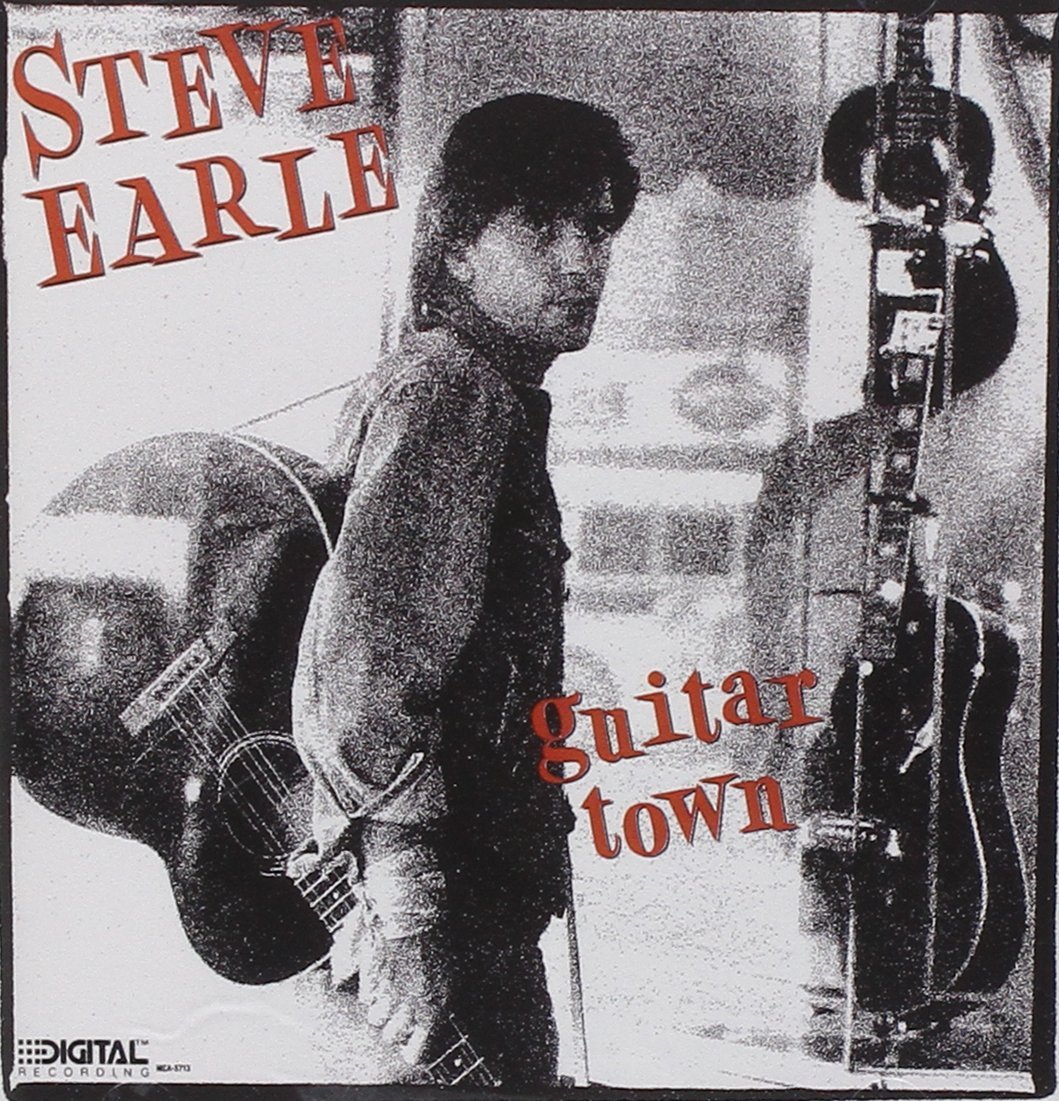
What I appreciate about Steve Earle is that he writes about a side of humanity that I don’t live. He writes about irresponsibility, about separation by choice, about the rambles of a man who searches but never seems to find. Steve Earle’s tribulations are well known and rather unimportant to mention . With his many great albums behind him, it is important to remember Guitar Town, a terrific piece filled with a variety of styles and the kernal of all the things Earle still seems to represent.

Steve Earle seems to be always questioning why. and with Guitar Town, the questioning has never been more succinctly stated or as catchily written. Inspired by Earle’s attendence at a Bruce Springsteen concert, this singer/songwriter masterpiece lovingly exploits the conflict between the hero’s desire to stay in a small town and the need to leave. Set in 1980’s Reagan-era America and featuring Duane Eddy-style reverberated guitar lines blazing through dangerously infectious melodies, Guitar Town’s dusty, blue-collar vignettes relentlessly engage and tug at the heart strings, and Earle’s stark character development revives desperate (“Someday”) and exhuberantly hopeful (“Guitar Town”) emotions from the listener’s childhood. This ‘Dylanesque-country’ sound inadvertantly awakened a young, rock-loving, college-educated country audience yearning for the disappearing rock sounds of John Mellencamp and Bruce Springsteen. Earle set the mark on the top rung for this type of new country, and with the public expecting only the best, Nashville delivered its finest and most daring projects of the post-Hank Williams era. Easily the most groundbreaking Nashville recording since Waylon Jennings’ “Honky Tonk Heroes” sessions, Guitar Town was named one of Rolling Stone’s Top 100 Recordings of the 80’s and was praised in the rock press (Robert Cristgau’s “The Village Voice” and Dave Marsh’s “Rock and Roll Confidential”) long before receiving favorable country reviews. Guitar Town continues to exert a massive influence on songwriters 16 years after its release and is widely regarded as a cornerstone of the 1980’s “New Traditionalist” movement in Nashville. Steve Earle may never understand the full impact this recording will continue to have on future generations of songwriters. As his music continues to move towards exclusively political themes, it becomes clear he will not visit Americana territory again, but since he virtually defined the genre with this monolithic MCA debut, he can leave well enough (or, in this case, near perfect) alone.


arielpinkpompom

“Pom Pom” isn’t like anything you’ve heard before, but I suppose you could say that about most Ariel Pink releases to date . The singer/songwriter has navigated away from a lovably lo-fi approach – built on vintage synths and percussive beat  into one more representative of a full band with his “Haunted Graffiti” group. While “Before Today” and “Mature Themes” were still great records, I couldn’t help but feel that some tracks were a bit too polished , at least in the sense that shimmering production made Ariel Pink stifle his wonderful audible personality more so than earlier releases. With “Pom Pom”, his first release under just the Ariel Pink name, he goes full Zappa and Todd Rundgren with the double-album approach, resulting in an enjoyably indulgent release that has its share of immediate pop genius alongside large doses of experimental personality, the latter most apparent in the album’s mid-section. The beginnings are quite accessible, though. “Plastic Raincoats” touts an organ-y psych-pop feel reminiscent of The Kinks, while “White Freckles” is a concisely combustible piece of driven power-pop that takes full advantage of Ariel’s various vocal characters. “Four Shadows” is a goth-rock/post-punk homage that utilizes the darkly orchestral Zappa production Ariel Pink is so fond of throughout the album. One of the year’s best tracks, “Not Enough Violence” explores this post-punk territory in even more depth, being a build-up of epic proportions that serves as one of 2014’s greatest tracks. While the album’s middle can sound intimidating and somewhat overbearing, later efforts like the irresistibly infectious “Black Ballerina” and harmonizing-friendly pop gem “Dayzed Inn Daydreams” which is a wonderful title, close this mad genius of an album in stellar form. Pom Pom is the year’s most fascinating listening experience.

http://

His full-length debut, ” All Kinds Of You”, came out less than a year ago, 25-year-old Ryley Walker is already returning with a follow up release titled  “Primrose Green” in April . Ryley Walker has been getting his fair share of positive attention, often focusing on his guitar playing and the unique and unpredictable forms his vocal melodies and song structures take. Despite being raised in the industrial Northern Illinois town of Rockford and cutting his teeth in Chicago’s noise-rock scene, the other constant with Walker is that people always want to compare him to ’60s and ’70s folk musicians like Nick Drake, Bert Jansch, John Martyn, and Tim Buckley. (more…)

horsethief

Considering it was a debut album there were shockingly high expectations for “Fear In Bliss“. Following the earlier superb EP, “Grow Deep Grow Wild”, and a jaw dropping support slot with Midlake at Shepherds Bush Empire, we anticipated something good, maybe even something great, , but it exceeded beyond even our wildest expectation the release was frankly remarkable.

The Oklahoma based five-piece created an album deeply routed in the traditions of American alternative music, both old and new, it simultaneously recalled the true greats, artists like Bob Dylan and Bruce Springsteen and the more modern classic, with shades of Fleet Foxes, Beach House and Grizzly Bear. The album managed to balance experimentation, the almost acapella “Already Dead”, the buzzing synths and low-key vocal of closing track “Warm Regards”, So with songs that fitted perfectly with their previous output, the likes of “Human Geographer” and stand-out track “Dead Drum” wouldn’t sound out of place on their previous recordings, but they sounded more refined, better recorded and just stronger examples of song-writing.

If musically it was a varied collection, it was all pinned together by both the voice and lyrics of front-man Cameron Neal. His voice is not a classically trained beauty, but it’s powerful, and carries an emotional weight like almost no other. Lyrically he delves into issues many songwriters wont touch, there were flirtations with religion, mortality and growing up with unshared doubts about the reality of all you are told.

http://


We are a Mexican NetZine that work with several indie bands from all over the world! Available now through Bandcamp. featuring Oživit Music compilation (free download), along with Sounds of Sputnik,@ Lights That Change, The Virgance, Adryelle,Soy Chiosan, Union Attempt, Lykanthea, Axons, Hante., Demure For Sure, Hexagrams, Savage Sister & Two Souls. ‪#‎dreampop‬ ‪#‎shoegaze‬‪#‎synthpop‬

http://

Dick Diver is the moniker of a carefree dream-rock quartet from Australia. But it turns out Dick Diver is a character from F. Scott Fitzgerald’s “Tender Is The Night”, a literary reference about a doomed psychoanalyst that makes far more sense — and feels much more meaningful .  Their third album Melbourne, Florida , is a wonderful listen , the surprises kept coming, like when the end of “Year In Pictures” breaks out into a lush saxophone solo, or on the next track, “Leftovers,” when the band’s only female member — drummer Stephanie Hughes — takes over lead vocal duty. For most tracks Hughes joins guitarist Rupert Edwards on vocals, and their musical chemistry is one of the most enjoyable parts of the record. It’s part of what helps them rise above clever, jangling pop and into more experimental and psychedelic territory without it ever feeling forced. Edwards sounds like he’s channeling Lou Reed sometimes, like on “% Points” when he clips his phrasing to flit around guitar parts and slides up and down to notes like Reed would. Though this is the group’s third album, none of them have been released in the US until now, but Melbourne, Florida is a great entry point regardless. Melbourne, Florida will be out 10th March via Trouble In Mind/Chapter Music.


bob seger

Bob Seger and The Silver Bullet Band released their classic album “Against The Wind” on Feb 25, 1980. It is Bob Seger’s only number-one album, spending six weeks at the top of the American chart. To get to be the #1 album on the chart, they knocked Pink Floyd‘s “The Wall” from the top spot. The album also earned two Grammy Awards. Seger got a little help from some friends of his for the vocals on the record, the Eagles members Glenn Frey, Don Henley and Timothy B. Schmit. all added vocals.

“Against the Wind” is a song by Bob Seger & The Silver Bullet Band from the 1980 album “Against the Wind” is the highest ranking single from the album,  Glenn Frey of the Eagles sang background vocals on this song. The song is about trying to move ahead, keeping your sanity and integrity at the same time

During an interview on  Bob Seger said that “Against the Wind” came about from his days as a high-school cross country runner. The line “Let the cowboys ride!” towards the song’s end is a reference to the closing lyrics of the song “Santa Fe/Beautiful Obsession” by Van Morrison.

Seger later said that the line “Wish I didn’t know now what I didn’t know then” bothered him for a while, but that everyone he knew loved it, so he left it in. He also said that it has since appeared in several other hits by other artists, so that proved it was o.k