The day Say Sue Me make a bad record is the day I’ll stop singing their praises, but that day is not today because the indie pop darlings from Busan, South Korea recently dropped it’s just a short walk!, their second fantastic release of 2018. A Record Store Day EP from Damnably, its just a short walk! is made up of four playful covers that showcase the band’s versatility and deep knowledge of guitar rock. Blondie’s “Dreaming” is stretched out into a languid, nearly psychedelic shoegaze droner augmented by vocalist Sumi Choi’s light, airy vocals. “Do You Wanna Dance?” is the sweet, slow dance flipside to the band’s own surfy “I Just Wanna Dance,” from their Where We Were Together LP. “Rockaway Beach” is the sparkling indie pop Ramones cover the world has been waiting for, and, well you really need to hear their Velvet Underground cover. Say Sue Me’s greatest strength is not just their ability to make any song their own, but to make it sound effortlessly fun at the same time.
‘It’s Just A Short Walk!’ is a limited edition EP of cover songs performed Say Sue Me on a special one-sided transparent 12” vinyl, and released by Damnably Records for RSD 2018.
1. Dreaming (Blondie)
2. Do You Wanna Dance (Bobby Freeman)
3. Beginning To See The Light (The Velvet Underground)
4. Rockaway Beach (The Ramones)
The first two albums from Dream Syndicate frontman Steve Wynn get the deluxe Omnivore Records treatment! 1990’s Kerosene Man is bolstered by six rare live recordings from a promo EP, while 1992’s Dazzling Display (featuring guest shots by R.E.M.’s Peter Buck, The Bangles’ Vicki Peterson, and Flo and Eddie) gains six bonus tracks including covers of Paul Simon and Sonic Youth! Both titles have been remastered and are released with the participation of Steve Wynn!
The Debut solo album from founding member of The Dream Syndicate, remastered and expanded with 6 live bonus tracks from a rare promotional EP.
Sure, I was nervous. I had spent most of my adult life making music with The Dream Syndicate—a very good, successful band, with musicians I still considered very good friends. Bands break up because the members hate each other, or because nobody cares, or because someone in the band joins The Rolling Stones, or something. That wasn’t the case with us. I just wanted to try something different. I wanted to play different kinds of music, make new sounds, play with new people. I wasn’t running away from anything. I was just running towards something new. —Steve Wynn (from his liner notes)
After nearly a decade fronting The Dream Syndicate, Steve Wynn struck out on his own with a debut solo album. With Wynn originals and help from friends including Johnette Napolitano (Concrete Blonde), D.J. Bonebrake (X), Steve Berlin (Los Lobos), and even Mark Walton from The Dream Syndicate, 1990’s Kerosene Man showed a new side to Steve, while retaining everything that attracted music lovers to him in the first place. “Tears Won’t Help” became a radio staple, and “Carolyn” found its way to MTV.
Kerosene Man returns nearly two decades later, remastered and expanded. The 11 tracks from the original release are now joined by six live recordings from the rare, promo only vinyl Straight To The Swapmeet: Legendary Authorized Bootleg. His second solo album, Dazzling Display, has also been remastered and expanded with 6 bonus tracks. That album was another star-studded affair.
Second solo album from founding member of The Dream Syndicate, remastered and expanded with 6 bonus tracks.
I’ve had the chance to revisit Dazzling Display in the course of writing these liner notes and putting together this reissue and, as is often the case, time has brought its merits into focus. Here’s the bottom line. It’s a really fun record. It was made with a fan’s enthusiasm as a reflection of the things that made me happy and got me excited in 1991. It may not have been the right record for its time and it may not have been the right record for this particular recording artist. But it sure feels good to listen to it now.
And in 2018, that’s what matters most of all. Enjoy. It truly is a dazzling display. —Steve Wynn (from his liner notes)
Oooh-ooh that smell, can’t you smell that smell? The smell of Wand surrounds you! Yes – “Perfume” is on the wind, and time is inching closer and closer to the much-anticipated May 25th EP drop, but how about another snoot-ful to carry you through until then? A bit of “Pure Romance” perhaps, with chimes of guitars, crisp and fresh melodies and a core-shattering thump that takes hold with an iron grip, drawing you tight into a dangerous liaison of pop and rock, as both long for one another powerfully. Wand paints electrifying hues, beaming shocks of light that flagrantly provoke the dark with a bright balayage of sound and vision for your ears. YES! “Perfume” is coming soon, so take in the creamy, spiky aroma of “Pure Romance”.
If you’ve been fanging for some Middle Kids action then crave no more because the band have gone and unleashed a ripper live video for their tune “Mistake”.
Filmed at Sydney’s Golden Retriever Studio, the video shows the trio in their element with lead singer Hannah Joy tearing the track apart as emotion floods her face.
Mistake is the first taste fans have copped from the group’s highly anticipated debut albumLost Friends, which is due to drop on 4th May. The band are currently in the UK, smashing out some London gigs, but will return for a huge Australian tour that kicks off in May and culminates in a massive show at Sydney’s VIVID LIVE festival.
Dawes are excited to announce their sixth studio album “Passwords” will be released on June 22nd via HUB Records.
Hi folks. Taylor here.
As you’re probably aware, it’s a wild time to be alive. There are a lot of thoughts and feelings we feel less inclined to share than we ever have before. At least in my lifetime. A lot of controversial conversations that feel like they only serve as something for the next person to crumple up and toss aside.
So it’s with all that in mind that we are proud to announce our new album ‘Passwords.’ In this rapidly approaching age of transparency, passwords can feel like this last vestige of a wall between a world we can see and one we can’t. Having a password allows you gain access to some information or perspective that you didn’t have before. In that sense, I like the idea of looking at a song as a password – an opportunity for some sort of insight that had previously been unavailable to you. And that goes for the singer as much as the potential listener, I promise. 🙂 These songs are about everything to the extent that any Dawes record has been…but in this case there is more of an objective…at least for us – to think a little harder about not just how but WHY we (not just ‘you’ or ‘I’ but ‘we’) feel the ways that we do. What small steps can be taken to revisit these old ideas of empathy? How can we develop a form of communication that goes beyond making sure you’ve said your piece and accurately aims at being heard?
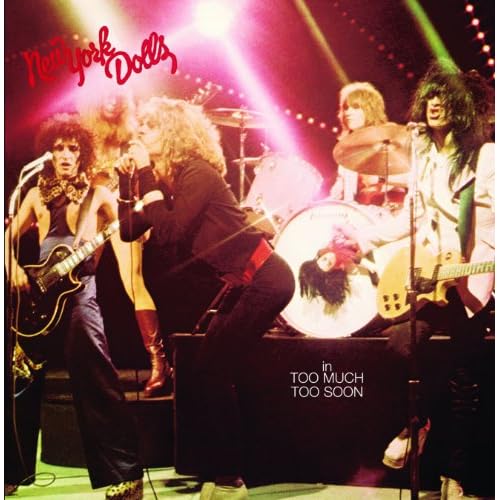
The New York Dolls – were David Johansen, Johnny Thunders, Sylvain Sylvain, Billy Murcia, and Arthur Kane Jr. A band that kept the erection but deflated the egos. The Dolls “single handedly lowered the standards of an entire industry.” They came on like a prima ballerina on a spring afternoon wearing a rag-tag concoction of Thrift Store and Salvation Army toss offs. the band’s first two albums New York Dolls (1973) and Too Much Too Soon (1974) became among the most popular cult records in rock.
From fashion sense alone, the New York Dolls set a unique tone, inspiring glam rock and hair metal artists alike. On stage, they donned an androgynous wardrobe, wearing high heels, eccentric hats, and satin. However, their influence doesn’t just end at their choice of women’s attire and big-screen drama. Their sharp-tongued alienation and jigsaw guitars get at the wild energy and “anything goes” intensity of kids escaping their family lives and finding freedom in the big city. That could mean pushing deeper into hard rock or embracing pop, as long as it was done with the smirking power of David Johansen. The opener to the Dolls’ self-titled debut has been covered by everyone from Sonic Youth to Scott Weiland, Teenage Fanclub to Todd Rundgren, showing their ability to appeal to anyone, even though they refused to play by anyone’s rules.
The band had a glammed up look and pared down sound. They were funny. They were rude. They covered classic rock and roll hits like “Stranded in the Jungle” by The Cadets under a red communist flag.
The New York Dolls won Best New Band and Worst New Band in Creem Magazine’s Readers Poll in 1973. Music aficionados complained that the New York Dolls couldn’t play. So what? Whoever said Bob Dylan could sing? Robert Christgau called them “the best hard-rock band since the Rolling Stones.”
The New York Dolls predated punk and glam metal. They influenced rock groups like the Sex Pistols, The Damned, Kiss, the Ramones, Guns N’ Roses, W.A.S.P (whose leader, Blackie Lawless, replaced guitarist Johnny Thunders after he left the group in 1975, playing guitar in the last New York Dolls performances, and also played guitar and sang in bassist Arthur “Killer” Kane’s only EP, Mr. Cool, When the Dolls started, Patti Smith did poetry readings before their shows. Richard Hell and Tom Verlaine caught the Dolls right before they formed the Neon Boys, which became Television.
The New York Dolls can be traced to the 1967 band The Pox, which included Sylvain Sylvain and Billy Murcia, who were friends since a schoolyard fight at Van Wyck Junior High in Jamaica, Queens. Sylvain crossed the Suez Canal from Cairo to be a New York Doll and the first words of English he learned were “fuck you.” Murcia came from Bogota, Colombia, not Jersey, and the two were finally able to finish sentences, according to the book Too Much Too Soon: The New York Dolls. They met Johnny Genzale at New Town High. The Italian bassist was thunder on a basketball court or a baseball diamond, but wound up being just a Jaywalker. Arthur Kane came down from the Bronx with a thick Irish accent.
The Pox were recorded by Harry Lookofsky, the same guy who produced “Walk Away Rene.” When the Pox broke up, the two friends got into fashion, opening Truth and Soul. Sylvain also worked at men’s boutique, A Different Drummer that was across the street a doll repair shop called the New York Doll Hospital. Sylvain said that the shop inspired the name for their future band. They also sold “keef,” which was really good hash. By the early seventies they were playing with Rick Rivets. Thunder rechristened himself after the hero of DC Comics’ All-Star Westernafter he turned down the Volume. Thunders played lead guitar and sang for the band, called Actress during practice but named Dawn of the Dolls on an October 1971 rehearsal tape release.
David Johansen was living on East 6th Street when he got the call because he looked like a cross between Mick Jagger and French actress Simone Signoret. Thunders decided that he no longer wanted to be the front man, David Johansen joined the band. Johansen had started singing in the late 1960s in the local Staten Island band the Vagabond Missionaries before hitting Café Wha with Fast Freddie and The Electric Japs. He was a stud on Main Street and maybe some other porn movies. David Jo looked 16 and bored shitless. Rick Rivets was replaced by Sylvain Sylvain and the bottom was held together by bass guitarist Arthur “Killer” Kane and drummer Billy Murcia.
The Bowery butterflies wore Spandex and platform boots at their debut first performance at homeless shelter The Endicott Hotel on Christmas Eve 1971. They caught the eye of Andy Warhol who helped them get a gig on Broadway, lower Broadway. Ex-Paramount Records exec Marty Thau saw a sign outside the Mercer Center advertising: “NEW YORK DOLLS: 2 SETS $3.” For six bucks he and his wife caught “five guys dressed as women in horrible makeup and jewelry” and became the band’s manager, arranging a residency at the Center.
Bands did New York City residencies at theaters in the early seventies. Frank Zappa and the Mothers of Invention played Wednesday afternoons at the Garrick Theater on Bleecker St. The Fugs played seven nights a week at the Players Theater on MacDougal Street. The Velvet Underground played around the block twice a night, five days a week at Max’s Kansas City. The New York Dolls had a regular Tuesday-night gig in the Oscar Wilde Room of the Mercer Arts Center.
The New York Dolls were plastic dolls with a fresh coat of paint . Who was gonna sit through the madness and still act quaint? They mixed drag queens with glam rock to lead an assault on what was happening on the radio. “Is it a crime for you to fall in love with Frankenstein?” asked David Johansen, Johansen began a solo career who would go on to become BusterPoindexter .before learning intricate blues guitar and go back to being David Jo. Johansen only wore a dress one time onstage at Club 82, though he rocked the Capri pant.
Mercer Arts Center kicked The New York Dolls out in 1972 because they wanted neither rock nor roll in the theaters. The center came crawling back after they saw the diminished bar tabs. The Center’s Blue Room theater also hosted the Modern Lovers and Suicide. Rod Stewart invited the Dolls to open for him at a London concert. The Mercer Arts Center was buried in the Grand Hotel collapse just after five p.m. on Friday August 9, 1973.
Well if you don’t like it, go ahead, find yourself a saint. Billy Murcia would be dead of “misadventure” before the New York Dolls even signed a record contract. While on a brief tour of England in 1972, Murcia passed out from an accidental overdose at a party. He was put in a bathtub and force-fed coffee to bring him around but wound up choking on it, dying of asphyxiation. Murcia was found dead on the morning of November 6th, 1972, at the age of 21, David Bowie, who proclaimed The New York Dolls as a major influence, immortalized Murcia when he sang “Billy Dolls and other friends of mine” in the song “Time” which opened side two of his 1973 album Aladdin Sane.
Once back in New York, the Dolls auditioned drummers, including Marc Bell (who was to go on to play with Richard Hell, and with the Ramones under the stage name “Marky Ramone”), Peter Criscuola (better known as Peter Criss, former drummer of Kiss and Jerry Nolan, a friend of the band. They selected Nolan.
The Dolls were signed by Mercury Records‘ A&R man Paul Nelson. Their debut album was produced by Todd Rundgren. Stereo Review magazine said they sounded like lawnmowers. How she ever gonna love you when she can’t parlez vous your Francais?They topped from the bottom in Creem magazine and lit out for Europe, where Bob Harris called them “mock rock” on the BBC’s Old Grey Whistle Test.
The New York Dolls’ second album, Too Much Too Soon, was produced by George “Shadow” Morton. He made his bones recording morbid motorcycle death hits like “Leader of the Pack” and “Out on the Street” for girl groups like the Shangri-Las and helping Janis Ian bridge the racial divide in “Society’s Child.” There’s gonna be a showdown don’t you worry. Mercury Records let them go shortly after the album also failed to do much on the charts.
By 1975 the Dolls were playing smaller venues than they had been previously. Drug and alcohol abuse by Thunders, Nolan and Kane as well as artistic differences added to the tensions among members , Future Sex Pistols manager Malcolm McLaren managed to split the band up by 1975. He put the band in front of a communist flag for a 5-concert-five-borough tour of New York. Television opened for them. Their last show in New York State was at The Shoram, in Quogue, New York. Thunders and Nolan left while on tour in Florida in 1975. Blackie Lawless sat in on guitar for the rest of the Florida tour. The New York Dolls played at the Beacon Theater on New Year’s Eve, 1975 and a follow-up show at Max’s Kansas City. The group played its final shows in 1977.
Sylvain formed The Criminals. Johansen got funky, but chic and by the late 1980s he rechristened himself Buster Poindexter for Saturday Night Live, kept it through Sunday morning, made some movies, had some laughs. Thunders and Nolan formed The Heartbreakers with bassist Richard Hell.
A rock n roll nurse went into my head. In 1991, Johnny Thunders died in New Orleans. It was originally believed he overdosed on heroin and methadone but it later came out that he had t-cell leukemia. Nolan died in 1992 following a stroke brought about by bacterial meningitis.
Early New York Dolls demo tapes were released on cassette as Lipstick Killers on ROIR Records in 1981. Sylvain’sThe Criminals, cut a solo album for RCA and drove a cab. He recorded the album Sleep Baby Doll for Fishhead Records in the early 1990s.
The Smiths’ Morrissey reunited Johansen, Sylvain and Kane for the Meltdown Festival in London in 2004. Morrissey’s Attack label released a live album. A film called New York Doll came out and it looked like the Dolls could be back. But Arthur Kane died of leukemia on July 13, 2004. After reuniting, they recorded and released three more albums One Day It Will Please Us to Remember Even This (2006), Cause I Sez So (2009) and Dancing Backward in High Heels (2011)
All dressed up, I got nowhere to go. In November 2006, the Dolls headlined “Little Steven’s Underground Garage Presents the Rolling Rock and Roll Show” about 20 times and the former new Dead End Kids played in Australia and New Zealand. On September 22, 2007, the Dolls were then dropped by Roadrunner Records
The current lineup is David Johansen on vocals and harmonica; Sylvain Sylvain on guitar, bass and piano; Brian Delaney on drums, and Claton Pitcher on guitar and vocals.
A lot of the information for this article was retrieved from the book Too Much Too Soon: The New York Dollsby Nina Antonia
Singer-songwriter Liz Phair’s Exile in Guyville is about to turn 25, and Matador Records is making sure that anniversary doesn’t go unnoticed. On May 4th, the label will issue Girly-Sound to Guyville: The 25th Anniversary Boxset, a 7-LP or 3-CD (or digital) collection tracing her artistic evolution from her three pre-Matador demo cassettes (originally released under the name of Girly-Sound) to her acclaimed debut album.
Girly-Sound to Guyville kicks off with each of the three privately-pressed cassettes remastered and restored on vinyl, and now titled Yo Yo Buddy Yup Yup Word to Ya Mutha (Girly-Sound 1), Girls Girls Girls (Girly-Sound 2), and Sooty (Girly-Sound 3). Volumes 1 and 2 are pressed on two vinyl LPs, while Volume 3 takes up one LP. The box is rounded out, on two LPs, with a remastered version of Exile in Guyville.
Additionally, the box set will feature a book with an oral history by Jason Cohen, drawing on interviews with Chris Brokaw, Gerard Cosloy, John Henderson, Chris Holmes, Tutti Jackson, Nash Kato, Mark Ohe, Casey Rice, Brad Wood, Tae Won Yu, and of course, Phair. Essays by Phair (“You Might Be a Lucky Star”) and Ann Powers (“Talking Back in Guyville”) are also included, along with rare photographs and memorabilia. For her June tour, Phair will exclusively perform material from the Girly-Sound tapes.
For those interested in having the Girly-Sound tapes in their original cassette format, a bundle of three cassettes can be ordered directly from Matador to add to a box set pre-order. Lastly, the original Exile in Guyville album will be reissued on double-vinyl or single CD, also on May 4. Amazon links are currently available below for the vinyl and CD editions of the box set; the standard reissue isn’t yet available for preorder at Amazon.
Originally released in 1993, Exile In Guyville is a seminal album and a feminist landmark. Its legendary status has only grown over the years. It’s continually included in countless lists…Rolling Stone’s 500 Greatest albums of all time + 100 best albums of the 90s, Pitchfork’s Top 100 albums of the 90s, etc. Numerous essays and think pieces have been written about it and the number of accolades piled on is endless. Since the release of Exile in Guyville, Liz Phair has continued to defy expectation and break barriers. She has released five albums, and is currently working on a new one with Ryan Adams. She has also composed music for television shows and received awards for that work. In November, it was announced that she would be fulfilling a longtime dream to be an author, and she received a two-book deal with Random House. Her first book will be called Horror Stories which focuses on “heartbreak, motherhood, and everything in between.” “A landmark of foul-mouthed, compromised intimacy, a tortured confessional, a workout in female braggadocio, and a wellspring of penetrating self-analysis and audacity.” – The New Yorker “Maybe the greatest work of traditional American indie rock that anyone has ever made. It’s also probably the best road-trip album of its generation and the signal of a rare talent’s arrival. It deserves to be celebrated. Let’s do that.”
Liz Phair, Girly-Sound To Guyville: The 25th Anniversary Box Set(Matador, 2018)
Wild Animals must have fans all over the world. No less than seven record labels spread across the U.S., Spain, Italy, Chile and Japan are co-releasing The Hoax; a lot of people really want you to hear the Madrid trio’s new album, which recalls little bits of Superchunk’s crunchy pop-punk or Bob Mould’s triumphant, post-Hüsker Dü jangle with Sugar. But where Wild Animals‘ debut kept everything fast and distorted, these new songs punch out raucous melodies like boxing gloves made from marshmallows.
“Science-Fiction,” the album’s first single, is a solid case in point. At once nostalgic for technology of yesteryear that brought quiet nerds together (“We spent our time in the arcade / Our second home back in sixth grade / Playing Tetris, Double Dragon / But Street Fighter was our favorite one”) and critical of modern convenience that keeps us at arm’s length, it’s a power-pop song with fuzzy power chords, ringing guitar riffs and a big dang heart.
Texas singer-songwriter Alejandro Rose-Garcia, Aka Shakey Graves, is known for twangy, blues-rooted Americana that charms your socks off, the kind fit for dancing barefoot on a back porch in the southern heat. On Can’t Wake Up, his fifth album, he gambles with the very formula that brought him fame. Armed with new instruments and a lifetime of dreams, he forgoes his boot-stomping, cheeky folk for a sound that fluctuates between finely-tuned rock and full-band pop. Alejandro Rose-Garcia pulls it off in large part due to his storytelling prowess; these songs would be welcoming, even enthralling, in any style.
Last December, Rose-Garcia took to Twitter to hint at the change: “Next album. New sound. Sell your suspenders.” While the message is apt in that straightforward folk is nowhere to be found on Can’t Wake Up, it’s best to keep the suspenders on for support given the amount of trekking through new soundscapes. It’s a dense listen Shakey Graves describes life lessons he’s learned over the years . He says: I honestly don’t want to blab too much about it outside of saying that I couldn’t be more proud of every aspect of this record. It is vast in sonic range but was built at home the same way I’ve always done it. some of the songs where it sounds like a small confused symphony is merely one excited boy and a tape machine.
The album’s dioramic artwork depicts Shakey Graves in a ghost town, enrobed in purple and a dazed expression, walking between vibrant violet and magenta plexiglass plates. Above, a human face peers through the clouds, curious as to what could happen next.
As a freshly minted 30-year-old, Rose-Garcia has accumulated a surplus of memories; he dug as far back as high school to pen those that appear on the album. He’s mining for moods and moments, not people or particulars. By utilizing this open-ended storytelling, Shakey taps into powerful feelings: the specific aching brought on by sleepless nights of love-sickness, the stubborn denial of continuing to use selfish excuses, the humanitarian curiosity that arises when comparing your neighbor’s lifestyle to your own. In the album’s most despondent number, “Tin Man,” his final words hang with the asteism of someone who missed the chance to advise his younger self: “Day by day, if the posted limit you obey / Then the biggest shot in your life / Will be dressed with salt and lime.”
It’s the way Shakey Graves delivers these sentiments that illuminates Can’t Wake Up.He’s evolved from a campfire storyteller into a songwriter armed with a full band, and the rich instrumentation clouds around his lyrics like Broadway set designs: “Aibohphobia” walks through a kitschy, old-timey cartoon thanks to a Mellotron; the use of a retro Optigan makes “Climb on the Cross” sound like it’s playing through a boombox on the beach; “Dining Alone” dances through the countryside with slide guitar and backup vocals by alt-country fellow musician Rayland Baxter (he also joins on guitar elsewhere). Perhaps the biggest trick is how Shakey Graves vocals use slightly out-of-sync double tracking for a dreamy, disillusioned feeling.
Listen closely to the one-two punch of kick drum-heavy “Cops and Robbers” and 1990s ode “Mansion Door.” Though they’re dazzled up in dreams and electric guitar, this is the same Shakey Graves that captured hearts with his debut seven years ago. When creativity and charm are ingrained in your DNA, everything else is malleable.
Can’t Wake Up comes out NEXT FRIDAY, MAY 4th, on Dualtone Records
Each new song Iceage have released ahead of Beyondless has revealed it’s an album to get excited for, but this one just might be the most intriguing of the bunch. Surrounded by haggard, chain-smoking rockers and arid, brooding slow-burners, “Take It All” instead conjures up the just-left-of-reality experiences of dream states. Iceage have never recorded a song so elusive yet so emotive.
“The Day the Music Dies” combines raunchy brass, frontman Elias Bender Rønnenfelt’s sassy lead vocals and driving keyboards into a theatrical, Rolling Stones-esque stomper with Rønnenfelt drowning in anxiety (“How can one kill an impulsion / When it’s still kicking and breathing”) and restlessness (“The future’s never starting / The present never ends”).
From the new album ‘Beyondless’ out May 4th on Matador Records.