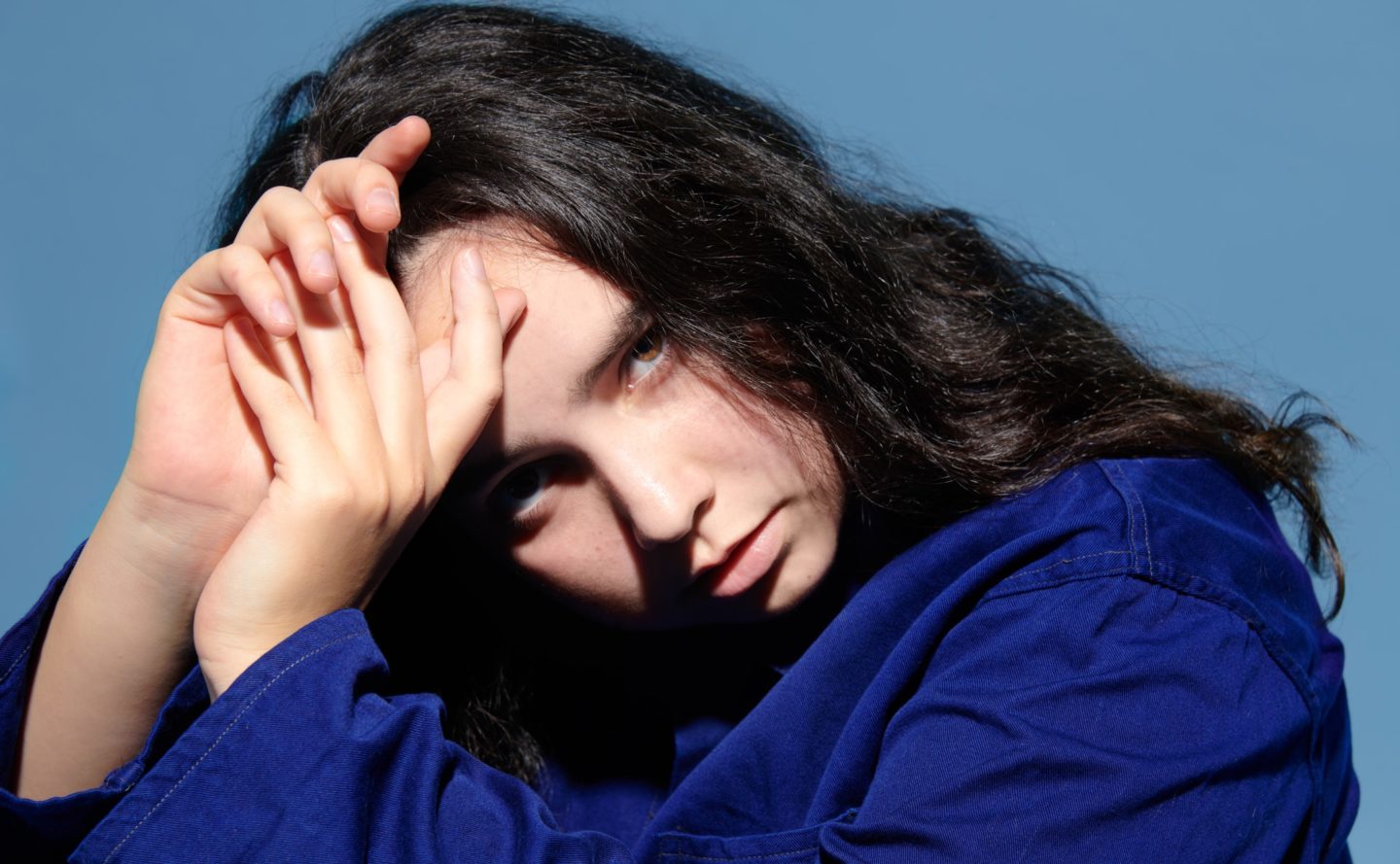
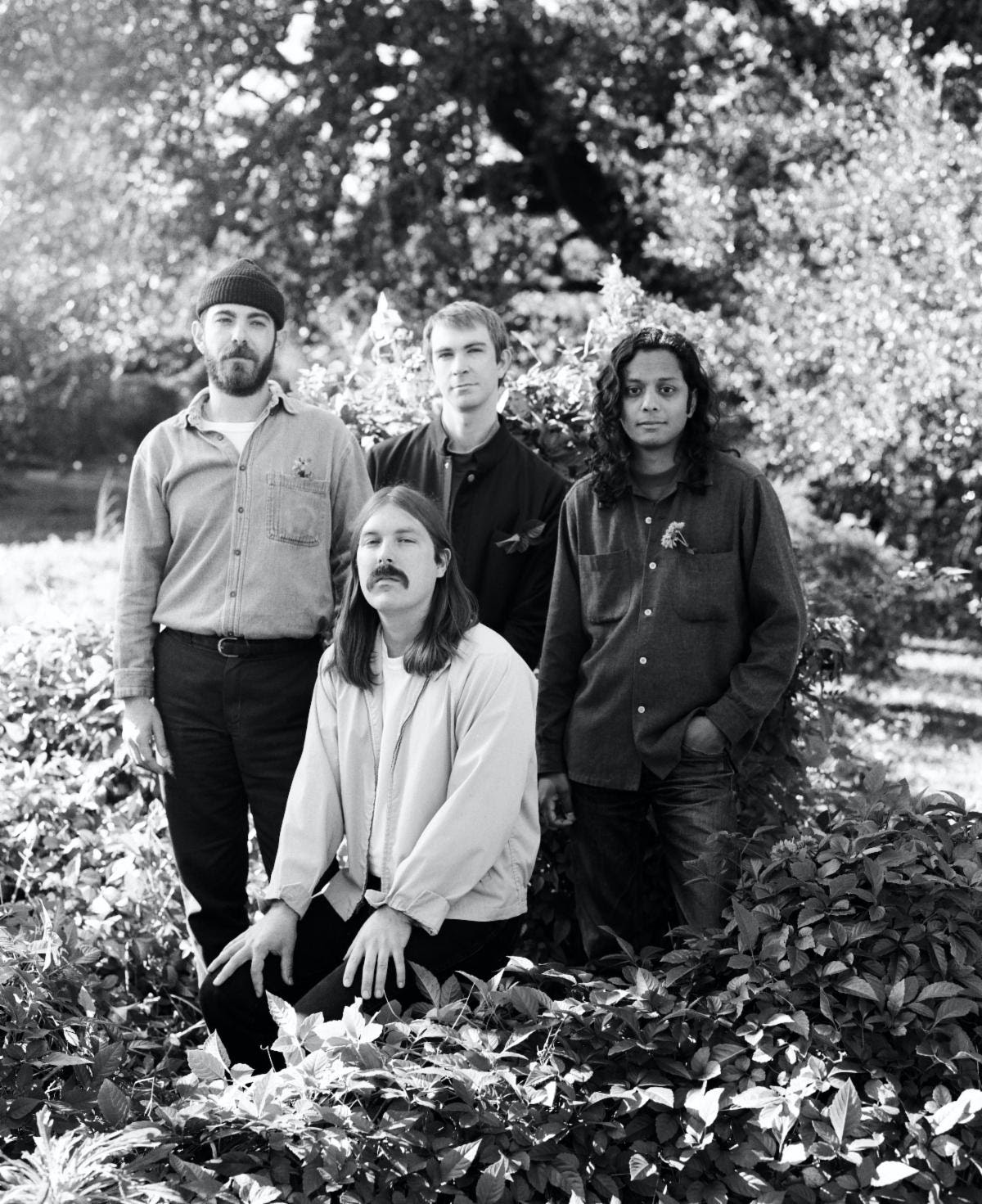
Francis of Delirium is the combination of 19-year-old Jana Bahrich and Chris Hewett, who hail from Vancouver, CA and Seattle respectively, but now are based in Luxembourg where they currently reside and make music. They’re preparing the release of their new EP “Wading” via Dalliance Recordings and have recently let go of it’s passionate lead single “Let It All Go.”
Part pummeling garage rock and art-rock anthem with some Art Brut-esque delivery, it blossoms into something else with the vocals converging into an acapella-like moment before diving into a 90s garage rock finish. You can feel the emotion pouring out of Bahrich at every moment in a convincing raw fashion.
Throughout 2020 Luxembourg-based, Canadian-American two-piece Francis of Delirium gave us plenty of musical reasons to get excited about them and their powerful Equality Song also made it into our list of the favourite tracks of the year. Despite her young age charismatic songwriter Jana Bahrich writes very mindful and musically profound tracks that shouldn’t shy away from some true classics of indie rock history. There’s this special lo-fi vibe that makes these songs as timeless as they are fresh. A first EP was released last year, a follow-up called “Wading” is set for a release on February 12th. We also asked Bahrich about her personal thoughts and hopes for the upcoming year and here’s what she had to say:
“You can expect my favourite music we’ve made to be out in the world next year, my favourite video I’ve made so far to be out and for us to be doing everything we can to be putting on our best shows yet. My hope is for the world to get to a point where it is safe enough for artists to play to a packed audience/for us to play to a packed audience so that I would be able to stage dive and not fall straight to the ground, that would be pretty cool. That’s my lofty goal for next year, a stage dive.”
After over a 15 year hiatus, the Imajinary Friends are back with a new collection of sizzling electric dreams from space that pulsate with a strange, sexy, far out groove (i.e. L’Outsider, with guest vocals and lyrics by Deborrah Morgan aka Moogy.) On their eponymously self-titled 3rd LP, the Imajinary Friends tweak the frequencies and really fry all the instrumentation that is both dizzying and danceable (i.e. The Dark Sparkle or Space Trash.) The Imajinary Friends continue to experiment with sounds and rhythm on tracks like 101 Kazoos and Frangipani. This record brings the rhythms of the 70’s Krautrock scene with the dark guitars of UK Post-Punk paired with buried vocals and slurred sounds of the 90’s shoegaze movement.
The Imajinary Friends are a somewhat mysterious collective. Ever changing and evolving. The core 3 are Tim Digulla (one half of Lounge/Exotica/Electronica duo Tipsy,) Ricky Maymi (current guiterrorist & founding member of The Brian Jonestown Massacre; he also played with Mellow Drunk, Spectrum, The Wild Swans and Steve Kilbey, among many others) and Travis Threlkel (also a founding member of BJM, now, founder & creative director at Obscura Digital) For these recordings, the Imajinary Friends enlisted the following to sing vocals on several tracks: The aforementioned, Australian/French-Belgian Singer-songwriter Moogy (L’Outsider); Stephen Lawrie of The Telescopes (Hate This Party); and Marleen Nilsson of Death And Vanilla (Baby’s Bathwater, What’s being said about The Imajinary Friends…
“San Francisco’s The Imajinary Friends, mercurial pranksters of soundscape and pop, continue to turn in the unexpected with their unique brand of original and uncompromising music.” — Pete Kember aka Sonic Boom
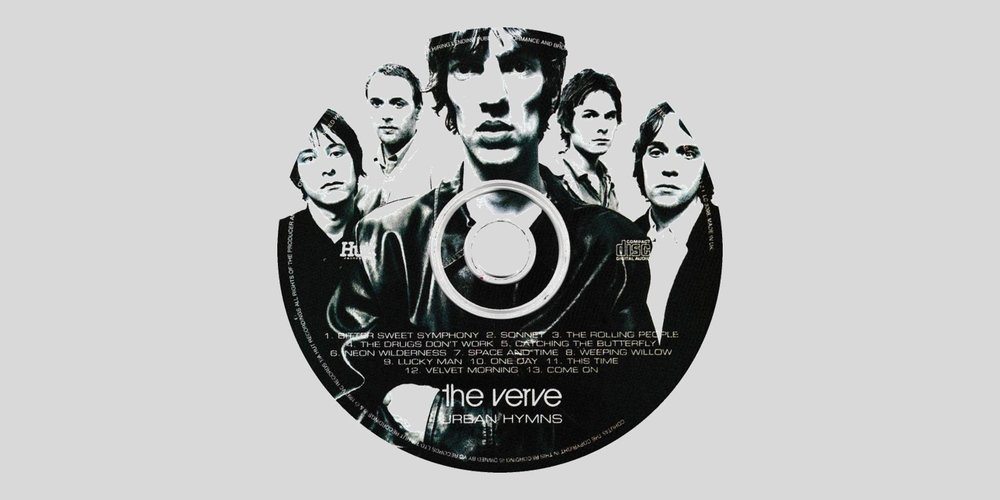
The Verve’s third studio album “Urban Hymns”, originally released September 29th, 1997. Mojo magazine’s recently published a revisionist assessment accompanying the album’s deluxe reissue’s, which curtly dismisses the album as “a flawed piece of wish fulfillment: Thus epic songs struggling to mend a broken heart.”
“I remember listening to “Urban Hymns” for the first time and I was completely enthralled with it,” I couldn’t stop listening to the album from beginning to end. It was pure brilliance. Each song could stand on its own and the album was flawless.
Although Urban Hymns represented my overdue introduction to The Verve’s songs, my education thankfully didn’t end there. The band’s excellent first two albums, 1993’s A Storm in Heaven and 1995’s A Northern Soul, the latter of which many still believe remains their greatest achievement on wax, both albums are remarkable in their own right.
Listening to all three albums also prompted me to seek out more information about the group’s genesis and career progression up to that point. Together with his schoolmates Simon Jones (bass guitar), Nick McCabe (lead guitar), and Peter Salisbury (drums), the Wigan, England born Richard Ashcroft formed The Verve in 1990 (guitarist/keyboardist Simon Tong joined the band in 1996 and remained until 1999). Three years later, the group released its critically acclaimed debut LP A Storm in Heaven, a hypnotic song suite defined by its sweeping arrangements awash in distortion, reverb, and vocal effects in abundance. Their follow-up effort, A Northern Soul, found the band balancing their more experimental proclivities with noticeably more accessible and melodic fare, including a trio of singles (“This is Music,” “On Your Own,” and “History”) that rank among the finest songs to emerge during the British Rock resurgence of the mid ‘90s.
Though the band briefly split a few months after A Northern Soul’s release, the fracture thankfully proved ephemeral and they soon returned to the studio to record once again. Initially propelled by the ubiquity of lead single “Bitter Sweet Symphony,” but also owing to the fact that the album as a whole is a masterpiece of exquisite musical vision and expertly executed songcraft, Urban Hymns became one of the biggest selling and most critically applauded British albums of all time upon its release.
Co-produced by the band with Youth and Chris Potter roughly splitting duties across its thirteen songs, Urban Hymns is defined by its ambitious, anthemic compositions that sound like the natural expansion from its two precursors. It’s immediately apparent, upon even cursory listens, that this was The Verve’s bold attempt to fulfill their self-imposed destiny, which envisaged them morphing into a band capable of crafting a truly timeless suite of songs. A fully realized album that lodged itself firmly within the depths of listeners’ hearts, minds and souls. And I’d say mission accomplished, gents.
Urban Hymns’ legacy is not without its blemishes and distractions, particularly when it comes to the infamous legal rigmarole surrounding “Bitter Sweet Symphony” and more recently articulated conflicts regarding acknowledgement of the album’s creative influences. But these antagonisms have not diminished the album’s enduring power and resonance, with respect to what ultimately matters most: the music.
Though the album’s creation was indeed a family affair with contributions from each of the group’s five members, a compelling case can be made that McCabe and Ashcroft were the central driving forces most instrumental in executing the band’s vision. McCabe’s adventurous, at times counter-intuitive guitar work is the sonic glue that holds each of the songs together and solidifies their sweeping grandeur. Meanwhile, the songs’ existential weariness and angst, coupled with their whimsical innocence and palpable romanticism, are the product of Ashcroft’s lyrical prowess. There are plenty of moments that gravitate toward the darker, more sobering dimensions of early adulthood, but Ashcroft’s boyish optimism and joie de vivre do shine through from time to time.
Though listeners have inevitably attempted to decode the true meanings behind Ashcroft’s sometimes elusive verses, it may simply be the case that he penned his lyrics so as not to be immediately or singularly interpreted. “I don’t think the listener needs to know anything more than the song,” he explained to MTV back in 1997. “Because we always abuse our listeners’ imaginations by giving them too much, and telling them too much. We’re making music, we’re not making cheeseburgers. So I’m not about to give it to them on a plate and say what exactly it’s about. I think that’s important. I hate it when you see lead singers taking all the mystery away.”
The universally familiar album opener and lead single “Bitter Sweet Symphony” is one of the easier songs to discern, as Ashcroft sings the praises of self-agency as the means of triumphing over the thankless, soul-sapping grind of the material world, with music offering much-needed respite (“I let the melody shine, let it cleanse my mind, I feel free now”). “As for ‘Bitter Sweet Symphony,’ all those legal wrangles still don’t take away the hours I put into it in the studio to create an incredible piece of pop art,” Ashcroft reflected to Vogue magazine earlier this year. And incredible it still most definitely is. Having said that, and perhaps because of its prevalence, it’s not among the five or six songs that instantly come to mind for me when I think of Urban Hymns after so many years.
The lower profile songs with the album, beginning with the other three official singles that were released from the LP. On the inspired “Sonnet,”Ashcroft unleashes his yearning for the purer incarnations of love, without the embellishments of false or forced sentimentality, through a mixture of despair and hope, with lines like, “Sinking faster than a boat without a hull / My lord / Dreaming about the day when I can see you there / My side / By my side.”
An introspective, sombre ode to the fleeting comfort of drug-induced escapism, the profoundly stirring “The Drugs Don’t Work” can be construed as an examination of Ashcroft’s feelings about his own drug use and/or perhaps a nod to his father, who died of a brain hemorrhage when Richard was eleven years old. “When I heard ‘The Drugs Don’t Work,’ I stood there with a lump in my throat,” The Verve’s former manager Jazz Summers recalled in 1998. “At times like those, you know why you’re in the music business.”
“Lucky Man” is a notably more uplifting anthem of redemption and self-satisfaction, with Ashcroft overcoming personal adversity to find balance and contentment in life: “Happiness / More or less / It’s just a change in me / Something in my liberty / Oh, my, my / Happiness / Coming and going / I watch you look at me / Watch my fever growing / I know just where I am.”
Though it’s challenging to distinguish highlights when the entire album unfurls as one grand highlight reel, a handful of non-single tracks are bona fide standouts. “Catching the Butterfly” is a stirring ode to summoning youthful innocence as a way to cope with the harsher realities of adult life (“So you’re born / And so you thought / The future ours / To keep and hold / a child within / Has healing ways / It sees me through / My darkest days”). With McCabe’s insistent guitar play galvanizing the steady percussion, “Space and Time” is a moving exploration of a relationship that has been sapped of its passion, with Ashcroft doing all that he can to salvage the connection to assuage his fear of being alone.
The longest track at seven minutes and seemingly the antithesis of the more accessible, radio-friendly fare on offer throughout the album, the sprawling jam “The Rolling People” harkens back to the more free-form sonic footprint the band established on A Storm in Heaven. As does the considerably shorter, largely instrumental “Neon Wilderness” and the dissonant, reverb-laden “Come On,” which features a brief Liam Gallagher cameo.
Elsewhere, “Weeping Willow” is a melodic dirge that finds Ashcroft exploring the symbiotic connection between depression and addiction, with references to suicidal tendencies captured in the song’s outro (“Weeping willow / The pills under my pillow / Weeping willow / The gun under your pillow”). With allusions to The Velvet Underground in the song’s title and lyrics, not to mention the Lee Hazelwood and Nancy Sinatra’s classic 1967 duet “Some Velvet Morning,” the subdued come-down of “Velvet Morning” is an introspective portrait of loneliness and despondency, feelings that come into sharper focus as the remnant effects of last night’s pills fade away as a new day dawns.
Most people seldom cite “This Time” as among their favourite tracks from the album, but it has always been an exhilarating, standout moment for me. The coalescence of its propulsive momentum, Ashcroft’s vocal echoes, and the overarching message of acknowledging past regrets and moving on with life the best you can has always resonated, particularly as conveyed through memorable refrains such as “No time for sad lament / A wasted life is bitter spent” and “Into a light I pass / Another dream, another trance / This time, this time / This time I’m gonna rise.”
I’ve spoken to people who’ve got nothing to do with the critical side of this business,” Ashcroft shared with MTV shortly after Urban Hymns’ arrival. “I’ve spoken to people in pubs, I’ve spoken to people on the street who weren’t even aware of who The Verve were six months ago. But something connected with them with “Bitter Sweet Symphony” and “The Drugs Don’t Work” that they can’t explain. Sometimes music touches you and you can’t deny it. So I’m not too interested in what the critics say. I’m interested in how the music can still have a power, and can still affect people and still move people.”
Controversies, conflicts and commercial achievements notwithstanding, The Verve’s “Urban Hymns” remains their creative pinnacle and continues to move people twenty years on. For better or for worse, all of The Verve’s and Richard Ashcroft’s music that has followed since 1997 has been measured against “Urban Hymns”, an unfair but inevitable consequence of the album’s ubiquity and acclaim. And while I embrace it as my personal favourite album of all time, I also appreciate that “Urban Hymns” is just one component—albeit a vital one—of the much broader narratives of the band members’ careers, which are still evolving in exciting and unexpected ways.
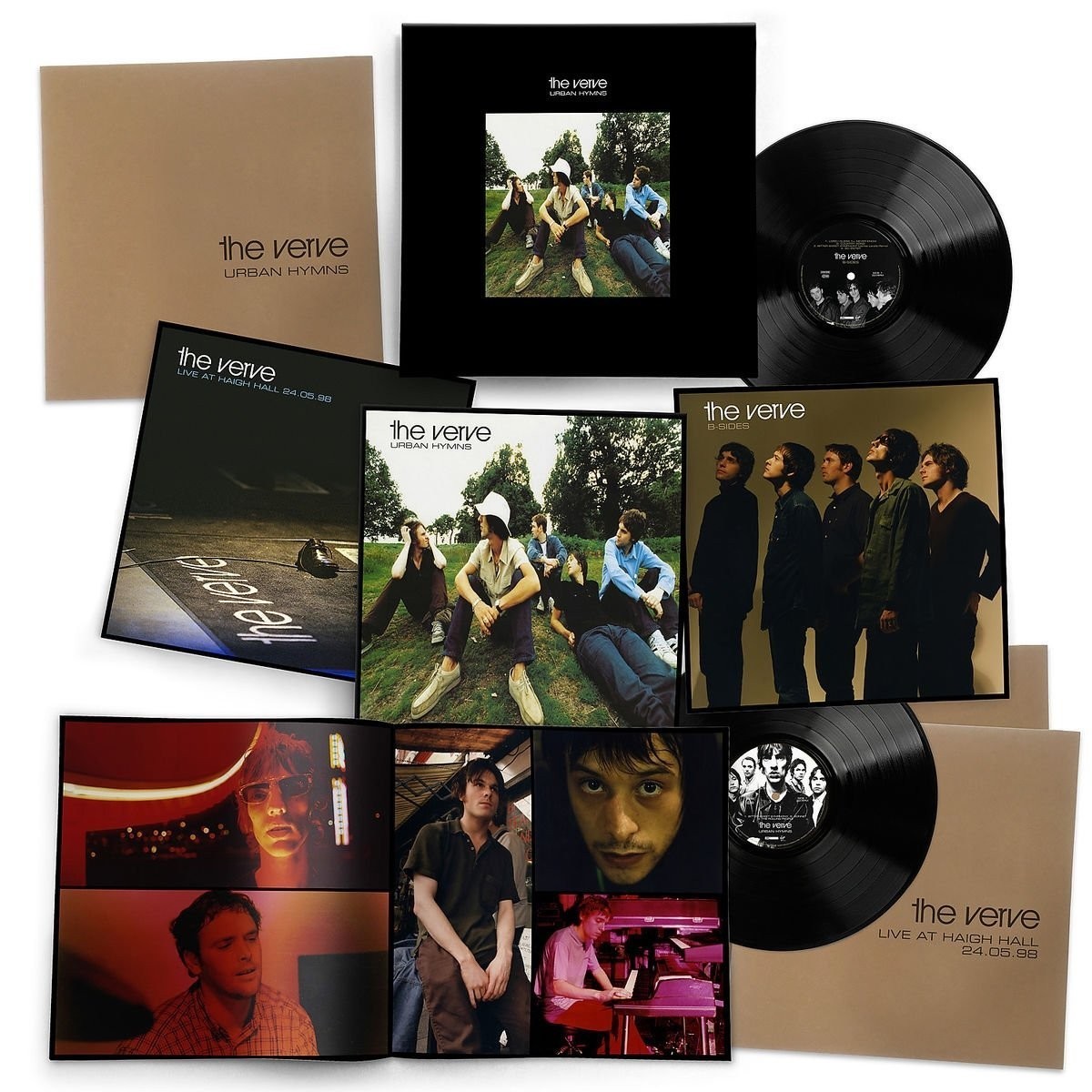
Expertly catching the mood of the late-‘90s upon its release in September 1997, The Verve’s third studio outing went on to become one of the all-time classic British albums. Eleven times platinum in the UK and with ten million copies sold worldwide to date, it also delivered four of the era’s most iconic singles – ‘Bitter Sweet Symphony’, ‘The Drugs Don’t Work’, ‘Lucky Man’ and ‘Sonnet’. Now, exactly twenty years on, comes this 3 double-LP box set version of ‘Urban Hymns’ containing a host of special features. Re-mastering was undertaken by original co-producer Chris Potter and the original album, spread over two vinyl discs, comes supplemented by a double album of B-sides and sessions, plus a further double set containing the previously unreleased concert at Haigh Hall. The box also comes with a 20-page booklet book including a selection of unseen photographs by Chris Floyd, who travelled with the band and was granted unprecedented backstage and offstage access. There is also a download card entitling the purchaser to all of the audio and the further music included on the 4CD Box Set edition.
The Verve’s third studio album “Urban Hymns”, originally released September 29th, 1997.
Arriving at a time of considerable uncertainty in the world, Son Lux’s multi-album ‘Tomorrows’ is ambitious in scope and intent. Born of an active, intentional approach to shaping sound, the music reminds us of the necessity of questioning assumptions, and of sitting with the tension.
The music encompassed on Tomorrows provides an appropriate parallel for the sustained cacophony of the present moment, advancing a friction that reveals the strange in the familiar and the familiar in the strange. While this carefully crafted inversion acclimatizes the ear to tension, the steadily hardening exterior fractures at unlikely moments, revealing a strikingly visceral, emotional core. The process of creating Tomorrows is iterative in nature, with the lyrical content and music continually adapting and responding to one another and the shifting landscape of the moment.
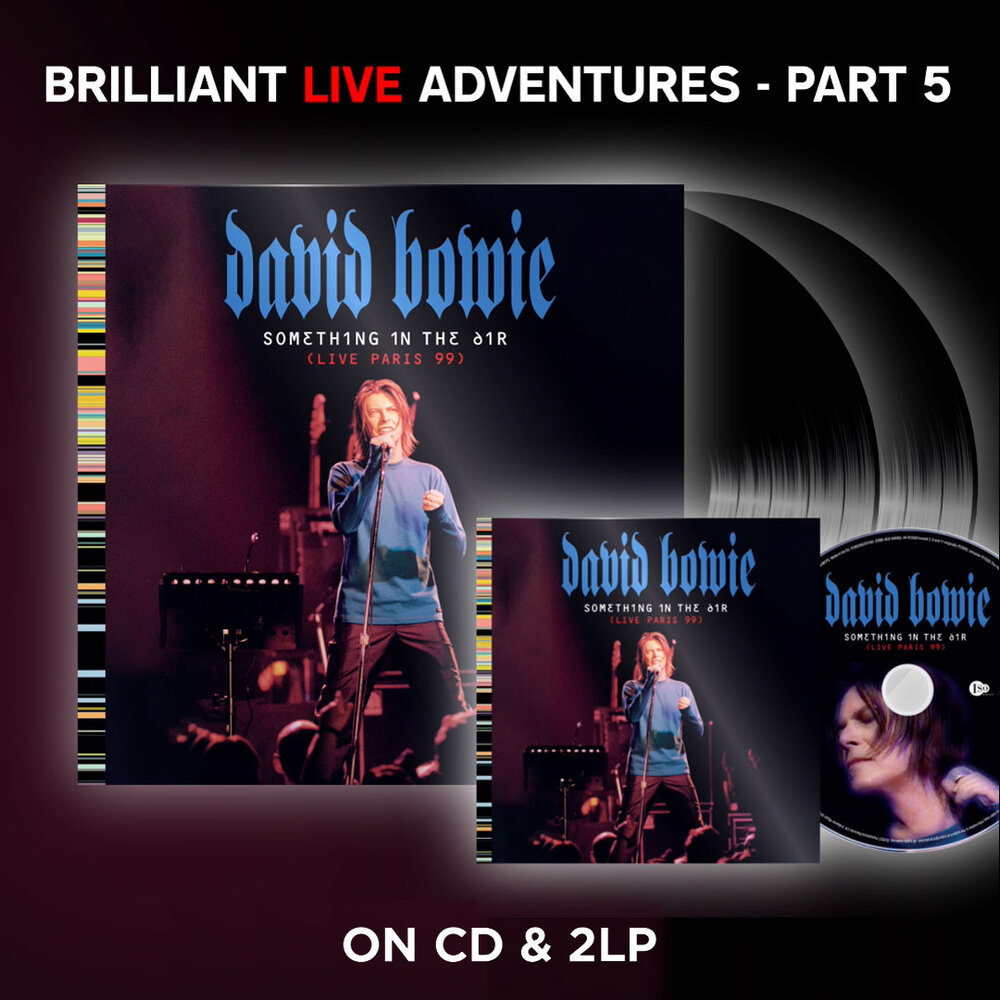
“Lived all our best times…” Some of you have successfully second-guessed Brilliant Live Adventures Number 5 edition, on account of it already having been released for streaming last year. The news is that it will be available for pre-order this coming Friday, 26th February, with a release date of 12th March on CD and double vinyl.
‘SOMETHING IN THE AIR (LIVE PARIS 99)’ The Fifth Release in the ‘BRILLIANT LIVE ADVENTURES’ Series of six single pressings of Live albums from the 1990s Vinyl, CD and Limited edition boxed sets to complete sets available exclusively via the The DAVID BOWIE OFFICIAL STORE & WARNER MUSIC GROUP’S DIG! STORE
On the 24th February 2021 London Parlophone Records is proud to announce the newest instalment of DAVID BOWIE ‘BRILLIANT LIVE ADVENTURES’, a series of six live albums from various 1990s era Bowie performances being released on vinyl and CD as limited one run only pressings. The albums and limited-edition boxes for both vinyl and CD to house the full collection will be available only via the David Bowie official store and Warner Music Group’s Dig! store.
The fifth in the series, out 12th March on CD and double vinyl, is “Something In The Air” (Live in Paris 99) a 15-track live album, featuring 12 previously unreleased recordings and three B-sides of singles from the ‘hours…’ album. The day of the show was a momentous one for Bowie, as that afternoon he was awarded the Commandeurs of the Ordre des Arts et des Lettres, the highest artistic honour that France can bestow.
The Elysée Montmartre performance was one of only seven full shows promoting the ‘hours…’ album. For this special limited run of gigs Bowie dug deep into his back catalogue making these shows particularly memorable. Standout tracks include ‘Can’t Help Thinking About Me’ first released in 1966 and not performed live in over 30 years, ‘Word On A Wing’ from Station To Station reinstated into the set after a 23-year absence, ‘Drive-In Saturday’ performed for the first time since 1974, and ‘hours…’ track ‘Something In The Air’ in its first live performance.
“Something In The Air” (Live in Paris 99) was recorded live at the Elysée Montmartre on 14th October 1999. It was mixed by Mark Plati, and features Bowie backed by Page Hamilton – guitar, Gail Ann Dorsey – bass, vocals, Mark Plati – guitar, Sterling Campbell – drums, Mike Garson – piano, keyboards, synthesisers and Emm Gryner and Holly Palmer – backing vocals.
“Bad Hair Day” is the first taste of his Francis Lung’s forthcoming second album, “Miracle” which is set for release via Memphis Industries on 18 June 2021.
“Bad Hair Day” is a relentlessly catchy and deceptively upbeat ode to hangovers and missed connections. Sonically, the song arrives as a fusion of power-pop and sunny art-rock where angular guitars dart around glowing melodies and quickfire percussion. “For me, [Miracle] is about the struggle between my self destructive side and my problem-solving, constructive side,” says Francis. “I suppose through a lot of these songs I’m dealing with these emotional problems, acknowledging the negative aspects of my behaviour instead of burying them, and providing an alternative point of view for myself”. Despite its serious subject matter, Miracle is far from austere in sound, marrying the cinematic, dreamlike quality of Francis’s earlier music with the pared-back charm of great singer-songwriters like Judee Sill, Jeff Tweedy and Elliott Smith.
The album opens with ‘Bad Hair Day’, a relentlessly catchy—and deceptively upbeat—ode to hangovers and missed connections. “I’ve been calling on you all night /But I never get through, I just get in the way” Francis laments; “I am a cloud in the sun’s light/Whatever I do, whatever I say.” Elsewhere, the title track finds him pondering the fickle nature of the music industry: “I think of [Miracle] as acknowledging and even encouraging the feelings we’re not supposed to succumb to – giving up, giving in – just because it can be comforting to hear it from someone else. ‘Why am I climbing these social ladders and jumping through the hoops of this creative industry? Does this make me happy?’”
These themes of longing, and lacking, missing and being missed, reoccur throughout Miracle. “When I die/Will I be missed/Or am I missing the point?” asks ‘Say So’; while ‘Lonesome No More’, inspired by the Kurt Vonnegut book of the same name, begs the question: if loneliness was eradicated, would we miss it? By confronting these feelings, Francis is able to move forward, as triumphant album closer ‘The Let Down’ proves. Its lyrics serve as a call to action, as Francis wills himself (and the listener) to ‘Get up/Get something going/Do something, do it/Do it now’
Miracle was produced by Francis in collaboration with Brendan Williams (Dutch Uncles, Matthew Halsall, Kiran Leonard) and Robin Koob (who co-arranged and performed strings). The opportunity to take creative control was one Francis relished. “I’m quite bad at delegating” he admits, noting that he played every instrument except strings on Miracle. The result is a cohesive, deeply personal record, which is as vital as it is vulnerable. “I don’t want to be defined by my anxiety, my depression or any history of substance abuse,” Francis says, “but I do want to reach out to other people who have had similar experiences, especially if it’s in a way that helps them feel a little better. To me, this music is celebrating healing as much as it focuses on the darker sides of the human psyche.”
Francis Lung, the uber-talented Manchester singer songwriter (& former Wu lyf man), to the dinked fold. Despite its serious subject matter, ‘miracle’ is far from austere in sound, marrying the cinematic, dreamlike quality of Fancis’s earlier music with the pared-back charm of great singer-songwriters like brian wilson or elliott smith & the prog-like maximalism of b.c.camplight or field music. the album opens with ‘Bad Hair Day’, a relentlessly catchy – & deceptively upbeat – ode to hangovers & missed connections & from here on in, we are besotted.
John Darnielle has written almost 600 songs now, and some of them are very sad, dealing with hard drugs and tragic ends, hurting yourself and others, sicknesses of both body and brain, off-brand alcohols. They are told in beautiful, unnerving, specific detail because he is a very good writer, and also some of them are just true stories about his own life.
The Mountain Goats released this live collection, The Jordan Lake Sessions: Volumes 1 And 2, on Bandcamp today via Merge Records. The recordings come from a pair of virtual concerts the band conducted at Manifold Recording in Pittsboro, North Carolina in August of last year.
The Jordan Lake Sessions: Volumes 1 And 2 follow The Mountain Goats’ 2020 studio release, “Getting Into Knives”, which arrived in October. The new live collection — featuring John Darnielle (vocals, guitar, piano), Peter Hughes (bass), Matt Douglas (keyboards, guitar, saxophone, piano) and Jon Wurster (drums) — contains 36 carrer-spanning songs the band recorded over the course of two virtual concerts on NoonChorus, which became one of the livestream platform’s highest-attended online concerts to date.
Like a lot of bands, we thought, we have to figure out some way to play together, it is unnatural for us to not be playing together, it feels weird and wrong, and it also feels weird and wrong to not be playing for the people who dig what we do, that is a huge part of who we are, it’s a circuit, you know, an energy transfer, it’s the coolest thing and we’re lucky to have it and then the pandemic came in to remind us just how lucky. And also there’s the I-try-not-to-be-talking-about-this-stuff issue of how playing live is our paycheck, it is how we make ends meet, it’s the gig. So we booked a studio that had cameras, and I put together a couple of set lists, and we played two shows in two days and then we put the shows up on sale; and the Mountain Goats Massive showed up, in truly humbling numbers, and the whole groove felt really emotional for us—and, it seemed to me, for the audience, too. There is an immense loss for me in this time away from the stages and rooms which are, in many ways for us, home. I miss the people who bring our music to life, so much.
And so a lot of people, like a lot, in the chat during the show, and in various @’s across social media, said, Hey buddy, what if there were a live release of some kind, I’d buy that, and I thought, well, cool, I’ll look into it; and we did indeed do that, and here it is, but I wanted to make it “pay what you like” on release day: because you people who already paid to see these shows, you are the people who literally put food in our children’s mouths this year. If you feel like you’re done paying for these shows, then we are cool with that, zero pressure. But!! if you’re in good shape, and your own job has figured out a way to let you report to the workplace in 2020, and you’re in a position to pay for these shows, then we are deeply grateful, it has been pretty harrowing to be banned from all clubs for a whole year. The news on the wire however is that a vaccine is coming which will unban us from clubs around the world, and, friends, when that viral ban is lifted, please know that there will be few places to hide from the Mountain Goats. We will rock them in the steel towns, and in the coastal towns, too; and on the cities of the plains, and in the oases of the desert, lo, we shall rock them, and then rock them even harder, at serious Deep Purple levels of rocking, the head-nodding, hair-flying style, at which many will say, I have been rocked, and indeed I wondered if my time of rocking were past, but it has returned this day with gale force. May that day speed hither with all due haste! Finally, if you are a reclusive Howard Hughes type reading these words, and thinking, What if “pay what you like” means I just throw an absurd amount of money at the Mountain Goats, well, friend, we’re glad to meet you. Please be assured that your gesture will be met by JD with similarly absurd gestures, as for example fulfilling his dream of commissioning a translation of the book Elfriede Jelinek got the Nobel for, but which still hasn’t been published in English twenty years later, for crying out loud.
Anyway that’s the news! Here’s two shows! We’re proud of them! If you wanna pay us for ’em, we won’t complain! We will see you next year!
Released December 4th, 2020
John Darnielle – vocals, guitar, piano Peter Hughes – bass Matt Douglas – keyboards, guitar, saxophone, piano Jon Wurster – drums
Recorded live in studio at Manifold Recording in Pittsboro, NC, on August 8th & 9th, 2020
It’s been a while, 4 years in fact. We quite literally could’ve had 4 babies each in that time but instead we’ve grown out two mullets, gathered a few wrinkles, downloaded TikTok, deleted it and then downloaded it again and now finally we’ve made you some new music. We think it’s our best stuff yet. it doesn’t get much bigger than this! after 2017’s mercury prize-winning stunner, ‘visions of a life’, our anticipation for Wolf Alice’s third album couldn’t be higher. its predecessor showed an unwavering boldness & desire to constantly play around with genres, working through moods of shoegaze, fuzzy punk, moody pop rock & understated, emotionally charged lighter-wavers. the cherry on top is the limited indies only transparent red lp!,
Sweet Annie Mac will be premiering our new single ‘The Last Man On Earth’ from 6pm tomorrow on BBC Radio 1.
Lets tune in together, hope you’re ok out there we have missed you so so much. xxx Our third album ‘Blue Weekend’ will be released on the 11th of June.
Los Angeles’s Beachwood Sparks said that they hated the term “americana” to describe their music . But looking back now, there was something about their sound in terms of the production and energy in it that I think is missing from some of the big names in americana these days. It had that Laurel Canyon country-rock feel of bands like The Byrds and Buffalo Springfield but didn’t feel derivative. There was a buzz about it – the album felt messy but at the same time exciting. And the songs were just crazily good. Those first few bars of opener‘ Desert Skies’ still make the hairs on the back of my neck stand up. Even the cover is one of my favourite album covers of all time. Thank God they were reincarnated into GospelbeacH, but nothing will beat their debut – it’s a record I can’t imagine ever tiring of hearing and it’s great news to hear it is now being re-issued.
If ever a band sounded like the sunbaked children of a partnership between the trippy psychedelic dreamers of the paisley underground and the lonesome cowboys of the late-’60s Laurel Canyon cosmic country, Beachwood Sparks are it. The group’s self-titled debut album is a perfect distillation of the two thanks to soaring pedal steel, winsome harmonies, alternately twanging and swirling guitars, and songs that sparkle like lost gems. The band take care to adorn each sweet and sad melody with note-perfect arrangements that fill every corner of the mix with something good. They coat the melancholy songs in a woody patina of dusky sunlight, surrounding Chris Gunst’s fragile vocals with sympathetic strums and vocal harmonies. “Canyon Ride” is a blue delight, especially when the downcast “doo-doo-doos” come in, “New County” is a lovely laid-back waltz that sounds lifted from a late-’60s Byrds record, and “The Reminder” features some excellent barroom piano and sounds as lowdown and broken as the saddest Gram Parsons song.
The bulk of the album revolves around these tender ballads with the band showing off considerable skill as singers, writers, and players. They balance these moments with a handful that cut loose a little as they kick up some serious dust on rockers like “Sister Rose” or “The Calming Seas,” take a detour to the beach for “This Is What It Sounds Like,” drop some acid-y, guitar-heavy elements into the woozy “Something I Don’t Recognize,” and ramble through some hippie C&W on “Silver Morning After.” No matter the mood or tempo, every song comes across like the band playing at their absolute peak. Most of the members of the group had already been making music for a long time when they started Beachwood Sparks, notably with lo-fi heroes Further, and it shows. They play with confidence and restraint, while still filling the uptempo songs with a sense of joy and the sad songs with tear-streaked soul. Beachwood Sparks might not be the first band to give cosmic country a shot, but their debut album proves right away that they are one of the best.
[The 2020 reissue of the album adds a second disc of single tracks and rarities, including two that were on the Japanese release of the record. Two alternate versions of songs from the album are fun: “This Is What It Feels Like” has an explosive psych-rock coda that doubles its length; “Canyon Ride” leans even more into Laurel Canyon rock with a ripping guitar solo added.
The band’s 1999 Sub Pop single is made up of one of their summeriest tunes in “Midsummer Daydream” and a pleasantly laid-back slice of country-pop titled “Windows 65.” The two tracks from the Japanese album are lovely: “We’d Love to See You” is fine soft rock complete with electric piano; “Surfing Saints” is drifting psych pop that the Rain Parade might have come up with if they were stranded in the desert for a week. Best of all is the previously unreleased song “Morning Light.” It’s hard to see why this jangling, sun-dappled power pop ballad didn’t make the final cut for the album. These extra tracks help tell the complete story of this version of the band and make for an essential addition to what’s already a brilliant album.
Loved the debut EP from New Orleans chooglers Silver Synthetic which came out last year and with “In The Beginning,” the band announces their first LP for Third Man coming on April 9th. The song follows the debut’s sunbaked country saunter — a gulf stream gust of Cosmic Americana that’s steeped in twang with just a hint of West Coast vibe and running through it. While its not easy to shake the salt air out of the song, at its core there’s a heat struck, back porch sound to ease “In The Beginning” that feels soaked in humid Southern summer nights with nothing on the docket the next day. Despite its title, the cut’s a bit of an end of party tune, winding down with the last couple of stalwarts still taking in that star-borne vista and feeling set for the moment. The band’s eponymous debut sets them up nicely to slot in among the current cosmic revival, clipping a couple of stunners from the EP and setting them up with a whole bunch of new favourites as well.
New Orleans’ Silver Synthetic were formed by members of other, more raucous, garage punk groups who wanted a musical outlet where they could, you know, chill. Their debut album is a real cool time indeed, drawing on a wide variety of ’60s/’70s psychedelic guitar pop (The Kinks, Big Star, Television) with undeniable hooks, heavenly harmonies and stellar musicianship. If you are also down with a little noodling, “Silver Synthetic” provides a pasta factory’s worth, all deliciously al dente and made with purpose. The jamming never gets in the way of the songs, though, and there’s not a mediocre one on this fantastic record.
The magisterial “Chasm Killer” is a baroque gem with the album’s best guitar solo.
In the Beginning · Silver Synthetic · Third Man Records Released on: 2021-02-17







![Beachwood Sparks [Deluxe Edition]](https://rovimusic.rovicorp.com/image.jpg?c=VTzY6S_nwk-kpTMAgzPohlWnbEN5fCjifro6xhIBuB4=&f=5 "click to embiggen")
 The Fat Angel Sings