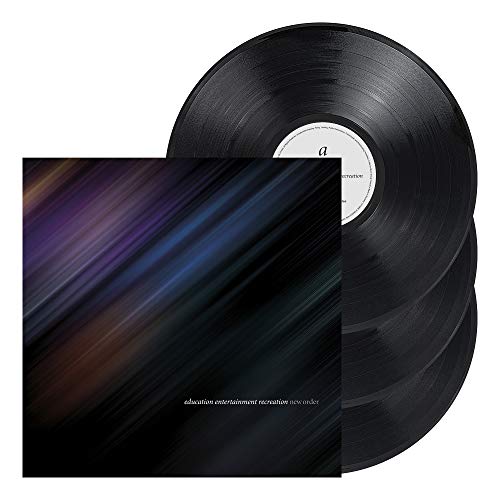
New Order have officially announced Education Entertainment Recreation, a new live album and concert film recorded during the band’s sole UK show of 2018, held at Alexandra Palace. The career-spanning performance is being released on 2xCD, 2xCD with Blu-Ray, 3xLP, and as a limited edition box set with the aforementioned physical formats plus a book and art prints. Education Entertainment Recreation arrives May 7th via Mute; below, find a previously released clip of “Sub-Culture” from the film release.
New Order released a new song called “Be a Rebel” last fall. A music video by Spanish director NYSU was revealed in December. Their last full-length studio album Music Complete arrived in 2015. Recorded live on 9th November 2018 (their only UK show of 2018), ‘education entertainment recreation’is a brand new live album from London’s Alexandra Palace. Sonically spectacular, spanning 2 hours 20 minutes, the show joyously mixed New Order classics, their latest acclaimed album ‘Music Complete’ and Joy Division’s finest.
Opening with ‘Singularity’ from ‘Music Complete’, they eased back in time to 1993’s ‘Regret’, to ‘Love Vigilantes’ from 1985’s ‘Low-Life’ to ‘Ultraviolence from 1983 debut ‘Power, Corruption and Lies’. Later, their power over the dance floor was proven by sublime performances in the manner of the celebrated extended 12 inch remixes they are synonymous with – on ‘True Faith’, ‘Blue Monday’ and ‘Temptation’ before a four song Joy Division mini set to end
A career spanning celebration, the band were on relentlessly sparkling form, blending eras and genres and redefining themselves as perhaps the most vital British band of recent decades. This spectacular live album is spread across various formats, a triple 180 gram edition, a 2CD edition or a 2CD + film on BluRay edition.
The Times *****: “the pristine power of the band….filled the sometimes unforgiving space of Alexandra Palace quite magnificently”
Clash: “a celebration of innovation, fabulous tunes and a career that has mined gold from tragedy”
New Order are: Bernard Sumner – lead vocals, guitar Stephen Morris – drums Gillian Gilbert – keyboards Phil Cunningham – guitars Tom Chapman – bass
Mamalarky spent two years working on their self-titled debut album (released last year via Fire Talk on November 20th). Raw and cerebral, the LP looks to a range of influences from their collective musical nerdiness. ”We might have a vocal melody that sounds like the lead steel guitar from Santo & Johnny, played over production that aims to be noisy and weird like Deerhoof or Sheer Mag, all the while steeped in the greats like Stevie Wonder or The Four Seasons,’ explains Livvy. The album itself was cobbled together in a mix of DIY ways: home recordings with Livvy’s roommate Joey Oaxaca (White Reaper, Mo Dotti), singles with Daniel McNeill (White Denim) and a “final wrapping-up” with engineer Jim Vollentine (Spoon, Skating Polly). The result is an album that’s as musically fun and explorative as it is catchy and sweet. Or as Mamalarky puts it “We want to provide an experience that’s exploratory and trippy, but far removed from the problematic and corny psych stereotypes carried out by all those 60s dude bands.”
“Any song on Mamalarky’s self-titled debut deserves to be a single.” – Vice
“Mamalarky are a band that emanates cool factor.” –
The harmony is beautiful and slightly strange. The drums are really strong, the vocalist is really skilled. The guitars and synths are really tasteful. Basically, the sound overall is really original, and really satisfying.
Mamalarky spent two years working on their self-titled debut album. Mamalarky debut album out October 14th on Fire Talk Records.
Due this April, London three-piece Flyte’s sophomore album is a labour of love – finely-crafted rootsy indie rock across ten timeless-sounding tracks. Made alongside collaborators Justin Raisen (Angel Olsen, Yves Tumor), Andrew Sarlo (Big Thief, Bon Iver) and engineer Ali Chant (Aldous Harding), the band’s extraordinary three-part harmonies span a rawer space than they covered in their 2017 debut album. It’s off-kilter, unpolished, music for music’s sake.
Flyte’s “I’ve Got A Girl” has been bouncing around my head non-stop ever since they released it and now we get a little video compliment to go along with the track that stars Tina Malone, star of the UK version of Shameless Feeling like a post-Halloween hangover, the video has a much different vibe than the one for “Losing You” and goes all in on a David Lynch eerie vibe that captures this sound that is very much Flyte, but a new form that we haven’t quite heard before.
watch the music video for “I’ve Got a Girl” below and stay tuned for a more Flyte related content coming very soon.
This Is Really Going To Hurt, on the 9th of April. This will be Flyte’s second album and features the previously released songs: Easy Tiger, Losing You, I’ve Got a Girl as well as the brand new, Under The Skin. This album beautifully weaves together complex and rich vocal arrangements and melodies, with lyrics steeped in literary imagery.
‘This is really going to Hurt’ follows up from their debut album The Loved Ones which was acclaimed by The Sunday Times as “The Best British debut album of the year” and is set to cement the band as refreshingly mature and exceptionally talented.
It’s hard to believe that it’s been nearly six years since I stumbled across the music of Flyte, one of the best bands out of the U.K., or anywhere, for that matter. While Covid has screwed up the release and touring plans for their looming second album, the band has still been slowly laying down the foundation by releasing a handful of new singles, such as the newly released “I’ve Got A Girl.” Late last month I had the pleasure of video chatting on Zoom with the band’s very own Will Taylor and Nick Hill. We spoke about the new track, how much of it really is about the departure of a founding member and friend, the evolution of their sound over the years, some hints of the new record, as well as what movies they’ve been watching. This is an interview I had wanted to do ever since I accidentally discovered their early single “Light Me Up” thanks to a brilliant working YouTube algorithm.
Having risen to fame following an appearance at the Monterey Pop Festival, where she was the lead singer of then little-known San Francisco psychedelic rock band Big Brother and the HoldingCompany, Janis Joplin released two albums with the group, but at the conclusion of 1968, she left Big Brother to continue as a solo artist with her own backing groups. The first of these, the Kozmic Blues Band, supported Janis throughout 1969 when she performed across Europe in the early months of the year.
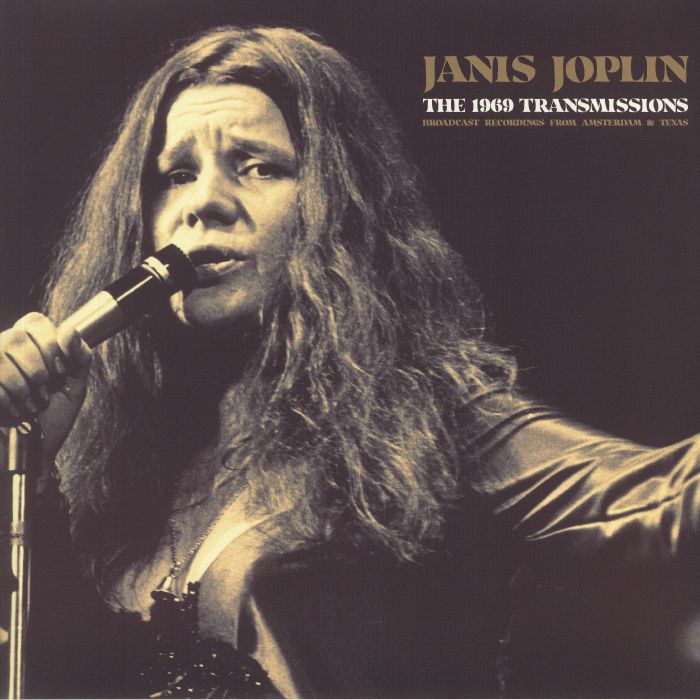
One of the finest shows Janis and band performed during this time was at the Concertgebouw in Amsterdam on 1st April, which was recorded for FM Broadcast and transmitted live across central Europe. Janis Joplin is of the most successful and widely known rock stars of her time. 50 years after her death she remains famous for her powerful vocals and “electric” stage presence.
Fuelled by The Kozmic Blues Band she knows how to rock a concert hall build for classical music. Experience the rich sound of this unforgettable performance like never before with hit songs like ‘Ball and Chain’, ‘Piece of my Heart’ and ‘Try (Just A Little Bit Harder)’.
Janis Joplin also performed at the Woodstock Festival in August 1969, and a few weeks later, in her home state, at The Texas International Pop Festival. This set was also broadcast and is generally deemed by critics to be a better performance to the one she gave at Woodstock. Both the Amsterdam and Texas performances are now included in full on this vinyl, providing fans with a fine opportunity to hear these rare recordings, which have remained unavailable for so long.
Live at the Concertgebouw, Amsterdam, April 1st,1969.
Janis Joplin – vocals. Sam Andrew – guitar,vocals. Gabriel Mekler – keyboards. Terry Clements – tenor saxophone. Cornelius Flowers – baritone saxophone. Luis Gasca – trumpet. Brad campbell – bass. Lonnie Castille – drums.
The new single, “I Will Be Gone,” is the title-track off her upcoming album out April 16th via Shimmy-Disc.
Per the press release: I Will Be Gone, which represents a collaboration between Emily Rodgers, her husband/guitarist Erik Cirelli and legendary producer Kramer, with whom she has worked for over a decade, was written and recorded in just six days. While the title track, “I Will Be Gone,” was fully formed before Kramer arrived, the rest of the album was written and recorded in Emily and Erik’s attic in Pittsburgh, utilizing lyrics by Emily and music by Erik. In addition to mixing, mastering, and producing the album, Kramer also serves as vocalist, bassist, pianist, and arranger, and the record belies an immediacy that is reflective of the time-limited nature of the recording process. Emily, Erik and Kramer plan to continue to write and record albums in this fashion, once the pandemic has passed and it is possible to be together again.
Emily Rodgers’s music has been compared to Mazzy Star, Cat Power, and Neil Young. Rodgers has shared stages with artists including: Magnolia Electric Company, Great Lake Swimmers,
Via Shimmy-Disc: New LP of songs coming soon from Emily Rodgers, an artist Kramer has been working with for over a decade. “This is her very best work. The emotional range of these new songs is immeasurable”, Produced by Kramer (Galaxie 500, Daniel Johnston, Will Oldham), who has praised her music in a number of interviews, callingher “a songwriter in the classic sense of the term.”
Mixed/mastered/produced by Kramer Emily Rodgers-vocals, guitar Erik Cirelli-guitar, mandolin Kramer-vocals, bass, piano Megan Williams-violin Mark Lyons-percussion
If Harlequin, she of Joker girlfriend fame, sat down and penned a song, then something in the opening section of “Seize The Power”, tells me it would be this. I’m writing this review upon the first listen as it grabbed me at the first sound. I’ve not even written the first sentence fully when I’m hearing lyrics “forget me and the Joker” and I’m all “bam! It’s not just Yonaka that are back… I’m back and I’ve still got it!”
Evidently, Yonaka never lost it. This is another dark, powerful and raw rock track, the fabrics of which are stitched together with tiny slithers of other musical genres. My instincts were to use their term Urban, but that is so trite in 2021, but to me, there is certainly a hint of grime, a dollop of dance (is Theresa channelling the late Keith Flint here? I feel like The Prodigy would make the mother of all remixes of this- and if you’re looking for a cover I wouldn’t mind Nothing But Thieves giving this beauty a bash).
Who has seen the video for the Seize The Power? It was super fun to make from smashing through glass (sugar ) being poured in like 2 bottles of lube to get that latex on and everything else. I am so proud of this and thankful to everyone who worked so hard on it. Thanks for the wake-up call….. and the dollop of empowerment!
Happy 20th Anniversary to The Cure’s eleventh studio album “Bloodflowers”, originally released in the UK February 14th 2000 and in the US February 15th, 2000.
The Cure greeted the millennium with their eleventh studio album Bloodflowers, a deliberate statement from singer and guitarist Robert Smith written in the run-up to his fortieth birthday. Whereas predecessors Wish (1992) and Wild Mood Swings (1996) were more exploratory entanglements by the British group’s five members, Bloodflowers shows Smith fully reclaiming the artistic reins, just as he had 10 years prior with Disintegration (1989).
At the time he was making Disintegration, Smith was recently married and confronting the crisis of turning 30. His meticulous care in delivering on his vision for Disintegration was not only a gift to himself and the band, but to fans as well. Nearly 31 years later, the gorgeous opus continues to stir love and tears among all who come to know it. But, perfection is never easy to attain. And, Smith was well-aware of his obsessive, if agonizing, ways.
Speaking circa Bloodflowers’ released in February 2000, Smith commented, “I was very difficult to work with on this album, as I was with Disintegration, for that reason because I insisted everything was done exactly as I wanted. So, it’s kind of unpleasant band members really cos they don’t feel that they’re of any value, I suppose, when we’re making the record. Although I try and impress upon them the fact that without the group, it wouldn’t sound like The Cure….Who’s in the group defines the sound. But, with Wish and with Wild Mood Swings, they were group collaborations and everyone had a say. And I would kind of be just a fifth member of the band really a lot of the time.”
Only about half of the songs seemed to have any real depth. To my barely adult ears, the new album sounded somewhat recycled and uninspired. “39,” the penultimate track from Bloodflowers I caught up to the headspace Smith was in when he penned that song. But, it was also distressing to feel the gravity of the lyrics and realize them to be true: “Half my life I’ve been here / Half my life in flames / Using all I ever had to keep the fire ablaze / To keep the fire ablaze / To keep the fire ablaze / To keep the fire ablaze…But there’s nothing left to burn.”
After giving so much of yourself to life, whatever that may entail—relationships, career, artistic expression, yourself—it can be incredibly draining. It’s a struggle to find the energy to keep going through the motions, and if you do, it’s often devoid of emotion, which is all the more devastating for someone whose identity is so entrenched in feeling.
But, if Bloodflowers met midlife with this scorching warning, it also offers mature meditative acceptance that youthful ambitions and hopes may blind us to. Even in their earliest moments, Cure lyrics and instrumentation held a wistful longing, a romantic pull against reality, a nostalgic yearning for what never was. And although so much of Smith’s poetry, and the accompanying melodies, acknowledge the painful, often tragic, rift between fantasy and reality, time and time again, the records return us to this dreamlike world. With Bloodflowers, Smith consciously faces these idealistic tendencies. His choice to release the album on Valentine’s Day offers further evidence.
Smith explained, “I just thought it would be kind of darkly romantic…Valentine’s Day when you’re young particularly is a day of unrequited love. It’s actually one of the most depressing days of the year because you find yourself unable to tell the person you’re lusting or loving that it’s you….There’s elements of that, I think, that are in Bloodflowers…that sense of love never ever being able to be perfect, like my constant desire for things to be just as they are, as they should be and for them always to be as they are, which is not how I want them to be.”
As the tracks progress on Bloodflowers, the illusory narrative of youth asserts itself before eventually withering into quiet acquiescence, delivering waves of the heart-melting pangs, tingles and thrills long synonymous with The Cure.
“Out of This World” is the enchantingly woozy opener, immediately drawing us into a dreamy reverie no sane soul would ever want to crawl out from—even if we know we someday must. It captivated me the moment I first heard it 20 years ago and tranquilizes me still. As mentioned, I’ve come to comprehend the sage musings of Bloodflowers, but if this song was the album’s only treasure, I’d cling tight to it forever. And in many ways, that’s what this starry-eyed, wonder-filled intro is all about.
The escapist sentiments continue into the writhing odyssey of “Watching Me Fall,” which thrusts headlong into the expansive night with nocturnal seductions and terrors that would serve handsomely as the abstract to David Lynch’s next film. Perhaps not so coincidentally, the song takes place in Tokyo, which is where I chose to celebrate my 40th birthday. (Have I already mentioned how Smith is always way ahead of me?)
Although my take on Bloodflowers has shifted in the last few years, I can’t say I’ve warmed up to the album’s third and fourth tracks, “Where the Birds Always Sing” and “Maybe Someday.” However, Smith has noted the latter was included to add a little upbeat levity to an otherwise heavy record. Unsurprisingly, it was also the first promotional track for U.S. radio, which is telling, especially since Smith was adamant about not releasing any singles for Bloodflowers.
The remainder of the album showcases the breadth of The Cure’s songwriting talents, with songs like “The Last Day of Summer” and “There Is No If” evoking some of the band’s sweetest ‘80s B-sides. In fact, although the two flow together well, “There Is No If” was written in Smith’s adolescence, signifying a constancy in character despite his newfound perspective. I’m so glad this courageously simple tune about innocent love found the light of day, and revel in its placement between the solitary depleted spirit of “The Last Day of Summer” and the shared disillusionment of “The Loudest Sound.”
It’s been so long I can’t quite remember what I envisioned upon first hearing “The Loudest Sound,” but now I see a relationship that hasn’t run its course. Rather, it lives on in calm perpetuity. The couple have grown old together and care for each other deeply. The chimes are no longer bursting and the edge-of-the-world exhilaration is no more, but they both remember what those heart-racing moments were like together. And while the tenor of their connection has evolved, they’re still side by side, united by the commonality of their youth and the loneliness of aging. Despite the silence, his thoughts still manage to echo hers. When I was younger, I probably thought of these lyrics more in the vein of The Cure’s “Apart” (from Wish), but Smith’s ever-masterful words are well-suited to new interpretations.
As Bloodflowers approaches its end with the aforementioned “39” and the closing title track, it pushes past the acknowledgement of our individual finite capabilities into a greater spiritual understanding. The fire may indeed be almost out, but it’s better to accept that as part of life than to fight reality.
Before Bloodflowers, the Cure trilogy consisted of their second, third and fourth albums— Seventeen Seconds (1980), Faith (1981) and Pornography (1982)—as they were created in close succession and thematically related. However, once Bloodflowers was completed, Smith reassessed the trilogy as Pornography, Disintegration and Bloodflowers, citing these works as the three definitive achievements in the band’s career. I still wouldn’t say Bloodflowers is in my top three Cure albums, but I certainly have gained newfound appreciation in the last few years and see how it rounds out a story, for Smith the individual and the artist—and how the two are irrevocably intertwined.
Smith recalled, “When we were making it, everyone in the group believed that it would be the last Cure album because I wanted to have that sense of finality. There’s no point in making a record like Bloodflowers if you really think you’re going to do something else. I wanted it so that Bloodflowers would be so perfectly The Cure, there was no point in making another Cure album.”
The Cure
Robert Smith – guitar, keyboard, 6-string bass, vocals
As a member of the Buzzcocks, Shelley—alongside co-guitarist Steve Diggle, bassist Steve Garvey and drummer John Maher—released three albums (Another Music In A Different Kitchen, Love Bites and A Different Kind Of Tension) in the late ’70s which pretty much drafted the blueprint for modern pop punk.
The band originally started with frontman Howard Devoto in the lead singer slot for the infamous 1977 EP Spiral Scratch. When Devoto quit to join the band Magazine, Diggle was enlisted, and Shelley moved to the vocalist position.
During their late-’70s tenure on the United Artists label, the Buzzcocks crafted one perfect pop-punk track after another. They were masters of fractured love songs that were everything from cautionary (“Ever Fallen In Love (With Someone You Shouldn’t’ve)”) to awesomely creepy (“Orgasm Addict”). While the band had energy to spare, the tunefulness of the songs caught the ears of fans of the then-nascent new-wave scene.
June 21st, 2019, Royal Albert Hall, London: What was intended as a celebration of perhaps English punk’s most universally beloved band, The Buzzcocks, is now a wake. On December. 6th, 2018, frontman Pete Shelley died of a heart attack in Estonia, where he’d been enjoying a less hectic existence than London had afforded him for 30 years.
The occasion was supposed to be the biggest 1977 punk gig ever, with opening sets from Penetration and the Skids. The original Buzzcocks rhythm section of bassist Steve Garvey and drummer John Maher would join remaining co-guitarist/songwriter Steve Diggle and current drummer Danny Farrant and latter-day bassist Chris Remington. But now the center mic had no one manning it. The band’s guitarist and chief songwriter was gone. Diggle announced he’d keep Buzzcocks going, in an agreement made with Shelley. Valiant and appropriate, considering all the best modern-day Buzzcocks songs, such as the extraordinary “Sick City Sometimes,” were Diggle’s. When you see them on tour, he will be singing Shelley’s songs, too. But that night at Royal Albert Hall, a brace of special guests took the stage. Peter Perrett of the Only Ones; Penetration’s Pauline Murray; The Skids’ Richard Jobson; Dave Vanian and Captain Sensible of the Damned; Tim Burgess of the Charlatans UK; and Sonic Youth’s Thurston Moore.
For the grand finale, every single guest vocalist piled onstage to sing the greatest Buzzcocks tune, “Ever Fallen In Love (With Someone You Shouldn’t’ve?).” They needn’t have bothered: All that was necessary was to turn the mic toward the audience and play instrumentally. The crowd knew every word.
This was because Shelley did write the best songs in all of punk. So good, they went beyond punk. He had a keen melodic sense. It was born of ’60s pop but leavened with a yen for the strident experimentation of German art-rock acts (Can, Neu!) and the fundamentalist rock ’n’ roll of glamsters such as David Bowie. But most important was his subject matter: He wrote supremely universal lyrics. They were almost all love songs, except no one got the object of desire in a Shelley song. And they might as well have been objects, considering gender was never specified in any of them. Perhaps this was due to his lifelong bisexuality. But it was as revolutionary as any political lyric coming out of London.
There are exactly five essential Buzzcocks albums that are stone-cold classics.
Behold the dawn of U.K. indie rock, as well as DIY and several other historic firsts. Buzzcocks were initially conceived by university students Howard Trafford and Peter McNeish in 1976, after having their Damascene moment seeing the Sex Pistols earlier that year. Diggle met them after they became Howard Devoto and Pete Shelley at the summer 1976 Pistols gig in Manchester that sired the entire local scene. (The Fall, Joy Division, Factory Records and the Smiths all start here.) Diggle was meeting someone else at the venue, and it was then Sex Pistols manager Malcolm McLaren accidentally introduced him to the Buzzcocks singer/guitarist. With teenage Keith Moon acolyte Maher on drums, they wed a noise akin to a krautrock Ramones to Devoto’s arch lyrics, delivered in a flat yawp impossible without Johnny Rotten’s example.
Following a rough-and-ready demo session (captured on Domino’s Time’s Up LP), the band decided to properly document the sound they’d forged. Four songs were recorded in late December 1976 by Martin Hannett, the man who shaped the sound of Manchester. “It took three hours [to record], with another two for mixing,” Devoto recalled of the session. Funds exhausted, the band borrowed £500 from friends and family to press it. Released on Jan. 29th, 1977 on their own New Hormones label, Spiral Scratch made Buzzcocks the first British punk act to issue their own records. It swiftly sold out its initial thousand-copy pressing.
Historical value aside, the music makes this such a brilliant release. Crisply recorded and sonically dry, there’s an urgency to these speedy missives, especially “Breakdown” and “Time’s Up.”“Friends Of Mine” bemoans pals who keep Devoto “pissing adrenaline,” while Shelley unleashes a two-note guitar hook across “Boredom” that sounds simultaneously like a siren and the death of six-string heroics.
Almost immediately following Spiral Scratch‘s release, Devoto decided punk’s over and he’s done all he wanted with Buzzcocks. He left to finish his university studies, eventually forming prime post-punk outfit Magazine after graduation. This put Shelley in front of the centre vocal mic, enabling Diggle to return to guitar. Garth Davies assumed bass duties, replaced by the more-amenable Garvey by the time Buzzcocks signed with United Artists Records. The explosive “Orgasm Addict” 45 soon followed, guaranteed to escape airplay.
In December, the band entered the legendary Olympic Studios to essentially liquidate their inventory of Devoto-era material for a debut LP. Another Music In A Different Kitchen offered 11 slices of loud speed pop. With Maher’s animalistic drums propelling Shelley and Diggle’s hot-wired guitars, the former’s fey, delicate warble delivered lyrics surely penned by Devoto, such as the skewering of the traditional rock obsession with hot rods, “Fast Cars.” But it was on “I Don’t Mind” that Shelley previewed his vision for Buzzcocks’ future: a singles band offering a bitter view of romance, with no one getting the object of desire.
Six months after the release of their debut LP, Buzzcocks appeared bleary-eyed and disheveled from Love Bites‘ pure white sleeve. The music also sounded less upbeat than Another Music. This is the sound of a band who’d undertaken two national tours, countless Top Of The Pops appearances and issued two hit singles on the way to its creation. Not that Love Bites lacked energy. The key track is their greatest single, “Ever Fallen In Love.” Perhaps the most glorious singalong ever written, the lyrics lament a secret love that could ruin a friendship. (“I can’t see much of a future/Unless we find out what’s to blame, what a shame/And we won’t be together much longer/Unless we realize that we are the same.”) Yes, Shelley essentially wrote “Love Will Tear Us Apart” a full two years before Joy Division did. “Ever Fallen In Love” is better, however.
The greatest Buzzcocks album isn’t a proper LP. It’s a greatest hits album, assembled from the eight U.K. 45s they’d released across the previous two years, presented in sequence with the A-sides on Side One and the Bs on the reverse. Intended as a U.S. introduction to the band as they embarked on their first American tour in the second half of 1979, “Singles Going Steady” worked because it presented all of Shelley and Diggle’s best material. It’s their essential music. Buzzcocks would never record a more perfect full-length.
The last original Buzzcocks album was the sound of Shelley’s nervous breakdown, set to a precursor of modern cut-and-paste digital record production. Yes, it was recorded analogue. But all guitars and vocals were set atop tape loops of the Maher/Garvey rhythm section. Electronic elements were seeped in, flavouring even Diggle’s punk screamers (“Mad Mad Judy”). But the heart of this LP is the fragile, disturbed tunes Shelley was penning under doses of LSD. “You Say You Don’t Love Me” was the one great 45 not on Singles Going Steady. But the album’s highlight is truly the lengthy existential breakdown “I Believe,” with its shrieked refrain of “There is no love in this world anymore!” From here came the 45 RPM triptych that became 1981’s Parts 1,2, 3 and dissolution until eight years later. Buzzcocks live, since 1989.
Unlike many acts with similar beginnings, the Buzzcocks carried on making great records and sharing stages with contemporary acts. Whether he was supporting ’90s alt-rock staples (Nirvana, Pearl Jam) and still getting must-see notices on stages from Warped Tour (summer of 2006) to the 2017 Riot Fest stage, Shelley was still bringing joy, sweat and harmonies for your head, feet and heart. The man may be gone, but his place in punk history will continuously resonate and evolve.
“It’s good that people like what we do,” Shelley told AP in July 2008. “It’s an unexpected side effect because when we started out, we thought no one would like what we did at all. It was the most uncommercial form of music we were attempting to do.”
When younger fans approached him to say their parents were big fans of the Buzzcocks, Shelley would say “I congratulate them on a fine choice of parents.”
This song is an anthem of sorts about the possibility of each new, seemingly meandering and unimportant day. I use the reference to Bloomsday, born from James Joyce’s “Ulysses”, as a substitute for any day, just a normal, nothing special, any day. The song is meant to inspire the agency we have over our participation in any day. Although it feels like much of the time we are being pulled along in life, we have the instrumentality to find within us light and belief.
I also have a music video for the song which you can view now! Because this song reminds me of the capacity I have for influencing my own day, the days of others, and a larger connectivity, I wanted to express that in the video as I was coming up with the concept. I wanted to write a visual story that showed the simplicity of that exchange. I had the idea of this cake being passed around in a very simple “pay it forward” fashion…one person is shown kindness, light, belief, wisdom… and can choose to pass that along to someone else.
FYI *We did not eat this cake afterwards as it had to be frozen multiple times between shoot days AND many fingers and clothing articles ended up in it or upon it, so it went in the bin…sadly* RIP Bloomsday cake.
Since I’ve been sequestered at home for the past year, I’ve been reminded of the specific beauty and complexity of Oklahoma and the fascinating things being made here and I want to share that with others. in celebration of vacationing in your own back yard, I’m giving away a mega-prize of Oklahoma-made products to someone. It will include art prints and objects by some of my favourite local artists, a guitar pedal from a local boutique pedal company, books by local authors and on local interest, local food products, and other goodies. All you have to do to enter is pre-save the album on your favourite streaming service – make sure to tick yes on receiving updates so we can contact you if you win!
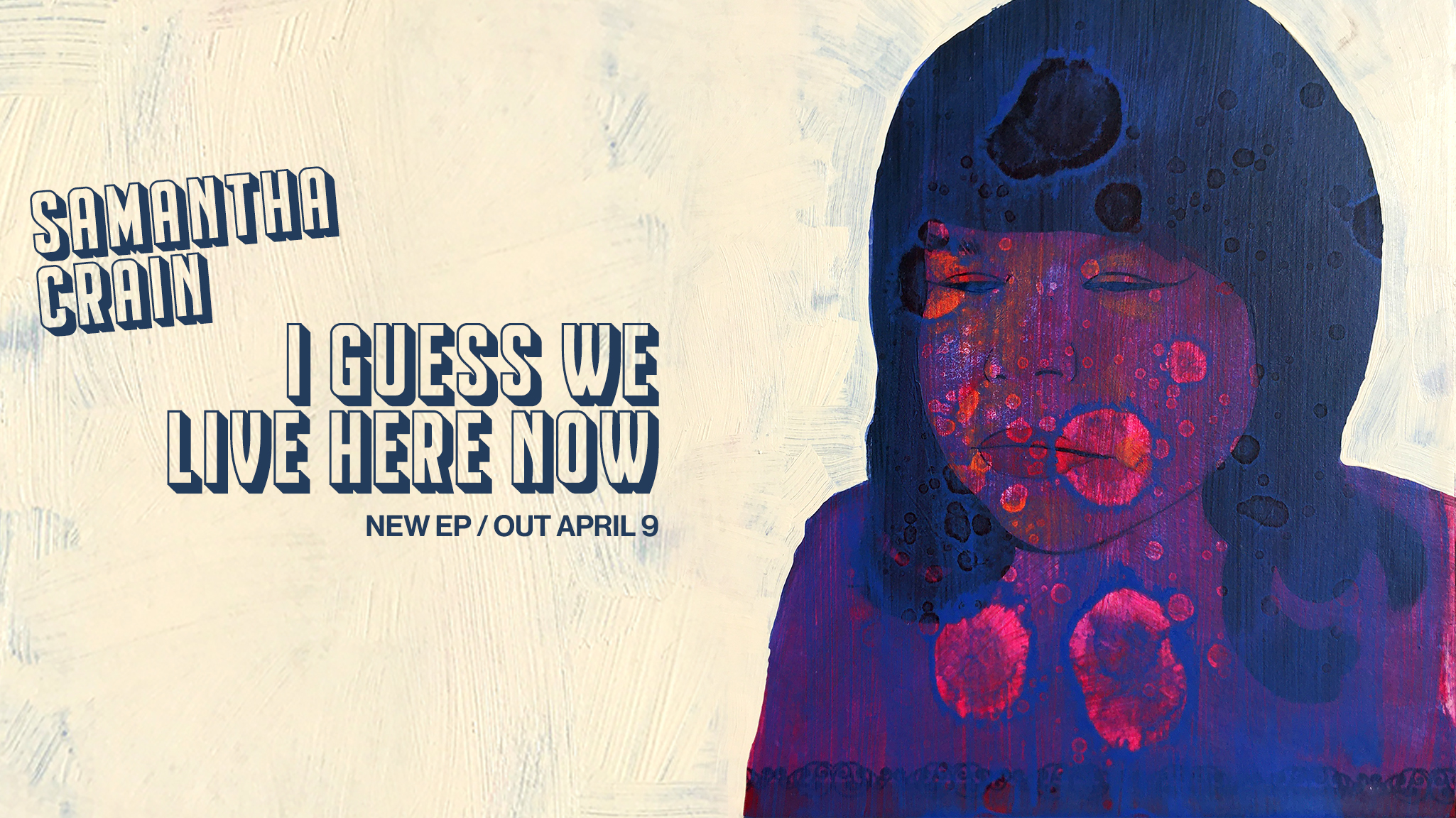
My new EP ‘I Guess We Live Here Now’ will be out April 9th on Real Kind Records. Pre-order and listen to new single ‘Bloomsday’ now. Pre-order the Limited Edition 10″ vinyl record exclusively on Bandcamp now.
The Other Half were formed in Los Angeles in 1965; some of the members met in the MGM mailroom. They played covers of The Kinks, The Yardbirds, The Animals, and The Rolling Stones, and their first gig was opening for The Doors. Amazingly none of the original members were still in the band when they recorded ‘Mr. Pharmacist’ in 1966 – early guitarist Tommy Lennon was drafted, while keyboardist John Branca was fired because he was too young to play in 18 plus venues. Composed by singer Jeff Nowlen, ‘Mr. Pharmacist’ was released in November 1966 but wasn’t a big seller perhaps its barely veiled drug references were too daring for the time.
‘Mr. Pharmacist’ is similar to Count Five’s ‘Psychotic Reaction’, released a few months earlier, in but it stands on its own as a great pop tune. Many younger listeners may have heard The Fall’s 1986 cover before the original. The Fall’s version is tougher sounding but Jeff Nowlen’s vocal is surprisingly similar to The Fall’s acerbic Mark E. Smith. Nowlen often adds an “uh” to the end of each sentence, just like Smith.
The Other Half released their only studio album in 1968 – it didn’t include ‘Mr. Pharmacist. Lead guitarist Randy Holden left the band shortly after, and they broke up after they were unable to find a suitable replacement. Rhythm guitarist Geoff Westen continued his music career but also worked as a graphic designer, creating the sleeve for Steely Dan’s Aja. Lead guitarist Randy Holden joined Blue Cheer for their 1969 album New! Improved!, while bassist Larry Brown found work in TV and film composing.
The Other Half – Mr. Pharmacist / I’ve Come So Far