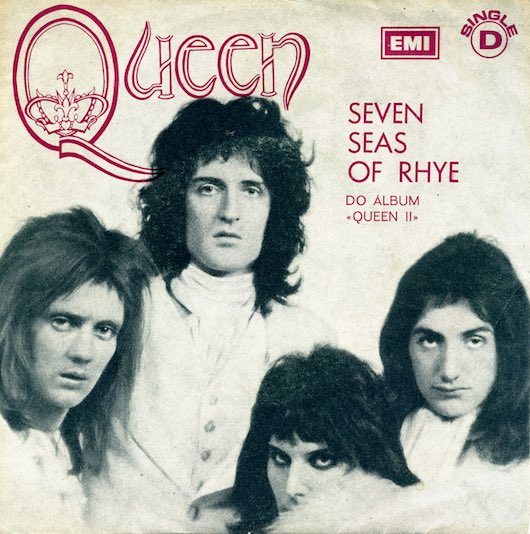
In early March of 1974, Queen did something that they’ve now done 54 times to date. They made the UK singles chart for the very first time, as ‘Seven Seas Of Rhye’ took its bow at a modest chart place No. 45. It was the first of what currently stands at 440 weeks overall on the British bestsellers or, to put it another way, nearly eight and a half years.

The song has, of course, taken its rightful place in Queen history, both for being their chart breakthrough and for representing the band at the height of their rocking powers. But when Roger Taylor spoke to Record Mirror in 1975, he revealed that he hadn’t expected it to do well, and that he had thought their earlier, debut single, which wasn’t a chart item, would perform better.

“Apart from ‘Killer Queen” he said, “which was obviously catchy, I don’t think of our singles as being immediately commercial. For instance, when ‘Seven Seas of Rhye’ was a hit, I was very surprised. It was only intended really to draw attention to the album. I thought that ‘Keep Yourself Alive’ was a much more commercial song. I think it is probably an advantage not to know exactly what will sell, “because then you are not inhibited in your choice of a single.”

As ‘Rhye’ made its chart debut, the album it was on, Queen II, was new in the shops, and the single and LP would climb the UK charts in tandem. After that No. 45 entry, ‘Seven Seas’ climbed to No. 30 and then No. 15, where it seemed to have stalled before it rose again, peaking at No. 10 in mid-April. Queen II would within two weeks it was in the top ten, for a No. 5 peak. Queen’s sales momentum was now well and truly under way.

“Seven Seas of Rhye” was primarily written by Freddie Mercury, with Brian May contributing the second middle-eight. The song is officially credited to Mercury only. A rudimentary instrumental version appears as the final track on the group’s debut album Queen with the final version on the follow-up Queen II , The completed version served as the band’s third single, It was publicly premiered when Queen were offered a sudden chance to appear on Top of the Pops in February 1974, and was rushed to vinyl two days later in February. It became their first chart entry after gaining airtime on BBC Radio 1.
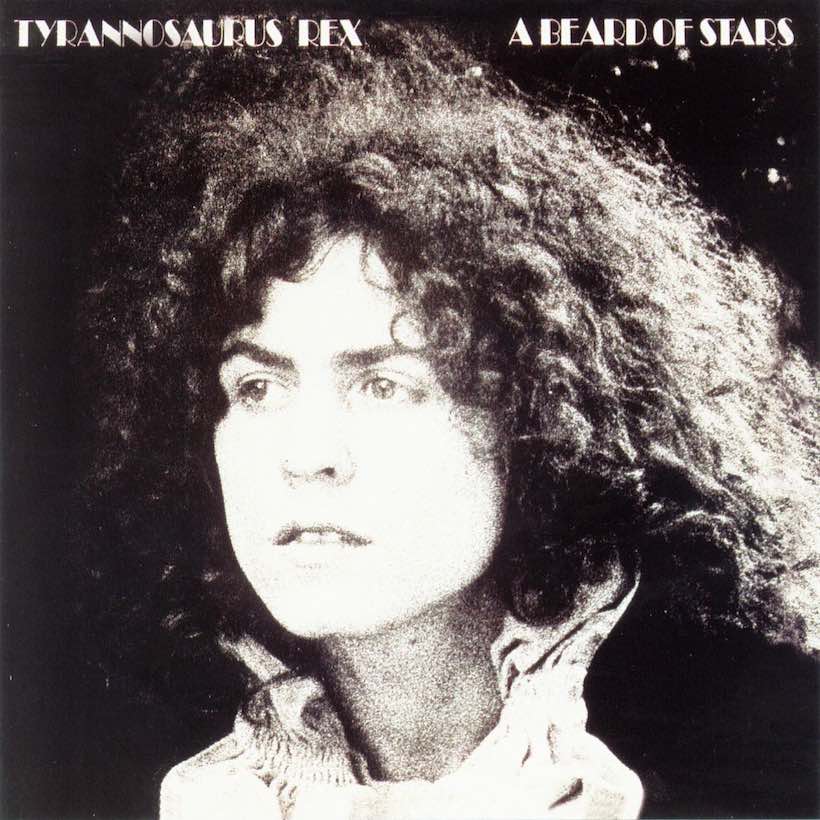
“Something was definitely happening,” said Tony Visconti. “We knew we were getting closer to what we wanted.” The American-born producer was talking about A Beard Of Stars, the album that paved the way for the “Bolanmania” of the early 1970s. The final LP released by Marc Bolan and his band as Tyrannosaurus Rex before they transmuted into T. Rex, it came out on 13th March 1970.

The album was the follow-up to 1969’s Unicorn, after which Bolan took the bold and decisive step of firing musical partner Steve Peregrin Took. His voice was already on some of the new material Visconti had recorded, so the producer had to replace it with new vocals by Bolan. Meanwhile, Took’s successor, Mickey Finn, started to be integrated into the band. Even if Visconti would find him to be less versatile than his predecessor, his good looks were a help, and he played percussion.

In his autobiography, Bowie, Bolan and the Brooklyn Boy, Visconti wrote: “The album was made in a really good atmosphere, helped no end by Finn’s positive spirit, which all led to the sessions being very creative and experimental.” A Beard Of Stars was also the album on which Marc Bolan went electric, playing Visconti’s guitar just before buying his own Fender White Stratocaster.

“A combination of Marc’s growing proficiency on rock guitar and my engineering chops getting better helped the duo sound more aggressive,” remembered Visconti. One single was released from the album, ‘By The Light Of A Magical Moon’; it missed the UK charts, but the album debuted and peaked at No. 21 and totalled six weeks on the bestsellers. It was clear that Marc Bolan was ready to become the pop star figurehead and idol he soon turned into.

“A Beard of Stars” was the fourth studio album by English psychedelic folk band Tyrannosaurus Rex, and their last before changing their name to T. Rex. It was released on 13th March 1970 by record label Regal Zonophone.

Tracklist 1. “Prelude” 1:04 2. “A Day Laye” 1:56 3. “Woodland Bop” 1:39 4. “Fist Heart Mighty Dawn Dart” 2:45 5. “Pavilions of Sun” 2:49 6. “Organ Blues” 2:47 7. “By the Light of a Magical Moon” 2:51 8. “Wind Cheetah” 2:38 9. “A Beard of Stars” 1:37 10. “Great Horse” 1:42 11. “Dragon’s Ear” 2:37 12. “Lofty Skies” 2:54 13. “Dove” 2:06 14. “Elemental Child” 5:33

Warpaint‘s Theresa Wayman announces new music under the moniker TT.

Track Love Leaks is the first to be taken from brand new album LoveLaws, which will be available on 18th May.

hi all! Theresa here, introducing my new solo project — TT —
It’s my first body of work called  “LoveLaws”  is to be released on May 18th, 2018 but today, the first peak of the album is a track called Love Leaks. have a listen! there’s a link below and also across every social platform cuz i guess that’s just the way things go these days….
I hope you enjoy the sounds! it’s been quite a journey making them.. I’ve learned so much about myself. I suppose that’s the point of art and the creative process…to see what we look like like on the inside. and to hear what we have to say.
peace and love to you all! 

Chicago musician Jude Shuma,  talks about his creative process, his influences, and news about his upcoming release, this charismatic singer-songwriter, multi-instrumentalist, producer, and part-time exterminator that is Jude Shuma. He says:

“I found my grandma’s guitar under my mom’s bed… started playing it, had a few lessons and then I bought a little 8-track recorder. From there, I just kinda… I wanted to write songs, so I started writing songs and kinda laid down one track, and then laid down the next,” Jude explains when I asked what got him into music. Now, more than 15 years later, Jude says he’s collected more than enough instruments and gear to start his own home studio, saying, “It’s kind of been like a ball and chain, cause you have all this gear and you need the space and the studio to record. Living in an urban area like Chicago, it’s really hard to find a space…you can get a rehearsal space with other bands, but then you’ve got fucking metal bands next door to you and you can’t record an acoustic guitar. So it’s been kinda like, the past four years I’ve been bouncing around and finding new spots.”

he loves producing, at the moment he acknowledges that he can’t really take on production work for other artists, although he wouldn’t rule it out in the future. “I think once I finish this record, I’ll be more in control. People open studios, and then they can’t chose who they get to record there because they need to accept business to keep the money flowing. I wanna be able to be a little picky.  I want to work on music I like. Although he plays live shows with three musicians called Blaze, Blade, and Church, Jude currently plays everything from drums to bass by himself in the studio, saying that he often finds himself running back and forth between instruments.

EP Biggest Hits out now

http://

Biggest Hits was my first attempt at engineering a record with a tape machine. I wanted to make a record that wasn’t so much driven by computers and plugins, but rather the instruments and the tones that I chose. Try to get it right the first time so when it came to mixing, the majority of the work was already done. I wanted that 60’s record simplicity in a 21st century fashion.

Wilco - Star Wars

On July 16th, Wilco shocked their fans in the best way possible: by releasing Star Wars, the band’s first album in four years, for free on their website, with no advance warning. The album is Wilco’s best in at least a decade, full of loose, poppy rockers like “Random Name Generator” and “The Joke Explained.”  After recording the basic tracks himself in the Wilco loft in Chicago, frontman Jeff Tweedy brought in the other members of the band separately to play on them. The process has proved so productive that Tweedy says he’s already halfway finished with the next Wilco album. “I have a whole lot of material,” he says.

It’s kind of an extension of the thought process behind, I don’t know, staying in touch with some sort of wild energy as much as possible and some sort of an irreverence. But that painting of that cat hangs in the kitchen at the [Wilco] loft, and every day I’d look at it and go, “You know, that should just be the album cover.” Then I started thinking about the phrase “Star Wars” recontextualized against that painting — it was beautiful and jarring. The album has nothing to do with Star Wars. It just makes me feel good. It makes me feel limitless and like there’s still possibilities and still surprise in the world, you know?

“What’s more fun than a surprise?” Jeff Tweedy asked cheekily on instagram as he introduced us to Wilco‘s ninth studio album. In a year when fans of another Star Wars were being incessantly teased, this album dropped out of nowhere, no endless teaser trailers required. Instead it was free to download,

The album’s got a great sound—jagged guitar (courtesy Nels Cline), distorted vocals—but a critical shortage of great songs. “You Satellite” rules and “Random Name Generator” is formidable enough to make Jeff Tweedy feel like a shapeshifter rock star, but much of the album feels unfinished, like sketches for something that might’ve been great, a perception that’s fairly amplified by the album’s brief length and lazy title. The best thing you can say about Star Wars is that it injected some spontaneity, some aggression back into Wilco’s music. The album thrilled fans when it was surprise-released for free in 2015, following the longest gap between Wilco albums to date. But it’s already been eclipsed by the superior Schmilco. Wilco’s weakest effort isn’t bad at all, just—well, underwhelming

Kitsch kitty cover art and silly title aside, the fuzzed up, lean rock on Wilco’s most concise album in years took plenty of unexpected turns. Tweedy worked largely alone, the band adding the gloss and grit to finished arrangements and basic tracks. The result is at times wild and weird but always Wilco.

We did our best mechanic impression and starred in a vid for “Desire” made by the great Heather Rappard. Check it out below! .

Ought the great Montreal post-punk outfit returned with their third album, “Room Inside The World”. It’s a dense, exciting new collection of songs, one that rewards spending some time with it and parsing all the different avenues the band ventures down across its nine songs. Of course, there were also tracks that didn’t require too much patience, compositions that immediately revealed themselves to be something special. One of those was “Desire,” a song that also acts as a highlight and centerpiece once heard in the context of Room Inside The World as a whole.

The video for “Desire.” The clip begins simply, a nicely filmed performance from the band interspersed with a narrative that follows a guy who affably but somewhat shyly goes about his daily routine. We see him go to work, meet a friend at a bar, and hit it off with a waitress at a coffee shop. But he really comes into his own when he dresses up in drag and winds up fronting Ought during the climactic build of “Desire.”

It’s a video that plays with the song’s central themes as well as gender. Here’s what director Heather Rappard had to say about the concept:

“Desire” as a song has a real triumphant quality and masculine energy; I wanted to take this and subvert it and create a video that focused more on internal desire. Something that was important to me was that the video feel cathartic and positive; I’ve seen a lot of videos that take on ideas around gender that have characters being assaulted, or just exoticized. I wanted this character to have a full life but be most empowered, happiest, and at peace with himself when he’s on stage at the end.

Room Inside the World is Ought’s third album and their first for Merge Records growing up doesn’t mean mellowing out so much as it means learning to pay attention, listening carefully and openly, staying somewhere long enough to really understand where you are. Recorded at Rare Book Room in Brooklyn with producer Nicolas Vernhes (Deerhunter, Animal Collective, Silver Jews), Room Inside the World explores themes that have always concerned the band—identity, connection, survival in a precarious world—but with a bolder, more nuanced sound palette. Vibraphone, justly intonated synthesizers, drum machines, and a 70-piece choir suffuse the precise post-punk breakdowns that spangled Ought’s first two albums, giving rise to an emotional complexity that pushes their characteristically taut sound to greater depths.

The band are in Austin this week for SXSW, performing on some great showcases before heading back out on our headline tour.

I hope you are having a fab spring! I have manifested in your inbox to let you know that today is the 28th birthday of my 1990 record “EYE”. The picture at the bottom is the promo shot we used at the time and marks the inception of my last mullet haircut phase, which sadly didn’t end until 1993.  “EYE” may not be the easiest listen, but it is my favourite collection of my own songs. The album was recorded in San Francisco during a period of great personal turbulence. I was breaking up with two people at once and the misery shines through all these years later. Rock on universe! To celebrate the album’s Saturn Return, we created a new t shirt that riffs on the original album artwork.

Promotional clip for Robyn Hitchcock’s ‘EYE’ record. Made in early 1990 in London by Tony Moon & Robyn Hitchcock. 
Fast forwarding into the bewildering present, I have a new 7 inch vinyl coming out on Record Store Day this year. The release is a live recording of three tracks from my 2017 show at The Troubadour in Los Angeles with His LA Squires. The A Side is “Insanely Jealous” and the B Side is “I Pray When I’m Drunk” and “If You Were A Priest”. Get to your local record store on April 21st

Welcome to the world of Natalie Prass co-produced by Matthew E. White. It looks a lot like our own, but it’s all painted in bright smears of blue and light pink. There are a lot more horns this time. The year of the ’70s singer-songwriter never really took off again, but Prass album certainly did, and that’s mainly due to the boundless creative energy she exhibits on her debut, where the limits are only as high as her ambition. The 2015 album from the Nashville-based singer/songwriter. Not only one of the sharpest up-and-coming songwriters in Nashville, Natalie Prass possesses a rare artistic method she infuses into all her endeavors. She handcrafts album artwork and flyers and organizes local vinyl listening parties/drawing sessions, and there appears to be little end to the homespun creativity of this bright young talent. She’s also no slouch in the pipes department either — the girl can sing. While her delicate alto evokes clear benchmarks of influence — see early Rilo Kiley, Feist, Karen Carpenter, etc. Natalie Prass never seems weighed down by the artists she’s absorbed. Instead, she has developed a refreshing guitar-grounded musical vocabulary and a knack for infectious and entrancing tunes. Still, it’s a spirit of invitation and friendship that continues to be Prass’ most pronounced attribute.

By crafting ornate, grandiose arrangements about heartbreak and loss and desire, she imbues all of these emotions with the dramatic flair they deserve.

Natalie’s live set also got better as the year went on, but she was never short of surprises throughout it all. One night at the Los Angeles’ Troubadour, Prass brought out Ryan Adams on stage for a couple songs that left the crowd speechless (and she was opening for San Fermin mind you). Prass essentially courses through the entirety of her brilliant debut album (Top Albums of 2015) and her incredible backing band is just as mesmerizing as she is. Trey Pollard on guitar, Michael Libramento on bass and Scott Clark on drums all—like Prass—hail from Richmond, Va. and are all essential to enacting Prass’s live experience. In late October, Natalie performed at a few of our festivals this year, her set was highly intimate. She had a few drinks in her and the confidence of her budding career came through with every joke and every gorgeous note as she was among  one of the best live performances I saw all year

Jefferson Airplane’s contribution, the immense “Bless Its Pointed Little Head”, seems to have gone oddly un-heralded, despite being one of the very best of the period. Jefferson Airplane were -and remain- legends of the hippie counter-culture that sprang up in the mid-sixties in San Francisco. Their politically-charged and drug-tinged anthems touched a deep chord in the hearts and minds of California’s youth, whilst the charisma and beauty of singer Grace Slick made them perhaps the most media-friendly of all the West Coast bands bar The Byrds. Their 1967 hits ‘Somebody to Love’ and ‘White Rabbit’ became staples and signatures for an entire generation of American refuseniks.”

No ’60s concert scene was better documented than the San Francisco explosion . But of the official releases that came out at the time, the one to have is this Jefferson Airplane set, recorded during October ’68 dates at SF’s Fillmore West and a month later at Fillmore East in NYC. Here in that time between Monterey and Woodstock, between the albums “Crown Of Creation” and “Volunteers” , the band was growing daily in confidence, muscle and a knack for making the most of the moment. The constantly shifting dynamic of vocal triad Grace Slick, Marty Balin and Paul Kantner was a nimble beast, but more evident than ever was how much the tandem of guitarist Jorma Kaukonen and bassist Jack Casady formed the beating heart of this band.

Must-hear song: Balin’s “Plastic Fantastic Lover” has fury only hinted at on the Surrealistic Pillow studio version . But the real treasure is the version of folk figure Fred Neil’s written staunch and steely “The Other Side Of This Life” , a live Airplane staple from the early days, but never before seeing official release.

The cheat: Not only was it pieced together from several dates, some of the songs themselves are multi-date spliced jobs.

The live rock album really took flight at the end of the decade with Bay Area bands like The Grateful Dead “Live/ Dead”  Quicksilver Messenger Service  “Happy trails” , Big Brother & the Holding  Company(parts of ’68’s ) Cheap Thrills . It made perfect sense: part of the San Francisco mystique was the live experience, the sense of community and unpredictability, bands being given the space—and the state-of-the-art sound systems to take winding (and long) musical trips. With , a combination of 1968 recordings from the Fillmores East and West on both coasts,

The Airplane

Jefferson Airplane made one of the defining albums of the band’s career, with dynamic vocal interplay among its three singers (Marty Balin, Grace Slick, Paul Kantner), a blues spotlight for guitarist Jorma Kaukonen and Rock Me  , a swirling rendition of Donovan’s “Fat Angel” (“Fly Jefferson Airplane, gets you there on time,” it goes, making this a self-referential self-tribute), and a soaring 3/5 of a Mile In Ten Seconds . The Airplane were a strange amalgam, part post-folk (there’s a terrific take on Fred Neil’s “The Other Side Of Life” on ‘Pointed Little Head’), part psychedelic rock, part electric blues, and it could all get scattered, but when it locked in, they were one of the more mesmeric of the groups who came out of San Francisco scene. If you want to get a sense of what made them, on a good night, so special, you can start here.

Image may contain: 4 people, people smiling, people sitting

It’s just a single 19 minute EP, rather than a full album. But the first recordings by Melbourne Australia’s The Outdoor Type will make you thirst for more. The group has a bright alterna-pop-rock sound, made intimate by folky harmonicas and sweet melodies. Zack Buchanan leads the five man band, using conversational vocals that make obvious his Aussie accent. He’s at his most earnest in “Day To Day”,which features a Groundhog Day-like plot. Even better is the single, “On My Mind”  which may be the catchiest song of this summer. It has a witty, deadpan vocal and a Velvet Underground riff that’s pure bliss.