Texas-based Katy Kirby roams indie rock’s outer perimeter, graceful in pace and nimble in lyrical footing, finding space for crushing guitar solos as well as moments of ambling playfulness. Inviting comparison to artists akin to Phoebe Bridgers and Angel Olsen, Kirby inhabits a singular style in her own right – lending the experience of her upbringing to a wistful pastoral sound. Indie-rock songwriter Katy Kirby grew up in a small-town Texas, where her primary exposure to songcraft came via “the pasteurized-pop choruses of evangelical worship.” On her forthcoming debut album “Cool Dry Place”, out February 19th, 2021, on Keeled Scales, the still-Lone Star State-based Kirby wrestles with the indefatigably cheery spirit of the church songs she was raised on, twisting her jangle-pop sound into subtly adventurous shapes suggestive of a roving soul. “Ten segments in an orange / Only so many ways that you can pull apart someone,” she sings on the title track, effortlessly tossing off the kind of line that makes your heart ache instantaneously. Kirby thrives in the place between easy appeal and more complicated explorations, and she’s already made believers out of us.
Katy Kirby on “Audiotree Live (Full Session)”
Katy Kirby is a buoyant post-folk song writer whose elastic, pristine vocal delivery wraps around and within experimental song constructions. The Keeled Scales signee continues to hone her craft with each release; perfecting a divine blend of stylish song writing.
On his opulent debut album “Giver Taker” Anjimile’s most powerful and enchanting instrument is his voice. The project which serves as a testament to the different stages of healing is a sparse nine-track undertaking that reveals just how resilient our protagonist truly is. Anjimile’s story is an uncommon one, but an uplifting one nonetheless: A trans person in the midst of battling his own demons excavates the most troubling parts of his past and ultimately seeks out catharsis. Giver Taker is captivating in its detailed storytelling, luscious harmonies and admirable vulnerability. On Giver Taker, the gorgeous debut album by Anjimile, death and life are always entwined, wrapping around each other in a dance of reverence, reciprocity, and, ultimately, rebirth.“Giver Taker” is confident, intentional and introspective. Anjimile Chithambo (they/them, he/him) wrote much of the album while in treatment for drug and alcohol abuse, as well as while in the process of living more fully as a nonbinary trans person. Loss hovers over the album, whose songs grieve for lost friends (“Giver Taker”) and family members (“1978”) along with lost selves (“Maker,” “Baby No More,” “In Your Eyes.”) But here, grief yields an opening: a chance for new growth. “A lot of the album was written when I was literally in the process of improving my mental health, so there’s a lot of hopefulness and wonder at the fact that I was able to survive,” says Chithambo. “Not only survive but restart my life and work towards becoming the person I was meant to be.”
Each song on the album is its own micro-journey, adding up to a transformative epic cycle created in collaboration with bandmate Justine Bowe of Photocomfort and New-York based artist/producer Gabe Goodman. “1978” and “Maker” both begin as Sufjan Stevens-esque pastoral ballads with Chithambo’s mesmerizing voice foregrounded against minimal instrumentation and swell into the realm of the majestic through the addition of warm, steady instrumentation (informed by the mix of 80’s pop and African music Chithambo’s Malawi-born parents played around the house) and harmonies by Bowe. “In Your Eyes” starts out hushed and builds to a crescendo via a mighty chorus inspired by none other than The Lion King. The allusion is fitting: each song encapsulates a heroic voyage, walked alone until accompanied by kindred souls. The choirs present throughout are equally deliberate. Chithambo grew up as a choir boy himself, and several songs (notably “Maker”) grasp not only towards reconciliation between his trans identity and his parents’ strong religious beliefs, but towards reclaiming his trans identity as an essential part of his own spirituality. (“[Less] Judeo-Christian, more ‘Colours of the Wind.’”) There is a boldness to this borrowing and shaping, a resoluteness that results from passing through hardship and emerging brighter, steadier. As a closing refrain on “To Meet You There” might sum it up: “Catalyst light of mine / now is your time.”
Giver Taker was recorded in Brooklyn, Boston, and New Hampshire by Goodman, thanks in part to the Live Arts Boston Grant by the Boston Foundation. All songs written by Anjimile Chithambo
“Maker” by Anjimile From the album, Giver Taker, out now. released September 18th, 2020.
Jordana released a new album titled “Something to Say to You”, out digitally on December 4th and physically in January 2021, via Grand Jury Music. The album combines her Something to Say EP ( named one of the best of the year so far on various bloggers) with the recently announced ...To You EP for one full-length LP. Jordana also shared a new single, “I Guess This Is Life,” alongside an accompanying video. “‘I Guess This Is Life’ is a song about the motions of everyday life and how experiences, no matter big or small, make up the person that you are and how you both perceive and are perceived by the world,” Jordana says of the new single. “I want to be the multi-genre queen, for real. I don’t just want to be this indie girl. I just want to make a lot of cool shit.” Whilst some (us) may have vegetated courtesy of their self-isolated 2020, others – namely singer-songwriter Jordana had a very productive stint. What began as the release of her debut album Classical Notions of Happiness soon developed into the release of two new EPs, Something to Say and To You, later combined as her sophomore outing Something to Say to You (smart). Dropped in the middle of the year, “Big” is a perfect introduction to the Kansas artist’s quirky sound with its bubbling beats and chunky, gurning bassline. Think Warpaint at their poppiest, and you’ll dig it.
Jordana shared an EP titled Something To Say via Grand Jury Music in July. It was the first of a two-part EP series, with her follow-up To You arriving shortly after. Her debut album Classical Notions of Happiness has plenty of folk and lo-fi pop moments as well as stripped-back indie-pop ones, and Jordana’s music has only become more dense since then. Something To Say is full of richly produced, hooky indie-pop—each song brimming with intriguing textures.
Fried synths and warm guitar tones hover over bulky, glitchy beats, and there’s never a flat moment. The six-track EP’s sonic magnetism is due in part to producer MELVV, who also worked on “Crunch,” a standout track from her re-released debut album. Jordana’s stylish, airy vocals have never sounded better as they float effortlessly like plush clouds.
“I Guess This Is Life” from the To You EP and the Something To Say To You LP.
West Lothian’s The Snuts have been creating a buzz throughout this previous year, capping off the year with a run of sold out dates. They issued their “Manhattan Project” single in September and have already lined up shows at Austin’s SXSW . The Snuts released their raucous, hook laden debut album, W.L. on Parlophone Records.
Hailing from Whitburn, West Lothian, The Snuts have well and truly found their stride on W.L.. Produced by Tony Hoffer (Beck, Phoenix, M83) and recorded at the Firepit London, the album encapsulates the band’s journey from four working class kids growing up with a dream in Whitburn, to becoming one of the UK’s most exciting and vital bands of the new decade. The album opens with the poignant track ‘Top Deck’, winding through a voyage of genres including the raw, rousing, hip-hop driven ‘Elephants”, heart-wrenchingly honest ‘Boardwalk’, the undeniable pop banger ‘Somebody Loves You’, the hauntingly heartfelt anthem ‘Always’ and the main stage festival ready hymn, ‘All Your Friends’.
Guitar music may be out of fashion, but Scottish band The Snuts are on course for success in 2020 with their fluid brand of blues and hip hop-driven rock. The four-piece’s debut EP reached number 14 in the charts back in March but, of course, their live dates and release schedule were halted by coronavirus. But now their debut album, WL, is slated for release in March and they have a sold-out gig at legendary Glasgow venue Barrowlands in the diary, things seem brighter.
Their debut EP, titled Mixtape, was overseen by Inflo, the producer behind Michael Kiwanuka’s Mercury Prize-winning Kiwanuka and Little Simz’ Grey Area. This should be a hint towards their evolving sound – experimental, atmospheric, raucous. Adored up and down the country for their uninhibited, sweat-drenched live shows, the band have also announced a UK tour for May/June 2021.
The only context I really have for awakebutstillinbed is seeing them open for Joyce Manor, Jeff Rosenstock, and AJJ at the Hollywood Palladium last January, an evening with a haha-what-the-fuck energy radiating from each of the bill’s four DIY punk bands as they took to the historic stage in front of a sold-out crowd. While they still seemed pretty confident onstage, the opening single to the EP awakebutstillinbed dropped on Christmas morning oozes uncertainty, with vocalist Shannon Taylor punctuating verses with “I don’t knows” before erupting into punky rasps—a considerably more existential scenario than the party vibes I first experienced the band in, though just as engaging.
Recorded in Shannon’s house, the twins’ house, the art boutiki and ally’s basement in december 2020. Thanks to chillwavve for inspiring me to write “leave” for their christmas comp, as well as martin and eric for helping us with this release. thanks to everyone who has ever supported this project, love you all, thanks for listening.
songs by Shannon. arrangements by Shannon with help from Brendan.
the following people contributed to this release: Ally Garcia – bass Brendan Gibson – guitar, synth Jpegstripes – drums, synth, piano Cat Egbert – drums Jason Hallyburton – drums Shannon Taylor – guitar, bass, vocals
Most often, forgetting can feel like a failure—a missed birthday or a neglected anniversary. But forgetting can also mean freedom, an unburdening from past twinges of pain. On her debut album, “The Joys of Forgetting”, Allegra Krieger embraces the idea of forgetting as relief.
Growing up in suburban Florida, Krieger was raised staunchly Catholic. Much of her childhood was spent in a church, where she also studied classical piano and sang in the choir. Although she was encouraged to pursue a consecrated life, she chose a different path, dissociating from religion. The following years brought continual transitions of personhood and place. From housekeeping at a Death Valley motel, to tree-planting in Georgia, she explored different sides of herself, chasing ideals yet avoiding certain truths. As she reckoned with her own malleability, she came to understand the value of leaving something behind. The solitude and disenchantment that accompanied this lifestyle gave way to introspection, yielding the songs that became the Joys of Forgetting.
Like memory itself, Krieger’s personal growth ebbs and flows across The Joys of Forgetting. She makes for an inviting companion as she connects the nonlinear dots on her journey. She lays her feelings and desires plain as she unfolds them: to find someone to confide in, to talk on the telephone, to catch up with a friend. She learns to seek comfort in patience, finding that affection is easy, but loving takes time. Her arrangements are elegant and unobtrusive, skirting her crystalline voice with acoustic guitar, curling strings, and percussion that gently tumbles. And though Krieger makes a strong case with her Joys of Forgetting, her songs leave a lasting imprint that’s a pleasure to recall over and over again.
I came to this record through the photographer of the cover and they didn’t steer me wrong here. This record starts off slow but truly builds to blow you away by the time you reach “Forgot”. Allegra’s voice is a wave of joy in a rough year. On “Welcome” her self harmonizing is gorgeous and plays well off the string section that comes in to overtake the track halfway through before it becomes a western waltz again. The arrangements of these songs are stunning. “Telephone” shimmers and glides along while Allegra calls for human connection rather than interacting through devices. The album floats along delicately until “Forgot” which just comes at you harder than anything up to that point. It ends in a glory of mashing up off-kilter drumming, an echoing of voices and slashing guitar chords that just cut right through you. “Rot” brings some welcomed rock and roll vibes to the record that continue into “Come In”, which ends in another great loud convergence by the musicians. The string section in “I’m Gonna Drive” swell as Allegra cries out “thing things you’ve been after” is heartbreaking. Allegra has a bright future ahead, this was her first LP, and it will be great to hear where she takes her arrangements and writing next.
Released August 7th, 2020
The Band: Rob Taylor on Bass Jacob Matheus on Electric Guitar Eladio Rojas on Drums
Our fully quarantine-recorded album came out, called “The Black Hole Understands” It’s me on instruments with strings and singing, Jayson on drums. it is poppy and sort of sad. Cloud Nothings released The Black Hole Understands this summer, a remotely assembled album that followed the free-jazz spirals of frontman Dylan Baldi and drummer Jayson Gerycz in the spring. Then, in December, they shared the Bandcamp-exclusive “Life Is Only One Event”. Soon, they’ll deliver the all-new “The Shadow I Remember” which was produced by Steve Albini, who helmed 2012’s classic Attack on Memory.
Part of the proceeds from this will be going to play on Philly and the Rainey institute (in Cleveland), two organizations dedicated to helping provide arts education in areas of Philladelphia and Cleveland where its not generally easy to access.
Cloud Nothings dropped a new song “The Spirit Of,” and it’s the latest glimpse of their forthcoming album The Shadow I Remember, out on February 26th via Carpark Records. “The Spirit Of,” the follow-up single to “Am I Something?,” is a fast-paced track propelled by ascendent guitars, and Dylan Baldi’s punk vocals reach a mighty peak by the end. We are also reissuing our debut album “Turning On” – can’t believe it’s been 10 years since it was originally released!
Another throwback was Baldi’s return to constant song writing à la the early solo days, which led to the nearly 30 demos that became the 11 songs on “The Shadow I Remember”. Instead of sticking to a tried-but-true formula, his song writing stretched out while digging deeper into his melodic talents. “I felt like I was locked in a character,” Baldi says of becoming a reliable supplier of heavy, hook-filled rock songs. “I felt like I was playing a role and not myself. I really didn’t like that role.” More frequent writing led to the freedom in form heard on The Shadow I Remember. What he can’t do alone is get loud and play noisily, which is exactly what happened when the entire band — bassist TJ Duke, guitarist Chris Brown, and drummer Jayson Gerycz—convened.
The band had more fun in the studio than they’ve had in years, playing in their signature, pulverizing way, while also trying new things. The absurdly catchy “Nothing Without You” includes a first for the band: Macie Stewart of Ohmme contributes guest vocals. Elsewhere, celebrated electronic composer Brett Naucke adds subtle synthesizer parts.
The songs are kept trim, mostly around the three-minute mark, while being gleefully overstuffed. Almost every musical part turns into at least two parts, with guitar and drums opening up and the bass switching gears. “That’s the goal — I want the three-minute song to be an epic,” Baldi says. “That’s the short version of the longass jam.”
Lyrically, Baldi delivers an aching exploration of tortured existence, punishing self-doubt, and the familiar pangs of oppressive mystery. “Am I Something” Baldi screams on the song of the same name. “Does anybody living out there really need me?”, It’s a heart breaking admission of existential confusion, delivered hoarsely, with an instantly relatable melody. “Is this the end/ of the life I’ve known?” he asks on lead single and album opener “Oslo.” “Am I older now/ or am I just another age?” Despite the questioning lyrics, the band plays with more assurance and joy than ever before. The Shadow I Remember announces Cloud Nothings’ second decade and it sounds like a new beginning.
The Shadow I Remember is the hugely triumphant return of Cloud Nothings. It’s pretty raw, but singer-songwriter Dylan Baldi’s ability to write a banger has arguably never been as clear. Melodic whilst still full of grit.
“The Spirit Of” is taken from Cloud Nothings’ forthcoming album “The Shadow I Remember”, out February 26th, 2021.
Jack Antonoff has stayed busy since his last record as Bleachers, 2017’s Gone Now. He formed a new project called Red Hearse alongside Sam Dew and Sounwave and produced albums such as Lana Del Rey’s Norman Fucking Rockwell! and the Chicks’ Gaslighter. His most fruitful creative partnership continues to be with long time collaborator Taylor Swift—they collaborated on 2019’s Lover and 2020’s folklore and evermore. Recently, Antonoff shared two tracks that foreshadow an upcoming third Bleachers album, “45” and “chinatown,” which features none other than New Jersey hero Bruce Springsteen.
Joined by Bruce Springsteen for ‘Chinatown’, Jack Antonoff said in a statement, “I go to Electric Lady every day to work. I sit on the roof for hours and hours. Probably spent more time on that roof this year than my bed. Kept imagining the band up there on all the different levels playing on 8th street with everything patched into the console of studio D. Was the first time we played these songs and the first time we played together since the pandemic. Was like a dream.”
Guitar and Keys – Mikey Freedom Hart Keys – Sean Hutchinson Percussion and Bells – Mike Riddleberger Sax and Keys – Evan Smith Sax and Keys – Zem Audu Sax – Anna Webber
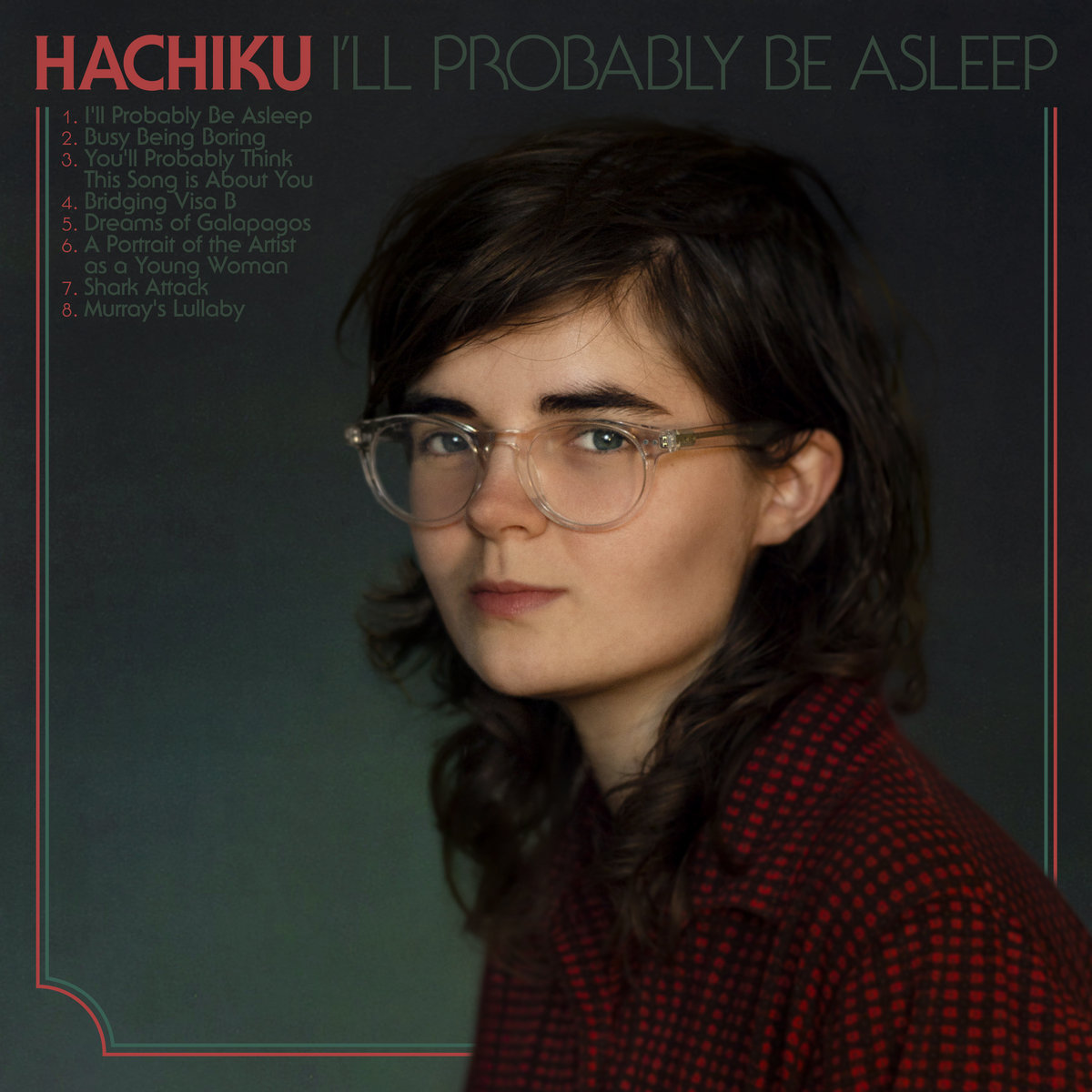
Hachiku, a.k.a Anika Ostendorf, 26, writes and produces dream pop with an avant garde twist from whichever bedroom she is currently inhabiting. Coming from Australia and on the glorious Milk Records is the one and only Hachiku. I got to see her earlier this year opening for labelmate Courtney Barnett on a brief solo tour in the winter. Right away she gripped my ears with her playing and song writing and it’s on full display here. “I’ll Probably Be Asleep” is an absolute scorcher to start the record off, sounding like it came out of the 80’s with a new wave vibe that ends with a guitar solo that climaxes as the song abruptly ends. From there we get a quieter affair in “Busy Being Boring” and “You’ll Probably Think This Song Is About You”. The former is about destroying everything around you and the later is about how to deal with a new love.
She writes in a way that makes you feel like you’re having a private one on one conversation and I find it refreshing. The sweeping guitar riffs in “Bridging Visa B” feel like she borrowed some ideas from Courtney on that winter tour this year. The production she does on the record is so great. There are backwards loops, dropping her voice down a few octaves (“Dreams of Galapagos”), harmonizing with herself. I love when an artist sits down and makes almost an entire album by themselves. It ends with “Murray’s Lullaby”, a song to the dog, Murray, who was at the farm she was on to get her Australian Visa and it’s a sweeping beautiful ode to the companion.
Its introduction is unlike any other. Silence. Waiting. Turning up the volume to see if anything is coming out, waiting some more. Then those gurgling low notes, followed finally by a catchy piano figure, pristinely captured, perfectly balanced. Just like that, Steely Dan has invited—no, wrangled—you into their world of freaks, creeps, lost love and suspended time.
Steely Dan was three years into their professional career when “Pretzel Logic” hit shelves on February 20th, 1974. They’d made a name for themselves with “Can’t Buy a Thrill”, gone from studio band to touring outfit with Countdown to Ecstasy, and found chart success along the way. For their next move, the band retreated into Village Recorder in L.A. with Gary Katz again presiding over the sessions. There they tracked what might be the most concise album of their career.
Call this a time-travel blues. (How Steely Dan is that?) Becker makes his debut as a guitar soloist, weaving in guttural answer lines to Fagen’s vocals on the second verse. But what’s he talking about? “When it says, ‘I stepped upon the platform, the man gave me the news,’ we conceived the platform as a teleportation device,” Fagen said in Steely Dan: Reelin’ in the Years. “And there are other key lines like, ‘I have never met Napoleon, but I plan to find the time.’ What we’re actually saying is that I plan to find the time that he lived in.” The solo is classic Steely Dan, too: Becker painstakingly pieced it together from a number of earlier takes, searching for the perfect combination of sounds. An engineer later estimated that this process took as long as “one hour per bar” to complete. (They got so far out into the weeds that at one point Becker reportedly asked: “Did I play that?”) Of course, this being Steely Dan, the chorus on “Pretzel Logic” isn’t really bluesy at all. Still, this song provided a signature early showcase for Becker, who’d principally worked before this as a bassist. He was always at his best when Steely Dan took rootsier sideroads.
On Pretzel Logic, Steely Dan honed their wryly humorous lyrics; perfected their luscious arrangements that straddle rock, pop, jazz, blues, carnival music and everything in between; and they’d set aside the lengthy jams. The classic line up was still intact and with backing from L.A.’s best session musicians, there was no way it wouldn’t be sonic perfection. The core duo of Walter Becker and Donald Fagen had progressed as writers, too. They introduce us to even more beguiling characters—Charlie Freak, Buzz and many that went unnamed. But the world of Pretzel Logic begins with Rikki.
“We hear you’re leaving, that’s okay,” Fagen sings, a certain resignation in his delivery. Our narrator speaks of a romance cut short, but is it really OK? It seems as if he’s faking it. He wryly lists off activities the pair could do in an effort to win her back, followed by a flippant, protective “I don’t know.” But by the middle he lets his true intent show: “You tell yourself you’re not my kind/but you don’t even know your mind/and you could have a change of heart.” Will she? He knows she’s leaving, and it’s not OK, but what can he do, really?. It’s unexpected to see this role reversal in pop storytelling. It wasn’t often that a ’70s pop record would centre around a man’s fight to retrieve lost love, especially with such a “whatever” attitude. It’s a dejected, resigned cousin of those old “how do I make him love me?” pop successes of the previous decade. Here, the solution isn’t in a kiss, in telling him you’re never gonna leave him or in wishing and hoping. Rikki is moving on, though their little wild time had only just begun, and all our narrator can do is leave behind his number and hope she’ll come back around.
“Rikki Don’t Lose That Number,” which became Steely Dan’s highest-charting single was more than the opening salvo of the album, it’s a tightly packed, four-minute hit single that demonstrates the band’s shift into bite-sized yet filling song-craft. It also introduces another theme—loneliness and social isolation. The bulk of Pretzel Logic, which itself peaked at #8 on the Billboard LP chart, deals with outcasts. Whether in the rube town in “Night By Night,” or the other side of the tracks in “Barrytown,” we’re dealing with people who know they’re trapped in a certain social or economic status within a disorderly world, wishing to “cash in their 10-cent life for another one.”
Underpinning the story on “Night By Night” is a tight and funky arrangement featuring a young Jeff Porcaro on drums. He’d go on to fame with Toto in the decade to follow, but here he was covering for Jim Gordon, the Wrecking Crew member and one-time Domino who features on the rest of the album. Add to it the syncopated chop of the rhythm guitar courtesy of Denny Dias, the alternately swirling and stabbing horns and Jeff “Skunk” Baxter’s note-perfect shredding solo, and you get all the ingredients that make Steely Dan great band they are.
But while the Dan prove they can rock on “Night By Night,” “Any Major Dude Will Tell You” (released as the B-side to “Rikki”) shows a gentler, more comforting side, supported by a fluid electric guitar riff and bridged with a memorable country-inspired guitar solo. A similar breeziness makes its way to “Barrytown,” with its jangling pedal steel, guitar and tambourine combo.
This commentary on class and social differences is a clear Dylan pastiche, from the “Times They Are A-Changin’” reference to Fagen’s nasally drawl. Yet it’s also a careful meditation on belonging, prejudice and the challenge of adjusting to surroundings. The narrator concedes in the beginning, “I’m not one to look behind, I know that times must change.” Yet, the folks over in Barrytown represent a shifting tide—their hair and their clothes just aren’t proper. For all the acceptance he claims to have at the start, the narrator “likes things like they used to be.” His love interest? More progressive and clearly from Barrytown. She’s got that “special lack of grace,” he says, and she won’t be treated kindly in the world outside of the Barrytown bubble. Whether she represents a societal change he can’t handle or simply a threat to his street cred, he has to break off their relationship.
Sides one and two are bridged by convincing odes to jazz. “East St. Louis Toodle-Oo” revamps the old Duke Ellington/Bubber Miley composition. Skunk Baxter’s pedal steel takes the place of the original trombone, Becker’s wah-wah guitar emulates the muted trumpet line and Fagen not only shows off his stride piano chops, but also contributes saxophone.
The jazz nods continue with “Parker’s Band,” a tribute to legendary saxophonist Charlie Parker. The angular backing, weaving chordal movement and the jabbing horns take a page from bebop, while Fagen sings of “Groovin’ High,” a song Parker performed, and “Relaxing at Camarillo,” Parker’s jazz-blues standard inspired by his stay at a Ventura mental hospital.
The time-hopping continues on the title track. With a snarling vocal once again by Fagen, horn jabs galore, a ferocious guitar solo and some of the most abstract lyrics on the album, “Pretzel Logic” remains a fan favourite and a staple of live shows over the decades. While the original recording smokes, recent live performances with Steve Winwood on vocals bring the song to another level.
“Charlie Freak” and “Through With Buzz” see Becker and Fagen returning to character studies, delivering observations on unsavory people. Buzz seems to have no redeeming qualities: “He takes all my money, he’s not very funny,” Fagen declares before switching tenses once again and revealing what’s really bugging him: “I remember when he stole my girl/Drug her all around the world/You know I’m cool, yes I feel alright/’Cept when I’m in my room and it’s late at night.” That sense of paranoia lingers on through the murder ballad “With a Gun” and “Charlie Freak,” a tale about a desolate man with instrumentation so sinister you can almost see him walking alone on a winter’s night.
The album wraps with another highlight, “Monkey in Your Soul” propelled by a slinky horn line and a brief tale of leaving love behind. It might just be the funkiest song on the album.
After Pretzel Logic, Steely Dan would effectively escape the fishbowl of concert touring (at least until 1993) and retire into their playground, the recording studio. They went on to create more examples of slick, jazzy pop that would bring them even more acclaim. But here on Pretzel Logic, the band managed to synthesize all the things that made them great—observant storytelling, humour, inventive instrumental breaks and sleek production—all in a digestible, radio-friendly package that no doubt helped make their later experiments possible.






 The Fat Angel Sings