The Hold Steady have announced a 10th Anniversary Reissue of their 2010 album “Heaven Is Whenever”, and with it comes the usual assortment of bonus material. Yes, that means there’s previously unreleased material. “Separate Vacations,” out along with the news of the reissue, has been performed live before but never released in its pristine studio form. It’s a cascading midtempo rock track that moves with the beaten-down grace that defined that era of the band.
In addition to nine rare or unreleased songs, the reissue includes liner notes by Patterson Hood of Drive-By Truckers. The Hold Steady shared this message about it all: Everyone seems to have an opinion about our fifth album, “Heaven is Whenever”. Ten years later, going over these songs for this reissue, we’ve taken on a great new appreciation for this collection. With some distance, it seems we were trying to get somewhere else, and this was a necessary transition record. The songs are weary, but with a dark humour. It might even be the funniest Hold Steady LP, although it’s sometimes hard to tell because it doesn’t convey the same ecstatic joy as some of the earlier records.
For the 10th Anniversary Deluxe Edition, “Heaven is Whenever” includes nine bonus tracks that tell the story of the time it was made. We were chasing something that was mostly undefined, and we kept making more and more music. We recorded stuff we forgot about like “Wonderful Struggle”, stuff we’ve played live but never released, like “Separate Vacations”, and even an alternate version of “We Can Get Together”. The album wasn’t a lot of fun to make. It was recorded in fits and starts. At one point, we left Dreamland Studios early due to a medical issue. The label folks flew in and visited to see what the hell was going on. Franz had left the band, Steve had yet to join, and we were coming off several years of non-stop touring.
We’d become a bit more self-aware than in our early days. Many of our favourite bands didn’t make it to their 5th LP, and it’s hard to keep a band evolving for that long. One huge bright spot about this period is that Steve Selvidge came in for the touring on this album cycle. He became and remains a huge part of the heart and soul of The Hold Steady. In fact, our biggest regret about Heaven now is that we didn’t record this album with Franz and Steve. There’s even more to the story — the Super Deluxe version of the album available on streaming platforms will include tracks from the 2009 Avatar Sessions in New York City, versions of “Heaven is Whenever” songs that Franz was working on with the band prior to his departure. Here in 2020, we’re very proud of Heaven is Whenever. It’s the sound of a band pushing through difficult times by making music about that very struggle. It acknowledges suffering as part of human life. And with all the extra songs that we recorded beyond the album tracks, it’s a testament to the band’s willingness to show up and try to work through uncertainty. Our amazing friend Patterson Hood from the Drive-By Truckers has a lot more to say about that in the LP liner notes.
Released November 27th, 2020
THE HOLD STEADY (2009) was: Bobby Drake, Craig Finn, Tad Kubler, Galen Polivka,
THE HOLD STEADY (2020) is: Bobby Drake, Craig Finn, Tad Kubler, Franz Nicolay, Galen Polivka, Steve Selvidge,
Buildings burning in every direction; macabre unknowns in your friendly neighbour’s basement; undecided voters sharpening their pencils: under pressure we could call Kiwi Jr’s Cooler Returns “timely.” But what year is it, again? On their sophomoric smash-up released world-wide by Sub Pop Records, Kiwi Jr cycle through the recent zigs & looming zags of the new decade, squinting anew at New Year’s parties forgotten and under-investigated small town diner fires, piecing together low-stakes conspiracy theories on what’s coming down the pike in 2021. Put together like a thousand-piece puzzle, assembled in flow state through the first dull stretch of quarantine, sanitized singer shuffling to sanitized studio by streetcar, masked like it’s the kind of work where getting recognized means getting killed, Cooler Returns materializes as a sprawling survey from the first few bites of the terrible twenties, an investigative exposé of recent history buried under the headlines & ancient kings buried under parking lots.
Not so long since their debut Football Money in archaeological time, unending grey eons later in the dog years of quaran-time, spiritually antipodean Canadians Kiwi Jr return to disseminate this year’s annual report to the shareholders, burying the incriminating numbers in the endless appendices of a longform narrative record, a 3,000 word tract for stakeholders to pore over.
Opener “Tyler” builds a Frankenstein of all your musician exes; don’t you remember “falling apart in the green room while they drank half the headliner’s rider?” In “Waiting In Line” we’re still slumbering at the bar, agitation skyrocketing contemplating “what breed of beast protects the back door.” We hear “it isn’t past until it burns,” in “Maid Marian’s Toast” but what explains the accompanying & extensive itinerary of incinerated Eastern Canadian eateries? Investigated off the clock by Kiwi’jrs amateur arson division, suspicion is cast on all: The Cook, The Regular : Ms. Scarlett, Colonel Mustard. Throughout these crises, histories, and head games Kiwi Jr. don’t expect you to be taking notes or checking dates – and on the back nine, when “Omaha” demands proof that “Woodstock ever happened in the first place,” perhaps the freewheeling guitar groove underfoot tells us all we need to know about who’s been flipping through the festival files, air-drumming along to the complete 10-CD set.
Opening with a sweet melody on 12-string guitar, the band offer up even more evidence that ‘Cooler Returns’ is set to be one of the best releases of 2021. Reminiscent of a forgotten 70s classic, its fairground piano and bouncing rhythms are prefect for blowing away the January blues.
These stories – memories of Augusts past, unrepressed & transcribed fast – go down easier thanks to meaningful changes enacted in 2019’s KiwiCares Pledge: delivering on a promise to transition from Crunchy to Smooth by 2021, the caveman chug of Football Money has been steamed & pressed with the purifying air of a saloon piano – operated with bow-tie untied – and a spring green side-salad of tentatively up-tempo organ taps & freshly fluted harmonica.
A chronically detuned spin of the dial through swivel-chair distractions & WFH daydreams, an immersive ctrl-tab deluge cycling through popular listicle distractions like the unentombing of Richard III, or the deja vu destruction of the Glasgow School of Art, Kiwi Jr sing this song to an indoor audience, crisscrossing cancelled, every other prestige distraction source wrung dry, only song writing remaining to deliver engrossing tales to the populace, just how I imagine it worked in the old days.
Fixing loose ingredients into a sturdy whip, Kiwi Jr beam in live from the 9-5, striding into 2021 with a mastered brainwave that comes equally from the back room of the record store as the penalty box. And how do we, left holding this box of deliberate entanglements, sign off to those as yet uninitiated, undecided, uncertain, unseen, absent return coordinates
Kiwi Jr.’s “Cooler Returns”, featuring the title track, “Undecided Voters,” “Maid Marion’s Toast,” and “Waiting in Line,” will be available January 22nd, 2021 worldwide through Sub Pop with the exception of Canada through the band’s Kiwi Club imprint. The album was produced by Kiwi Jr., mixed and engineered by Graham Walsh (METZ, Bully, Preoccupations) in Toronto, and mastered by Phillip Shaw Bova at Bova Labs in Ottawa, Ontario.
Kiwi Jr. is Jeremy Gaudet (mic, guitar), Brohan Moore (drums), Mike Walker (bass), and Brian Murphy (guitar).
Lancaster, PA’s Innocence Mission have been making delicate dreampop for longer than that descriptor has existed, with Karin Peris’ heartbreaking voice forever the star of the show. Draped in aching melancholy, “See You Tomorrow” is among the group’s finest in a span over a 30 year plus career. Alternative folk act The Innocence Mission first gained recognition in 1989, when they found chart success with their self-titled debut album. By the time the band released their third album, Glow, in 1995, they had earned a zealous cult following that remains loyal to them to this day. Their songs tend to be exquisitely crafted, featuring ethereally beautiful acoustic-based music and hauntingly introspective and thoughtful lyrics, all combining into a sound that is at once delicate yet intense. The band, led by married couple Karen Peris (vocals, guitar, piano, organ) and Don Peris (guitars, drums vocals), originated when they first met in high school. Now, more than thirty years later, they (along with bassist Mike Bitts) are preparing to release their twelfth studio album,
Love. Connection. Community. Understanding. Most of us experience these aspects through the prism of family and friends. But not everybody can turn those feelings into song, especially not with the beauty and sensitivity of Pennsylvania trio the innocence mission, fronted by Karen Peris and husband Don. Following their Bella Union album debut “Sun On The Square”, which won the band some of their best-ever reviews, they have made another exquisite and touching album, “See You Tomorrow“.
This is a record steeped in awe and wonder, intense longing, sadness and joy; a rich sequence of songs that attempt to describe the essence of what makes us human. Sufjan Stevens, who has covered the innocence mission’s classic Lakes Of Canada, once called their music “moving and profound. What is so remarkable about Karen Peris’ lyrics is the economy of words, concrete nouns which come to life with melodies that dance around the scale like sea creatures.” The band recorded See You Tomorrow in the Peris’ basement (and the dining room where the piano sits). Karen wrote and sang ten of the album’s eleven songs, and plays guitars, piano, pump organ, accordion, electric bass, melodica, mellotron, and an old prototype strings sampler keyboard. Don contributes guitars, drums, vocal harmonies, and one lead vocal on his song Mary Margaret In Mid-Air. Fellow founder member Mike Bitts adds upright bass to four songs including On Your Side, the album’s first single.
With wistful strings and distant acoustic guitar, “On Your Side” sounds like the first chill of autumn.
Rising from the ashes of Brooklyn’s Grooms, Activity tread a similar dark, unsettling groove with krautrock rhythms, slashing guitars and creepy, surreal atmosphere. “Unmask Whoever” is doppelganger music for a parallel universe. This supergroup featuring members of Grooms, Field Mouse, and Russian Baths. Produced by Jeff Berner of Psychic TV. Mastered by Heba Kadry, known for her work with Bjork, Slowdive, Deerhunter, Japanese Breakfast, Cass McCombs, et al. Activity are an avant four-piece featuring Travis Johnson, and drummer Steve Levine, both from the band Grooms, bassist Zoë Browne from Field Mouse, and guitarist Jess Rees from Russian Baths. Their debut forms a casually menacing framework for lyrical themes of paranoia, exposed character flaws, and the broader human capacity for growth when an ugly truth is laid bare. Lead single Calls Your Name, establishes the record’s spectral aura with nauseated electronic bells, and a relentless Geoff Barrow-esque drum beat beneath a half-sung, half-spoken lyrics inspired by C.S. Lewis’s 1945 novel The Great Divorce.
In the novel, characters stuck in a grey, joyless conception of hell repeatedly deny opportunities to be taken into heaven, instead making excuses as to why they should remain in their embittered purgatory states. Allegorically, this speaks to the kind of opportunity for metamorphosis and positive change that’s possible when the depths of disillusionment are reached, an idea which permeates much of the album. Despite recurrent aches of discontentment, each track glows with radiant waves of catharsis while elegantly evoking jubilation and anguish within the same breadth, showing that the two are always around the corner from one another. For fans of Blonde Redhead, Clinic, Deerhunter and Broadcast.
“Earth Angel” is both sinister and sensuous and when singer Travis Johnson sings “I wanna fuck around” barely above a whisper, danger lurks.
“I was guzzling wine at my favourite bar the entertainment that night was some local opera singers singing along with a big video screen showing a collage of various operatic moments with subtitles. One particular subtitle, ‘Ah!-(etc)’ made me laugh, I thought it was a perfect description of life – the joy of existence against the etcetera of it all, the struggle. With a heavy head of rose’ it seemed like ecstatic poetry! I scribbled it on a napkin and thought it might make a good title for something” And so the mystery behind the title of Kelley Stoltz new record is solved. Less of a mystery is the quality contained therein… after 12 self-titled releases and a several more under pseudonyms, Stoltz is the word for “one-man-band-home-recording-pop-songs of idiosyncratic character.” A quick follow up to his more power pop and pub rock LP only “Hard Feelings” offering in the summer, “Ah-(etc)” finds Stoltz returning to his sweet spot, writing songs that never were, but should have been in the 60’s and 80’s.
As with other LPs Stoltz makes virtually every noise on the album which was written and recorded in 2019 at his Electric Duck Studio in. San Francisco. A few friends popped in to play along… Stoltz former bandmate, Echo & the Bunnymen’s Will Sergeant adds electric guitar to “The Quiet Ones” a sort of Scott Walker lyrical take on strangers and neighbours. Karina Denike formerly of Dance Hall Crashers adds gorgeous vocals on the bossanova groover “Moon Shy”, where Sergeant pops up again in a spoken word role on the outro. Allyson Baker of SF’s Dirty Ghosts sings on “She Like Noise”, a song Stoltz wrote for her in celebration of her love of seeing live bands.
Both the records Kelley Stoltz released this year were great, but Ah! (Etc) has the edge over the pub rock-inspired Hard Feelings. This one has no high concept, just 12 unbelievable catchy songs performed in Stoltz’s sweet spot — somewhere between ’60s garage pop and ’80s new wave, though heavier on the latter this time around, with Echo & The Bunnymen’s Will Sergeant showing up to work his guitar magic on a few tracks. Album Title of the Year maybe.
“Never Change Enough” wears its Bunnymen influence on its sleeve, by way of Nick Lowe.
The album was mastered by Mikey Young in Australia, Tour dates scheduled for summer 2021.
Rolling Stone issue #10, dated May 11, 1968 featured a picture of Eric Clapton on the cover. The heavily processed image (taken by Linda Eastman) shows Clapton in close-up, his 1967 Hendrix-inspired perm grown out and his hair longer than it would ever be again. Around his neck, nestling incongruously (or perhaps ironically) alongside some hippie beads, is a football scarf. His sideburns are fashionably bushy and he is also sporting what can only be described as an impressive Tom Selleck style moustache. No doubt about it – Eric looked great in ‘68. Every inch the guitar hero, in fact. But inside issue #10 of Rolling Stone things were about to turn very ugly.
Five weeks earlier Cream had played a concert at Brandeis University in Boston and Rolling Stone writer Jon Landau (the man who in 1975 would become Bruce Springsteen’s producer/manager) was there to review it. What he wrote would not only spell the end of Cream it would also send Eric into a tailspin of self-doubt which would last for years to come. Among other things Landau’s review read: “Eric Clapton is a master of the blues clichés of all of the post-World War II blues guitarists…”. There was plenty more in the same vein but that line alone was enough to make Clapton resolve to quit what was probably the biggest touring rock group in the world at that point. It’s been said that Eric had already heard The Band’s debut album Music From Big Pink and wanted to do something similar following the Landau mauling. But Big Pink wasn’t released until July, two months after the Rolling Stone piece, so the chain of events seemingly developed over time. Just to complicate matters, although the seeds of Cream’s demise were irrevocably sown in May of 1968, it was later revealed that the band had secretly agreed to call it a day before Landau’s review went to press, mainly due to the ongoing tension between Jack Bruce and Ginger Baker.
Whatever the truth behind the break-up Cream still had one more lucrative tour to complete. This was their so-called “Goodbye Tour” consisting of 22 shows at 19 US venues from 4th October to 4th November 1968, followed by two concerts at the Royal Albert Hall in London on 25th and 26th November.
Cream’s final album (excluding posthumous live releases) “Goodbye” appeared in February 1969, three months after the Albert Hall shows. I have reason to remember it possibly more than any other Cream record from their short, 30 month career. A close friend and talented fine artist from Sheffield, Paul Winter, had recently moved to London to work for the Alan Aldridge Ink Studios, so when Goodbye appeared with that distinctive Aldridge airbrush lettering on the front cover it was a source of great local pride. I never did find out if Paul had very much (if anything) to do with the Cream sleeve, but I like to tell myself he did. Pleasingly, this Goodbye Tour Live 1968 box set retains a variation of the original Alan Aldridge design as well as that delightful showbiz send-up photo by Roger Philips showing the band decked out in silver suits, with top hats and canes. True to form, Ginger seemingly didn’t like the idea of dressing up and threatened the photographer during the shoot. No change there, then.
This lavishly presented box contains four complete shows from the last eight weeks of that final tour: Oakland, California (October 4), the Los Angeles Forum (October 19), San Diego Sports Arena (October 20) and the Royal Albert Hall, London (November 26). Of the 36 tracks, 29 have never been released on CD before (19 are previously unreleased, plus the Royal Albert Hall show which was only available on VHS and later, DVD).
This lavishly presented box contains four complete shows from the last eight weeks of that final tour: Oakland, California (October 4), the Los Angeles Forum (October 19), San Diego Sports Arena (October 20) and the Royal Albert Hall, London (November 26). Of the 36 tracks, 29 have never been released on CD before (19 are previously unreleased, plus the Royal Albert Hall show which was only available on VHS and later, DVD).
The packaging is excellent. It comes housed in a 10-inch hard cover box with 70 page book incorporating a wealth of colour and black and white photos showing onstage action, concert tickets, posters, music magazine cuttings and record sleeves from around the world. The book also features some entertaining liner notes by Rolling Stone senior editor David Fricke. On the downside Fricke confuses Lincolnshire with Lancashire when referencing a May 1967 UK gig in Spalding and the picture on page 17 of the book has been flipped, turning Eric into a left-handed guitarist. Not the end of the world, admittedly, but with such an expensive item, someone should have taken a second look.
Considering the band was apparently falling apart and the members eager to go their separate ways, you’d never know it from these performances. Cream are on fire throughout with their playing as powerful and accomplished as ever. The three California shows are top-quality soundboard recordings which have been circulating as bootlegs for years so it’s good to see them finally get an official release. The London show is presumably taken from the soundtrack of Tony Palmer’s film Cream: Farewell Concert and the sound has not improved in the transfer. While still quite listenable (especially without the dizzying camera zooms, close-ups and annoyingly fast edits of Palmer’s film), the fourth disc is of somewhat lower fidelity.
“White Room” was the opening song almost every night and there are four versions here. The first thing you notice is what a great singer Jack was. The finest bass player of his generation was also blessed with a tremendous voice, the equal of anyone in rock at that time. And, save a few fluffed lyrics and wayward harmonies here and there, the quality and power of his vocals never waivers throughout. The set list hardly varies across all four shows with the lion’s share of songs coming from the recent Wheels of Fire double album (released in August 1968) plus a couple from Fresh Cream and just “Sunshine of Your Love” from Disraeli Gears. But Cream rarely played a song the same way twice, anyway, instead using the basic structure as a launch pad for their extended improvisations. This is especially true of the longer pieces such as “I’m So Glad” and “Spoonful”. The four versions of “Spoonful” total over an hour in length yet all are wildly different, with only the vocal section sticking to any kind of plan. Two tracks pre-date the formation of the band. Although “Traintime” later appeared on a couple of Cream albums Jack’s harmonica solo spot originated during his time with the Graham Bond Organisation. Likewise “Steppin’ Out” started life as Eric’s instrumental party piece with John Mayall’s Bluesbreakers.
Cream and the Jimi Hendrix Experience are often compared and although Eric and Jimi were friends, contemporaries and first among equals it’s impossible to imagine Hendrix tackling a number like “Politician”. This lumbering monster of a song contains not a skerrick of swing or soul, but it swaggers along with feel to spare, laying waste to all before it. One of four songs on Wheels of Fire co-written by Jack Bruce and Pete Brown, “Politician” took on new momentum when played live and seemed to grow in stature as the tour progressed.
In the late 60s and early 70s drum solos were de rigueur for any rock band with virtuosic tendencies. They were not everyone’s cup of tea, however, and even the most hardened rock concert-goer will likely blanche at the thought of a 20-minute solo. I’m with those people much of the time but always made an exception in Ginger’s case. He was a drummer of unique power and invention and I could quite happily sit though virtually anything he cared to serve up.
Ginger’s solo spot was typically the thunderous “Toad” and it appears on three of the four shows (35 minutes of it, in total). The Oakland concert on disc one is different, however. Here the drum solo happens during “Passing The Time”. Ginger co-wrote this song (along with two other tracks on Wheels of Fire) with jazz pianist Mike Taylor who sadly died only a year later in 1969 aged 30. Oakland was the first date of the tour and at the end of “Passing The Time” Ginger announces “We have to apologise for being a little rusty. We’ve been on holiday”.
Like most people of a certain age I first heard Cream’s “Crossroads” in 1968 on Wheels of Fire. 52 years later I’m still of the opinion it could be the greatest live rock ensemble recording ever committed to vinyl. This powerhouse 12 bar blues thunders along at a fair old lick with not one but two life-affirming guitar solos. It’s moderately fast without being frantic. It’s punishingly loud but still swings like crazy with every instrument cutting through the mix equally. It may be a showcase for Clapton’s guitar but it’s very much a team effort with the bass and drums doing just as much of the heavy lifting. With almost telepathic understanding Eric, Jack and Ginger lock onto the beat, mindful of every micro-shift in tempo. At one point the song seems in danger of tripping over itself as it rushes headlong into the last verse a little too fast. But just in time they pull it back and then, a little over 4 minutes after it began, the “Crossroads” juggernaut shudders to a halt, rivets straining on the boiler and steam coming off the brakes. “No one will ever beat it” opined Springsteen guitarist Steven Van Zandt, speaking about “Crossroads” to Rolling Stone in 2005. “They literally solo for four verses in a row… The fact that they all come back together at the end, at once, is one of the most remarkable moments on record”.
Such was the impact of this track it went on to have a life of its own. In 1988 Eric released Crossroads, an early multi-CD compilation and one of the biggest selling box sets of the digital era. A decade later he launched the Crossroads Guitar Festival, a series of all-star benefit concerts which is still running today. In 2005 Gibson guitars issued a limited edition replica of the Gibson ES335 Eric used on the 1968 recording. The original guitar was sold at auction for just under one million dollars, but you can buy one of 250 exact Crossroads replicas for a bargain US$10,000. So, while Clapton has sometimes coyly attempted to play down the importance of the original Wheels of Fire recording there’s no denying “Crossroads” holds great significance for him.
First the good news: Goodbye Live Tour 1968 features four unreleased live versions of “Crossroads”. Now the (slightly) bad news: not one of them is quite as good as the Wheels Of Fire version recorded seven months earlier at the Winterland Ballroom in San Francisco. The Oakland recording has a slightly hesitant feel with the famous riff changed to something resembling the opening of the Monkees’ “I’m A Believer”, albeit on steroids. Two weeks later and the Los Angeles version is more like it. The riff is now in place but it’s played a little too fast, as is the London recording. Only in San Diego did they come close to matching the Winterland original but even here the two guitar solos don’t have quite the same impact.
Cream may have invented heavy rock and a lot more besides but they were a blues band at heart and the three versions of “Sitting On Top Of The World” drive this point home comprehensively. The LA recording on disc two previously appeared on the 1969 album Goodbye and is perhaps the pick of the bunch (although San Diego runs it a close second). Never was the term “power trio” more appropriate as the band bulldozes its way through this slow blues. Ginger nails it all down at the back, rock solid and immovable. Jack is all over the fretboard like a lead player, his rasping bass bubbling through the mix, louder than any recording engineer would dare risk today. His vocals are astounding especially considering he’s singing while playing some extremely complex bass lines. Meanwhile Eric fires off a series of exhilarating fills topped off with a solo of murderous intensity. It’s a masterclass in muscular electric blues. Subtle it ain’t, but my goodness it sounds great.
“Sunshine of Your Love” appears on all four discs, the extended solos taking it far beyond the rigid confines of Cream’s biggest hit single. Much looser than the studio version, the most famous riff in all of rock takes on new life when played live. There’s a strange moment during the LA show when the bass drops out for several seconds but we assume this was nothing more than a technical glitch. The strongest performance of “Sunshine…” by far appears on the San Diego concert. It’s also the best recorded version with all three instruments way up in the mix and Jack and Eric’s vocals strong and clear.
“Steppin’ Out” is the final number of the final show and, as the Albert Hall crowd yells for more, MC John Peel, always a master of studied indifference, signs off with the characteristically deadpan line “That really has to be it, but I’m really glad you’re here tonight. Goodnight”. And with that, Cream leaves the stage forever (or until their 2005 reunion, 37 years later).
Cream existed simultaneously as two very different groups. There was the studio incarnation which recorded beautifully crafted pop rock gems such as “I Feel Free”, “Strange Brew” and “Badge”, but the live band was another matter entirely. Onstage they were a high-volume stadium monster who could justifiably claim to have drawn up the blueprint for heavy rock, jam band rock and much else besides. Part jazz, part blues and several parts rock, Cream’s improvised flights of fancy elevated music to places it had never been before.
Jack Bruce passed away in 2014 and with the recent death of Ginger Baker it’s sad to reflect that now only Eric remains, adding even more poignancy to this release, at least from the listener’s perspective. Following Cream’s demise the baton would be picked up by Led Zeppelin, Deep Purple and others who took the same basic format and turned it into 70s commercial gold. For all their success, though, none of the pretenders would achieve the same legendary status or, dare I say it, quite the same level of musical excellence.
Let’s leave the last word to Buddy Miles who, coincidentally, was about to exit his own group Electric Flag in late 1968. He comes onstage at the Los Angeles Forum to introduce who he calls, in the hip speak of the time, “Three really outasite groovy cats”. Buddy continues (presumably referencing the impending split), “What can you say? It’s happened, and we can’t do anything about it, but just remember they’ll still be there, and they’ll always be there. That’s Jack Bruce, Ginger Baker, Eric Clapton. Ladies and gentlemen, the Cream”.
DISC ONE – OCTOBER 4, 1968 – Oakland Coliseum, Oakland (all tracks previously unreleased, except *)
1. White Room (6.19)* (previously released on Live Cream Volume II and Those Were The Days)
2. Politician (5.22)* (previously released on Live Cream Volume II and Those Were The Days)
3. Crossroads (3.57)
4. Sunshine Of Your Love (5.35)
5. Spoonful (16.47)
6. Deserted Cities Of The Heart (5.26)* (previously released on Live Cream Volume II)
7. Passing The Time (10.40)
8. I’m So Glad (7.07)
DISC TWO – OCTOBER 19, 1968 – Los Angeles Forum, Los Angeles (all tracks previously unreleased except *)
1. Introduction by Buddy Miles (1:39)
2. White Room (6.53)
3. Politician (6.41)* (previously released on Goodbye)
4. I’m So Glad (9.37)* (previously released on Goodbye and Those Were The Days)
5. Sitting On Top Of The World 4.53* (previously released on Goodbye and Those Were The Days)
6. Crossroads (4.25)
7. Sunshine Of Your Love (6.27)
8. Traintime (8.11)
9. Toad (12.55)
10. Spoonful (17.27)* (previously released on Eric Clapton’s Life In 12 Bars)
DISC THREE – OCTOBER 20, 1968 – San Diego Sports Arena, San Diego (all tracks previously unreleased)
1. White Room (6.42)
2. Politician (6.26)
3. I’m So Glad (7.53)
4. Sitting On Top Of The World (5.45)
5. Sunshine Of Your Love (5.13)
6. Crossroads (4.13)
7. Traintime (9.39)
8. Toad (14.03)
9. Spoonful (9.12)
The Oakland Coliseum, Los Angeles Forum and San Diego Sports Arena concerts were mastered from the original 1968 analogue mix reels by Kevin Reeves at Universal Mastering, Nashville, TN.
DISC FOUR – CREAM FAREWELL CONCERT NOVEMBER 26, 1968 – Royal Albert Hall, London (all tracks released on CD for the first-time)
1. White Room (8.02)
2. Politician (6.37)
3. I’m So Glad (6.53)
4. Sitting On Top Of The World (5.06)
5. Crossroads (5.03)
6. Toad (11.22)
7. Spoonful (15.47)
8. Sunshine Of Your Love (8.37)
9. Steppin’Out (5.02)
The Royal Albert Hall concert was mastered from the original 1968 analogue transfer reels by Jason NeSmith at Chase Park Transduction, Athens, GA.
This month I’m releasing Deadstock: Uncollected Recordings 2005 – 2020, an album gathering up the songs no one got to hear: unreleased tracks and alternate versions from six studio records and scattered sessions, that form a kind of alternate history. ‘Here’s bunch of songs so good I never put them out,’ but these are as good anything I ever wrote, and we’ve played some of them on the road for years. They didn’t make it onto albums because I still think of albums as the unit of measure, and it’s more important to me to make a record work than it is to make sure a particular song sees the light of day. They tend to find their own way out the door anyway. Deadstock isn’t a documentary, it’s an album.
It’s arranged and meant to be heard that way, with seven new original songs – and two released prior only in Europe – as well as new full-band takes of back catalogue numbers like ‘Mesa, Arizona,’ ‘Ghost Repeater,’ and ‘Pretty Hands.’ Some of these are blood relatives, like ‘Real Love,’ ‘Any Town Will Do,’ and ‘Mesa, AZ’ (three songs written in three days driving around the desert southwest before the Ghost Repeater sessions) while some show the obverse side of the coin, like ‘Cold Late Spring Bark River’ (a less austere telling of a night I wrote about in ‘Heart to the Husk’ from Horse Latitudes), and ‘Crown of Smoke,’ the present-tense companion to the narrative flashback in ‘Little Warble,’ from Blood Brothers.
There’s a song I wrote for one of my heroes, the late great Rainer Ptacek of Tucson, and a song called ‘Jacaranda’ that I wrote while driving up the 101 in California years ago, feeling lucky; there’s a song called ‘Adios Mexico’ that I co-wrote with my friend Airon Kluberton – an airplane mechanic in Talkeetna, Alaska – when I was up there on tour, and there are two songs I always loved from the Cold Satellite collaborations with poet Lisa Olstein and guitarist David Goodrich, presented in new versions. The band is mostly the one you know from the last many years (featured on the Wolves and Blood Brothers records, and on the road), and then the Iowa boys from Ghost Repeater on two tracks, plus guest appearances by Kris Delmhorst, Pieta Brown, and Caitlin Canty on backing vocals. Deadstock won’t be streaming until 12/18, but you can pre-order copies for everyone you know right damn now to get it early, and in time for the holidays. To make that decision easier, you can go listen through all sixteen tracks right now, and hear/see the full single of ‘There’s a Destruction on This Land,’ (from the Salt As Wolves sessions).
All the older (in-print) albums from the back catalogue are available all this month 20% off, with the promo code JF2020. That’s right, I have a promo code. I’m having it tattooed on my ass. I’m not going to play a livestream concert this month, but I’ll be back in the new year to play through Blood Brothers, and maybe Deadstock too. In the meantime, keep an eye on the Store, as we’ll announce a few more things in the next few weeks. And then, if you would, please share the link for Deadstock around with your people, and add it to a playlist. I’m not hiring publicity or touring to promote this record, it’s just something to keep the party faithful amused, and a way to make a little cash in a lean year. You’re all deputized Junior Publicists now. Badges and hip boots will arrive by mail. I’m grateful to all of you out there, for taking care of each other, and for looking after us in a hard year. It’s meant the world. You’re all just aces.
The Band’s classic 1970 album is often considered slightly inferior to its two stone-cold-classic predecessors, the group’s debut “Music From Big Pink” and the self-titled follow-up — but what’s not often stated is that “slightly inferior” to those albums still makes it one of the best albums of the year if not the era.
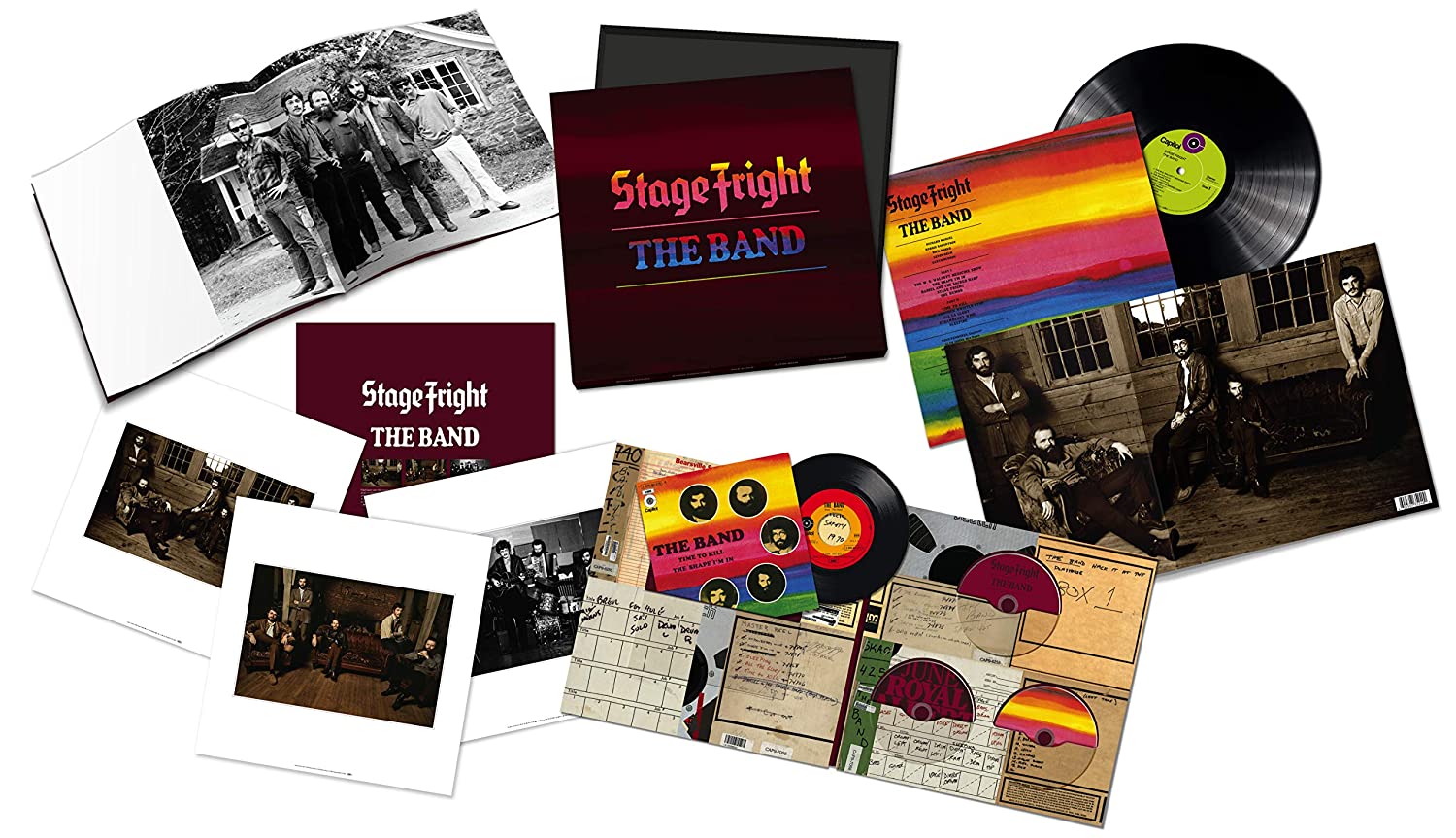
While the group had started to fragment a bit at the time of its recording — largely due to substance abuse — it still contains several of their all-time best songs, like the title track, “The Shape I’m In,” “Strawberry Wine” and others. On February 12th, 2021, Capitol/UMe will celebrate the 50th anniversary of The Band’s classic third album, “Stage Fright”, with a suite of newly remixed, remastered and expanded 50th Anniversary Edition packages, including a multi-format Super Deluxe 2CD/Blu-ray/1LP/7-inch vinyl box set photo booklet; digital, 2CD, 180-gram black vinyl, and limited edition 180-gram colour vinyl packages. All the Anniversary Edition releases were overseen by principal songwriter Robbie Robertson and boast a new stereo mix by Bob Clearmountain from the original multi-track masters. For the first time, the album is being presented in the originally planned song order. The boxed set, CD and digital configurations feature a bevy of unreleased recordings, including Live at the Royal Albert Hall, June 1971, In the set’s liner notes, Robertson calls the show at London’s Royal Albert Hall “One of the greatest live concerts The Band ever played. ”It was a thrilling full concert captured in the midst of their European tour; alternate versions of “Strawberry Wine” and “Sleeping”; and seven unearthed field recordings, Calgary Hotel Recordings, 1970, an impromptu late-night hotel jam session between Robbie Robertson, Rick Danko and Richard Manuel of several Stage Fright songs recorded while the album was in the mixing stage.
Exclusively for the boxed set, Clearmountain has also created a new 5.1 surround mix and a hi-res stereo mix of the album, bonus tracks and the live show, presented on Blu-ray. All the new audio mixes have been mastered by Bob Ludwig at Gateway Mastering. The set also includes an exclusive reproduction of the Spanish pressing of The Band’s 1971 7-inch vinyl single for “Time To Kill” b/w “The Shape I’m In” in their new stereo mixes and a photo booklet with new notes by Robbie Robertson and touring photographer John Scheele, who recorded the Calgary HotelRecordings; 1970,” a fun and loose, impromptu late night hotel jam session between Band members Robertson, Rick Danko and Richard Manuel of several “Stage Fright” songs, recorded during the group’s legendary “Festival Express” Canadian tour with Janis Joplin, the Grateful Dead, Buddy Guy and others. plus a reprinting of the original Los Angeles Times album review by critic Robert Hilburn; three classic photo lithographs; and photographs from Scheele and several other photographers.
Originally Released on August 17th, 1970, Stage Fright features two of The Band’s best-known songs, “The Shape I’m In” and the title track, both of which showcased inspired lead vocal performances by Manuel and Danko, respectively, and became staples in the group’s live shows. Recorded over 12 days on the stage of the Woodstock Playhouse, the album was self-produced by The Band for the first time and engineered and mixed by Todd Rundgren with additional mixing by Glyn Johns.
For the 50th Anniversary collection, the sequence has been changed to present Stage Fright with the originally planned song order.
The release follows last year’s stellar reissue of “The Band,” which included the group’s previously unreleased set from the Woodstock festival. All the Anniversary Edition releases were overseen by principal songwriter Robbie Robertson and boast a new stereo mix by Bob Clearmountain from the original multi-track masters (which resolves the conundrum caused by some of the album’s earlier re-releases, which included incorrect mixes of several songs). While the release notes that “For the first time, the album is being presented in the originally planned song order,” what will really interest fans is the previously unreleased material.
Dana Margolin really has a way with words. She likes to roll them ’round and ’round until the meaning flakes off and there’s nothing but feeling left. With their debut record five years in the making, the Brighton collective provided us with an unusual take on somewhat-anachronistic indie, shaped by Dana Margolin’s quaking, often unpredictable vocal delivery. All the memorable peaks on “Every Bad” are characterized by Margolin’s unreliable insistence that, say, “everything’s fine,” while the jarring opener climaxes and ebbs with the repeated, impossibly tense line “Thank you for making me happy.” I don’t think you could possibly adapt the “This is fine.” meme more fluently into song writing.
As many of us have followed them around for years, we predicted big things for these Brighton locals but we never suspected they had something quite this special in them.
Songwriter Dana Margolin’s vulnerability has been her constant strength and despite the nuanced and difficult subjects she takes on in her songs, she’s always had some level of lo-fi production or guitar fuzz to shield her, thanks to the bedroom pop genesis of most of these tracks. however, on ‘every bad’, she unabashedly centres herself and the result is astounding. That’s not to say that the guitar fuzz and lo-fi production have vanished – far from it in fact. ‘Every Bad’ takes cues from nirvana, who mastered underpinning anxiety with abrasion, raincoats in their tendency to twist, turn and change a song without warning and pixies in their ability to turn the aggression of grunge into a diverse and supple sound. so yes, they are clearly inspired by the bands of their youth but on these familiar foundations, something uniquely dynamic has been built. the jagged instrumentation complements dana’s rugged vocals and authentic lyrics perfectly, matching the mood of each song and manoeuvring effortlessly to enhance a lyricist who tackles sensitive, esoteric and existential subjects.
On opener “Born Confused” the singer chants “Thank you for making me happy” for a minute and a half. It starts off a little wistful, then genuine. With about 40 seconds left the edges start to wobble and the mantra becomes a frenzied wash of anguish. By the time the song cuts out, mid-sentence, it sounds like an accusation, if not an attack.
She told Apple Music that the track “captures the feeling of frustration and trying to figure things out”, which is maybe the core of Every Bad. It’s full of direct contradictions, cocksure one second and confused the next. It does an incredible job of transmitting the anxiety of being in your mid-20s. I’m an adult, why am I still adrift? “Oh, I don’t know what I want/But I know what I want/Oh, I don’t know what I want/But…”. Despite this vulnerability, dana never softens her edges or compromises in her lyrics. her pronounced and very forthright uncertainty and confusion comes across as defined and unflinching – the only thing she can be certain of is that confusion. this is not music that moralises or offers answers to life’s big questions – it is here to express raw emotional response with no interest in resolution.
That refusal to offer an easy way out is what makes it both so personal and so relatable. we may not have experienced the same situations, but we’ve felt those same nameless, onerous emotions. these guttural anthems amass into a defining album that’s burst them out of their established Brighton bubble, got them mercury nominated and has firmly planted them in hearts everywhere.
‘Sweet’ by Porridge Radio, taken from their forthcoming album Every Bad released in March . The DIY Brighton outfit were called ‘slacker indie’ when they released their first full album. “Every Bad” shows that description had more to do with the garage they recorded it in than their motivation.
“We just want to confuse the fuck out of people, in a good way,” said Working Men’s Club frontman Sydney Minsky-Sargeant. Mission accomplished. The band’s self-titled debut draws from a large swath of danceable ’79-’83 post punk and second-gen ’00s groups, with great songs, infectious beat-heavy production and a clear love for The Fall.
It’s old music for young people and young music for old people. It’s the sound of teenage possibilities current or remembered. we’re discovering house music in New York with New Order, riding the night train in Germany looking for Kraftwerk with Simple Minds, out of our minds and sticking to the floors of the Hacienda. our tour guide is Sydney Minsky-Sargeant who reacquaints us with what has been before whilst giving us something tangibly modern by navigating an untrodden route through those familiar places. This Yorkshire indie-guitar turned synth-techno band stormed into our lives in early 2019 with the razor-sharp post-punk of their debut ‘Bad Blood’ (released via Melodic Records) – kicking off our obsession with their output, it turned out not to be a blueprint for the direction the ensuing album would take however, for when they emerged a year later with the irrepressible propulsion of ‘Teeth,’ it felt like we were dealing with quite a different band. But it transpires that we pretty much were, as Syd was the only remaining member of the original set up. With a band of new recruits consisting of Drenge’s Rob Graham and Moonlandingz’s Mairead O’Connor (whose influence feels like it permeates ‘Tomorrow’ and ‘Cook a Coffee’) – Syd drew further on his dance influences (Justin Robertson, 808 state, Jeff Mills and Soulwax) to pursue more heuristic grooves. . acid house, rave culture, Detroit techno, Italian sleazy house. “it’s almost like the difference between ’81 New Order and ’89 New Order , but achieved in the space of a year” – the line of best fit.
Although a majority of the album is a riot of hard electronic beats, everything is cut through with an industrial, post-punk grit that keeps this firmly rooted in sweaty northern basement clubs and not on shiny, well-lit dancefloors – a collision of euphoric rave and stomping claustrophobia. how is it possible that someone so young can have such an affinity for – and knowledge of – the entire 80s indie dance scene?.
Savage and stylish, I absolutely love the hedonistic rush of rising dark synth-pop stars Working Men’s Club. Choosing to play along to a drum machine can be a wee bit stifling during most live performances, but for Working Men’s Club it ensures their sets remain tightly wound which retains their razor-sharp edge on stage.
Finding a home on the iconic label Heavenly Recordings, the West Yorkshire band have already released “Bad Blood” that has that killer bass line and the truly infectious “Teeth” which is most definitely my single of the year. they exhibit a level of cynicism and alienation only possessed by the young but here it’s channelled into a music that sticks two fingers up at any musical age discrimination: old acid-head ravers stand up! industrial goths indulge! nostalgic grown-up indie kids get yer converse on.
It’s an album of contradictions and juxtapositions. despite the influences spanning decades and genres, it smartly coalesces into a fluent and vitally modern whole, whilst simultaneously retaining the sense of this being a mixtape you’re listening to in your best mate’s bedroom in the early 90s; the lyrics predominantly focus on fatalism, imprisonment and despair whilst the music is imbued with hope, freedom and redemption; it’s music for the elation of the dance floor that works equally as well as a headphones listen slumped in your armchair; it’s full of fervour and vivacity but delivered with a piercing, icy stare and a tone of ennui. it’s this friction, this tension, this opposition, that makes this album so compelling.
like Fat White Family partying with the Happy Mondays and then hooking up with Suicide for an after party at Gary Numan’s pad, this is a cross-generational, cross-genre masterpiece that reverberates with the enthusiasm of a house party but resonates with the maturity of a dinner party. it’s odd that a record which evokes club culture, energy and togetherness doesn’t make you miss what you can’t have, but instead celebrates what you can. The whole Working Men’s Club aesthetic is steeped in 90s rave culture – the acid house smiley, the flouro colours, their iconic dancing kanji logo – it’s the return to freer times we’re all craving so much right now. their frenetic energy brings a much-needed adrenalin shot to the tail end of a year that damn well needs it.
We are hearing reports they’ll be sticking with Jeff Barrett for the release of their debut album early next year and I need a copy now.
“[a] potent set of bruising electro songs like a cool composite of stephen mallinder and mark e smith” – uncut.
“packed with gurgling, yelping energy” – the line of best fit







 The Fat Angel Sings