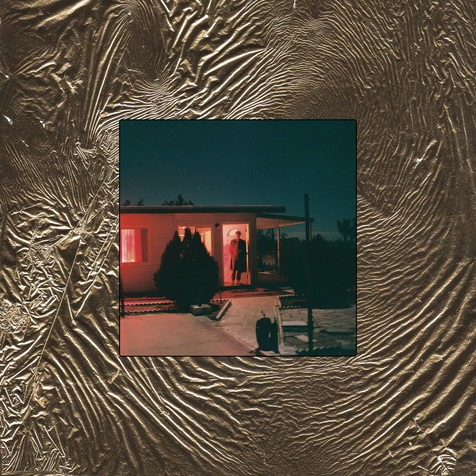
This month I’m releasing Deadstock: Uncollected Recordings 2005 – 2020, an album gathering up the songs no one got to hear: unreleased tracks and alternate versions from six studio records and scattered sessions, that form a kind of alternate history. ‘Here’s bunch of songs so good I never put them out,’ but these are as good anything I ever wrote, and we’ve played some of them on the road for years. They didn’t make it onto albums because I still think of albums as the unit of measure, and it’s more important to me to make a record work than it is to make sure a particular song sees the light of day. They tend to find their own way out the door anyway. Deadstock isn’t a documentary, it’s an album.
It’s arranged and meant to be heard that way, with seven new original songs – and two released prior only in Europe – as well as new full-band takes of back catalogue numbers like ‘Mesa, Arizona,’ ‘Ghost Repeater,’ and ‘Pretty Hands.’ Some of these are blood relatives, like ‘Real Love,’ ‘Any Town Will Do,’ and ‘Mesa, AZ’ (three songs written in three days driving around the desert southwest before the Ghost Repeater sessions) while some show the obverse side of the coin, like ‘Cold Late Spring Bark River’ (a less austere telling of a night I wrote about in ‘Heart to the Husk’ from Horse Latitudes), and ‘Crown of Smoke,’ the present-tense companion to the narrative flashback in ‘Little Warble,’ from Blood Brothers.
There’s a song I wrote for one of my heroes, the late great Rainer Ptacek of Tucson, and a song called ‘Jacaranda’ that I wrote while driving up the 101 in California years ago, feeling lucky; there’s a song called ‘Adios Mexico’ that I co-wrote with my friend Airon Kluberton – an airplane mechanic in Talkeetna, Alaska – when I was up there on tour, and there are two songs I always loved from the Cold Satellite collaborations with poet Lisa Olstein and guitarist David Goodrich, presented in new versions. The band is mostly the one you know from the last many years (featured on the Wolves and Blood Brothers records, and on the road), and then the Iowa boys from Ghost Repeater on two tracks, plus guest appearances by Kris Delmhorst, Pieta Brown, and Caitlin Canty on backing vocals. Deadstock won’t be streaming until 12/18, but you can pre-order copies for everyone you know right damn now to get it early, and in time for the holidays. To make that decision easier, you can go listen through all sixteen tracks right now, and hear/see the full single of ‘There’s a Destruction on This Land,’ (from the Salt As Wolves sessions).
All the older (in-print) albums from the back catalogue are available all this month 20% off, with the promo code JF2020. That’s right, I have a promo code. I’m having it tattooed on my ass. I’m not going to play a livestream concert this month, but I’ll be back in the new year to play through Blood Brothers, and maybe Deadstock too. In the meantime, keep an eye on the Store, as we’ll announce a few more things in the next few weeks. And then, if you would, please share the link for Deadstock around with your people, and add it to a playlist. I’m not hiring publicity or touring to promote this record, it’s just something to keep the party faithful amused, and a way to make a little cash in a lean year. You’re all deputized Junior Publicists now. Badges and hip boots will arrive by mail. I’m grateful to all of you out there, for taking care of each other, and for looking after us in a hard year. It’s meant the world. You’re all just aces.
The Band’s classic 1970 album is often considered slightly inferior to its two stone-cold-classic predecessors, the group’s debut “Music From Big Pink” and the self-titled follow-up — but what’s not often stated is that “slightly inferior” to those albums still makes it one of the best albums of the year if not the era.
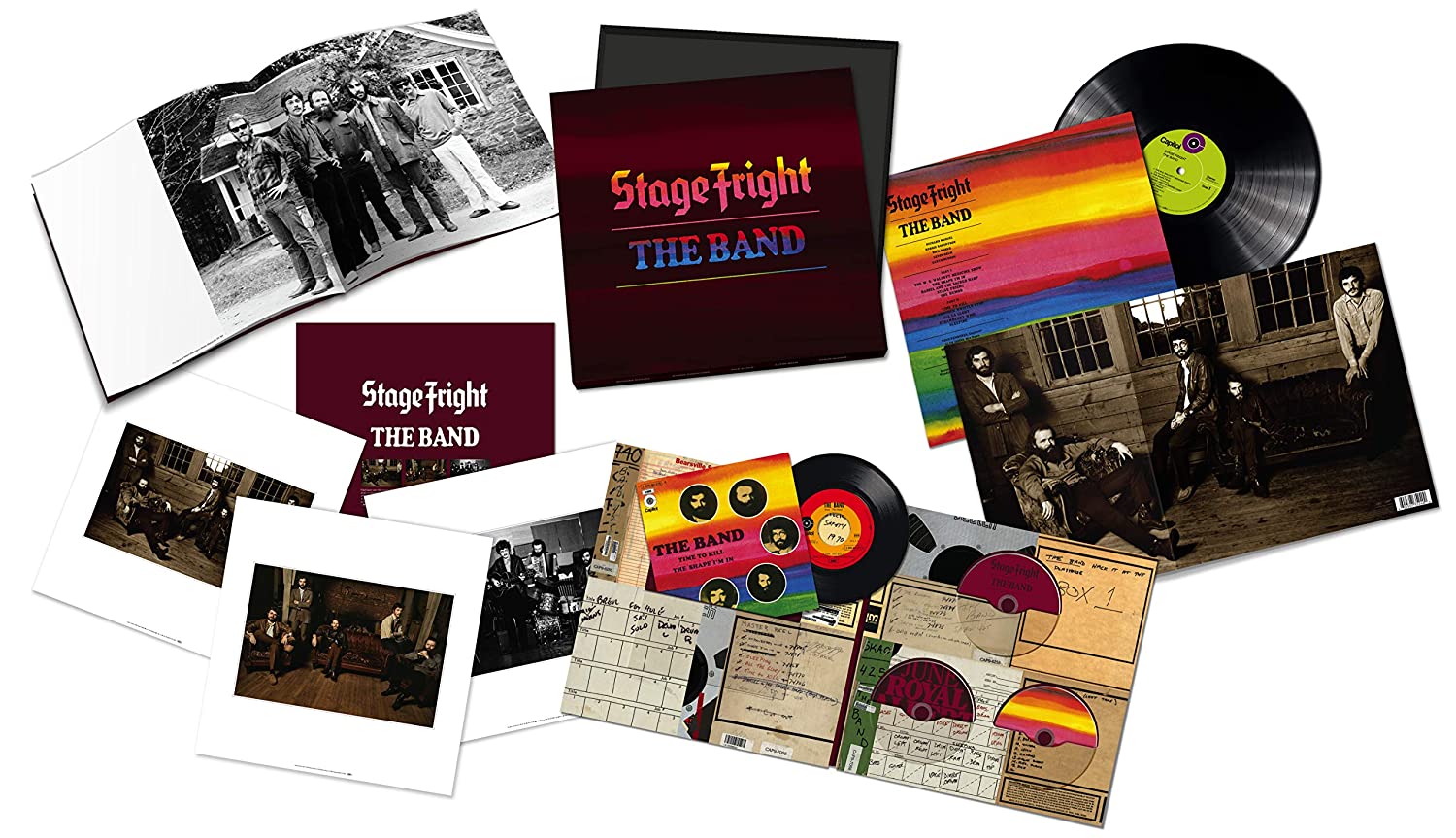
While the group had started to fragment a bit at the time of its recording — largely due to substance abuse — it still contains several of their all-time best songs, like the title track, “The Shape I’m In,” “Strawberry Wine” and others. On February 12th, 2021, Capitol/UMe will celebrate the 50th anniversary of The Band’s classic third album, “Stage Fright”, with a suite of newly remixed, remastered and expanded 50th Anniversary Edition packages, including a multi-format Super Deluxe 2CD/Blu-ray/1LP/7-inch vinyl box set photo booklet; digital, 2CD, 180-gram black vinyl, and limited edition 180-gram colour vinyl packages. All the Anniversary Edition releases were overseen by principal songwriter Robbie Robertson and boast a new stereo mix by Bob Clearmountain from the original multi-track masters. For the first time, the album is being presented in the originally planned song order. The boxed set, CD and digital configurations feature a bevy of unreleased recordings, including Live at the Royal Albert Hall, June 1971, In the set’s liner notes, Robertson calls the show at London’s Royal Albert Hall “One of the greatest live concerts The Band ever played. ”It was a thrilling full concert captured in the midst of their European tour; alternate versions of “Strawberry Wine” and “Sleeping”; and seven unearthed field recordings, Calgary Hotel Recordings, 1970, an impromptu late-night hotel jam session between Robbie Robertson, Rick Danko and Richard Manuel of several Stage Fright songs recorded while the album was in the mixing stage.
Exclusively for the boxed set, Clearmountain has also created a new 5.1 surround mix and a hi-res stereo mix of the album, bonus tracks and the live show, presented on Blu-ray. All the new audio mixes have been mastered by Bob Ludwig at Gateway Mastering. The set also includes an exclusive reproduction of the Spanish pressing of The Band’s 1971 7-inch vinyl single for “Time To Kill” b/w “The Shape I’m In” in their new stereo mixes and a photo booklet with new notes by Robbie Robertson and touring photographer John Scheele, who recorded the Calgary HotelRecordings; 1970,” a fun and loose, impromptu late night hotel jam session between Band members Robertson, Rick Danko and Richard Manuel of several “Stage Fright” songs, recorded during the group’s legendary “Festival Express” Canadian tour with Janis Joplin, the Grateful Dead, Buddy Guy and others. plus a reprinting of the original Los Angeles Times album review by critic Robert Hilburn; three classic photo lithographs; and photographs from Scheele and several other photographers.
Originally Released on August 17th, 1970, Stage Fright features two of The Band’s best-known songs, “The Shape I’m In” and the title track, both of which showcased inspired lead vocal performances by Manuel and Danko, respectively, and became staples in the group’s live shows. Recorded over 12 days on the stage of the Woodstock Playhouse, the album was self-produced by The Band for the first time and engineered and mixed by Todd Rundgren with additional mixing by Glyn Johns.
For the 50th Anniversary collection, the sequence has been changed to present Stage Fright with the originally planned song order.
The release follows last year’s stellar reissue of “The Band,” which included the group’s previously unreleased set from the Woodstock festival. All the Anniversary Edition releases were overseen by principal songwriter Robbie Robertson and boast a new stereo mix by Bob Clearmountain from the original multi-track masters (which resolves the conundrum caused by some of the album’s earlier re-releases, which included incorrect mixes of several songs). While the release notes that “For the first time, the album is being presented in the originally planned song order,” what will really interest fans is the previously unreleased material.
Dana Margolin really has a way with words. She likes to roll them ’round and ’round until the meaning flakes off and there’s nothing but feeling left. With their debut record five years in the making, the Brighton collective provided us with an unusual take on somewhat-anachronistic indie, shaped by Dana Margolin’s quaking, often unpredictable vocal delivery. All the memorable peaks on “Every Bad” are characterized by Margolin’s unreliable insistence that, say, “everything’s fine,” while the jarring opener climaxes and ebbs with the repeated, impossibly tense line “Thank you for making me happy.” I don’t think you could possibly adapt the “This is fine.” meme more fluently into song writing.
As many of us have followed them around for years, we predicted big things for these Brighton locals but we never suspected they had something quite this special in them.
Songwriter Dana Margolin’s vulnerability has been her constant strength and despite the nuanced and difficult subjects she takes on in her songs, she’s always had some level of lo-fi production or guitar fuzz to shield her, thanks to the bedroom pop genesis of most of these tracks. however, on ‘every bad’, she unabashedly centres herself and the result is astounding. That’s not to say that the guitar fuzz and lo-fi production have vanished – far from it in fact. ‘Every Bad’ takes cues from nirvana, who mastered underpinning anxiety with abrasion, raincoats in their tendency to twist, turn and change a song without warning and pixies in their ability to turn the aggression of grunge into a diverse and supple sound. so yes, they are clearly inspired by the bands of their youth but on these familiar foundations, something uniquely dynamic has been built. the jagged instrumentation complements dana’s rugged vocals and authentic lyrics perfectly, matching the mood of each song and manoeuvring effortlessly to enhance a lyricist who tackles sensitive, esoteric and existential subjects.
On opener “Born Confused” the singer chants “Thank you for making me happy” for a minute and a half. It starts off a little wistful, then genuine. With about 40 seconds left the edges start to wobble and the mantra becomes a frenzied wash of anguish. By the time the song cuts out, mid-sentence, it sounds like an accusation, if not an attack.
She told Apple Music that the track “captures the feeling of frustration and trying to figure things out”, which is maybe the core of Every Bad. It’s full of direct contradictions, cocksure one second and confused the next. It does an incredible job of transmitting the anxiety of being in your mid-20s. I’m an adult, why am I still adrift? “Oh, I don’t know what I want/But I know what I want/Oh, I don’t know what I want/But…”. Despite this vulnerability, dana never softens her edges or compromises in her lyrics. her pronounced and very forthright uncertainty and confusion comes across as defined and unflinching – the only thing she can be certain of is that confusion. this is not music that moralises or offers answers to life’s big questions – it is here to express raw emotional response with no interest in resolution.
That refusal to offer an easy way out is what makes it both so personal and so relatable. we may not have experienced the same situations, but we’ve felt those same nameless, onerous emotions. these guttural anthems amass into a defining album that’s burst them out of their established Brighton bubble, got them mercury nominated and has firmly planted them in hearts everywhere.
‘Sweet’ by Porridge Radio, taken from their forthcoming album Every Bad released in March . The DIY Brighton outfit were called ‘slacker indie’ when they released their first full album. “Every Bad” shows that description had more to do with the garage they recorded it in than their motivation.
“We just want to confuse the fuck out of people, in a good way,” said Working Men’s Club frontman Sydney Minsky-Sargeant. Mission accomplished. The band’s self-titled debut draws from a large swath of danceable ’79-’83 post punk and second-gen ’00s groups, with great songs, infectious beat-heavy production and a clear love for The Fall.
It’s old music for young people and young music for old people. It’s the sound of teenage possibilities current or remembered. we’re discovering house music in New York with New Order, riding the night train in Germany looking for Kraftwerk with Simple Minds, out of our minds and sticking to the floors of the Hacienda. our tour guide is Sydney Minsky-Sargeant who reacquaints us with what has been before whilst giving us something tangibly modern by navigating an untrodden route through those familiar places. This Yorkshire indie-guitar turned synth-techno band stormed into our lives in early 2019 with the razor-sharp post-punk of their debut ‘Bad Blood’ (released via Melodic Records) – kicking off our obsession with their output, it turned out not to be a blueprint for the direction the ensuing album would take however, for when they emerged a year later with the irrepressible propulsion of ‘Teeth,’ it felt like we were dealing with quite a different band. But it transpires that we pretty much were, as Syd was the only remaining member of the original set up. With a band of new recruits consisting of Drenge’s Rob Graham and Moonlandingz’s Mairead O’Connor (whose influence feels like it permeates ‘Tomorrow’ and ‘Cook a Coffee’) – Syd drew further on his dance influences (Justin Robertson, 808 state, Jeff Mills and Soulwax) to pursue more heuristic grooves. . acid house, rave culture, Detroit techno, Italian sleazy house. “it’s almost like the difference between ’81 New Order and ’89 New Order , but achieved in the space of a year” – the line of best fit.
Although a majority of the album is a riot of hard electronic beats, everything is cut through with an industrial, post-punk grit that keeps this firmly rooted in sweaty northern basement clubs and not on shiny, well-lit dancefloors – a collision of euphoric rave and stomping claustrophobia. how is it possible that someone so young can have such an affinity for – and knowledge of – the entire 80s indie dance scene?.
Savage and stylish, I absolutely love the hedonistic rush of rising dark synth-pop stars Working Men’s Club. Choosing to play along to a drum machine can be a wee bit stifling during most live performances, but for Working Men’s Club it ensures their sets remain tightly wound which retains their razor-sharp edge on stage.
Finding a home on the iconic label Heavenly Recordings, the West Yorkshire band have already released “Bad Blood” that has that killer bass line and the truly infectious “Teeth” which is most definitely my single of the year. they exhibit a level of cynicism and alienation only possessed by the young but here it’s channelled into a music that sticks two fingers up at any musical age discrimination: old acid-head ravers stand up! industrial goths indulge! nostalgic grown-up indie kids get yer converse on.
It’s an album of contradictions and juxtapositions. despite the influences spanning decades and genres, it smartly coalesces into a fluent and vitally modern whole, whilst simultaneously retaining the sense of this being a mixtape you’re listening to in your best mate’s bedroom in the early 90s; the lyrics predominantly focus on fatalism, imprisonment and despair whilst the music is imbued with hope, freedom and redemption; it’s music for the elation of the dance floor that works equally as well as a headphones listen slumped in your armchair; it’s full of fervour and vivacity but delivered with a piercing, icy stare and a tone of ennui. it’s this friction, this tension, this opposition, that makes this album so compelling.
like Fat White Family partying with the Happy Mondays and then hooking up with Suicide for an after party at Gary Numan’s pad, this is a cross-generational, cross-genre masterpiece that reverberates with the enthusiasm of a house party but resonates with the maturity of a dinner party. it’s odd that a record which evokes club culture, energy and togetherness doesn’t make you miss what you can’t have, but instead celebrates what you can. The whole Working Men’s Club aesthetic is steeped in 90s rave culture – the acid house smiley, the flouro colours, their iconic dancing kanji logo – it’s the return to freer times we’re all craving so much right now. their frenetic energy brings a much-needed adrenalin shot to the tail end of a year that damn well needs it.
We are hearing reports they’ll be sticking with Jeff Barrett for the release of their debut album early next year and I need a copy now.
“[a] potent set of bruising electro songs like a cool composite of stephen mallinder and mark e smith” – uncut.
“packed with gurgling, yelping energy” – the line of best fit
50 years following the release of his self-titled first solo album McCartney, featuring Paul McCartney playing every instrument and writing and recording every song, Macca delivers McCartney III. Paul hadn’t planned to release an album in 2020, but in the isolation of “Rockdown,” he soon found himself fleshing out some existing musical sketches and creating even more new ones. Before long an eclectic collection of spontaneous songs would become McCartney III: a stripped back, self-produced and, quite literally, solo work marking the opening of a new decade, in the tradition of 1970’s McCartney and 1980’s McCartney II.
At midnight on the day of the release, McCartney released the official music video for the lead track, “Find My Way.” Directed by Roman Coppola, the shoot utilized 46 cameras to capture McCartney on every instrument and from every angle, resulting in an intimate glimpse.
McCartney III is mostly built from live takes of Paul on vocals and guitar or piano, overdubbing his bass playing, drumming, etc. atop that foundation. McCartney III spans a vast and intimate range of modes and moods, from soul-searching to wistful, from playful to raucous and all points between — captured with some of the same gear from Paul’s Rude Studio used as far back as 1971 Wings sessions. And Paul’s array of vintage instruments he played on the new album have an even more storied history, including Bill Black of Elvis Presley’s original trio’s double bass alongside Paul’s own iconic Hofner violin bass, and a mellotron from Abbey Road Studios used on Beatles recordings, to name but a few. Just as McCartney’s 1970 release marked Paul’s return to basics in the wake of the biggest band break-up in musical history, and the 1980 avant-garde masterpiece McCartney II rose from the ashes of Wings, McCartney III finds Paul back on his own, turning unexpected circumstances into a personal snapshot of a timeless artist at a unique point in history.
With extra time on his hands due to the pandemic, Sir Paul is rumoured to have recorded as many as 25 tracks. In keeping with McCartney & McCartney II’s photography by Linda McCartney, the principal photos for III were shot by Paul’s daughter Mary McCartney—with additional photography by Paul’s nephew Sonny McCartney as well as photos Paul took on his phone (it’s a family affair). The cover art and typography is by celebrated American artist Ed Ruscha.
From the album’s announcement: Recorded earlier this year in Sussex, McCartney III is mostly built from live takes of Paul on vocals and guitar or piano, overdubbing his bass playing, drumming, etc. atop that foundation. The process first sparked when Paul returned to an unreleased track from the early 90s, “When Winter Comes” co-produced by George Martin). Paul crafted a new passage for the song, giving rise to album opener “‘Long Tailed Winter Bird”—while “When Winter Comes,” featuring its 2020 intro, “Winter Bird,” became the new album’s grand finale.
Recorded earlier in 2020 in Sussex, “McCartney III” is mostly built from live takes of Paul on vocals and guitar or piano, overdubbing his bass playing, drumming, etc. atop that foundation. McCartney III spans a vast and intimate range of modes and moods, from soul searching to wistful, from playful to raucous and all points between. [A Songbook edition containing piano/vocal/guitar arrangements for all songs from McCartney III and accompanying CD is also available, The three releases are true solo efforts in that McCartney performed all the instruments himself (with occasional vocal assistance from his wife, Linda, on the first two).
A follow-up to his 1970 self-titled solo debut and 1980’s McCartney II, the new album features the McCartney playing all the instruments; he wrote and recorded every song.
Pedro the Lion has always been David Bazan, but it took a long time to get back there. In August 2016, during what he now recognizes as his lowest point, Bazan was touring the country alone in an aging minivan and found himself in his hometown of Phoenix, AZ. In need of a break from the road, he spent a night off at his grandparents’ house instead of driving on to San Diego. Before leaving town the next morning, after realizing that even the most familiar places can become unrecognizable, Bazan gave himself the gift of a quick detour past the house he grew up in, and on the way, experienced a breakthrough – one that would lead him both forward and back to another home he had built many years before.
From the beginning, Pedro the Lion didn’t work like the bands Bazan had played drums in, where each player came up with their own parts. Instead, like scripting scenes of dialogue for actors to play with, Bazan recorded and arranged all of the skeletal accompaniments for his obsessively introspective lyrics and spare melodies. Each player would then learn their parts and, together as a band, they brought the skeleton to life. While bandmates played on a few recordings, Bazan often played all or most of the instruments himself.
“I found so much joy working this way,” Bazan remembers. “It came naturally and yielded a feeling and a sound that couldn’t have existed by any other process. At the same time, I was also aware that not everyone wanted to play in a band where the singer wrote all the parts and might perform them on the record. Someone even suggested it might not be a valid approach to having a band in the first place. Being insecure and wanting to find camaraderie, I became conflicted about my natural process.”
By 2002, after recording Control, the high rate of turnover in the band finally caused Bazan to ditch his “natural process” in favour of a collaborative writing process. When, after a couple more years, this move did nothing to stabilize turnover, Bazan was perplexed. In November 2005, Bazan decided to stop doing Pedro the Lion altogether.
Ironically, Bazan didn’t see “going solo” as a chance to revert back to his original process of writing and playing all the parts. For the next decade Pedro the Lion felt off limits, even forgotten, like a childhood home Bazan had moved out of. He pushed forward with releasing solo albums & relentless touring in living rooms and clubs, through every part of the US and beyond, sometimes with a band, but mostly on his own. It took a toll on his family and more acutely on himself. By the summer of 2016, he still hadn’t found the personal clarity or the steady collaboration he’d been seeking and was at the end of his rope.
“I had abandoned my natural way of working in the hopes of creating space for a consistent band to write with…and it hadn’t worked. So I got a rehearsal space, mic’d up drums, bass, and guitar, and really leaned into my original process again. It immediately felt like like home. Before long I realized it also felt like Pedro the Lion.”
In June 2018, with Bazan on bass, vocals, and arrangement writing, Erik Walters on guitar and backing vocals, and Sean Lane on drums, Pedro the Lion went into Studio X and Hall of Justice with producer Andy Park to create Phoenix, the first new Pedro album in 15 years.
The songs themselves are the result of mining your past for who you are now. On opening track “Yellow Bike,” Bazan encapsulates a core ache he’s been exploring since 1998’s.
“Phoenix” also deals with having to be better to yourself in order to be better to others on “Quietest Friend,” and harkens back to Control’s “Priests and Paramedics” with a story about EMTs facing a gruesome scene, and storytelling as coping mechanism, on “Black Canyon.” It bears witness to both what was around and what was inside, with the signature kindness and forgiveness that lightens Pedro the Lion’s darkest notes.
The result is a twisting, darkly hopeful introspection into home and what it means to go back, if you ever can. It is rock and roll wrapped in tissue paper, its hard edges made barely soft. Every melody is careful, a delicate upswing buoyed by guitar lines that hold each tender feeling together like string before ripping them apart to see what’s inside. It is an ode to the place he still loves despite how alien it can appear to him now. It is the story of a life from the beginning, but not a linear one. This life is a circle, and Phoenix goes back to that first point, to show that when we are looking for home we’ll eventually run into it again, whether it’s in the desert, in a rehearsal space, or on a stage.
“I’ve been driving through the darkness…through the smoke and fire on the ground”
Lingering at the remains of a campfire before dawn, with the politics of the personal burnt into ash, running his stick through what’s left, Wand singer/guitarist Cory Hanson is reflecting on moments of stepping further into himself, finding the ultimate big sky country on the inside of his skull. It’s a combination of songs and sounds that journey through bleak and broken territory and places of sweet, lush remove and it adds up to the best record he’s been involved in yet: his second solo album, “Pale Horse Rider”.
The session was loose and flowed onto tape well. First takes were mostly best takes. Fuelled with DNA lifted from country-rock cut with native psych and prog strands, Cory Hanson guided his craft toward the cosmic side of the highway, a benevolent alien in ambient fields hazy with heat and synths, early morning fog and space echo spreading the harmonies wide. Pale Horse Rider eyes the city, the country and the fragile environment that holds them both in its hands – a record as much about Los Angeles as it can be with its back to the town and the sun in its eyes; as much about nostalgia as new music can be with the apocalypse over the next rise…
On “Pale Horse Rider”, Cory Hanson moves ceaselessly forward. The old myths weave and waft, the shadows of tombstones flickering in the mirages and the light that lies dead ahead. Watch the video for “Paper Fog” now and get ready to saddle up and ride – reserve your copy before it touches down, on March 12th, 2021.
Hanson directed the “Paper Fog” video with Casey Hanson, and it’s a weird one. In the video, Cory Hanson stands on a sand dune, playing his acoustic guitar and looking nightmarish, with red face paint and unnatural contact lenses. Meanwhile, a disoriented Santa Claus wanders through the desert and then rips his own skin off.
Pale Horse Rider released March 12th, 2021 through Drag City Records
A dark and tattooed attitude with a dance floor punk throb. All hail Viagra Boys. Sweden’s finest.
A re-release of the Stockholm sextet’s debut album with extra tracks. Produced by Daniel Fagerstrom (Skull Defekts, Chronic Heist) and Pete Gunnerfeldt (The Hives). Sebastian Murphy (vocals), Henrik Höckert (bass), Benjamin Vallé (guitar), Oskar Carls (saxophone) Martin Ehrencrona and Tör Sjodén (drums) deliver a satirical punk-rock take on masculinity. Caustic and caustic with powerful dance-floor devastating rhythms of pounding motoring beats that are powered by churning bass, swinging broken-glass formed guitars and of course the drums – the relentless no-prisoners-here drums. A theatrical, passionate vocal shower storm of proclamatory emotional outbursts cajole and entreat you and always carry you away. An intense, unusual and captivating blend of theatrics, rockabillyroll, post-punk and dark power.
‘Just Like You’ from our debut album ‘Street Worms’.
Eight of the finest performances from Bruce Springsteen’s 1978 tour are now available in a limited, collectible box set. This 24-CD set contains all five of the legendary radio broadcasts on the Darkness On The Edge Of Town tour: The Roxy in L.A., The Agora in Cleveland, The Capitol Theatre in Passaic, NJ, Fox Theatre in Atlanta and Winterland in San Francisco. Rounding out the collection are the second shows in Passaic and San Francisco, plus the December 8th show in Houston, Texas. A limited number of empty boxes are also available to hold previously purchased CDs.
By Erik Flannigan
I’ve written before about the role the Darkness tour radio broadcasts played in the career development of Bruce Springsteen. Broadcast live from the Agora in Cleveland, the Capitol Theatre in Passaic, The Roxy in West Hollywood, and Winterland in San Francisco, those concerts were recorded off air by thousands of people listening at home in 1978. In the years that followed, many wore out their tapes, playing them again and again as the only “official” live Springsteen product until Live/1975-85 was released in 1986.
Through the “magic of bootlegging,” home recordings wound up on illicit vinyl pressings like Piece de Resistance and Live in the Promised Land. Copies of those LPs made their way to Europe, which wasn’t visited by the Darkness tour itself, so overseas fans at least got to hear Springsteen on stage. He and the band wouldn’t return to those shores until 1981; for such Bruce-starved fans, those recordings were manna from heaven. Without question, the familiarity fans have with the broadcast recordings of shows like The Roxy and Capitol Theatre cemented their status among Bruce’s greatest performances ever. But what if there were another?
It would be an exaggeration to call Atlanta 9/30/78 “the lost broadcast.” But compared to the other four, which were pressed multiple times on vinyl and CD bootlegs, Atlanta is the least familiar, having no meaningful history on bootleg vinyl and a limited one on CD. Originally broadcast live on radio stations across the Southeast, Atlanta 9/30/78 is the fifth and final Darkness tour transmission released in the Live Archive series. While not as familiar to fans as other ’78 broadcasts, the blistering Atlanta performance more than holds its own and is newly mixed from Plangent Processed, multi-track analogue master tapes. The 23-song show presents a potent core Darkness tour setlist augmented by the yet to be released “Independence Day” and “Point Blank,” plus special additions “Santa Claus Is Coming To Town,” “Raise Your Hand” and the only performance ever of James Brown’s “Night Train.”
The home recording enthusiasts alluded to above were certainly more plentiful in the Tri-State area, for the Passaic broadcast, than in the Southeast for Atlanta. Other broadcasts got wider distribution (the Agora show was syndicated to FM rock stations around the country after the fact) or were simply bigger events to begin with (Bruce’s Roxy appearance was the most buzzed-about show in Los Angeles in 1978). On the other hand, Atlanta and the Southeast were more of a development opportunity for Springsteen that year, and legend has it, stormy weather in the region on 9/30/78 caused reception problems for those who did record.
All of which explains why, as fans traded tapes and bought bootlegs in the ’70s and ’80s, the quality of the Atlanta broadcast, if it could be found at all, was inferior to the other four broadcast recordings, hence its outlier status. But one listen to Jon Altschiller’s new mix from Plangent Processed, 24-track analogue master tapes and Atlanta is an outlier no more.
The 9/30/78 set captures the Darkness tour “picked at the peak of freshness,” as the old commercial used to say. It’s like getting a lost episode of Seinfeld, shot but never aired during Season 5. The official release of this Fox Theatre show gives us the chance to fall in love all over again with a spectacular slice of Springsteen ’78.
After a great intro to the stage, the show smashes to a start with “Good Rockin’ Tonight” straight into “Badlands.” Each E Street Band member quickly shows they are in it to win it this night, with first-among-equals Roy Bittan carrying the melodic load with aplomb, as he will throughout the night. “Spirit in the Night” sets the band-fan tenor. “Darkness on the Edge of Town” is flawless, and Bruce sings with total conviction — no more so than on a subtle lyric change, replacing “Where nobody asks any questions or looks too long in your face” with, “You can drive all night, and never make it around.”
Sonically, Atlanta offers crystalline clarity. In the stately “Independence Day,” which Bruce introduces as the “flipside to ‘Adam Raised a Cain’,” the level of instrumental detail — from Danny’s glockenspiel to Max’s hi-hat, Garry’s bass to Stevie’s delicate strumming — is breath taking and immersive. It pulls you into what just might be your new favourite version of “Independence Day,” a sentiment you are likely to feel across several Atlanta performances. Yes, the audience is mixed just right, too.
The rest of the first set holds to the same gold standard as we move from a faultless “The Promised Land” to a scintillating, extended “Prove It All Night” that’s as good if not better than any version you’ve heard from this tour — and that’s saying something.
The same goes for “Racing in the Street.” Listen for a gorgeous and distinct bit of interplay between Danny and Roy around the 2:05 mark. The first set wraps with the peerless pairing of “Thunder Road” and “Jungleland.” It doesn’t get any better than this.
“Santa Claus is Comin’ to Town” opens the second half of the show in jolly spirits, and because the fake snow that fell needed to be swept up by stagehands, Bruce and the band vamp by paying tribute to one of Atlanta’s adopted sons, James Brown. They play the Godfather of Soul’s “Night Train” so well, one would think the song was in the set every night of the tour. In fact, this is the only performance ever of “Night Train.”
“Fire” extends the frivolity before the tone turns dramatic via “Candy’s Room.” Danny and Roy again weave around each other in stunning fashion in the long intro to “Because the Night,” which includes a superlative guitar solo in yet another “name a better one” version. The second River preview of the night, “Point Blank,” surely sent anticipation soaring for Springsteen’s next album, with Danny and Roy intricately swirling behind the striking original lyrics.
E Street Band vocals in the “Not Fade Away/Gloria” intro to “She’s the One” have never sounded livelier, the guitar licks never more Link Wray than this terrific extended reading, another reminder of how special it is to re-live such a beautifully recorded document of the tour. “Backstreets” provides a tour de force denouement, with the middle section a Van Morrison-inspired, mind-blowing melange of “sad eyes,” “Drive All Night,” “you lied,” and “we’ve got to stop.” Listening to the Atlanta version will reaffirm everything you love about the song, this tour, and these musicians.
Even venerable “Rosalita” gets an intriguing instrumental introduction more than two minutes long. There are so many moments in Atlanta 9/30/78 that are just a little different from the Darkness shows we know best, and it is all the more compelling because of it.
The traditional but no less exceptional Darkness tour encore of “Born to Run,” “Tenth Avenue Freeze-out” and “Detroit Medley” brings us home, and the night ends with one of only eight tour performances of “Raise Your Hand,” far fewer than you’d guess because all five broadcasts are counted among those eight renditions. With the release of Atlanta, the quintet of 1978 broadcasts in the Live Archive series is now complete, representing not only some of the greatest Bruce Springsteen performances of all time, but arguably the greatest live concert recordings in rock history.
8 Complete Shows On 24 Factory-Pressed CDs. • 7/8/78 The Roxy, West Hollywood, CA • 8/9/78 The Agora, Cleveland, OH • 9/19/78 Capitol Theatre, Passaic, NJ • 9/20/78 Capitol Theatre, Passaic, NJ • 9/30/78 Fox Theatre, Atlanta, GA • 12/8/78 The Summit, Houston, TX • 12/15/78 Winterland Arena, San Francisco, CA • 12/16/78 Winterland Arena, San Francisco, CA
Listening back to this year’s Gold Record, is a sentimental journey; once again, one hears the intuitive coming together forming richly behind Bill Callahan’s titanic voice. Across the stereo spectrum, the gentle conversation of Bill and Matt’s guitars, the subtle percussion of bass and drums, striking notes both decorous and discordant, like the naturally occurring sound meant to accompany and express lives lived everywhere. A fitting addition to Bill’s encompassing vision of our lives together and apart is this new vid for Gold Record track “Breakfast”. Dave Bryant’s colour-saturated video footage vision of digitally distorted interactions plays like like art and life, and the static and disconnect on our screens acts as an unexpected visual analogue to Bill’s tale of a dissolute domestic partnership. Compare and contrast for yourselves! And don’t forget to eat your brekkie! It’s still the most important meal of the day.
“Breakfast” is a track from “Gold Record,” released September 4th, 2020 on Drag City Records.