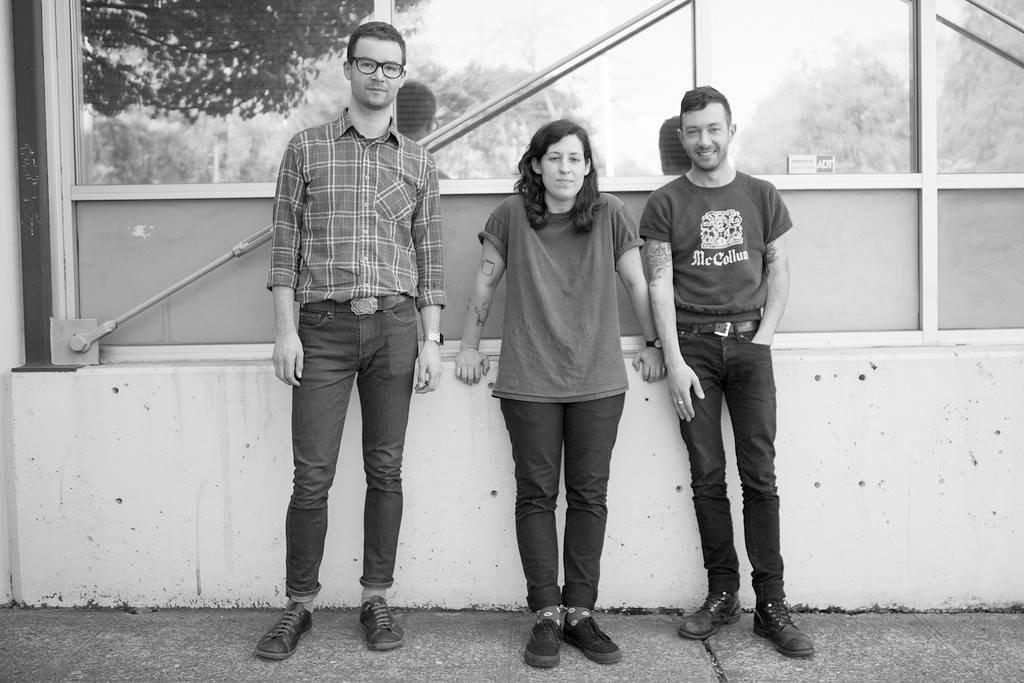
The R.E.M./Smiths-inspired band’s jangly pop returns today with the title track from their upcoming EP, Vicious Folly. The guitar break mid-way through the song sounds so much like “Dreams” by the Cranberries that I half-expected Dolores O’Riordan to have a feature.
Maybe next time. After arriving on the national scene in 2012, Line & Circleʼs “Roman Ruins” and “Mine IsMine” singles, and eponymous EP,received wide acclaim, appearing on a range of year-end lists on both sides of the Atlantic. The band’s debut full length “Split Figure” arrived in 2015 . The Ohio-born, Los Angeles-based Line & Circle will follow up their acclaimed singles and debut LP with their new EP Vicious Folly, due December 1st via Grand Gallop Records.
At a moment when societal divisions seem increasingly tense and tribalistic, Vicious Folly explores a belief the Romans held centuries ago: homo homini lupus — man is a wolf to man. Whether the conflicts here are romantic (“Man Uncouth”), ideological (“Vicious Folly”), or familial (“Who Runs Wild”), the songs contemplate the disquieting idea that man himself is his own greatest threat.
Vicious Folly brings the resulting emotional complexity to life by expanding on the band’s characteristically moody but vibrant color palette. Interweaving bass clarinet pulses and distorted tape loops move underneath minimalist patterns of chiming guitar and bass melody counterpoint. Singer/guitarist Brian J. Cohen‘s dramatic tenor pulls across the songs’ brisk rhythmic foundations, which are more unhinged here than in previous releases.
The bulk of the record was tracked live to tape in one day at Los Angeles’ Vox Studios with Michael Harris (Angel Olsen’s My Woman), with additional sessions in various warehouses, bedrooms, and backhouse studios around the band’s Echo Park neighbourhood.
The project was mixed with frequent collaborator Jonathan Low (The National, The War On Drugs) at Aaron Dessner of The National‘s Long Pond studio in Hudson Valley, New York.
Vicious Folly‘s cover features Peter Flötner‘s 16th century hand-painted playing cards from post-Reformation Germany. Flötner used his cards to depict and denounce the perceived greed, gluttony, and folly of his time. That the imagery strikes a chord today — as it surely did then is either deeply comforting, or incredibly disconcerting, depending on your information filter.
Line & Circle:
Brian J. Cohen (voice, rhythm guitar)
Eric Neujahr (guitar)
Jon Engelhard (bass guitar)
Garrett Ray (drums)
Bass Clarinet: arranged by Lewis Pesacov, performed by Brian Walsh
“Singing Saw”, was the solo album from Los Angeles singer-songwriter (and former Woods bassist) KevinMorby, was one of the great “growers” of 2016. Dusky and unassuming, it revealed its considerable charms slowly but surely. Morby’s follow up, City Music, mines a similar aesthetic, though its songs in general seem to endear themselves more quickly. Where Singing Saw was inspired in part by Morby’s sleepy neighborhood in the hills northeast of L.A., City Music is about the metropolis: city life, city noise, city people, a city’s pace, and so on.
Morby has said Singing Saw was Bob Dylan and Joni Mitchell, while City Music is Lou Reed and Patti Smith, and the comparison is clear in Morby’s speak-sing deadpan and bulging crescendos from brooding guitar-folk to driving rock. (The barreling “1234” makes a beeline for the Ramones.) City Music doesn’t hustle and bustle. But it won’t let you miss it, either so cool.
Kevin Morby’s title track off his excellent record, “City Music” nearly hits the 7-minute mark and challenges what fans may have come to expect from him. The song builds like a slowly accelerating subway train, as does this deeply impressionistic video.
Kevin Morby “City Music,” from his album, ‘City Music’, out 6/16 on Dead Oceans Records
Temples returned with their neo-psychedelic follow-up to their neo-psychedelic debut “Sun Structures”. Some moments strike like Tame Impala , others soar and don’t look back. They didn’t slump with “Volcano”, they, well, I was going to say like they played the trump card,
We kick off with “Certainty”, echoing the repeated, falsetto hook “I want to know that certainty is in my life.” It’s catchy, airy, uber-singable and has a light pop mix. Leaning in to the chorus, all I can hear is drums, vocals and a little icing. It’s a play from the top 40 playbook. Its cheesy on paper, but works wonders as an advancement on their sound. Not like a left turn into pop at all, more like a recipe with an extra appealing ingredient.
The second track, “All Join In” plays more like an intro, with its extended drum reverberations and epic mountain top synth line. The chorus is a half time jaunt with another soaring melody from James Edward Bagshaw. Elsewhere, “Oh the Savior” has immediacy and hooks on hooks. The first time through the verse it feels familiar, by the third time, you feel like you wrote it. Then the chorus takes off too. Like being in the stratosphere, then jumping in a rocket to go the megasphere.
The majority of the choruses here feel airborne, popping back to the 90’s, when every verse was pointless, and every chorus could fly. But it isn’t just Temples’ choruses, it’s the way they lead into them. The one measure hold and pop, or the seamless flow, their transitions flourish.
The guitar makes one major appearance on “Roman Godlike Man”. The rest is plenty of psychedelic keyboards, like the rainbow sherbet leads of the lead off track, and the waves of Cut Copy color on “How Would You Like To Go?” Also, the is-it-a-guitar-is-it-a-synthesizer lead on “Open Air” and the weighty, deliberate intro on “Celebration”. The sneaky hook lead on “Mystery of Pop” is inviting, my compliments to the chef.
The lyrics are typical dreamer, adventurer stuff, “We stand we land the form of parallelogram” and “mystic man stands like a contest”. They leave enough ambiguity for the imagination, sometimes leaning on the absurd with a british wit — “I’d like to put you in my pocket.” Like some psychedelic pop records, the first two or three listens offer little differentiation, but repeated listens reveal subtleties between the main similarities — drums, falsetto choruses.
They save the best for last as “Strange or be Forgotten” is the one track you won’t forget. A slightly funky groove kicks in, and a guitar echo base that both fade into a classic Temples verse melody, repeated, syncopated, and begging to be sang in falsetto. There are four different melody structures to the song, a verse, something of a pre-chorus, that fades into an additional pre-chorus, most bands would have built the song around these key pieces, but Temples bury the lede and keeps the chorus melody for last, and it’s the strongest on the record.
Volcano follows a rich tradition of British bands with pop sensibilities that flew under the radar: Supergrass; or never quite made it in America: Blur. How that much legendary music has come from this small island we will never know. This record’s closest counterpart is last year’s Currents from Tame Impala. Temples can’t quite reach pop solidarity like those Aussies, but they can come close enough.
The sibling due of Maggie and Tyler Heath (and a bunch of their friends), known as The Oh Hellos, are back with another album of gang vocals and hand clapping. The other day they announced a robust North America tour in support of the album. It is worth noting, though, that this album is even more ambitious than their previous folk salvos; it shows off a band who has seen success and can bring more “tricks” to the dynamic folk-pop sound that has made their name. Notos feels like a natural evolution of a sound that can be at times “down home” and other times feel quite modern and progressive.
“On the Mountain Tall” feels like an old time gospel set of lyrics put to a modern mix of music. Some of the electronic and rock elements are considerable divergence from the sound original Oh Hellos fans have come to expect. But as this is normal for a sound to change over time, this does feel like a logical next step. The vocal on the following tracks “Torches” really takes off for the chorus. The lyrics are so complicated, you almost have to stop and read them to understand them. In a world of simplified music.
Gospel-infused Malian rhythms meet experimental western orchhestrals in Ladilikan, a collaboration between griot (storyteller) musicians Trio Da Kali and Kronos Quartet. The result is a uniquely uplifting combination, merging lesser-known, traditional instrumentals like balafon (xylophone) and bass ngoni (lute), with the kind of playful strings you might find in a deep grooving Salsoul disco track. This album shows how different styles can enrich each others in magnificent ways, especially when operated by such virtuosos musicians.
Ladilikan, the new album by Trio Da Kali and Kronos Quartet, represents a landmark in cultural cross-fertilisation that both parties rank among the most satisfying musical experiences of their careers. David Harrington, Kronos’ artistic director and founder, enthuses that the album is “one of the most beautiful Kronos has ever done.” On first hearing their griot grooves being played by violins, viola and cello, Trio da Kali’s musical director Fodé Lassana Diabaté said, “This is going to be the best collaboration of my life.” Da Kali means ‘to give a pledge’ – in this case to a musical heritage that dates back to the time of Sunjata Keita, founder of the great Mali empire in the early 13th century. The line-up of balafon (xylophone) bass ngoni (lute) and female singer is also based on ancient tradition, although the trio format and its repertoire is now an endangered species in contemporary Malian music.
If you’re hoping to score some life tips from Camp Cope’s sophomore LP How To Socialise & Make Friends, you might want to look elsewhere.
“It’s not like an instructional album. Like I don’t know how to socialise or make friends,” frontwoman Georgia Maq admits . The Melbourne trio are about to follow their acclaimed, self-titled debut with a record that’s even more raw than the first, if that’s even possible.
“In the last one we had like a couple a harmonies and like a gang vocal and this one is just like fully stripped back, there’s nothing,” Georgia says. “Everything was done just really quickly, how we like it, and I think I don’t care as much for this album. I don’t care what people think.
“I care less because I’m happy with what we’ve done and so anyone else’s opinion doesn’t really matter.”
When shesays “really quickly”, she means it. The album was written in a couple of months, and recorded injust two days(though half a day longer than the first). In fact, drummer Sarah ‘Thommo’ Thompson says she booked the tour for this album before a single word was written.
“[We] went ‘Uh oh, now we have to record it’ and we just went to the same place we did last time, just booked two days with nothing written knowing that if we didn’t have dates to aim for we wouldn’t do it,” Thomo says.
The album is totally done now, though we’ll have to wait until March to hear it.
gmaq – vocals/guitar
kelly- lead bass
thomo – drums
Pre Oreders for ‘HOW TO SOCIALISE & MAKE FRIENDS now if you’re in australia, hit up www.poisoncityestore.com to check out the different colour options, along with this lovely tee designed by Celeste Potter, & the first ever camp cope stickers. friends throughout the rest of the world! run for cover have a different range of colours for you to choose from over at http://www.runforcoverrecords.com available to order now. thanks so much to everyone who’s helped make this possible, we are stoked for you to hear it
Shannon Lay has the voice of an angel. When the fiery, orange-haired guitarist isn’t shredding for Feels, she strips down to an acoustic guitar and melts your mind away. Lay’s debut solo album, All This Life Going Down, dropped in February on Do Not Disturb Records, Check out her video for “JHR”, directed by Castle Face Records co-founder Brian Lee Hughes and Sandy Kim.
Kevin Morby started a record label just to put this album out, that’s how much I love and believe in it. Incredible timeless music. Please do yourself the favor and not only listen to this album, but if you get the chance and feel like fully transcending into the heavens, go see her live. “Debut release on Kevin Morby’s new imprint with Woodsist Records.
“When I first heard Shannon Lay play me “JHR” it was like taking some sort of hypnotic pill and I wanted to make a film for it that matched it’s trance,” said Hughes of the video. Lay recently finished touring with CFM and the Cairo Gang, but the local LA musician plays more shows than I can count. Check out the band Feels.
FEELS are psych punk grunge post future rock + roll whatever band born and raised in Los Angeles, CA and taking the world by storm with the wild energy of their live shows and with their Ty Segall produced, self-titled debut LP, released in Spring 2016 on Castle Face Records (LP/CD) and Burger Records (cassette). Sophomore album due out Spring 2018!!!
On her earlier albums, Alynda Segarra (aka Hurray For the Riff Raff) explored the troubadour wanderings and raffish sounds of Americana. On the 29 year old’s visionary new work, The Navigator she brings it all back home, re-connecting to her buried Puerto Rican roots. In the process, Segarra struck an original mix of roiling bomba rhythms and catchy New York rock. Drawing inspiration from Ziggy Stardust , she conceived ‘The Navigator’ as a sci-fi tinged concept album, tracing the life of a character named Navita Milagros Negron through a metaphysical world. The lyrics present the story as a play, with allusions to the Latin political group of the ’70s, The Young Lords and verse from Puerto Rican poet Pedro Pietri. Segarra’s catchy songs connect the dots in the long lineage of Latin influences on popular music, from the street-corner harmonies of doo-wop to the romantic hits of the Brill Building to the Latin-rock of acts from Mink DeVille to The Ghetto Brothers. A song like “Living In The City” sounds like something Lou Reed could have cut in the early ’70s, delivered with righteous fervor by Segarra’s resonant vibrato. Themes of gentrification and cultural appropriation anchor the story. Properly staged, ‘The Navigator’ could become a rock opera for our time.
Sad news from the city of Seattle the band Posse decided to add to the ash pile and call it quits. The trio gifted to the world their final album Horse Blanket
If Seattle indie rock had a poet laureates, Posse would surely lay claim to the title. Since 2010, across two previous albums, the trio chronicled the banality and disappointments of life in their Northwest city with wit and sadness and hilarity. The sound they crafted to accompany their stories of bad dates at terrible Seattle rap shows (“A bald white guy/With a mumu onstage” one lyric went) and workplace frustration was beautifully spartan; just two guitars and a drum chugging along in a haze. Horse Blanket is the band’s final record, an EP of six songs about the things they know best: “boredom and loss, miscommunication and regret.”
On opener “Dream Sequence” vocalist Sacha Maxim gently shoves a listener into Posse’s disaffected, overcast world: “I was sick/I was tired/I was standing in the rain” she sings with a frown. The lyric is without frills or metaphor. Instead, Posse find poetry in blunt and dead-simple observations. This reflects in their arrangements, which are without ornamentation or glitz, just Maxim and Paul Wittmann-Todd’s depressive guitar strums accompanied by Jon Salzman’s quiet drumming.
While their sound could almost be described as rudimentary, it’s never boring. The deliberate nature of their music, the almost shuffling sleepwalking stupor of their voices and each instrument trudging forward, create a sense of pace and place that is so real it can be hallucinatory. Like on “Shiver” when Wittmann-Todd slurs, “I feel cold/Or maybe something like that,” the frigid trickle of guitar notes perfectly mimics the loneliness of his line. Something the band does so amazingly well, They recreate an entire universe of subtle, painful interactions, “funny little rituals,” and personal landmarks. Wittmann-Todd takes you through a detailed tour of a break-up that travels between cold beaches and the interiors of shitty Volvos. The pain is self-lacerating: “I told myself I’d differ, but I never really change,” he sings.
Patsy’s Rats are a Portland band. Their “Is It Alright” single is pure pop to the jugular. Reminds me of Let’s Active with the boy-girl choruses and jangly nature. If you don’t like singles, this is also on the compilation of singles the band just released on Bachelor Records. Patsy is Patsy Gelb, formerly of Scavenger Cunt and occasional collaborator of her father, Howe Gelb of Giant Sand. Her Ratsconsist of main-squeeze Christian Blunda (erstwhile Billy Jeans of Mean Jeans) and a rotating door of rock ‘n’ roll vermin-for-hire