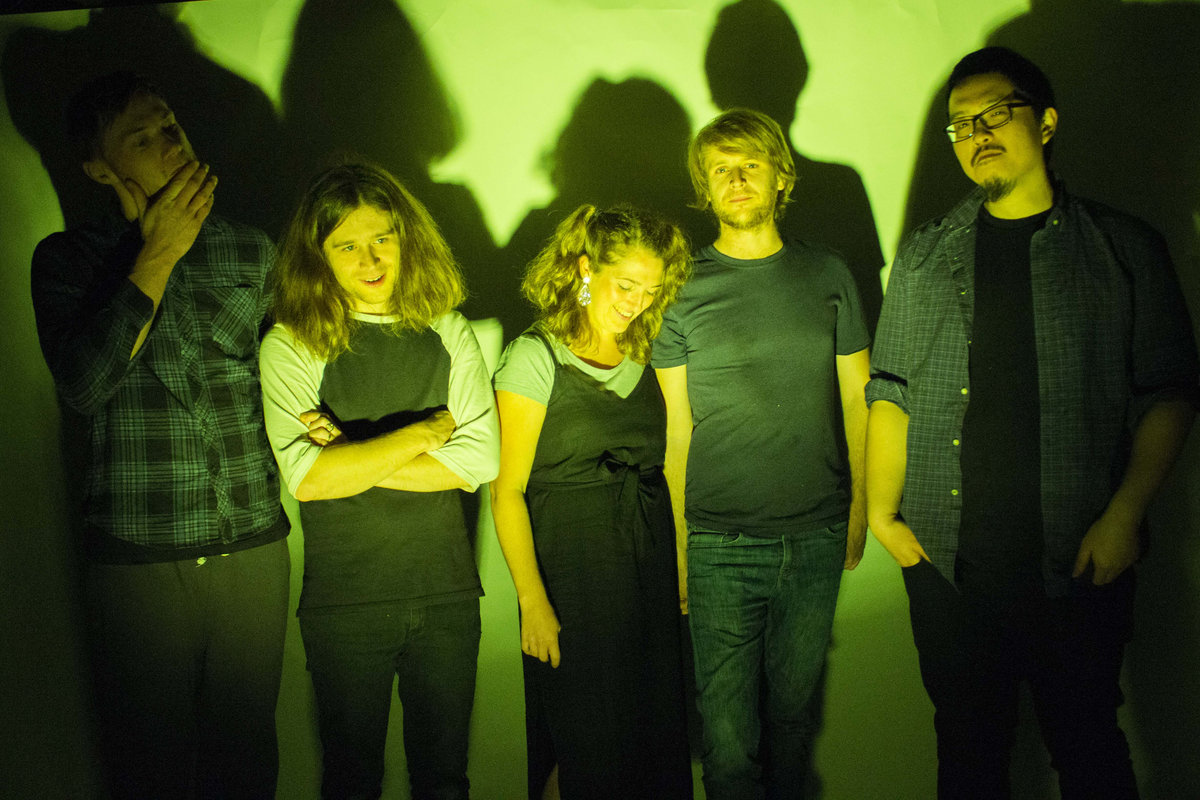
Wand’s last two releases, 2017’s Plum and 2018’s Perfume EP, meshed Cory Hanson’s touching, beautiful melodies with ramping psych riffs. The Drag City Records psych-leaning five-piece is set to release their latest full-length, Laughing Matter, on April 19th and they made an appearance at Hotel Vegas for the Levitation showcase. Playing lots of new material, Hanson and co. brought zigzagging guitar jams (sometimes with a violin bow in hand) and melodies with an alluring, warm purity. Hanson’s delicate psych croon and wintery backing vocals from keyboardist Sofia Arreguin sounded sublime when paired together, and the Los Angeles-based Wand proved to be a charming, soothing oasis from much of the freakier psych rock acts on the bill.
Laughing Matter offers bits of fuzzy parable, travel diary, pep talk and lullaby, amid a joyous, eclectic sense of pastiche and ascendant choruses. Wand form new music from the ashes of a world that can no longer suffer its human abusers, to inspire us to hold the spirit close and do what’s next.
For a sample of these new reaches in the Wand-iverse, look no further than the track “Walkie Talkie”, the third pre-release single and latest video from Laughing Matter! Lookin’ like it might’ve beamed in directly from sideways post-punk pastward futures, “Walkie Talkie” shines brightly with the reflective sheen of Wand’s modern flicker. Muted neon colors swallow seething imagery as Lee Landey and Evan Burrows‘ emphatic rhythm section slams into Cory Hanson and Robbie Cody‘s screaming guitars, whilst Sofia Arrequin‘s warped Morse keyboards sew the song together at the edges. “Walkie Talkie” is a wheelhouse Wand jammer, a barely-contained swarm of alien and uncanny tones driven to the maximal edge.
Track from the Wand album “Laughing Matter,” available on 2xLP/CS/CD from Drag City on April 19th, 2019.
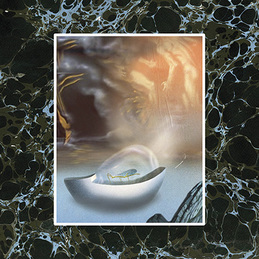
Auckland psych-rock behemoth Ounce have unleashed their hugely anticipated debut album OZ, following hot on the heels of a mind-altering run of singles and senses-defying live shows. The incendiary six-piece’s ten track collection, released today via local independent mavericks 1:12 Records, features previously released favourites ‘Electric Eye’, ‘Satan II’ and ‘Crocodile’ alongside a fistful of fresh tracks, drawing upon a diverse sonic melting pot of influences including propulsive ‘kraut rock’ grooves, surf guitar and 50’s exotica percussive workouts. You can experience Ounce’s blazed double drum attack for yourself on their national album release.
All words and music by Ounce except for Interstellar Overdrive riff by Pink Floyd in “Desert”. Recorded and mixed by Callum Rooney. Mastered by Patrick Haight. Art and design by Callum Rooney.
The Band
Antony Pike – Drums and percussion, some keys and backing vocals
Kieran Ruffles – Drums and percusion
Callum Rooney – Baritone guitar, vocals, keys
Yves Yang – Bass guitar
Fi Browne – Hand percussion
Cambridge-based trio Mammoth Penguins are soon to return with their third album, “There’s No Fight We Can’t Both Win”. This week the band have announced an array of dates across Spring and early Summer, as well as sharing the video to the record’s second single, “Closure”.
Discussing the inspiration behind the track, front woman Emma Kupa has suggested Closure, “is a song about an interaction, or day, or moment, or occurrence when something shifts and feelings that you may have been carrying around for a while just dissipate”. The track seems to not mourn this passing feeling but celebrate it and cherish the freedom that it brings. Musically, this feeling manifests as probably their heaviest, most dynamic track to date; the moments of shimmering calm never lasting long before a crashing crescendo of rhythmic noise comes roaring into their place. The mighty chorus serves as reminder of the band’s ability to write a scream-your-heart-out refrain; “all the yearning and all the regret, all the sadness just left me”, surely set to soundtrack every storming out of the house moment in indie films for years to come. Plus there is an excellent feather-flying, pillow fighting video courtesy of director Fraser Watson, so what’s not to like really?.
Band Members
Emma, Mark and Tom
There’s No Fight We Can’t Both Win is released on 26th April 2019 via Fika Recordings.
Producer, engineer and former FIDLAR drummer Danny Nogueiras has just released downey, the debut album by his band No Win. The album’s title is borrowed from the Southern California city Nogueiras grew up in and the 10 songs offer a power pop compendium of glory days, melancholy memories, hopes for a future already passed, and dreams that may still be one day be realized. No Win will join Swervedriver and Failure on tour later this spring. Get Downey now.
NO WIN party in the parking lot for the “Carbar” video directed by Ryan Baxley (FIDLAR, The Front Bottoms, Culture Abuse).
Modern Nature – the name taken from the title of Derek Jarman’s garden diaries – is the new project of Jack Cooper, ex of Ultimate Painting / Mazes and Will Young of Beak featuring Aaron Neveu of Woods and Sunwatchers’ Jeff Tobias on saxophone. Their debut EP, titled “Nature”, will be released 22nd March 2019.
As Jack Cooper explains: “The EP is based around a song called ‘Nature’ so ‘Supernature’ is a different perspective on the EP’s title track, but taken to another conclusion. It’s our most recent recording and there seems to be some sense in people hearing that first. ‘Nature’ is our take on that propulsive rhythm of A Sailor’s Life-era Fairport Convention but ‘Supernature’ is something else entirely. The band is so new, it’s hard to say who’s in and who isn’t. At the moment it’s myself and Will Young (Beak) with Aaron Neveu on drums (Woods/Herbcraft) Rupert Gillett on cello and then Jeff Tobias on saxophone (Sunwatchers).
The band started as a vehicle for a wider project that Will and I spent the year putting together so it feels very exciting to be an actual band now. Every song we record or musician we gain, another door seems to open on a route that’s worth pursuing.”
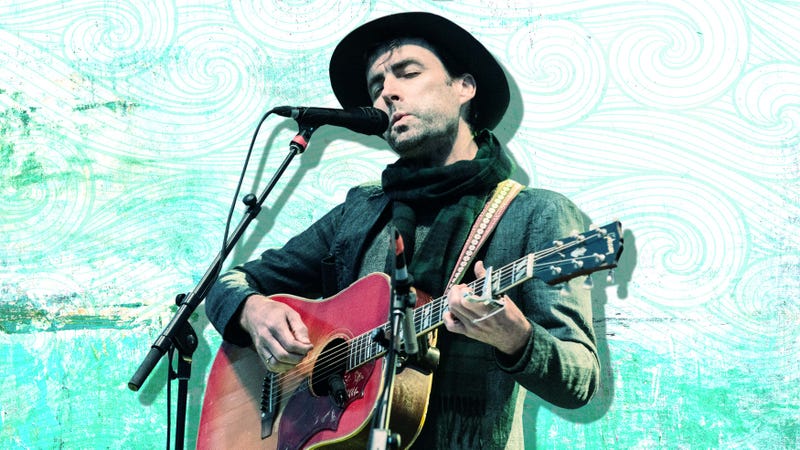
Illinois songwriter and multi-instrumentalist Andrew Bird is back with his 12th solo album “My Finest Work Yet”, and it might actually live up to its name. These 10 new tracks find Bird doubling down on the heady folk storytelling that we’ve come to expect from him, but in a way that feels more immediate and of the moment than ever before.
Ambiguity, like virtuosic whistling and erudite lyrics, is a hallmark of Andrew Bird’s music, but it’s seemingly absent from the title of his latest album, On which the multi-instrumentalist and singer-songwriter has dubbed “My Finest Work Yet”. The other superlative in the discussion around the 10-track album, is that it’s Bird’s most political or topical work to date, thanks in part to the Lake Forest native being forthcoming about the real-life events that informed tracks like “Bloodless.” But My Finest Work Yet travels further back than the 2016 election,
In addition to raising the question of whether this is his finest work yet, the conversation around the album has also been about it being maybe his most political work to date. My Finest Work Yet certainly explores a lot of divisions in this country.
There are all these songs that have made it across airways that are dealing with anything that’s going on now these are troubled times, And I think what better medium than songwriting to go in deep and figure out what’s really going on and maybe offer suggestions of how to get out of it. So a lot of the songs, from “Archipelago”, “Fallorun” to “Bloodless” they’re dealing with this deal that’s been made that we’re somewhat unwittingly being played by these people that are profiting through algorithms and whatnot on this division, and just amplifying it. And the more they amplify it, the more they seem to benefit from it. It’s just taking things that have always been there, and exploiting them, and making them worse for profit. It has to do with a certain aspect of human nature that’s been around for eons. But it’s just that attraction one has to their enemies—what space, what void in us is being filled by our adversaries? And how that gets our horns locked and we can’t pull them out. And it’s that sort of intimacy, that need that’s being filled by your adversary. What would happen if you just walked away? They’d probably really miss you, you know?
AB: Yeah, I kind of stumbled on that word, “Fallorun.” I kind of ran the two together. I was going through, like, five different possible choruses that were all way too heavy-handed, I think. “Fall of throne.” And then my wife thought I was saying “fall or run,” instead of “Fallorun” And I thought, “That’s actually better than ‘fall of throne.’” And so it is talking about that fight-or-flight instinct. And it’s just sort of addressing that, “What is patriotism?” And the verse is, beyond those first couple lines, “What if Trump were not human, he was just an algorithm that takes all our worst impulses as people and amplifies them and exploits them, turns them on us?” That’s effectively what we’re dealing with. It’s just almost a reflection of ourselves in a way.
“Manifest” is the latest song to be released off the album. AB: Yeah, I guess I was thinking about fossil fuels—just that term is kind of interesting in how it points out that what we pull out of the ground and put into a combustible engine is the result of millions of years of plants and animals dying and being compressed underground and being fossilized. But I also wanted to look at the afterlife for those organic things. There’s still energy contained in that organic matter, and that’s what we’re doing, is spending the last bit of energy of that life form. And from there it becomes vapor, so it’s almost like the ghost of that thing. There’s a certain poetry to all that, as frightening as it is. So that’s mostly what it’s about.
The first line is like, “Coming to the edge of the widest canyon.” I was imagining the Spanish explorers coming to the edge of the Grand Canyon, and in that moment thinking, “Whoa, we just got to the end of it all.” That’s how the song kind of started, but the chorus is talking about the tendrils, the fracking, these things going deep into the ground to find every little bit of fossilized fuel. The video that’s out at the moment is just us in the studio, but there’s an official video coming out in, like, a week and a half that’s an animated thing that kind
“Cracking Codes” feels like one of the “bread and roses” moments on the albums; it’s more personal, AB: Yeah, it sounds more like a love song than anything else on the record. The chorus is about either telling the truth, or just being able to tell if someone is being true—that search for truth relates to everything else on the album. And through it I’m just talking about how even without words two people can, through body language or just even atmosphere that one creates with energy, that you can just tell if someone is really who they say they are. ’Cause it’s quite straightforward. I wrote that song very quickly, and so it hangs together better than anything I’ve written in a long time.
How would you come to realize this is your finest work yet? You have an extensive discography, which means you have a lot to compare. Is it kind of just like a gut feeling in the middle of the night after finishing recording.
Having such an extensive discography makes me saying something like that about myself more okay,
AB: I really liked “Inside Problems,” but that didn’t really make sense for these songs. I was really trying to convey this idea of horns being locked, of a struggle of two wrestlers just starting to make out or something. Two people or sides, just so close and so intimate, yet locked in the struggle. And I couldn’t figure out a way to do that without it being just too much. So I gave up on trying to encapsulate the whole record with a few words, and that process just seemed kind of silly on record No. 14 anyway. So I just went with this somewhat tongue-in-cheek statement.
But that being said, these songs on the album do feel different to me. There was an urgency in the writing of them that felt different, like I had a purpose even though I was still kind of doing what I was always do, which is pay attention to what’s around me and process it.
These songs make up this kind of path to war, from trying to avoid it on “Fallorun” to spouting propaganda on “Proxy War,” and then there’s a call to “Don The Struggle.” Is the album closer, “Bellevue Bridge Club,” intended to bring an end to the conflict?. That song, I’ve been writing for a long time, five or six years. It went through so many versions. As opposed to “Cracking Codes,” which took a half an hour, this one took years. And eventually I scrapped everything in the song except this line, “We’ll be playing bridge in the psych ward with Barbara, Jean, and Sue.” I had the hardest time working backwards and figuring out what makes that line make sense. All I knew is that that was the best line in the song. The original idea was someone coming home from the Great War and seeing horrible things and just wanting to have a boring life, or in this case, suffering, or recovering from shell shock in the psych ward just playing bridge, and wanting to live in a small town.
Something that’s been happening on the last couple records is that I embrace the second voice that enters in my head as I’m writing a song, the one that’s a bit critical of the song. I think it’s a refreshing thing, and usually people don’t choose to put their own self-doubt in the song, they usually try to block that voice out. But I kind of like to embrace ’cause it gives us a break from the first-person narrative that you’re listening to through most of the record. And so that’s where that line comes from.
American Football’s original triumph, on their 1999 self-titled debut, was to reunite two shy siblings: emo and post-rock. It was a pioneering album where lyrical clarity was obscured and complicated by the stealth musical textures surrounding it. Like Slint’s Spiderland, or Codeine’s The White Birch, even Talk Talk’s Laughing Stock, American Football asked far more questions than it cared to answer. But there wasn’t a band around anymore to explain it, anyway. The three young men who made the album – Mike Kinsella, Steve Holmes, and Steve Lamos – split up pretty much on its release.
Fifteen years later, American Football reunited (now as a four-piece, with the addition of Nate Kinsella). They played far larger shows than in their original incarnation and recorded their long-anticipated second album, 2016’s American Football (LP2). The release was widely praised, but the band members still felt like their best work was yet to come.
‘I feel like the second album was us figuring it out,’ says Nate. ‘For me, it wasn’t quite done. I knew there was still more.’
Enter American Football (LP3). ‘We put a lot of time and a lot of energy into it,’ says Mike. ‘We were all thoughtful about what we wanted to put out there. Last time, it was figuring out how to use all of our different arms. This time, we were like – Ok we have these arms, let’s use them.’ The band used the same producer, Jason Cupp, and recorded the album at the same studio (Arc Studios in Omaha, Nebraska) as its predecessor – yet they approached it in a markedly different way. There was a determination to let the songs breathe, to trust in ideas finding their own pace. The final result is a definite, and deliberate, stretching of the band.
As a result, LP3 is less obviously tethered to the band’s past than the second album. An immediate contrast between LP3 and its two predecessors is its cover. The two previous albums featured the exterior and interior of a residence in the band’s original hometown of Urbana, Illinois (now attracting fans for pilgrimages and photo opportunities), by the photographer Chris Strong. But American Football knew that LP3 was an outside record. Instead of the familiar house, this time the cover photo (again by Strong) features open, rolling fields on Urbana’s borders. It is a sign of the album’s magnitude in sound, and of the band’s boldness in breaking away from home comforts.
American Football also joked that LP3’s genre was ‘post-house’, because of this very conscious visual break. But, in a strange way, there are links in LP3 with an actual post-house genre: shoegaze. The more exploratory members of the original British shoegaze scene were inspired by the dreamtime and circularity of house music (ambient house in particular), cherishing its sonic possibilities. That spirit drips into LP3, most obviously on ‘I Can’t Feel You’, a collaboration with Rachel Goswell of Slowdive.
The album also features Hayley Williams from Paramore on the album’s catchiest moment, ‘Uncomfortably Numb’, and Elizabeth Powell, of the Québécoise act Land Of Talk. Mike wrote lyrics in French especially for her.
LP3 is contemplative, rich, expressive, yet with a queasy undercurrent. It is heavy with expectancy, revealing its ideas slowly, eliciting the hidden stories people carry around with them. ‘I feel like my lyric writing has changed a lot over the years,’ says Mike. ‘The goal is to be conversational, maybe to state something giant and heavy, but in a very plain way. But, definitely in this record, I keep things a little more vague.’ As on the first album, the lyrics on LP3 may seem confessional and concentrated, but the more you scrutinize them, the further their meaning slinks away. Or, as Mike tellingly sings on ‘I Can’t Feel You”: I’m fluent in subtlety.
‘Somewhere along the way we moved from being a reunion band to just being a band,’ says Steve Holmes. American Football is now a bona fide ongoing focus, and they are making some of the best music of their lives. American Football (LP3) stands with two other rare reunion successes – Slowdive and My Bloody Valentine’s mbv – as a fine example of how a band refinding one another can augment, rather than taint, their legacy.
‘I think that there are those albums, or the music that you heard when you were younger, and they imprint on you,’ says Nate. ‘And no matter where you go, or what you do they’re always there.’ He is talking of Steve Reich – an early and ongoing influence on American Football – but he might as well be reflecting what is said of his own band, and the ardent following they inspire. American Football stands as an enduring symbol of elusive emotional landscapes, where introspection can be as dramatic as confrontation.
Cherry Red is putting out a 4CD 80 track set that celebrates the independent side of the UK’s post punk synthpop boom that took place between 1978 and 1984. The collection is called Electrical Language and it also comes with a booklet featuring the sleeve notes from many of the recordings and words from the artists themselves. The collection includes several household names such as OMD, The Normal , Human League, Thomas Dolby and Fad Gadget in addition to underground artists from the era.
This collection also contains some hidden gems from Mute Records, Rough Trade, 4AD, Survival Records and of course, Cherry Red. Cherry Red Records say this about the collection,
A broad church from the outset, this synth-pop movement wasted no time in embracing players from all corners of the musical dressing up box. From guitar groups drafting in a keyboard playing friend and the progressive rockers using their expensive banks of electronics in new ways to the modernists and the Thatcherists, full of unabashed aspiration, and the punks – arguably the purest punks of them all – who discarded the guitar and the drum kit overnight in their pursuit of something fresh that their generation could truly call their own. All were welcome, and all contributed to the many different directions synth-pop would mutate in over the coming five or six years.
‘Electrical Language’ captures this time and place in microscopic detail. The uptempo would-be hits with suburban nightclub aspirations, the science and technology enthralled proto-techno workouts and the otherworldy experiments are all here, sitting comfortably amongst each other in some cases, jostling for position in others. This was a post-punk revolution of another kind, played out on a stage free of the traditional boundaries and limitations, entirely alien to anybody over twenty-five and enthralled by the new and the exotic. For the first time in a while, the future looked bright, albeit illuminated with electric light.
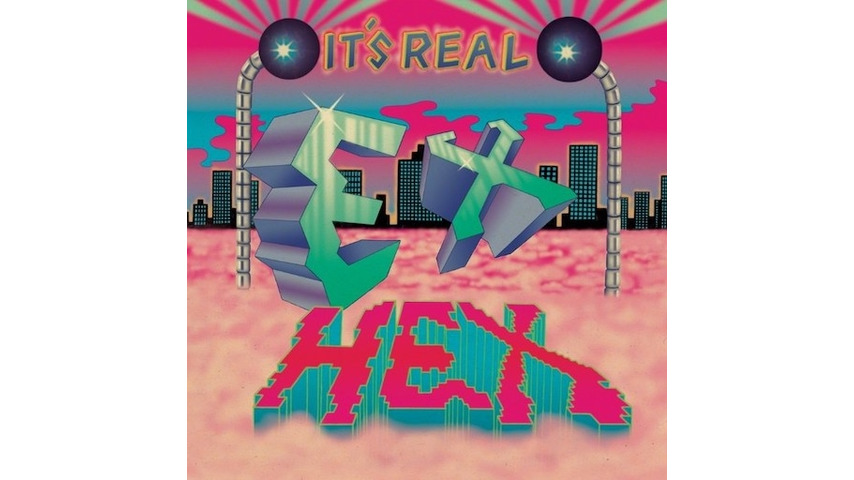
Whoever Mary Timony’s singing to on It’s Real, Ex Hex’s sophomore follow up to 2014’s Rips, they’ve taken her on one dizzying rollercoaster ride. From start to end, It’s Real warps around “you,” more than likely the same person all the way through the record’s track list; Timony sings the same yearning for “you” on the opening song, “Tough Enough,” and on “Good Times,” “Want It to Be True,” all the way to “Talk to Me,” where Timony appeals to her nameless audience to grant her the simple courtesy of a conversation.
“If you shut me down, will all be lost in space and time? / I’ll wade into your stormy sea,” she croons, vulnerable but possessed of steely dignity. It takes immense strength of spirit to guide a boat over rough waters, and “It’s Real” charts a perilous course: The second track, “Rainbow Shiner,” soberly rings with implied violence, a document of triumph through “the black and blue.” If anyone wishes to make the case that Timony intends to address more than one subject, “Rainbow Shiner” is a good place to start; this song feels aimed at someone she’s breaking away from rather than someone she’s trying to get closer to. But maybe It’s Real, in keeping with its title, means to acknowledge complications of the heart. Maybe the one Timony got all the black and blue from is the same one she ran from shadows with in “Cosmic Cave.”
Following It’s Real’s unifying thread is a complex task. The music, granted, isn’t as complex, in the sense that the music itself requires no moralizing for engagement: It’s great, unqualified awesomeness soaked in ‘80s and ‘90s rock ‘n roll, echoing anyone and everyone from Joan Jett to Sleater-Kinney to Scorpions and even to Tsunami Bomb. But here rests the line of delineation. Folks who don’t appreciate an aesthetic planted firmly in the eras of grunge and Camaro rock likely won’t change their tune on hearing It’s Real’s stomping power-pop stylings (assuming they’re generous enough to give it a shot in the first place). People who read that description as a promise of Good Times, on the other hand, will embrace It’s Real as Ex Hex’s return to the modern day rock ecosystem.
There’s a gentle hand needed to make music with as much edge as Ex Hex’s sound so tender through the crackle and buzz of distortion pedals and the confident strut-worthy boom of Laura Harris’ drums. In some cases, the music actually sounds reckless: “This illusion of love is coming to ya,” sings Timony on “Diamond Drive. “The dots are moving on, and the lines are keeping time.” Calling back to “You Fell Apart” from Rips, Timony starts pointing out the “creeps” catching up to her. She doesn’t want the driver to crash, but boy, she wants to get the hell away from the creeps as they swing around on chandeliers. Between the creeps and a crash, the latter sounds preferable. If you’re going to wreck a car, might as well wreck it with the volume cranked up.
But the key word in “Diamond Drive” is “illusion.” It’s used on a recurring basis over the course of It’s Real, not only in “Diamond Drive” but “Another Dimension” and “Cosmic Cave” Was the love between Timony and her listener real? Did she just imagine the whole relationship? “We hung our minds / on an illusion of our love,” she muses on “Cosmic Cave.” If it was an illusion, it’s a remarkably substantial one. She can’t forget the experience she had with this person, however good or bad they might have been. She went so far as to craft an album about those experiences, after all.
Somewhere in Toronto, Canada resides a psych-tinged pop/rock duo called Maybelleen which aim to meticulously craft music that, according to them, stems from a possible encounter with “a mythical spirit they’ve bumped into, somewhere between our world and another dimension.” Madness? Yes! But it’s a rad and necessary madness. Consisting of brothers Peter Camiré and Charles Camiré, Maybelleen is following up their May 2018 EP, Neon Lights & Magic Moments, with the brand new single “Emily”, for which we happen to be debuting the music video today. Huzzah!
“Emily”, much like the majority of their output, was inspired by all things ‘80s new wave but also includes a modern rock edge. Originally from Montreal, the relocated lads are always out gigging and plan on dropping The Paris Tapes, their third EP, this spring. Speaking of the new track, the boys boasted:
“The way we work in the band is, one of us will arrive with a song idea and we’ll build something around it. In the case of ‘Emily’, it was more of a melancholic melody, and lyrically, we wanted to respect this specific atmosphere. We like to think that there’s something bigger than us out there contributing to the song haha, especially when we talk about music. We also feel like it’s a tribute to our teenage years spent in Montreal, when time wasn’t even a thing.”