Archive for the ‘CLASSIC ALBUMS’ Category

After The Gold Rush

By the end of the 1960s Neil Young was catching the ear of many influential figures – not least his old band mate Stephen Stills, who was now part of the Grammy-winning folk-rock super group Crosby, Stills & Nash. The band were keen to have him onboard as a sideman, but Young was insistent that he be given a full title credit as a condition for his contributions. Stills frequently found himself fighting with Young for control over the band’s songwriting, and has famously said that the latter “wanted to play folk music in a rock band.”

Young’s dogged self-determination, despite its interpersonal downfalls, was a major artistic virtue that fed directly into what was perhaps his first true masterpiece. After The Gold Rush had its beginnings in an unlikely place. Dean Stockwell, a former child star of the ‘40s and ‘50s, had been encouraged by his friend Dennis Hopper to write a screenplay whilst the pair were in the jungles of Peru producing a film entitled The Last Movie. Hopper assured Stockwell that he had the relevant connections to help get the film made, and once back in the US the latter retreated to his home at Topanga Canyon in the Los Angeles Mountains to commence the writing process.

A fellow resident of the canyon and a close friend of Stockwell’s, Young was suffering through a prolonged period of writer’s block and was under growing pressure from his label to record an album of new material. After learning of the writer’s creative endeavour he was intrigued to learn more and asked Stockwell if he could read a draft of the story. The script, which has since been lost, was an unconventional, non-linear narrative with religious and psychedelic undertones. It loosely detailed an end-of-the-world scenario centred on the local Californian environment, in which a biblical flood threatened to pull the state into the ocean. Captivated by this messy but intriguing tale, Young recalls: “I was writing a lot of songs at the time, and some of them seemed like they would fit right in with the story.”

Ironically Hopper’s proximity to the project scared off any interested executives, and before long the film seemed destined to remain in limbo. Nonetheless, Young was fired up and undeterred, commencing work immediately on what he imagined to be the soundtrack of this deeply counter-cultural Hollywood film. Finding time to write and record was difficult, as large swathes of 1970 were blocked out by Crosby, Stills, Nash & Young’s huge US Tour and further live obligations with Crazy Horse. In the precious gaps between shows, Young made initial recordings at Hollywood’s Sunset Studios, yielding “I Believe In You” and “Oh Lonesome Me” but quickly realised he preferred the atmosphere of the Canyon, continuing the process at the home studio set up in his lead-lined basement. It was here that his ensemble of bassist Greg Reeves, drummer Ralph Molina, and guitarist Nils Lofgren assembled.

The studio was a small and sweaty space, adjoined to a side control room from which producer David Briggs kept an eye on proceedings. The youngest of the ensemble, eighteen year-old Lofgren was brought in to play keyboards despite being a relative novice at the time of recording, highlighting Young’s unconventional laid back approach. Accordingly the musician recalls that “Neil didn’t mind rehearsing a bit” but they “didn’t belabour stuff.” It’s often considered that Young was attempting to merge musicians from both Crosby, Stills & Nash and Crazy Horse on this album, and Stephen Stills even appears on “Only Love Can Break Your Heart” to provide backing vocals.

The basement’s make-shift setup influenced the stark and plaintive sound of After The Gold Rush. Young featured solo on piano throughout the album, most notably on the title track which is often praised as the centrepiece of the album. Charting a surreal and fantastical course through three verses, the song starts in a medieval era of knights and peasants and ends in outer space with the remnants of humanity, after the world has descended into apocalypse.

The song was designed to directly mirror the plot of the proposed film, and Young invited Stockwell to sit in on some of the album’s sessions. The writer was impressed: “If you could calculate the amount of human energy that goes into the making of one of his songs, you would have a really fucking high number, man.”
Explaining his thoughts behind the environmentally conscious song Young recalls: “I recognise in it now this thread that goes through a lotta my songs that’s this time-travel thing… When I look out the window, the first thing that comes to my mind is the way this place looked a hundred years ago.”

But stepping out of the failed film’s shadow, After The Gold Rush as a whole fits neatly into Young’s continued development as one of the finest songwriters of the North American tradition. Young’s ability to convey nuanced emotion through potently simple chord sequences and unvarnished yet poetic lyrics is exemplified on songs such as “Birds” and “Only Love…”, which highlight the often overlooked yet effortless sonic beauty of his music. The fact that the album allows such space for this aspect of Young’s work to blossom reveals why it remains one of the most beloved in his expansive catalogue.

Despite producing no major hits and suffering a ferociously critical review from Rolling Stone, the album truly kicked off Young’s celebrated solo career, preceding game-changing albums, such as 1972’s Harvest, and was quickly re-considered as one of the finest albums of the 1970s by the very publications who had tore it to pieces just a few years prior. It’s a testament to how swiftly Young’s career was ascending – from folk-rock’s resilient underdog to one of the standard-bearers of the great American songbook.

Image may contain: 5 people, people standing

The backlash began before Generation X had even put out their first album. Although the London group played fast and loud, they also had a knack for melody, and some of punk’s bands and fans weren’t certain that Generation X were the real thing. In the British music press, accusations flew that the quartet were “using” the nascent punk genre to become pop stars.

Yet the band had their punk credentials singer Billy Idol had been part of the Sex Pistols-backing “Bromley Contingent” and bassist Tony James had played with the Clash’s Mick Jones in the London S.S. Was it possible to simultaneously love punk rock and the Beatles and the Stones? Apparently such nuance was ill-advised in 1977-78.

Before, and during, the backlash, Generation X had steadily grown a healthy fan base in London, playing gigs opening up for the headline punk bands (including the Ramones) and joining bills with the next wave (such as the Jam and the Police). They signed a deal with Chrysalis Records, put out their debut single in the fall of 1977 and became the first of the punk groups to play the mainstream music TV program Top of the Pops – which both aided Generation X’s popularity and fueled the sell-out notions of the band’s detractors.

But it was clear that the band was made for TV, particularly singer Idol with his high cheekbones, shock of bleach-blond hair and Elvis-like sneer. On Top of the Pops, Idol bounced his way through “Your Generation,” a song that carried the influence of the Who in more than its title. Songwriters Idol and James were unabashed Who fans, as was Generation X’s newly recruited drummer Mark Laff, whose idol was Keith Moon.

“Tony and I increasingly looked to the Who as a guide when attempting to suss out our development,” Idol recalled in his autobiography, Dancing With Myself. “I discovered a Pete Townshend Eel Pie songbook with notations for some incredible chords and progressions. I used this book as a guide, taking off from Townshend’s ideas with some of my own, making it up as I went along. I wanted our songs to ring out as if they were a call to arms.”

In a departure from the typical division of labor, singer Idol wrote the bulk of the music for Generation X songs, while James penned the majority of the lyrics. Drummer Laff and guitarist Bob “Derwood” Andrews brought their spin to the tunes when performing or recording.

After the release of a couple singles, the foursome went into T.W. Studios to spend two weeks making their debut LP with producer Martin Rushent, who had just helmed releases by the Stranglers and the Buzzcocks. T.W. was a small studio, in Fulham in West London, that had been converted from a garage into a recording space. Looking back, Idol thought that was appropriate.

“The first Generation X album was essentially our stage show with a few overdubs,” Idol wrote. “Recording it in a converted garage made it garage-rock, which was perfect for punk and our musical sensibilities at the time.”

Tracks recorded for the album included the melodic charge of “Ready Steady Go” (the LP’s lead single and a reference to a ’60s music show), “One Hundred Punks” (a song about loyal punk fans) and “From the Heart” (which Idol saw as a “punk love song”). “Promises, Promises” had its roots in early ’70s glam rock.

“It was inspired by Mott [the Hoople] and it’s a very Mott-type lyric,” James said in 2010. “Billy wrote a great tune for it. It was very heartfelt, but still played on that generational thing. Listening to it now … well it sounds too fast! But then everything was. It’s a nice tale of the moment.”

A punk band taking lessons from glam acts such as Mott, T. Rex or David Bowie wasn’t particularly unique (these were also references for the Pistols and the Clash, after all). But there probably weren’t too many of Generation X’s contemporaries being inspired by Born to Run.

“Tony played me Bruce Springsteen’s ‘Jungleland,’ which rocked but also had a gripping storyline and several moving parts that led to a crescendo,” Idol recalled. “I dug the idea of a narrative culled from his personal history; it inspired me to dig deep and come up with my own equivalent from the raw materials of my life.”

The result was “Kiss Me Deadly,” perhaps the lead “punk”-sounding song on the album, with its slow build, talk-sung beginning and four-and-a-half-minute length. Idol wrote the music to James’s words, drawing on Springsteen’s widescreen songwriting, as well as the Who’s multi-part story songs.

When Generation X’s self-titled debut arrived on March 17th, 1978, it didn’t convince the naysayers, but it did prove successful – going to No. 29 on the U.K. chart with “Ready Steady Go” topping out at No. 47 on the singles spread. In the U.S., Generation X was issued with a different track listing, substituting some singles and B-sides for album tracks and slapping on the band’s ska-addled cover of John Lennon’s ”Gimme Some Truth” as an opener (which likely didn’t help the band’s punk persona, even if Idol saw the former Beatle as a punk-adjacent figure).

To promote the LP overseas, Chrysalis refused to send the entire band, so only Idol made the trip to New York and California, hanging out with American punk heroes such as Patti Smith and Darby Crash. Although Generation X would stay together for a few more years (and for two more LPs), Idol has claimed that the promotional trek marked the beginning of his notions of being a solo star.

GENERATION X - DEBUT ALBUM (DELUXE EDITION)

This is the Deluxe Edition of Generation X, the self-titled 1978 debut album of one of the great British punk bands of the late 1970s.

Generation X’s story is deeply rooted in the London punk scene. Brian James who went on to form The Clash and The Damned respectively. Both Idol and Tony James joined punk band Chelsea in early 1976 before leaving to form Generation X.

The Generation X expanded deluxe edition CD set has been newly remastered from the original production tapes and includes 11 previously unreleased recordings. CD1 contains the original UK 11 track album with CD2 including all the A and B-sides of their singles from the period, 11 previously unreleased outtakes, a single mix and a number of mixes made by engineer Alan Winstanley (Madness, Elvis Costello, Morrissey).

This 2CD is an 8-Panel Digipak with O-Card and 12-page booklet, with previously unseen photos and newly commissioned sleeve notes by journalist Adrian Thrills.

The expanded deluxe edition vinyl box set has also been newly remastered and cut from the original production tapes. LP1 contains the original UK 11 track album, LP2 includes all the A and B-sides of their singles from the period and LP3 contains 11 previously unreleased outtakes.

Image may contain: ocean, bird, sky, water, text, outdoor and nature

Hello love, I’m a television star. I late-night-debuted on the boob tube. Of course, life is funny. You don’t get to be on Jimmy Kimmel Live! when you’re healthy. You get to play on Jimmy Kimmel Live! when you’re midway through a nine day spell of near-nonstop hiccups, when you’ve got a brutal cough/cold and nearly no voice at all. I did a lot of my go-to “lay on the floor and get mindful AF” thing that day.

In the end, things went pretty great and I can’t believe how lucky we were that we got to go down to Hollywood and do that. Everyone who works at Jimmy Kimmel Live! was just incredible to work with – kind, professional and easy. The culture of any organization flows from the top down, so it’s a credit to Jimmy himself for running such a quality ship. This is my fifth album. I worked with some incredible people who have made many of my favorite albums. It was an important lesson in minimalism, and while their consolidated stamp on the album is vast, it’s a credit to their creative generosity that the result feels more like ‘me’ than ever.

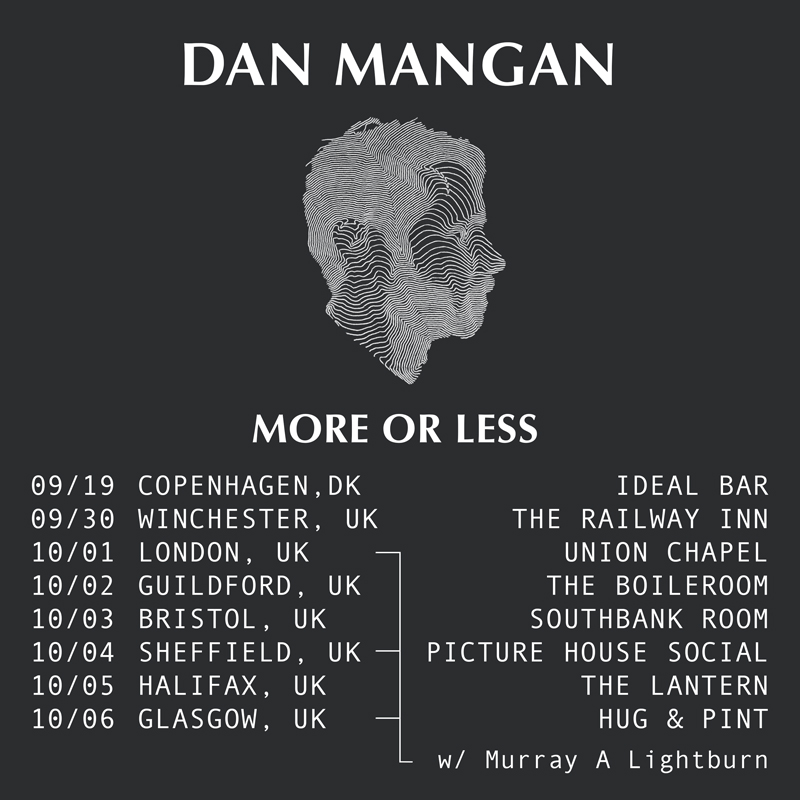
Thrilled to announce more shows in Europe this autumn! Including a show at the absolutely stunning Union Chapel in London – one of the most magical concert venues in the world. And what’s more is that Murray A Lightburn will be supporting some of the shows. His work in The Dears was powerful and informative to me as a young songwriter,

Last week I released the fourth song in a series of cover songs I’ve recorded – it’s John Hiatt’s “Have A Little Faith In Me”. When I was a kid, I’d hear this song waiting at the dentist’s office. Or waiting to get a hair cut. I imagined that there was an entire genre of music from the past that was just there to help people wait for appointments. A few years ago, I was asked to pitch a version of it for a TV show and, in the process of learning it and listening a few times, I was struck at how sweet it is. It’s the kind of earnest I might have scoffed at in my youth, but in the present, the sentiment is working for me.

I also recently released a cover of Lauryn Hill’s Ex-Factor. As I wrote on Instagram at the time of release: “One of the best choruses since George Harrison’s ‘Something’. Lauryn Hill is an unfathomable talent, and as such, I tried to find my own angle into the song as there’s no hope in imitating her power.”

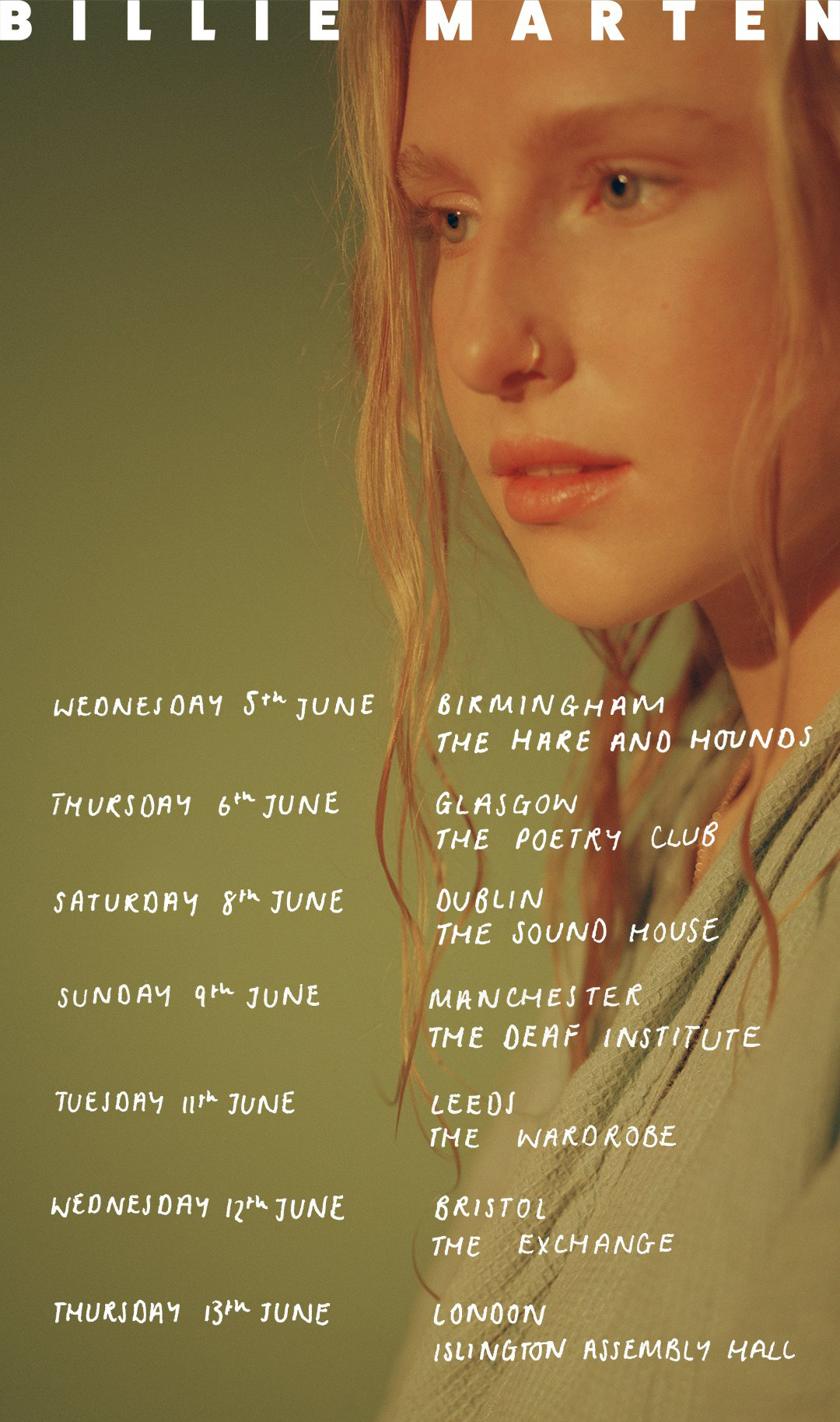
Billie Marten - UK Tour 2019

The young singer-songwriter’s sophomore album is a gorgeous work of textured indie folk that generously gives space to her fluttering vocals; it soothes and enchants in equal measure. recorded on four track tape at producer Ethan John’s house – the result is an honest, imperfection-speckled album from an artist unbothered by the idea of achieving a flawless gloss. if you’re a fan of artists like Julia Jacklin, Haley Heynderickx, or Nadia Reid , you owe it to yourself to hear this! “this collection of softly sung songs forms nothing short of a gentle and reserved masterpiece”

Billie Marten: Feeding Seahorses By Hand (Live Album) – BBC York Feeding Seahorses By Hand, the album out now

For over two decades, “The Rolling Stones Rock and Roll Circus” was a lost film, unfinished and unseen, more rumor than pop culture memory. In theory, it captured a lot of what anyone might desire in a rock ‘n’ roll movie from London circa 1968: the Stones, the Who, John Lennon, Eric Clapton and more.

On a sound stage designed like the inside of a circus big top, each of the musicians performed at the height of their powers while mingling with trapeze artists, fire-eaters and other semi-dazzling acts from a traveling circus. “The clowns and the Rolling Stones got along very well,” recalls the film’s director, Michael Lindsay-Hogg, 78.

Yet the film’s planned television premiere was delayed indefinitely for one reason: The Stones thought the Who’s performance was better.

It took 28 years, but the Stones came around in time for Lindsay-Hogg to finish the legendary rock film for a 1996 premiere at the New York Film Festival and release on home video. “You had these little explosions of greatness in the room,” says Lindsay-Hogg of the two-day shoot, “and the Rolling Stones recognized that.”

Now, in time for the North American leg of the Stones’ ongoing No Filter Tour, “Circus” has been remastered for a limited U.S. theatrical run during the first week of April. Last week, Lindsay-Hogg, who now lives in Los Angeles, attended a private screening in Hollywood of the film, recast in vivid Dolby Vision color and Dolby Atmos sound.

“I was thrilled by it anew, which I hadn’t been for a long time,” says Lindsay-Hogg, whose career began in England as director on the ’60s music show “Ready Steady Go!,” where the camerawork could be as frenzied as the acts onstage.

He also directed music videos for the Stones, Beatles and the Who, and made the intimate Beatles documentary “Let It Be.” In the pipeline is a long-awaited restoration of the 1970 Beatles film, which will follow an entirely new film being assembled from the same 55 hours of footage by New Zealand director Peter Jackson. Attending the “Circus” screening was Brett Morgen, director of 2015’s acclaimed “Kurt Cobain: Montage of Heck” and his own Stones documentary, 2012’s “Crossfire Hurricane.” In an onstage Q&A with Lindsay-Hogg following the film, Morgen celebrated the filmmaker’s essential work with these epochal musical figures.

“The man defined the image that so many of us have of the Stones and the Beatles,” Morgen said in an interview with The Times. “He created a new language. You look at the ‘Jumping Jack Flash’ video and what he did is as innovative as what Busby Berkeley did to the musical.”

In “Circus,” the Stones performed several songs from the just-completed “Beggar’s Banquet,” the first of four consecutive album milestones that defined the band’s greatest work. There was also Lennon leading a supergroup he called the Dirty Mac, with Eric Clapton on guitar, Keith Richards on bass, and drummer Mitch Mitchell from the Jimi Hendrix Experience performing a new Beatles song, “Yer Blues.” Yoko Ono then joined for an improvisational jam. Other performers included Marianne Faithfull, Taj Mahal and Jethro Tull. The Who’s playful reading of the mini-rock opera “A Quick One While He’s Away” was close to perfect. Jagger had personally invited all of them.

“In those days, rock ‘n’ roll bands would arrive late. You’d schedule something for 1 and they’d arrive at 4,” recalls Lindsay-Hogg. “But on this particular day, because they all respected each other, everybody was on time.”

A London sound stage was rented and Lindsay-Hogg hired the best camera operators from “Ready Steady Go!” The production also used experimental cameras from France, which shot both 16mm film and provided a video feed to the control room. Aside from having to change film canisters every 10 minutes, the new cameras frequently stopped working. “When one of the cameras had broken down for the 11th time that day, we had a little break,” the director recalls. The musicians would then retreat to their dressing rooms. “I went backstage to see how everybody was, and they were all sitting in a room – John Lennon, Mick Jagger, Pete Townshend, Eric Clapton – playing blues on guitar and harmonica. Keith Moon was playing spoons on a table.”

The Stones didn’t get onstage to perform until 2 a.m. It was the final live appearance of guitarist Brian Jones, dazed and fading from drug abuse, but still able to re-create his heartbreaking slide guitar lines on “No Expectations.”

Within months of filming, Jones left the band and drowned soon after. Jagger went to Australia to star in “Ned Kelly.” Lindsay-Hogg traveled to California to work on a film. The momentum of the era pushed its participants forward, but somehow left “Circus” behind until the footage was rediscovered in the ’90s.

Lindsay-Hogg continued working with the Stones through the early 1980s, directing several music videos, from “It’s Only Rock ‘n Roll (But I Like It)” to “Waiting on a Friend.” He turned his attention to feature films, TV specials and directing theater, though he remains friendly with the Stones. “We knew each other when we were kids,” he says now. “It wasn’t my nature to hang ’round if I didn’t have to. In a funny way, I think they respected that. I was happy to just be working with them.”

Image may contain: text

Psychedelic Porn Crumpets are pretty much unlike any other band out there. A truly unique live proposition, their other-worldly psychedelia is melded into some startling shapes on incoming album ‘And Now For The Whatchamacallit’.

Due out on May 31st, the record is previewed with bold new cut ‘Bill’s Mandolin’, the title (and concept) seemingly sparked by an object gifted to singer Jack McEwan before the band’s last European tour. Jack McEwan: “I wanted to write an ‘Ode To Bill’ and the travels with the mandolin that summed up the tour and sounded as chaotic as the adventures that ensued…”The video traces a ghostly path to an abandoned castle, where the titular mandolin is magically reconfigured into a sword.

‘And Now For The Whatchamacallit’ will be released on May 31st.

There’s always been a tenderness beneath the buzzing, brassy noise that has become characteristic of Radiator Hospital. For their latest project, the Philadelphia-based band have chosen to further indulge their sentimental side. True to its title, Sings “Music for Daydreaming”, is introspective and unassuming, the perfect soundtrack to drift away to.

Noticeably more acoustic than past albums, “Stories We Could Tell” opens with a bluesy guitar riff that develops into what can only be described as an upbeat polka-rock song — think the Felice Brothers, only grittier and more garage, the kind of song indie-heads could line-dance to.

On “Guitar,” however, the band strips down to bare essentials: Sam Parrot-Cook’s whiny vocals, which double and harmonize beautifully during the chorus, are accompanied only by a simple, spare piano melody. The song tells the story of how Parrot-Cook left his favourite guitar, which once belonged to his sister, backstage at a dive bar in Savannah. “Never thought I would lose something I loved so much,” goes the chorus.

Music for Daydreaming is a significant departure from the grunginess of Torch Song, for example, but no less raw. Though they rarely pass the three-minute mark, each track is dense and intricate enough to get lost in.

Recorded October 8th-10th 2018 at Uniform Recording in Philadelphia, PA. Produced, arranged, composed, and performed by Sam Cook-Parrott.
Special thanks to Marco at Salinas for putting it out, my band for not being mad that I made a record without them, my roommates for putting up with my loud ass while writing and practicing this, to all my friends and family, and most of all to anyone who considers themself a “fan.” It’s my life’s great honor to rock for you. –Sam
Releases May 10th, 2019

ex hex

When Washington DC power-trio Ex Hex reconvened to record the follow up to their searing 2014 debut Rips, they slipped into this mindset. “We wanted to open up the sound from the first record, which sounded pretty garagey,” guitarist and vocalist Mary Timony says. “Even in how it was mixed – really overly compressed. We wanted to take it back from being blown out and use really diverse guitar sounds, make it lusher and bigger. We were talking a lot about Mutt Lange.”

Specifically, they talked about Lange’s work on Hysteria, Def Leppard’s 1987 monster hit and one of the most fastidiously overproduced albums of all time. Given the dirt under Rips’ fingernails, and Timony’s rep as a classically trained guitarist who favoured difficult, mathy melodies during her time with Helium and Autoclave, on paper ‘Ex Hex x Def Leppard’ is a weird look. But It’s Real drops that perception with its first couple of punches – this is a muscular, furiously enjoyable record that mainlines brazen riff worship.

With Betsy Wright, who played bass and sang on Rips, stepping up to spar with Timony as a second guitarist and drummer Laura Harris keeping a tight rein on things, behind its day-glo exterior lurks a shared set of blueprints that ensured Ex Hex hit their marks. “It was super collaborative,” Timony says. “If something could be played better by someone else, we’d do that. The parts just became parts.”


Both guitarists took time away from Ex Hex before settling in to write It’s Real. While Timony toured around some Helium reissues, Wright issued an LP with her side project Bat Fangs that set out some signposts for what would follow. Its sound – righteous power chords, Gibson SGs and cranked Orange amps – bleeds into her writing here, bouncing off Timony’s more studied, punk-leaning work.

“I’ve been getting more into 80s metal,” Wright says. “I got really inspired by a lot of guitar players and tried to stretch my ability a little bit by learning a lot of solos – Randy Rhoads, Angus Young, a lot of the songwriting on the solo Ozzy stuff.”

But getting your Mutt Lange on in the studio is expensive and time-consuming. Ex Hex didn’t have an 80s budget for their 80s ambitions, so they had to improvise. Producer Jonah Takagi, who also helmed Rips, provided the meticulousness, while the LP was tracked at several locations, including sessions with engineer Ben Green at Ivakota in DC and in Baltimore with post-hardcore hero J Robbins at his Magpie Cage studio. During their stay in Maryland, that improvisation was facilitated with a room of amps mic’d up at all times, while helping hands also came from the nearby Big Crunch.

Timony and Wright are an achingly cool duo who have riffs and hooks to spare, and on It’s Real, Ex Hex have hit on a formula that works perfectly for them. “We started with: ‘What songs do we have?’ and went with whoever had ideas – it was pretty natural,” Timony says. “There wasn’t a lot of figuring it out.”

From the album It’s Real, out now on Merge Records.

Image may contain: 4 people, text

After the release of their exceptional debut EP, What’s On Your Mind?, Brighton four-piece Thyla made their American debut at this year’s SXSW. The band performed misty guitar cuts like “Pristine Dream,” “Only Ever” and “Blue,” with enigmatic frontwoman/guitarist Millie Duthie at the helm of their lush dream-pop meets moody post-punk. With an impressively consistent discography thus far and an exuberant live show that does their cloudy atmospherics justice, Thyla have all the bearings of a band worth obsessing over.

Music towns like Brighton often come with a set of contrasts. They’re inspiring, because there are tons of artists milling around, collaborating, figuring out their voices alongside each other as they jump from band to band. You’ll always find one gig or another to go check out. But on the flipside, that means there’s that much more noise to cut through, that many other names from which you have to stand out. In the last year or so, one of those bands that has stood out from the local pack is Thyla, a group that’s putting their own spin on the tradition of dream-pop.

“It’s just crazy, every other person in Brighton is a musician,” Thyla frontwoman Millie Duthie says over a Skype conversation from her home in the seaside UK town. “It’s really competitive and sometimes it can get a bit catty, but you just have to stay above it, and then it’s amazing.”

Duthie who was actually born in the States before her family returned to the UK when she was a small child — is like a lot of other musicians in Brighton, in that she moved there with the explicit goal of being a musician. The same goes for her bandmates — drummer Danny Southwell, bassist Dan Hole, and guitarist Mitch Duce all of whom came from other parts of the UK and relocated to Brighton to attend the British And Irish Modern Music Institute (otherwise known as BIMM). That’s where Thyla came together in its earliest form: Duthie met Southwell on their very first day of school, and the genesis of the band goes back to when the two lived in the same house during their college years.

When they found each other, it was the result of years off exploring by themselves. Southwell, Hole, and Duce all grew up as musicians; Duthie started a little later, picking up a guitar at 16 and discovering she had an innate knack for songwriting despite lacking formal training or theory knowledge. All of them gigged around Brighton with other groups until their own project started to percolate. Duce, the latest addition, joined last year, a moment Duthie locates as Thyla truly coming into their own and beginning to feel a distinct forward momentum.

“Things didn’t really start moving for us until he really started gelling with the band and our sound developed a little bit,” Duthie remembers. “About a year ago, we started playing gigs and people started turning their heads rather than going ‘Oh, this band has loads of potential.’”

The band’s early days and growth have, thus far, been catalogued by an impressive series of singles that span early 2017 up to the present. Earlier tracks like “Pristine Dream,” “Ferris Wheels,” and “Tell Each Other Lies” took a lot of cues from dream-pop: aqueous-then-chiming guitars underpinning Duthie’s vocals, which could escalate from an elusive breeze to a gale-force wind in one beat. Oddly, you can find them compared to Interpol in some write-ups from the time, which doesn’t make a whole lot of sense — aside from the fact that, crucially, they injected a propulsive edge to their soaring dream-pop choruses by grounding them with hard end post-punk rhythms on occasion.

While Duthie still writes solo and sometimes brings a song to the band, she argues that their best material arises when it’s the four of them in a room jamming, ideas developing on the spot within minutes. “That’s where the magic happens,” she says. “You just have to hope for the best, but it’s where the coolest music comes from.”

Combined with the effect of a recently-expanded lineup and the new perspectives that inevitably come out of a fresh band dynamic, the result has been a slightly different aesthetic in their most recent work. Two months ago, Thyla returned with “I Was Biting,” a composition that still had shimmery guitars and Duthie’s voice swooping up into the stratosphere, but now paired those facets with a distorted, grunge-indebted churn — the fire to the air of Duthie’s voice, each element in tension with but also fueling the other.

That’s partially how Thyla concocted their latest single “Blame” as well. The most aggressive and hard-hitting single the band has released yet, it bears the mark of that specific energy — the energy not just of the four of them kicking up then containing a storm together in a room, but also of their intensifying live shows. “We wrote it out of a real want to go for it onstage, and we didn’t have the tune to facilitate that,” Duthie explains. “’Blame’ was written for the need of a live energy we didn’t have before.” She adds with a wry laugh: “It’s 170 [BPM], you could nearly call it drum n’ bass. It’s super fast and it’s wicked to play onstage.”

“Blame” still has traces of the more otherworldly moments in earlier Thyla singles, but there’s a new ferocity, a frantic forward charge and Duthie opting for vocals more percussive than parabolic. The tone of the song mirrors the fact that it came from a more furious and desperate place thematically, influenced by the anxiety and insecurity that can come with trying to make it as an artist and the more detrimental qualities of a music town like Brighton. “’Blame’ is the frustration of that, the pressure to be a specific type of person, to look or sound a specific type of way,” Duthie explains. “The chorus … it’s a bit extreme, but it sums up the attitude of ‘Ugh, what do I do. I know what I want to be doing, but I don’t know how to get there.’”

Topically, these are concepts Duthie often likes to traffic in elsewhere, too. “I tend to write a lot from insecurity, because I’m always scared that it’s not going to be good enough, because it’s all self-taught and a bit untamed,” she says. But she’s quick to point out that, by her estimation, a lot of Thyla’s music comes from a sad source yet counters itself with the brightness of its music.

http://

That’s often the unique quality of dreamy, ambiguous music: It can be what you need it to be in that moment. Out of any of the songs Thyla’s released so far, this might be most evident in the bursting chorus of “Tell Each Other Lies.” You can’t quite tell if it’s defiant, melancholic, or exultant. That’s where a lot of their music’s power is rooted. Whether it’s the burn-it-away catharsis of “Blame” and “I Was Biting” or the gleaming heights and pure beauty of “Pristine Dream” and “Tell Each Other Lies,” Thyla look inward to this emptiness, this feeling of not being good enough, and roar back to prove themselves worthy. “An answer to it,” as Duthie asserts.

http://

Accordingly, these singles have started to catch on, garnering Thyla a bit of buzz in their homeland, earning them some tour slots outside of Brighton’s local music scene. But they’re careful not to let any external pressure threaten the fragility of a still-sorta-nascent project that’s just now taking shape. There’s more music in the works — Duthie’s currently recording new demos — but it remains to be seen when Thyla may arrive with an EP or a full-fledged album. “An EP would be awesome, hopefully by the end of the year, but it just depends on whether we think we have the tunes to do it,” she says. “We’re not just gonna do it because someone thinks we should have an EP out. We want to make sure we have something to say.”

They might be proceeding with level heads, but they are also aware of, and feeding off of, the positive attention that’s been bubbling up around them. As Duthie puts it, there’s a “real cool energy” surrounding Thyla right now, which is the kind of gratifying encouragement you need at some point, the realization that toiling away on music while holding down a day job is worth it when people start responding to your work. Thyla might feel the hype, and want to capitalize on it, but they’re also not letting those reactions impact their focus. “You have to straddle it, and have confidence,” Duthie says of this moment in their early career. “It’s just sheer grind and hard work. Every second we get, we’re in the room writing music. Because that’s what we love doing.”

http://

Brighton dream-pop outfit THYLA are cementing their position as one of the UK’s most promising acts. They’ll be touring the UK this October, including dates in Manchester, London and Bristol.

Ryan Pollie Announces New Self-Titled Album

Inspired by the warm, inviting sounds of ’70s singer-songwriters like Jackson Browne, Carole King, and Graham Nash, Ryan Pollie is the most personal music of the seasoned songwriter’s career to date. Leading the showcase is the video for “Aim Slow,” a touching clip featuring childhood home videos and footage taken during Ryan’s recent chemotherapy. The song is the lyrical centerpiece to the album and addresses the paradoxical nature of life and death, good and evil, yin and yang. Weaved throughout the song is a story of a struggling romance, the beauty and pain of what goes into love, and “Aim Slow” proves to be successful to Pollie personally – it tells his story which is one of love and searching.

Ryan Pollie had released two albums as Los Angeles Police Department, and working on his soon-to-be-released, self-titled studio album, he prepared himself to shed the protective barrier of his old band name — to make music, simply, as himself.

And then he got cancer. Nearing the end of his twenties, Pollie had already been mulling over the big questions: spirituality, purpose, the fleeting nature of existence. “I just wrote a record about mortality and whether or not I believe in anything, and then I’m faced with the biggest challenge of my life,” he says. Open, searching, and vulnerable, Ryan Pollie takes full advantage of the language of 20th century California pop to bolster its queries on the perplexing nature of being human. Piano, guitar, and bass intertwine with banjo, pedal steel, and saxophone to support Pollie’s sugar-sweet hooks.

Bolder and crisper than the albums he’s made as Los Angeles Police Department, the new album emerges from a deeply collaborative place. As Pollie went through chemotherapy in the summer of 2018, he relied on the support of his friends to finish the album. “Mixing is where it all came together for me,” he says. “Because I was sick, it was this new challenge — ‘I have to finish this record. I have to get out of bed. I don’t feel too well, but I’m going to go down the street to the studio and I’m going to give my notes and overdub some piano.’ I finished the record while I was sick, and that was a big thing for me, being sick and being able to finish something. It made me feel strong.”

One song, “Only Child,” addresses that period directly. Ironically, it’s one of the more upbeat tracks on the record, tackling the fear and uncertainty of illness with Pollie’s characteristic levity and humor. “My hair is falling out/My parents are calling now,” he sings amid a buoyant bassline and trills of flute. Other songs work through periods of loss, confusion, and ultimately triumph. The delicate, synth-driven “Raincoat” traces the end of a relationship with careful empathy. Against a briskly strummed guitar, “Leaving California” fleshes out his relationship with his parents and his childhood home in New England, while “Getting Clean” makes use of a glowing West Coast pop palette to articulate the frustration of trying to break out of a deep rut.

Living through illness becomes just one chapter in a record that celebrates living in general, and all the difficulties and surprises that come with it. More than anything, Ryan Pollie is a testament to the power of vulnerability — to the magic that happens when you open yourself up and invite the world inside, no matter how frightening or uncertain it may be.