Archive for the ‘CLASSIC ALBUMS’ Category

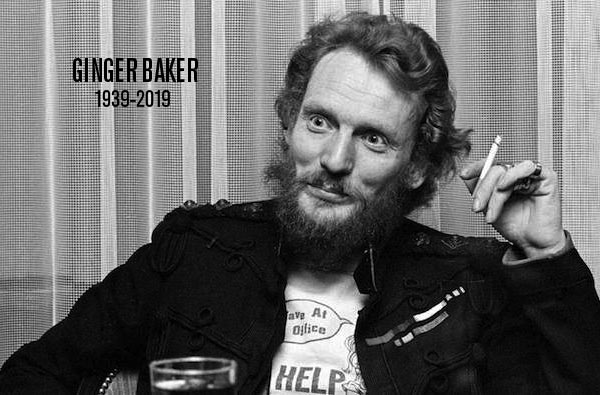
Ginger Baker 1939-2019

Ginger Baker, drummer and co-founder of 1960s blues-rock supergroup Cream, died on Sunday (October. 6th), his family confirms. He was 80 years of age.

He’d been struggling with failing health for some time and had been hospitalized after falling “critically ill” last month.

“We are very sad to say that Ginger has passed away peacefully this morning,” a brief statement on his Facebook page announced. “Thank you to everyone for your kind words to us all over the past weeks. Baker’s death follows a 2016 fall in his home and subsequent open heart surgery after being diagnosed with a heart condition, and the news follows recent posts on his social media channels that he was hospitalized in “critically ill” condition.

Baker leaves behind a legacy as the drummer for Cream, his 1960s power trio with guitarist Eric Clapton and bassist Jack Bruce that tossed up the blues with sunshine-pop, with “Sunshine of Your Love” and “White Room” in 1968. The band split in 1968 and reunited in 2005 for a residency at the Royal Albert Hall, captured that year on the live album Royal Albert Hall London May 2-3-5-6, 2005.

His first professional band, Alexis Korner’s Blues Incorporated, where he replaced Charlie Watts (who left to join the Rolling Stones) and met bassist Jack Bruce, with whom he’d play in the Graham Bond Organisation and then form Cream in 1966. From almost the start, their relationship was a tumultuous one, with the mercurial Baker often lashing out at his bass-playing bandmate.

Later in life, Baker often appeared in the press as a lovable, irascible grouch, living in South Africa with his Zimbabwean wife, Kudzai, while treating his emphysema and degenerative spine condition. During Cream’s brief reunion, he sang his oddball interlude “Pressed Rat and Warthog”.

“It’s a knife-edge thing for me and Ginger,” Bruce was once quoted ,“Nowadays, we’re happily co-existing in different continents, although I was thinking of asking him to move. He’s still a bit too close.”

The son of a tobacco shop employee and a bricklayer who was killed in WWII, Baker was enamored early on with jazz legends like Art Blakey, Max Roach and Philly Joe Jones. He made the rounds in traditional jazz combos in the mid-1960s before coming into orbit of British blues nuts Eric Clapton and Jack Bruce. The former was fresh from the Yardbirds and John Mayall’s Bluesbreakers; the latter would jam with Baker in the blues-jazz band the Graham Bond Organization. Considering themselves the “cream of the crop” of British bluesmen, they called themselves Cream and released their debut Fresh Cream in 1966.

Apart, the members of Cream were good-to-great blues sidemen. When they got together, they were dynamite. Their riff-heavy originals like “Sunshine of Your Love” inspired riff-mongers from The Allman Brothers Band to Lynyrd Skynyrd. When they tackled the blues, they were reverent, staying true to the melodic backbones of Skip James’ “I’m So Glad” and Willie Dixon’s “Spoonful” while giving them a fresh, modern feel.

Cream released two more albums during their run, 1967’s Disraeli Gears and 1968’s double-disc Wheels of Fire, and 1969’s Goodbye, a mix of live and studio recordings, followed after their split. Despite existing for only two years, Cream sold over 35 million records over their lifespan. Cream one of the period’s biggest bands. His self-penned instrumental “Toad,” which was on the group’s debut album and credited as one of the first rock drum solos on record, became a concert centerpiece, often stretching to 20 minutes.

With Cream in the rearview mirror, Baker and Clapton started another blues-rock supergroup, Blind Faith – featuring bassist Ric Grech and Traffic keguitarist Steve Winwood — in 1968. The band burned out even quicker than Cream, releasing a 1969 self-titled album and undergoing one tour before going their separate ways. In 1972, Baker released two solo albums, Ginger Baker at His Best and Stratavarious, in which he dabbled in jazz fusion and Afrobeat.

From 1980 onward, Baker briefly joined space-rock agitators Hawkwind, one of over a dozen drummers in the band’s history. “Ginger fitted the band like a glove,” their guitarist Huw Lloyd-Langton said in the 2004 biography The Sage of Hawkwind. “His style was just right for it.” During the dawn of metal, Cream’s heavy blues was sometimes cited as an influence, which made Baker irate.

Baker went on to stretch beyond blues-rock, playing on Public Image Ltd.’s 1986 album Album and in a jazz trio with Bill Frisell and Charlie Haden. In 2009, he published an autobiography, Hellraiser: The Autobiography of the World’s Greatest Drummer. He stayed behind the kit until heart issues laid him low in 2016. “Just seen doctor… big shock,” he wrote on his official blog. “No more gigs for this old drummer. Everything is off. Of all things, I never thought it would be my heart.”

Image may contain: 3 people

The descent into darkness is a trope we find time again across history, literature and film. But there’s also an abyss above. There’s a winding white staircase that goes ever upward into the great unknown – each step, each turn, requiring a greater boldness and confidence than the one before. This is the journey on which we find Angel Olsen. The singer-songwriter’s artistic beginnings as a collaborator shifted seamlessly to her magnificent, cryptic-to-cosmic solo work, and then she formed bands to play her songs, and her stages and audiences grew exponentially. But all along, Angel Olsen was more concerned with a different kind of path, and on her vulnerable, new album, “All Mirrors”, we can see her taking an introspective deep dive towards internal destinations and revelations. In the process of making this album, she found a new sound and voice, a blast of fury mixed with hard won self-acceptance.

By her usually prolific standards, it’s been a long time between albums for Angel Olsen. “All Mirrors” is her first album for three years – an epic gap given that she used to average an LP a year in the early stage of her career. As usual, Olsen has redefined her sound once more, offering up impassioned songs that come backed by bold, wall of sound style production from John Congleton.

There are many moments of stirring intensity, where swirling strings, eccentric electronics and low-slung indie-rock grooves join forces to create stunning and arresting musical works of art. The more contemplative moments often sound a little like “Mezzanine”-era Massive Attack or Portishead, though Olsen’s voice and Congleton’s production are always unique enough to make comparisons with those bands moot.

The mid-album ballad, “Spring.” Over warm, gently warped piano, Olsen opens with advice: “Don’t take it for granted, love when you have it,” she singe, before observing almost in passing how quickly time flies: “Remember when we said we’d never have children, I’m holding your baby now that we’re older.”

For anyone who’s ever invested too heavily in a hypothetical future, or mentally broken apart every minuscule bit of a fresh and failed romance, that lyric can be a terrifying reminder that we will never know what will happen next. Olsen says as much in the next few lines: “I’m beginning to wonder if anything’s real, guess we’re just at the mercy of the way that we feel.”

Her message never veers into existential-panic territory, though, instead held steady by the song’s even-paced, rolling rhythm, and Olsen’s fuzzy vocals, hovering like a reassuring guide. She ends her gentle journey on the only piece of certainty she has access to: the fragile and fleeting present. “So give me some heaven, just for a while,” she sings, before her falsetto takes off into the heavens: “Make it eternal, there in your smile.”

“Spring” is the song that stayed with me the longest, through my dozens upon dozens of replays lying in my darkened bedroom, cooking with my roommates in my kitchen, singing by myself in the shower, like a forever-looping Twilight Zone-ish theme song. There is no true rhyme or reason to anything; there are just things that happen to us and people we meet, and we should try to enjoy everything while it lasts. It may not be a satisfactory revelation and — don’t get me wrong — it will emotionally wreck you. But once the tides of perpetual uncertainty subside, it’ll feel quite freeing.

The debut self-titled album from Dyson Stringer Cloher (out Oct 4th) was recorded at Wilco’s The Loft studio in Chicago April 2019 with Grammy Award winning engineer Tom Schick and Wilco’s Glenn Kotche on drums.

There’s an undeniable intimacy to this collaboration between Jen Cloher, Mia Dyson and Liz Stringer. The powerhouse singer-songwriters released an EP and toured extensively under the Dyson Stringer Cloher moniker in 2013, before splitting off to conquer their own corners of the local and international indie music scenes.

It’s quite a show. The trenchant, Cloher-led rocker Falling Clouds frames the album as a manifesto for women and gender non-conforming artists too often relegated to a supporting role: “Nothing against Paul or Nick, but if you want to be remembered then you better have a dick.” Such gendered iconoclasm broils along in the background and comes to a head later on in the album with the equally resounding Be Alone, a boot-stomping statement about self-actualisation, where to be alone is a gesture of power rather than passivity or failure.

Dyson Stringer Cloher’s ten tracks happily plumb an array of modes and moods. There’s an energy to the album that seems to have absorbed the entire oeuvre of women-led rock music. With My Hands delivers its chunky guitar riff and rimshot-driven chorus with a swagger worthy of The Runaways; it is tailor-made to get audiences jumping. Elsewhere Believeris stadium-sized rock that winks at The Jezabels.

Now, nearly three decades later, these three artists are inspiring a new generation. Supergroups don’t always work, but this is a winner.” – STACK

“A manifesto for women and gender non-conforming artists too often relegated to a supporting role.” – The Music 

“An album that celebrates the importance of music in each of their lives.” – The Australian

‘With My Hands’ from Dyson Stringer Cloher’s self-titled album is out October 4th, 2019 on Milk! Records.

The arrangements and musicianship are as solid as the songwriting is memorable – from the tightly wound beats and dialogical guitar section that steer future road trip anthem The Other Side down its sombre highway, to the brushed snare and picked guitar that bring colour and texture to the bitingly confessional Young Girls. All of which provides a perfect setting for the three-pronged vocal onslaught, the contrast and complementarity of the singers’ voices helping to ensure that this collaboration is as aurally rich as any.

Lest you fear that Dyson Stringer Cloher are taking themselves too seriously, for a change of pace there’s, well, Too Seriously a tongue-in-cheek gospel-country romp delivered with alternating lead vocals and honky-tonk flair, and more than a little Wilburys-esque goofiness. It’s a moment to both celebrate and lampoon this whole supergroup business, albeit coupled with a little obligatory hard-bitten wisdom about rising above life’s more bruising knocks.

Be Alone’s pounding drums and haze of fuzz guitar bring things to a rousing climax ahead of the album’s stunning benediction, Can I Borrow Your Eyes. Sung largely a cappella, aside from a wafer-thin bed of synth, the closing track finds the singers’ voices blended in perfect three-part harmonies, their contrasting styles united into a singular vision. It sums the album up nicely, and leaves the listener to slip back into the world warmed by the knowledge that these are three artists who’ll be remembered, together and alone.

Mia Dyson – Vocals / Guitar / Bass
Liz Stringer – Vocals / Guitar / Bass / Keys
Jen Cloher – Vocals / Guitar
Glenn Kotche – Drums / Percussion

“In a self-experiment, I drew my face with black thread. The first to be affected were the eyes and mouth, because I could not see or speak – communication was destroyed….the details of my face seemed to be gone and, at the same time, frozen. It was similar to the act of mummification. I reached for the scissors and freed myself”

These are the words of Annegret Soltau, the German avant-garde feminist artist, whose work graces the cover of Julie’s Haircut’s transcendent new album. It’s a piece that maintains as much of its power and relevance today as in the time of its inception 40 years ago, yet forms a curious parallel with a record that is nothing if not the sound of psychic liberation from the shackles of oppression and of the everyday.

‘In The Silence Electric’, the latest record from a band with a quarter-century-history, is notable for its deft balance between hypnotic radiance and otherworldly intensity, between beatific calm and palpable anger. Yet it’s also a record which has arrived through a strange process of osmosis from a band confident enough to let subconscious and metaphysical aspects steer them in the appropriate directions.

The result was nonetheless also informed by a recent live soundtrack project the band embarked upon in tandem with Josef Von Sterberg’s 1928 classic ‘The Last Command’, as well as recent visits by the band’s Andrea Rovacchi to Mozambique, where he was subsumed by the local music and culture, bringing back a finger piano which makes its presence felt amidst the polyrhythms and primal scream therapy of ‘Pharaoh’s Dream’.

For all the nature of its divings, the result is a collection of supremely confident and cohesive ditties that sees the deep-end diabolism and mantric intensity of their Rocket debut, 2017’s ‘Invocation And Ritual Dance Of My Demon Twin’ expanded into a righteous fury and
incandescent splendour. Whether it’s the heavy-lidded rapture of ‘Lord Help Me Find The Way’ (like Spiritualized transposed to 1970s Berlin) the menacing dream-state of ‘In Return’ or the Suicide-damaged psychic assault that is ‘Sorcerer’, all is subsumed by a bold singularity of intent, amidst a colourful firestorm of electronic monomania, jazz-tinged atonality and indelibly memorable vocal hooks.

http://

Even when we write about very dreamlike situations, or metaphors, we always address very real, concrete aspects and problems of our life” says Luca “There is a lot of the classic dualism between sex and death on this record. Sometimes it’s more dark and gritty (“In Return”), sometimes it’s more elevating (“Anticipation of the Night”).

“There’s a theme springing from the title of the record and the photos of Annegret Soltau that deliver some sense of helplessness, suffocation, difficulty in communication” notes Luca. Yet for all this – and paradoxically enough – ‘In The Silence Electric’ is both this mysterious and rebellious band’s most adventurous and most direct record to date – not to mention an ever more compelling transmission from renowned experts in altered states.

Released October 4th, 2019

Image may contain: one or more people

A year ago, Melbourne musician Grace Cummings started playing her own songs armed with nothing but an acoustic guitar and a harmonica. She has since fascinated local Melbourne audiences as she sings simple and honest songs with a powerful recklessness. Within a year she has shared bills with the likes of J Mascis and Do Re Mi as well as a breakout performance Boogie Festival. Her very first collection of solo songs will be released by Flightless Records in late 2019.

Grace comments ,A little while ago I started playing my own songs and writing more and more of them.
I went over to Jesse Williams’ house and recorded a bunch of solo songs in an afternoon… These have become my first album.

I am lucky enough to have it put out by Flightless Records who are the absolute coolest. The album ‘Refuge Cove’ comes out November 1st.

Over a month after sharing “Best Laid Plans” from her sophomore album as Harmony Woods, Sofia Verbilla is rewarding our patience with one more single from “Make Yourself at Home” in the form of that track’s sequel, the equally heartfelt “Best Laid Plans II.” Where the former detailed the first cracks in a young relationship, the latter explores the tension that arises when this rift can no longer be ignored.

“This song is the culmination of all the angst and tension that has built up since the two characters have realized they may not be right for each other,” Verbilla explains. “Moments from the first ‘Best Laid Plans’ are echoed as the narrator realizes that giving into this infatuation early on was not the best idea. They genuinely care about the other person, and they want things to feel good again, but they ultimately attempt to postpone this fight because they know deep down it will lead to the end.”

“Months ago, I promised you / I would never dare to let us go to bed angry / Can you feel the resentment building?” sings someone who definitely listens to both boygenius and Paramore.

http://

All songs written by Sofia Verbilla

Vocals/Rhythm Guitar/Keys – Sofia Verbilla
Lead Guitar – Chance Halter
Bass – Hank Byerly
Drums – Jeremy Berkin

Released October 4th, 2019

Kurt Vile released a new album, “Bottle It In”, back in October 2018 via Matador Records. Among our Top Albums for that year. Now he has announced some more tour dates. He has also covered The Rolling Stones’ “No Expectations” in a session for Spotify, where he also performed his own “Loading Zones.”

Matador Records is now sharing a little behind-the-scenes info on the project in the form of a twenty-minute documentary detailing Vile’s experience leading up to its recording. Filmed in New York’s Catskill Mountains, (bottle back) follows Vile as he rehearses the songs that would appear on Bottle It In alongside Canadian alt-westerners The Sadies and guitarist/producer Matt Sweeney, as well as his band The Violators.

In addition to full-song footage of Vile playing through “Baby’s Arm,” “Bassackwards,” and “Check Baby,” (bottle) provides plenty of insight into the artist’s personal life and how he’s learned to balance raising a family with a prolific output of new music. “I basically would do a whole album cycle, then start a new record and go out again when the record was done,” he says at one point before swigging a beer. “I just get so deep into the record that I can’t stomach that ever again—I’ll puke. I just gotta live my life, make music in between everything else—family world, playing live, and otherwise. It’s just the way I live.”

You can watch the Ryan Scott–directed doc in its entirety below, and stream the new version of “Baby’s Arm”.

Bottle It In includes “Loading Zones,” a new song Vile shared in August 2018 via an amusing video for it, When the album was announced Vile shared the near 10-minute long “Bassackwards,” via a lyric video for the song.  Then he shared another song from the album, “One Trick Ponies,” via a lyric video for the song. He also stopped by SiriusXM for a session covering Tom Petty’s “Learning to Fly” and perform “Bassackwards.”

Then he stopped by Jimmy Kimmel Live! to perform “Loading Zones.” He also shared a non-album track, “Timing Is Everything (And I’m Falling Behind),” which was an Amazon Original. Vile also performed another session for NPR Music to performing three songs as part of their Tiny Desk Concert series, where he did “Bassackwards,” “Loading Zones,” and “Peeping Tomboy.” Then he stopped by Late Night with Seth Meyers to perform the album’s “Yeah Bones.”

“Bottle It In” was the follow-up to 2015’s b’lieve i’m goin down…, although in 2017 Vile teamed up with Courtney Barnett for a collaborative album, Lotta Sea Lice. Bottle It In was recorded over the course of two years in various cities (including Los Angeles, Brooklyn, and Portland), with various producers (including Rob Schnapf, Shawn Everett, and Rob Laakso, a member of his backing band The Violators). The majority of Bottle It Inwas recorded at Tarquin Studios in Bridgeport, Connecticut, with Peter Katis (Interpol, the National) engineering and producing. The album also features Cass McCombs, Kim Gordon, Mary Lattimore, Lucius, Warpaint’s Stella Mozgawa, and Farmer Dave Scher.

“Carnage Bargain” would earn its stripes for being a million times better than a garage record has any right to be in 2019, but hooray for The Paranoyds for putting brains in front of bubblegum. The L.A. band are here to please with their house show-ready mix of glossy new wave and DIY garage punk, all delivered with the cheeky raised eyebrow of pre-Lilith fair alternative girl rock, every beautifully produced track going down like cold diet soda. But the band also consistently delight with how much thought they’ve put into their songs, and the chops they bring to their playing.

http://

The Paranoyds offer up both glittery sunny California vibes and serious anti-consumerist messaging without putting their finger on the scale either way, and they do it without resorting to internet-speak or instantly dated cultural reference points. We’re all trying to be good citizens but sometimes you want to hide (“Bear”) and sometimes you’re just trying to do laundry in 103 degree heat, man (“Laundry.”) “Girlfriend Degree” lightly wheedles women who rely entirely on men—some people probably won’t think it’s funny or cool, but whatever—however the band nails it on “Courtney,” a rainbow-hued art pop ode to female economic freedom that sparkles as brightly as its protagonist.

Released September 13th, 2019

Big Star - In Space OV-338

October 25th marks the release of the latest in Omnivore’s ongoing Big Star series: an expanded reissue of the band’s 2005 album “In Space”. In four short years, Big Star created three cult classic albums. Their legend grew over the years, and in 1993 – nearly two decades after disbanding – Alex Chilton and Jody Stephens collaborated with The Posies’ Jon Auer and Ken Stringfellow for a one-off performance.

This led to a well-received tour, which led to years of concert performances. A decade later, they surprised everybody with a new studio album, 2005’s In Space. The well-received 12-song set included ten new originals and two covers and was recorded in the fabled Ardent Studios, where Big Star began. The album was originally released on Ryko and received a limited vinyl run on DBK Works. Now, the album will return to vinyl on translucent blue wax and will be expanded on CD to the tune of six bonus tracks. Among them are five unissued demos and alternate mixes, plus the 2003 reunion track “Hot Thing,” previously available on the out-of-print Ryko comp, Big Star Story. The packaging will include notes from Supermegabot’s Jeff Rougvie, formerly of Ryko A&R, plus recollections from Jon Auer, Ken Stringfellow, Jody Stephens, engineer Adam Hill, and co-producer Jeff Powell (who also cut the new vinyl edition).

Released in 2005, Big Star’s reunion album In Space has been ignored by some fans, and derided by others. Now some 14 years on, Omnivore Recordings has decided to bring this album back into the spotlight for a much needed reappraisal.

In order to really get a handle on this album, I think it’s important to understand the context. After the group’s implosion in 1974 following the chaotic sessions that would eventually be released as the group’s third and final album, the group’s only two remaining members Alex Chilton and Jody Stephens would part ways. While each would remain involved in music, there seemed little hope that in spite of the cult that had begun to sprung up around the music of Big Star that a reunion would ever happen. That all changed in 1993.

Sporadic reunion gigs followed over the ensuing years. But, other than a one-off track, “Hot Thing,” that the lineup cut for a somewhat ill-fated tribute album, Big Star, Small World, in 1997 (eventually the track ended up making it’s debut on the out-of-print Ryko compilation Big Star Story when the company behind the tribute went belly up), at any rate no one expected a new album. So when the notoriously contrarian Chilton suggested the group record some new songs, I can imagine everyone including his bandmates were somewhat shocked.

Convening in Memphis at the legendary Ardent Studios where Big Star recorded their 1970’s recordings; the plan was to write and record a song a day. At the end of the day, In Space featured 12 tracks (10 originals and 2 covers) with songwriting contributions from all members. I remember there was an almost immediate feeling of disappointment upon the albums’ release. Stringfellow later recalled: “The album was released in 2005 and a year later we found ourselves on the main stage of Primavera Sound, a prestigious music festival in Barcelona. Some 10,000 people in the crowd. Before we played ‘Hung Up on Summer’ Alex addressed the crowd: ‘Here’s a song from our latest album . . . you know, it totally bombed— just like the other ones! But don’t worry . . . 30 years from now you’ll be saying it’s the greatest thing ever!’”

In retrospect, I think perhaps we, as fans of the group might have been a bit harsh. Is it a record that scales to the heights that any of the first three Big Star albums do? The short answer is unfortunately, no. But that doesn’t mean the album doesn’t have some nice moments that do a great job of honoring the group’s prior work while pushing the group into some new sonic territory. In Space is a seriously frontloaded album with its first four tracks representing the best the album has to offer. Kicking off with “Dony,” a tune that boasts a crisp autumnal twin guitar groove with Chilton’s vocal delivery a sort of professor hulk amalgamation of all of his various personas from blue-eyed soul crooner, to lounge lizard to reluctant power pop icon.  “Lady Sweet,” drizzles a little bit of daisy glaze on the proceedings that recall some of Radio City‘s hazier moments, “Best Chance,” is classic Jody Stephens power pop optimism in the same mode as Big Star’s 3rd standout “For You.”  While “Turn My Back on the Sun,” is a pitch perfect Beach Boys pastiche. Which makes perfect sense given Chilton’s affection for America’s band, and Big Star 2.0’s penchant for covering “Wouldn’t It Be Nice,” live.

After those first four tracks (which would have made a killer EP on their own, mind you), let’s just say your results will vary based on your level of fandom and affection for some of Chilton’s more subversive impulses such as the disco romp, “Love Revolution,” or quirky covers of The Olympics’ “Mine Exclusively” and French baroque composer Georg Muffat’s “Aria, Largo.” While the jam oriented album closer “Makeover,” is a bit of a half-baked commentary on consumerism.

In some ways, it was impossible for Big Star to ever make an album equal to that untouchable trio of 1970’s releases. Those were different times, after all. The guys who recorded In Space were different people in some cases literally, and other cases metaphorically. That doesn’t diminish some of the great music you might discover on here if you open your mind, and adjust your expectations a bit.  It’s still Big Star, and although no one knew it at the time, this was their last time to shine.

Buy the album via Omnivore Recordings.

Based on your current station in our technological age, Death Valley Girls’ fusion of feral proto-punk, ‘70s scuzz dirges, and third eye mysticism is either completely at odds with your worldview or utterly revelatory. Words like “retro” or “old school” convey a starry eyed nostalgia that do a disservice to the band’s harnessing of primal instrumentation and communal reverberations—if something in Death Valley Girls’ sound harkens to the past, it’s only in an attempt to dislodge us from the static of the present. That dedication to lifting the veil of modern illusions continues with their current single “Dream Cleaver”—a rousing anthem in praise of psychonaut and ethnobotonist Terrence McKenna, his research on “the spirit molecule” DMT, and the possibility of trans-dimensional travel. Lest one thinks that this is some blissed out cosmic ride on new age synth pads, be aware that “Dream Cleaver” is an unapologetic stone-cold rocker—an unabashed orgy of Farfisa organ hooks, Larry Schemels’ hypnotic and propulsive guitar chords, hallucinatory sax lines, and Bonnie Bloomgarden’s call-to-arms vocals. If you need to get elevated, take a three-minute dose of “Dream Cleaver”.
released August 9, 2019