Having last month announced their new 7-track mini-album “Annual”, To be released 5th June via Bella Union, and shared a video for lead track ‘Flourish’, today Modern Nature now share a video for new single “Harvest” which features Kayla Cohen of Itasca on lead vocals. Of the track bandleader Jack Cooper says: “Harvest represents Autumn on the record and centres around rituals and superstitions. A lot of the words and ideas that became the bones of the song were written the days after a vivid experience in Lewes for Bonfire Night.” Of the video he adds: “Lockdown Britain forced us (my wife Tsouni and I) into making our directorial debut and this is the outcome. A moving snapshot of the year through the medium of everyday objects. The record moves from winter through the seasons and back to winter… We end up back where we began… It’s familiar, many of the objects are the same but everything has morphed.”
Released in August 2019, Modern Nature’s debut album – How to Live crossed the urban and rural into each other. Plaintive cello strains melted into motorik beats. Pastoral field recordings drifted through looping guitar figures. Rising melodies shone with reflective saxophone accents, placing the record somewhere between the subtle mediations of Talk Talk, the stirring folk of Anne Briggs and the atmospheric waves of Harmonia.
The album was met with universal acclaim and featured in a number of publication’s ‘Best Of 2019’ lists. As the group took the album out on the road, Modern Nature became something even more expansive. “It feels like there’s scope and room to grow. I want the group to feel fluid and that whoever’s playing with us can express themselves and interpret what they think this music is” says Jack Cooper.
Their new mini-album Annual, recorded in December 2019 at Gizzard Studio in London, is another step towards something more liberated and a world away from the sound of Jack Cooper’s previous bands. Will Young sits this one out, concentrating on his work with Beak, but How To Live collaborator Jeff Tobias takes a more central role, alongside percussionist Jim Wallis.
After reverential reviews of their 2017 debut, Be OK, Deep Throat Choir return with their new single “Camille”. Taking its name from Children of the Compost, a collection of future fables by the eco-feminist writer Donna Haraway, the track is “an exploration of the feeling that the boundaries between yourself and the natural world, or somebody else, are entirely porous and dissolving”, says choir leader Luisa Gerstein. A music video for the track has been created by London based visual artist Rachel Sale.
It is the first single from Deep Throat Choir’s forthcoming album, and marks the foundation of the Amorphous Sounds collective. The label takes its name from the lyrics to Camille, in which the group sing “I’m reeling / I’m restless / porous / amorphous”. Describing the collaborative practice of the artists working within Deep Throat Choir, it gives name to an already existing collective of music makers from a wide-range of disciplines, and is a statement of intent for future cross-stitched imaginings. The label is founded by Luisa Gerstein and Anika Mottershaw.
“I wanted to formalise a cohesive space for all of us within Deep Throat Choir making work of our own, be it solo or collaborative; so really it’s giving a name to a collective that already exists, and making fertile ground for even more collaborative work. Outside the longer-term projects of albums and EPs, I want to have a space where we can create and put out stuff more regularly, sometimes without the context of that bigger project” – Luisa Gerstein.
Deep Throat Choir is an all-female singing collective that formed in 2013, driven by a desire to strip music making to the basic elements of voices and percussion, and to gather for the joy and communal experience of raising voices together. They released their debut album “Be OK” on Bella Union in 2017, and followed in 2018 with “Murmurations”, a collaborative album with Simian Mobile Disco, where voice and synthesiser were one and the same. They continue to explore the capacities of the human voice, and are working on a new body of work, this time with more extensive instrumentation, the product of a collaborative effort.
Eight years since the release of their debut, the acclaimed trio Mountain Man return with a cover The trio Amelia Meath, Alexandra Sauser-Monnig, and Molly Sarlé have been doing a series of covers, and their latest is this beautiful, harmony-laden take on Kacey Musgrave’s “Slow Burn.” “We are all huge fans of Kacey Musgraves,” the trio says. “‘Slow Burn’ embodies the magic of the unfolding of life, the power of being present and patient and knowing that sometimes things just take time. Like following a thread—it requires attention and curiosity.”
Mountain Man – “Sings Kacey Musgraves”, Bella Union Records Released on: 2020-05-05
Sonic Boom are Experimental, psychedelic pop rockers . was formed by Pete ‘Sonic Boom’ Kember, founder of Spacemen 3.
Sonic Boom’s music is often a headtrip but the video for “Things Like This (A Little Bit Deeper)” from his forthcoming All Things Being Equal is literally one, a nesting doll journey that heads deeper and deeper inside a bust, each time exploring unknown territory, blowing new minds. A fantastic, mind bending music video for Sonic Boom is out today! The official music video for Sonic Boom’s latest single ‘Things Like This (A Little Bit Deeper)’ is a must see – animated and directed by James Siewart.
“Things Like This (A Little Bit Deeper)” is taken from Sonic Boom’s forthcoming record, ‘All Things Being Equal,’ out June 5th, 2020 on Carpark Records.
UK/EU TOUR DATES:
September 12, 2020 – Yes – Manchester, UK
September 13, 2020 – Dingwalls – London, UK
September 14, 2020 – The Green Door Store – Brighton, UK
September 17, 2020 – Le Petit Bain – Paris, FR
Online music marketplace Discogs has just launched the Discogs Daily Dig, an initiative to support indie record labels during the coronavirus pandemic. Each day they will focus on a different indie label that will sell rarities, test pressings, out-of-print releases, and back catalouge through Discogs. It started today (5/5) with Numero Group and here’s the first week’s schedule:
Jay Watson Gum “Out In The World” the fifth album from the project helmed by Tame Impala and Pond multiinstrumentalist Jay Watson, Gum.
The title track and first single off the album, Out In The World received critical acclaim from Clash Magazine [“explores his continuing creativity, a psych-pop wonder built around that baroque-tinged acoustic guitar line”], Life Without Andy [“…pairs euphoric funk with Watson’s spacey vocals”], VENTS Magazine [“glimmers with rich textures”], DIY Mag [“soaring”], and NME.
Official video for new single Out In The World by GUM.
Stranded In Reality, a masssive 30-disc anthology box set celebrating the solo career of British rock legend and Mott the Hoople iconic frontman Ian Hunter…
Strictly limited to 2,500 copies worldwide and available to buy exclusively through propermusic.com, the set has been compiled and curated by Ian Hunter and his biographer Campbell Devine. Covering the years 1975 to 2015, it comprises over 400 rock ‘n’ roll tracks, with 17 original albums spread across 19 CDs, nine ‘new’ discs of rare and unreleased tracks plus two DVDs.
The panoply of solo albums include expanded Anniversary Editions of Ian Hunter, All-American Alien Boy, You’re Never Alone with a Schizophrenic and Welcome to the Club, plus bonus track discs of Short Back n’ Sides, The Artful Dodger and When I’m President.
The other nine CDs offer many unheard and ‘lost’ songs from Hunter’s archive:
Tilting the Mirror (rarities – two-CD) If You Wait Long Enough for Anything, You Can Get It On Sale (Live 1979-81 – two-CD) Bag of Tricks (Live Volumes 1, 2 and 3) Acoustic Shadows (The 2008 Acoustic Tour) Experiments (Unreleased Trax)
Highlights include San Diego Freeway, Nobody’s Perfect and Salvation as well as rarely performed live versions of Wild East, While You Were Looking At Me, The Outsider and a 2008 acoustic concert.
The worldwide-compatible two-DVD package that completes the set is entitled It Never Happened and features promo, concert and archive material, most of which has not been issued commercially on DVD before. It includes a TV film from the 1979 tour, live in Toronto
This weighty collection is presented in an LP-size box with specially commissioned Escher-esque cover artwork and various goodies to complement the music. There’s an 88-page hardback book with a comprehensive essay on Hunter, rare memorabilia and Ian Hunter ‘track by track’ for every song; an Alien Boy lithograph personally signed by Hunter; a reproduction Shades newspaper featuring classic old press features; and original and new album artwork in replica card sleeves.
Those wary of diving straight into such a pricey pre-order purchase, can first dip into seven-track CD Sampling In Reality, which contains five tracks from the forthcoming limited edition set plus two songs unique to the sampler (all songs on here are previously unreleased bar Your Eyes from Shrunken Heads from the Shrunken Heads EP).
Also look out for Hunter’s new studio album with his Rant Band, Fingers Crossed, scheduled for release a couple of weeks after Stranded In Reality. Among the self-penned ten new tracks is Dandy, his tribute to the David Bowie who produced and provided the hit title track for Mott the Hoople’s 1972 album All The Young Dudes.
Stranded In Reality was originally released on 2nd September 2016.
“There’s no handbook for releasing an album in the middle of a global pandemic. But if any band is ready to adapt, we’re that band.”
BJ Barham is sitting in his home in North Carolina, taking a break from packing mailers of his band’s new record, Lamentations, which comes out this Friday. This marks American Aquarium’s eighth studio album and Barham seems at peace — as much as one can be — with celebrating a new LP during this unprecedented crisis.
“The country is in a weird spot, a lot of people are struggling,” he says. “A lot of people are out of work. People need these kinds of distractions. Instead of taking it away and putting it out when it might be better to put out an album, we’re going to go ahead and release it. We’ve worked too hard on this record and we believe in it. If there’s ever a time to release a record like Lamentations, it’s right now.”
There is a prophetic voice that guides the new album. Though it was recorded in December, Lamentations features 10 tracks that highlight the things that can break humanity, including financial loss, political strife, and death. “If COVID-19 never happened, this record would still be just as effective,” Barham says, though there is no sense of joy in this statement. “Loss is not something that only happens during a disease or once every 100 years. On a daily basis, people are having to deal with the themes of this record.”
He takes a breath. “But throw in a global pandemic, and this album really hits home for a lot of people.”
Prayers of lament are some of the most common prayers found in the Bible; there’s an entire book that shares a name with American Aquarium’s new record. In Western society, though, individuals prefer to lift their voices to their respective gods with more self-serving prayers. But when one laments, one simply cries out in grief with no goal other than giving a voice to injustice and suffering.
“The dictionary’s definition of lament is simply an extreme expression of sorrow or grief,” Barham says, “but look at the biblical version. There is a central character who cries out to God, who questions the very existence of God, because God has turned his back on this man and this man’s country. I saw a lot of parallels between questioning God’s existence because of political turmoil and what we’re experiencing. That’s originally where I got the idea for Lamentations.”
Out of that, Barham put pen to paper and wrote what would turn into the title track and opener of the record, “Me and Mine (Lamentations).” Over the course of seven minutes, the band creates an atmosphere like nothing that’s ever been recorded by American Aquarium, an almost ambient space that builds into a freakout crescendo, all in support of Barham’s devastating lyrics of deception, disappointment, and demise as he laments what’s become of the American Dream.
“You can tell where I was when I wrote that song,” he admits. “It’s very much me standing up for what I believe in, standing up for the people who I think are being misrepresented and bamboozled.”
Barham is no stranger to being public about his opinions, but there’s something that resonates deeper than just politics on Lamentations. Maybe it’s the grief that saturates the opening track, or the autobiographical struggle with life after sobriety found on “Six Years Come September,” featuring one of Barham’s favorite lines on the whole album: “I’ve been cursed with this clarity.” It might be the all-too-real heartache of “The Day I Learned to Lie to You,” as Barham sings, “I know good and well that I’m going straight to hell / For all the things I put you through / My biggest regret in life, the thing that keeps me up at night / The day I learned how to lie to you.”
But whatever that something is, it resonates most powerfully on the flawless “A Better South.”
“There are so many people who sit around and talk about how good our country could be, especially in the South,” he explains. “But nothing’s going to change until we all go out and put our thoughts into action.”
Barham cites Patterson Hood and Drive-by Truckers as inspirations for living with a love-hate relationship with the South. “They’ve always been really great at talking about that duality,” says Barham, who grew up in the central North Carolina small town of Reidsville. “You love the culture, food, music, and people, but you also hate the dark history, having to come to terms with the fact that most of our great-grandparents were racists and bad people. Don’t get me wrong, in the last 50 years or so, we’ve made some progress, but then you see us every now and then take two steps back. If 2016 taught me anything, it’s that we like to pretend that the South sees everything through these rose-colored glasses — ‘We killed racism, it’s done, there’s no more hate in the South.’ … Well, that is, until you have a politician who tells you it’s okay to talk about your hate. Then all of a sudden you see this disgusting underbelly of something that I love.”
A self-professed “progressive redneck,” Barham realizes he doesn’t fit comfortably into any political category. “I don’t believe in big government. I believe in the 2nd Amendment, but I also believe in equal rights and a woman’s right to choose,” he says. “I’m not liberal enough for my liberal friends and I’m not conservative enough for my conservative friends, and you know what? I think that’s most of the country.” “A Better South” is Barham’s attempt to lament this reality while standing up for his Southern pride. “The only dream that ain’t worth having, is the one you won’t chase down,” he sings on the stunning track. “They say sing your songs, boy, and shut your mouth / But I believe in a better South.”
When he hears those lyrics read back to him, there’s a genuine sense of frustration with wanting to live up to the song’s theme. But his frustration doesn’t end with grief; it points toward hope.
“When you tell somebody that you’re a proud Southerner, they think you’re flying a Confederate flag and screaming, ‘South’s gonna rise again!,’” he says. “That’s not what it’s about. Being a proud Southerner is knowing what we could be and not just talking about it, but putting that talk into action.”
Sorrow and struggle aren’t abstract themes on Lamentations; they were very real for Barham as he prepared to record. Two weeks before heading to Memphis to make the album, Barham learned the original producer was backing out. “We got told they had a gut feeling that it wasn’t a right fit for them,” Barham says. “As a writer, that took a huge toll on me. Are the songs not good? I sent these people “Me and Mine” and “The Day I Learned to Lie to You,” what I consider some of my best writing in a very, very long time, and they told me it wasn’t a good fit.”
For the next week, Barham found himself practicing the very thing his new album would be named after. Sitting in confusion and grief, he began to question whether this was even the album he was supposed to be making right now. But in that lament, a glimmer of hope burst into flames. “My booking agent called me and asked if I would have any interest in working with Shooter Jennings,”Barham says, replaying how his jaw hit the floor when he received that call. As fate would have it, Barham’s booking agent represents Jennings.
“When it popped up on my radar, before even listening, I said I’d love to,” Jennings says about being thrust into the producer’s seat for Lamentations. A fan of American Aquarium since he first heard 2012’s Burn. Flicker. Die., Jennings still keeps “Abe Lincoln” in his weekly listening rotation. “When I heard the songs, they really had a profound impact on me emotionally. I could feel it already, and I knew we would be able to make a slamming record together.”
Though Barham still wanted to record in Memphis, Jennings suggested he and the band come to his home turf in Southern California instead to record at engineer David Spreng’s studio.
“It was really weird to take this record, which in my mind was a Memphis record, to Southern California,” Barham confesses. “But we couldn’t have made this record in Memphis. It definitely has that Southern California vibe to it, and Shooter added the Shooter touch. He’d say, ‘Well, what if we do a Paul Simon drum thing and then give it a Latin feel and have these experimental Pink Floyd guitars and then we double down the vocals and then we turn the pedal steel into a theremin for a second?’ And luckily for me, I have a band that is all on the same wavelength and could do everything Shooter was hearing in his head.”
That band is made up of guitarist Shane Boeker, Rhett Huffman on keys, pedal steel player Neil Jones, percussionist Ryan Van Fleet, and bassist Alden Hedges, and Barham proudly calls Jennings the seventh member of American Aquarium, an accolade the producer humbly accepts.
“It’s really easy to make music with people who love music,” Jennings says, “and BJ is somebody that has a fire in his eyes and his belly to be greater and stronger and more introspective with each record. I always feel really fortunate to be able to be inserted into a well-oiled working dynamic. With American Aquarium, I got to stay in the control room and really work with every member of the band with a clear head. With such a powerful live band, it was really fun just to be the guy in the back of the room rooting on the dissonant moments of the music.”
Six months later, Barham is still in a bit of awe as he recounts the twisty path that led to being in the studio with Jennings.
“To go from that kind of valley to having the hottest producer in music right now? Talk about an emotional roller coaster,” he confides. “Shooter wasn’t doing us a personal favor. He loved our songs and he wanted to make a record.” Jennings concurs.
“BJ and that band and I will be lifelong friends after this whether we do more projects or not. I’m very proud of what we did.”
Lamentations is leveling-up in moral courage and fearlessness on Barham’s part as a songwriter and bandleader, and it’s a level of musicianship that has never existed in American Aquarium’s storied discography. Thanks in large part to Jennings, all of those things come together for a career-defining, unforgettable masterpiece.
“It’s a collective consciousness between all the members of the band,” Jennings explains, “and my job is to kind of steer the plane into the storm while everyone else is doing what they need to do to keep the engine running and all the passengers calm. BJ is excellent at this, and he’s just a really funny, charismatic guy. His enthusiasm for the record is that rocket fuel, and all I have to do is take off, have a few drinks, and land the thing safely ahead of schedule and on budget. Some of that slips, but sometimes it all comes together into something really special..
Steve Earle examines the physical strength and life-risking bravery of Appalachian miners in “Devil Put the Coal in the Ground,” the first preview of the singer’s new album, “Ghosts of West Virginia”. The follow-up to the Texas-born singer-songwriter’s 2019 Guy Clark tribute album, Guy, Earle and his band the Dukes’ Ghosts of West Virginia has roots in the New York theater community.
Earle was approached by playwrights Jessica Blank and Erik Jensen, with whom he’d worked on The Exonerated, to collaborate on a play about the 2010 Upper Big Branch disaster in West Virginia, which killed 29 men. The finished work, Coal Country, features Earle as a kind of Greek chorus and opens March 3rd, with shows running through March 29th, at the Public Theater in New York. During a production of Coal Country, Earle sings seven of the songs that have been recorded for Ghosts of West Virginia, which also centers on the Upper Big Branch disaster. For composing around this theme, the famously liberal Earle challenged himself to write songs that would embrace and sympathize with people who may not align with him politically.
Steve Earle’s latest release — “Union, God and Country” — from his forthcoming album, Ghosts of West Virginia,
“One of the dangers that we’re in is if people like me keep thinking that everyone who voted for Trump is a racist or an asshole, then we’re fucked, because it’s simply not true,” he says in a release. “So this is one move toward something that might take a generation to change. I wanted to do something where that dialogue could begin.”
Over the course of the album, Earle examines hardship and loss, but also sets his sights on the mining company whose safety violations doomed the miners and the union-busting politicians who eroded their bargaining power. But in “Devil Put the Coal in the Ground,” Earle employs a heave-ho work-song rhythm to conjure the pride of working men as they descend into the mines. With a bluesy, hypnotic musical backdrop of banjo, droning fiddle, and pounding percussion, Earle drawls his lyrics in a way that almost sounds like a taunt: “The good lord gimme two hands/Says is you an animal or is you a man.” It transforms into a psychedelic guitar odyssey, thrilling and anxiety-ridden all at once.
Steve Earle’s latest release his forthcoming album, Ghosts of West Virginia, available May 22nd, 2020
In 1972-73, Leon Russell released two albums about as far apart on the musical spectrum as they could be. “Carney” was an ambitious concept album with flashes of psychedelia. ‘Hank Wilson‘s Back!”, brought him back to his rockabilly/country roots. One is seriously ambitious. The other is just serious fun.
The dramatic shift between the two reflected Leon Russell’s multi-genre reach and aspirations as well as the changing musical times. But what drove both was his need to try on different personas, to figure out how to deal with the sudden glare of the spotlight fame brought him in the early 1970s. In a musical sense, Leon Russell was asking, “Who am I really?” And the answer to that question was anything but simple, In the Early Days Leon Russell had, he admitted freely, “huge stage fright.”
Sure, back in his early Tulsa days he started working in bars and clubs when he was severely underage… like fourteen. But when he graduated from high school, his band the Starlighters hit the road for two months to back Jerry Lee Lewis, one of rock and roll’s most aggressive onstage performers. That was the first time, but far from the last, that Russell would play straw boss for a scenery-chewing front man.
When the seventeen-year-old moved to L.A., his multi-instrumental talents—this child prodigy studied classical piano, could play tenor sax or xylophone, and took guitar lessons from the one and only James Burton made him a go-to session guy. He thrived in the studio. Everyone knows he did literally thousands of sessions for a phone book’s worth of artists. But he always kept his own level-headed perspective. “I was a jobber, like an air-conditioning installer,” he told one interviewer. “You need air-conditioning? Call this guy. People called me to do what I did.”
When Russell migrated to the house band for TV’s Shindig in 1964, he transferred his skills, once again helping to organize musical backing for a weekly cavalcade of pop stars. Revealingly, in 1967 he built his first home studio. Not long after, he started Shelter Records, his own label, with partner Denny Cordell. Over time, Shelter would release records by the likes Freddie King, J.J. Cale, the Gap Band, and Tom Petty and the Heartbreakers.
It’s as if Russell was building his own musical ecosystem where he could do what he loved most—write, record, and produce. Russell was a control freak in the studio and onstage. He was intuitively finicky about details others didn’t know they’d missed. It made him an excellent producer and bandleader. Shelter Records was barely open when Delaney Bramlett, an ex-Shindogs colleague, tapped Russell for the floating cast of characters that toured as Delaney & Bonnie and Friends. Then he got a panicky call from Joe Cocker, whose ‘Joe Cocker!. album he’d co-produced.
Joe Cocker had parted ways with his Grease Band, partly because he didn’t want to tour. Whoops! His management informed him they’d set up three months on the road. Suddenly Cocker needed a new touring band… in a week. Russell pulled together pals from the Friends and added a horn section and background vocalists to create Mad Dogs & Englishmen. The number of folks onstage could hit fifteen or so, but Russell was always in control… and usually out of the spotlight.
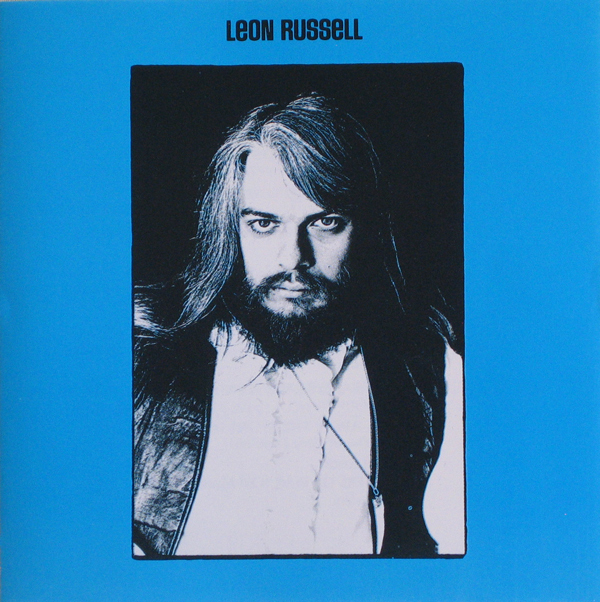
Leon Russell
His debut album, came out while he was ramrodding Cocker’s travelling circus. The album’s personnel bristled with A-listers: Eric Clapton, George Harrison, Steve Winwood, Mick Jagger, Bill Wyman, Charlie Watts, and so on. It had his take on “Delta Lady” which Cocker had a top 100 hit with. And “A Song for You” which became an instant classic; eventually somewhere between one and two hundred other artists would cover it.
When Cocker’s tour was done, the documentary Mad Dogs and Englishmen focused its spotlight on Russell and made him a star almost despite himself. Then he had to tour to support his own album for the first time. Along the way, he appeared at the Fillmore with admirer Elton John, who’d later play a crucial role in his last “comeback,” and made the rounds of TV shows to promote sales. Watch those appearances now, and you can see he’s trying out a public persona to deal with a sudden fame that kept growing after mega-events like the 1971 Concert for Bangladesh.
His sense of reserve wasn’t new or an afterthought. Leon Russell was a stage name; Claude Russell Bridges never legally changed his handle, because it offered him some mental insulation.
As he put it, “It’s handy. I can be a different person for a while.”
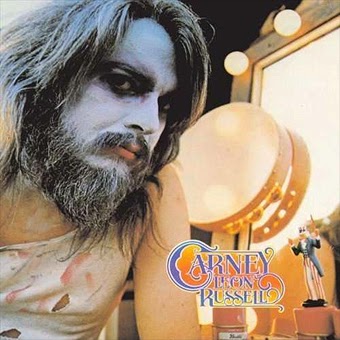
‘Carney’
With ‘Carney’, his third album, Leon Russell, Joe Cocker’s Master of Space and Time and victim of acute stage fright, pulled the curtain back on his unexpected stardom.
It was 1972, the apex of the age of concept albums, too many of which were flatulent self-indulgence—which may be a big reason that ‘Carney’ these days is virtually forgotten, except for its hit “Tight Rope” Another is that the album is challenging. Until ‘Carney’, Russell’s primary musical calling card was his usually sunny roots-rock directness. Here his songs gather ingredients of classic rock to veer determinedly into a layered complexity and dark vision that can flummox those expectations.
Take “Acid Annapolis To most critics, this experimental psychedelic flight of wordless swoops and chittering sonics verged on seeming trite even at the time. But you can also hear it as an abstract comment on this concept album’s central themes: the gaps between perception and reality, between public and private faces—fundamental human traits that both unite and divide us.
That’s foundational for the album’s big hit—the biggest Russell ever had—“Tight Rope.” Its Fellini-esque picture rides rhythms alluding to a circus oompah beat. Russell’s nasal drawl and hiccup-like falsetto stabs mimic the fragile balance he’s maintaining as a performer. The B section’s musical jauntiness underpins some pretty sarcastic lines: “Like a rubberneck giraffe / You look into my past / But baby you’re just too blind to see.”
That last word, separated from the others, is almost a yelp. The next cut, “Out in the Woods” explores being lost and alone in a tumult of others’ expectations. “My love she is not waiting” is a deftly poignant line that underlines how completely cut off from human contact the singer feels. He begs her to come get him even though “your sweet understanding can’t fix this broken heart.”
In similar fashion, “Me and Baby Jane” looks back at his Okie childhood and the lost girlfriend who “offered me balance for a while” now has “vacant eyes and a needle in her vein,” as old friends “stand beside me too late to try and find excuses in the face of being blind.” But dark as it is, can you doubt, listening to it, that Russell fan Elton John drew inspiration from this song? Or that Mark Knopfler at least glanced off the honky-tonk-meets-gospel “Roller Derby The Queen here, after all, is another performance artist, like the Carney: she’s daunting as hell on the floor, but once she’s home “alone in love / she murmurs like a sweet mourning dove.”
Bird cheeps, rain, road sounds—the opening of “Manhattan Island Serenade” seems counter-intuitive. But that’s exactly how alone he is, in his imaginary landscape at the center of this country’s most populous city, where this song’s gospel feel adds complex tension to lines like, “With every step I’ll see your face / Like a mirror looking back at me.”
That conceit is the core of “Magic Mirror” the album’s final track dealing with the central theme of projection. What you see up on that tightrope is some version of what you’d like to be. It may have nothing at all to do with what’s actually going on. That’s OK: after all, it’s a show.
But then Russell retrains the lens on himself to ask, “Do I see myself in anyone I meet?… If only we could try to see ourselves as others would.” ‘Carney’ peaked at number two on the Billboard charts. It was Russell’s last hit record for decades.
‘Hank Wilson’s Back!’
When Russell headed to Owen Bradley’s studio in February 1973, he wasn’t exactly what Nashville’s music establishment was looking for in their continuing quest to woo mainstream America to listen to their takes on country music. He looked like a hippie, but that Okie drawl proved his pedigree; he wasn’t just another one of those longhairs who’d created country-rock despite the Grand Ol’ Opry crowd’s sneering, dismissals, and resistance. Nor was he one of the emerging Outlaws they’d marginalized, who’d very soon draw crossover listeners with their fusions of rock and country.
Russell wanted to pay homage to their tradition’s classics, fit into it, maybe above all redefine himself as he nestled within it as a fictitious persona. Say hi to Hank Wilson—the name itself a homage to country-star Hanks like Williams, Snow, and Thompson. Tellingly, his album cover portrait is taken from behind.
Choosing Bradley Barn to make the album is a big clue to his motives. So is this veteran session man’s tapping an A-list of Nashville session stalwarts for his sidemen.
But what Russell wanted, maybe above all, was a fresh start with a new persona that cut virtually all ties with his last decade. If ‘Carney’ was ambitious and probing, this disc seems like remarkably un-radical fun. Yet there are also sly, subtle touches of creative reinterpretation throughout. Recasting Lester Flatt’s “Roll in My Sweet Baby’s Arms” the disc’s opener, as classic rockabilly before putting the bluegrass hammer down announces Russell’s unconventional embrace of Nashville’s roots.
Hank Thompson’s “A Six Pack to Go” reiterates that move, when the bluesy acoustic intro that also punctuates the song yields to good old honky-tonkin’ in a modified Thompson vein.
This concept shapes the album’s best stuff: unconventional Leon wearing a Stetson instead of a top hat or greasepaint.
His aside, “Ah, Billy Byrd,” on “I’ll Sail My Ship Alone” is just one of his overt grins at playing this new role. Another is the party atmosphere made explicit at the end of Lead Belly’s “Good Night Irene” which he infuses with an infectious passion that peaks on his interpolated autobiographical lines about Tulsa and Nashville.
The album’s last cut is revealing: “In the Jailhouse Now” these days famous thanks to the Coen Brothers’ O Brother, Where Art Thou? gets a tasty back-porch acoustic treatment that midway, mirroring the opening track, upshifts to modified rockabilly. You could argue that particular song underlines Russell’s aims with this album: to redefine his relationship with the prison fame can be. And there’s truth to that. But what’s palpable on almost every track, even Bradley-style string-laden stuff like Hank Williams’ “I’m So Lonesome I Could Cry” and “Am I That Easy to Forget”
is how much fun he’s having as he throws himself wholeheartedly in his personal tour through the country classics of his youth.
No doubt that’s why he recorded more Hank Wilson albums even though fewer and fewer listeners cared. He’d made a pile, achieved more than he’d dreamed of, and could now cut back on touring and delve into… well, whatever he felt like. He’d come down from the tightrope and had no regrets. Decades later, during his Elton John-instigated comeback, he told an interviewer, “I was surprised by the success I had. I was not surprised when it went away.