New York indie rock pairing Alex Luciano (guitar/vocals) and Noah Bowman (drums) have been playing as awesome band Diet Cig for six years now and despite their hard-earned reputation for their passionate performances they’ve always felt somewhat like they’ve got something to prove. The duo blast away any shadow of doubt just how amazing they are on their second LP ‘Do You Wonder About Me?’
“We spent a lot of time after the first record growing as people, being humans outside of tour for a little bit, and trying to shed the imposter syndrome.” – Alex Luciano
It can get truly exciting when you strip rock right down to the bare basics. Getting rid of all the unnecessary gimmicks and gadgets allows the purity of a song can shine through and it’s the truly special bands that dare to write in this way. Dashing all fears of a difficult second album, they have returned with a rousing record that has all the energy of their debut as heard on stand out song ‘Broken Body’ plus the added dynamism of gorgeous slower tracks like ‘Night Terrors’.
From the album, ‘Do You Wonder About Me?’ out May 1, 2020 on Frenchkiss Records.
This album was originally released in 2007 on CD only, so a 2020 once-over that sees the record remastered, and available digitally and on vinyl, is very welcome. Not only that, but it wasn’t heard by anything like enough people back in ’07 and it certainly deserves another chance to shine.
The timing is weirdly appropriate; many of us are locked down at home, revisiting a lot of old films as we strive to fill time ordinarily spent socializing, at gigs, etc. Here, Cotton covers the theme tunes to some of her favorite B-movies, offering us some glorious music and maybe a couple of cool movie suggestions simultaneously.
“I first got the idea one night when I was watching Ghidora the Three-Headed Monster,” Cotton says on a press release. “I had seen that movie so many times, but there is a moment in that movie when these tiny twin princesses who live in a flower are singing the most heartbreakingly beautiful song to Mothra… pleading with her to save the world. It was strange and beautiful and funny and sad all at the same time… It suddenly occurred to me that I could do a whole record of theme songs from B-movies. So I went on a search and watched an insane amount of movies for about a year. That’s the time frame I was indoctrinated into the cult of Russ Meyers. My criteria was it had to be a ‘great’ song from a ‘bad’ movie… ‘bad’ meaning ‘good’ and ‘great’ meaning it was a fantastic ‘song‘.”
So that’s what we get, and Cotton manages to be campy, moving, funny and earnest, often within the same song. Take the emotion she puts into “Green Slime,” from the Kinji Fukasaku ’68 flick of the same name. Or the sweet, authentic sing-song of “Days of Then and Now” from Russ Meyer’s cult classic Beyond the Valley of the Dolls.
Her version of “Female Trouble” from John Waters’ 1974 film led the celebrated director to write that Cotton, “makes the unlistenable unforgettable.” And the album closes with a jaw-dropping version of “Goodbye Godzilla.” The whole record, produced by Cotton with Geza X and Bill Rhea, is a joyous experience. This time, don’t miss out.
Josie Cotton’s Invasion of the B-Girls is available from May 1st through Kitten Robot Records.
Since forming 22 years ago, Bobby Hecksher’s psych rockers the Warlocks have enjoyed a career as turbulent as the circumstances under which they were born. As well as enduring the chaos that was the Brian Jonestown Massacre/Dandy Warhols saga (portrayed vividly in the film Dig!), Hecksher was rejected by Weezer. What else to do but form your own band?
But things didn’t get any easier. The Warlocks have worked their way through record labels and indeed band members like Pac-Man with little balls. Two years ago, Hecksher told us that he was unsure about the future of the band. But here we are, pandemic be damned, enjoying the release of the band’s tenth studio album.
As with the last two, the album is released through local label Cleopatra (the grey vinyl is a nice touch), and this time there’s a concept running through it — a story of a Bonnie and Clyde-ish couple on the run, called Rocky and Diamond. Not that you’d necessarily know if you weren’t told. This isn’t a rock opera; rather, the storyline lends some lyrical subject matter which, in truth, resonate in the current environment anyway.
“I’ve been reading lots of articles about our justice system” Hecksher said in a press release. “I’ve also been watching a lot of real-life/fictionalized prison TV series. All these young adults are caught committing very low-level crimes, but they end up getting these huge bits of their lives taken away from them. The ones who have money usually fair better.”
He has a point, and he makes it well on songs such as the touching “Dear Son,” “We Don’t Need Money” (with its enduring, repeated “rock and roll” refrain) and “Sucking Out Your Soul Like a Son of a Bitch.” Musically, the album is typically adventurous, droning Warlocks fare. The melodies are there, but they’re buried and require some effort. The ’60s psych/Madchester blend is still hypnotic. This is The Warlocks at their magical best.
The brand new studio album from L.A.’s premiere psych band, The Warlocks!
This ambitious album tells a single story, of two star-crossed lovers who commit a bank heist together, over the course of 10 gorgeous, densely layered guitar tracks spiced with keyboards and reinforced with powerful bass and percussion grooves!.
Available from April 3rd on CD, limited edition coloured vinyl in your choice of PURPLE or SILVER, and streaming in all digital stores.
Neil Young’s personal life was in free fall by 1974. His wife, actress Carrie Snodgrass, was gone for good, and attempts to rekindle a working relationship with CSNY only resulted in the aborted Human Highway project and the goodwill-shattering “Doom Tour.” It was during this turbulent time that he composed songs for a new collection to be named “Homegrown”.
“It was intense, like trying to make a record in the middle of 42nd Street, or Vietnam,” says producer Elliot Mazer “Here’s a guy going through hell, and this is like a fuckin’ catharsis for him.” Titles like “Frozen Man,” “Separate Ways” and “Love-Art Blues” paint a stark portrait of a lonely and heartbroken man. Those who heard the completed album insisted that it was as strong as Young’s breakthrough smash, Harvest. Cover art was printed, and label executives braced themselves for a million seller.
And then Young changed his mind. He had assembled friends, including the Band’s Rick Danko, at L.A.’s Chateau Marmont to get an opinion on his latest work. As a tape of “Homegrown” came to an end, a mix of the dark, gritty and unreleased “Tonight’s the Night” came on the stereo by chance.
Danko preferred the raw power of “Tonight’s the Night” to the comparatively delicate “Homegrown”. Disregarding advice from his label, Young released it instead that June. “[Homegrown] might be more what people would rather hear from me now, but it was just a very down album,” he told Rolling Stone at the time. “It was a little too personal. It scared me.
Neil Young fans have been clamouring for the release of Homegrown, the lost album that was nearly released in 1975 and most recently slated for the still-yet-to-happen Record Store Day 2020. Now, it’s been announced that the album described by Neil as “the missing link between “Harvest, Comes” “A Time, Old Ways” and “Harvest Moon” will finally reach fans on June 19th.
“Homegrown” is all analouge! The purest sound,” Young wrote in a post on his Neil Young Archives site. “Hear the vinyl. Get a nice phonograph player. This is the record to do that on! My first ever narration with Ben ‘Longgrain’ Keith and live sound effects. Some beautiful music and fun rockin’ songs as well. This is the one that got away. I am stoked to share this with you.”
While much of the industry is in flux due to the COVID-19 outbreak, Neil hasn’t stopped moving forward with his Archives projects. Also on the radar is a audiovisual release of a Greendale stage tour performance from Toronto in September 2003 entitled Return to Greendale. That one is currently set for release on double vinyl in July.
The Neil Young Archives team has also unearthed pro-shot video and multitrack audio tapes of Neil Young and Crazy Horse’s celebrated November 1990 show at The Catalyst. Previews have been posted sporadically in the Hearse Theatre section of the Archives website, whetting the appetite for the October release. “I think this has to be one of my all-time favorite Crazy Horse performances!” Neil wrote last year. “It’s hard to believe this did not come out a long time ago! .
Neil will also look back to a solo show from January 1971 with Young Shakespeare, the show came three days after his Massey Hall concert and stands as a career “high water mark,” according to producer John Hanlon. Currently slated for November 27, Young Shakespeare will include both audio and video content.
If that weren’t enough, it seems that the long-awaited box set Neil Young Archives, Volume 2 will finally arrive on August 21st should all go to plan. Neil has revealed it will be a 10-CD set covering the prolific period from 1972-1976 and will include Odeon Budokan, a live album and concert film from the Zuma tour’s stops in London and Japan.
Finally, Neil has been in touch with Graham Nash about compiling a 50th Anniversary Edition of Crosby, Stills, Nash and Young’s “Deja Vu” album which would likely appear by the end of the year.Looking ahead to 2021, Young has announced that he’s also been working on an album called Road of Plentywhich spotlights his work with Crazy Horse during the late ’80s. The album will feature recordings from the group’s 1986 tour, plus “some amazing music” recorded during the rehearsals for Saturday Night Live in 1989.
This is the first of 5 Archives releases Neil Young has announced for this year. It’s confirmation gives me hope that the other 4 will happen as scheduled. The release schedule is 31st July-“Back To Greendale Live” album plus film of a 2003 Toronto concert of the Greendale album with Crazy Horse complete with actors and stage settings. He has been previewing a song a week on the Archives site
21st #August- Archives Volume 2.The big one-10 cds plus a DVD covering the years 1973 to 1976. Includes the already released Tuscaloosa, Roxy and Songs For Judy..The only other confirmed disc is a live album from the Zuma tour taken from shows at the Hammersmith and Budokan which is also the basis of the DVD. The Homegrown tracks are likely to be included but mixed in with other recordings rather than as a stand alone album.
16th October-Down In The Rust Bucket Live album plus film of a Crazy Horse show at a small club called the Catalyst at the outset of the Ragged Glory tour. Again he has been showing a song a week on the web site.
27th November-Young Shakespeare Live album plus film of a solo show done within a few days of the Massey Hall concert that was in Volume 1. Yet again previews have been on site.
There was some mention this would be part of an expanded After The Gold Rush but lately it is being referred to as a stand alone.
This Will be a great year to be a Neil fan if all this happens. Another good reason to stay safe.
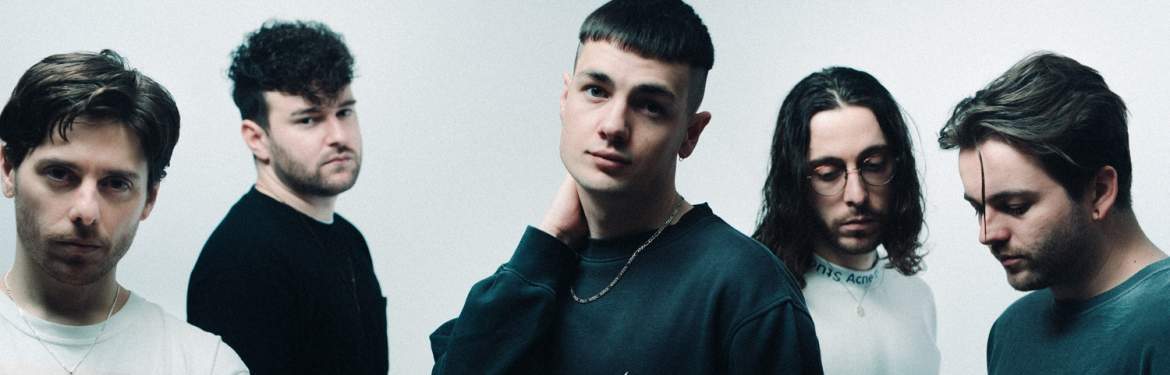
Blackpool based pop punks Boston Manor have been threatening to become something truly great and by taking a harder edge on third album ‘Glue’, they might just breakthrough and achieve the huge success they have been on the cusp of achieving. Boston Manor’s third full-length Glue is the sound of a band questioning the state of the world around them. Inevitably, in a critical examination of the modern world, it comes from a dark place, but one that fuelled the five-piece to create a body of work that elevates their craft further than ever before. Its 13 highly charged songs came out of a process that singer Henry Cox describes as “very chaotic”, but the result is a truly ferocious album – one that both draws and moves on from what they’ve done in the past, incorporating the gloomy atmospherics of 2018’s Welcome To The Neighbourhood with the highly charged yet melodic punk of 2016’s debut Be Nothing.
“It’s a lot more abrasive and a weirder record… It’s just new territory for us. The whole point was to throw away any preconceived notions of what the band is and push ourselves out of our comfort zone.”
“This is the start of our band finally becoming the band that we want to be. It’s taken us so long to get here, but I’m really proud of us for becoming our own thing. Not once did we think about what people wanted to hear – we just went entirely down the rabbit hole with it. Our only rule was to do what we wanted to do. And I’m really happy that we did that.” – Henry Cox
Tapping into the anger and frustrations of a generation that can see past the problems of late stage capitalism and yet are continued to kept down, ‘Glue’ tackles issues of toxic masculinity, mental trauma, class war and sets its sights on the powers that be, determined to see them come unstuck
“I want people to listen to it and feel something and think about things. The aim of the whole record is to make people angry. It’s to make them go ‘Well, this pisses me off, how can I change it? What is one thing that I can personally do – that I can start doing today – to make a difference?’ Because we can do better than this. We just need to start.” – Henry Cox
‘Glue’ is released on CD and limited spatter 12” vinyl, plus an additional 12” vinyl splatter design only available at independent record stores.
Boston Manor will be on the road this summer, playing SWX at Bristol, Electric Brixton in London, O2 Institute2 Birmingham, Newcastle Riverside, Rescue Rooms at Nottingham and Manchester Academy 2 during August 2020.
The Grateful Dead‘s first of two 1970 albums, Workingman’s Dead, is about to turn 50 years old this June, and in celebration of that, they’ll put out a 50th anniversary deluxe reissue that comes with a previously unreleased concert recording from Port Chester, New York’sCapitol Theatre on February 21st, 1971. Released on June 14th in ‘70, Grateful Dead’s fourth studio album, eschewing the psychedelic endeavours of the previous albums in favour of a CSN&Y approach to Jerry Garcia and Robert Hunter’s beautiful Americana styled songs, magnificent album in my top ten albums of all time…
“For an album as important and great as Workingman’s Dead, it seemed appropriate to double the amount of bonus material,” said Grateful Dead archivist and producer David Lemieux.
The show we’ve selected gives a definitive overview of what the band were up to six months after the release of the album and shows the Dead sound that would largely define the next couple of years. From Workingman’s Dead through Europe ’72, the Dead’s sound was Americana, and the live show included here is a workingman’s band playing authentically honest music.”
The original LP was released on June 14th, 1970, and marked a pivotal change for the Dead. Their previous three studio albums, including 1969’s predecessor Aoxomoxoa and the landmark concert LP Live/Dead, also from 1969, emphasized the six-member band’s psychedelic shadings and experimental streak. But with Workingman’s Dead, they scaled back and stripped down for a roots-digging Americana record that gave the Grateful Dead their first Top 30 album. The LP also spawned the Dead’s first Top 40 single, with “Uncle John’s Band”,
The liner notes were written by Rolling Stone‘s David Fricke, who adds, “The Capitol Theatre show was] a great night in what has long been deemed a legendary run, another turning point as the band entered a live era combining the focus of Workingman’s Dead and American Beauty with the exploratory verve of Live/Dead. Many of the classic songs spread across Dead LPs in 1971 and ’72… were introduced that week at the Capitol, and many of them are in this concert, still fresh off the griddle.”The Grateful Dead continued this folk-rock sound on the follow-up album, American Beauty which was released less than five months after.
Workingman’s Dead is a great album for a lot of reasons. From the purple mountains’ majesty of inventive steel guitar and pedal steel (“High Time,” “Dire Wolf”) to the fruited plains of goofy choogles (“New Speedway Boogie,” “Easy Wind”) and the nimble flatpicking and banjo (“Cumberland Blues”), this album is a nation of guitar. Also, I just love the sound of Jerry Garcia’s guitar through the Leslie rotating cabinet on “Casey Jones” and “High Time.”
These songs are harmonically unorthodox, with progressions both lyrical and inspired. The surprising minor key outro of “Uncle John’s Band!” The mid-phrase key change in “High Time!” The ninth chords in “Black Peter,” which feel almost like Satie moves! And, lest it all get too muso, this album plays yin to its own yang: for every wonderfully non-repeating labyrinth like the bridge of “Dire Wolf,” there’s a two-chord blues workout like “Easy Wind.”
The way the drums drop in on the second verse of “High Time” — quietly, stuffed entirely into the right channel, but full of character — feels emblematic of Kreutzmann and Hart’s approach. What a melodic and sensitive double-rhythm section team! There are so many details in the kit playing and percussion that elevate these recordings: the brushes on “Black Peter,” the guiro on “Uncle John’s Band,” the handclaps and maracas (mixed surprisingly loud!) on “New Speedway Boogie,” the beautiful snare tuned high on “Uncle John’s Band,” and elsewhere. The carefully calibrated dynamics and drum tuning throughout are really marvelous.
And let’s not forget: the singing is pretty incredible too. Jerry, taking lead duties on every song except the Pigpen-fronted “Easy Wind,” is at his most commanding and soulful. (“New Speedway Boogie,” “Casey Jones,” “Dire Wolf” and “Black Peter” are particular faves). His performances are brought into sharper relief by the blithely loose harmonies from Bob, Phil and Pigpen that pepper the record and remind me, happily, more of the Wailers than of the Dead’s smoother Californian contemporaries like Crosby, Stills, Nash & Young or the Byrds.
There are the occasional hokey old-time tropes about miners and trains and gin — which, hey, Jerry almost pulls off — but many of these images and rhymes have a kind of legitimately out-of-time uncanniness. “Come on along or go alone, he’s come to take his children home” sounds like a lost couplet from a 300-year-old nursery rhyme. These songs feel like stories, but often the particulars aren’t quite clear — like old tales that have shed so many details in retelling that they’ve lost literal sense, but acquired a kind of sculptural presence.
And that’s what Workingman’s Dead is to me: a totem — of America, of a band.
The album, which was recorded in 10 days, also featured several of the group’s best songs, including “Cumberland Blues,” “Black Peter” and “Casey Jones.” Many of them show up in the previously unreleased concert included in the Deluxe Edition.
The fiery rendition of “Casey Jones” from that show is streaming now, and you can listen to it and check out the full track list below. The reissue comes out July 10th.
Workingman’s Dead 50th Anniversary Reissue CD Tracklist
Disc One — Original Album Remastered
1. “Uncle John’s Band”
2. “High Time”
3. “Dire Wolf”
4. “New Speedway Boogie”
5. “Cumberland Blues”
6. “Black Peter”
7. “Easy Wind”
8. “Casey Jones”
Disc Two — Capitol Theatre, Port Chester, NY (2/21/71)
1. “Cold Rain And Snow”
2. “Me and Bobby McGee”
3. “Loser”
4. “Easy Wind”
5. “Playing in the Band”
6. “Bertha”
7. “Me and My Uncle”
8. “Ripple” (False Start)
9. “Ripple”
10. “Next Time You See Me”
11. “Sugar Magnolia”
12. “Greatest Story Ever Told”
13. “Johnny B. Goode”
Disc Three — Capitol Theatre, Port Chester, NY (2/21/71)
1. “China Cat Sunflower”>
2. “I Know You Rider”>
3. “Bird Song”
4. “Cumberland Blues”
5. “I’m a King Bee”
6. “Beat It on Down The Line”
7. “Wharf Rat”
8. “Truckin’”
9. “Casey Jones”
10. “Good Lovin’”
11. “Uncle John’s Band”
Meanwhile, Bob Weir continues his ‘Weir Wednesdays’ streaming series tonight (5/6) at 8 PM ET with his Wolf Bros show from 11/5/2018 in Nashville. Tune in for free at Facebook.
Pete Townshend’s “Empty Glass” Turns 40 years old, In 1980, the Who guitarist’s cup overflowed as the finest solo outing of his career. Although a true solo album from The Who’s wunderkind might have been eagerly anticipated at the time, Empty Glass–Pete Townshend’s first fully fleshed out album outside the boundaries of his band–still begs the question of why he didn’t opt to record these songs with the Who.
The album was written and recorded between 1978 and 1980, when activity with the Who had started to pick up again, and Townshend found himself having to write for both his solo project and his band. After all, Face Dances, the album the group released shortly thereafter, was, by all estimations, an inferior effort, widely derided as one of the weakest releases of the Who’s career. Roger Daltrey himself claimed he was disappointed that Townshend denied the group the opportunity to take a shot at Empty Glass and make it a masterpiece the band could claim as its own.
Some could consider the singer’s resentment a matter of professional jealousy. If so, it’s easily dismissed. Where Townshend’s first nominal effort on his own, “Who Came First”, was essentially a grab bag of demos and solo sketches, Empty Glass is a masterpiece even by the Who’s exacting standards.
The album title alludes to Townshend’s eternal search for spiritual salvation, particularly at a time where he was beset by an array of issues that had all but consumed him — among them, alcoholism, substance abuse, marital difficulties, and the death of his friend and bandmate Keith Moon two years before. Symbolically, “Empty Glass” refers to an analogy that compares a bar patron passing a bartender an “empty glass” in hopes it will be filled, and a seeker of spiritual redemption approaching God with an open heart, looking for the solace only the Almighty can provide. Townshend was finding further inspiration in the works of a Persian poet named Hafez, who drew the musician’s interest in the wake of his fascination with his personal guru, Meher Baba.
Indeed, the songs offered such a sense of reflection and rumination, it’s hard to imagine Empty Glass being delivered from anything other than his personal perspective. The song that emerged as the album’s initial hit, “Rough Boys,” bows to Townshend’s unresolved sexual ambiguity. Although he dedicated it to his children Emma and Minta, it made more sense as a shout-out to the Sex Pistols who, at the time, represented punk’s brooding, blistering upending of traditional rock norms. Years later, Townshend himself alluded to its alleged homosexual references, noting that he knew members of the gay community but was not gay himself. Given that some saw the song as a coming out of sorts a decidedly wrong assumption, Townshend assured them — it would have been an awkward choice for the macho Daltrey to voice. Nevertheless, The Who did eventually include it in their live sets, a wise choice considering that it ranked among their strongest contemporary material at the time. It also hit America in the top ten, the only Townshend solo song ever to achieve that distinction.
The rest of the album is similarly introspective. “Let My Love Open the Door,” the second single from the album, made its way up the charts, although both Townshend and his management allegedly expressed some misgivings about the song. A third single, the similarly philosophical “A Little Is Enough,” which Townshend acknowledged was his bow to the Kinks’ Ray Davies, failed to make any impact at all, although Townshend considered it a better bid for chart success than the aforementioned “Let My Love Open the Door.”
While several songs could have been compelling candidates for inclusion on a new Who album — “And I Moved,”“Empty Glass,” “Gonna Get Ya,” “A Little Is Enough,” and “I Am an Animal” would have been fine fits for Daltrey’s vocals — Townshend surrounded himself with an able support cast. Producer Chris Thomas, best known for his work with the Pretenders, Procol Harum, Paul McCartney, Elton John and Pink Floyd, helped manage his client’s blend of pomp and poignancy, while four different drummers — recent Who recruit Kenney Jones, all-star session man Simon Phillips, Big Country’s Mark Brezicki and James Asher — as well as the Who’s erstwhile keyboardist John “Rabbit” Bundrick, Medicine Head’s Peter Hope-Evans on harp, and another Big Country stalwart, bassist Tony Butler provided the instrumental underpinnings.
Townshend once claimed he wanted Todd Rundgren to oversee the proceedings, but changed his mind, fearing Rundgren’s abilities as a singer and guitarist would steal the album’s focus.
Regardless, Empty Glass still ranks as the best individual effort of Townshend’s career and a worthy companion piece to his Who resume. In this case, the glass was more than half full.
Los Angeles-via-Toronto songwriter and composer Lydia Ainsworth released her third album, Phantom Forest, last year, and as she works on her fourth, she’s shared a new single, “Forever,” which she says “is a song about an attempt at astral projection in order to be close to a loved one who is far away, Forever is a song about my futile attempts at astral travel
They weren’t the best-known of the early ‘60s “British Invasion” bands, but the Pretty Things are undeniably one of the most enduring and influential of the first wave of U.K. rockers to wash up on U.S. shores.
The various eras spanned by the band’s work could give the uninitiated pause, however, ranging from the Pretty Things’ mid-‘60s British R&B romps and the unbridled psych-rock of 1968’s “S.F. Sorrow” to the hard rock ‘70s when the band was signed to LedZeppelin’s Swan Song Records label, and beyond into the 21st century. The best that the Pretty Things have to offer from across the band’s storied half-century of music.
With a December 2018 “farewell” performance held at the O2 Indigo in London, and the recent release of the show in a couple of formats by Madfish Music, the Pretty Things take a final bow after 55 years in the rock ‘n’ roll trenches. The line-up for this event was comprised of band originals Phil May (vox) and Dick Taylor (lead guitar) along with longtime guitarist Frank Holland, bassist George Woosey, and drummer Jack Greenwood. Former Pretty Thing’s bandmates Jon Povey, Wally Waller, and Skip Allan appeared onstage, and rock legends Van Morrison and David Gilmour (Pink Floyd) joined the band in celebrating their storied career.
The band’s story begins with guitarist Dick Taylor, who was the odd man out in the earliest incarnation of the Rolling Stones. With both Brian Jones and Keith Richards in the fold, the Stones didn’t need a third guitarist, so Taylor gamely switched to bass. Taylor quit the Stones a few months later, after he was accepted by the Central School of Art and Design in London. It was there that he met singer Phil May, who convinced him to form a new band. Named after a song by legendary Chicago bluesman Willie Dixon (1955’s “Pretty Thing”), England’s Pretty Things were a typical early ‘60s British R&B band playing American blues tunes by artists like Bo Diddley and Jimmy Reed.
The Pretty Things scored a minor chart hit with their first single, “Rosalyn,” which was released in early 1964 and they quickly followed it up with the Top Ten hit “Don’t Bring Me Down” and, in early 1965, Taylor’s “Honey I Need,” which peaked at #13 on the UK charts. While the band never enjoyed a hit single in the U.S. they were extremely popular in Australia, Germany, and the Netherlands as well as their home country. As the 1960s wore on, however, the band’s ever-changing line-up and ever-evolving sound resulted in diminishing commercial returns. In 1968, the Pretty Things released what is considered by many to be their masterpiece, the “S.F.Sorrow” album.
A notch above contemporaries like the Rolling Stones or the Beatles in their status as England’s premiere R&B outfit, the Pretty Things’ self-titled debut was a rockin’ collection that relied heavily on American blues standards by folks like Bo Diddley, Jimmy Reed, Willie Dixon, and Tampa Red. Even when the band cranked out an original like the hit “Honey, I Need” or “13 Chester Street,” they dressed it up in their best Chicago blues garb and played like they were auditioning for Chess Records. As was the trend at the time, the U.K. version of the album differed in song selection and sequencing from the U.S. release, which front-loaded the hit singles and added a couple of tracks not available across the pond.
The Pretty Things created some of the most exciting and innovative records of the late sixties and early seventies. Winners of the Hero award at the 2009 Mojo Honours, the band have been name checked over the years by an array of artists ranging from The Clash, David Bowie and Aerosmith through to The Libertines and Kasabian. The band first burst onto the scene in 1965 with a blend of raw, explosive R&B, this their debut album which reached no. 6 in the UK album charts. Over the course of several albums they evolved into psychedelic pioneers.
The 1967 release ‘Emotions’ bridged the gap between the R’n’B era of The Pretty Things and the psychedelic Sergeant Pepper and Pink Floyd era of their ’68 release ‘S.F. Sorrow’. The album is almost an exact snapshot of swinging London at its purest. ThePretty Things were formed by Phil May and guitarist Dick Taylor in 1963. Taylor was hot from the first days of the RollingStones, the band he formed with Mick Jagger and Keith Richard, but left because it was time to go to art school; May was a hooligan disguised as a fellow student; and the rest of the band just picked things up from there.
Other bands played R&B, of course… the Kinks, the Yardbirds, even the Beatles tried their hand at it. But none of them played it like the Pretty Things. Their hair was long, their music was greasy, and they genuinely did not understand how to turn down the volume on their amplifiers.
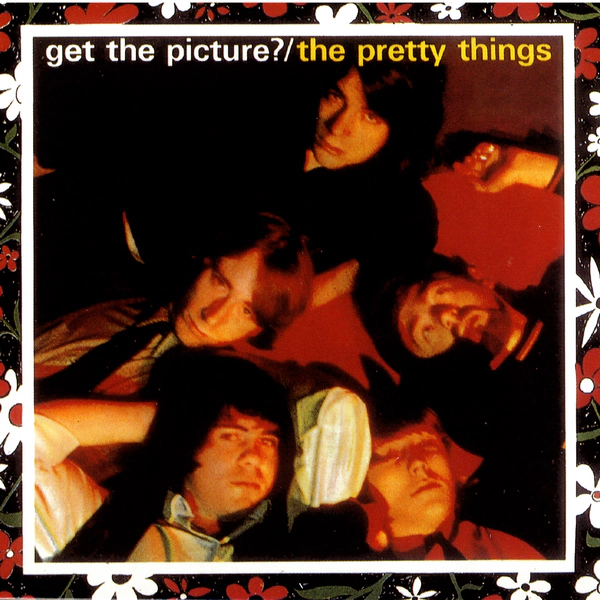
The legendary 60s RnR upstarts’ cherished second album from 1965 featuring 6 bonus tracks and liner notes including the singles “L.S.D.”, “Midnight To Six Man”, “Cry To Me” and “Come See Me”. This edition of ‘Get the Picture?’ is presented in complete with an 8-page booklet featuring liner notes from renowned journalist and editor Paul Du Noyer
The Pretty Things’ sophomore effort and the band’s second album in less than a year found the PTs relying less on American blues standards in favour of exploring their own growing songwriting chops. The results were inconsistent, but impressive nonetheless as the band delivers a blistering set that ranges from jangly ballad “You Don’t Believe Me” (co-written with then-session pro Jimmy Page) Listed among the composing credits on ‘Get The Picture’ is one Jimmy Page, the most in demand session guitarist of the era. the fuzz-drenched, garage-rockin’ title track to the freakbeat classic and minor chart hit “Midnight To Six Man.” Get the Picture? was the last PTs’ disc to feature notorious (and erratic) drummer Viv Prince.
Released December 1965 ‘Get The Picture’ – The Pretty Things certainly did with this follow up to their debut album of the same year. The band were getting wilder and the music getting better, with two remarkable singles ‘Midnight To Six Man’ and ‘Come See Me’. The Pretty ThingsMay was a hooligan disguised as a fellow student; and the rest of the band just picked things up from there. Other bands played R&B, of course.
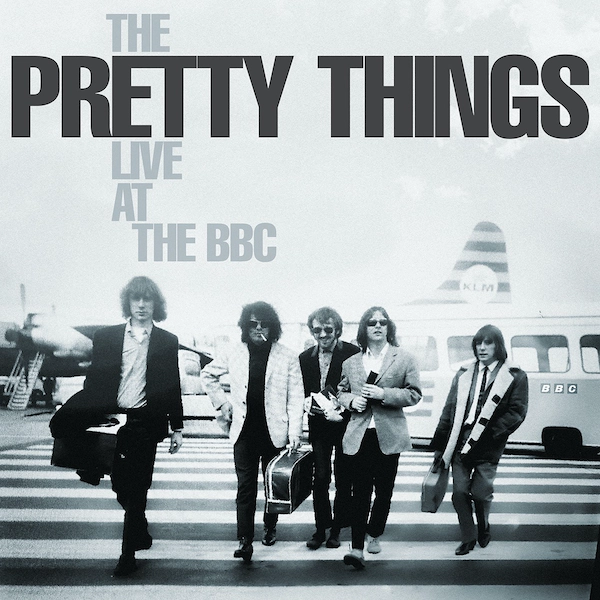
As well as recording hit singles and albums, the Pretties were also heard live in action on BBC radio shows that captured their dynamic performances with remarkable clarity and presence. We are fortunate that this audio heritage has been carefully preserved and has now been digitally restored for future generations to enjoy. Repertoire is proud to present this comprehensive collection that provides hours of non-stop R&B, original songs and new concepts. Such seminal BBC shows as Saturday Club presented by DJ Brian Matthew and Top Gear by John Peel -who also hosted his own regular Sunday Concert – welcomed the band to their studios where they’d romp into everything from Pretty Thing favourites like “Big Boss Man”, “Road Runner” and “Buzz The Jerk” to the experimental “Defecting Grey”.
There is more broadcast material from the 1970s and even into the 2000s with BBC shows hosted by Mark Lamarr and Marc Riley that bring the band’s history up to date with vibrant versions of “Belfast Cowboys”,“Singapore” “Silk Torpedo” and even a revival of their first hit single “Rosalyn”. This superb boxed set has informative liner notes by Richard Morton Jack, progressive rock historian and editor of Flashback magazine, and includes an interview with Phil May discussing the recordings. Repertoire’s Chris Welch also interviews founder member guitarist Dick Taylor, who reminisces about the early days of the Pretty Things and pays tribute to his old friend Phil May who sadly passed away in 2020.
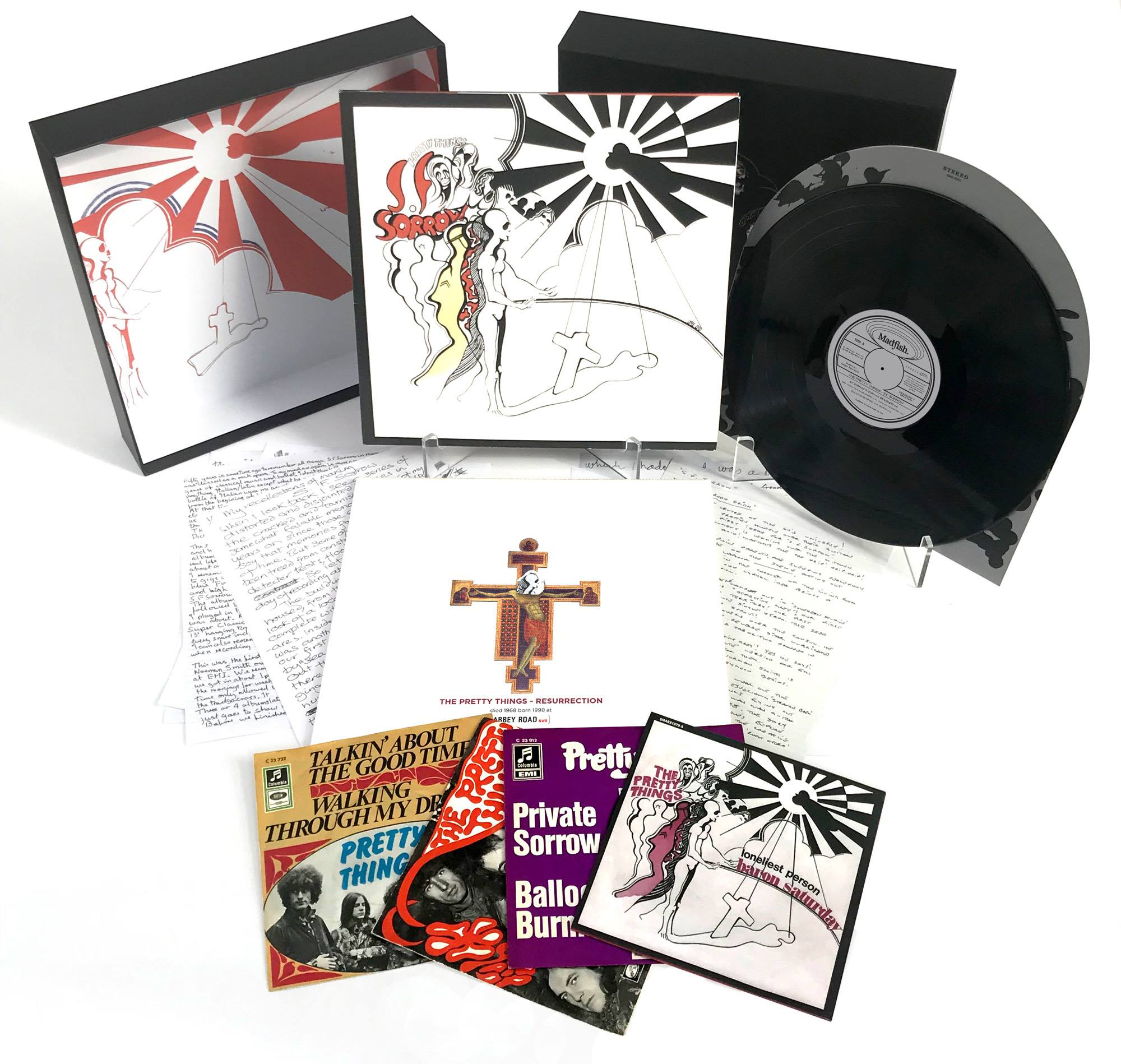
One of rock music’s first concept albums, “S.F. Sorrow” was based on a short story by May and although it failed to gain traction commercially, it has only grown in fans’ and critics’ estimations in the decades since.
The band’s unquestioned masterpiece and one of rock music’s first concept albums, “S.F. Sorrow” was released at a point where rock ‘n’ roll was experiencing “peak psychedelia,” and the Pretty Thing’s obviously rose to the occasion. Based on a short story by Phil May, the album is structured as a song cycle that tells the story of its protagonist, “Sebastian F. Sorrow,” from birth to disillusioned old age, with all the travails that ensued in between. From a musical perspective, this is probably the most imaginative and daring as the band would ever get, with Taylor, Waller, and Povey contributing some of their finest performances.
“S.F. Sorrow”, is one of the great classics of the Psychedelic era. The album stands favourable comparison with Sgt Pepper and Piper At The Gates Of Dawn as one of the defining records of the time. Originally recorded at Abbey Road in 1967 and 1968 it was one of the first true concept albums, pre-dating Tommy by a full year.
The Pretty Things created some of the most exciting and innovative records of the late sixties and early seventies. Winners of the Hero award at the 2009 Mojo Honours, the band have been name checked over the years by an array of artists ranging from The Clash, David Bowie and Aerosmith through to The Libertines and Kasabian.
Released in 1970 the album was named Rolling Stone’s album of the year ahead of ‘Let It Be’ by The Beatles, ‘Morrison Hotel’ by The Doors, ‘After the Gold Rush’ by Neil Young, ‘Moondance’ by Van Morrison, ‘Bridge Over Troubled Water’ by Simon and Garfunkel, Pink Floyd’s ‘Atom Heart Mother’ and Led Zeppelin ‘III’. Following the now legendary and critically acclaimed ‘S.F. Sorrow’, the psychedelic ‘68 classic, the band returned to Abbey Road Studios and started work on “Parachute”.
The legendary 60s RnB upstarts’ highly acclaimed 1970 5th album featuring 6 bonus tracks including the singles “The Good Mr. Square”, “Blue Serge Blues”, “October 26” and “Cold Stone”.
The PTs entered an uncertain new decade as disillusioned founder Dick Taylor left the band after “S.F. Sorrow” failed to improve the PTs’ fortunes. The band borrowed guitarist Victor Unitt from the Edgar Broughton Band as Taylor’s replacement for the recording of “Parachute”, a criminally-underrated follow-up that took the psychedelia of its predecessor into interesting new directions.
The vocal harmonies are outstanding, Unitt’s fretwork offers a fresh perspective, and the songwriting displays the band’s unique penchant for reinvention and evolution. Sadly, “Parachute” was virtually ignored at the time of its release, but critical reappraisal of the album would begin almost immediately, with Rolling Stone scribe Stephen Holden calling it an “obscure underground classic” a mere two years later when reviewing “Freeway Madness”for the magazine.
Taylor left the band before the underrated 1970 album “Parachute”, replaced by former Eire Apparent guitarist Pete Tolson, who would perform and record with the band through the remainder of the decade on sorely overlooked albums like 1972’s “Freeway Madness” and 1974’s “Silk Torpedo”. The band effectively broke-up when May was fired by his bandmates after the release of 1976’s “Savage Eye” album.
A new year, a new record label (Warner Brothers), and a new bass player in the form of Stuart Brooks (from Paul Kossoff’s Black Cat Bones) after longtime PTs member Wally Waller flew the coop. Oddly, Waller hung around after quitting, producing “Freeway Madness” for his former bandmates under the pseudonym “Asa Jones.” The results moved the band further onto the hard rock turf they’d fully explore during their Swan Song years. Waller did a great job in capturing the band’s sound; May took more chances with his vocals; and new guitarist Pete Tolson clearly found his comfort zone here, tearing off creative, cutting-edge solos. Proving that you can teach an old dog a new trick, the PTs further updated their sound; the mix of blues, boogie, and rock ‘n’ roll on “Freeway Madness” is period perfect.
The band’s 21st century “comeback” album, “Balboa Island” was the first PTs release in almost eight years, and only their second album in over a quarter-century. The classic trio of May, Taylor, and Waller are all in the saddle alongside old friends like keyboardist Jon Povey and drummer Skip Alan, as well as the “new guy,” guitarist Frank Holland, who had played on 1999’s …“Rage Before Beauty”. Another underrated entry in what’s not an enormously large Pretty Things catalogue, the album isn’t without its hiccups…the album-ending title track kind of fizzles out without ever hitting escape velocity, and the vamping “(Blues For) Robert Johnson” would have been embarrassing even in the band’s glorious 1960s heyday. But the musicians’ 40+ years of chemistry clearly shines on blustery originals like “Livin’ In My Skin” and “Buried Alive.” Throw in inspired covers of Dylan and Muddy Waters song and you’ll wonder why “Balboa Island” didn’t get more love when it was released.
May and Taylor reunited with bassist Wally Waller and keyboardist Jon Povey for 1980’s “Cross Talk” album, but otherwise the Pretty Things spent much of the 1980s and ‘90s out of the studio and out of the record-buying public’s consciousness.
The band’s new manager, Mark St. John, helped keep the band alive and performing during those dark years, and in 1999 the Pretty Things released the band’s first album in almost two decades in “Rage Before Beauty“, which included a new addition in guitarist Frank Holland. The critically-acclaimed “Balboa Island” album followed a mere eight years later in 2007, and the Pretty Thing’s twelfth and final studio album, well-received “The Sweet Pretty Things (Are In Bed Now, of Course…”) was released in 2015. Throughout this period, the band stayed busy with live performances and, also in 2015, the Pretty Things were honoured with the release of the deluxe, career-spanning multi-disc box set “Bouquets From A Cloudy Sky”.
The Pretty Thing’s go “glam” with an inconsistent set of songs that takes a stab at a more commercial sound while eschewing the tough-as-nails British R&B and imaginative psychedelia with which they’d made their bones. Turnabout is fair play, I suppose, the band finding inspiration in acolytes like David Bowie and Ian Hunter, and while “Silk Torpedo” provides, at times, an ill-fitting musical direction, songs like “Joey,” “Singapore Silk Torpedo,” and “Belfast Cowboys” rock pretty hard for glam, riding the rails of Pete Tolson’s wiry lead guitar and May’s reckless vocals. An often-overlooked entry in the Pretty Things’ catalogue, “Silk Torpedo” remains many a fan’s favourite nonetheless.
Listening to the two-LP version, the performance documented by “The Final Bow” makes little effort to include the band’s post-“S.F. Sorrow” material, largely eschewing the 1970s for a laser-focused trip back to the Pretty Things’ beginning years. After a brief intro, the band rips into two of their earliest hit singles, swinging through “Honey I Need” with reckless aplomb before jumping into the swaggering, blustery “Don’t Bring Me Down,” which features some incendiary Dick Taylor fretwork. The title track of the band’s sophomore album, “Get the Picture?” is a swinging slice of mid-‘60s British R&B with spry May vocals. “Midnight To Six Man” was a modest hit in 1966 and the band plays it pretty close to the vest a half-century later, the upbeat tune propelled by an undeniable rhythm, shards of jagged guitar, and bursts of manic energy.
Jumping ahead to 1968, much of side two features the band playing a condensed version of their landmark album “S.F Sorrow”, Pink Floyd guitarist David Gilmour sitting in with the band. The performances are so damn satisfying for the old-school PTs fan – “S.F. Sorrow Is Born” crackles with energy, the band backing May’s vocals with a swirling tsunami of psych-drenched instrumentation. Gilmour’s contributions to “She Says Good Morning” and “I See You” embellish, rather than detract from the original arrangements, his ethereal tone and fluid string-bending adding to the psychedelic vibe. The latter song is provided a gorgeous extended jam that will thrill any six-string junkie.
“Cries From the Midnight Circus,” hailing from the band’s underrated 1970 album “Parachute”, is chronologically the newest song here, and is afforded a rumbling, hard rocking arrangement with funky rhythms and May’s leather-lunged vocals, proving once again that the Pretty Things were a few years ahead of the rock ‘n’ roll curve stylistically. Name-checking friends like Keith Richards and David Bowie (née Jones), the band revisits its past life as a British R&B outfit with the legendary Van Morrison stepping in to help on blues standards like the rollicking “Baby, Please Don’t Go” and the jaunty “You Can’t Judge A Book By ItsCover,” both of which benefit from Morrison’s infusion of Irish soul. May’s nuanced vocals and Taylor’s slinky guitar-picking take “Can’t Be Satisfied” back to its Delta roots.
“The Final Bow” final side closes out with another appearance by Gilmour on a thirteen-minute-plus “medley” of two early PTs songs – the controversial non-album B-side “L.S.D.” (ostensibly “pounds, shillings, and pence,” using the British currency symbol £ for the ‘L’ but really about the mind-bending drug that was in vogue in 1966) and “Old Man Going” from “S.F. Sorrow”.
The first part is a foot-stomping rave-up before the song devolves into a dreamlike instrumental miasma with guitar interplay is every bit as enticing as you can imagine. The show’s encore includes the first Pretty Things’ hit, “Rosalyn,” the song shining every bit as brightly as it did 55 years ago (the late David Bowie adored the band, recording “Rosalyn” and “Don’t Bring Me Down” for his 1973 covers LP “Pin Ups”). After a few fitting words from Phil May, the band closes out with another “S.F. Sorrow” track, the lovely, melancholy “Loneliest Person.”
The Pretty Things’ “The Final Bow”is available in a couple of formats depending on your financial status and dedication to the band, including a nifty two-LP vinyl set with gatefold cover and individual sleeve notes by Phil May and Dick Taylor. For those of you with deeper pockets, you can get “The Final Bow” in a deluxe package with two concert DVDs of the event accompanied by a pair of live CDs and a 10” vinyl record with tracks selected by May and Taylor. It also includes a 52-page hardback book with photographs and more. Either way you go, “The Final Bow” is both a fine introduction to, as well as a fitting swansong for this timeless band.
Greatest Hits (2017)
If all you want is a taste of the Pretty Things to whet your appetite, you can’t do better than this 2017 release. Although the band didn’t have “greatest hits,” as such, they did enjoy a modicum of commercial success in the U.K. during the early ‘60s, and charting singles like “Rosalyn,” “Don’t Bring Me Down,” and “Cry To Me” are among the two-dozen tracks included here.
“Greatest Hits” covers a period from the band’s first hit in 1964 through their 1970 LP “Parachute” and includes a wealth of obscurities as well as four tracks from their masterpiece, “S.F. Sorrow”. I’m giving extra credit to the band for including a 25th bonus track, a new recording of the Byrds’ “Mr. Tambourine Man” which displays the band’s ability to creatively reinterpret material in their own image.
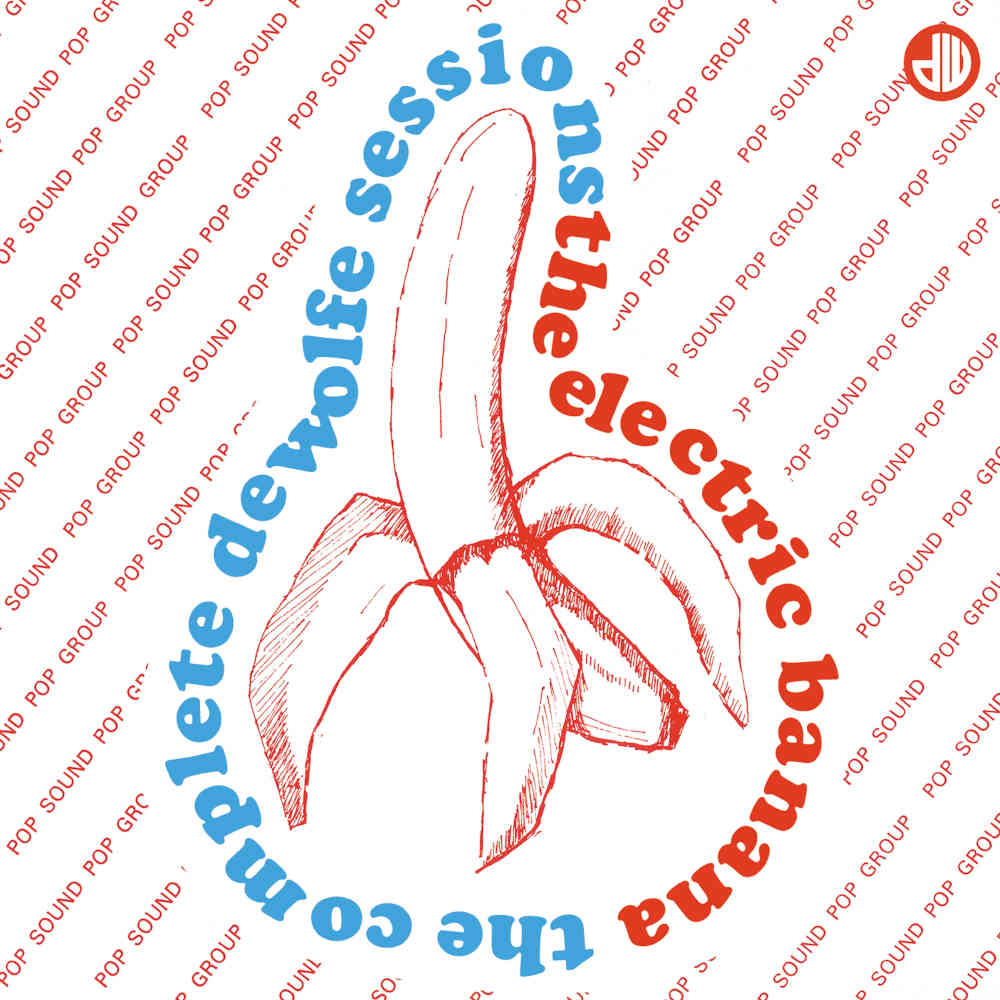
Also check out the “The Complete De Wolfe Sessions” [as Electric Banana] (2019)
It’s a poorly-kept secret among collectors that, during the late ‘60s and well into the 1970s, members of the Pretty Things supplemented their meagre cash flow by recording tracks for British music library company DeWolfe under the alias ‘The Electric Banana’. The music was never designed to be released commercially, but rather licensed to cheap-o movies and TV shows for soundtrack filler. That didn’t stop the band from cranking out some cool new tunes for their paydays, and the ElectricBanana ended up recording what amounted to six albums worth of material for the De Wolfe library, all of which have been collected in a nifty, budget-priced three-CD box set “The Complete De Wolfe Sessions”. Each “album” included five or six vocal tracks accompanied by instrumental versions, and the box set preserves 55 tracks in total.
There wasn’t really a “legit” live set released during the band’s heyday (1965-1980), the first (of sorts) being 1998’s “Resurrection”, recorded live in the studio with guest David Gilmour of Pink Floyd. If I had to recommend a couple of live discs for the still-hungry new PTs fan, I’d go with “Live at Rockpalast” (which features German TV appearances from 1998, 2004, and 2007) and “Live at the BBC” (which offers British TV appearances from the 1960s and ‘70s) as well as “The Final Bow”, of course…
Many thanks to longtime Pretty Thing’s members Phil May (vocals); Dick Taylor, Pete Tolson, and Frank Holland (guitars); Wally Waller and John Stax (bass); Jon Povey (keyboards); and Skip Alan (drums) for all the great music!