Cristina Vane is a songstress and slide guitarist based in Nashville and specializing in blues, country blues, folk, androck. Her background in Europe allowed for a unique formation of flavours in her musical inspirations, and this eclectic nature carries through into her work. “Old Played New” is a tribute to the delta blues artists that have shaped my sound, including Son House, Skip James, Charley Patton and others. With 5 cover songs from various artists and one original on the track list, it is also my first solo guitar record. I am so happy with how Brook Sutton captured these live takes at The Studio here in Nashville, and so happy to share it with you.
I have gleaned so much as an artist and a person from the music that these talented folks made. Blues music is rooted in the African American experience and now more than ever, it is important to highlight once again how much black culture has contributed to our society, especially in the field of music. I hope to honor the memory of these artists and pay tribute to the cultural debt I owe them at large, coming in from a different background and partaking in this music.
Slide guitarist and singer-songwriter Cristina Vane has known the lighter and darker sides of Venice. SoCal’s sunshine noir ripples through her music- a blend of folk and blues, angst and elation. [..] Since becoming enchanted by the blues, she’s developed an almost encyclopedic knowledge of the musical genre, expertly rattling off idols like Skip James, Mississippi John Hurt, and Blind Willie Johnson.
Slum of Legs are a feminist noise-pop DIY band. We write songs about ghosts, architecture, gender, loneliness, goodhair and many other important topics. We are Alex, Emily, Kate, Maria,Michelle and Tamsin. Long-awaited eponymous ‘queer feminist noise pop’ debut album from the Brighton-based Slum of Legs, a self-described ‘giant pop-psych, punk monster with twelve legs’. In their own words, “a manifesto for compassion and defiance in a confusing, unrestful world.”, gender, loneliness, goodhair and many other important topics.
Slum of Legs are a queer, feminist noise-pop DIY band. We are Alex, Emily, Kate, Maria, Mich and Tamsin. We write songs about ghosts, architecture, gender, loneliness and hair envy. You can dance to all of them. Sometimes we sound like The Shaggs, Slant 6 and La Dusseldorf playing at an impromptu party in space.
One of our songs is a live séance. We’ve performed on a Norwegian mountain and in many, many basements. We like pylons and onstage pile-ons. We’re interested in modernist architecture, art & literature.
We use collage & cut-up in our artwork and this also reflects the fractured nature of our songs and how the 6 of us, who all bring completely different influences to the band, have been stuck into a blender with the controls jammed. We are a giant pop-psych, punk monster with twelve legs. Our songs are melodic and dissonant, anthemic and experimental. The Fall meets The Raincoats in this noisy, bloody minded, defiant, lo-fi collage art-punk. Absolutely brilliant, up there as Album of the Year 2020 with Torres & Porridge Radio.
Our debut album ‘Slum of Legs’ is a manifesto for compassion and defiance in a confusing, unrestful world. As Slum of Legs are currently scattered across continents, we couldn’t film a video all together, so synth player EK put together this little homemade vid out of photos and gifs, featuring ‘Benetint & Malevolence’ from our forthcoming self-titled LP.
Released March 13th, 2020
The Band are:
Tamsin – vocals, backing vocals, drums, shouts
Mich – drums, vocals, backing vocals, guitar, shouts
Maria – violin, vocals, backing vocals, guitar, percussion, glockenspiel, field recordings, shouts
Kate – guitar, backing vocals, drums, shouts
Emily – synths, samples, monotron, piano, glockenspiel, noise, shouts
Alex – bass guitar, shouts
Lyrics by Tamsin Chapman except: 5 – lyrics by Tamsin Chapman and Michelle Steele; 8 – lyrics by Michelle Steele; 10 – lyrics by Maria Marzaioli
All songs by Slum of Legs
One of Australia’s best band’s Cub Sport have released their fourth album. Sitting at 13-tracks long, “Like Nirvana” is a beautiful and deeply honest trip through the mind of singer-songwriter-producer Tim Nelson. Navigating topics like gender, personal discovery and ultimately evolution, the alt-pop group from Brisbane the record which is a collection of soft, dreamy pop songs. Originally slated for a May release, Like Nirvana was pushed back due to the COVID pandemic, but the wait was worth it.
Tim Nelson tals about the group’s new LP, “Like Nirvana”, is an uplifting release that doesn’t shy away from the shadows, “it embraces both the light and dark with warmth.”
In Confessions there’s a line ‘the truth is I’m looking for myself and I can’t see it in anybody’. And I couldn’t, but now I can. It sounds a little cliché but this album has helped me find and love myself more deeply. I listen to this album and I can see, hear, feel ‘me.’ It’s the gentle and powerful energy of the introvert empath who, for some reason, is drawn to the light, even though they’re scared of it sometimes and feel more at home in the shadows. It’s the acknowledgement of lingering trauma, an embracing of the journey, rather than a need to see and understand the destination.
The track Nirvana is kind of the title track. It embodies some of the most important lessons I’ve learned over the last year. ‘Free myself from ego’s chains, free my body from my mind, leave the painful parts behind.’ It’s about learning my own worth outside of other peoples’ perception of me. In western society, we’re largely taught that our value is tied to the material things we have, how we appear to others, our career progress, what the world tells us about ourselves. I wanted to strip all of that away and form my own self not built by others. It’s by no means easy to do, but being aware of when your actions are motivated by ego/fear rather than love can be a strong guiding force.
In the second verse of 18 there’s a line ‘sorry, didn’t wanna make this sad, guess I wrote this all to try and heal from that, to let me feel all that’. I always wanted this album to be uplifting. I think in my mind I had this idea that to be uplifting it had to sound ‘happy’ but I couldn’t write any happy-sounding songs that I was excited about, but rather these cinematic, all-encompassing laments. I had to write this album as part of my healing process, I had to let myself feel everything and experience and live all of the emotions that were weighing on me. And I feel like that’s what has made Like Nirvana such an uplifting record in its completion; it doesn’t shy away from the shadows, it embraces both the light and dark with warmth and I hope it sets other people free in ways that it’s done for me.
The closing song on the album is Grand Canyon. I wrote this song for someone very dear to me. I wanted them to see them the way that I see them. ‘You’re a mountain, baby, Grand Canyon, you hold all the power if you believe it then you can, yeah. Too much of an angel to be held down, your battles, too much of an angel to be held down.’ It’s anthemic and soaring, pure power and warmth. It ended up becoming a reminder to me of my own power when I needed encouragement. I feel like this song was brought to me for the purpose of inspiring and empowering people who need it. And that goes beyond this song alone, I feel like that’s largely why Like Nirvana the album came to me.
Like Nirvana becomes a landmark moment in Australian pop, contextualising Nelson’s life and art on a universal scale. “Forget the limits that we learned / The light is coming, it’s our turn / You’re a mountain baby, Grand Canyon / You hold all the power,” Nelson sings on Grand Canyon, joined by bandmates united as a choir.
“It really feels heavenly,” Nelson says. “That’s kind of what making this album has felt like for me: finding a more peaceful place; getting to know myself better; acknowledging my whole self, even the parts that are hard to acknowledge sometimes.”
Nelson’s emotional purge continues on ‘My Dear (Can I Tell You My Greatest Fear)’, where his voice and soul are laid bare over spectral guitar fuzz and feather-light instrumentation. ‘I Feel Like I Am Changin’’picks up where ‘Sometimes’ left off on ‘Cub Sport’, with Nelson, back in Brisbane after a period of relentless touring, experiencing a newfound appreciation for home. ‘Be Your Man’ is an ’80s power ballad complete with dramatic Phil Collins-style drums while ‘Be Your Angel’ pays homage to Savage Garden’s ‘Truly Madly Deeply’. “Like Nirvana” is an emotional voyage of self-discovery that celebrates the joys of life. This album captures some of Tim Nelson’s most vulnerable moments. Elegantly understated and, for the most part, supremely chill, Cub Sport have stripped back the synth-pop hooks to create mellow clouds of sound intended to provide a little comfort and succour.
Four albums in. It’s evident in their staggering creative, aesthetic, and personal evolution, particularly over the past couple of years. Described by Nelson as more of a holistic release from Cub Sport in contrast to their largely linearearly records, This is a glistening, tightly-woven exploration of religious reckoning, oppressive structures of masculinity, and feelings of inadequacy. Dovetailing with a shift in Nelson’s gender expression they now identify as ‘free’, and use both neutral and male pronouns the record is impressionistic and abstract, pushing aside the brightly coloured realism of 2019’s self-titled record in favour of gauzy lucid dreams. Nelson’s embrace of raw emotion has pushed them and their bandmates, to create a record more fiercely emotive than ever.
Band Members
Tim Nelson, Zoe Davis , Sam Netterfield and Dan Puusaari
Cub Sport’s fourth album Like Nirvana, out July 24th
With her bold and bracing new album, “Bad Vacation”, Liza Anne hasn’t just shaped her liberation, she’s completely reinvented it. The record is defiant and thoughtful, showcasing a remarkable confidence as it tackles destructive habits and finds Liza at her most self aware yet. “I was writing what I needed to hear,” Liza explains. “I was writing what I needed to feel. I was quite literally writing a stronger, more empowered version of myself into existence.”
The songs here represent an audacious sonic leap forward for Liza and her band, mixing accomplished full-throttled art rock anthems with playful new wave jams and power pop earworms. Produced by Micah Tawlks Kyle Ryan and co-produced by Liza and Justin Meldal-Johnsen, arrangements are poised and fierce to match, fuelled by muscular guitar hooks, retro synthesizers, and wry, incisive and insightful lyrics.
Bad Vacation marks a remarkable development in her sound and vocal performance – a collection that calls to mind everything from St. Vincent and Sleater-Kinney to Kate Bush and Talking Heads.
In 1965 the Dutch scientist and psychedelic pioneer Bart Huges embarked on a personal journey by taking an electric dentist’s drill and using it to open a hole in his skull, theorising that this measure – known as trepanation and chronicled in this book ‘The Mechanics Of Brain Blood Volume (BBV) – would result in enhanced mental power, and in effect a permanent high for the owner of the skull in question. Fifty-one years on, in 2016, this act formed an inspiration for a meeting of mind and matter on an entirely different level, as Salford’s imperious collective Gnod locked horns for a collaboration with Dutch psychedelic and experimental force Radar Men From The Moon, also originally set to take place in the Netherlands, at Eindhoven Psych Lab.
Written and recorded in only four days, the result is four uncompromising transmissions, informed equally by stark intensity and hypnotic repetition. ‘Temple Of BBV’ sees both acts spurring the other on to higher peaks of intensity. “Both bands had agreed from the off that we were not just gonna go in there and just jam and play over each other for hours in the hope that something good would happen” elaborates Gnod’s Paddy Shine. “We went in with the mindset of creating sound structures which turned out to be a very gratifying process”
Powerful testimony to the expansive and exploratory nature of both bands, ‘Temple Of BBV’ is a radical foray into the unknown that exists firmly outside of genre or classification. Aptly, the set will be performed once again as part of Gnod’s residency at this years Roadburn Festival. The collaboration maps out intimidating psychic landscapes that revel in challenge and confrontation, and appear set to enter the skulls of the uninitiated by any means necessary.
Nearly a year’s passed since the world lost David Berman, and it’s tempting to think about what he would’ve made of the time since he’s been gone. Coming up in the same college rock scene as Stephen Malkmus and Bob Nastonvich, Berman would often find himself unfairly lumped together with his contemporaries in Pavement. In reality, though, he was a singular voice. Witty, melancholy, profound, low-brow, poetic—in his writing and music, he found a way to channel all these forces into little gems that gleamed for whoever took the time to look. His passing saw a flood of tributes that crossed generational lines, with everyone from Bill Callahan and Kurt Vile to First Aid Kit and Stef Chura showing the mark Berman and his music left on their lives.
For most of his career, Berman released music under Silver Jews, a project started in 1989 with his college friends Malkmus and Nastanovich. The lineup would change dramatically across the band’s six studio albums, but with Berman’s writing and wry delivery always resting at its core. His presence for fans was defined almost as much by his absence. Silver Jews never embarked on a single tour until 2005 with the release of Tanglewood Numbers. And shortly after that, in 2009, Berman announced that he was retiring from music, with Silver Jews’ final show inside a cave at the Cumberland Caverns. Almost a decade of silence followed until out of the blue Berman announced he had a record coming in 2019 under the new band name of “Purple Mountains.” Recorded with members of Woods, the self-titled album quickly found both praise and concern as a brutally sad, but clever, lovingly produced and fitting return for one of the sharpest lyricists in music. While this would tragically mark the end of Berman’s musical legacy, what he left behind was a trove of beautifully heavy music.
Here are his best songs.
‘Suffering Jukebox’
Berman stated That’s one of my favourites, but I don’t think we did a good job of putting it across. I want to figure out a good way of doing it with this live band, and make a real version of it. Before Nashville became what it has become in the last seven years – it’s become intolerable – from like ’98 to 2008, let’s say, it was paradise for me. I loved it. One of the great things was being able to, starting at 10 in the morning if you cared to do so, go sit in a bar and listen to an amazing live band play covers of the greatest country songs ever made, down on Lower Broad.
Now, of course, you can’t do that. There are a hundred bars like that, and they’re crammed with frat boys and sorority girls and bachelorette parties. They have hot tubs on wheels now that they drive around. But going down and sitting at those places when they were empty, at sunset or in the middle of the day, and watching those guys play, [I came] up with that metaphor for a person like that.
‘Aloysius, Bluegrass Drummer’
A brisk tempo and barrelhouse piano gird this brief, almost giddy story — from the final Silver Jews album, “Lookout Mountain, Lookout Sea” — about a young man’s ardor for a voracious gal who incites him into crimes. It’s a noir miniature, and Berman somehow gracefully rhymes “lard” and “fired.”
‘Pet Politics’
The chorus is a goof (“You never know when your pet will go”), but the rest of this staggering-about rock song from “The Natural Bridge” is a plea for protection from nature and man: “Please guard my bed,” Berman sings several times, as the song dies out.
“We Are Real”
About halfway through American Water Berman gave one of his most lyrically pointed tracks with “We Are Real.” “Won’t soul music change now that our souls have turned strange?” he asks, searching for something that’ll affirm his reality instead of masking it. The music hits a perfectly simple balance of tension and release to mirror Berman’s muted indignation in some parts (“We’ve been raised on replicas / of fake and winding roads / and day after day, up on this beautiful stage / We’ve been playing tambourine for minimum wage”) and defiant hope in others (“When on and off collide / We’ll set our souls aside and walk away”).
“The Sabellion Rebellion”
This track from the split 7’’ between New Radiant Storm King and the cheekily titled Silver Jews & Nico is a hidden gem within the Jews’ early recordings. Hinting at some of the chaotic energy of Berman, Malkmus and Bob Nastanovich’s college-rock days, the song has a perfectly sloppy ’90s lo-fi sound, with fuzzy guitars, slippery drums and a rousingly simple refrain of “Welcome to the sabellion rebellion.” It’s more of a testament to the direction Pavement would take than that of the Jews, but, nevertheless, it stands as a great song in itself and a glimpse into the period when the band was still experimenting to find its own distinct voice
“Snow Is Falling In Manhattan”
There’s no debate as to which 2019 song is the best and truest NYC ballad. It hits different after David Berman’s death last summer, but it maintains the dark, mystical beauty that simmered up the first time I heard it on a sweltering day in July. Hearing Berman’s lyrical poetry is nothing new, but there’s something so special about this particular description of New York. It works almost like an antithesis to Mitchell’s “Chelsea Morning.” Her NYC scene was a bright, light spring morning; his, a dark, cozy winter’s night. “Snow is falling in Manhattan / In a slow diagonal fashion / On the Sabbath, as it happens,” he sings. Then, later, the location becomes even more exact as the borough count rises to four: “Coming down in smithereens / On Staten Island, Bronx and Queens / It’s blanketing the city streets.” But he’s safe inside, with a “fire crackling.” And what a comforting vision that is, especially now.
“We Could Be Looking For The Same Thing”
The last Silver Jews track before Berman entered over 10 years of radio silence, “We Could Be Looking For The Same Thing” pulls all types of heartstrings with the delicate duet between David and Cassie Berman. Berman’s music plunges the depths of loneliness so often that it’s refreshing to hear him assert that no matter where someone is in their life, someone else is always out there looking for the same thing. Maybe that sort of pragmatism is anti-romantic, but it’s still comforting to know that people, for the most part, will always need other people.
“People”
“People” is one of the jammier cuts from American Water. Stephen Malkmus uses his playful wah-wah tendencies to full effect over Berman’s breezy portrait of life. It’s the band’s idiosyncratic take on the country mentality of employing stock portraits of tiny pleasures (rainbows in garden hoses, sunny and 75 degree days), and throwing out Wittgenstenian lines like “The meaning of the world lies outside the world.” It’s a gentle reminder that remaining interested in the world around us, whether that’s staring out into space or at an unpainted ceiling, makes up a vital part of what being a person is. It’s a musical changeup from “American Water,” complete with wah-wah guitar and an almost-disco backbeat, as well as an emotional digression: Carried away by the giddy music, Berman gazes out his city window and coos, “It’s sunny and 75/It feels so good to be alive.”
Stephen Malkmus gets to sing a bit of the lead vocal on American Water’s “People,” and it’s easy to picture him slyly savouring the song’s wah-wah guitars as he does. But listeners primed for all things slanted-and-enchanted (a phrase Berman coined!) instead found a song that was pure Berman, with turns of phrase vivid enough to become band monikers (“suburban kids with biblical names”), sage advice (“Be careful not to crest too soon”), and another brilliant opening line that now doubles as a lovely epitaph: “Moments can be monuments to you/If your life is interesting and true.”
“How to Rent a Room”
Around 2009, Berman had a confession to make. On a Silver Jews forum, he made two posts, the first announcing that the band was calling it quits, and the second, titled “My Father, My Attack Dog,” revealing what Berman described as “Worse than suicide, worse than crack addiction: My father.” He disclosed that Richard Berman—a notorious lobbyist responsible for dismantling unions, combatting minimum-wage increases and discrediting organizations dedicated to fighting everything from environmental protection to drunk driving—was his father. Berman said within the post that part of what drove him to form Silver Jews, before finally driving him to end it, was the hope of being a force that could amend some part of his father’s damage. He may have come to believe that art couldn’t do enough, but it doesn’t erase the seething vitriol that retrospectively pours from songs like “How To Rent a Room.” It’s one of the more haunting tunes in Berman’s discography, capturing the complexity of both his relationship to his father and his relationship to himself in light of it, ending with this chilling line: “Life should mean a lot less than this.”
Berman is famous for his album-opening couplets. “How to Rent a Room”—the first track from Silver Jews’ second full-length, The Natural Bridge—shows why. “No, I don’t really wanna die/I only wanna die in your eyes,” Berman murmurs gently amid lightly country backing, with a Pavement-free line up behind him that still sounds slack but no longer lo-fi. The track’s later lines resonate just as deeply: “An anchor lets you see the river move,” Berman sings with wisdom to spare.
When The Natural Bridge was released, it was suddenly, starkly apparent that The Silver Jews was Berman’s enterprise. Malkmus and Nastanovich were out, banished to cut Pacific Trim and Brighten the Corners; members of New Radiant Storm King and the Pernice Brothers were in. Though a gentle shagginess suffused the new sound, the playing was tighter. The sentiments were bleaker, more wistful, coy, and philosophical in range. Opener “How to Rent a Room” ranks among Berman’s finest plaints: a sleepy, shuffling earworm far more awake than it really wants to be. It also ushers in a profoundly existential, poetic colours that would characterize his music for the rest of his life. His voice is a distinctive instrument, and you can almost hear him starting to master it here, selling “I wanna wander, through the night/Like a figure in the distance even to my own eye” and “Chalk lines around my body, like the shoreline of a lake” just so. “Room” is heartbroken, funny, ice-cold, and transcendent, all at once. It’s easy to memorize and uncannily comforting to sing while alone, even if its gravity shifts and deepens somewhat between age 19 and age 42.
“Nights That Won’t Happen”
Most of the tracks on Purple Mountains are painful to listen to in light of Berman’s death, possibly none more so than “Nights That Won’t Happen.” The song reads so much like a foreshadowing, opening with the line, “The dead know what they’re doing when they leave this world behind.” Berman led a hard, lonely life, and he poured that heartache into his music, but it was more than a well-crafted spectacle of suffering. This song stares right into the bare pain of existing in the world and rails against it, not necessarily in anger, but in an attempt to emphasize the pockets of empathy and acceptance that remind us, “When the dying’s finally done and the suffering subsides / All the suffering gets done by the ones we leave behind.” The presence of that void, of acknowledging all the nights that won’t happen, doesn’t end in grieving over them; it ends in holding out hope for all the nights that still could
“The Wild Kindness”
In spite of its title, “The Wild Kindness” opens with menacing reverb to deliver one of the more defiant songs in Silver Jews’ discography. The lyrics mix around the mythic and quotidian, with dogs that stand for kindnesses and silences, motel “voids,” and Manets described as “Oil paintings of X-rated picnics.” As the value of everything melds together into an ambiguous soup, the narrator seems to toe the line between self-abdication and self-annihilation, before reaching a final resolution to continue on, if for nothing else, to “hold the world to its word” in one of the closest things to a Silver Jews anthem.
“The Wild Kindness” is home to one of Stephen Malkmus’ best guitar solos as a Silver Jew. Arriving before the final verse, it sounds warm and jagged and sloppy—the kind of take a session musician would probably want to run through one more time before moving on. In other words, it’s the perfect accompaniment for Berman, whose vocals are similarly charming and imperfect. It’s a prime example of how adept Berman was at collaboration, be it with Malkmus or his final backing band, Woods. Here, he sings in a particularly poetic cadence, “It is autumn and my camouflage is dying.” Instead of finding perfection, he finds a home.
“There Is A Place”
Tanglewood Numbers marked a decisive turn in the sound of Silver Jews. The subdued, mid-tempo alt-country that defined most of their first four albums took a backseat to a larger sound, with a huge list of rotating personnel on the album that brought Malkmus and Nastanovich back into the mix alongside the talents of Will Oldham, William Tyler, Berman’s wife Cassie Berman and others. Nowhere is the sound bigger than on the album’s barn burning closer, “There Is A Place.” It’s difficult not to read the song in light of the change in Berman’s life between the recording of Bright Flight and Tanglewood Numbers. In 2003, he’d attempted suicide through an overdose, only narrowly surviving through the intervention of his wife. After a bout of solipsism following his near death, Berman found himself turning seriously to Judaism for the first time in his life. In one of his last interviews, he described his period of religiousness, saying, “One thing that just seemed absolutely clear to me was that everything was unravelling, and that we were losing the last generations of people who knew how to work the country and knew how to work the institutions.” That sense of prophetic confidence, wisdom and dread explode out of the music as Berman shifts from fearful recollection of a place beyond the blues to manic affirmations of “I saw God’s shadow on this world.” he tempo, noise, aggression and all-around sonic density boil to a fever pitch as it fittingly caps off the loudest of Berman’s musical statements.
“Advice To The Graduate”
The Silver Jews’ origin goes back to the University of Virginia, where founding members and then-students Berman, Malkmus and Nastanovich (along with Yo La Tengo’s James McNew, because why not) played together in the noisy college-rock project Ectoslavia. It’s fitting, then, that one of their first great songs is about the disconnect a graduate feels between what people say to expect for life and how the real world really feels (bearing in mind that Berman, Malkmus and Nastanovich would’ve been splitting a Hoboken apartment while daylighting as security guards and bus drivers around the song’s time of writing). It’s also just a jam with great chemistry between Berman and Malkmus, with loose guitar work that recalls the stronger parts of Slanted and Enchanted-era Pavement. With shambling electric guitar, slippery drums and a guest vocal from Stephen Malkmus of Pavement, Berman’s friend and champion, this track from the first Silver Jews LP, “Starlite Walker,” summons optimism for a graduation speech delivered to whomever needs to hear it: “So get in some licks and hold your head up/And soon you’ll be drinking from that crystal cup.”.
Silver Jews’ first full-length album, Starlite Walker, arrived in 1994. Pavement gate-crashed MTV the same year. Since its members Stephen Malkmus and Bob Nastanovich also appeared on the Jews record, many fans discovered Berman through them. “Advice to the Graduate,” a loping Americana rock track in the vein of Crooked Rain, Crooked Rain, underlined the connection between artists, right down to Malkmus’s vocal assist on the plaintive refrain. But Berman’s gruff delivery and the plainspoken poetry of his lyrics introduced listeners to what was clearly a distinct talent. “On the last day of your life, don’t forget to die,” Berman sings. They’re the sort of words that become a part of you.
“I’m Getting Back Into Getting Back Into You”
The texture of this song is almost as heartbreakingly gorgeous as Berman’s lyrics on it. Lap-and-steel guitar, subtle theremin wobbles and lush backing vocals hit just the right note to draw out the offhand loneliness when Berman says “I’ve been working at the airport bar, it’s like Christmas in a submarine.” The song, as do many of Berman’s, picks up from the already down-and-out as Berman tries making it up to some flame he’s left behind only to find himself drawn back. With few words, it glides between the strangeness of falling out of love and the sentimental warmth of falling right back in. Whether that juxtaposition fills you with hope or dread is up to you.
‘Punks in the Beerlight’
Getting into a subculture is easier than getting out of one, Berman knew. He describes a drunk pair of lovers who are regretting their lost lives as they stagger through a rock club. The narrator knows the allure of getting even more lost than ever, and that late-night feeling when “You wanna smoke the gel off a fentanyl patch.” At the end of the song, only love is keeping the couple upright.
I hadn’t listened to any of the Silver Jews albums after I made ’em – until this recent drive up to Chicago [from Nashville], when I listened to them all in a row. I had listened to certain songs [before that], and [1998’s] ‘Night Society’ was one of those instrumentals that I’ve listened to since then. I was like, “Wow, we were really rockin’!”
Then I tested it against ‘Punks in the Beerlight’ because that sounded so much bigger, it was like the [car] stereo was shaking. The end sounds like a heavy truck braking really hard – it was like heavy freight to me. I would say that when I came out of the car, those two songs pleased me the most. Maybe I should have tried to rock harder earlier.
Tanglewood Numbers, Silver Jews’ fifth album, was Berman’s comeback record after he embraced sobriety and religion, and it kicks off with all the energy of a second wind. His band, which now included Malkmus, Nastanovich, Cassie, Bobby Bare Jr., Paz Lenchantin, and William Tyler, also sounded rejuvenated, now more adept at adding drama and momentum to his observations. So while he and Cassie sing to each other about how drunk and sick and bad things might get, the message of “Punks in the Beerlight” sounds more like a celebration. “Aintcha heard the news?” Berman sings. “Adam and Eve were Jews.” Here was a tale as old as time, sung like there was no tomorrow.
“San Francisco B.C.”
Many of David Berman’s best-loved songs are tragedies, but “San Francisco B.C.” is pure comedy. With enough plot twists and dialogue to warrant the Coen Brothers treatment, it’s a narrative unlike anything on its surrounding record—the comparatively zoomed-out Lookout Mountain, Lookout Sea—and a standout in Silver Jews’ catalogue. The characters are cloaked in several layers of irony—even their haircuts are “sarcastic”—and their fates are strange and intertwined. When our protagonist is told that he doesn’t make enough money, his response is, “What about the stuff that we—quote—’believe?’” The air quotes speak as loudly as the words, while the band rides an uncharacteristically rollicking surf-rock riff toward its twisted, karmic conclusion .
“The Poor, The Fair, and The Good”
When Cassie Marnett—later Cassie Berman—joined the Silver Jews and illuminated Berman’s life, the band’s duets took on a new poignance. This Tanglewood Numbers gem, a lighthouse of hope in a stormy sea, finds them at their collaborative best: “The river winds ’round these little green hills/And stays in the woods for days/We were built to consider the unmanifested/And make of love an immaculate place.” In the wake of Purple Mountains and Berman’s suicide, this can be a tough song to return to.
“Black and Brown Blues”
Berman’s music has an uncanny knack for being able to say so much without really saying much. “Black and Brown Blues” literally follows the singer as he chooses between putting on a pair of black or brown shoes, and in that moment of reflection, conjures images of kings trapped in golden rooms, jaded skylines of car keys and corduroy suits made of a hundred rain gutters. These are some of Berman’s most evocative lyrics, all pouring out over the simple decision to make any decision at all.
People get used to reactions to their songs, but I don’t have the sense of my songs being [successful that way]. But I know people love that song – they go crazy for it.
‘Black and Brown Blues’ and ‘Pretty Eyes’ were the first songs I wrote after [1994’s] Starlite Walker. And for Starlite Walker, I had just enough material to call it an album. I had to add in an instrumental passage here [‘The Moon is the Number 18’] and a spoken word passage there [‘The Country Diary of a Subway Conductor’]. ‘Trains Across the Sea’ was the first real song I ever wrote. That one and ‘New Orleans’. [Then] I just had to fill up space. ‘Advice To The Graduate’ is good too, but the rest aren’t really songs.
And so with Natural Bridge, I was really proud that I thought of those two really quickly, in a couple weeks. I was like, “Wow, this seems better. I like them all the way through.” I really lucked out, ’cause those could be bad lines, about the shoes and the corduroy suit. They’re on the edge. [Laughs] I do feel like it works, but I feel lucky that it works.
“I Remember Me”
There are whiffs of narrative in Berman’s music, but most of it rests in an abstract, internal space. Then there’s “I Remember Me.” Through five-and-a-half minutes, it charts in painstaking, country-esque detail a ballad of two people falling in love. But right when the man gets on his knee to propose, he’s hit by a runaway truck. Waking from a coma years later, he finds his love’s married a banker in Oklahoma and, stuck on the land he’s bought with his settlement, feeling the metal of the truck that tore him from his dreams, remembers the people they once were. It’s a brutal distillation of how it feels like to live in the past and a standout among the almost categorically bleak tracks on Bright Flight.
“Trains Across The Sea”
Berman said that “Trains Across The Sea” was the first real song he wrote. If that’s true, it was a hell of a start. Musically, the song’s about as simple as they come: two chords, guitars, drums and just a sprinkle of keyboard. Berman’s lyrics and delivery is the glue that brings it all together. Wiser beyond his 27 years, he strikes a balance between world-weary, concerned, comforting, resilient and resigned, spewing one instantly quotable line after another. “Half hours on earth, what are they worth? I don’t know / In 27 years, I’ve drunk fifty thousand beers, and they just wash against me, like a sea into a pier.” These sort of lines, poetic without any pretense, cryptic enough not to mean anything in particular but moving enough to mean something to anyone, are the Silver Jews at their most potent and Berman at his most irreplaceable .Melancholy piano gives way to a country-ish shuffle, including lap-steel guitar, on this “Starlite Walker” track. Its final line is a memorable image of alcohol’s familiar comfort and slow erosion: “In 27 years/I drunk 50,000 beers/and they just wash against me/like the sea into a pier.”
The way David Berman told it, “Trains Across the Sea” is the first song he ever wrote. Musically, it’s not so hard to believe; two major chords wobbling back and forth, the kind of thing a band can learn in the time it takes to hear it. The words, however, already sound like the work of a veteran writer, full of quiet poetry and unanswerable questions. “In 27 years, I’ve drunk 50,000 beers,” he sings in its final lines. “And they just wash against me/Like the sea into a pier.” Then he hums a bit as the song fades, deceptively casual but hellbent on leaving a mark.
‘That’s Just the Way That I Feel’
Berman mothballed Silver Jews in 2009, then came back this summer under a new moniker and with a new dedication — the songs are fuller and closer to rock ’n’ roll, the vocals less tossed away, and the lyrics flood out of him. “I spent a decade playing chicken with oblivion/Day to day, I’m neck and neck with giving in,” he sings, but he sounds hearteningly, hilariously committed to holding out.
“Random Rules”
“In 1984, I was hospitalized for approaching perfection,” Berman says, adding to his vast repertoire of unforgettable opening lines. What proceeds from there is not so much a sketch as a world in miniature, touching on love, time, loss and the general chaos of being a living, changing thing in a world changing at the same time. Buffeted with melancholy horns, Berman’s wry delivery becomes both terrifying and comforting, a reminder of the randomness that prevails in our lives as well as a guide toward accepting it. The best-known Silver Jews song opens their beloved third album, “American Water,” with a deadpan wink: “In 1984, I was hospitalized for approaching perfection.” A maudlin horn keeps Berman company as he struggles to accept the way lives are buffeted by chaos and loss.
I never checked to make sure that everything in that song world was coherent. They have sites where people try to figure out what a song means, [but] I never played the whole thing out to see the characters and what they were doing. So I just took a shot at the line about the tan line on the ring finger.
I didn’t really realise until yesterday that that’s the guy’s sign that there’s some hope, because he’s seeing this ex in this place and it appears that things aren’t going well: “You look like someone I used to know.” He still clearly desires her, and he says that before he goes he has to ask about the tan line on the ring finger. Does that mean she took her ring off right before they spoke? Which would belie all the attitude before that. Other people probably saw that before, but I never saw it. I just thought it sounded cool.
Another of Berman’s instant-classic album openers: “In 1984, I was hospitalized for approaching perfection/Slowly screwing my way across Europe, they had to make a correction.” These lines from “Random Rules” set the stage for Silver Jews’ third album, 1998’s American Water, and also the way his entire career would be perceived: Here was a man too brilliant for his own health, held captive by unseen forces. The return of Stephen Malkmus helped solidify what became Silver Jews’ touchstone album. Berman’s careful lyrics, sung in a stoic deadpan, offer as much as you’re willing to accept from them. It’s not a song about guidelines that are random, but about how randomness prevails.
This fan-favourite number from fan-favourite LP American Water plays like an impressionistic dream, so amiable that it’s easy to miss the lyrical devastation left in its wake. Malkmus is back on board for this casual bummer, with Mike Fellows, Tim Barnes, and Chris Stroffolino rounding out “the American Water Band.”
David Berman once sang, “all my favourite singers couldn’t sing.” It wasn’t Berman’s forte either, and rather than try to sweeten his crooked croak, he took a deadpan approach to his music, which was consumed with classic literary themes: death, family, booze, escaping fate and finality. Berman occupied a cultural midpoint between Townes Van Zandt and Raymond Carver, and his imagistic, lively, endlessly quotable lyrics always had a cleverness buoying the emotional struggles and glimpses of life at the margins. leaves behind a rich legacy: thirty years of music, a celebrated poetry collection and a bizarre book of cartoons, a treasure trove of interviews both puny and expansive, dozens of random acts of generosity, and legions of adoring, teary fans. That he took his life by hanging at the age of 52 is an awful fact, but in time, his affecting, essential songwriting—blithe, literate, ponderous, hilarious, despairing—will eclipse the tragedy of his passing.
There is an idea that poetry is not the poem itself, but rather the small tidbit here and there that you are able to find, make meaningful connections with. and carry with you in your heart. This is certainly true of what it’s like exploring the absurd yet strangely dignified world of David Berman. In every piece of his writing at any point you might stumble upon the most stunning view of the miraculous beauty of decaying American life. Every line had the same opportunity to blow your mind with it’s brutal and transformative honesty, achingly encompassing a landscape of tragedy-turned-comedy and vice-versa.
All proceeds from this tribute compilation will be going towards Shatterproof, an American charity dedicated to helping those struggling with substance abuse disorders find effective, science based treatment. Shatterproof has done a great deal of campaigning for legislation and policy changes to be put in place to extend funding, research, and education of substance abuse disorders. One of the many great achievements they’ve been able to reach is having 16 healthcare providers commit to their evidence-based standards of care, helping ensure that those living with substance abuse disorders are able to find the care they need.
The roster of artists plays like a who’s who of contemporary bedroom pop, Florry and Fog Lake and Cormier joined by twenty four other artists who each provide their own unique and respectful take on one of Berman’s songs. There are too many to describe in detail, but rest assured that filler is nowhere to be found. Chad Maheny dials back the usual manic intensity of his EmperorX project with a version of Bright Flight’s ‘Horseleg Swastikas’, while Molly Drag provides a suitably melancholic take on ‘Suffering Jukebox’, a lament of a lonely artist playing to themselves in the corner of an otherwise happy room.
Greta Kline (of Frankie Cosmos fame) covers ‘Death Of An Heir Of Sorrows’ under the moniker Franz Charcoal, transforming The Silver Jews original into their characteristically simple and subtly emotive bedroom pop. Pickle Darling’s contribution is even more of a departure, turning ‘Nights That Won’t Happen’ into a stripped-back contemporary pop song. There are some louder moments too, notably as Joyer play ‘Night Society’ and The Funs share a wonderfully scrappy and lo-fi take on ‘Trains Across the Sea’. Final track ‘We Could Be Looking For the Same Thing’ by Hotheadand the Baby also has a nice depth of sound, fittingly capturing Berman’s countrified indie rock.
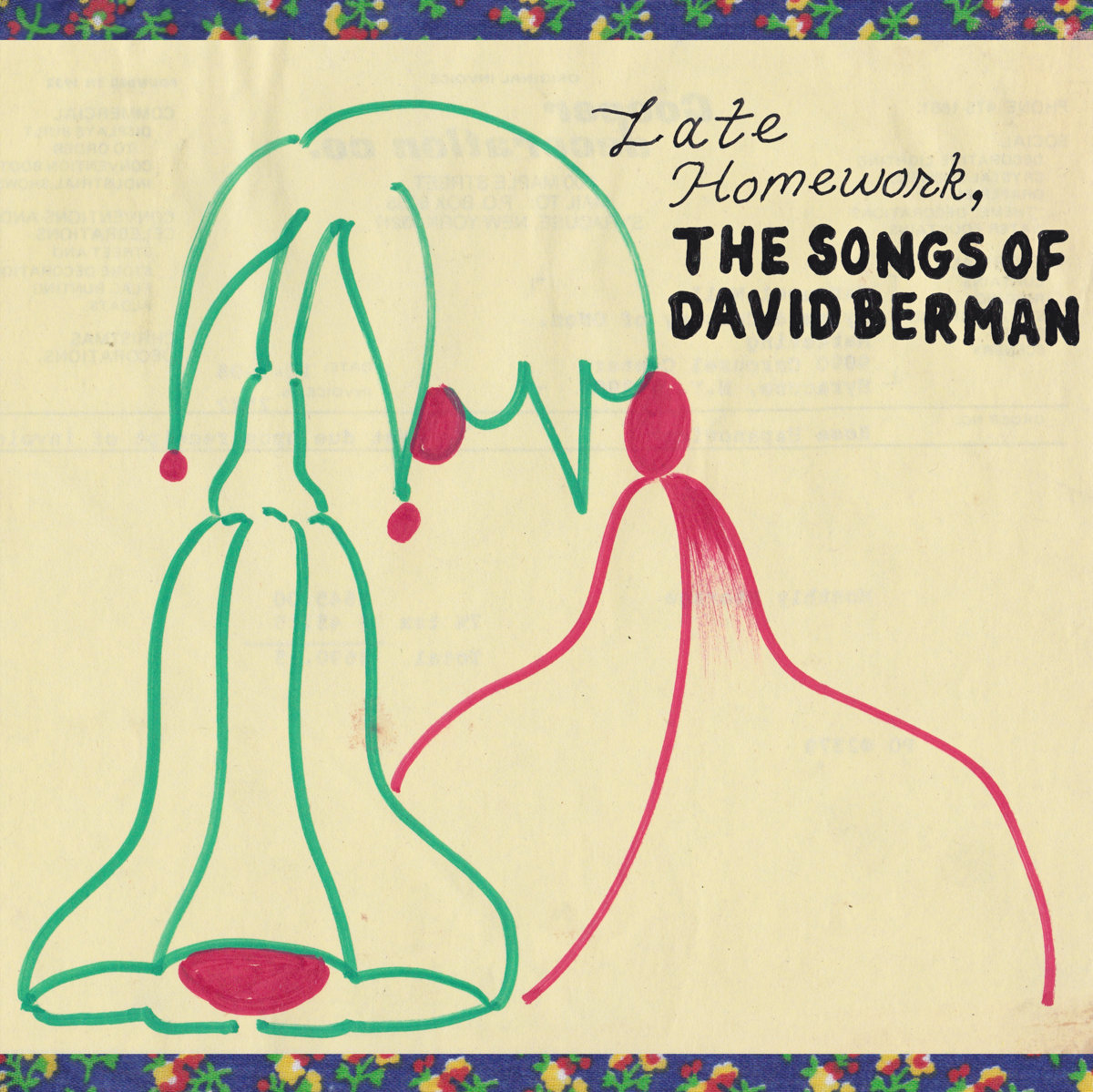
This compilation was put together in tribute to the endless, personalized legacies that David Berman left with his listeners and readers. The very night news of Berman’s passing came out, Sheridan Frances “Francie” Medosch (of the Philadelphia/New York based project Florry) and Aaron Powell (the ‘Fog Lake Guy’) found each other with the same insistence that they had to do whatever they could to help commemorate his incredible life. With help from Michael Cormier’s (Hour, Friendship) Philadelphia based record label, Dear Life Records, Filip Zemčík (founder of the Slovakian cassette label Z Tapes), and a multitude of musicians who took inspiration from Berman, this delightful compilation came together effortlessly.
You can get Late Homework – The Songs of David Berman from the Dear Life RecordsBandcamp page. And if you haven’t listened to Purple Mountains yet, now seems like a good time.
‘Ready Steady Bang’ is the debut album that kicks off with singer and guitarist Angela Martin insisting ‘time and time again, you fail to see my point’. I’m instantly hooked. It’s not even 30 seconds into the entire album when there’s a shimmering synth hook thrown in by Grace Healey. I had to rewind to catch that again. Paula Snow’s bass comes in like something straight from a stomping 70s disco floor; a cut from Donna Summer or (more recently) Gossip. Kerrie Smith on drums is holding it down, keeping it solid then we hit not even a minute into the album and out comes this totally different, wild beat which she then steers effortlessly back into the verse, driving the song on. Like it was nothing.
Ok, so I wasn’t ready, despite the warning of the album title. And don’t worry; I’m not here to give a second by second account of each song, There’s so much packed into just under 30 minutes, it’s truly astounding. We have lurking, creepy psychedelic riffs mixed with spiky lyrics contemplating the birth of consumerism on ‘Shake and Bake’. ‘Sunday Monday’ sparkles and spins; showing off helter skelter riffs comparable to The Like. ‘Electric’ swaggers and saunters; if Elastica had thrown in some disco beats, this would have been the result. Oh, and did I mention that this gem is brought to us by Reckless Yes, who are continually knocking it out the park with every passing release.
This has been Hercury-nominee with the longest gestation period, an early incarnation of Bugeye having been active in the late 90s before the band reformed five years ago. Ten indie-disco-punk nuggets with a post-Britpop feel .
Blending cherry-liqueur lyrics, bubblegum-kneecap bass electrics, goth-heavy drum compactions & hi-rise guitar sculptures, maybe one day all music will sound this good. But for now Bugeye stand alone, Bugeye are a 4 piece band from Croydon. Flying the flag for women in music, they also run a gender balanced music festival called Cro Cro Land in South London. Not content with ‘only’ releasing their debut album, Bugeye also have a podcast ‘Rock, Pop, Rambles’ which sees (hears) them discuss various legends of rock and pop alongside sharing music from more newer, emerging bands.
It’s a powerful slice of disco-punk…’ – Louder ‘Each song just gets better and better’- John Kennedy – Radio X ‘With a sound that’s both retro and remarkably fresh, it’s easy to see why Bugeye have been making waves…’ – Gigslutz ‘dripping in attitude and obstinance, one for fans of the soulful fierceness of Gossip and the craft and meodies of Sleater-Kinney..’ – God is in the TV
Disco-punks Bugeye are teasing their indie debut album with the release of new single Don’t Stop, via independent label Reckless Yes originally released on 28th February 2020.
Fenne Lily is back with a new single, “Berlin,” this new song came out just now alongside this animated video about a man and his umbrella from her forthcoming sophomore album “Breach”, out September 18th via Dead Oceans. Following the release of “Alapathy,” this new single is a gorgeous, meandering stream-of-consciousness that almost feels as if you’re in the room with her. Lucy Dacus and Ali Chant also share shimmering vocals on the track, making it even more transcendent. This song was partly inspired by Patti Smith’s Just Kids, which explains its nostalgia and rosy colour.
“Berlin” by Fenne Lily, from her upcoming album ‘BREACH,’ out September 18th on Dead Oceans Records.
Midnight Manor, the much anticipated sophomore album of the six-piece rock outfit The Nude Party is released via New West Records. This is the good time album of 2020 that has energy, passion and instant pop nuggets. It takes bits of early 70’s Rolling Stones, The Modern Lovers, The Velvet Underground and classic Southern rock, and makes something you can’t help but put on repeat.
Following two years of non-stop touring in support of their eponymous debut release, the band returned to their farmhouse in New York’s Catskill Mountains to record the follow up to their acclaimed 2018 self-titled debut. Like The Band’s sacred home-recording habitat The Big Pink, The Nude Party’s communal dwelling provided the landscape and proximity to focus on deepening their bonds through music. It was at the Manor that the band of childhood friends could shift their energies from the archetypical emotional journeys of mid-twenty-somethings towards rebuilding their road-worn relationships with one another, leading them to write Midnight Manor – an album that lead singer Patton Magee describes as “a stone skipping over troubled waters”. With Midnight Manor, The Nude Party shine a light on their past while at the same time moving towards a brighter future.
We’re excited to announce the new album from The Nude Party, Midnight Manor –– due out October 2nd. The first single from the LP, “Shine Your Light” was released this week .