Posts Tagged ‘Best Albums Of 2017’

mount eerie a crow Top 50 Albums of 2017

Anyone familiar with Mount Eerie is likely to know that songwriter Phil Elverum’s wife, Geneviève Gosselin, died of cancer last July and that the album “A Crow Looked at Me” documents the ongoing aftermath of that loss.

It’s enough to break your heart before you even drop the needle, and that’s kind of the point. After that type of sudden, life-shattering blow, what good could listening to records, jotting down thoughts, or figuring out chords really do? “Ravens”, for instance, finds Elverum a month on after his wife’s death, very certain of the fact that she’s gone and yet still picking her berries and reminding himself of things to tell her when she gets back. In these deeply intimate moments, we doubt that anything will lift his grief and restore the normalcy we all depend upon, and yet the record ultimately acts as a journey that reveals how art can help the soul and heart begin to mend. Through painstaking reflection and unfathomable honesty, Elverum has crafted indie’s answer to Joan Didion’s The Year of Magical Thinking. It’s not beautiful because he shares his pain; it’s beautiful because he shares the hope he finds through his pain.

Essential Tracks: “Ravens”, “Seaweed”, and “Swims”

Fleet Foxes: <i>Crack-Up</i> Review

It was reasonable to think we would never get another Fleet Foxes album.

After the band’s rustic self-titled debut took off unexpectedly in 2008 (eventually earning a Gold record for mega-indie label Sub Pop), frontman and core creative force Robin Pecknold poured himself fully into making its excellent follow-up, 2011’s Helplessness Blues. Then Fleet Foxes toured the world for a while, a process that seemed to take a toll on the band. Pecknold moved to Portland and dropped out of public life. His drummer left the band and became a star in his own right. Other members moved on to their own projects. A couple years ago, Pecknold popped back up as a student at Columbia University, then disappeared again. At some point, he took up surfing, apparently. With the future of Fleet Foxes firmly in his hands, Pecknold seemed ready, willing and able to check out for good.

Thank the heavens he didn’t.  Fleet Foxes third album, “Crack-Up”, is at once sumptuous and ambitious, a serpentine journey from the center of harmony-drenched folk-pop out to the edge of Pecknold’s brain and back. It is lovely, strange and generous, and ultimately a very welcome return for the Seattle band.

On Helplessness Blues, Fleet Foxes pushed back against the successful formula of their debut, expanding their palette and inserting some free-jazz skronk just because they could. Crack-Up, on the other hand, sounds like a band that has become perfectly comfortable with its wanderlust. The evidence comes early, as opening track “I Am All That I Need / Arroyo Seco / Thumbprint Scar” is three songs in one, evolving from yawning anti-tune to orchestral gallop to a collage of cozy vocal ooohs, sloshing water and found sounds.

Later, the band juxtaposes its bracing first single, “Third of May,” with a coda called “Odaigahara” that slowly drips with a sort of submerged desperation. “I Should See Memphis” is built out of insistent acoustic guitar, playful string arrangements and Pecknold’s Civil War and Muhammad Ali references, rumbled below his natural register. And “Mearcstapa” might be the album’s most curious track, with Pecknold singing inscrutable lyrics over restless rhythms and a mishmash of sounds.

These kinds of explorations might’ve sunk a Fleet Foxes album five years ago. Now, they hang together enough to counterbalance Crack-Up’s half-dozen classic, gorgeous gospel-roots hymns; the kinds of songs that have defined this band since it oozed from the gaps in a pile of old Beach Boys, CSNY and Simon & Garfunkel LPs just over a decade ago.

“Third of May” and “Fool’s Errand” and the title track, these are the faster, more urgent ones. The slower, sparser numbers include “Kept Woman” and “If You Need to, Keep Time on Me.” They are all paragons of songcraft, teeming with lush instrumentals, indelible melodies and the kinds of harmonies you expect to hear as you approach the pearly gates. There is perfection here in among the exploration.

Crack-Up is a collective effort, no doubt. These are skilled singers and players, up and down Fleet Foxes lineup. It’s Pecknold, however, who is blessed with not only an incredible songwriting gift, but also the unwillingness to sit still for very long. The latter took him away from music for a while, but perhaps that was necessary to recharge the former. It’s good to have him back.

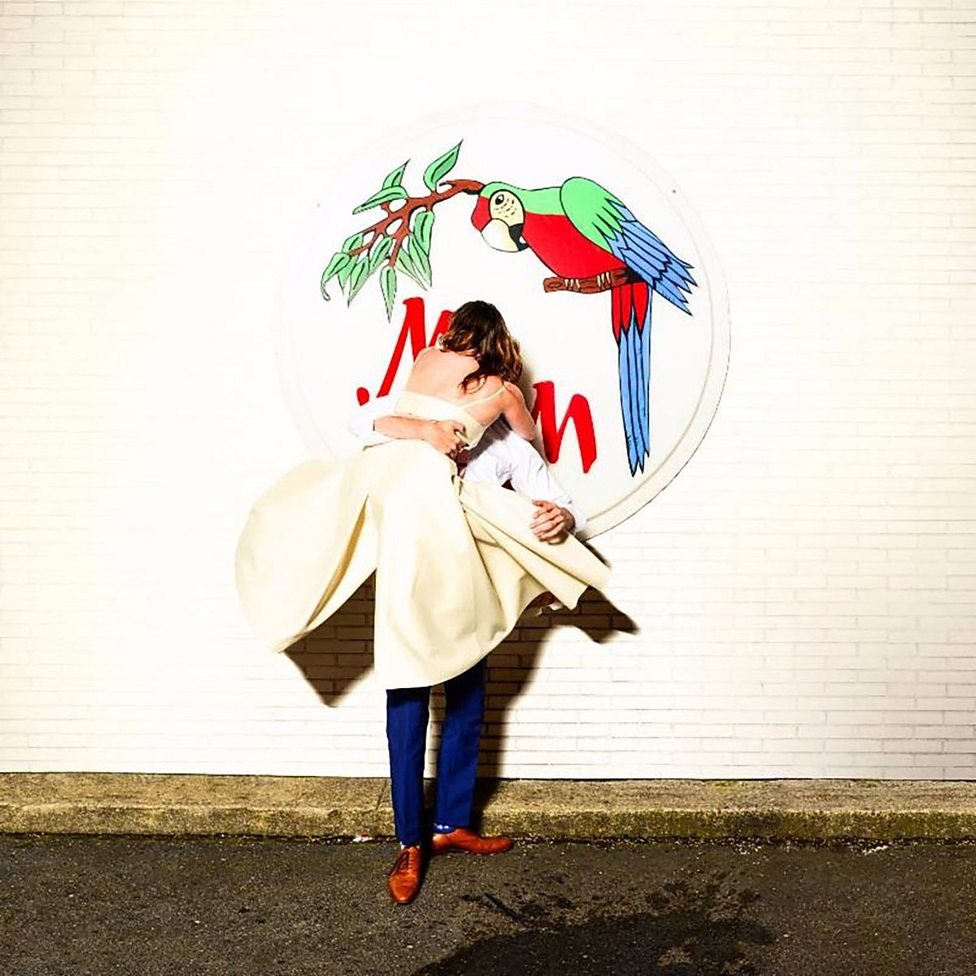
Slowdive 2017 album cover

In 1995 maybe it was not the best time for the shoegaze sounds of Slowdive. Their most obscure record — an instant cult favorite, “Pygmalion”spent none of its time looking at the ground, and all of its 49-minute runtime looking inside an all blue kaleidoscope. It owed more to Brian Eno’s ambient than Brian Jones’ psychedelia, alienating shoegaze fans and quickly becoming a catalyst for the premature end of the band. But trends are a capricious thing and indie pop ended up spending two decades catching up.

Few albums this year sounded as wonderful and complete and thorough as Slowdive. That it’s the first album in 22 years from a band whose moment many thought had come and gone is even more remarkable. Slowdive is deeply connected to their earlier works Souvlaki and Pygmalion, but it also sounds modern, a band that has tracked and absorbed another quarter-century of musical evolution.

The opening sixty seconds of their new self-titled record could easily be confused with a lost Beach House song until two minutes in when Neil Halstead’s voice reappears from hibernation worn and wiser. It wasn’t like he disappeared, he made three solo records and five (!) Mojave 3 records, but 2017 is the time resurrect the output of this cardinal project. Every social media post I saw from the band during their 2014 reunion tour had the tone of humble surprise at the teenagers humming their songs at festivals worldwide.

The premiere track “Slomo” is an almost seven-minute preface to the record. As if 22 years wasn’t long enough, the two-minute intro peaks curiosity before launching into its deliberate extensions of shoegaze, and breezy indie-pop. Breaking into the pre-release teaser “Star Roving”, is a punchy quick five-minute single that feels like two. Most artists tend to mellow out as they age; “Star Roving” is the exception that proves the rule. It’s one of the most dynamic pieces of Slowdive’s career.

The opening duo is well sequenced, playing off of each others energy. “Don’t Know Why” plays at a higher bpm with a floating harmony and a smooth melody, when the full band pushes in.

Slowdive keeps one foot firmly planted in their 90’s heritage but the acquisition of Chris Coady on production is a win . Slowdive shows that their core value is still what it was way back when. The patience to let chord progressions develop and surprise movements have their space, and patience to let simplistic patterns prove strong. The guitar hook on “Sugar For the Pill” is deceptively simple and surprisingly catchy. Halstead’s emotional melody underneath rotates slowly. Ingredients this simple shouldn’t add up to all they do, but the sum is greater than the parts here. “Sugar” plays its clarity and doesn’t over-complicate, Halstead is 15 again writing plain and powerful. Few bands can make the turn from pleasant to intense as quickly and purposefully as Slowdive.

“Everyone Knows” piles on with a noisy collapse, the fifty-four-second outro never loses any steam, just pulsing on, it could have continued for 10 minutes without complaint. “No Longer Making Time” pops into its chorus like it’s going for radio, the guitar piercing like it’s trying to get ahead of the rhythm but never losing synchronicity. The band never falls into self-parody, their noise instincts are too intact from two decades of hibernation. Right when the song sounds like it will kick in for one last chorus, it sputters out, echoing the band’s own faulty trajectory in 1995.

“Go Get It” shows a side of hardness, Its chorus wrecks any beauty remaining from the verse as the multiple guitars continuously assault. “Falling Ashes” proves to be the records only misstep, not quite living up to its cinematic intro. Most of the record’s lyrics are intentionally obscured, but “Falling” has the plainest spoken. Seven songs and 38 minutes probably didn’t seem like enough but leaving the ultimate track off would have been an overall improvement. Or perhaps a moving ambient stretch to hearken back to the underrated Pygmalion.

Whatever band you most hope reunites, you can only hope they do it like Slowdive. Not rushed, not cash-grabbing, but focused on relationships and on furthering the legacy of the band. If anyone asks how to get into Slowdive, the correct answer is still to start with Souvlaki but Slowdive wouldn’t be a bad second choice

Image may contain: 1 person, on stage

Life out on the lonely road It’s a tale that many musicians sing about, longing for a day they can actually come home from touring around the world, meeting faceless fans and playing show after show. It can get lonesome on tour, and yet, somehow, they can’t shed their vagabond ways.

But that’s not the case for Courtney Marie Andrews, who had toured in other people’s bands for a decade before taking a break to bartend in a small Washington town these past few years. Pushing pause on non-stop touring allowed her to sit back and re-evaluate, sparking the thesis for the album “Honest Life” via Fat Possum Records, with a pressing of the deluxe edition. At 16, Andrews left her Arizona home to become transient, playing and busking in bars and cafes around the country. She continued on as a session singer and touring musician for nearly 40 artists, from Jimmy Eat World to Damien Jurado.
http:/https://www.youtube.com/watch?v=4xz6nOLSF7I

Her work took her all around the world, but at some point, she realized she’d lost touch with reality.“You can start to just stop calling people or stop keeping up with the people that you know and love,” Andrews said, calling from an unseasonably warm Seattle. “All of a sudden it’s been three years and you haven’t seen them.”In Washington, Andrews made connections again, getting to know people at the bar and laying down tracks for Honest Life with a trusted group of musicians. Together, the band sounds like home. Drums chug away at moderate paces, piano glitters organically over top and the guitars are cozy. In the final track, she even added a somber arrangement of strings, gifted by her friend Andrew Joslyn.
Over the majority of the album, a pedal steel guitar drifts lazily under the melody, tangling with Andrews’ voice. With her Emmylou Harris-like pipes and the pedal steel, the album is what some people have called “country.”“When I went in to make Honest Life, I didn’t think, ‘Oh, I’m making a country record,’” Andrews said. “It’s more about creating a timeless sound. Something that can be released now or in the ’60s or whenever… I take pleasure in being a songwriter and creating a record that’s hard to place where it’s from.”

http://

Honest Life is technically her sixth album, although she’s kept the first three for herself. It’s her first LP on a label. The album has made several best-of-lists, The accolades couldn’t have come at a better time, she said, when she was wiser about the industry and had gotten some time to grow.

Some people get lucky and their first record is just like a masterpiece fully formed, but that was definitely not me,” Andrews said. “I feel like I’ve really come into my own as a songwriter in the past few years. … I’m glad [the recognition] happened now when I’m a good songwriter, rather than when I was young.”To improve her craft, Andrews studied up on the greats—Neil Young, Bob Dylan, etc.—and in turn, she gained notice from other impressive songwriters, like Ryan Adams and Jurado. With practice and careful observation of legends and her contemporaries, she perfected the “tasteful way of revealing things” in her music.“When I was younger, I would write a song and I would reveal things in every single line, and that was the problem,” Andrews said. “We don’t need to know all that. The listener is overwhelmed. It’s like when you’re at a bar and somebody’s telling you their life story and you’re like, ‘Whoa, calm down.’”

https://www.youtube.com/watch?v=_cv0ATLNDJQ

Andrews’ songwriting is more subtle now, but not cryptic. The first track, “Rookie Dreaming,” reflects on her troubadour life and the missteps of what Andrews calls “blind youth.”

“I was moving too fast to see / All the paintings in Paris or sunrise in Barcelona / I was too broke too shallow to dive deep / Too busy carrying the weight of everything,” Andrews sings, her voice rife with mild vibrato, swooping with a twang that’s not Southern, but something unique altogether. She punches syllables that condemn her apathetic lifestyle—“TOO broke, TOO shallow”— while letting other verses flow freely, warm with harmony.

While she criticizes herself in “Rookie Dreaming,” she turns her perspective to address a meek friend in “Irene.” She sings directly to the title character, a pseudonym for the real-life subject, delivering the type of constructive criticism you might not have the guts to give to a friend’s face.

“Gain some confidence, Irene / If you speak let your voice ring out / But keep your grace, Irene / Don’t go falling in love with yourself,” she sings. An organ warbles as Andrews delivers her sermon.

“‘Irene’ was originally written for a friend, but I feel like probably every growing, youthful woman has felt like Irene at one point or the other,” Andrews said. “Every woman who’s amazing but doesn’t really know it yet. We feel like all these magazines and articles that are saying, ‘No, we’re not good enough’ … It’s sort of realizing that that’s total bullshit and you are awesome and you just have to know it.”

Not only did Andrews take care of all the songwriting on Honest Life, but she was the sole producer on the album—essential for keeping control in the studio.

“With this record, I knew so clearly what I wanted that I didn’t want distractions or arguments,” Andrews said. “One person sees it one way, one person sees it another way. Sometimes it makes a great record, but for Honest Life, I just wanted the sort of clear, easy, raw and realness. And that’s what we did.”

As for settling down and slinging drinks, Andrews knew that wouldn’t last forever. She said she’s always going to travel in the name of music. But this time, she’s not going to be singing anyone else’s songs. She’s at center stage now, and she’s ready to brave the lonely road once more.

“A lot of Honest Life was realizing that I didn’t want to tour as a backup singer anymore,” Andrews said. “If was going to be on the road, it was going to be for me, for my songs, for the dreams that I’ve always had as a teenager and as a young adult. Bartending is not my career path. Music is everything.”

Image may contain: one or more people and people playing musical instruments

Near the end of last year, King Gizzard & the Lizard Wizard promised they’d release five albums by the end of 2017. As we creep closer to the end of this year, the Aussie psych outfit have thus far shared three: Flying Microtonal Banana, Murder of the Universe, and Sketches of Brunswick East (with Mild High Club). They’ll bring the tally up to four this week with the release of their latest full-length effort, Polygondwanaland.

Lead single ‘Crumbling Castle‘ opens the immersively brilliant POLYGONDWANALAND. It’s a mystical, slow-building psych-blues epic. The song sets a fine precedent for an album that listens like a cleverly constructed amalgamation other King Gizzard releases. The 60’s pop relaxation of 2015’s Paper Mache Dream Balloonthe jazzy time signatures of 2017’s Sketches of Brunswick Eastthe trackless rhythmic relentlessness of 2016’s Nonagon Infinitythe microtonal, ancient conjurings of (also) 2017’s Flying Microtonal Bananaand the lyrical stories and themes so strongly present in (also, also) 2017’s Murder of the UniverseThese guys have so richly explored and stretched the boundaries of their own musical and thematic universe that it’s nearly impossible for all their new stuff not to be entirely self-referential. King Gizzard can only sound like King Gizzard, and that’s a really, really awesome thing.

The album’s eponymous second track cruises upliftingly along on the burbling surface that is Gizz’s ever-deepening rivers of intertwining concept-driven song themes and stories. It opens in to the mouth of a swirling ocean, pulsing synth and clever guitar picking that spreads itself across the expansive and catchy ‘The Castle in The Air‘ and ‘Deserted Dunes Welcome Weary Feet‘. These back-to-back tracks will swallow you up in them. Gizzard front man Stu Mackenzie delivers slightly tense, staccato vocals over a somber bass and synth combination.

A hugely 80’s synth warble that’d be at home in the middle of the Stranger Things intro opens ‘Loyalty‘ and ‘Horology‘; a back-to-back psych trip that skips along with whimsical aplomb. Mackenzie unleashes the exceptionally capable flautist within him, making sure Gizz’s trademark of deft musical ability.

Lucas Skinner’s trademark bass wanderings really come to the jazzy surface, then guitarist Joey does some more Mongolian throat singing, then there’s what I believe is a sitar for a bit, and then ‘Tetrachromacy‘ seamlessly begins, Eric and Michael begin to really warm up on the drums, and we change gears once more… goodness gracious. Always on the hunt for new horizons both thematically and musically, Gizz employ that desire and curiosity here more so than any other track on POLYGONDWANALAND. We get our first – and very minimal – taste of Ambrose Smith’s mouth organ skills, dashes of cross-album hook repetition and recycling, more glass/ tubular bells, a lyrical querying of undiscovered colours near blue, flute throughout, and some seriously swift rolls and fills from the beguilingly synchronized actions of dual-percussionists Michael Cavanagh and Eric Moore (who also runs Flightless Records while seamlessly doing tandem drumming across some seriously complicated musical structures .

The album expansively closes with the hypnotic and polysyllabic wanderings of ‘Searching‘; heavily 60’s stoner psych journey in to introspection, and finally ‘The Fourth Colour‘; a staggeringly large and complicated song that both drifts and turns corners.  It’s a rollicking album closer.  Just put POLYGONDWANALAND on repeat and keep discovering.

If King Gizzard and the Lizard didn’t release another LP for a decade, their musical output within this year alone would still eclipse most (if not all) multi-millionaire, studio-backed, advertising-funded, marketing-think-tanked pop-star’s album releases by a wide margin. And they did it in their own houses, with their own equipment, under their own record label, while touring the world to sold out shows, running their own music festival, making half a dozen film clips, and personally sending you the merch and records from each release to save on overheads.

Tracklist:

0:00 – Crumbling Castle 10:44 – Polygondwanaland 14:16 – The Castle In The Air 17:04 – Deserted Dunes Welcome Weary Feet 20:38 – Inner Cell 24:35 – Loyalty 28:13 – Horology 31:06 – Tetrachromacy 34:36 – Searching… 37:40 – The Fourth Colour

Acclaimed US electro pop duo Sylvan Esso bought out their warmly received second LP “What Now” out this year .  For quite some time this blog-hyped, neon-synth deploying duo from North Carolina have been in the peripheral vision of the cool kidz’s vision.

The North Carolina folk-meets-electro duo return with a bigger, bolder take on their sound with What Now? While the instrumentals are as euphoric as ever, the album also reflects the troubled and anxious environment in which it was created.

“I think we definitely write music about exactly how we’re feeling at any given moment. When I listen to it, I hear how anxious we were and I also hear how joyous we were. I hear the claustrophobia in the production of what we were working with, and even lyrically, I think I hear us looking around for meaning…” – Nick Sanborn says on the origins of the album’s title, selected in the wake of Donald Trump’s election.

They write bedroom-pop (or is it on-the-go commuter headphone pop?)

Comprising of vocalist Amelia Meath from acclaimed indie folk outfit Mountain Man and producer Nick Sanborn, the pair issued debut LP Sylvan Esso to sizeable praise in May 2014, scoring widespread acclaim and a place on the US Top 40 Album Chart. 
Signed to Loma Vista Recordings “What Now” received similar praise,The LPs lead single Die Young has scored almost a million YouTube views and a recent BBC 6 Music session for Lauren Laverne has spread word of group’s beguiling electro-pop .

Arguably the most overtly political act on the folk-rock scene right now, we suspected this new album from Alynda Lee Segarra and co would be a bit of a call to arms. Indeed, it is, and it delivers. “The Navigator” is the sixth full-length studio album by Hurray for the Riff Raff, released by ATO Records last March 2017. The album was produced by Paul Butler, a member of the band The Bees. This powerful album has musical diversity, consistent quality and gripping songwriting all while feeling effortless,

“The question of identity is touched upon throughout the songs here (national, political, gender), but in terms of musical identity, Hurray for the Riff Raff know exactly who they are.

http://

The newly shorn Oh Sees waste no time in racing headlong into nightmarish battle with the mighty ORC, and wouldn’t ya know it, they’ve clawed even farther up the ghastly peak last year’s A Weird Exits stormed so satisfyingly. The band is in tour-greased, anvil on a balance beam, gut-pleasingly heavy form, nimbly braining with equal dashes of abandon and menace on this fresh batch of bruisers and brooders, hypnotically stirred into to the cauldron of chaos you’ve come to expect from, ahem, Oh Sees. Fresh blood Paul Quattrone joins Dan Rincon to form a phalanx of interlocking double drums, alternately propelling and fleet footing shifting ground to pinion Dwyer’s cliff-face guitars to the boogie. Tim Hellman keeps it swinging like a battle-axe to the eyebrows.

http://

The tunes veer towards the violence of their live shows, with a few tasty swerves into other lanes…heavy to lush, groovy to stately…throughout it remains sinister in its swaggering skulk, manic in its fuzz-fried fugues…they hit all the sweet spots the heads foggily remember, and there’s plenty to sweat over if you just hopped into the sauna. Ew. More evil….more complex…more narcotic…more screech….more roar….more whisper…there’s even more Brigid. Less “Thee”, but more of everything else, it’s out on Castle Face Records

Directed and animated by Alex Theodoropulos. “Nite Expo” appears on Orc, by Oh Sees, out on Castle Face Records now.

The Week in Music: Paste's Favorite Albums, Songs, Performances and More

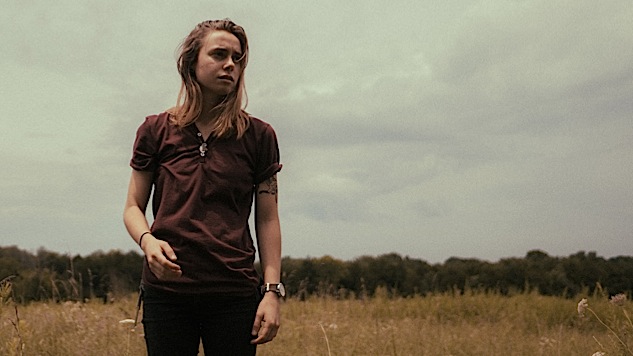
It’s impossible to assess Julien Baker’s sophomore effort, Turn Out the Lights, without acknowledging the considerable shadow of its its predecessor, Sprained Ankle. released two years ago, the debut snuck up on all but a handful of people. Turn Out the Lights hopefully will sneak up on no one. It sounds lush and meticulously made. Sprained Ankle was stripped to the bone, sonically speaking, but its followup features lots of keyboards, plus string sections, vocal harmonies and more atmosphere.

From the new album ‘Turn Out the Lights’ out October 27th on Matador Records.

Semper Femina

This past year has brought on a new wave of feminism, and with it, the most strikingly feminine album I have heard. At 27 years of age, by U.K. singer-songwriter Laura Marling who has crafted a collection of intimate, emotionally rich songs that seek to explore the female gaze turned on itself. Semper Femina which is Latin for “always woman”..

This is Marling’s conscious edit of a cautionary phrase from Virgil’s Aeneid: Varium et mutabile semper femina. (“Woman is ever a fickle and changeable thing.”) In fact, it is precisely the mutability and complexity of women, in our relationships to each other and to the world around us, that Marling celebrates within these nine vignettes. From the darkly sensual album opener, “Soothing,” which banishes with love an unwelcome lover, to the coda, “Nothing Not Nearly,” which concludes “nothing matters more than love,” she gets to the heart of the beautifully multifaceted nature of women — and, indeed, of Laura Marling herself. Personally, I am deeply grateful to her for the gift of this panoramic view of ourselves: We need soothing. We can take away your pain. We need beauty. We cry sometimes. We sing. We put up a fight. We need to be free. We love you. We are the muse, but also the artist. We were wild once, and must remember. Semper Femina.

The characters in Marling’s songs feel like real people—often restless, frequently viewed from afar and almost uniformly mysterious in their motivations. Despite all her growth over the past decade—which has included adding a soulful bounce to her occasionally brittle hooks and orchestral heft to her simpler arrangements—Marling remains at heart a folksinger who uses the foundational elements of songcraft to express abiding truths. And like any great folk singer, she has created an album of songs whose sounds and sentiments are much weightier than they might appear.