Jimi Hendrix At Woodstock

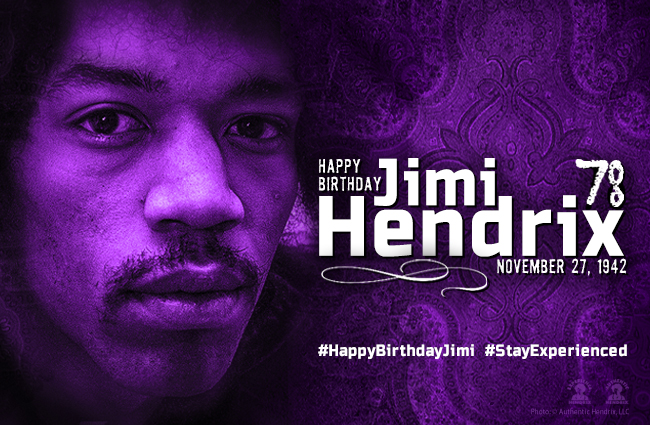
Today would have been the 78th birthday of the great Jimi Hendrix. Born James Marshall Hendrix on November 27th, 1942, the guitar god rose to fame for his insane guitar playing abilities during the British blues revival period of the mid-1960s. Hendrix was a powerhouse musical entity, commanding attention with his unique style like never before. He redefined the instrument, and what it meant to perform with it.

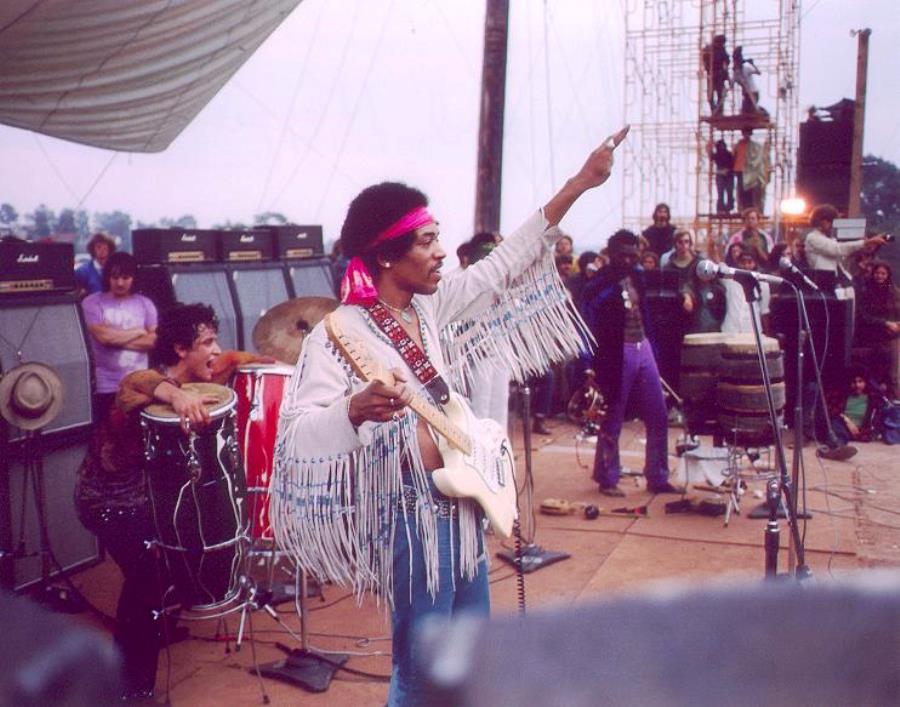
Though Hendrix only lived until the age of 27, his influence on music has been enormous ever since. His work with the Jimi Hendrix Experience was second to none, and perhaps no performance captures the essence of his abilities better than his apperance at Woodstock. Though it may not have been his best show of all time, Jimi Hendrix took the stage at 9AM on August 18th, 1969, launching into otherworldly versions of well known jams like “Fire,” “Izabella” and the famed “Star Spangled Banner.”

Few performances in the history of rock ‘n’ roll are more iconic than when Jimi Hendrix cemented his legendary status and delivered the show of his career on the biggest stage of them all, a moment when the mercurial artist headlined the inaugural Woodstock Festival in 1969.

The whole weekend was a watershed moment for music, but one specific part was the most poignant of all. As the subversive edge of America’s youth descended upon a small town, with fear of crime and panic sweeping the outer limits, Hendrix paid tribute to his country. One of the most enigmatic performances of the weekend came when Hendrix rolled out an unexpected, distorted rendition of the US national anthem. The performance was considered as an offensive moment and it sent a ripple through America and when he appeared on the Dick Cavett show some months after his headline show — he had to answer why he made this statement on such a grand stage.

Hendrix cunningly decided to use the music’s own bombastic nature to project the violence carried out under his nation’s flag. He managed to do this by holding a keynote longer than he usually would and also applied a little more pressure to his Stratocaster’s tremolo bar which then created an unsettling effect. With a guitar in his hands, he was more effective than his words could ever be. He then stopped playing the song in its original form and just turned the lyrics about bombs bursting in air and rockets lighting up the night into music.

This was Hendrix’s way of kicking back at the idea of military power being the only thing that is great about America and, through the use of just his instrument, he managed to evoke the opposite feeling of what the anthem was intended to cause and is one of the great political statements in the music history.

“I don’t know, man,” Hendrix said on his decision to play the track before adding, “I’m an American, so I played it. They made me sing it in school, so it was a flashback.” Cavett then pointed out that Hendrix is likely to find himself on the receiving end of a barrage of hate mail because of his decision to cover the national anthem in an unorthodox manner, to which Hendrix proudly stated, “It’s not unorthodox, I thought it was beautiful.” Cavett would later reflect on the interview years later and said that he should have supported Hendrix’s version rather than opening him up for criticism: “I suppose I could have added that since we somehow acquired the most dismal, virtually unsingable dirge of a national anthem of any known nation, we should decorate Hendrix for turning it into music.”

The band was scheduled as the last performance of the festival, Sunday night. Due to several delays, they eventually played on Monday morning, 9:00 am, when most of the audience had already left.

Hendrix’s performance at Woodstock came at a major transition point in his life since the Jimi Hendrix Experience disbanded earlier that summer. He took to the stage with his newly formed band Gypsy Sun and Rainbows, a.k.a. a Band of Gypsys — consisting of Experience drummer Mitch Mitchell, bassist Billy Cox, guitarist Larry Lee and percussionists Juma Sultan and Jerry Velez.

The irony about the legendary performance is that few people actually saw it in person since so many fans had fled the upstate New York farm by that point. He went on late because he wanted to be the final act, not realizing that would mean playing on Monday morning to a virtually empty audience. The crowd had gone from “half a million strong” to a handful of diehard fans sitting in a giant ocean of garbage.

1. Hendrix performed with a temporary band. The Jimi Hendrix Experience, with which he had recorded three smash albums and electrified crowds at the Monterey Pop Festival two summers before, had broken up. Hendrix assembled a group he called Gypsy Suns and Rainbows, which included two musicians he had played with at the start of his career on the Chitlin’ Circuit in Nashville: bassist Billy Cox and guitarist Larry Lee. Neither had ever performed in front of a large crowd before. Drummer Mitch Mitchell, who was part of the Experience, and two percussionists rounded out the band, one of the largest Hendrix ever appeared with. The group performed just twice more before disbanding.

2. It was the only Hendrix band that included a second guitarist. Larry Lee backed up Hendrix on a number of songs, played some lead on Jam Back at the House, and contributed several lead choruses to the 12-bar blues Red House. He played some lead on both Voodoo Child (slight return) and Spanish Castle Magic and sang lead on two numbers. Lee’s solo guitar work accounts for much of the footage of the Hendrix Woodstock set that has never been made public. In fact, no recordings, audio or visual, have ever been officially released of Lee’s two featured numbers: Mastermind and a medley of Gypsy Woman and Aware of Love.

3. It was the only major performance that Hendrix gave in the morning. By 1969, Hendrix was a major star who had earned the traditional headliner’s position: playing last. Technical and weather delays caused the festival to stretch into Monday morning. The organizers had given Hendrix the opportunity to go on at midnight, but he opted to be the closer. One benefit of the delay: the morning light made for excellent filming conditions, which may be part of the reason this particular Hendrix performance is so well known.

4. Hendrix did not perform for half a million people. In fact, when he took to the stage at 9 a.m., the crowd, which once numbered 500,000, had dwindled to fewer than 200,000–perhaps considerably fewer. With the demands of work and school weighing on them, many of those fans waited just long enough to see Hendrix begin his set, and then departed themselves.

5. The Woodstock performance had the potential to be a disaster for Hendrix. Recordings made at the house in upstate New York where Hendrix and the Gypsy Suns and Rainbows rehearsed and of a performance they gave at the Tinker Street Cinema in Woodstock show that the band “simply could not play well together,” Brattin says. “After listening to those tapes, you would not have guessed that the Woodstock performance would be so good. The credit has to go to Jimi and the strength of his onstage presence.”

6. Woodstock was a time of transition for Hendrix. He had left behind one long-term band and not yet formed another. He was beginning a period of musical experimentation that was risky from a commercial perspective. While the Experience was dominated by white musicians (both his bandmates were white Englishmen), he was now appearing with more black performers (bassist Cox, guitarist Lee, and percussionist Juma Sultan were all African American). It is interesting, Brattin notes, that while so much of the Woodstock set pointed to Hendrix’s future, the performance also included songs that harked back to his beginnings. In particular, two of the songs Lee sang, Gypsy Woman and Aware of Love, were written or co-written by Curtis Mayfield, with whom Hendrix had performed within the early 1960s. It was the only Hendrix concert that included these songs.

7. The Star-Spangled Banner was not played on its own. It was part of a medley lasting over half an hour, one of the longest such medleys. The medley also included hits like Voodoo Child (slight return) and Purple Haze, and an unaccompanied improvisation lasting nearly five minutes. Hendrix performed the national anthem as a solo in the midst of this medley.

8. It was not the first time Hendrix had performed the Star Bangled Banner–by a long shot. In fact, there are nearly 50 live recordings of Hendrix playing the national anthem, 28 made before Woodstock. They range from about a minute to more than six minutes; the Woodstock version was three minutes and 46 seconds. It was among the best, Brattin says. “And, certainly, no other version is so iconic.”

9. Hendrix performed an encore, a rarity. He almost never performed encores, but at Woodstock, despite the vanishing crowd, he did. On recordings, he can be heard considering Valleys of Neptune, which he never performed publicly, before or after Woodstock. He opted, instead, for Hey Joe, his first hit song.

10. Hendrix was not supposed to close Woodstock. Steeped in childhood memories of the song, Woodstock organizer Michael Lang wanted Roy Rogers to come on after Hendrix and play Happy Trails. The cowboy crooner declined.

Setlist :0:01 (message to love) 7:38 (spanish castle magic) 14:29 (red house) 19:56 (lover man) 24:50 (foxey lady) 29:30 (jam back at the house) 37:28 (izabella) 42:48 (fire) 46:10 (voodoo child) 58:28 (star spangled banner) 01:02:11 (purple haze) 01:05:39 (woodstock improvisation/villanova junction blues) 01:13:15 (hey joe)

In honour of Jimi Hendrix’s 78th today, check out a full video from his Woodstock performance
In 2002 and 2003, following the release of his album UP, Peter Gabriel went on the road with his Growing Up tour, once again collaborating with production designer Robert Lepage to create a spectacular and theatrical live experience. The tour took in thirty-two cities across the USA, Canada and Europe and this concert performance was recorded over two nights at the Filaforum in Milan in May 2003, with Peter Gabriel and the band performing in the round at the centre of the arena.

A concert film capturing the live show was released in late 2003, but Growing Up Live has never been a stand alone audio release, until now. It was the beginning of 2002 that we decided to go out on the road. I hadn’t been out for 10 years so it was going to be interesting to see if there were any fans still out there, if we could sell any tickets and how it would all work on-stage.

The fourth, and last, of this autumn’s series of live LP releases, “Growing Up Live”, is released today. Like Live In Athens 1987 and Secret World Live, this is the first time on vinyl for Growing Up Live, but this concert is presented as a 3LP set in a gatefold sleeve and full colour printed inner bags. The LP has been Half-Speed Remastered and cut to lacquers at 33RPM by Matt Colton at Alchemy Mastering and comes with a hi-res audio download code (24bit or 16bit).

“It was the beginning of 2002 that we decided to go out on the road. I hadn’t been out for 10 years so it was going to be interesting to see if there were any fans still out there and how it would all work on-stage. Last time [Secret World tour] we had two stages, a male stage and a female stage, and they were representing different things, urban, rural and this time we have moved the axis vertically, and it’s a sky stage and an earth stage. The album title had been UP, so there was a certain logic to this vertical translation onto the stage.” – pg

The touring band you will hear on this recording consists of Ged Lynch (drums), Tony Levin (bass, vocals), David Rhodes (guitar, vocals), Richard Evans (guitar, mandolin, whistle, vocals), Rachel Z (keyboards, vocals), Melanie Gabriel (vocals) and Peter Gabriel (vocals, keyboards).

“The band is a mixture of old and new. In the tried and tested friend department there’s David Rhodes on guitar who I’ve played with for many years, since his band Random Hold supported me on a tour way back. He began life as a sculptor, never wanted to be a professional musician, but sort of fell into it.

Tony Levin, who’s on bass, was actually on the first record that I did after I left Genesis. He’s the longest serving member, but obviously he does so many other things on his own, with King Crimson and many other people over the years. I think he is one of the most respected bass players in the world, so I feel very lucky that he is always out with me.

Rachel Z who is a very able keyboard player. She is better known in the jazz world but has been developing her own sort of rock stuff and has just put out an album of Joni Mitchell covers too. She’s very good. She’s also the daughter of an opera singer and has a very useful set of pipes on her as well.

I’ve worked in the studio with Richard Evans many times, but this is the first time live. He plays numerous instrument; mandolin, flutes, whistles, guitar. So that’s fun.

The drummer Ged Lynch. When we were making the album, Manu (Katché) was away on tour for some of the time so Ged came in. Manu’s a brilliant player but he is quite a decorator in some ways so it’s always beautifully and very musically done. Ged, on the other hand, sits in this tight box and there’s this sort of powerhouse driving things forward. It felt good for me to try and make the band focus more direct this time out. Ged is also a great percussionist and did a lot of percussion on the record as well.

Then, my daughter Melanie is out with me singing, and that’s a real pleasure for Dad.”

“Growing Up Live” – on vinyl for the first time – chronicles a Peter Gabriel performance from May 2003. Featuring PG with Ged Lynch, Tony Levin, David Rhodes, Richard Evans, Rachel Z, Melanie Gabriel and special guest appearances by The Blind Boys of Alabama, Sevara Nazarkhan, Dr Hukwe Zawose and Charles Zawose (plus the voice of Nusrat Fateh Ali Khan). Triple vinyl in gatefold sleeve with printed inners. Half-speed remastered and cut to lacquers at 33RPM, across 2x heavyweight LPs. Vinyl cut by Matt Colton at Alchemy Mastering, mastered by Tony Cousins at Metropolis and overseen by Peter’s main sound engineer Richard Chappell. 

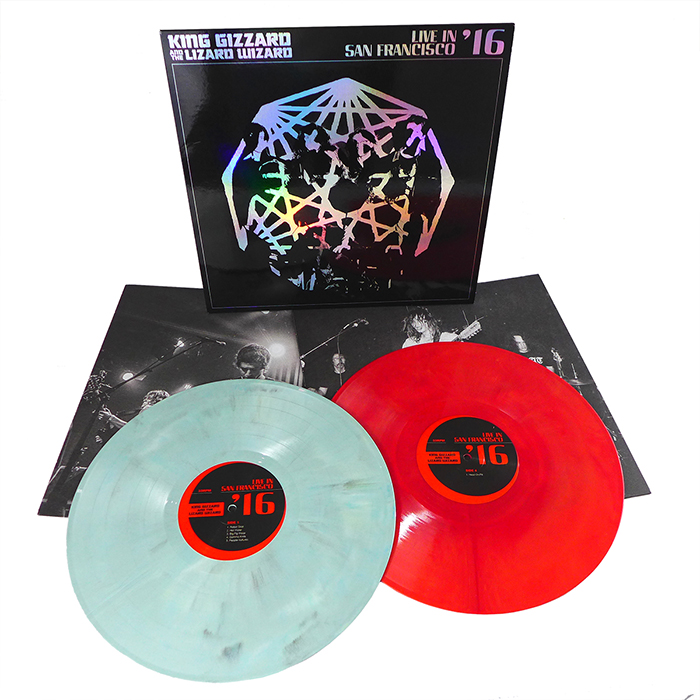
King Gizzard & The Lizard Wizard – ‘Live in San Francisco ‘16’ limited deluxe double golden gate sunburst and bay fog vinyl LP with rainbow foil wide-spine jacket and packaged in a recycled brown paper bag.

King Gizzard recently made multiple announcements including their first studio album of 2020, Along with the announcement was the new single “Automation” The single release saw the band give full access to fans by providing a bunch of film and audio assets to make your own remix and clip.

 King Gizzard & The Lizard Wizard gave fans a preview of their upcoming “Live in San Francisco ’16″ release with a video of “Evil Death Roll”. The live 13-track, double album is set to arrive on November 20th via ATO Records along with a full concert film. Coming in as the band’s second official live release of 2020, behind April’s Chunky Shrapnel, it helps pad the stats on what has been a—comparatively—light year for the Australian-bred psych rockers. This year saw no studio releases from the group that usually puts out multiple a year, with King Gizzard largely exploring their archives with live releases—many of which the band used as fundraising initiatives for various causes.

In this black-and-white clip shot at The Independent, King Gizzard & The Lizard Wizard come in hot straight out of the gate with the song’s pounding rhythm. With Stu Mackenzie jumping around like a madman from the very start, one wonders how they can keep this up for the whole song—let alone an entire concert.

The answer comes with an instrumental breakdown in the middle of the tune, where the band is able to catch its breath and slow things down a bit. Meanwhile, repeated wah wah pedal-infused phrasings coming from somewhere in the trio of guitars featuring Joey Walker and Cook Craig in addition to Mackenzie. The style shifts around during the instrumental portion, as Walker’s harmonic-led lead brings the drums down and eventually to a full stop. As drummer Michael Cavanagh gently revives the rhythm, it abruptly turns into a fever pitch as the band comes back in at full velocity, and before you know it Stu is holding his guitar up to the mic to create hectic feedback. In short, this performance is raw energy for 7:31 minutes straight.

Just under a month after delivering their award-winning 2016 album Nonagon Infinity, King Gizzard & The Lizard Wizard took the stage at San Francisco’s The Independent for a set both wildly frenetic and meticulously executed. In one of their final club gigs before bursting onto the international scene—soon selling out amphitheaters and headlining festivals—the Melbourne septet laid down a breakneck performance that, in the words of SF Weekly, “made every organ ache just right.” Newly unearthed by ATO Records, Live in San Francisco ’16 captures an extraordinary moment in the band’s increasingly storied history, a 13-song spectacular likely to leave every listener awestruck and adrenalized.

Multi-tracked and impeccably mixed, Live in San Francisco ’16 simultaneously channels the massive energy of King Gizzard & The Lizard Wizard’s set while echoing the sweaty intimacy of the 500-capacity venue. Like Nonagon Infinity—the band’s eighth full-length and worldwide breakthrough—Live in San Francisco ’16 kicks off with “Robot Stop,” an immediately transportive track built on blistering riffs and bombastic rhythms. Reaching its majestic climax with a 22-minute rendition of fan favourite “Head On/Pill” (from 2013’s Float Along – Fill Your Lungs), the album rushes forward with a furious intensity as the band tears through the entire set without ever breaking—a feat that induces a sort of joyful delirium in anyone who bears witness.

With nearly half the setlist made up of Nonagon Infinity tracks, Live in San Francisco ’16 unfolds with the same exquisitely controlled chaos King Gizzard & The Lizard Wizard brought to that arguable masterpiece—a nine-song body of work crafted as the world’s first infinitely looping LP (i.e., each track flowing seamlessly into the next, with the album-closing “Road Train” linking straight back into the opener). “2016 was peak tightness for Gizz,” notes frontman Stu Mackenzie. “Around this time we were really into tightly composed sets, and the show was like one long song—everything linked, everything planned. We threw that idea out the window later on, but this live record is a great document of that moment in our collective psyche.”

An unequivocal turning point for King Gizzard & The Lizard Wizard, Nonagon Infinity arrived in April 2016 and drew major critical acclaim, with NPR hailing it as “masterfully bizarro” and Pitchfork stating that the album “yields some of the most outrageous, exhilarating rock ‘n’ roll in recent memory.” Not only a critical success, Nonagon Infinity won Best Hard Rock/Heavy Metal album at the 2016 ARIA Music Awards, while eternally zeitgeisty director Edgar Wright named it among his favourite records of all time. Two years in the making, the album marked a drastic departure from the folk-and-Tropicalia-tinged psych-pop of its 2015 predecessor Paper Mache Dream Balloon, with the band taking a bold creative leap in its structure. “I wanted to have an album where all these riffs and grooves just kept coming in and out the whole time, so a song wasn’t just a song, it was part of a loop, part of this whole experience where it feels like it doesn’t end and doesn’t need to end,” Mackenzie explained back in 2016. When replicated live, that effect is doubly mesmerizing, as frenzied and transcendent as a glorious fever dream.

The vinyl product will be available in 2 formats;
1) The deluxe double LP on “Golden Gate Sunburst” & “Bay Fog” coloured vinyl with rainbow foil wide-spine jacket, printed on recycled board. Custom inner-sleeves, printed on recycled board. The product will be packaged in recycled brown paper bag in lieu of plastic shrink wrap
2) The standard double LP on recycled, randomly coloured, eco-wax vinyl with wide-spine jacket and custom inner-sleeves printed on recycled board. The product will be packaged in recycled brown paper bag in lieu of plastic shrink wrap

Live In San Francisco 16′ Double Disc. Glow in the dark embossed sleeve.
Both out everywhere November 20th

The Perth-based psych/Krautrock group Mt. Mountain are today announcing their fourth full-length, ‘Centre’, and sharing the first single, ‘Aplomb’. Their first release on Fuzz Club, the incoming album is due for release on vinyl, CD and tape on February 26th 2021. Australian five-piece Mt. Mountain are today announcing their fourth album, ‘Centre’, and sharing the first single ‘Aplomb’. Taking cues from Krautrock pioneers like Neu! and Can whilst existing in a similar world to contemporaries like Moon Duo, Kikagaku Moyo and Minami Deutsch, Mt. Mountain are formidable torchbearers of the minimal-is-maximal tradition. Out today, ‘Aplomb’ was one of the first songs written for the album and marked a conscious shift of focus towards more rhythmic patterns within their music. Stephan Bailey (vocals/organs/flute) reflects on the song: “‘Aplomb’ is essentially the voice that I hear in my head, reminding me to not rush and slow down, and to have the confidence to bring this into practice in everyday life. We wanted there to be this clear contrast here between the tempo of the song and the lyrical content, an approach which appears throughout the album.”

Very excited to announce that we have signed with Fuzz Club Records. Details on the incoming release coming soon! through fuzzclubrecords: “We’re super excited to announce that we’ve signed the great mt.mountain for their incoming third album – the details of which will all be revealed soon!
Hailing from Perth, Australia and forming in mid-2012, Mt. Mountain deal in just about everything we love here at Fuzz Club: a sprawling, motorik psychedelic rock sound that effortlessly journeys between tranquil, drone-like meditations and raucous, full-throttle wig-outs that’ll blow your mind as much as your speakers.
Bailey describes how, thematically, much of ‘Centre’ is a dissection of faith – both spiritual and secular – and his personal, often complicated relation to it: “The album for me, lyrically, is mostly about my experience of religion. It explores these concepts and the rules that were told to me from childhood to adulthood and my thoughts on my own connection to them. Similar themes arise between the tracks whether it be lyrically or structural, both a play on repetition and simplicity.” ‘Aplomb’ is lifted from Mt. Mountain’s incoming fourth album ‘Centre’, due for release February 26th 2021 on Fuzz Club Records. You can pre-order the album on vinyl, CD and tape here:https://fuzzclub.lnk.to/aplomb
JIMI HENDRIX EXPERIENCE - LIVE IN MAUI 3LP/BLU-RAY

Experience Hendrix announces a brand new collection that couples the brand new feature length documentary “Music, Money, Madness . . . Jimi Hendrix In Maui” with the accompanying live performances on both audio and video. The film chronicles the Jimi Hendrix Experience’s storied visit to Maui, their performance on the dormant lower crater of Haleakala volcano on the island and how the band became ensnared with the ill-fated “Rainbow Bridge” movie produced by their controversial manager Michael Jeffery. Directed by John McDermott and produced by Janie Hendrix, George Scott and McDermott, the documentary incorporates never before released original footage and new interviews with first hand participants and key players such as Billy Cox, Eddie Kramer, Warner Bros. executives and several Rainbow Bridge cast members, as well as its director Chuck Wein.

The Blu-ray will include the full documentary as well as the 16mm colour film shot of the two afternoon performances captured on July 30, 1970 mixed in both stereo and 5.1 surround sound. Also included in the package will be Live In Maui – both of the aforementioned sets spread across 2 CDs, newly restored and mixed by long time Jimi Hendrix engineer Eddie Kramer, and mastered by Bernie Grundman. The 2 sets finds The Experience – Hendrix, Billy Cox on bass, Mitch Mitchell on drums – at the height of its powers playing flawlessly against a stunning natural backdrop. Included are breathtaking renditions of crowd favourites like “Foxey Lady,” “Purple Haze” and Voodoo Child (Slight Return),” as well as then-unreleased songs like “Dolly Dagger” and “Freedom” that showcased the new direction Hendrix was moving toward.

Release Date: November 20th, 2020, Limited numbered editions available.

Music, Money, Madness … Jimi Hendrix In Maui

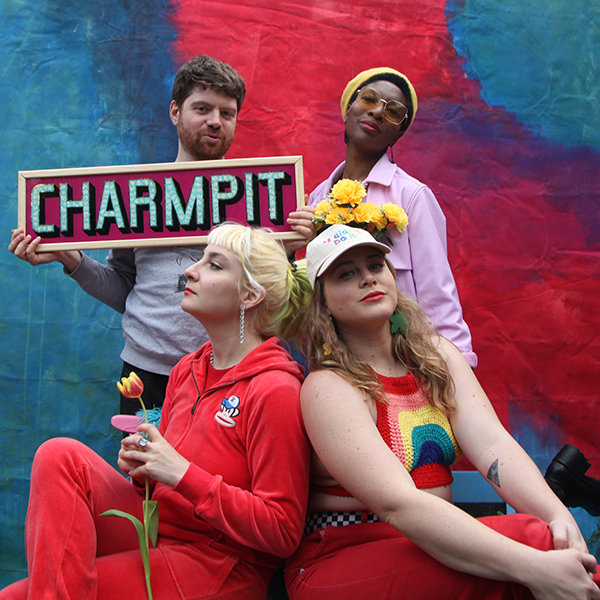
Debut album on Specialist Subject from the partly California-raised ‘anarcuties’ Charmpit. Quietly subversive cultural politics with a barrelful of musical sugar to ease the medicine down. File under femme, not twee (then burn the filing system; they’re anarchists). “Cause A Stir” by Charmpit (by Emma Prew) London via California DIY pop(star) punk band Charmpit are gearing up to release their much anticipated debut full-length on the 3rd of April. Titled Cause A Stir, the album is being released by the always excellent Specialist Subject Records and follows on from Charmpit’s previous releases on Keroleen Records and Everything Sucks.

This London x California 4 piece, Charmpit, deliver Pop(star) Punk in a queer, DIY “Anarcutie” package. Through playful harmonies, sparkling guitar and to-the-point lyrics, they place a high value on friendship, the power of femme, and FUNctional social justice politics. Their debut LP Cause A Stir is a shining showcase of powerful song-writing twisted up in their hot couture and glittering vision. Charmpit got their start in 2016 during the DIY Space For London’s ‘First Timers’ project; an annual series of workshops, skill-shares and first time performances that ‘celebrates demystification’ and pours fresh, diverse, new talent into the UK music scene. They are what ‘First Timers’ dreams are made of! Releasing their first 7” vinyl single,

New single from upcoming CHARMPIT LP ‘Cause A Stir’ out 3rd April, 2020 on Specialist Subject,

http://

Released April 3rd, 2020

As Mamalarky set out to make their debut album, they had a vision in mind: to shape the, “patchwork of different influences that comes together as a cozy quilt you can cuddle under”. Mamalarky are a collective of musical obsessives, outside of the band they are touring musicians and band managers, people dedicated to music above all else. The result is a record that seems to be indebted to the great and good of music history, a blur of musical ideas, melded into weird and wonderful soundscapes entirely of their own creation. There’s an almost hyper level of creativity here, a record that zips between styles and sounds, rarely stopping anywhere for long, channelling the spirit of an array of artists, from the angular stop-start rhythms of Weaves, the wonky-pop of Pom Poko and the wonderfully noisy edge of Deerhoof. In the foreground throughout is Livvy’s vivid story-telling, scratch the surface and these are personal tales, memories of feeling lost and lonely, repressing old relationships and the band’s own experience of being dotted across the country, wondering when the chance would come to be together again. This is the sound of a band in love with making music, a record that’s a fun, exciting and joyous expression of self

From Mamalarky’s Debut Self Titled Album Out in November on Fire Talk Records.

With unfettered access to the Zappa Trust and all archival footage, “Zappa” explores the private life behind the mammoth musical career that never shied away from the political turbulence of its time. Alex Winter’s assembly features appearances by Frank’s widow Gail Zappa and several of Frank’s musical collaborators including Mike Keneally, Ian Underwood, Steve Vai, Pamela Des Barres, Bunk Gardner, David Harrington, Scott Thunes, Ruth Underwood, Ray White and others. The soundtrack is a perfect complement to the film available as a limited edition 5-LP 180-gram smoke color vinyl set for the Zappa completist. Showcasing 69 total songs, there are 12 previously unreleased recordings from the Zappa archive along with his 1978 Saturday Night Live performance; 24 additional Zappa songs from his extensive catalogue spanning four decades; songs from Zappa’s labels Straight / Bizarre Records like “No Longer Umpire” by Alice Cooper and “The Captain’s Fat Theresa Shoes” by The GTO’s; 2 classical compositions by Edgard Varese and Igor Stravinsky; and 26 Original Score cues newly composed by John Frizzell for the documentary – all of which give the universe a sonic exploration into the musical brilliance of Frank Zappa.

The music in “Zappa” spans the composer’s entire career, including psychedelic rock, jazz and classical experiments — beginning with several cuts from his 1966 debut with the Mothers of Invention, Freak Out, to the last recording released in his lifetime, 1993’s The Yellow Shark. It contains 12 tracks that have never been commercially released — including three selections from a June 1968 concert at the Whisky A Go-Go, his 1978 performance of “Dancin’ Fool” on Saturday Night Live and several interview clips — along with two songs originally released on Zappa’s labels. 

For Zappa, Winter received full access to the Zappa Trust. He interviewed several musicians who worked with Zappa, including Steve Vai, Mike Keneally and Ian Underwood, as well as Zappa’s widow Gail, who died in 2015. You can see the trailer below and stream the movie from its official website.

Frank Zappa’s story is not a predictable arc of youthful talent and enthusiasm blossoming into commercial success and critical acclaim followed by a long, boring afterlife. Frank began composing as a teenager after hearing the rhythmically iconoclastic sounds of Edgard Varèse, and well before picking up a guitar. In 1965, he formed the Mothers of Invention to support his composing habit. According to Paul McCartney, Sgt. Pepper’s Lonely Hearts Club Band was directly inspired by the Mothers’ debut album, Freak Out!, which would have been rock’s first double album if a different variety of freak out, Dylan’s Blonde on Blonde, hadn’t arrived a week earlier. Have I mentioned that ZAPPA devotes surprisingly little screen time to Frank onstage with his various Mothers iterations? There are snippets galore, but don’t stream this movie expecting previously unheard guitar magnificence or comedy-rock tomfoolery. Winter points out that you can easily find that sort of thing elsewhere, and that’s definitely not the crux of this cinematic biscuit.

A triple-CD companion soundtrack, meanwhile, delivers oodles of complete tracks along with composer John Frizzell’s unexpectedly discreet and complementary score for the film. Universal is accepting orders for the physical set, which will be available next year as three-CD or five-LP formats (black or smoke vinyl), along with a 21-track compilation that will be sold digitally and on clear vinyl.

Marvin Country is Marvin Etzioni’s ambitious fourth album. The two-record set hits the streets on April 17, 2012 and features Lucinda Williams, Steve Earle, John Doe, Richard Thompson, Buddy Miller, Maria Mckee, and more. Marvin Etzioni is an American singer, mandolinist, bassist, and record producer, Etzioni is best known as a founder of, and bassist for, the band Lone Justice.

In 2012, Marvin Etzioni released a double album extravaganza: Marvin Country! It featured guest appearances from folks including John Doe, Lucinda Williams, Buddy Miller, Steve Earle, The Dixie Hummngbirds, Murry Hammond, and Richard Thompson. Even old Lone Justice cohorts Maria McKee, Shayne Fontaine, and David Vaught were along for the ride. But, the origins of some of those songs go back two decades.

Marvin issued Marvin Country: Communication Hoedown himself, on cassette in 1992, saying “I was single-handedly trying to bring back cassettes at a time when the industry said they were done. I still liked the analogue sound versus the high glossy digitalness (to coin a new word) of CDs.” It has never had an official release until now.

http://

There’s country, there’s alt. country, and there’s Marvin Country. It’s a magical place, way off the map, populated by back-porch philosophers, hobos, brokenhearted lovers and spacemen and presided over by the man the L.A. Times called “one heck of a songwriter.” Grammy award winner Marvin Etzioni has been known over the years as producer (Counting Crows, Toad the Wet Sprocket, Peter Case), sideman (T Bone Burnett, Dixie Chicks, Grey Delisle) and songwriter (Cheap Trick, Victoria Williams) Even before there was No Depression, Marvin was a co-founder of the seminal roots-rockers Lone Justice. It’s safe to say Marvin is revered in Americana circles worldwide. “Marvin Country!” is his ambitious fourth album, and first in over a decade. The two-record set hits the streets on 16th April. The mandolin man is back. “(Etzioni’s) material ranges from stark folk-based tunes to raw Stone’s-like rockers.”

http://

This time around Marvin lacks his mind blowing poetry & almost makes up the CD set with simple repeatable blues refrains. Yet he is his normal playful self with analogue sound effects, inner jokes, & songs about death & salvation. I hear more Blues & a few Cajun songs than the number of any country style of music. Some other songs are beyond categorization. There are many references about past Country greats as with Pasty Cline & Gram Parson, even the death of Bob Dylan. Don’t worry Bob is still around, but Marvin is thinking about that day that all of us shall meet.

The struggle continues on Will Toledo’s latest effort. Id does battle with superego; fame seduces and repulses; and self-acceptance tangles with self-loathing. What’s evolved magnificently is the music: Toledo has stowed the seven-minute-plus rock operas for a collection of single-length songs that are crawling with earworms, such as the shimmying “Can’t Cool Me Down” and the stunning LP climax “There Must Be More Than Blood.”

This album was made from January 2015 to December 2019, starting as a collection of vague ideas that eventually turned into songs. I wanted to make something that was different from my previous records, and I struggled to figure out how to do that. I realized that because the way I listened to music had changed, I had to change the way I wrote music, as well. I was listening less and less to albums and more and more to individual songs, songs from all over the place, every few days finding a new one that seemed to have a special energy. I thought that if I could make an album full of songs that had a special energy, each one unique and different in its vision, then that would be a good thing.

Andrew, Ethan, Seth and I started going into the studio to record songs that had more finished structures and jam on ideas that didn’t. Then I would mess with the recordings until I could see my way to a song. Most of the time on this album was spent shuttling between my house and Andrew’s, who did a lot of the mixing on this. He comes from an EDM school of mixing, so we built up sample-heavy beat-driven songs that could work to both of our strengths.

Each track is the result of an intense battle to bring out its natural colours and transform it into a complete work. The songs contain elements of EDM, hip hop, futurism, doo-wop, soul, and of course rock and roll. But underneath all these things I think these may be folk songs, because they can be played and sung in many different ways, and they’re about things that are important to a lot of people: anger with society, sickness, loneliness, love…the way this album plays out is just our own interpretation of the tracks, with Andrew, Ethan and I forming a sort of choir of contrasting natures.

The songs are shorter but denser, a melding of driving guitar rock and euphoric EDM, with unexpected flourishes that range from white-boy hip-hop to prog rock. Toledo has credited drummer and his co-producer Andrew Katz with the album’s electronic direction — a direction related to their electro-comedy side project 1 Trait Danger, which has something to do with the gas mask that the frontman has been wearing in recent photos. Ignore the get-up, listen to the album. Music should be about enjoying yourself, especially live music, and I think of this costume as a way to remind myself and everyone else to have some fun with it. I don’t think it changes anything else about the songs or how you feel about them to be able to drop it for a second and have fun with it. If you can’t do that then you’re in a bad place…

http://

The character comes from another project Andrew and I have been working on called 1 TRAIT DANGER. This is something Andrew started doing on tour¬—recording ideas for his own songs as they came to him, and forcibly enlisting everyone else to participate. It appealed to me because it was nothing like Car Seat Headrest, and the ideas cracked me up. Before we knew it we had two albums released, a video game that was almost impossible to beat, and a growing number of people who seemed to be enjoying it all. It’s been a great outlet for weird and untenable musical experiments, and the live performances have been a blast. I play a character called TRAIT, and we’ve been working out the backstory as we go. I think he spent a lot of time in classified government facilities before getting into the music business.

‘Making A Door Less Open’ is the new album by Car Seat Headrest released May 1st, 2020

Written by Will Toledo. “Hollywood” written by Will Toledo and Andrew Katz.
Published by Mattitude.

Will Toledo – vocals, synths, keyboards, organ, guitar, piano, drum programming
Andrew Katz – vocals, drums, drum programming
Ethan Ives – guitar, vocals
Seth Dalby – bass guitar

Violin on “Can’t Cool Me Down” by John Huggins.
Guitar on “Hollywood” and “There Must Be More Than Blood” by Gianni Aiello.