See the source image

Despite being miles ahead of their time and writing one of the greatest rock songs ever (“For What It’s Worth”), Buffalo Springfield fell into the margins of rock history after making three albums between 1966 and 1968 and splitting up. That’s probably because a few of the members namely Stephen Stills, Neil Young and Jim Messina would go on to even bigger things. Another core member, Richie Furay, took Messina (plus recruits Rusty Young, George Grantham and future Eagle Randy Meisner) and started Poco as a vehicle for the blend of rock and country that he’d brought to Buffalo Springfield. Poco’s debut 1969 album, Pickin’ Up the Pieces, along with the first Flying Burrito Brothers album, are now considered two of the most influential albums of the country-rock movement. On Poco’s self-titled sophomore album, another future Eagle, Timothy B. Schmit, replaced Meisner on bass. Both records were well-regarded, but neither got much radio play.

Messina departed in 1971 but, interestingly, secured the services of his replacement, guitarist and songwriter Paul Cotton, and actually oversaw a transition of power during a three-night run at Fillmore West on Oct. 30th, 31st and November. 1st, 1970, when Poco opened for Procol Harum. On the first two nights, Messina played while Cotton studied. On the final night, Cotton took over, with Messina observing. It wasn’t the band’s first personnel shake-up, and it would be far from the last, but Rusty Young kept Poco kept chugging along into the 21st century.

Initially naming themselves after Walt Kelly’s iconic comic strip character Pogo, the band made its live debut three months after the release of the Byrds’ seminal Sweetheart of the Rodeo and three months before the Burritos’ debut, The Gilded Palace of Sin.“If any one event can be said to have ignited L.A.’s country-rock scene it would have to be the debut show by Pogo at the Troubadour in November 1968,” writes Barney Hoskyns in Hotel California, his definitive history of Southern California’s folk-rock scene in the ’60s and ’70s. Playing in full view of Linda Ronstadt, Rick Nelson and other luminaries that would share country influences, they played “a tight, ebullient set as good as any performance the Buffalo Springfield had given,”

During sessions for that band’s final album, Buffalo Springfield co-founder Richie Furay and Jim Messina, the Springfield short timer who produced the set, recruited steel guitarist Rusty Young to play on Furay’s “Kind Woman,” the album’s most country-influenced piece. With the band’s demise, the trio formed the core of the new band, adding bassist Randy Meisner and drummer George Grantham and gaining not only a rhythm section but two more singers, thus laying the foundation for the choral muscle that would become an earmark.

Poco (as they would rename themselves following legal threats from Kelly) gelled quickly. With Furay on rhythm guitar, Messina’s wiry Telecaster leads answered Young’s virtuosic pedal steel and Dobro. If the Byrds and Burritos gave country-rock substance, Poco helped fine-tune its style with a tight live sound that moved the fulcrum of the genre away from Nashville and straight into Bakersfield—country and western, emphasizing California’s leaner accent.
See the source image

Behind the scenes, they were less cheerful: Tension over Furay’s dominance as songwriter and Messina’s guiding hand as producer fractured the nascent group before it could complete the album, with Meisner rebelling when he was excluded from final mixing sessions. Meisner quit prior to its release, his bass parts and backing vocals retained and lead vocals erased and replaced by new leads by George Grantham. Poco’s formation occurred at an inflection point in country’s influence on rock. Apart from the Byrds and the Burrito Brothers, former Byrds lead singer Gene Clark, Bob Dylan, the Beau Brummels and the Everly Brothers all tapped into country elements between ’67 and ’68, with the pace of country-rock releases quickening in 1969 with the Burritos’ debut, the Byrds’ Dr. Byrds & Mr. Hyde and Dylan’s Nashville Skyline preceding Poco’s first studio album in May. Manager David Geffen landed them a contract with Epic Records, freeing Furay from his ties to Atlantic Records in a swap enabling Graham Nash to depart his obligations to the label, via the Hollies, and join David Crosby and Stephen Stills on Atlantic.

Furay and Messina wasted little time in replacing Meisner with Timothy B. Schmit, whose fleet, melodic bass guitar and high tenor vocals brought a seamless fit onstage and on their self-titled second studio album a year later. It was this line-up that was recorded at back-to-back concerts at the Boston Music Hall and New York’s Felt Forum on September 22nd and 23rd, respectively

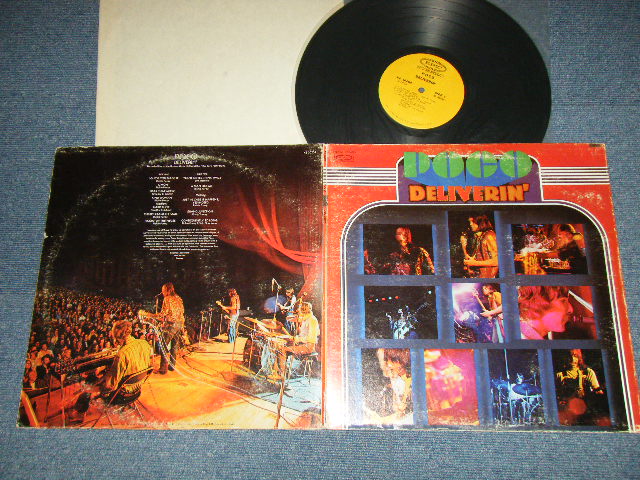
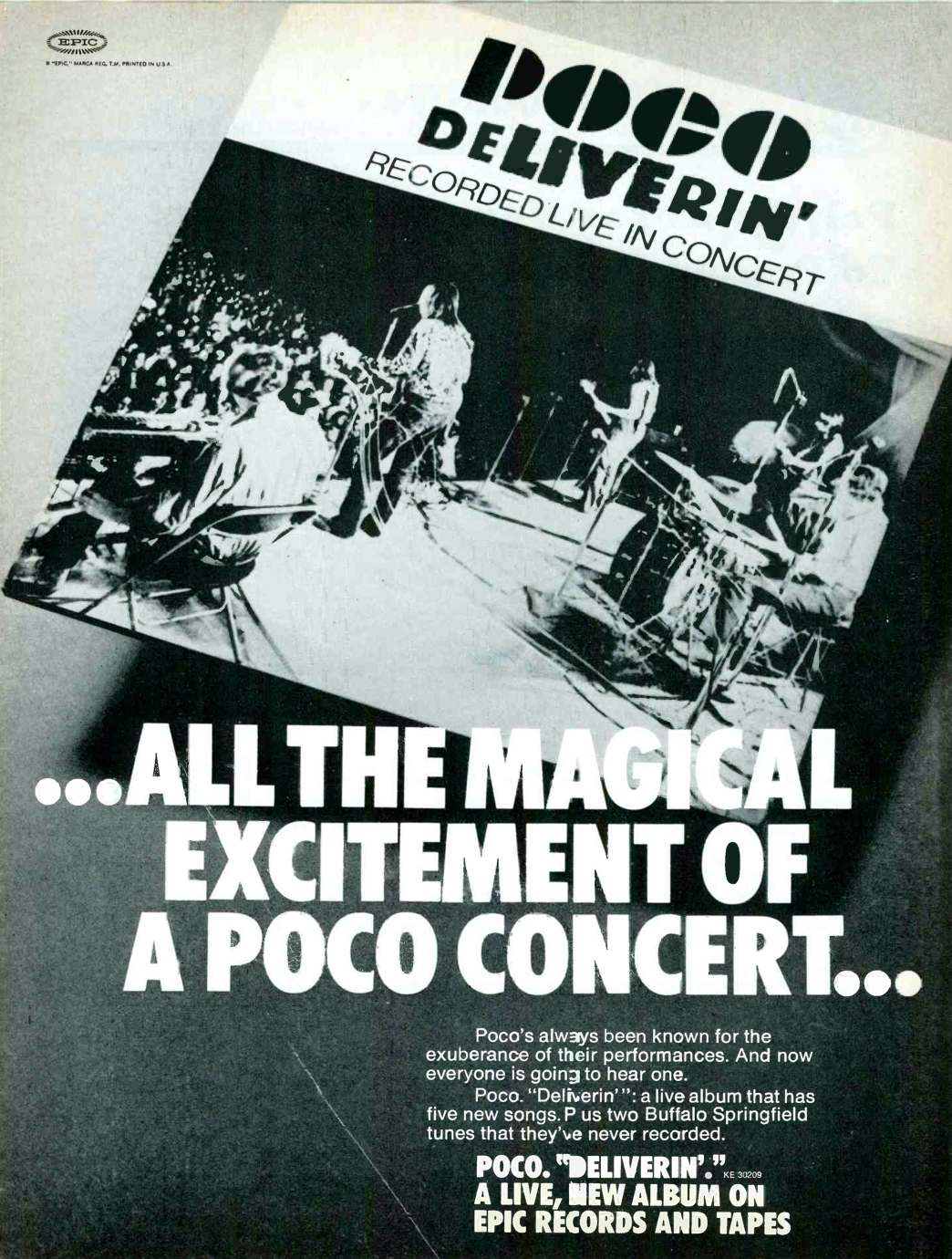
The quintet’s early records met with modest sales, but onstage they were a force from inception, as captured by their third album and first live recording, “Deliverin’”, released on January 13th, 1971.

Deliverin’ opens at a gallop with “I Guess You Made It,” showcasing Young’s shapeshifting pedal steel, here routed through a Leslie speaker cabinet to emulate a Hammond B-3 organ. Like the Burritos’ steel player “Sneaky Pete” Kleinow, Young shrewdly mixes classic steel technique with rock effects. Both the brisk tempo and the band’s vocal zeal are signatures that recur throughout the set, with Poco noteworthy for spontaneous shouts closer to the days of the British Invasion than typical for the era.

Reflecting both Furay’s prolific song writing output and the band’s confidence in breaking in material on the road, the album includes three more previously unreleased songs, while devoting the other four tracks to more familiar works, starting with a leisurely performance of “Kind Woman,” the Springfield track that first brought Furay, Messina and Young together. A warm ballad in waltz time, the song offers a breather between the uptempo songs and medleys that dominate their set.

The album’s first medley welds a new Schmit song, “Hard Luck,” with Furay’s “A Child’s Claim to Fame,” introduced on Buffalo Springfield Again, and his title track for the Poco debut full-length. A testament to Young’s technical command, his Dobro work here gives no ground to James Burton’s studio take on the Springfield perennial. With tracks from their second studio album still percolating on FM playlists, the band refreshes one of Poco’s best-received songs, Messina’s “You Better Think Twice” (here listed as “You’d Better Think Twice”) by shifting from the razor-edged electric lead figures Messina played in the studio to an acoustic setting their spoken intro flags as “down home,” with Young moving to Dobro rather than steel.

For the album’s closing track, the band revisits three of the debut album’s songs in a medley framing Rusty Young’s lively pedal steel instrumental, “Grand Junction,” with two more Furay originals, “Just in Case it Happens, Yes Indeed” and “Consequently, So Long.”

Across its brisk 39 minutes, Deliverin’ maintains a lighter touch than harder blues-leaning rockers of that era, consistently pushing vocal harmonies higher thanks to Schmit’s and Furay’s ease at slipping into falsetto head tones. Coupled with the band’s instrumental dexterity, that style was what galvanized that first audience at the Troubadour and would continue to be a hallmark of the band and an influence on peers and successors such as Pure Prairie League, Firefall and the Eagles.

That Deliverin’ conveyed their potency as a live band was borne out by sales handily outstripping their two studio albums, reaching #26 on the album chart and yielding a minor hit in “C’mon” that validated their confidence in emphasizing new material rather than familiar album tracks. But internal squabbles would again interrupt Poco’s forward momentum, this time between Furay and Messina, who chafed at Furay’s control, leaving the band less than a month after those live shows to partner with a more compliant Kenny Loggins and bequeathing his perch in Poco to Illinois Speed Press alumnus Paul Cotton.

Young’s steady commitment to the band would provide the constant that enabled Poco to become one of the longest-running country-rock outfits, based in Colorado where the native Californian was raised. Furay would remain with the band for three more albums, quitting in 1973 to join J.D. Souther and Chris Hillman in the ill-fated Southern Hillman Furay Band, while Schmit would leave four years later to join the Eagles, replacing Meisner for a second time.

Poco’s most successful album came a year later, with 1978’s Legacy reaping the hit profile for which Furay and Messina had hungered. Its breakout hit was “Crazy Love,” written and sung by Young, the last man standing from the original band. Young’s persistence would enable Poco to survive subsequent label and line-up changes, securing the band’s induction into the Colorado Music Hall of Fame in 2015, two years after Young’s formal retirement.
.
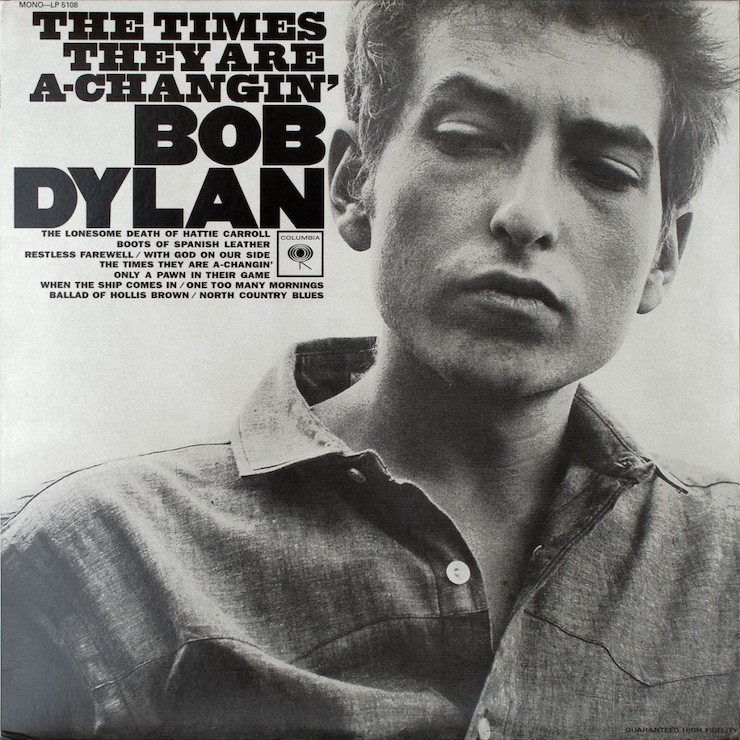
“The Times They Are a-Changin’” is the third studio album by American singer-songwriter Bob Dylan, released in January 1964 by Columbia Records. Some critics and fans were not quite as taken with the album as a whole, relative to his previous work, for its lack of humour or musical diversity. Still, The Times They Are a-Changin’ entered the US chart at No20, eventually going gold, and belatedly reaching #4 in the UK in 1965.  The title track is one of Dylan’s most famous; many feel that it captures the spirit of social and political upheaval that characterized the 1960s.

Produced by Tom Wilson, it is the singer-songwriter’s first collection to feature only original compositions.  Whereas his previous albums Bob Dylan and The Freewheelin’ Bob Dylan consisted of original material among cover songs, The album consists mostly of stark, sparsely-arranged ballads concerning issues such as racism, poverty, and social change. The title track is one of Dylan’s most famous; many felt that it captured the spirit of social and political upheaval that characterized the 1960s. The message isn’t in the words, …. I don’t do anything with a sort of message. I’m just transferring my thoughts into music. Nobody can give you a message like that.
~Bob Dylan (to Ray Coleman, May 1965)

Dylan’s third album reflects his mood in August-October 1963. It is also a product for his need to live up to and expand on the role he found himself in, topical poet, the restless young man with something to say, singing to and for a new generation. Dylan began work on his third album on August 6th, 1963, at Columbia’s Studio A in New York City. Once again, Tom Wilson was the producer for the entire album. Dylan had, by the time of recording, become a popular, influential cultural figure. Eight songs were recorded during that first session, but only one recording of “North Country Blues” was ultimately deemed usable and set aside as the master take. A master take of “Seven Curses” was also recorded, but it was left out of the final album sequence.

Another session at Studio A was held the following day, this time yielding master takes for four songs: “Ballad of Hollis Brown”, “With God on Our Side”, “Only a Pawn in Their Game”, and “Boots of Spanish Leather”, all of which were later included on the final album sequence.

A third session was held in Studio A on August 12th, but nothing from this session was deemed usable. However, three recordings are taken from the third session eventually saw official release: “master” takes of “Paths of Victory”, “Moonshine Blues” and “Only a Hobo” were all included on The Bootleg Series Volumes 1–3 (Rare & Unreleased) 1961–1991 released in 1991. In 2013, “Eternal Circle” and “Hero Blues” were included in the 1963 entry of The 50th Anniversary Collection 1963.

Sessions did not resume for more than two months. During the interim, Dylan toured briefly with Joan Baez, performing a number of key concerts that raised his profile in the media. When Dylan returned to Studio A on October 23rd, he had six more original compositions ready for recording. Master takes for “The Lonesome Death of Hattie Carroll” and “When the Ship Comes In” were both culled from the October 23rd session. A master take for “Percy’s Song” was also recorded, but it was ultimately set aside and was not officially released until Biograph in 1985.

An alternate take on “Percy’s Song”, a “That’s All Right” (Arthur Crudup)/“Sally Free and Easy” (Cyril Tawney) medley and “East Laredo Blues” were released in 2013 on the 1963 entry of The 50th Anniversary Collection. Another session was held the following day, October 24th. Master takes of “The Times They Are a-Changin'” and “One Too Many Mornings” were recorded and later included in the final album sequence. A master take for “Lay Down Your Weary Tune” was also recorded, but ultimately left out of the final album; it was eventually released on Biograph. Two more outtakes, “Eternal Circle” and “Suze (The Cough Song)”, were later issued on The Bootleg Series Volumes 1-3 (Rare & Unreleased) 1961-1991. A final outtake, “New Orleans Rag”, was released in 2013 on “The 50th Anniversary Collection”.

The sixth and final session for The Times They Are a-Changin’ was held on October 31st, 1963. The entire session focused on one song—“Restless Farewell”—whose melody is taken from an Irish-Scots folk song, “The Parting Glass”, and it produced a master take that ultimately closed the album.

There were to be 6 recording sessions alltogether for The Times They Are a-Changin’.

If “The Times They Are a-Changin’” isn’t a marked step forward from The Freewheelin’ Bob Dylan, even if it is his first collection of all originals, it’s nevertheless a fine collection all the same. It isn’t as rich as Freewheelin’, and Dylan has tempered his sense of humour considerably, choosing to concentrate on social protests in the style of “Blowin’ in the Wind.” With the title track, he wrote an anthem that nearly equaled that song, and “With God on Our Side” and “Only a Pawn in Their Game” are nearly as good, while “Ballad of Hollis Brown” and “The Lonesome Death of Hattie Carroll” are remarkably skilled re-castings of contemporary tales of injustice. His absurdity is missed, but he makes up for it with the wonderful “One Too Many Mornings” and “Boots of Spanish Leather,” two lovely classics.

On October 26th, 1963, three days after recording the final song for The Times They Are a-Changin‘, Dylan held a concert at New York’s Carnegie Hall. That night, he performed eight songs from his forthcoming third album, as well as several outtakes from the same album sessions (including “Percy’s Song”, “Seven Curses”, and “Lay Down Your Weary Tune”). Columbia recorded the entire concert, but it was decades before a substantial portion of it was officially released (in fact to date the concert in its entirety has not been released). Nevertheless, the performance was well received by the press and audience alike

If there are a couple of songs that don’t achieve the level of the aforementioned songs, that speaks more to the quality of those songs than the weakness of the remainder of the record. And that’s also true of the album itself — yes, it pales next to its predecessor, but it’s terrific by any other standard.

timesb

Manchester’s teenage pals of the Goa Express have recently been swept up by Rough Trade for their fresh psych-infused garage rock. Although influences varying from 60s psychedelia to post-punk are obvious, their sound is distinct and compelling, with a sound that perfectly complements their fun-loving attitude and charm of the city of Manchester.

Hailing from Manchester, the group have been pals since they were teenagers, steadily making their name around the scene with their garage-rock sizzlers. Ludicrously-catchy garage rock from these NME 100 graduates. 

On recently released track ‘Be My Friend’, the group describe it as being about “taking a step away from those who’re always trying to get close to you and as both a shout out to individuality and an acceptance of rejection. It’s a dismissal of the modern world’s hyper-connectivity and a return to privacy, rather than the involvement of everyone knowing everyone’s business all of the time.”

With tons more exciting things on the horizon, based out of Todmorden/Burnley, UK, if you like : Spacemen 3, Ty Segall, Ending the who-knows-how-long Yorkshire vs. Lancashire feud with short and snappy Ramones-style hits. While their early influences ranged from Spacemen 3 to Brain Jonestown Massacre, James tells us the band now tries to “find influences in everything we see and in everywhere we go”. You’re going to love them: A precedent was set by The Goa Express when they formed in the wake of a wild, substance-heavy night seeing The Brian Jonestown Massacre – one that left them newly single and sleeping rough outside a Tesco. All about having a good time, the lads have already caught the eye of producer Ross Orton (Arctic Monkeys, Amyl & The Sniffers) and Fat White Family’s Nathan Saoudi (a fellow lover of chaos) with their jangly, loud-mouthed garage-psych.

The Goa Express are a band you need on your radar. Enjoying life under the wings of Rough Trade Management (Shame, black midi), the Manchester-based five-piece have wowed with singles The Day and Be My Friend. Their first single proper, The Day, saw them enlist the talents of Fat White Family’s Nathan Sauodi for production duties at their own Champ Zone studio in Sheffield, culminating in a 2-minute explosion of guitars, synths, and youthful energy.

The band’s tight-knit camaraderie – formed during their teenage years at school and playing intimate live shows above vintage shops – is captured in their self-produced video for Be My Friend; a lockdown-created clip pieced together using footage taken on nights out and day-to-day laughs filmed on a phone with no intention they’d ever be used in a music promo.

BBC 6 Music legend Steve Lamacq is an early champion, having invited the quintet to play their first radio session at London’s iconic Abbey Road Studios.

The Goa Express are riding the tracks to the top and rightfully find their place among the exciting charge of UK and Irish outfits tearing up the rule book.  The Goa Express are very, very good. They’re five mates from the north who are more of a brotherhood than a band. Their effortless gung-ho garage rock is causing a buzz, with singles The Day and Be My Friend prime examples of a band ready to smash down barriers and shake up the establishment.

The Goa Express are James Douglas Clarke, Joey Stein, Naham Muzaffar, Joe Clarke and Sam Launder

Philadelphia rock quartet Soraia are giving fans new music for the start of the New Year: The single Tight-Lipped, with a B-side cover of Aerosmith’s Angel, featuring a cameo by Jessie Wagner. Frontwoman ZouZou Mansour says, “Tight-Lipped is about a woman who politely refuses to challenge the status quo and direction of her life. It’s a final recognition of the part she has played in her own oppressive censoring — a soulful rebuke of her former beliefs on how to live. But by the end of the song, it becomes a triumphant declaration of who she now is: Meet Ophelia — no more promises. I refuse to be so tight-lipped.”

some fun hard rock with some really good vocals.

http://

Side A: Tight-Lipped
(Soraia Mansour/Travis Smith) Green Eyed Lady Publishing (BMI)/Real
Bad Music Publishing (BMI)
Side B: Angel (ft. Jessie Wagner)
(Steven Tyler/Desmond Child) Primary Wave Steven Tyler/Universal
Polygram International Publishing

ZouZou Mansour: Lead Vocals, Backing Vocals, Organ Nick Seditious: Lead Guitar, Rhythm Guitar Travis Smith: Bass Guitar Brianna Sig: Drums, Percussion, Backing Vocals John Hildenbrand: Organ Geoff Sanoff: Backing Vocals, Organ Jessie Wagner: Featured Artist singing on “Angel” Soraia Released January 8th, 2021

Image may contain: 2 people

Los Angeles-based quartet SLUGS first appeared back in 2018 with their EP, “Cool World“, a record that caught the attention of many blogs, and saw the band share stages with the likes of Jessica Lea Mayfield, The Districts and Let’s Eat Grandma. Since then things have gone a little quiet, which all changed last month, when they returned with a brand-new single, “Super Sane“.

Citing influences from Linda Perhacs to The Oh Sees, Slugs are not a band easily pigeon-holed, with a sound that flutters from the sweetly melodic to the riotously energetic. Super Sane is probably the band at their most restrained, as washes of burbling electronics and gently meandering guitars create a gorgeous backing for vocalist Marissa Longstreet’s impassioned vocal delivery.

This is a song of sweet juxtapositions, at times it feels intimate and insular, the next fierce and strong-willed, as it seems to muse on ideas of healing and finding a path to acceptance of your lot. While plans for the year ahead remain as yet unconfirmed, there’s enough here to hint that the return of Slugs is a reason to be very excited about whatever is coming next.

Vocals/Guitar – Marissa Longstreet Vocals/Bass – Sarsten Noice Guitar – Josh Beavers Drums – Dash Hutton

“Super Sane” Written by SLUGS

Vault 47 Jack White Live At the Masonic Temple

Jack White will release his July 30th, 2014 concert at Detroit’s Masonic Temple on vinyl via Third Man Records, the singer-songwriter announced on Monday. The release will mark the 47th Vault package from his record label and will be available to those who subscribe by January 31st. A preview of the album is available now with a live cut of “Missing Pieces”.

The 38-track concert clocks in at nearly three-and-a-half hours. Over the course of the evening, White ran through memorable White Stripes tracks like the opening “Fell in Love With a Girl” as well as “The Big Three Killed My Baby”, “Icky Thump”, “We’re Going To Be Friends”, and more. The show also finds White offering up covers of Beck‘s “Devil’s Haircut”, Led Zeppelin‘s “The Lemon Song”, and Hank Williams‘ “Ramblin’ Man”.

The four, 180-gram LPs come in White’s signature solo colours of blue, black, and white. Together they are housed in a slipcase cover with photo inner sleeves, featuring pictures from the show shot by David Swanson. Along with Live at Masonic Temple, subscribers will also receive a 7′ vinyl of White’s appearance on Saturday Night Live on October 10th where he performed a medley comprised of “Ball and Biscuit”, “Don’t Hurt Yourself”, and “Jesus Is Coming Soon” as well as paid tribute to Eddie Van Halen with his performance of “Lazaretto” using a guitar modeled after Eddie’s.

Ahead of the Vault package’s release, White has also shared live audio of “Missing Pieces” from the concert, available below. 

“Live at Masonic Temple” and subscribe to Third Man Records‘ Vault series by January 31st to receive the vinyl.

Paper Birch are an experimental noise-rock duo, consisting of Fergus Lawrie, of Urusei Yatsura, and Dee Sada of Steve Albini-produced An Experiment On A Bird In An Air Pump. The band started working together under the enforced distance of 2020, and created their debut album, “Morninghairwater”, which received a minimal digital download release through Cafe Oto imprint TakuRoku. Now one of eight new signings to the excellent Reckless Yes label, alongside the likes of Breakup Haircut, Piney Gir and th’sheridans, Morninghairwater is set to receive a much more expansive release later this year.

Listening to Morninghairwater, Paper Birch’s sound seems to exist between an array of genres, one moment engulfing the listener in a flurry of angular shoegazing noise, before the next slipping into richly melodic moments of indie-pop. The result is a record that seems to ebb and flow, one that is far more than the sum of its songs; they seem to have almost created a sonic landscape, full of moments of real beauty, and others where the brutality of the natural world is laid bare. Particularly wonderful is Fallen, reminiscent of early-Liars or even Joy Division’s Atmosphere, as it combines dissonant guitars with easy, half-spoken vocals and a steady rhythmic pulse. While the album is already out in the world, with the backing of one of the UK’s most exciting new indie-labels, Paper Birch’s music should reach a whole new array of ears in the year ahead.

Official music video for Paper Birch’s ‘Summer Daze’ directed by Grant McPhee, written and recorded by Dee Sada and Fergus Lawrie, produced by Fergus Lawrie and mastered by Steven Ward. Taken from the album, Morninghairwater released August 5th 2020 on TAKUROKU records.

On Saturday, December 26th, Fifty plus artists and hundreds of thousands of viewers around the world came together for “Georgia Comes Alive”, a virtual music festival aimed at promoting voter participation in Georgia’s Senate runoff elections on January 5th, 2021, which saw a record-breaking voter turnout.

One of the major headliners to take part in “Georgia Comes Alive” was alternative powerhouse Portugal. The Man who performed the original song “Colors”. For this take on the Censored Colors track, the Alaskan-bred experimental outfit performed from an empty venue as the dreary blend of blue and green lights accentuated the downtempo indie crawl. As frontman John Baldwin Gourley belted out the refrain of “I’m not afraid to die/’Cause all these colors will change,” guitarist Eric Howk softens the blow with smooth phrasings on his Fender Stratocaster that round out the song.

Portugal. The Man performing “Colors” for Georgia Comes Alive, a virtual festival to get out the vote in the Georgia Senate runoff elections presented by #LiveForLiveMusic​


Image may contain: 1 person, standing, tree, night, plant, child, outdoor and nature, text that says 'The Weather Station IGNO IGNRANCE New Album Out Feb 5 Live Stream Event Feb 11 Pre-order www.t neweatherstation.net'

The Weather Station (the project of Toronto-based singer/songwriter Tamara Linderman) is releasing a new album, “Ignorance”, on February 5th via Fat Possum Records. This week she shared another song from it, “Atlantic,” via a self-directed video for the track. 

Linderman had this to say about the song in a press release: “Trying to capture something of the slipping feeling I think we all feel, the feeling of dread, even in beautiful moments, even when you’re a little drunk on a sea cliff watching the sun go down while seabirds fly around you; that slipping feeling is still there, that feeling of dread, of knowing that everything you see is in peril. I feel like I spend half my life working on trying to stay positive. My whole generation does. But if you spend any time at all reading about the climate situation circa now, positivity and lightness are not fully available to you anymore; you have to find new ways to exist and to see, even just to watch the sunset. I tried to make the band just go crazy on this one, and they did. This is one where the music really makes me see the place in my mind; the flute and the guitar chasing each other, wheeling around like birds, the drums cliff like in their straightness; I love the band on this one.”

“Ignorance” includes “Robber,” a new song The Weather Station shared in October via a self-directed video for it in her directorial debut. “Robber,” an atmospheric horn- and string-backed track, When the album was announced in November, Linderman shared its second single, “Tried to Tell You,” via another self-directed video for the track. Ignorance is the follow-up to The Weather Station’s acclaimed self-titled and self-produced fourth album, released in 2017 by Paradise of Bachelors.

In a previous press release, Linderman said the album was built on rhythm. “I saw how the less emotion there was in the rhythm, the more room there was for emotion in the rest of the music, the more freedom I had vocally,” she says. Linderman, who plays guitar and piano on the album, was aided in this cause by drummer Kieran Adams (DIANA), bassist Ben Whiteley, percussionist Philippe Melanson (Bernice), saxophonist Brodie West (The Ex), flutist Ryan Driver (Eric Chenaux), keyboardist Johnny Spence (Tegan and Sara), and guitarist Christine Bougie (Bahamas). Linderman co-produced Ignorance with Marcus Paquin, who also mixed the album. 

“Atlantic” from The Weather Station’s new album ‘Ignorance’ out February 5th, 2021

‘Pacific Kiss’ is the fourth album from Australian musician David West’s underground pop band, Rat Columns. It was engineered by Griffin Harrison and DW in New York City and Perth, and mixed by Mikey Young in Victoria. ‘Pacific Kiss’ sees Rat Columns plunging headfirst into an azure sea of power pop, rock’n’roll and indie. The tones are bright and optimistic, though fans of confusion and gloom will still find solace in the album’s darker moments, of which there are a few.

Rat Columns emerged from San Francisco via Perth, Western Australia in the late 2000’s with the mope ’n’ jangle of their first self-titled cassette release, from which several tracks were drawn for their first vinyl release, a four-song 7” on the San Francisco based indie label, Smartguy Records. From that moment, David West and a constantly evolving troupe of friends and co-conspirators have forged a persistent trail of albums and EP’s on a number of interesting small labels such as RIP Society, Upset The Rhythm, Blackest Ever Black, Syncro-System, Adagio 830 and now the London-based Tough Love Records, who have also released many of David’s eponymous pop records. West has also found time to play in a number of other interesting outfits, such as Rank/Xerox, Lace Curtain, Liberation, Scythe, Total Control and Burning Sensation over the years.

‘Pacific Kiss’ was primarily recorded in a dingy but comfortable practice space in East Williamsburg, Brooklyn. The core of the record is West, bassist Max Schneider-Schumacher, drummer Dylan Stjepovic and keyboard wiz Joey Fishman. Additional fairy dust was sprinkled by Amber Gempton and Raven Mahon (vocals), Jef Brown (saxophone) and Mikey Young, who found time to contribute some off the wall guitar solos during the mixing process. ‘Pacific Kiss’ is a record for those astral voyages into the spheres conducted from bedrooms, kitchens, grassy fields and open car windows. 

Releases February 14th, 2021
