“No Time For Love Like Now” is the first song from Big Red Machine since the release of their critically acclaimed self-titled debut in 2018. Big Red Machine began as a collaboration between Aaron Dessner and Justin Vernon in 2008, and has grown into a multi-artist collective. When the group got together this year to begin working on new music, this particular song made a detour and ended up with Michael Stipe.
We’re so pleased to share this powerful new song from Michael Stipe & Big Red Machine, out now on 37d03d. The collaboration came about when Aaron Dessner shared a folder of new Big Red Machine music with Michael last year. No Time For Love Like Now was written last fall but when the reality of the COVID pandemic and social distancing and self-isolation descended the words felt like they were written about this time. The song features orchestration by Bryce Dessner, Justin Vernon, Brad Cook, JT Bates, Thomas Barlett, Clarice Jensen and Yuki Numata Resnick also perform on the track.
Michael Stipe & Big Red Machine have also designed a “No Time For Love Like Now” t-shirt and tote. All proceeds from the sales will go to the Equal Justice Initiative and COVID-19 Protest Relief Fund.
Written by Michael Stipe and Aaron Dessner, produced by Aaron Dessner, with Orchestration by Bryce Dessner, and lyrics by Michael Stipe
To celebrate the tenth anniversary of Moon Duo’s long-out-of-print debut LP “Escape”, Sacred Bones is proud to present a new deluxe version of the album.
The new reissue will include the original album in its entirety, plus three additional rare tracks taken from Moon Duo’s wild early days. Reflecting on the album in March 2020, the band shared the following statement: “We made this record in a rehearsal space in San Francisco in late 2009. It was kind of a classic band space, shared by a rangy assortment of musicians over months and years, behind one of several similar doors in a dark red hall. A windowless room lit by string lights and an odd assortment of lamps, the walls a palimpsest of posters and gig fliers.
The band shared the following statement on the 10th anniversary of the album: “We made this record in a rehearsal space in San Francisco in late 2009. It was kind of a classic band space, shared by a rangy assortment of musicians over months and years, behind one of several similar doors in a dark red hall. A windowless room lit by string lights and an odd assortment of lamps, the walls a palimpsest of posters and gig fliers. There was a grimy, burn-pocked rug, cluttered gear in various stages of use and abandonment, and the air seemed to hang in a permanent film of smoke residue and stale beer. We recorded to a 4-track tape machine over the course of a few nights – we’d just start the beats, hit ‘record’ and let fly. We had a vague sense of coalescence, or fomentation, like a glimpse of a thing in outline which you can’t yet see, but neither of us knew at the time that this was the record that would mark the beginning of our life as a touring band and would initiate our connections to so many (now long-time) friends, familiars and collaborators. Ten years feels like both a lifetime and the blink of an eye – measurable but impossible to quantify. These four tracks, and the others that join them here, are a snapshot of our earliest incarnation: flying blind, but high on the freedom of experimentation and filled with hope for things to come.”
Paul McCartney is set to give his 1997’s album “Flaming Pie” the full-scale reissue treatment. Arriving on July 31st, the Deluxe Edition consists of seven discs. Five CDs contain the remastered original album, demos, home recordings, studio outtakes, B-sides, highlights from 1995’s Oobu Joobu radio series and an audio tour of his home. Two DVDs consist of the In the World Tonight documentary, music videos, an interview by David Frost and several electronic press kits.
The box also includes a 128-page book featuring previously unpublished photos by Linda McCartney, other artwork, an essay by Chris Heath, new interviews with the people involved in the making of the album, track-by-track information, recipes, handwritten lyrics and more.
A Collector’s Edition, limited to 3,000 copies, adds four vinyl discs – the original double LP plus one record of home recordings on a hand-stamped vinyl sleeve and another featuring “The Ballad of Skeletons,” McCartney’s collaboration with Allen Ginsberg. There’s also a portfolio featuring six silk-screened prints by Linda. It’s all housed in a cloth-wrapped, two-piece box.
This is the 13th release in the Paul McCartney Archive Collection, personally supervised by McCartney and remastered at Abbey Road Studios. Originally released in 1997, the critically acclaimed and universally beloved solo album was produced by Paul, Jeff Lynne, and George Martin, featuring a supporting cast of family and friends including Ringo Starr, Steve Miller, LindaMcCartney, and son James. [Expanded double-CD edition features 21 bonus tracks. The triple 180gm vinyl LP edition features the remastered album cut at half-speed, packaged in a gatefold sleeve with exclusive artwork & booklet, plus one LP of unreleased home recordings in hand-stamped white label sleeve, “No, not another souvenir,” Paul pleads in the outro to the tenth track of Flaming Pie. In the case of its deluxe box set edition, however, he might want to rethink that stance. Each successive box in McCartney’s long-running Archive Collection seems more luxurious than the last, and this truly – even overwhelmingly – lavish collection is no exception.
The album is also being re-released with 21 extra tracks on two CDs, as a double-LP and as a three-LP set with the home-recordings disc found in the Collector’s Edition. You can get full info on all formats and pre-order at McCartney’s online shop. All pre-orders come with a re-creation of the “Young Boy” maxi-single, which contains the home-recorded version of the song “Looking for You” and excerpts of “Oobu Joobu Part 1.”
For Flaming Pie, McCartney brought in Jeff Lynne, with whom he had recently worked on the Beatles’ Anthology project, and George Martin to co-produce the record with him. It would up being his highest-charting LP since 1982’s Tug of War, debuting at No. 2. All digital pre-orders for the Archive Collection release of Flaming Pie will include YOUNG BOY. Also available as a stand-alone for digital download & streaming, the EP recreates the 1997 “Young Boy” maxi single and features the remastered Flaming Pie single “Young Boy,” a home-recorded version of the song, the original B-side “Looking For You,” and excerpts of “Oobu Joobu Part 1,” also from the original single. The two music videos for the track have been restored and will also be published on the same day.
Two additional EPs will be available with “The World Tonight” arriving on June 26th and “Beautiful Night” on July 17th. Paul remarking at the time“(The Beatles Anthology) reminded me of The Beatles’ standards and the standards that we reached with the songs. So in a way it was a refresher course that set the framework for this album.” Produced by Paul, Jeff Lynne and George Martin and featuring a supporting cast of family and friends including Ringo Starr, Steve Miller, Linda McCartney and son James, Flaming Pie is equal parts a masterclass in songcraft and a sustained burst of joyful spontaneity. With highlights ranging from the uplifting and inspirational opener “The Song We Were Singing” to the raucous title track (named for a quote from an early John Lennon interview on the origin of The Beatles’ name: “It came in a vision – a man appeared on a flaming pie and said unto them, ‘from this day on you are Beatles with an A.’” to the pensive “Calico Skies,” and featuring singles “Young Boy,” “The World Tonight” and “Beautiful Night,” Flaming Pie would represent yet another pinnacle in Paul’s solo catalogue: Released to rapturous reviews, the album would be Paul’s most commercially successful release of the ‘90s, achieving his highest chart positions since the ‘80s and would receive gold certifications in the US, UK, Japan and more.
Paul will reissue ‘Flaming Pie’ on 31st July 2020 as the thirteenth installment of his GRAMMY Award-winning Archive Collection.
Originally released May 5th, 1997, Flaming Pie ended a four-year gap between McCartney studio albums. Recorded largely in the wake of Paul’s involvement in the curation and release of The Beatles Anthology series, Flaming Pie was shaped and inspired by that experience. The album would become Paul’s most commercially successful release of the ‘90s.
At no time in his career has Macca truly run from his past; how could he, even if he wished to do so? But on Flaming Pie, he took hold of that past – and all of its attendant ghosts – in a striking embrace. The centerpiece of the deluxe edition is a hardcover 128-page book; at its heart is a lengthy and heavily-annotated, no-stone-unturned essay by Chris Heath. (It’s ideal reading accompaniment while listening to the album, and should take the average reader about as long.) It’s not long before Heath mentions McCartney’s old band from Liverpool: the second line of the second paragraph in fact. That’s as it should be; their spirit and sound are evoked often throughout the vibrant Flaming Pie. Ringo Starr plays and sings on the sweeping “Beautiful Night,” and his recognizable presence sends shivers up the spine. He also co-wrote the raucous “Really Love You,” the first song to bear a McCartney/Starkey credit. George Martin co-produced the lilting “Calico Skies” and reassuring “Great Day” and orchestrated both “Beautiful Night” and the reflective “Somedays.” (“I laugh to think how young we were,” McCartney sighs over a delicate melody and guitar-and-strings accompaniment.) Paul worked on Flaming Pieconcurrently with The Beatles Anthology (the three audio volumes of which were released in 1995 and 1996), and brought Jeff Lynne from that project to his new album.
The 4LP/5CD/2DVD Collector’s Edition — remastered at Abbey Road Studios and strictly limited to 3,000 numbered copies issued in a numbered cloth wrapped two-piece collector’s box — will feature everything in the Deluxe Edition plus a marbled art print portfolio of six silkscreened Linda McCartney art prints, exclusive vinyl versions of the remastered album cut at half speed across 2LPs in an exclusive gatefold sleeve, an LP of home recordings in a hand-stamped white label sleeve, and “The Ballad of the Skeletons” – Paul’s 1996 collaboration with Allen Ginsberg, also featuring Philip Glass and Lenny Kaye – released for the first time on vinyl and cut at 45 RPM with vinyl etching and poster.
Flaming Pie is also available on 180g black vinyl 2LP, 3LP, CD, Deluxe formats, as well as digitally on streaming platforms. Paul will reissue ‘Flaming Pie’ on 31st July 2020 as the thirteenth installment of his GRAMMY Award-winning Archive Collection.
The spectacular new single, “HUH,” from Grace Gillespie. This London-based artist and producer released her debut EP, “Pretending”, in June 2019 via Kaleidoscope and it was met with tons of praise across the music blog-o-sphere, including right here where it made my top albums/EPs of 2019 list. Her ability to blend multiple genres and styles to create her own musical identity grows by leaps and bounds with each new release.
The latest single questions why we allow ourselves to lose childhood wonder as we become adults and deal with the slog of 9-5 to life. On the song she says: “We become increasingly affected by external factors as we grow older and it becomes increasingly difficult to think like a child again. That innocence and curiosity is lost forever. But it’s still fun to think about, to try and look at things in different ways, as if through the eyes of someone else.”
Her sound takes influences from the folk, psych and dream-pop traditions, providing a backdrop to her intriguing vocal melodies, shifting harmonies and introspective lyricism.
“I grew up in Devon not far from the sea. Music was a big part of my life from very early on – I was lucky enough to attend a primary school where music was high on the agenda. I started studying piano very early, then sax and then drums for a year or so – but abandoned that pretty quickly.. too noisy for a tiny village. I’m a huge fan and you should be too! If you haven’t yet pick up her debut EP and get to know all about your new favourite musician.
Kaleidoscope Records Released on: 2020-05-29 Grace Gillespie
Many nations can lay claim to being Bruce Springsteen’s second home or adopted country. Italy has a strong case, given the ancestral roots of Bruce’s mother Adele (maiden name Zerilli) and a history of special shows that took place there, particularly in Milano. England is in the conversation too, with an incredible run of concerts dating back to 1975, and the passion of Spanish fans is well documented on Live in Barcelona. Australia may be a latecomer, but there’s no denying the love affair between Bruce and the land down under that played out in two major tours in 2014 and 2017.
Yet it would be hard to deny Sweden the symbolic honour of first among equals. Sverige’s history with Springsteen also dates back to 1975, when it was one of three markets Springsteen played on a brief European sojourn on the Born to Run tour. But the special relationship really starts with a pair of shows inside the very building in which this Devils & Dust performance takes place. Then called Johanneshovs Isstadion, the venue was the site of two legendary nights on the 1981 European leg of the River tour, memorialized on the famous vinyl bootlegs Follow That Dream and Teardrops on the City.
Four years later, Gothenburg cemented its place in the narrative with two dates at Springsteen’s home away from home in Sweden, Ullevi Stadium. Legend has it the passionate response of fans in Ullevi actually caused structural damage to the building in ‘85, and Springsteen has played the stadium nine times since that human rumble took its toll. Throw in the 1988 radio broadcast from Stockholms Stadion, the Tom Joad tour at Cirkus, and many other celebrated gigs, and the case is quite compelling. The country’s passion for Springsteen never wanes. Case in point: He sold out three stadium shows in Gothenburg alone in 2016, where it would appear he is as popular now as he was in 1985.
You can hear the special bond with Bruce’s Swedish fans on Stockholm 2005. Jon Altschiller’s mix showcases the audience-artist dynamic and the interplay between the two that makes live performance so special and so missed in these times of social isolation.
One element that made the Devils & Dust tour so bewitching was ever-changing setlists. At nearly every stop, Bruce dusted off a few songs that had been sitting on the shelf awhile and added them to a common core. In Stockholm, he opens with the tour debut of “Downbound Train,” hearkening back to those Ullevi ’85 shows. Boldly, the second song of the night is one of the highlights of that common core, “Reason to Believe.” Springsteen completely reimagined the song on this tour, transforming “Reason to Believe” into a Delta blues stomper with his inventive use of the bullet microphone.
Bullet mics are designed for harmonicas, with intentionally limited frequency range (usually cutting anything above 5,000 khz) and distortion. For his new take on “Reason to Believe,” Bruce played harmonica and sang his vocals through the bullet mic, distorting his voice and crunching down the sound to an eerily narrow slice.
The result sounds like an otherworldly transmission from the Crossroads or a lost Bluebird 78 RPM record spinning in the past. Rearranging his own songs is something Springsteen has excelled at going all the way back to “E Street Shuffle,” but this radical and riveting “Reason to Believe” is one of his most memorable and a standout every night of the Devils & Dust tour.
“Empty Sky” from The Rising had a second act on the tour as well, making close to two dozen appearances. The mournful tale rides Springsteen’s percussive acoustic guitar and focused vocals. Two guitar songs follow, the heartfelt parental reflection “Long Time Comin’,” which gains poignancy when Springsteen sings off-microphone, and the least-played track from Devils & Dust,“Black Cowboys,” which made 16 setlists in 2005.
Bruce moves to the keys for a rare outing of “The Promise,” in its first ever performance in Sweden. What a moment that must have been for diehard fans, five years before it became the title of the Darkness on the Edge of Town box set. We go down to “The River” on piano as well, with a striking prelude that starts with a single note, builds, swells and then settles solemnly before Bruce sings the evocative first lines.
Though it had been a standard feature on the Tunnel of Love Express tour, Bruce’s entertaining evolution tale, “Part Man, Part Monkey,” had its own second life on the Devils & Dust tour, a narrative befitting the candor Bruce was expressing about human behaviour in story and song during the shows, sometimes in deeply contrasting ways. Several Link Wray guitar turns only add to the appeal.
“All I’m Thinking About” is an underrated charmer. Sung in a faltering falsetto, it’s a series of sweet, real-life snapshots (little boys carrying fishing poles, little girls picking huckleberries) set to a simple chorus of devotion (or obsession?). Two songs later in “Reno,” fishing poles and blueberries give way to a price list of front and back door sexual access. Damn.
Snuck in between (no pun intended) is “Across the Border,” played for the first time since the Joad tour, augmented with a rich, accordion-like harmonica. You’d never know Springsteen hadn’t played it in so long, his reading is faultless.
Over to the irresistible eclectic piano we go for “Point Blank,” sounding more haunting and knowing than ever, then a true gift, “Walk Like a Man,” making its second archive appearance this year. Springsteen starts it on electric piano (not unlike the arrangement of “Tunnel of Love” from the previously released Grand Rapids 2005 show) and it unfolds warmly. It’s interesting to note that when he last played the song in 1988, he had no children of his own. Singing it here, Bruce is son and father. The song’s gravitas rises for the final verse as Bruce switches to full piano and the arrangement grows richer and more confident. What a gift to have two incredible live versions in our hands now.
That theme of fatherhood is enhanced with the piano pairing of “Walk Like a Man” with “My Hometown” in a powerful, straight-ahead reading where every line rings true. With that, the first half of the show concludes and we move back to guitar for “The Rising” and an intense take of “Lucky Town,” with Bruce strumming his acoustic with physicality and conviction like “Darkness on the Edge of Town” at the 1990 Christic Institute performances.
The back nine of the show rides his conviction to excellent performances of a trio of story songs, “This Hard Land,” “The Hitter,” and “Matamoros Banks.” One might go so far as to call “TheHitter” the closest thing to an unpublished screenplay Springsteen has penned since “Highway Patrolman” and until Western Stars, where it could have slotted in nicely. As character studies go, it is one of his finest.
As he does so masterfully, Springsteen rounds the bend and lightens the mood with a storming, Seeger-ized “Ramrod,” Dylan-ized “Bobby Jean” and a true-blue “Blinded By the Light,” making its Scandinavian premiere 32 years after its release.
The show wraps with the soul-stirring Devils & Dust tour pairing of “The Promised Land” and a cover of Suicide’s “Dream Baby Dream,” both offered in meditative, at times mantra-like arrangements. In “Dream Baby Dream,” the words “keep on dreaming” and “I just want to see you smile” sink into our subconscious, floating on dark-cloud organ notes that brighten as they turn towards heaven. Given the genuine dark clouds that so many of us are weathering, the spiritual power of the “Dream Baby Dream” mantra may provide genuine solace
Words by Erik Flannagan
Bruce Springsteen – Lead vocal, electric and acoustic guitars, ukulele, harmonica, electric piano, acoustic piano, pump organ
Additional musicians: Alan Fitzgerald – Off-stage keyboard
This King Biscuit Flower Hour show captures Irish blues guitarist Rory Gallagher during his terrific ’70s run of studio and live albums. He was renowned for his unhinged, impassioned live performances, and the quality of this show only helps cement his legendary status. The three-piece lineup, including longtime live band member Gerry McAvoy on the bass and new drummer, Ted McKenna, rips through eighteen tunes in a little over two hours on their second night at the Bottom Line in New York City.
Before launching his solo career, Gallagher led the London-based group Taste from 1966 to 1971, playing a Cream-inspired brand of blues-rock and gaining a U.K. fanbase that included John Lennon. By 1978, Gallagher had already recorded with Albert King, Muddy Waters, and briefly as part of the Rolling Stones in Rotterdam while they searched for a replacement for Mick Taylor. His tour of Ireland four years earlier had been documented by a live record, Irish Tour ’74, and in a film by Tony Palmer, Rory Gallagher: Irish Tour 1974. The record was an international bestseller, and the tour was momentous both for the band’s strength and Gallagher’s willingness to play in Northern Ireland during a violent, politically tumultuous year.
The band featured Lou Martin on keyboards until shortly after the recording of 1978’s Photo-Finish, when the group was reduced to the fiery three-piece that played this show.
Opening with “Shin Kicker” (which also opens Photo-Finish), Gallagher keeps the crowd excited, especially with “Shadow Play,” a particularly hot tune also on their then-new LP. Gallagher doesn’t indulge in much stage banter, providing brief introductory remarks to a couple of covers, including Leadbelly’s “Out on the Western Plains” as well as “Too Much Alcohol,” a tune originally by J.B. Hutto that also appears on Irish Tour ’74. These tunes receive a stripped-down treatment: Gallagher’s voice and his resonator, which come as a marked, pleasant contrast to his rousing originals, which are played on his loyal ’61 Sunburst Stratocaster that he bought at age 15. The main set swings back into full-on rock mode before concluding with Buddy Guy and JuniorWells classic “Messin’ With the Kid,” but it doesn’t end there—Gallagher then leads the group through two encores spanning a half hour.
Neil Young has released “Vacancy,” the latest offering from Homegrown, the previously shelved 1975 album he’s finally releasing on June 19th.
One of the seven unreleased tracks on the album, “Vacancy” opens with a churning guitar riff, as Young sings “Who are you?/Where are you going to?” He then addresses an old lover: “I look in your eyes and I don’t know what’s there/You poison me with that long, vacant stare.” One of the seven unreleased tracks on the album, “Vacancy” opens with a churning guitar riff, as Young sings “Who are you?/Where are you going to?” He then addresses an old lover: “I look in your eyes and I don’t know what’s there/You poison me with that long, vacant stare.”
Recorded at Young’s Broken Arrow Ranch Studio in January 1975, the track features Stan Szelest on Wurlitzer organ, Ben Keith on lap slide guitar, bassist Tim Drummond and Karl T. Himmel on drums.
“Vacancy” follows the single “Try,” another previously unreleased track he performed on tour between 2007 and 2008. He recently performed the title track — released off 1977’s American Stars ‘N Bars — during his home concert series in quarantine.
Young, who recently announced a Bootleg Series, dropped a 2019 solo acoustic rendition of “Southern Man” in the wake of mass protests over the police killing of George Floyd. “Have hope,” he wrote in an op-ed on his website on Monday. “I feel a change. … We know black lives matter. My heart goes out to all our black families affected, so that’s all the black families through American history. I feel like we are turning a corner. All Together, all colours on the street. We know our mission is the right one for America and for mankind.”
Neil Young’s “Vacancy” from ‘Homegrown’ available on June 19th.
Their debut album “Good Songs for Bad People”, due for release on June 12th is a compilation of dark and mysterious tracks that possess a hauntingly atmospheric quality that seems to seep into your bones. It opens with the mind-boggling “Entering Drag City”, which sets the tone perfectly. Distorted and irksome melodies are dark and unnerving. This darkness carries itself though the remaining nine tracks in various forms.
“Working For The Men” is dreamy, with melodies sifting in and out of the musical consciousness. It starts bright with a repeated guitar riff and soft muted flute but it dips into darkness. The guitar melody is on an aggressively exact loop that supports the muted vocals and drags you down into an inescapable trance. A Spanish guitar gives some light relief at the end of the track, which acts as a palette cleanser for the rest of the album.
Good Songs for Bad People bounces through many musical genres including hip-hop, dream-pop and jazz but it is evident that Drab City also likes to inject some level of theatrics into their tracks. Starting with a dramatic flair, “Troubled Girl” quite literally tells the story of a ‘troubled little girl, from a small troubled town, with nowhere to go’. The tempo of the track is that of a weary wander and picks up with a subtle level of funk that is both sultry and mysterious. Moving into the instrumental section at the end of the track, it transforms with some chill extraterrestrial vibes, creating something truly otherworldly.
Old-school sci-fi vibes are in abundance in male-vocal dominated “Problem”. This track places itself on the darker side of ’70s psychedelia. The slow pace and wavering melodies are intermittently interjected with various musical motifs but what really drags you out of this perfectly formed musical lull is the hypnotic spoken section in the middle. Maybe it’s because it’s French spoken word or because the track moves at such a slow pace, but it transports your mind to somewhere dark and melancholy.
Good Songs for Bad People is thought provoking and hits on a darkness that is difficult to manifest musically. What is really special is its soundtrack quality. It sounds like a musical manifestation of Twin Peaks, but more grounded in the current reality. It is haunting and despite my attempt to describe it, I still feel like I’m missing out on something deeper, something that can’t be understood. And that mystery, mixed with Drab City’s encompassing understanding of music; honestly, as debut albums go, it doesn’t really get any better than this.
Then on the heels of two stellar EPs, Melbourne’s Rolling Blackouts Coastal Fever first appeared on our radar at SXSW 2017. The marvelous quintet piled on guitars unapologetically in each of their breezy pop songs with life on the world’s roads and skies laid ahead for them. Their excellent 2018 debut LP, Hope Downs, solidified their status as a touring powerhouse, but the grind eventually made the band turn inward when writing “Sideways to New Italy”. “We saw a lot of the world, which was such a privilege, but it was kind of like looking through the window at other people’s lives, and then also reflecting on our own,” says singer/guitarist Fran Keaney. “She’s There” opens almost unconsciously with a nasty guitar hook that threads into a song about longing and pondering someone’s absence who might be thousands of miles away. “Falling Thunder” is a more traditional pop groove that’s still heavily stacked with guitars and asks “Is it any wonder? We’re on the outside / Falling like thunder, from the sky.” And while RBCF is shifting to make sense of their place in the world, they’re still very much committed to doing so while absolutely shredding.
Just two years ago, This Australian indie pop band Rolling Blackouts Coastal Fever rose to international prominence with the release of their critically acclaimed debut LP ‘Hope Downs’ which found an eager audience around the world. Showing absolutely no signs of second album fatigue, they make their welcome return with the newly released ‘Sideways To New Italy’.
Inspired by the New South Wales village of the same name where drummer Marcel Tussie grew up and spent his formative years; nostalgia plays a major part in this wonderfully wistful record which channels the melancholy and turns it into a dynamic explosion over ten tracks.
It also reflects on how immigration is increasingly becoming a contentious issue thanks to the dangerous rhetoric of popularist politicians, which contrasts sharply with the bands views who see the benefit of blending cultures as proven by the Venetians who came to New South Wales in the 1800’s and brought their rich history to their new home.
On their second full length record, “Sideways to New Italy”, Rolling Blackouts Coastal Fever have turned their gaze inward, to their individual pasts and the places that inform them. From a town in regional Australia that serves as a living relic to how immigrants brought a sense of home to an alien place, to the familiar Mediterranean statues that dot the front lawns of the Melbourne suburbs where the band members live, the inspiration for the record came from the attempts people make at crafting utopia in their backyard (while knowing there is no such thing as a clean slate). In searching for something to hold onto in the turbulence, the guitar-pop five-piece has channelled their own sense of dislocation into an album that serves as a totem of home to take with them to stages all over the world.
“These are the expressions of people trying to find home somewhere alien, trying to create utopia in a turbulent and imperfect world.” These guys continue to grow as songwriters- there are a ton of catchy melodies across this album, and not a weak track. I can’t wait to see them perform these songs live! . The tightest 3-guitar band I have ever seen, full stop. The dual-lead guitar crescendo in Cars in Space is pure bliss, something Verlaine and Lloyd would have been proud of.
Released June 5th, 2020
2020 Rolling Blackouts Coastal Fever under license to Sub Pop Records
‘Sideways To New Italy’ is now available on Limited Edition Sky Blue Coloured Vinyl, Standard Vinyl and a Bundle containing both records.
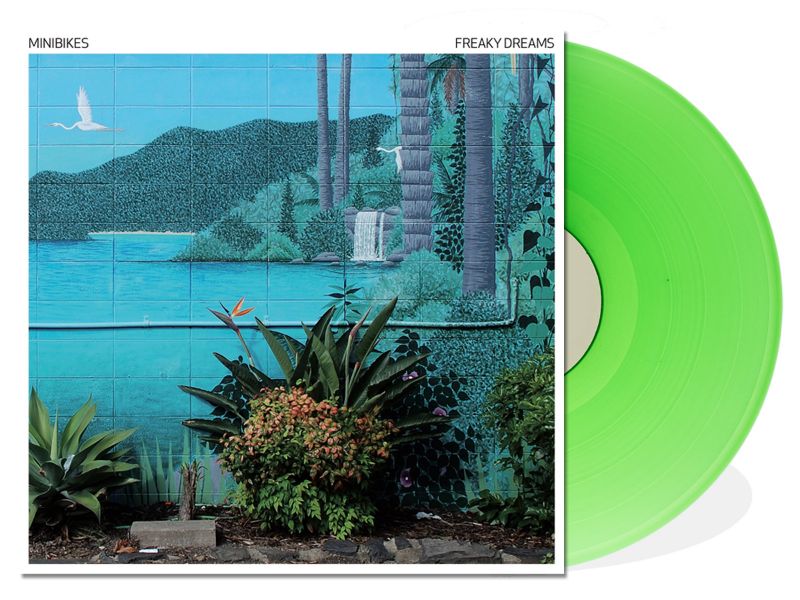
Minibikes have been soundtracking Australia’s endless summer for over a decade now, releasing their debut collection of tropicana rock ‘n roll For Woods Or Trail in 2011. Since then the somewhat elusive four-piece of Marcel Borrack, Libby Chow, Nathan Farrelly and Al Barden have been scarce on the live music scene, having played a handful of intimate gigs in their time together, but are gearing up to change this trend in a post-COVID world, no doubt to welcome their forthcoming album Freaky Dreams to the world. Their sophomore LP was recorded with Tim Harvey (Jade Imagine, Gena Rose Bruce) and is released today. Available now through Cheersquad’s Bandcamp in a limited edition fluro green or black vinyl.
Things happen slowly in the world of Minibikes… Time seemed to be a big influence on writing, recording and releasing this album. It all started when I walked past the mural that’s on the album cover. It was an aquamarine slice of paradise on the side of a motel, and it set the mood for writing the songs. I wanted to capture lush fantasy and grimy reality in the same place, so I spent a long time gazing at this scene, trying to evoke that feeling in the songs. Along the way I’d be in other towns on the east coast of Australia and similar images of palm trees and whales would reveal themselves, as if by magic they seemed to be everywhere like in some freaky dream. I discovered they were all the work of artist Geoff Slater, who turned out to be awesome and generously allowed me to use the cover image. When I emailed him and explained how I’d been inspired by his work he said “Inspiration has natural power”. I thought “Wow, this guy walks the walk”, so I wrote “Magic Happens” as a tribute to the beachy, 70’s new-age vibes I was imagining him exuding. Now I’ve never met Geoff and I may be completely misrepresenting him in my thinking, but without a doubt he’s a big part of the Freaky Dreams story.
The rest of the songs followed, all of them trying to meld seemingly disparate imagery or instrumentation into a single, if slightly blurry vision. The kind of feeling you might get when you stare into a mural too long I guess.
Released June 12th, 2020
Another freaky dream from the Minibikes featuring Snowy “Freaky Dreams” out on Cheersquad records and tapes.