Camp Trash have been a big deal on Twitter for a while now despite not actually releasing any music. The burgeoning hype is probably related to Keegan Bradford who is an editor at The Alternative and a highly active Twitter presence, with Stereogum contributors Ian Cohen and Arielle Gordon being in the band. Whenever someone with any amount of clout in a certain scene starts a new musical project, you always run the risk of that project coasting by on social goodwill. Fortunately, now that Camp Trash have shared the lead single from their debut EP, it appears they’re legitimately very good.
The band, whose members are spread out around the country, claims influence from the likes of the Get Up Kids, Oso Oso, and Something Corporate, and you can certainly hear all that in “Weird Carolina,” our first preview of the imminent “Downtiming” EP. There is some Built To Spill resemblance in the vocal melody, which Bradford confirms. And, as you’ll hear, there’s a well-executed lyrical reference to James Taylor.
The band explains that several of the songs on Downtiming were written before Camp Trash officially formed, resulting from Bradford and Bryan Gorman “exchanging voice memos and song ideas while living in different cities.” Bradford adds that “Weird Carolina” is about “moving away from places you love, and the people you love moving away from you, and how those places are usually Georgia or North Carolina.”
When I listened to “Weird Carolina,” I can hear the people who grew up at the same time and listened to the same bands digesting that music and creating something with a bit more distance and polish. I know even a normal January seems interminable, but the last few weeks — cold weather, short days, near-total shutdown, have been some of the toughest of the pandemic. I can’t walk to a friend’s house, but I can walk down memory lane for a few minutes at a time,
Camp Trash debut single from upcoming EP, “Downtiming”. Count Your Lucky Stars Records.
Following the release of debut single ‘Did I Get It Wrong?’, rising newbieDora Jaris back with new track ‘Multiply’.
A shapeshifting and hypnotic track that moves from folk, to grunge, to pop, with a lil’ surprise for you at its midway point too, Dora says of the song, “I’m building a funhouse of songs.‘DId I Get It Wrong?’is the basement, full of my subconscious fears.‘Multiply’ is a spiral staircase leading up to the rest of the house: excited and bursting into a brighter place.”
“Why do I live my life questioning every move I make / Is it a mistake?” That’s the first line from the debut single of New York-born, California raised artist Dora Jar. “It’s funny that my first release is me questioning myself,” Dora says. “I guess my intention is to purge all my worry from the start. If ignoring it means being ignorant then I want to face shit head on, and know myself.”
Despite the admission that she’s harbouring self-doubt, Dora Jar’s vocals exude calm strength and she’s open with her story—in “Did I Get It Wrong” she references her older sister Lueza, who was born unable to walk and talk. When Lueza passed, Dora was even more inspired to sing, dance, and create.
Dora Jar’s first offering is a powerful introduction. Produced by Felix Joseph (Pa Salieu, Jorja Smith) and paired with a striking music video directed by Dora alongside Erica Snyder, it’s the rare type of debut that feels fully formed. It does, however, leave a lot to wonder about what comes next—especially knowing that Jar’s influences range from Gwen Stefani to Outkast. We’ll have to wait and see.
An exciting glimpse at what else she’s got to follow,
The five members of Sun June spent their early years spread out across the United States, from the boonies of the Hudson Valley to the sprawling outskirts of LA. Having spent their college years within the gloomy, cold winters of the North East, Laura Colwell and Stephen Salisbury found themselves in the vibrant melting-pot of inspiration that is Austin, Texas. Meeting each other while working on Terrence Malick’s ‘Song to Song’, the pair were immediately taken by the city’s bustling small clubs and honky-tonk scene, and the fact that there was always an instrument within reach, always someone to play alongside.
Coming alive in this newly discovered landscape, Colwell and Salisbury formed Sun June alongside Michael Bain on lead guitar, Sarah Schultz on drums, and Justin Harris on bass and recorded their debut album live to tape, releasing it via the city’s esteemed Keeled Scales label in 2018. The band coined the term ‘regret pop’ to describe the music they made on the ‘Years’ LP. Though somewhat tongue in cheek, it made perfect sense ~ the gentle sway of their country leaning pop songs seeped in melancholy, as if each subtle turn of phrase was always grasping for something just out of reach.
Sun June returns with Somewhere, a brand new album, out February 2021. It’s a record that feels distinctly more present than its predecessor. In the time since, Colwell and Salisbury have become a couple, and it’s had a profound effect on their work; if Years was about how loss evolves, Somewhere is about how love evolves. “We explore a lot of the same themes across it,” Colwell says, “but I think there’s a lot more love here.”
Somewhere is Sun June at their most decadent, a richly diverse album which sees them exploring bright new corners with full hearts and wide eyes. Embracing a more pop-oriented sound the album consists of eleven beautiful new songs and is deliberately more collaborative and fully arranged: Laura played guitar for the first time; band members swapped instruments, and producer Danny Reisch helped flesh out layers of synth and percussion that provides a sweeping undercurrent to the whole thing.
Throughout Somewhere you can hear Sun June blossom into a living-and-breathing five-piece, the album formed from an exploratory track building process which results in a more formidable version of the band we once knew. ’Real Thing’ is most indicative of this, a fully collaborative effort which encompasses all of the nuances that come to define the album. “Are you the real thing?” Laura Colwell questions in the song’s repeated refrain. “Honey I’m the real thing,” she answers back.
They’ve called this one their ‘prom’ record; a sincere, alive-in-the-moment snapshot of the heady rush of love. “The prom idea started as a mood for us to arrange and shape the music to, which we hadn’t done before,” the band explains. “ Prom isn’t all rosy and perfect. The songs show you the crying in the bathroom,, the fear of dancing, the joy of a kiss – all the highs and all the lows.”
It’s in both those highs and lows where Somewhere comes alive. Laura Colwell’s voice is mesmerising throughout, and while the record is a document of falling in love, there’s still room for her to wilt and linger, the vibrancy of the production creating beautiful contrasts for her voice to pull us through. Opening track ‘Bad With Time’ sets this tone from the outset, both dark and mysterious, sad and sultry as it fascinatingly unrolls. “I didn’t mean what I said,” Colwell sings. “But I wanted you to think I did.”
“Everywhere” by Sun June from the album ‘Somewhere’ out now via Keeled Scales and Run For Cover Records
One of today’s best songwriters & voices. Laura of Sun June plays a couple solo acoustic tunes off the brand new album “Somewhere” !
Somewhere showcases a gentle but eminently pronounced maturation of Sun June’s sound, a second record full of quiet revelation, eleven songs that bristle with love and longing. It finds a band at the height of their collective potency, a marked stride forward from the band that created that debut record, but also one that once again is able to transport the listener into a fascinating new landscape, one that lies somewhere between the town and the city, between the head and the heart; neither here nor there, but certainly somewhere.
Released February 5th, 2021
Laura Colwell: vocals, keys, guitar Michael Bain: lead guitar Stephen Salisbury: guitar Justin Harris: bass
Sarah Schultz: drums
The Sydney-based three-piece Middle Kids release their second album, “Today We’re The Greatest” . Recorded and produced in Los Angeles by Lars Stalfors (St. Vincent, Soccer Mummy, Purity Ring), the follow-up to the band’s award-winning 2018 debut, Lost Friends, is their most personal and courageous effort to date. Moving away from lyrics of a more conceptual nature,Today We’re The Greatest is the open, uninhibited product of fearless collaboration. Showing a real vulnerability, Joy is pulling directly from her own experiences and breaking down barriers she had previously set for herself.
The album includes “nervy Strokes-esque floorfiller” (The Guardian) “R U 4 Me?” and their monumental new single, “Questions”, a charged three-minute odyssey which sees Joy struggle poetically with concepts of honesty and intimacy over an explosive rhythm section and a stunningly orchestrated brass-filled climax.
Here is our new song ‘Cellophane (brain)’. sometimes i picture my noisy brain as a crinkly bit of coloured cellophane. not sure what jung would say about that but i think it just means i don’t have a good grip on human anatomy.
Other tracks like “Run With You”, were written when Joy was a few months into pregnancy with her and Tim Fitz, her husband and bandmate’s, first child. They recorded her 20-week sonogram, and wove the gentle, rapid thump of their baby boy’s beating heart into the last 20 seconds of the track -an exuberant declaration of devotion. Joy’s journey to motherhood and her marriage with Fitz has imbued her songs with a vibrancy that’s unabashedly romantic yet free of clichés. There’s also “Stacking Chairs,” with its unique allegories and Joy’s sunny vocals, that strikes this delicate balance beautifully: it’s a testament to her deep connection with Fitz and the new, “infinitesimal” love that transformed their lives with their son’s arrival.
“Cellophane (Brain),” the new single from Middle Kids’ forthcoming album ‘Today We’re The Greatest,’ out March 19th, 2021. Domino Recording Co Ltd
If 2020 was a year for flexibility, then 2021 is the year where everyone will be showing off what they’ve been up to. Wolf van Elfmand has a head start — the author of the sweetly earnest tune “Flexible Cowboy Man” has his new album “All Blue”, to show for his quarantine pains. Van Elfmand is also from NYC, leaving cowboy yoga behind in Denver for whatever path awaits him here in the five boroughs. I talked the album up in last week’s podcast episode, but I wanted you all to get another listen to the bluesy “Way Down in Denver.”
While most of the album is comprised of sweet folksy blues, All Blue picks up when Van Elfmand is giving vent to a little spleen.
“This is the first full-length record that I wrote, produced and mixed. The conception of the album occurred when I started to learn how to sequence drum parts on my recording software. I was listening to artists like JJ Cale who frequently used drum machines and wanted to take a stab at it,” Van Elfmand . “At the onset of quarantine I had written a bunch of new songs in April. Without being able to play with other musicians, I wanted to find a project to give them life. This record is truly a product of 2020. While shacked up at a house in Northwest Michigan I spent the month of May recording the majority of the album. The bass parts and pedal steel were done remotely and the backing vocals were then added for a final touch. It’s a guitar-heavy album that lends itself more to a vibe than other lyric-centric stuff I’ve released.”
Indeed, the album is best experienced on a foggy day with a nice cup of tea: Van Elfmand’s hazy sadness truly captures those early days of spring 2020, and the solace we all continue to need.
Wolf van Elfmand writes songs and plays the guitar. His music explores genres within the Americana realm from finger-pickingfolk to alternative country to good ol’ fashioned rock & roll. As a solo artist and producer, Wolf’s albums contain different ensembles and players. With no touring in sight, Van Elfmand has plans to release some new music in 2021 so keep your eyes peeled and ears perked.
“All Blue” · Wolf Van Elfmand Released on: February 12th, 2021
The Bones of J.R. Jones—the project of New York singer-songwriter and guitarist Jonathan Robert Linaberry—will release a new EP called “A Celebration”, which was largely inspired by the sprawling deserts of the Southwest. Today he shares the EP’s second single, premiering below, and it’s a wistful, weathered folk number about yearning to “Stay Wild.”
I don’t mind the night / and the dark it brings / to my skies, Linaberry croaks in the opening verse, his voice more ember than flame. Later, Linaberry sings like he’s praying, or like he’s trying to submit to something larger than himself: I want the tinny taste of love / across my teeth / I want to feast / I want to be / a storm raging / I want to believe / in the American Dream.
“It’s the perfect distillation of what I wanted the EP to feel like,” the Catskills musician tells American Songwriter of “Stay Wild.” “It set the precedent and tone for the rest of the songs. I really wanted to tap into the vastness of the desert, which can make you feel so small, but there’s a certain strange freedom that comes with that smallness, with that insignificance—you feel exposed and in a way that makes you more open to the unknown wildness all around you.”
“Stay Wild” also arrives with a video—directed by Joshua Zimmerman and choreographed by Jacqui DeFranca—that shows a scruffy, stick-wielding Linaberry dancing in the headlights of his pickup truck. The flick, featured below, is a visceral complement to the song.
“I wanted ‘Stay Wild’ to toe the line of realism and the fantastical,” says Linaberry. “It was important to me that it reflects on how the mundane parts of life can overflow and the only outlet would be an ungraceful somewhat ugly response. In the case of the video, it was a dance performed by someone who does not dance… Hopefully once you lose yourself in that moment something spectacular could happen.”
“The EP and the art that comes along with it really does reflect every aspect of this song for me,” he explains. “The prints, the designs, the songs, the melodies, the words… all of it was designed to reflect a restrained explosion or an appreciation of that explosion. I wanted to feel it in my chest, but not have it be so otherworldly that it was unrelatable. Everyone can fall into the monotony of their days and then at some point, there is a subtle pop, a change, something that makes you want to get lost, to live, to lose yourself to a whim. That’s what I was after with A Celebration.”
You can hear that profound, lose-yourself quality in every fibre of “Stay Wild.”
Copenhagen’s Iceage will make their Mexican Summer Records debut on May 7th with “Seek Shelter”, their fifth album and first since 2018’s Beyondless. The Danish rockers shared another preview of the album in the form of new single/video “Vendetta” a menacing, yet danceable blues-rock track that moves in a fashion somewhere between swaggering and stumbling. “This ain’t no place for a sightseer,” Rønnenfelt warns, his impressionistic lyrics conjuring hazy images of transaction, exploitation and retribution. He swears vengeance over swaying shakers and drums, rowdy guitars and a monolithic synth hum that swells as “Vendetta” crescendoes, with discordant horns only sending it deeper into its dark downward spiral.
Of the album as a whole, Rønnenfelt had this to say: “When we started, I think we were just lashing out, completely blindfolded with no idea as to why and how we were doing anything. For Seek Shelter, we had a definite vision of how we wanted the album to be carved out, yet still the end result came as a surprise in terms of where we sonically were able to push our boundaries.”
A decade on from New Brigade, an instant punk record made by four Danish teenagers that came out of nowhere and inspired total devotion around the world, Iceage’s fifth album and label debut is a thrilling new chapter for the band. Produced by Sonic Boom (Pete Kember of Spacemen3) and mixed by Shawn Everett (Haim, The War on Drugs), Iceage come with a new emotional palette ripe with psychedelic flourishes, romantic piano balladry, invocations of patron saints and even a gospel choir for a song or two. Seek Shelter is a striking new direction for a band at their most expressive and expansive, recorded in a dilapidated wood-paneled Lisbon radio studio with a steady rain dripping through the ceiling. Equipment was arranged around puddles and slowly-filling buckets, garden lamps lit up the high-ceilings and a special record was made.
Sonic Boom (aka Pete Kember) produced the album. It includes “The Holding Hand,” a new song the band shared at the start of the February. The band’s line up features Elias Bender Rønnenfelt, Jakob Tvilling Pless, Johan Surrballe Wieth, and Dan Kjær Nielsen. An additional guitarist, Casper Morilla Fernandez, also joined them to record Seek Shelter, which was mixed by Shawn Everett.
Of the new single, Rønnenfelt had this to say in a press release: “Crime is the undercurrent that runs through everything. If you don’t see it, you’re not looking. In its invincible politics, it is the glue that binds it all together. ‘Vendetta’ is an impartial dance along the illicit lines of infraction.”
Director Jonas Bang directed the “Vendetta” video, which features actor Zlatko Burić alongside the band. Bang had this to say: “We wanted it to be less 1:1 story and more short format collage-ish like if you flick through a chapter in a book reading a bit here and there.”
The band’s previous album, Beyondless, came out in 2018 on Matador Records.
Iceage – “Vendetta” from the album ‘Seek Shelter’ out May 7th on Mexican Summer Records,their first for the label.
‘Romantic Notions’, the fourth album from Sydney post-punks Mere Women, confronts its listeners with a question about the nature of “romance” itself. We tend to think of romance, broadly speaking, in its simplest and most wholesome terms – a rose-tinted equivalence with love and fulfilment. But what of the word’s more sinister connotations? That is, the romanticising? If romantic notions are ultimately just that, how do we come to terms with the way they shape how we move through the world?
That tension forms much of the new record’s conceptual background. ‘Romantic Notions’ is not an easy listen, as it focuses on the coercion, obsessive love and controlling behaviour faced by women throughout time, and interrogates the way idealism can become a coping mechanism in otherwise fraught circumstances.“That term ‘romantic notions’, for me, it’s really double-edged,” explains singer and keyboardist Amy Wilson. “It’s really beautiful, and it sounds so lovely, but it’s also quite a naive state to be in, I think. It can be quite disempowering to live in a dream world of romantic notions.”
Wilson’s song writing is direct, economical, and plays a lot with repetition and motif. It’s a style well-suited to an album like this one, where lyrics are presented as intimate internal monologue. On album track ‘As You Please’, against a wave of discordant guitars and frenetic rhythms, she repeatedly sings, “Take what you want as you please / I’ll wear my heart on my sleeve”, a crescendo that epitomises the desperation, yearning and quiet hope that underpins ‘Romantic Notions’.
Women’s lived experiences have long informed Wilson’s song writing. They were particularly influential on Mere Women’s previous album, 2017’s ‘Big Skies’, written largely while Wilson was living in regional NSW. Exploring the expectations placed on women of her grandmother’s generation, along with the experiences of women in remote communities, the record juxtaposed its spacious textures with lyrics about being penned in and held back by tradition. ‘Romantic Notions’ – which is out this Friday – continues to examine those themes, with Wilson drawing heavily on her generational family history.
“This record was kind of brought about by my family, and particularly my grandmother, who recently gave me a whole stack of her mother’s diaries. And they’re amazing to read – how intensely she felt about everything, and how she was held back and mistreated by people around her, but she still held onto these really romantic ideals about how her life should be and would be.”
Given its subject matter, Wilson says it’s the most personally connected she’s felt to a Mere Women album, the closest to home she’s ever written. NME asks what it was like delving into such personal content, and about the kind of responsibility that comes with communicating stories like the ones Wilson does on ‘Romantic Notions’.
“I get obsessed with certain things, and it goes over and over and over in my mind,” Wilson says. She pauses.“It’s really complex, because I look at people in my family, especially women of older generations – I see all the things that they struggled with, how hard it’s been for them to find their identity, to find their way in the world independently of whoever their partners were. For me, I feel so lucky. There’s still challenges, of course, but these stories have affected how I’ve turned out as well. I feel so honoured and privileged that they’ve been able to share those stories with me, and I just want to be able to pass them on.”
‘Romantic Notions’ is Mere Women’s most accessible and cohesive record, the culmination of the 11 years spent finding their identity. It’s a refined version of what they’ve always done best: pairing urgent, angular guitars with atmospheric soundscapes, propulsive rhythms with Wilson’s Siouxsie Sioux-esque vocals. While ‘Big Skies’ was an album full of masterful performances, ‘Romantic Notions’ feels more focused on the band locking in with each other, each part in service of the song.
That may be due in some part due to the conditions in which the songs on ‘Romantic Notions’ first came together. Much of the album was written in a rustic house on the Hawkesbury River shared by Wilson, guitarist Flyn McKinnirey and bassist Trisch Roberts. An hour out of Sydney, it takes driving through national park for 15 minutes to get to the small town the house is located.
The trio – along with drummer Mac Archibald, who makes his recorded debut with the band on ‘Romantic Notions’ – crafted a huge deal of the record collaboratively, all crammed together in the house’s living room.
“It was really nice to not be in a studio in the city at 9pm on a Thursday night, trying to jam,” Wilson says. “We’d spend the whole day or the whole weekend just hanging out and playing, having lots of tea and coffee breaks and diving into the river when we felt like it. “It was just such a different way to write a record than we’d been used to in the past. This was a way less isolating experience, even though we’re still in a remote sort of place. We could all easily be together.”
Wilson formed Mere Women back in 2010 alongside McKinnirey and drummer Katrina Byrne, who played with the band up until 2017. Debut singles ‘Sun Rising’ and ‘Waves’, released shortly after the band’s formation, were stark no-wave cuts that commanded attention in the makeshift warehouse venues the band emerged from.
Following on from members’ previous acts like Ohana and Little A, Mere Women became a distinctive figure in Australia’s underground punk scene, finding their peers more through a shared DIY ethos than similarities in genre. Debut album ’Old Life’ arrived in 2012, with its follow-up ‘Your Town’ two years later. Roberts joined in 2016, and Archibald after the release of ‘Big Skies’ in 2017.
Throughout the decade, across a handful of records and line up changes, they found a home in the community fostered by the likes of inner west institutions like Black Wire Records and the Red Rattler, along with Beatdisc in Western Sydney. They were part of a sea of fiercely independent bands creating esoteric music, by and for the small niche who passionately championed it.
In 2021, things look different. Black Wire’s physical store and venue on Parramatta Road in Annandale, where the band regularly performed and rehearsed, has been gone for a few years – leaving a gap that has yet to be filled. Similar venues have had to weather the impacts of the pandemic over the last year, and the small, intimate shows that bands like Mere Women found an audience in were stopped dead in their tracks. While the band’s recorded output is captivating listening, they’ve always thrived most in a live context.
“I miss it so much,” Wilson says mournfully. “It’s like a piece of me is missing. I love playing live, and it’s such an important part of my life. And I knew that, but you don’t know what you’ve got until it’s gone.”
Though shows in Sydney have been able to safely return in recent months, the way they’ve been able to take place feels somewhat incongruous with the kind of community Mere Women emerged from. Large venues capable of hosting seated, socially-distanced shows may have begun to recover, but the impact on small, community-oriented spaces remains yet to be fully seen. Wilson says that while they haven’t found the right setup just yet, they’re planning on eventually touring ‘Romantic Notions’, excited at the prospect of bringing these urgent, visceral songs to a sweaty room once more.
‘Romantic Notions’ is out March 5 on Poison City Records
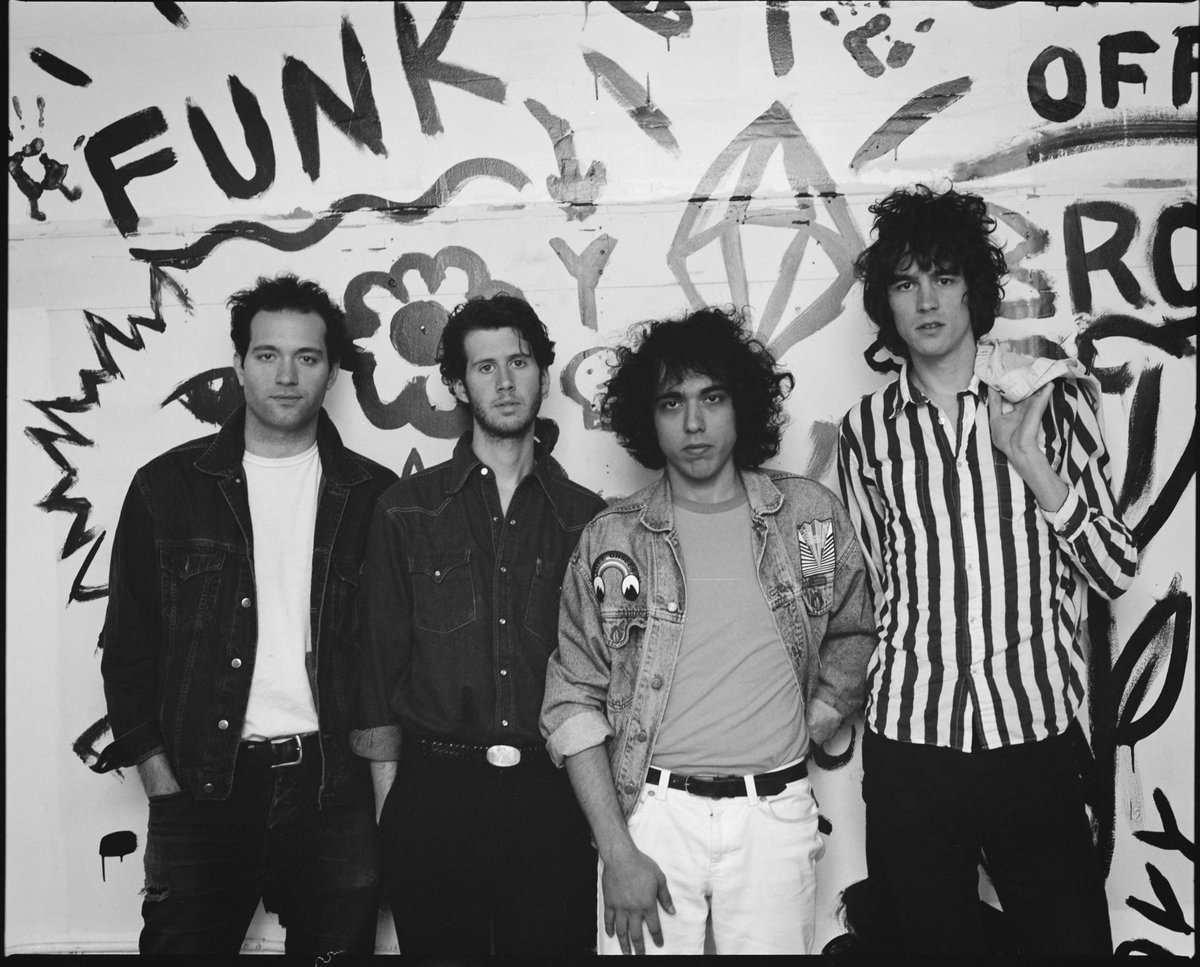
As The New York Times tells the story, lead guitarist and vocalist “Emir Mohseni, was inspired by the Strokes to pursue a career in music — a passion that brought him to New York all the way from his native Iran.” The move, profiled across acclaimed publications, from Rolling Stone to Billboard, only marked the beginning of the band’s story. Upon landing in this new environment, Mohseni met the three guys that would become his closest friends, and build with him the vitalizing sound and enrapturing live show that The Muckers are garnering early praises for: Anthony Azarmgin at the bass, Chris Cawley on rhythm guitar, and John Zimmerman behind the drums. These guys show a lot of promise, and have the potential to blow up in popularity in a couple more years! Can’t wait to see them live!
“New York City’s layers of continuous noise have become the backdrop to a rising four-piece that NME already calls “one of New York’s most exciting new bands.” Just like the city, The Muckers’ sound is equal parts vital and timeless, resolute and vibrant.
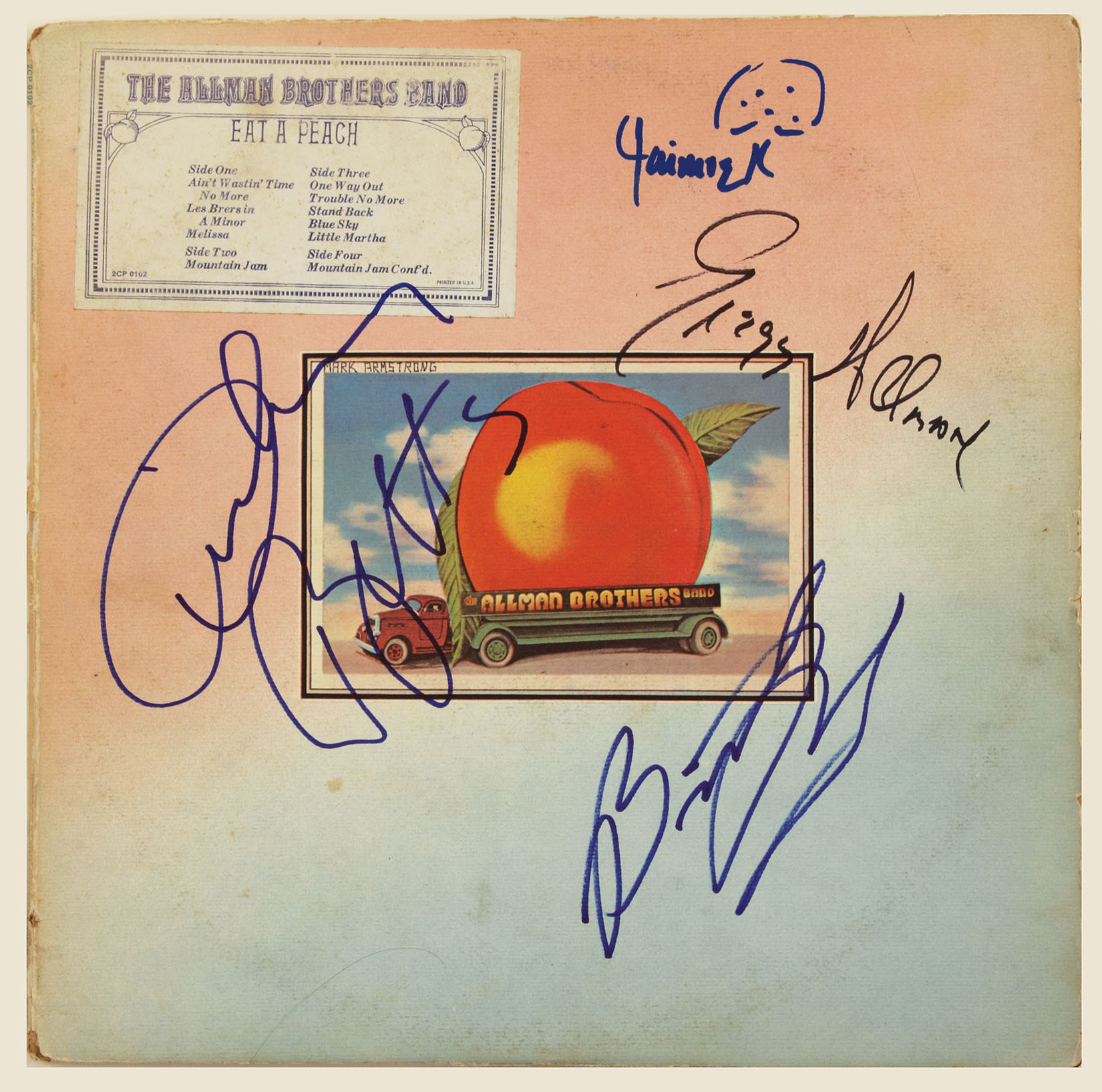
“Eat a Peach” is the third studio album by American rock band the Allman Brothers Band. Produced by Tom Dowd, the album was released on February 12th, 1972, in the United States by Capricorn Records. Following their artistic and commercial breakthrough with the release of the live album “At Fillmore East”. When guitarist Duane Allman was killed in a traffic accident on October 29th, 1971, the Allman Brothers Band was only partway through recording their third studio album at Criteria Studios in Miami, Florida. Following these tragic events, lead guitarist Dickey Betts gradually took over the role as group leader. The band returned to Miami in December to complete work on the album. Twiggs Lyndon, a friend of the band, joined them; he had just completed a stay in a psychiatric hospital stemming from his 1970 arrest for the murder of a concert promoter. Lyndon became the band’s production manager.
They had worked on “Blue Sky,” “Little Martha” and “The Road to Calico” (later titled “Stand Back”) during September sessions with Atlantic Records’ ace producer Tom Dowd. Earlier that year Duane told a journalist the band was “on a mission” to fulfill its promise, after several years of struggling to find an audience outside the bars and small clubs of the South.
Their live double-LP, At Fillmore East, released in July 1971, had indeed established them as a top performing act, but the recording studio still felt a bit alien. Guitarist Dickey Betts said that he didn’t really understand recording work until they entered Criteria Studios for another album: “It seemed like a prostitution of music. You been out playin’ in bars, then you go on to concerts, and it’s always the raw communication between people. But here you are in this tin can with a bunch of machines all ’round you, and you’re expected to produce. It takes a long time to get used to it.”
With the group finally financially solvent, there was more than enough money for drugs and booze and high living, always a temptation for the volatile personalities in the band. By early October 1971 four of the extended Allman family were fighting a heroin habit in a primitive “rehab” program at Linwood-Bryant Hospital: bassist Berry Oakley, Duane Allman and roadies Robert Payne and Joseph Campbell. Duane’s brother Gregg, who sang and played keyboards with the group and had his own demons, later recalled that in 1971, “We were taking vitamins, we had doctors coming over, sticking us in the ass with B12 shots every day.”
After Duane’s death, there was never a real chance they’d change the name of the Allman Brothers Band (they would never ditch that plural) or retire from the road. Betts told the New Musical Express’ Roy Carr, “Apparently, we were all of the same mind. The best way to relieve the immense pain we felt deep inside was to get back together again as soon as possible and go out on the road. We had agreed that we all wanted to stay together and keep the band going, therefore the only way we could try to forget what had happened was to carry on as if nothing had happened.” Predictably, denial only went so far.
Betts and Allman had achieved a nearly telepathic musical relationship on stage, where their lengthy guitar interplay couldn’t be considered “duels,” but rather a unified sound, each integrating their immensely intense guitar vocabularies. “When Duane was in the band, he’d play something and then I would try to extend what he was doing,” he told Carr. “Communication had always been our note. We didn’t tread on each other’s notes, Duane and I just used to listen to each other’s licks…it almost got to the point where Duane and I were thinking as one man, and believe me, it’s a very nice thing to get yourself into.”
They never seriously considered replacing Duane with another guitarist; Betts would have to do the work of two. Returning to Criteria in November and December, the band (which also included the astounding drum/percussion duo of Butch Trucks and Jai Johanny Johanson) completed “Ain’t Wastin’ Time No More,” “Les Brers in A Minor” and “Melissa.” It was decided the studio cuts would be supplemented by live recordings to create a double-LP. It was dubbed “Eat a Peach“, taking off from what Duane had told a journalist who questioned him about what the band was doing “for the revolution.” He replied, “There ain’t no revolution, only evolution, but every time I’m in Georgia I eat a peach for peace.” Insiders knew that Duane was jokingly referring to the two-legged, female “Georgia peaches” back home. Completing the recording of Eat a Peach raised each members’ spirits; Allman said, “The music brought life back to us all, and it was simultaneously realized by every one of us. We found strength, vitality, newness, reason, and belonging as we worked on finishing Eat a Peach”.”Those last three songs just kinda floated right on out of us … The music was still good, it was still rich, and it still had that energy—it was still the Allman Brothers Band.
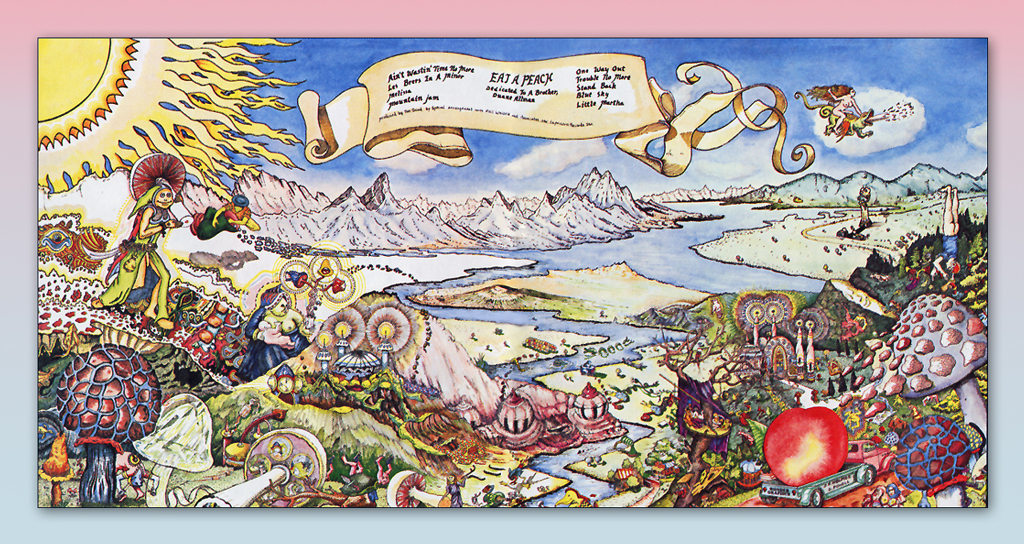
Eat a Peach, adorned with a magnificent gatefold sleeve designed by Jim Flournoy Holmes and W. David Powell of Wonder Graphics, was released in late February 1972 and “went gold” immediately, A line on the artwork read simply, “Dedicated to a brother.”
“Ain’t Wastin’ Time No More,” Gregg’s heartfelt tribute to returning Vietnam War veterans, his brother and his own spiritual development, kicks off the album: “Last Sunday morning, the sunshine felt like rain/Week before, they all seemed the same/With the help of God and true friends, I come to realize/I still had two strong legs and even wings to fly/And oh, I ain’t wastin’ time no more/’Cause time goes by like hurricanes, and faster things.
On the November-December recordings, Betts expertly plays the slide parts that would have been assigned to Duane, plus his own regular rhythm and solo parts, using Gibson Les Paul, SG and ES-335 models. Gregg is on both piano and organ, a potent combination that was popular with the likes of The Band, Procol Harum and others during this period.
“Les Brers in A Minor,” written by Betts, is nine minutes of blissful improv, melodic flights and dramatic loud/soft dynamic changes, not far from what the Grateful Dead were doing at the time. Trucks plays tympani, vibraphone and gongs, and Johanson adds congas, on top of their regular drum kits. The main theme doesn’t kick in until the four-minute mark, and Gregg gets the first solo, on organ, before a meaty drum break and Oakley’s funky bass lay the groundwork for a Betts solo (at this point we could be listening to a Santana outtake). It’s an impressive, experimental piece.
The beautifully poetic “Melissa,” written by Gregg and Steve Alaimo, was actually composed in 1967. Gregg thought it was a bit tame for the Allman Brothers Band, and saved it for a solo album he’d make someday, but the Eat a Peach take is one of the band’s most enduring hits, The melody is gorgeous, the playing delicate (Gregg handles the acoustic guitar and keyboards, Betts the electric guitar leads), and Allman’s vocal is a master class in understated passion: “Crossroads, seem to come and go/The gypsy flies from coast to coast/Knowing many, loving none/Bearing sorrow, having fun/But back home he’ll always run/To sweet Melissa.” Listen to what he does with his vocal control on the bridge, starting with “Again, the morning’s come.” And this is perhaps Berry Oakley’s greatest bass work with the Allmans, at least on a ballad.
Two entire sides of the original LP are turned over to a 33-minute live “Mountain Jam,” recorded at the same March 1971 dates that yielded At Fillmore East (four entire sets were taped). An extended riff on Donovan’s song “There Is a Mountain,” there are even longer and better versions in the full Allmans discography, but this one is a fine example of the coil-and-release dynamics of the band in full flight.
The version of Muddy Waters’ “Trouble No More” from the second show on March 12th ignites Eat a Peach further, with Duane spectacular on slide and his brother’s vocal one of his very best. “One Way Out,” from a June 27th, 1971, Fillmore East date, is likewise prime Allmans, Duane on fire on slide, the rhythm section driving like mad, and Betts laying down a fluid, super-bluesy solo. The single release of “One Way Out” has been one of the most-played tracks on FM radio for the last 50 years.
The album concludes with the zippy “Stand Back” (a Gregg Allman-Berry Oakley co-write for which Gregg Allman pairs organ and electric piano), “Blue Sky” (Betts singing nature-infused lyrics about his girlfriend Sandy Wabegijig, entwining his lovely guitar parts with Duane’s electric and acoustic work), and the only solo songwriting credit for Duane, “Little Martha,” an acoustic instrumental duet with Betts.
On “Blue Sky” the two guitarists trade leads, with Allman soloing at 1:07 and Betts at 2:37. Betts purposely left out “he” and “she” words in “Blue Sky” to make it more about spirit than gender; he originally intended it for Gregg but Duane encouraged him by telling Betts, “Man, this is your song and it sounds like you and you need to sing it.” It was his lead vocal debut, and strangely, given its immense popularity, it was never released as a single. Eat a Peach’s final tunes are moving examples of how Betts and Allman could sound like four hands with one brain.
Tom Dowd’s final mixing sessions were curtailed by impending work with Eric Clapton, and veteran engineer/musician Johnny Sandlin stepped in to finish preparing the album, only to be slighted by a lack of proper credit, with a vague “Special thanks to Johnny Sandlin” on the LP liner. The Allman Brothers Band had many decades of success ahead of them: for further reading, Gregg Allman’s memoir My Cross to Bear and Alan Paul’s band biography One Way Out are seminal texts. Many Allmans fans keep Eat a Peach, the poignant and multifaceted farewell to Duane, closest to their hearts.
Rolling Stone‘s wrote that, even without their leader, “The Allman Brothers are still the best goddamned band in the land … I hope the band keeps playing forever—how many groups can you think of who really make you believe they’re playing for the joy of it?” In Christgau’s Record Guide: Rock Albums of the Seventies (1981) called side three “a magnificent testament”, but was relatively unimpressed by the rest of the album, especially the low-tempo “Mountain Jam” sides: And all the tape in the world isn’t going to bring Duane back.” In a retrospective review, AllMusic gave the record a solid five stars, calling the record a showcase of “the Allmans at their peak”. David Quantick of BBC Music also considered it their “creative peak”, praising the album’s “well-played, surprisingly lean bluesy rock”.





 The Fat Angel Sings