Just over two years ago, Sophie Allison was writing melodic bedroom rock ahead of a move from her native Nashville to New York to study music business at NYU. During that time, she started to find a burgeoning fanbase on Bandcamp for her wistful demos under the name Soccer Mommy, which chronicled the harsh realities of the teenage experience. During her tenure at NYU, she began playing live shows around Brooklyn, building a presence in the DIY scene, and it wasn’t long until she caught the ears of Fat Possum (the influential independent label who’ve released records by Wavves, Youth Lagoon, and Lissie) and her life changed.
Still aged just 20, Allison is reeling from her rise to indie-rock stardom. On her recently released debut album Clean, she self-reflects, translating the loneliness and crushing disappointment that comes with being a teenager into intimate musings – a confessional sound that similarly launched the careers of Mitski and Julien Baker. However, age aside, Allison believes her music is universally relatable. “I think it resonates with people because it’s about struggling to be open, honest and take risks: struggling with your own identity,” she explains. “Everybody feels that at some point in their lives.”
Take for example her latest single “Cool”, a raucous track where Allison lilts about what it means to be the “cool girl.” Despite its initial appeal, her pursuit of the “cool girl” trope ends up creating her own unhappiness. Instead, she finds more solace in being herself. In Allison’s video for the track, premiering below, she explores “the depth beyond the image of coolness.” Playing with the idea of cool, Allison blossoms into different versions of herself, all the while interspersed with animated ice cream sandwiches, pot leaves, and crayons. She becomes one of the guys, clad in aviators and a leather jacket; a rocker who flaunts fuschia wing-tip eyeliner and a Hot Topic necklace; and a heartbreaker who chops off the hair of a Ken doll, ultimately revealing that “cool” doesn’t mean just one thing.
Taken from the debut, Clean, available on Fat Possum Records
John Parish is best known for his work with acclaimed British artist PJ Harvey, which dates back to when she was backing singerand guitarist in his cult band Automatic Dlamini. He is also an accomplished composer, solo artist, & producer. Parish co-wrote and performed on Eels’ 2001 album Souljacker, and has worked with many different artists , Sparklehorse, 16 Horsepower, Tracy Chapman, Adrian Utley and Howe Gelb/Giant Sand
PJ Harvey guests on “I’m Sorry for Your Loss,” a new song by her frequent collaborator and producer JohnParish. The song pays tribute to Sparklehorse frontman Mark Linkous, who died by suicide in 2010. Parish produced Sparklehorse’s 2001 album A Wonderful Life.
Harvey and Parish sing morose lyrics like “The sun never felt colder/The window rattled and I wondered if you’d just passed over” amid strummed acoustic instruments and a sorrowful melody. The three-and-a-half–minute track will appear on Parish’s upcoming album Bird Dog Dante, which is due out June 15th.
On May 18th, Ohio-based band The Sidekicks will release their fifth album, Happiness Hours. Produced, engineered, and mixed by John Agnello (Sonic Youth, Dinosaur Jr., Kurt Vile), Happiness Hours features some of the sunniest, most ebullient songs The Sidekicks have ever recorded—all ringing guitars, charging drums, and soaring vocals.
That dynamic is more than apparent on the infectious lead single “Twin’s Twist.” With its warm harmonies and shining melody, bouncing groove and bittersweet lyrics, “Twin’s Twist” also reveals the more narrative-driven direction that The Sidekicks pursued in creating Happiness Hours. As vocalist/guitarist Steve Ciolek explains, those narratives reach squarely toward a kind of universal experience.
“They are relative to my life, but they aren’t just about me,” says Ciolek, whose bandmates include drummer MattClimer, guitarist/vocalist Toby Reif, and bassist/vocalist Ryan Starinsky. “Unlike when you’re a kid, when every song has to be about falling in love or breaking up—about me, me, me—you get to a point when you really want your art to be inclusive. You want everyone to be able to locate themselves somehow in your songs.”
With a woozy, synth-laced sound that could pass for Ariel Pink after a couple night caps of NyQuil, the latest single from Holy Wave’s looming Adult Fear LP is exactlywhat we want to be hearing right about now.
Wrap yourself in the warmth of “Habibi” below, right alongside the Austin band’s commentary and a couple other selections from the magnum psych-infused opus that’s dropping on March 30th….“Habibi” represents the fall of the hero with a thousand faces. In every story and every history book, there is a point where we all experience a fall from grace. It is something necessary and human.
Or as Albert Camus once said, “I used to advertise my loyalty and I don’t believe there is a single person I loved that I didn’t eventually betray.”
Holy Wave is back with a new album Adult Fear, which arrives via The Reverberation Appreciation Society. The record sees the Austin quintet forging deeper into hazy synths and expansive melodies, coalescing the their myriad of influences into a signature sound.
From the Holy Wave’s new LP ‘Adult Fear,’ out March 30th, 2018 on The Reverberation Appreciation Society.
Since the mysterious clip titled “Servings and Portions from my Boarding House Reach” landed on 12th December last year (directed by none other than Jack White III), we’ve been watching it Over & Over . And even though it sounds like turning the radio dial surfing frequencies, the teaser touched our interest. We were reminded how much we ache for Jack White’s striking blue-and-black colour palette (with flashes of chrome and bursts of colour throughout ). Some believed the words that flashed up onscreen – such as Abulia, Papillon, Vache, Real Hands, Kale (plus some upside down words we’re not quite geeky enough to try and figure out) – were titles of songs from Boarding House Reach,. We’ve always considered Jack White to be a separated-at-birth contender for Johnny Depp’s Willy Wonka and this collection of songs is as phantasmagorical as Roald Dahl’s fictional character.
1. connected by love
The first taste of new Jack White material, the album’s lead single dropped on 10th January and those opening bass booms really do call to mind Muse’s most recent single, Dig Down.
When you’ve already seen a song’s accompanying music video, it’s virtually impossible for it not to play in over in your mind every time you hear the song afterwards. The Connected By Love clip is a collage of scenes featuring seemingly unrelated people in different environments: a woman on her death bed, a group of angry youths kicking the shit out of someone, brothers/twins doing their mum’s head in before stumbling upon a dead deer. And then there’s White himself, inside a room in a house somewhere remote. He beats his chest emphatically while trying to convince himself that humans are inherently good, “’Cause I know!/We’re connected by love,” as the gospel BVs emphasise, “We’re connected/We’re connected”. The circle of life (via death), loss of innocence, interplanetary shifts – hang on, they’re all “connected”! Love is all there is, people.
After a whirling instrumental dervish, there’s a glorious, bare-bones piano breakdown. “Don’t forsake me, woman!/And go and choose somebody else,” (as IF, Jack). Yep, this is punch the air, preacher-man stuff and by the time the organ comes in we’re speaking in tongues.
2. why walk a dog
Opening track two, a lumbering drum pattern calls to mind a dog being dragged along on a lead against its will. White asks all the important questions, such as, “Why does a dog need to be walked?” – except that he over-enunciates the word: dawg. White can definitely be a funny fucker as well: “These cats seem to blow everyone’s mind/But mine.”Indeed the bassline evokes a slinky cat stalking and then sneaking up on a bird. There’s a guitar solo that sounds like the guts are being wrenched out of this instrument and amps crackle under the pressure. Occasional organ stabs intensify to become a main melody and this instrument is already a recurring Boarding House Reach motif. Why Walk A Dog proves what we’ve always suspected: White really is Dr Seuss for grown-ups.
3. corporation
This one sounds like it belongs on The Get Down soundtrack. A skittish beat with hi-hats, an organ melody mimics the guitar riff, insistent egg shakers, drum demolition – “WHO’S WITH ME?” WE ALL are. Already. Corporationchanges tack just after the two-minute mark with demented bongos and sounds that fly from one earbud to the other (we almost duck at one point). “I’m thinkin’ about starting a corporation!/Who’s with me?” Then in come White’s piercing squeals, like a toddler protesting while being dragged towards the bath. It’s a freeform instrumental jam. Then White and his travelling band of gypsies march right out the door and off down the street, fading into the distance.
4. abulia and akrasia
Dramatic violin evokes a fortune teller gazing into her crystal ball. “These are my demands…” – hold up, we know that voice! It’s the inimitable CW Stoneking! And his storytelling prowess is undeniable. As is Stoneking’s ability to take us waaaaay back to a land that time forgot. Enter words we need to look up in the Thesaurus such as “abjuration”, “repudiate”, “abdicate” – wouldn’t wanna challenge this character to a game Scrabble! A tambourine shimmers to heighten suspense and honky-tonk piano comes straight from a saloon in Westworld. There’s a cute twist to the tale that we’re not prepared to spoil for ya. And we reckon Stoneking’s kids must get the best bedtime stories ever! He has a bright future in talking books if this music thing doesn’t work out.
5. hypermisophoniac
What are those crackling sounds? A super-fast typing speed? Then thumps suggest Godzilla’s traversing a nearby town. Hypermisophoniac sounds like a malfunctioning arcade game, but piano stabs introduce an organic element. Enter thrashing guitar. “Ain’t nowhere to run/When you’re robbing a bank.” Aha! Maybe those sounds at the start are note-counting machines!? We reckon this one would be a great soundtrack for a robot escaping a facility only to run outta battery life.
6. ice station zebra
These song titles, though! This chugging slice of hi-hat-heavy wonderment with insistent piano chords and trippy organ (or is it that theremin?) would perfectly soundtrack a Looney Tunes cartoon. Then enter White in full flight on a spoken-word rant: “You create your own box you don’t HAVE to listen.” This track particularly is best appreciated through headphones. Wow, the drumming on this album is next-level! And for this we have three drummers to thank: Daru Jones (Nas, Talib Kweli), Carla Azar (Autolux, Depeche Mode) and Louis Cato (Beyoncé, Q-Tip) – we salute you.
At one point the drum pattern is sparse in this song, then things turn cacophonous before it all stops on a dime. In the middle of Ice Station Zebra, there’s a breather during which we can take stock of our thoughts. Then more dialogue (“Come on over you can lick the stamp, son”) with funky keys to boot. “The name of the toon is Cold Hand Luke, ‘cause/I got stripes on my pants and boots” – White’s lyrics are absolutely nuts! Fast riffage then silence.
7. over & over & over
This one’s a more standard rock’n’roll number with killer heavy guitar riffs, loose “WOO!”s and frantic drumming. The rowdy-group backing vocals are quirky, almost The B-52’s-esque. “My shoulder holds the weight of the world.” Pitch-shifted BVs. We just wanna bust out and head-bang along to this track Over & Over & Over. “The rock’n’roller/The young and older/Going back to the stroller.” Guitar screeches underscore actual unhinged human squeals. Many different instruments take turns playing the same five-count main melody. Guitars beg for mercy in White’s hands and then bongos take over, like a galloping heartbeat. “And though you all want me/The gods have all scorned me, now.”
Music video for “Over and Over and Over” from Jack White’s new album BOARDING HOUSE REACH
8. everything you’ve ever learned
“HELLO! Welcome to. Everything You’ve Ever Learned.” There’s Gameboy bleeps and we feel like The Wizard Of Oz is speaking to us from behind a dodgy curtain (pay no attention to that man behind the curtain). Then the system malfunctions and it all goes wonky before bongos that sound like a horse bolting hijack this song’s arrangement. White enters the spectrum in full preacher-man mode again. “Do you wanna question everything?/Then think of a good question!” Those hi-hat-heavy drums return and bongos bring the loco. We feel like Marlon Brando’s Apocalypse Nowcharacter when he was losing the plot! Organ gives this track a religious feel and then White shouts before petering out, “SHUT UP AND LEEeeeeaaaaaaaarrrrrn”.
9. respect commander
Also released on 10th January, this is the B-side to Connected By Love and, as such, didn’t land with an accompanying film clip. Are they experimenting with trying to accelerate into the fastest beat possible? I can’t even type at that tempo! This track sounds like a chase scene in the Mission Impossible franchise and we’re tipping White would choose to do his own stunts. The dynamic variety demonstrated in Respect Commander and its constantly shifting tempos build suspense alongside the scattered, excitable “Whoop!”s. Tambourine shimmers like a rattlesnake. “She commands my respect/And I can’t recollect/A better time in my life… And I cannot protect/My heart from her command.” That guitar work! Prince would approve wholeheartedly. Then it all fades out.
10. ezmerelda steals the show
Gentle strumming, which actually calls to mind REM’s Everybody Hurts, and an endless keys drone underscore layered voices. Spoken-word – reverberant, overlapping voices – sometimes sounds like a poem, other times like a script or stage directions: “Ignoring the beauty of fog on a hill, and a kitten with a mouse in its mouth.”
“You can hear a bootlace…” – what would that sound like? “You people are totally absurd.” Ezmerelda Steals The Show sure is “totally absurd”, but it’s also absolute genius.
11. get in the mining shaft
Synths sound like an old sci-fi movie soundtrack (or Stranger Things?) with what seems to be White recounting the first time he ever encountered an old piano “in an abandoned house” and getting hooked after hitting several notes together at the same time. This album could very well be White’s ode to the piano. Guitars are present, of course – White choosing to play a brand new Wolfgang Special and 5150 amp from Eddie Van Halen’s signature brand on the record – but it’s a remarkably keys-driven set of songs. Enter spacey keys, AutoTuned wah-wahs and a casual, strutting drum pattern. Celestial choirs are like an aural epiphany.
12. what’s done is done
This gently swinging duet – White singing alongside a simultaneous female voice – sounds playful, instrumentally, but the lyrics bring a sinister twist. “What’s done is done/I just can’t fight it no more/So I’m walking downtown to the store/And I’m buying a gun.” Enter an organ solo that takes us straight to church. Amen. Directly after What’s Done Is Done track finishes, White says, “Either you go or I go.” Then a female voice whispers, “Then it won’t be me.”
13. humoresque
You’ll immediately recognise Antonin Dvorak’s Humoresque melody if you’ve ever taken a piano lesson in your life (or listened to your mate practising). White’s voice echoes the notes in Dvorak’s piano cycle, “You thrill and fill this heart of mine/With gladness like a soothing symphony.”
In a recent Rolling Stone interview, White revealed he purchased a musical manuscript that reworks Humoresque, which was written by Al Capone while he was imprisoned in Alcatraz in the 1920s. The fact that a gangster could pen such beautiful words moved White, he says. Boarding House Reach thus concludes like a jazzy lullaby, or “a soothing symphony” according to this song’s lyrics.
Deer Tick proves with their two simultaneously released albums titled, Deer Tick Vol. 1 and Deer Tick Vol. 2 that their punk-roots rock have only gotten better with age since their last LP. The twin albums complement one another but also stand independently. Vol. 1 is classic Deer Tick: folk-rooted acoustic guitars and soft piano cushion out-front vocals. Vol. 2 commits wholly to the band’s longtime garage-rock flirtations for a triumphant foray into punk. McCauley sees the two records as a natural progression as he’s always had one foot in each door. “Every album we’ve put out has had its manic moments in one way or another. I felt good enough about everything that I was writing to think that we could truly separate our two big interests: quiet and loud.”
It’s been four years since Deer Tick’s last release, Negativity. In the meantime, Deer Tick – an all-consuming band known for constant touring and steady artist output – took a backseat. The band – made up of McCauley, guitarist Ian O’Neil, drummer Dennis Ryan, and bassist Christopher Ryan pursued solo and worked on others’ projects. Personal lives also underwent massive changes, especially for McCauley, who married Vanessa Carlton and became a dad. When the band came back together for their beloved after-party shows at the Newport Folk Festival, the reunion reminded them what they missed about creating with one another so they started making plans to go in the studio.
“Jumpstarting” is from Deer Tick’s album ‘Deer Tick Vol. 2’.
McCauley says that he believes “Sea of Clouds” and “It’s a Whale” probably best capture the “extremities” of both records. He’s right, of course: It’s Vol. 1’s quiet vs. Vol. 2’s loud – Deer Tick’s dual personalities, finally channelled onto two distinct and equally brilliant records. “These albums represent a new phase of my life that I haven’t entirely figured out yet,” McCauley says. “I don’t know what’s going to happen but that’s part of the excitement for me.”
Deer Tick are , Robert Barry Crowell, John Joseph McCauley, Ian Patrick O’Neil, Christopher Dale Ryan, Dennis Michael Ryan
Deer Tick are currently on tour in support of their two 2017 releases Vol. 1 & Vol. 2, and they’ll be doing a few shows in Australia some of which are this weekend opening for Jason Isbell before playing a bunch of dates around North America next month.
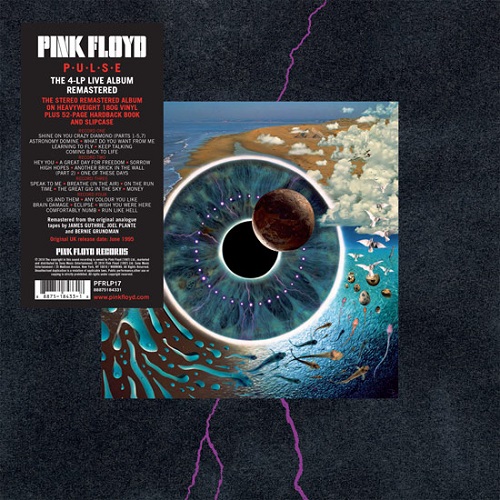
Pink Floyd ‘Pulse’ 180g 4LP vinyl box set reissue with 52-page hardback book, all encased in a thick card slipcase.
Pink Floyd will re-release their 1995 UK Number 1 live album ‘PULSE’, pressed on heavyweight 180-gram vinyl.
‘PULSE’ was compiled by James Guthrie, Originally released in 1995, Pulse was recorded as Floyd toured across the UK and Europe in support of their 14th studio album The Division Bell in 1994.using various performances from the band’s 1994 Division Bell tour across the UK and Europe featuring David Gilmour, Nick Mason and Richard Wright. The album includes ‘The Dark Side of the Moon’ performed in full, as well as a whole side dedicated to the show’s encore.
The 4-LP set includes four different inner sleeves, each inside individual outer sleeves, plus a 52-page hardback photo book, all encased in a thick card slipcase. It will also feature One Of These Days, which was only included on the LP and cassette version of Pulse upon its original release.
This 2018 release was remastered from the original tapes by James Guthrie, Joel Plante and Bernie Grundman. Aubrey Powell of Hipgnosis and Peter Curzon, who worked on the original art with the late Hipgnosis co-founder, Storm Thorgerson, recreated the art package.
Pink Floyd’s ‘P.U.L.S.E. Restored & Re-Edited’, will be released for the first time on Blu-ray on 18th February 2022. The P.U.L.S.E. concert film (helmed by esteemed director David Mallet) will be available as 2x Blu-ray and 2x DVD deluxe box sets, with the video footage having been expertly re-edited by Aubrey Powell/Hipgnosis from the original tape masters especially for The Later Years release in 2019. The cover design, originally created by Storm Thorgerson and Peter Curzon for the 2006 DVD release, has also been updated with photography by Aubrey Powell/Hipgnosis and Rupert Truman/StormStudios.
The packaging artwork is designed by Peter Curzon from StormStudios, under the direction of AubreyPowell/Hignosis. This release also sees the reintroduction of the iconic pulsating light as per the original 1995 CD release, this time operated by 2 replaceable AA batteries. The deluxe packages include music videos, concert screen films, documentaries, Pulse Tour rehearsal footage & more, alongside a 60-page booklet. P.U.L.S.E., originally released as an album in 1995, was recorded on the European leg of the Division Bell tour and the DVD and Blu-Ray packages include the whole live performance of ‘The Dark Side Of The Moon’ – the only full live filmed recording of this seminal album. The concert, filmed on 20 October 1994 at Earls Court in London, saw Pink Floyd play some of their classic tracks as well as highlights from the recently released album ‘The Division Bell’. Standout tracks include ‘High Hopes’,‘Keep Talking’, ‘Sorrow’, ‘Wish You Were Here’, ‘Comfortably Numb’ and ‘The Great Gig In The Sky’.
a brand new 2LP collection of Judee Sill demos, outtakes and rarities making their debut
on 180 Gram vinyl. Songs of Rapture and Redemptions: Rarities & Live will be a limited and numbered pressing.
Judee Sill may not have been commercially successful in her short recording stint, but her influence looms large with recording artists such as Warren Zevon, Andy Partridge, Liz Phair, Beth Orton, Bill Callahan, Bonnie Prince Billy and more having covered her songs. The Turtles recorded “Lady-O” in 1969, two years before Sill’s 1971 debut album on Asylum Records contained that song.
Hailing from California, Judith Lynn Sill was an American singer songwriter born 10/7/44. Her father owned a bar in Oakland and that’s where Judee initially learned how to play piano. Sill met, befriended and started opening shows for Graham Nash and David Crosby in the mid-to-late 1960s. After a bit of interest from Atlantic Records, David Geffen offered Judee a contract and she became the first artist to sign with his then fledgling Asylum label. During her early days at Asylum she sold her song Lady-O to the Turtles and was featured on the cover of Rolling Stone. Graham Nash produced her first single, “Jesus Was A Cross Maker,” off her self-titled debut album which was released on September 15, 1971 and engineered by Henry Lewy who worked with Joni Mitchell throughout the 1970s. The song was inspired by her romance with singer songwriter JD Souther. He later wrote the song, “Something In the Dark,” about her.
The album featured Sill’s voice in multiple overdubs, often in a four-part chorale or fugue. Her debut album was not a commercial success, despite good reviews. Sill took over orchestration and arrangements for her second album, “Heart Food,” which was released in March of 1973. The album was critically acclaimed but sold poorly which ended her association with Asylum and David Geffen. Judee continued to write songs and in 1974 began to record new material planned for a third album that was never finished. By this time she relapsed into more drug use and developed health problems. After a series of car accidents and failed surgery for back pain, Sill continued to struggle with drug addiction and dropped out of the music scene completely. Judee tragically died of a drug overdose on November 23, 1979 at her apartment in North Hollywood. Judee Sill’s music was not commercially viable at the time but was incredibly influential as well as ground-breaking and many notable songwriters admired her work and covered her songs.
“Lean In When I Suffer” is about that fun breed of “ally” who wears out their already exhausted friends by relying on us for excessive emotional labor. They want props for their wokeness, but don’t want to put in any actual work or divest themselves of power. They just take up space, and shut down when you try to talk them through their problematic tendencies. Because #selfcare? So you’re stuck in a toxic vampiric loop trying to maintain a relationship–Lean In And Suffer, why don’t you!
Director Ari Ratner gives the clip a hyperactive cut-and-paste PBS vibe, with lots of clowning and fun costumes, like the one worn by Speedy Ortiz bandleader Sadie Dupuis. The throes of her depression send her to a place with people promising relief, and delivering even worse feelings.
Director Ari Ratner took this concept a step further to address another annoyance we found relatable as hell, which is when “people give unsolicited advice about how to beat depression. [They] typically fail to acknowledge depression as a real illness and often minimize the experiences of the person they are trying to help.” So our OK-to-Cry-Corral band gets put through happiness bootcamp from a group of clowns who’ve “never been sad” (and some accompanying Crayola-bright illustrations from Julia Emiliani).
Ultimately, playing angry rock songs is our favorite form of therapy
“Lean In When I Suffer” is the second single from Speedy Ortiz’s forthcoming album, “Twerp Verse,” out April 27th on Carpark Records.
On this date 45 years ago a new incarnation of King Crimson released the album “Larks’ Tongues In Aspic”. The album marked a radical departure from everything they’d previously done. With guitarist Robert Fripp as the only survivor from the original line-up, the new line-up featuring the heat-seeking work of ex-Yes drummer BillBruford and the virtuoso bass work of ex-Family bassist John Wetton, who also took on vocals, presented a breath-taking tour of killer riffs, jaw-dropping dynamics, and poignant ballads. Featuring pastoral Vaughan Williams-style interludes from violinist David Cross, this line-up embraced a spikier sound that was both willing to rock out as well as explore and experiment with unorthodox textures and atmospherics thanks in part to eclectic percussionist Jamie Muir.
John Wetton helped lead King Crimson away from their influential early prog sound into more free-form areas, as band leader Robert Fripp addedmusicians David Cross, Jamie Muir and former Yes co-founder Bill Bruford to form the group’s short-lived fifth incarnation. The intro to “Exiles” is actually adapted from a piece of music that dates back to shows played by the original 1969 Crimson lineup, but almost nothing about the rest of this song – a great example of this lineup’s ability to move from one eruptive musical texture to another, and then to another still – could possibly be confused with any other era. Over the next two albums, Muir and Cross departed.
When Boz Burrell, Mel Collins, Ian Wallace and Robert Fripp walked off the stage of the Municipal Auditorium in Birmingham, Alabama on April 1st 1972, another chapter in King Crimson’s frequently turbulent history had come to an end. With Burrell, Collins and Wallace staying on in the States to form Alexis Korner’s band, Snape, even before the guitarist returned to London there was speculation as to what the guitarist might do next. “Fripp & Hiseman May Form Band” ran the headline in the New Musical Express.
Although that partnership failed to go beyond an exploratory discussion between the principals, Fripp busied himself during the Summer of ’72 sifting through the cassette tapes of what would become Earthbound, and sounding out potential collaborators. One name suggested to him by Melody Maker writer Richard Williams was Jamie Muir. The drummer and percussionist had been working primarily with the Music Improvisation Company alongside Evan Parker, Hugh Davies and Derek Bailey, had also been a member Pete Brown’s Battered Ornaments. Fripp and the percussionist got together as Muir observes “to see if there was a basis for us working together. I remember I was playing some really fast and furious blow-outs, from a drummer’s perspective it was the Tony Williams / Billy Cobham type of thing. It was fairly energetic stuff and I think we enjoyed ourselves. He didn’t say right then and there ‘OK you’re in’ but I think he said he’d give me a ring.”
Although Fripp and Bruford had discussed working together since Crimson supported Yes earlier in February in Boston, it wasn’t until May that the pair undertook some exploratory jamming at Bruford’s house. “We went into my music room and Robert said: ‘If I played this what would you play?’ Apparently I must have done the right thing because eventually he suggested that we do some more!” recalls Bruford.
“I hadn’t up until that time thought of asking [Bill] because as we all know, he had a good gig with Yes” Fripp told NME’s Tony Tyler. At this stage it was by no means certain the King Crimson would be resurrected. Yet it was while a guest in the Bruford household, and sitting in the bath no less, that the notion of a two-drum line-up came to Fripp. “I suddenly thought ‘Well, Bill’s a lovely drummer but he’s perhaps a little too straight for some things…Then I thought of this nut Jamie Muir whom I’d just met, and I thought, well Jamie’s a great drummer but he’s not really straight enough for some of the things I’d like him to do. Now, while I was sitting in the bath…I suddenly had this vivid idea to use the two of them…and it seemed so right.”
The next piece of the Crimson jigsaw was Fripp’s old friend, John Wetton, who’d been previously asked about joining Crimson when the Islands-era band were coalescing in 1971. It hadn’t felt right back then but after several months with Family the bassist was ready to move on. “One day the phone rang and Robert said ‘I’m round at Bill Bruford’s (he lived around the corner from me in Redcliffe Gardens) and we’re discussing the possibility of doing something. Do you want to pop around?’ So I did. I remember Bill came to the door with a carrot in his hand! I thought it felt good as soon as we started talking and so we put the ball in motion. I was actually in the studio with family still working on Bandstand and Bill had been working with Yes doing Close To The Edge. It wasn’t a jam or anything. We just sat and talked about what we wanted to do.”
For Fripp, a new venture offered the possibility of traversing the musical divide which had opened up after the break-up of the ’69 line-up. With Bruford feeling he’d gone as far as he could with Yes, it was a chance to extend his creative vocabulary. As far as Wetton was concerned there would finally be an opportunity to develop as a singer and composer, a role he was firmly denied as a member of Family.
Until now, the only visual record of Muir performing has been a short extract of the band performing Larks’ Tongues In Aspic” for the Beat Club programme in Bremen. However, with the full session now released for the first time as part of this release we can at last see this Crimson in full flight. Muir stalks around his exotic percussion rig, an avant-garde court jester ferrying the sounds and sensibilities of free jazz to the world of the rock band. “I always remember I had an urge to get Robert to let his hair down because he was very controlled in the way he played” says Muir. “At the TV gig, I really tried and tried to provoke him.”
It’s interesting watching the complete video how much eye contact plays a part in determining the force and direction of the music. “I was an absolute nervous wreck during that TV recording” admits Cross. “I can remember thinking ‘well, I’m going to be found out now’. Looking somebody in the eye means you’re furiously sending messages out and receiving them back. It can be quite terrifying for some people to do that kind of improvising, and you need a certain degree of mutually shared experience and be quite comfortable with the people in order to be able to do that. Somehow it was safer to look John Wetton in the eye than it was to ignore him and be out on your own.”
Returning to the UK, the band announced a huge UK tour that kicked off on November 10th in Hull and ended at Portsmouth’s Guildhall on December 15th. Never before had Crimson undertaken such an expansive domestic tour taking in 27 towns and cities, with only five days off. With Earthbound, released in June on Island’s budget label imprint HELP being the most recent but hardly the most representative album, when the tour began, none of the audience could have been prepared for what they saw and heard. With nearly half of the set given over to extended exploratory work outs, this new King Crimson was undoubtedly the most challenging and uncompromising line-up to date. Opening their concerts with the then-unreleased Heavenly Music Corporation (recorded with BrianEno just two months previously) playing over the PA, the five-piece Crimson took the audience on a dramatic tour of some of rock music’s most extreme environments. Blasted with slabs of skull-crunching riffs, raked with hybrid polyrhythms, taunted by abrasive bouts of atonality and occasionally soothing ballads, audiences were frequently stunned by the encounter. On top of the musical assault, Jamie Muir’s visual theatrics compounded the wonderment so many experienced. It wasn’t just the punters who were shocked by Muir’s performance art-antics of throwing chains about the place and spitting blood whilst glowering at the audience. “Jamie’s onstage persona never manifested itself in rehearsals” recalls Cross. “I could have died when I first saw him start his antics on stage for the first time. I thought it was wonderful but we had no idea he was going to do it – it was completely out of the blue.”
The only familiar point of reference was the inclusion of 21st Century Schizoid Man on the set list, delivered as an encore, almost as a reward to the audience’s patience and trust. This was a radical risk-taking Crimson that during the course of a single concert opened so many portals to diverse and different destinations. Critical reaction to Crimson’s return to the live stage bordered on the ecstatic. The NME’s Tony Tyler described the “spiritual impact” of the group as being comparable to the first Crimson, predicting that this time the potential which Crimson had always had within its reach would at last be grasped. Ian Macdonald wrote in the same paper in December that Crimson produced at least half an hour of the most miraculous rock he’d ever heard, while Melody Maker’s Richard Willams extolled the virtues of their “90-minute barrage of phenomenal creativity”.
Inevitably perhaps, the real challenge facing this Crimson, as it had been for previous line-ups, was somehow bottling all that ferocious energy generated during the course of a concert and getting it down in a recording studio. After an initial stab at recording the quintet at Wessex studios Fripp notes that “fairly quickly it became obvious that it wouldn’t work, particularly for a double drummer configuration. Wessex couldn’t find a drum sound whatever they did. And Command was always available at short notice!”
The band were in Command Studios in London’s Piccadilly Circus on Wednesday January 1, 1973, much to JohnWetton’s chagrin. “ In command is one thing you definitely were not in that studio! Things were constantly blowing up, or they were losing bits. We had the engineer, God bless him, who’d never done an edit before. We were talking away over a cup of tea and he had instructions to take a certain amount of footage out of the front of EasyMoney so we could move the first beat of the bass drum up. So we were sitting there and every now and then would ask how the edit was going. There he was with a razor blade in his hand and then after a while he told us he’d never done an edit before. We were like ‘Fuck! Put that razor blade down!’ (laughs) Every day there was something going wrong like that.”
Interviewed during the mixing of Larks’ Tongues In Aspic, Bruford offered his thoughts views on the frenetic activity undertaken by the band to date “We specifically wanted to tour before making an album having only just met. For example I knew of Jamie Muir’s position in contemporary music but I’d never met him…it was Robert’s idea to have Jamie and myself play together, and representing percussion through the ages…We’re all still getting to know each other. We’ve learnt to play together on stage, now we are learning to play in the studio.” Looking towards the future, Bruford offered “ There’s a Crimson way of doing things you know. And it’s a fairly intense emotional relationship in the band…It’s exhilarating to be part of and could produce magical music that will change people.”
With work on LTIA finished, the band played two nights at London’s Marquee Club. After the first live performance of 1973, on February 10th, Jamie Muir unexpectedly quit. Faced with the band’s gruelling tour schedule for the months ahead, Muir concluded a path to spiritual enlightenment was preferable. Leaving the group to follow his interests in Buddhism (something he’d been nurturing prior to Crimson), he informed EG management of his decision. Despite offering to serve a period of notice he was urged to leave immediately.
The story put out at the time was that the percussionist’s absence followed an injury sustained on stage. “That was nonsense about my having injured myself” says Muir. “I think I slightly sprained my ankle but then I did that nearly every night when I played. When I heard about what they’d said, I wondered why would anybody do that — what advantage could there be in not saying what actually happened? It didn’t seem to make any sense to me at all, but then there were a number of things which that management did which didn’t make any sense except perhaps to themselves.” Though Muir’s departure marked the end of a brief but intensely fertile period, it also helped usher in the birth of another remarkable chapter in the band’s story.
Steven Wilson recalls the first time he heard the album. “I was in my mid-teens and I’d borrowed it from a friend. My first reaction was that it was one of the most dynamic records you could ever hear. Within the first five minutes you been through every extreme of volume.”When it came to remixing the album Wilson was mindful of the criticism by the band that the original recording never quite captured what they were capable of in concert. “Although the music itself is extraordinary I approached things slightly differently than say the way I’ve done with previous Crimson records. I was a little bit less faithful to the original recording in the sense that I knew there were some things we could do to toughen the sound up a bit to give the album a bit more balls if you like.”
Perhaps because of their general dissatisfaction with the sound achieved at Command, none of the musicians who recorded Larks’ Tongues In Aspic are especially comfortable about the finished results. “I look upon it as part of the journey to Red if you like” says Wetton. “It didn’t really capture what we could do live. As I see it, there’s a very natural progression from Larks’ Tongues to Starless And Bible Black, which stretches out a bit sonically. By the time you get to Red it’s all in full flight.”
Echoing the meteoric trajectory charted by the 1969 incarnation, in just five short months five musicians from different backgrounds and influences distilled their collective experience to create a rock band that stood out and, largely, stood alone in the musical landscape of the day. “I think the music that came out of Crimson was purely a result of people being prepared to listen to each other even though they didn’t come necessarily from the same branch of the tree” says David Cross. Jamie Muir puts it like this “The essence of it was that we were still five musicians carrying with them their qualities and gifts and still trying to find a way of welding it all together into one distinct personality.”
Forty years on the music contained on their sole studio album, alongside their live legacy combines to provide a compelling testimony to the group’s breadth of ambition and startling originality. By the time that three-way conversation had taken place in Redcliffe Gardens, Fripp had already been invited to see a band called Waves rehearsing in the basement of the cafe on the Fulham Palace Road at the behest of David Enthoven. Although the band failed to catch EG management’s attention, violinist David Cross was invited by Fripp to do some playing. “Robert said he was interested in doing what he called an Indian type album and asked if I’d be interested in playing with him and Jamie Muir” recalls Cross. “The first time I met Jamie was when I turned up at his flat to play and we spent a couple of hours there having a jam, trying some ideas with just guitar, violin and percussion.”
On Wednesday 19th July Bruford and Wetton broke the news of their decision to quit Yes and Family. “We had to co-ordinate the whole thing” says Wetton. I remember calling Bill from Olympic Studios to wherever he was and agreeing to tell our respective bands. London was like a village then and everyone knew everyone else and if something happened in a recording studio, like in Olympic where I was recording, it would very quickly get to Advision, where Bill was recording. So we had to do things at the same time.”
David Cross also received a call from Fripp. “He said he was setting up another session but this time with Bill and John and he asked me to come along and he wanted to see what would come out of that. It was that afternoon that the project became King Crimson. There was a discussion as to what it would be called but eventually by the end of the day it was agreed that we’d call it King Crimson.”
“King Crimson was the ideal for me because it was a rock band and it had more than three brain cells” recalled Jamie Muir. “I was very much more an instrumental style of musician rather than being song based and there weren’t many other bands that I would have been any good in. I was extremely pleased and I felt completely at home with the Crimson.” On July 22nd the new line-up made front page news of Melody Maker. Yes Man To Join Crimson ran the headline. “The New King Crimson rehearsed quietly this week – with Yes’ Bill Bruford on drums alongside leader Robert Fripp”
It wasn’t until the end of August after Fripp had completed his work as producer of Matching Mole’s Little Red Record that the new Crimson started working in earnest. Wetton recalls that the early rehearsals outlined the bones of tracks such as Easy Money and Book Of Saturdays (then called Daily Games). Fripp also ran the bare bones of an idea that he’d first tried out with the Islands-era line-up, and which would be later titled Larks’ Tongues In Aspic – a phrase coined by Jamie Muir but appropriated by Fripp.
There was a conscious decision to break away from the old Crimson repertoire. Whereas Boz, Mel and Ian had to a certain extent been hobbled by the necessity of playing material fashioned by previous line-ups, this version of Crimson carried no such baggage. Although groups such as The Mahavisnu Orchestra and Can integrated improvisation into their set lists, it’s hard to think of any other rock band operating at the time who took that blistering mixture of calculated risk and blind faith as far as it could go. “There were long stretches where anything could happen and frequently did” laughs Wetton. “A lot of the time, the audience couldn’t really tell the difference between what was formal and what wasn’t because the improvising was of a fairly high standard. It was almost telepathic at times. You’d automatically know what the other person was going to do and when they were going to do it. Extraordinary. Those kinds of things don’t happen very often.”
Robert Fripp guitar & Mellotron, John Wetton bass & vocals, Bill Bruford, drums & percussion, David Cross violin, Mellotron, electric piano, Jamie Muir percussion & allsorts. Appears on Larks’ Tongues In Aspic