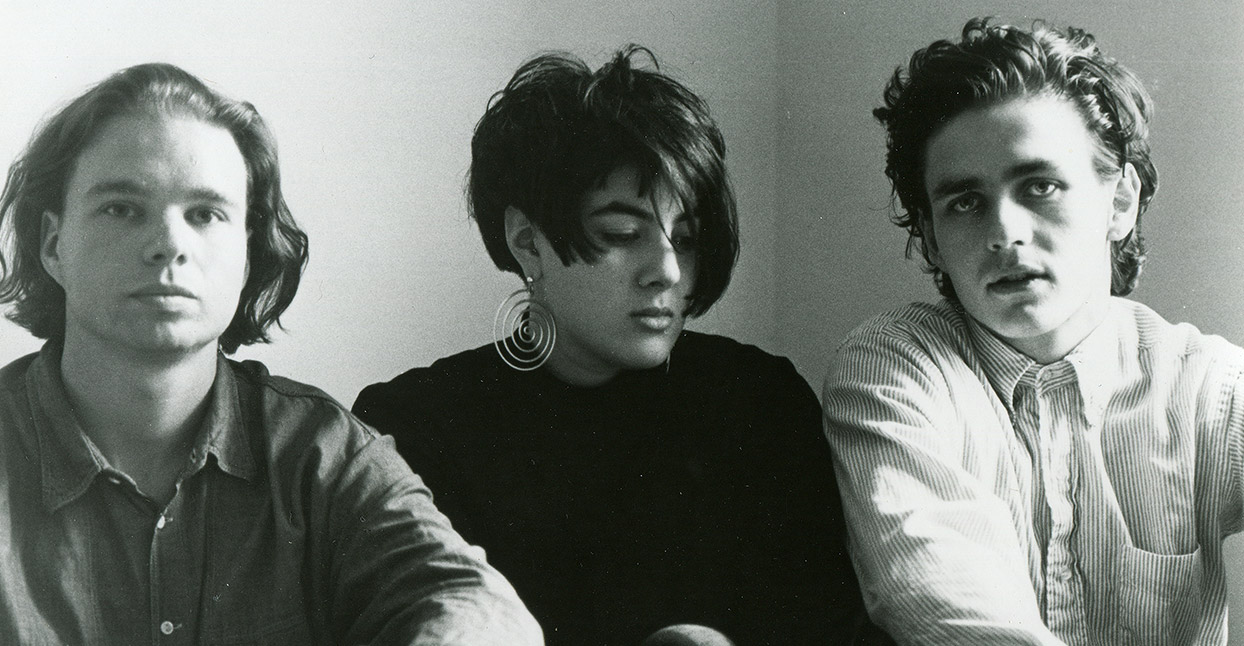
To make Certainty Waves, their seventh album as The Dodos, guitarist Meric Long and percussionist Logan Kroeber had to forget everything they knew about what it meant to be The Dodos.
Like the duo’s breakout sophomore album Visiter (which celebrates its 10-year anniversary in 2018), Certainty Waves finds The Dodos embracing the unlimited possibilities of a time when there were no preconceptions of what the band should sound like. Questions like whether the band needed to be more than just “acoustic guitar and drums,” and just what exactly the ratio should be of acoustic vs. electric guitar suddenly took a backseat to the realization that so much emphasis was mistakenly being put on form rather than spirit.
Perhaps not surprisingly, this epiphany occurred while the band was re-learning Visiter for a show in which they were to perform the record in its entirety.
Recalls Long: “At the time that show happened, I was a little bit lost in terms of which direction the record should go. We had a handful of recordings, nuggets, and song potentials, but they weren’t songs yet, and months had passed without any real progress. I was kind of debating whether to drop the kitchen sink, simplify things, or just leave them be.”
But a funny thing happened when he sat down to listen to Visiter for the first time in eight years.
“It completely surprised me how much electric guitar is on that record,” reveals Long. “The narrative had always been we were just acoustic guitar and drums.” This ostensibly simple observation was pivotal in unlocking a new approach to the material Long and Kroeber would later put to tape in the studio.
“Rather than thinking about the end result or considering the reaction of the listener, I tried to give in to gut reactions, first impulses, however silly or untrue to form they may be,” says Long. “If it was exciting in any way, we pursued it without hesitancy or question.”
What began to emerge from the band’s rehearsals was a quasi post-punk sound that Long immediately gravitated toward. It felt new and different, yet somehow still fundamentally “Dodos.” And so, Certainty Waves was born.
Speaking of the aforementioned spirit, album opener “Forum” has it in spades: a fanfare-esque synth intro, thumping drums, trumpet bursts and fist-pumping “Hey!”s — not to mention a guitar line that wouldn’t be out of place snaking its way through a Strokes album.
Later, “SW3” employs different tactics to achieve its own frantic vitality, intertwining acoustic guitar and clicking drumsticks in a beautifully syncopated rhythm.
They’re the kind of songs that might not have existed had The Dodos immediately started work on a new record after finishing their previous one (2015’s Individ), as they were usually inclined to do. Instead, Long — the band’s primary songwriter — stepped away from music for a time after the birth of his first child, before returning in May with the debut album from his synth-based solo project FAN.
“Making the FAN record [Barton’s Den] was a bit of a crash course in recording, but it really opened up a lot of new possibilities for me in how I thought about making records since there were no guidelines,” says Long. “It’s without question that Certainty Waves would be a completely different record, or perhaps would not have existed, had I not done Barton’s Den.”
Long eagerly applied this newfound sense of freedom to his approach to The Dodos, and subverting one’s own processes and identities quickly developed into a central theme during the creation of Certainty Waves. It’s also a sentiment reflected in the album’s title — the idea that what once seemed so certain will likely prove not to be in the future. That it was only a wave passing by.
“Certainty Waves is our midlife crisis record,” acknowledges Long. “Who we thought we were, how mistaken we were, how an interference in the trajectory can flip your understanding of what came before.”
We are happy to share some nice news with you. Adrianne Lenker of Big Thief has made a stunning new solo album and Saddle Creek Reords are proud to be releasing it. A songwriter who has undoubtedly made an impact on many lives, Lenker set out to make an intimate and immediate document of a particular time in her life after 2 years on the road with Big Thief.‘Abysskiss’ is the result it is out on October 5th.
Adrianne Lenker, is the lead singer of Brooklyn based rock band Big Thief, To coincide with the news, Lenker has also shared the single from the forthcoming album, it is called ‘Cradle’. “I want to archive these songs in their original forms every few years,” Lenker said in a statement.
“My first solo record I made was Hours Were the Bird. I had just turned 21 and moved to New York City where I was sleeping in a warehouse, working in a restaurant and photographing pigeons. Now five years later, another skin is being shed.”
Adrianne Lenker – Cradle From the album Abysskiss – Out 10/5/18
It’s hard to go wrong buying a compilation of recordings by the man named Huddie Ledbetter, given that his earliest songs were tracked by for the Library of Congress by John and Alan Lomax when he was in Angola Prison. An innovator on the 12-string guitar, he crossed over to white audiences in the ‘30s thanks to the popularity of his renditions of spirituals and folk songs, both original and traditional, such as “Goodnight Irene,” “Midnight Special,” and “C.C. Rider,” among many others that would be eventually be covered by his contemporaries, Elvis, Springsteen,Nirvana and Jack White. Even with the most primitive recording techniques, Lead Belly’s commanding power is unmistakably eternal.
Huddie Ledbetter, was better known as Lead Belly, was a folk-blues giant whose music and persona transformed American culture. He sang what he lived (poverty, prison, violence) in songs like ‘Gallow’s Pole’ and ‘Black Betty,’ but he also composed kids’ songs (‘Skip to My Lou’). Called ‘the King of the 12-String Guitar,’ he influenced multitudes:
In the fall of 1917, at a dance near New Boston, Texas, not far the borderline, where the Lone Star State meets Arkansas and Oklahoma, Walter Boyd, aka Huddie Ledbetter aka Lead Belly, shot Will Stafford between the eyes. Enraged over Ledbetter’s derogatory remarks about his girlfriend, Stafford drew his pistol a little too slowly and a moment later, lay dead on the floor. Charged with homicide on December 13th, Ledbetter, then aged 33, had previously served one year’s time on the Harrison County chain gang for assaulting a woman. After languishing six months behind bars, Lead Belly “made a good run, but ran too slow,” as the old song goes and was now serving a 30-year sentence at the Shaw State Prison farm.
In 1925, Texas Governor Pat Neff was so charmed by a song Lead Belly had spontaneously composed in his honour that he commuted his murder sentence. But, five years later, Huddie Ledbetter found himself behind bars once again, this time in a Louisiana prison.
Whether born in 1885, or 1888 (no one knows for sure), Huddie grew up working on the farm owned by his father, Wes Ledbetter, in Mooringsport, Louisiana. By age ten, he’d mastered the “windjammer,” a Cajun-style button accordion, along with the rudiments of the guitar, taught to him by his Uncle Terrel Ledbetter. As a teenager, Lead Belly was already a father, known to pack a Colt revolver and feared for his hot temper.
After leaving home, the young troubadour soon crossed paths with Blind Lemon Jefferson on the streets of Dallas where together, they allegedly tore their “guitars all to pieces,” playing for tips on the streets, and bars of the rough and tumble Deep Ellum neighborhood. Initially written off as a “songster” for his diverse repertoire which dipped into gospel (that he recorded under the pseudonym of Deacon L. J. Bates) as well as country-style ballads, Blind Lemon became famous for his “lowdown blues” like “Black Snake Moan” (1926) and “See that My Grave is Kept Clean” first released in 1927 (and later recorded by Bob Dylan on his 1962 debut album, as well as Lightnin’ Hopkins, Peter Paul & Mary, and the Grateful Dead under the title “One Kind Favor”). Thanks to the windfall from his enormous record sales, Jefferson lived his final years in style, allegedly buying a Cadillac limousine and hiring a chauffeur to drive him to gigs. But Blind Lemon wasn’t long for this world, found dead of a possible heart attack in Chicago on a frozen December night in 1929.
Had he lived long enough to collect royalties from the multitude of recordings of his songs, Lead Belly would have become rich and famous beyond his wildest dreams, as the author of such classics as “Goodnight Irene,” “The Midnight Special,” “Gallows Pole,” “Where Did You Sleep Last Night” and “The Rock Island Line,” which rocked Britain in 1954 after “The King of Skiffle,” Lonnie Donegan, sang a revved-up cover version, inspiring a clutch of Liverpool louts led by John Lennon called the Quarrymen to bang drums and strum guitars. As George Harrison once remarked, “No Lead Belly – No Beatles!” (Harrison, along with the Byrds’ Roger McGuinn helped popularize the 12-string guitar in rock with the sweet chime of their Rickenbacker guitars, while Lead Belly’s sound was brassy and ballsy. Inspired by the left-hand bass runs played by ragtime and boogie-woogie pianists, Lead Belly’s vigorous riffs bounced like sledgehammers off a trampoline.)
Said to be America’s greatest repository of Black music, Lead Belly’s vast repertoire of cowboy ballads, field hollers, folk songs, and children’s tunes were popularized by Bob Dylan, Creedence Clearwater Revival, Led Zeppelin, Motorhead, Brian Wilson, Willie Nelson, Keith Richards, Taj Mahal, Nirvana and Jack White, to name a few.
In 1964, the Animals topped the charts with the haunting “House of the Rising Sun,” a song often attributed to Ledbetter, that is said to be a favourite work song of miners as far back as 1905. Another song Lead Belly was credited with having written is “Skip to My Lou,” after recording perhaps the earliest known version of the song. But a bit of research reveals the Creole square-dance number originated before the Civil War, years before Lead Belly was born. “Skip to My Lou” (the “Lou” in question is a variation on “loo,” not a toilet, but Scottish for the word “love”) wasn’t the only children’s song in Lead Belly’s enormous repertoire.
In the kids’ tune “Go Tell Aunt Rhody,” the goslings mourn as the gander weeps over his wife, who is found dead down by the mill pond, apparently of a broken neck, after “standing on her head.” If this isn’t enough to disturb young minds, Lead Belly’s “Grey Goose” told the story of an indestructible supernatural bird who refuses to die, no matter how the hunter (an apostatized preacher who ignored the Sabbath to pursue a tasty Sunday dinner) wrestles with it. He tries everything he can think of to kill the poor thing, from shooting it, boiling it, cutting it with a saw to feeding it to his hogs, whose powerful jaws still couldn’t manage to squeeze the life out of it.
Enter the “Ballad Hunters,” the father and son team of John A. and Alan Lomax, who “were deeply moved by [Leadbetter’s] flawless tenor voice which rang out across the cotton field like a big sweet-toned trumpet.” After recording Lead Belly’s “great, green-painted 12-string guitar,” for the Library of Congress, the itinerant musicologists had his second jail sentence commuted after serving just three years, on the condition that he become their chauffeur and bodyguard. Lead Belly had successfully sung his way out of jail not once, but twice!
While John A. and Alan Lomax presented Lead Belly’s music to the world, organizing concerts and film shoots (where he often appeared in prison stripes, with a ball and chain around his leg) they spirited him off to live in the ultra-white town of Wilton, Connecticut.
“The Blues,” as Muddy Waters reminded us, “is not a matter of colour, it’s a matter of heart.” Between the burgeoning “Folk Boom” of the early 60s and the rediscovery of Delta bluesmen, Son House, Skip James and Mississippi John Hurt, Lead Belly’s star was once more on the ascendancy.
In 1965, Lawrence Cohn (soon to become Vice President of CBS/Epic Records and the visionary behind the label’s Legacy series) compiled Lead Belly’s Library of Congress Recordings, a 3-LP box set for Elektra Records.
“The Library of Congress made all of those recordings,” Cohn recalled. “But if anyone wanted to release any of that material, they had to get permission from Martha. But she had no faith in anyone. I was the one and only person she gave permission to the Library of Congress to work on the material. She proof-read the lyrics with me and we had a good time. I had to decipher Lead Belly’s speech and would ask, ‘Did he just say, ‘There was a man, milking a cow on Mars?’ and Martha would laugh herself silly and tell me what he actually said. I spent a year running back and forth from New York to Washington. I found some great photographs in a box that belonged to Old Man Lomax, [John A.] that hadn’t been opened since 1935.”
In the early 1970s, Ry Cooder’s funky take of “On A Monday” along with his cover of “Bourgeois Blues” four years later, helped shine a light on Lead Belly for a younger generation just discovering roots music.
in 1976, Leadbellyhit the silver screen. The movie, directed by Gordon Parks, was loosely based on Ledbetter’s life, and starred Roger E. Mosely, who did a fine job albeit lacking Lead Belly’s chiseled Cherokee cheekbones and soul-piercing gaze.
Nick Cave’s cover of ‘Black Betty’ was another song that brought up the spectre of Lead Belly. I had no idea what the song was about. A mean woman? But it seemed liked some secret kind thing I wasn’t privy to. As there was no internet then, the meaning of ‘Black Betty’ remained a mystery for years. I later discovered it was slang for a bullwhip, which made the song take on a frighteningly brutal dimension. What tipped me over the edge was a review of Tom Waits’s Swordfishtombones, which a critic called a mix of ‘Lead Belly and Kurt Weill.’
Lead Belly’s music came from a strange, very brutal world I knew nothing of,” he explained. “I could barely understand a single word the guy sang, but could taste the death, despair and deprivation. He sounded like a man trapped in the bottom of an empty well, bellowing to be released. And that guitar… He was picking it and beating on it like a drum at the same time. It was naked, raw and definitely not from FM radio or the suburbs where I grew up. Lead Belly was the perfect gateway drug. I wanted the weird, mysterious stuff, with a guttural, raw sound. It had to have scars, scratches and pops. The voice had to sound like a ghost from a different era. Pretty soon I was strung out on Robert Johnson, another shadowy name I explored. But Lead Belly was the Rosetta Stone.
For the last eight years of his life, Lead Belly managed to stay out of prison. Whether dubbed “A diamond in the rough,” “A man of the people,” or “A true genius of folk,” Lead Belly’s ongoing legacy has overcome the years of degradation and oppression he routinely faced as a Black man from the Deep South.
“I’m just letting the people know what American folk music is,” Lead Belly once said. “Unwritten music, made up by the mind [that reveals] how you feel when you sing.”
Lead Belly’s vast repertoire consisted of between 300 and 400 songs that he played from memory. Whether written by him or stamped with his indelible imprint, they forever changed the cultural landscape of America and the world.
He was 65 when he died [at New York’s Bellevue Hospital on December 6th, 1949]. He was a very strong guy but had been decimated by Lou Gehrig’s Disease. Although he loomed very large with his twelve-string guitar, he was actually short, just 5.6 and a half! I didn’t get that from Martha, but from his Texas prison records, which had his height and weight and other information.”
Growing up around the Mississippi Delta blues, Chester Burnett cut an imposing figure at well over 6 feet tall and somewhere around 300 pounds. After finding success in Memphis with help from Sam Phillips, he moved to Chicago in the ‘50s to team up with Chess brothers, with guitarist Hubert Sumlin following him. His debut album, Moanin’ in the Moonlight, highlighted his rough and raw vocals and intimidating persona, with backing from legends like Willie Dixon and Otis Spann, as well as a young Ike Turner who played piano on “How Many More Years.” But the standout track is still “Smokestack Lightning,” with its hypnotic riffs and the Wolf’s high-pitched bawling.
Moanin’ in the Moonlight was the debut album by American blues singer Howlin’ Wolf. The album was a compilation of previously issued singles by Chess Records. It was originally released by Chess Records as a mono-format LP record in 1959 (see 1959 in music). The album has been reissued several times, including a vinyl reissue in 1969, with the playing order changed, titled Evil.The two earliest songs onMoanin’ in the Moonlightwere “Moanin’ at Midnight” and “How Many More Years”. These two songs and ‘All Night Boogie’, were recorded in Memphis, the first two at Sam Phillips’ Memphis Recording Service in Memphis, Tennessee in July 1951, and, ‘All Night Boogie’, the last track on side one, in Memphis in 1953.
“How Many More Years” (recorded May 1951, unissued at the time, but later issued by Bear Family cited as the first record to feature a distorted power chord, played by Willie Johnson on the electric guitar.
“Listen to “On Fire” and pretend someone could love you.” Xiu Xiu’s Jamie Stewart’s lyrics in “Dr Troll” offer the most apt summary of Galaxie 500’s 1989 sophomore LP. Not simply a record to passively dream to, as most shoegaze records are, but a record to become helplessly immersed in. Galaxie 500 are shoegaze’s most consistently melancholic offering, at times more akin to Red House Painters than Chapterhouse, and On Fire finds them at their most deeply troubled, but finding beauty in the bleakness in such a way that would become synonymous with the legacy of the band. Their contemporary adoration is miles shy of that of Slowdive or My Bloody Valentine, but you get the sense that every Galaxie 500 fan is deeply, deeply indebted to them in one way or another. On Fire is a huge part of that. From the cinematic tenor sax on “Decomposing Trees,” to the eerily produced drums on “SnowStorm,” it’s a record that rewards each listen with a new moment of magic amid the melancholy. It’s the kind of record that stays with you for life.
“We knew we sounded wimpy compared to the rock ideal of the time. But to ourselves, we really were on fire”
On Fire, which I recorded with my then-band Galaxie 500, was the last all-analogue album I participated in. That means it’s not just old—it’s ancient. It was made to be a record—with two sides, and a paper sleeve. There was no other way to listen to it.
I can’t help but hear it now as preserved in analogue amber for that reason. There’s a hesitation, an aura of space around its sounds that’s more than producer Kramer’s beloved plate reverb—I hear it even in the silences between tracks. Maybe it’s the awe we felt toward the recording process itself. Tape was rolling, our palms were sweating, we had one chance to get this down and here it was, for better or worse. Can you hear the sound of a moment passing from present to past?. He tape lapped up that moment right away. By the time it reached the take-up reel it was already in the past. Listening back in the control room, the sounds instantly felt old, because the moment was gone. The performance was captured, the sound of our band was fixed.
We were happy—very happy, as I remember—with that sound. That’s why we titled the album the way we did. It was self-deprecating, in part, because we knew we sounded wimpy compared to the rock ideal of the time. But to ourselves, we really were on fire, because what we heard back was a record we would like.
I still like it, as a record. I love the hushed way it opens with “Blue Thunder,” such an unexpected move then for an indie band. I’m amazed we got everyone to go along with it. Some of the band’s best tracks are on there, but there are also weak songs for me—the ones I might skip were it not on vinyl. (I know most of our fans will disagree, but I never thought “Strange” really came together—it can still make me cringe.) Kramer knew well how to sequence an album to maintain interest—the long instrumental section of “When Will You Come Home” is one of my favourite grooves we hit, and always gets me to turn the record over, just as Kramer said it would.
On Side B, “Decomposing Trees” starts things off fresh and odd again, with its disconnected sounds and lyric. And sax? Who would have thought it! Have to see what they do on the next track… And so it goes, through the sad, elegiac ending of “Isn’t It A Pity” — a unanimous cover choice that presaged the band’s dissolution into lost friendship.
Along the way, there are enough surprises thrown in that I’m still taken aback—the nutty schoolyard “nah-nah-nah’s” behind the backwards solo in “Another Day,” the lead guitar entering on top of the second vocal verse in “Plastic Bird,” even some of my own drum fills give me a start (did I mean to play that, or did it just happen?). And through it all, Naomi’s bass, sounding so grand and melancholy.
Am I getting maudlin? Probably—it’s a moment in amber for me, remember? But maybe it could be for you, too. Many of my favourite albums are like that—soundtrack to a part of my life. If Galaxie 500 made a record like that, it must be On Fire. It was so charged for us. Maybe, under the right conditions, it can pass that charge on to the listener.
With its dislocating atmospheres and diffident vocals, all dream pop is outsider music. Galaxie 500 sounded so removed from a sense of time or place that they made this fact nonnegotiable. The droning, doleful music of their second album, On Fire, arrived with the quiet subtlety of a profound secret. Over a few chords and understated drumming, Dean Wareham mumbled clever lyrics about his Dodge Dart, the weatherman, and liminal things. Drummer Damon Krukowski and bassist Naomi Yang made their spare neo-psychedelia burst with emotion.
On Fire sounds like the Velvet Underground slowly warming up: In lieu of a Pop Art banana, Wareham sings about waiting in a line eating Twinkies; instead of heroin, he has a song about dropping acid in the woods; instead of Warhol, Galaxie 500 pair with an eccentric, no-frills producer named Kramer. As in all great dream pop, these impressionistic elements congeal into a single atomic sound, as if the instruments have eclipsed one another, moving with the crawl of a cloud.
I wonder what it’s like to encounter this album for the first time as a stream or download, instead of an LP. It has three bonus tracks tacked on the end now, a legacy of the CD era – so its sad conclusion might pass you by a good 10 minutes before the music actually stops. And you don’t get that reset after the first five songs, a pivot exactly midway through. Try an open-ended pause before Track 6 — it might be just a moment ‘til you want to hear those weird bells again; or it might stretch from getting ready to leave home, to coming back after a day’s work or evening out. Or maybe it will be much longer, if Kramer was wrong about the end of Side A. There’s other music that can slip into that space. Side B will be there whenever you come back to it, perfectly preserved.
Sad Bad is the second full-length by Izzy True. It’s a record about death and getting dumped at the end of the world. The songs were mostly written in Chicago in an apartment on the 11th floor of a tall building that would eventually turn out to have bedbugs and to which Izzy True can no longer return because it is no longer rented by people they love. That music was then carried back to upstate New York where it was subjected to TOTAL INSTRUMENTATION courtesy of the True’s dear friends and collaborators, Angela Devivo and Kyra Skye. The is available now digitally and also as a pack of stickers (designed by True) with a complimentary download code. Bless this mess.
Isabel Reidy began her career in The Realbads, a folk noise punk band with her brother Silas Reidy on guitar, percussionist Chris Polis, and bassist Mike Amadeo. Their full length album Here Comes The Realbads was released on Sweet Baby God Records in 2014. On her recent solo project, Izzy True, Reidy pursues a wistful and empowering punch of melodic pop rock.
The humor and charm of Izzy True is reflected in the animated music video for “Swole,” the debut track from her new EP, Troll. “Swole,” short for “swollen,” is gym slang for someone who has developed a larger physique from weightlifting. Reidy deadpans about her workout routine, getting huge, and how it gets her dates.
Reidy has also illustrated and published numerous comics, including “Powder Shiver”, which was released at the Chicago Alternative Comics Expo, and on “Swole”, she accompanies her inventive songwriting with animations of eccentric characters: a crocodile in gym shorts, a jubilant man lifting weights and a bizarre creature making a protein shake.
Riedy elaborates on the process of combing songwriting with illustrating:
“It all kind of feeds into itself. I write songs about my characters and I also sometimes try to write music that sounds how my images look. The music, the dudes, they all exist in the same universe, it’s just different ways of seeing that place. As for the content Those are just some of my guys, new and old, and they are working out. I’ve been trying to work out, so that’s why they’re doing it. I want them to be strong. It would be cool to be strong”.
Out September 21st, Tell No One is the debut full-length by Washington, D.C.’s Bad Moves, recorded at Philadelphia’s Headroom Studio by Joe Reinhart (Hop Along). Sharpening the themes of the band’s 2016 self-titled EP, Tell No One is a power pop album whose 12 songs balance brashness and vulnerability, volume and tenderness. Collectively, the songs tell a story about self-discovery in childhood: exploring how intense emotional moments often arrive before we’re old enough to understand them, and how those regrets and revelations ripple into adult life.
Short sharp and sweet with an acerbic undertone Muncie Girls return with a new video for their latest single ‘Locked Up’ from their forthcoming albumFixed Ideals which arrives via Specialist Subject 31 August 2018.
‘Locked Up’ could be partly interpreted as a list of things which are used to manipulate our fears and desires in order to keep us under control (locked up). Indeed the very things that we are told will free us or bring us joy could actually be viewed as tools of oppression, not unlike that story whereby prisoners build their own prison without realising its a prison and are so invested in it, they would defend it to the death!
Muncie Girls vocalist and guitarist Lande Hekt explained that ‘Locked Up’ does address a whole raft of things that she found bizarre about life, things “that we’re expected to not only accept, but celebrate. It’s kind of depressing really,” whilst also explaining that it relates to the prison system and claustrophobia. For a band who often write about the fucked up nature of the world and their difficulties embracing many of its aspects, they do so in a way that inspires, uplifts and offers hope, which is a rare gift.
Everyone idealises having a crush until you actually get one, and realise that it’s actually pretty exhausting, agonising over what type of text to send and why they haven’t responded and whether it’s correct to be obsessing so much. “Happy Unhappy”, the wonderful new single from Auckland four-piece The Beths, pinpoints this exact feeling of frustration perfectly.
“You’re in my brain taking up space I need for delivering lies and suppressing the sighs”, sings lead singer/guitarist Elizabeth Stokes on the song’s wonderfully acerbic pre-chorus, before pivoting to something altogether much sweeter: “and for navigating escape when I get lost in your eyes, it’s taking up all of my time”. The track deals with this frustrating duality perfectly; it’s nice to care about someone, but it’s a real pain too.
“Happy Unhappy” is another winner from The Beths, after 2016’s excellent EP Warm Blood, and the equally great singles “Great No One” and “Future Me Hates Me”.“Happy Unhappy” is taken from The Beths’ debut album Future Me Hates Me, which is out on August 10th on Carpark Records, and features both “Great No One” and “Future Me Hates Me”. It’s gonna be a good one.
Already strong contenders for the best band to come out Carmarthen, Adwaith are the trio of Gwenllian, Hollie and Heledd. After a number of well received singles, the band are ramping up to release their debut album later this year, and have this week shared the latest taste of it, new single Gartref.
Translating as, At Home, Gartref is a song about“a longing for something which isn’t clear. What is home? Where is it?”With each new track, Adwaith seem to take the listener to some new musical landscape; in Gartref’s case, it’s a darker, gloomier place than before. The percussion sounds bright and driving, as pulses of bassy synth and muted, processed vocals create a dense engulfing wave of noise that drags you down into the darkness with it. Outspoken, creative and ludicrously talented, Adwaith aren’t just the future of Welsh music along with Gwenno,