Archive for the ‘CLASSIC ALBUMS’ Category

This Is My Truth Tel lMe Yours - Manic Street Preachers

With the ‘This Is My Truth Tell Me Yours’ 20 Year Collectors’ Edition released on December 7th, Though each and every one of their albums occupies a special place in their long and momentous history, ‘This Is My Truth Tell Me Yours’ holds an arguably more exalted position than most.

Released in the autumn of 1998, Manic Street Preachers’ fifth album marked the start of a new epoch as a three-piece, while building on the sonic journey they’d embarked upon with ‘Everything Must Go’. Taking its title from a quote by Aneurin Bevan, the Labour Minister Of Health who drove the creation of the National Health Service, It is the first Manic Street Preachers album to have its lyrics solely penned by bassist Nicky Wire.

And while the music written by singer-guitarist James Dean Bradfield and drummer Sean Moore was ostensibly more restrained than the spitted slogans of the band’s earlier releases, the album nonetheless housed some of Manic Street Preachers’ most direct and powerful political statements. Taking its title from a Republican propaganda poster displayed during the Spanish Civil War, lead single ‘If You Tolerate This Your Children Will Be Next’ – released a month ahead of the album – perfectly encapsulated what was to follow. Like a fist wrapped in cotton wool, here was a hard-hitting, unashamed political message that was uncompromising in its intent. Debuting at the top of the UK singles charts, it gave Manic Street Preachers their first No. 1 single.

This proved to be a foretaste of what was to come, ‘This Is My Truth Tell Me Yours’ rocketed to pole position in the UK album charts and held off the competition for three weeks as it sold some 250,000 copies per week. And the hits kept coming in the shape of ‘The Everlasting’, ‘Tsunami’ and the Top 5 smash, ‘You Stole The Sun From My Heart’.

Little wonder, then, that ‘This Is My Truth Tell Me Yours’ was showered with well-deserved garlands. In addition to scoring high in their heartland territory of the NME Awards – the band scooped Best Band, Best Single and Video for ‘If You Tolerate This Your Children Will Be Next’ and Best Album, while Nicky Wire was crowned The Pop Personality You Would Most Like As Prime Minister and The Pop Personality’s Brain That Should Be Kept Alive For Posterity – the record was also declared Best Album at the 1999 Brit Awards, with Manic Street Preachers named Best Group.

Crucially, ‘This Is My Truth Tell Me Yours’ brought Manic Street Preachers to a wider, global audience that saw them repeat their domestic success in Scandinavia, Europe and the Antipodes.

Released on 7th December 2018, the ‘This Is My Truth Tell Me Yours’ 20 Year Collectors’ Edition will come as a 3-CD deluxe box set, as well as double vinyl and digital editions.

In addition to the original album, remastered, will be unheard demos and live rehearsal recordings, as well as remixes by Massive Attack, David Holmes and Mogwai and others.

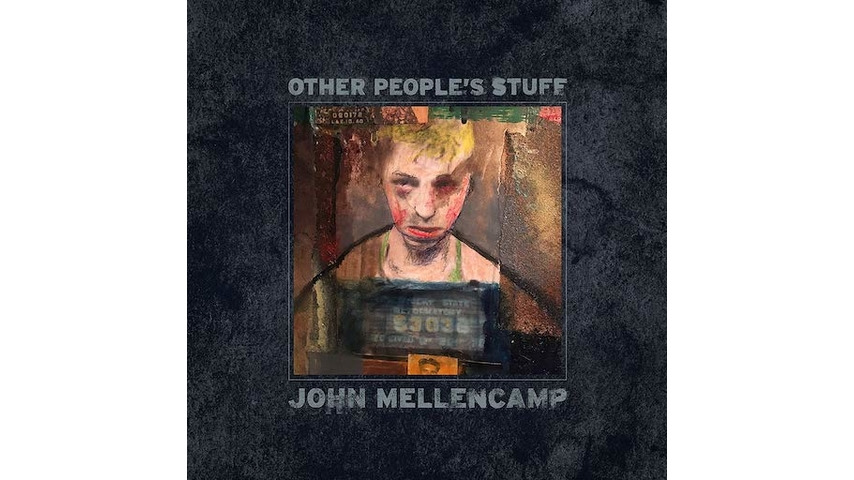
Image may contain: 4 people, people standing, tree, sky and outdoor

It’s hard to do Shame any justice by writing about their wild live shows. The way I can best summarize the aftermath of going to see Shame is that you’ll suddenly feel like you’ve been christened with the ability to perform some act of superhuman physical strength. Though the melodic, fervent post-punk of their debut album Songs of Praise needs no polite introduction, it’s not an angry “in your face,” it’s more like an “in your face” that’s beaming with happiness and with an overflowing passion that can’t be depleted. Their sweaty, bare-chested frontman Charlie Steen’s stamina and powerful presence is felt, but it’s not overbearing. He consistently reminds the crowd, “Smile! This is entertainment” while bassist Josh Finerty engages in a comical gymnastics routine and guitarist Sean Coyle-Smith embodies his guitar’s vigorous shredding with a similar vibrating fit of energy. By this point, Steen is an experienced crowd-surfer and as long as his motor is running, expect the unexpected at a Shame show.

Shame performing live in the KEXP studio. Recorded February 20th, 2018.

Songs: Dust On Trial Concrete One Rizla Friction The Lick

John Mellencamp: <i>Other People's Stuff</i> Review

Arriving a year after his rootsy Sad Clowns & Hillbillies, John Mellencamp’s new album is a series of (mostly) previously released folk standards and covers the 67-year-old singer has amassed over the years. The set is a testament to both Mellencamp’s signature sound and his wide-ranging taste. Culling recordings from a nearly 25-year period, Mellencamp’s latest LP is a surprisingly cohesive collection defined largely by the well-worn murky blues-roots arrangements the singer has become known for since his 80’s hitmaking days. The source material ranges from Atlantic Records soul (“Teardrops Will Fall”) to pre-war country (“Wreck of the Old 97”). Taken together, the record serves as a rendering of what Mellencamp’s own Great American Songbook might look like. 

Mellencamp noted that he doesn’t “get paid for being onstage, I get paid for leaving home, traveling on airplanes and staying in hotels.” “The part of being onstage, I’ll do that for free,” he said. “I’m pretty much an isolationist and my routine is always the same. I very rarely see anybody except when I walk onstage. It’s not like I hang out with anybody. … I don’t even stay in the same hotel as the band.”

Although the title’s something of a misnomer, it does accurately sum up the vintage sentiments that give this album its common bond. Still, it’s a viable concept, especially given Mellencamp’s reputable stance as a heartland hero and blue collar troubadour.

Nevertheless, the obvious question is why Mellencamp would choose to revisit songs he originally recorded. While these songs suggest varied sources, many revisit earlier offerings Mellencamp sang himself on previous albums. The easy answer seems to lie in his desire to express the outrage that he, like most similarly-minded musicians, feel in today’s maelstrom of polarized politics and increasing division. Fancying himself as a folk singer in the populist tradition—think Dylan, Springsteen, Pete Seeger and Woody Guthrie, he tackles these tunes with a gritty, rough hewn sensibility that reflects both his passion and purpose. The tattered yet timeless narrative “Wreck of the Old 97”,” the craggy folk blues of the oft-covered standard “In My Time of Dying” and the erstwhile narrative entitled “Mobile Blue” maintain that sense of resolve, yet still offer due reverence to the originals.

Consequently, Other People’s Stuff seems more than a mere recap of Mellencamp’s rootsier efforts. It’s an anthology of sorts enveloped within the protest motif. The lively roadway narrative “Dark as a Dungeon” was culled from a National Geographic special. The rugged blues and bluster of “Eyes on the Prize” was Mellencamp’s contribution to a White House gathering during the Obama era celebrating the Civil Rights movement. “Gambling Bar Room Blues” and “I Don’t Know Why I Love You” were culled from tributes to Jimmie Rodgers and Stevie Wonder, respectively.

Image may contain: 3 people, people sitting and guitar

At the tail end of Boygenius’ penultimate song in their live set, Julien Baker shreds on the guitar, playing a classic rock-inspired solo that’s completely out of place in her or either of her bandmates’ back catalogue. It’s something Lucy Dacus mentioned in a recent interview, that in the recording sessions for the Boygenius EP, Phoebe Bridgers would “suggest an idea as a joke, and then we realized, ‘Wait, this is an amazing idea!’” Those lighthearted, playful vibes are very much on display when you see the folk supergroup live; when Baker begins to solo, Bridgers and Dacus try their absolute hardest to get her to laugh, sometimes waving lighters and other times rolling around on the ground. The trio’s live energy is undeniably infectious and the crowd is more than willing to send it right back, even at the end of a show that spans four whole hours. This round of Boygenius shows, likely to be the only ones of their kind, simply represent three good—and generationally talented—friends at the top of their respective songwriting games, having the time of their lives. While there’s a definite “I was there” feeling to these shows, we definitely hope this likely once-in-a-lifetime tour happens again sooner rather than later.

Boygenius performs “Me & My Dog” for Late Night with Seth Meyers.

Since cropping up on the East Coast DIY circuit in 2009, amassing the sort of fervent cult fanbase that gets tattoos in their honor, Ovlov have had to break up a number of times in order to keep it together. Their most recent disintegration, in March 2015, seemed to suggest a greater degree of finality, however, with Hartlett expressing his uneasiness with demanding a full-time-band commitment from the revolving roster of friends and family members that have helped him realize his creative vision. But after redirecting his energies to his solo project Stove, he returned to Ovlov’s Facebook page in early 2016 to sheepishly announce an intention to reunite the band, “sometimes but not all the time.” Ironically, that commitment to be non-committal has since yielded two years of steady touring, a vinyl compilation of their early EPs, and now, Ovlov’s first proper album in half a decade.

The division between Ovlov and Stove was always blurry—the former may lean on Dinosaur Jr. overdrive while the latter wobbles on a rickety Guided by Voices foundation, but both ultimately forge a symbiotic relationship between Hartlett’s crestfallen melodies and his fuzz-pedal abuse. While Stove began as a wholly solo endeavor, it quickly formalized into a proper band in its own right—one whose bassist, Michael “Boner” Hammond Jr., is part of this current Ovlov line-up. But with Tru, Hartlett soundly reasserts Ovlov’s signature strength: the band’s ability to fortify tender songs with muscular squall in a way that doesn’t obscure their emotional intent, but amplifies it. Harlett’s songs tend to deal in themes of loneliness, estrangement, and the inability to communicate, and the onslaught of noise ultimately serves to make that desire for connection feel all the more cruelly out of reach.

Steve Hartlett sang, played guitar, bass & synth on the best of you
Theo Hartlett played drums, sang on stick, guitar soloed on grab it from the garden
Morgan Luzzi played guitar
Michael Hammond Jr. played bass, guitar on best of you
Erin McGrath sang on baby alligator
Michael John Thomas III played a guitar solo on grab it from the garden
Released July 20th, 2018

IMG-8513.jpg

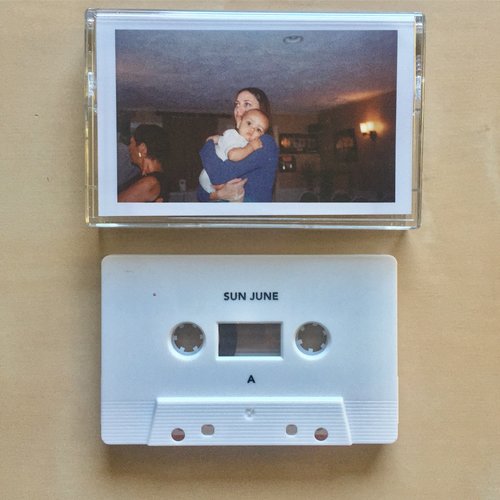
The latest release by Austin label Keeled Scales, Years is the debut album from fellow Austin residents Sun June. The band was formed by founding members Laura Colwell and Stephen Salisbury when they were working in Terrence Malick’s editing rooms, and even practised in the office when Malick was away. Now they’ve added Michael Bain (guitar), Sarah Schultz (drums), and Justin Harris (bass) to become the quintet that is Sun June.

Years is a record shaped and propelled by the gentle forces of the world, The album opens with the swaying slo-mo folk rock song ‘Discotheque’, Colwell showing off her impressive vocals with a kind of husky and effortless passion. The track conjures gentle winds that swirl in plaintive yearning, lifting memories and images and twisting them into a full nostalgic picture with the slow rhythm of nature. ‘Slow Rise II’ is equally patient, beginning with snake-like guitar and a kind of wary soul-bearing. “Go ahead and look me in the eye,” Colwell sings, “tell me everything will be alright, oh I’m lonely too.” It’s a moment of unguarded honesty that closes distances, and which lays the groundwork for the catharsis that comes later. The last minute of the song distils what has until then been encoded between the lines, infused with a golden energy as it whips up into a rousing finale, Colwell repeating the line “I’m coming home” with increasing fervour.

http://

Indeed, repetition forms a key part of Sun June’s sound on Years, a number of the tracks returning to a repeated phrase, cyclical patterns that rise in intensity like incantations, or else echo out into the fabric of the sound. ‘Young’ is an example of the former, a track we described previously as “staring back in time not to find answers or cast blame, but instead for the fleeting chance to warm your face on the now lost glow of past love.” After a restrained start, the song eventually kicks into a little eddy of motion, spurred by the catchy chorus, as though each cycle generates further motion.

Whispered and winey, ‘Johnson City’ features emotions fermented, made velvety with age, the taste haunting tongues beyond the moment, before ‘Homes’ presses forward with a sense of brooding intimacy that oozes and creeps. ‘Records’ is carried as if by a fresh spring breeze, with Colwell singing “I’ll try to love you right” and the rhythm possessing a warmth that goes halfway to fulfilling the promise. This warmth leaks through into ‘Apartments’, intensifying as the crispness is replaced by the humid heat of confused dreams, before ‘Baby Blue’ cools into an icy certainty. This is the darkest, most brooding track on the record, the drums tight and insistent, the vocals likewise, the track gathering momentum under its own motion, and though descending evenly from great height.

Released June 15th, 2018

Laura Colwell, Michael Bain, Justin Harris, Stephen Salisbury, Sarah Schultz

Hull’s artistic renaissance continues apace. Last year saw it taking on the mantle of UK City of Culture and drawing three-and-a-half million visitors in the process; Now, they can add Night Flowers to the admittedly humble list of Humber hometown heroes, albeit ones that have done something that most provincial bands can’t afford to these days and moved to the capital. If they hadn’t, though, there would be no Night Flowers, or certainly not the iteration that’s made this charming debut record; it was in London that the group recruited their singer, Sophia Pettit, who hails from Boston (not the one in Lincolnshire, whilst we’re on the topic of the regional United Kingdom).

This transatlantic lineup of the band toured the country with The Pains of Being Pure at Heart last May and it’s not difficult to understand why somebody thought the two groups would complement each other; Pettit’s vocals are as clear as a bell and very much in the same vein as The Pains’ revolving lineup of female singers, A Sunny Day in Glasgow’s Jen Goma and Fear of Men’s Jess Weiss among them.

Pettit’s warm tones are front and centre on Wild Notion and provide the record with its primary sonic and emotional throughlines, although that isn’t to say that you get the impression that the rest of the band were waiting for the right vocalist to come along to act as an anchor for their instrumental impulses. Night Flowers nod to dream-pop and psych at points on Wild Notion but they never get lost in them; the soundscapes are carefully controlled, with handsome, chiming guitars ringing out over undulating beds of synth.

There’s nothing musically or thematically ground-breaking about this collection of songs and it leaves a slightly sour taste in the mouth that, in the album’s press release, somebody felt it necessary to note that the Hackney studio that the record was cut at is about to be bulldozed ‘to make way for luxury apartments as the gentrification of London continues’. Wild Notion does a good line in endearing melancholy but it’s of the timeless variety; this isn’t a political record and it’s all the better for it.

“Wild Notion” is at the soft end of the collection, but really nice. The female fronted indie rock reminds me on Rough Trade bands from the 90s,

http://

Released April 13th, 2018

Written and performed by Night Flowers 

It has been a long musical journey for the Lovell family, with plenty of twists and turns along the way, and it all started at a bluegrass festival. Sisters Jessica, Megan, and Rebecca Lovell had been studying classical music from a young age and were surrounded by an eclectic mix of music at home—exposed to everything from Alison Krauss to Black Sabbath. But it was the sound of live bluegrass that served as the catalyst for their mutual epiphany.

Rebecca Lovell explains: “We were just blown away by the passion and spontaneity of bluegrass, with everyone improvising and everyone out dancing. That was a very different experience than we’d had thus far performing in classical trios and quartets and symphonies and orchestras. We were bowled over by it and instantly flipped 180 degrees. We put away all of our classical instruments and quit our classical lessons. That was the genesis of our really involved love of music.”

In 2004, the teenage sisters formed their band, the Lovell Sisters, and hit the ground running. They made records and toured the country, appearing on A Prairie Home Companion and at the Grand Ole Opry, as well as winning the John Lennon Songwriting Competition in 2008. But by 2009, oldest sister Jessica decided to leave music. “It’s a very strange way to make one’s life,” says Rebecca.

You have to be whole hog to make it work, and she just said, ’It’s not for me,’ and moved on to other bright and beautiful things. The younger Lovells regrouped and took the opportunity to make a fresh start, electrifying their sound under the name of their great-great-great-great grandfather, Larkin Poe. The new band built on the Lovell Sisters’ momentum, introducing Larkin Poe to the world in 2010 by releasing four EPs that year. It didn’t take long before their sound caught the ears of folks like T Bone Burnett, Elvis Costello, Steven Tyler, and Keith Urban—all of whom have tapped the Lovell sisters’ talent for recordings and performances.

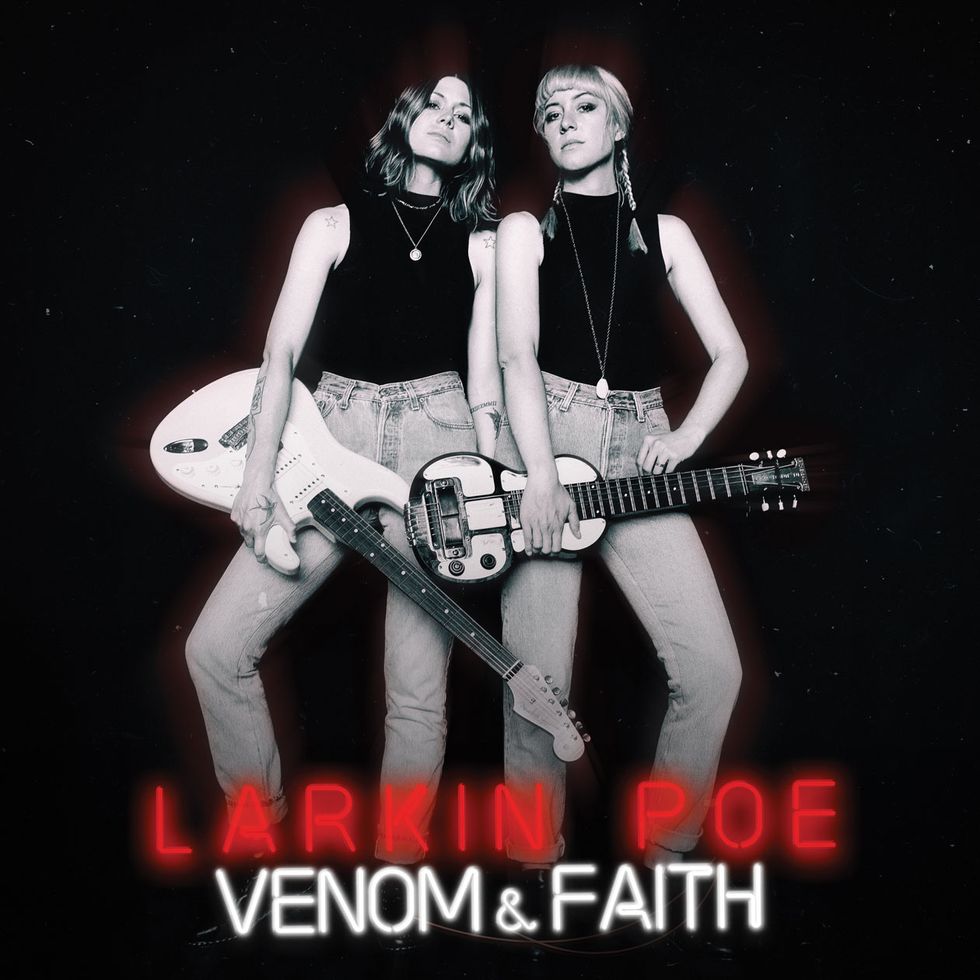
The duo released their newest album, Venom & Faith, hot on the heels of Peach, which dropped in late 2017. There is a sonic narrative between the two records: Megan and Rebecca decided to eschew outside help and to produce, write, arrange, and perform all of the instrumentation themselves. The result is a pair of albums that embrace a stripped-down sound based on nontraditional arrangements that focus on the sisters themselves. While Peach is a raw take on the bluesy side of their sound, Venom & Faith moves farther afield in its influences, drawing on the sounds of Southern hip-hop and alternative rock artists like Radiohead and PJ Harvey.

“Both of us are very influenced by the source music of the South—like bluegrass, blues, roots music, folk music—but we do differ a little in our individual inspiration. I’m inspired by a lot of classic rock people, like Pink Floyd or the Eagles or Black Sabbath.” Megan Lovell

We’ve been Larkin Poe now for eight years. I think it took us eight years to start making records that we finally feel represent the music we hear in our heads or the music we envision playing. So it was really just a baby-step-by-baby-step journey to realizing the dream of what it really means to be Larkin Poe.


No automatic alt text available.

“Modern Meta Physic” is the debut album of Peel Dream Magazine, the nom de plume of New York City-based musician Joe Stevens. Stevens, a talented multi-instrumentalist, wrote, played, recorded, and mixed the album in his apartment in Brooklyn — quite surprising, considering how much “Modern Meta Physic” sounds like it was played by a tour-seasoned band.

A nod to BBC Radio 1 legend John Peel, arbiter of all things underground, all things quality, and all things — it must be said — “cool,” Peel Dream Magazine is highly evocative of a certain strain of independent music. As Stevens explains, “I wanted to conjure media . . . to create an outlet for subcultural wanderers. Something you can subscribe to.”

Exhausted by what he thinks of as the manipulative aspects of contemporary pop music, Stevens harkens back to the early 1990s, when The Velvet Underground resurged as an inspiration to a new set of bands wielding synthesizers, off-set guitars, and a political bent. The Peel Dream experience is defined by a gentle, fuzzy psychedelia, largely indebted to London’s onetime “Scene that Celebrates Itself.” It’s a hypnotic bit of mod-ish lo-fi pop, recalling the best of early Stereolab, Lilys, and other shaggy haired kids with vintage fuzz pedals, slim trousers, and good record collections. Stevens conjures a distinctly 90s vision of the 60s. Not the actual 60s, mind you, but perhaps a 60s daydreamed about from the creature comforts of a suburban living room. An abstraction. Shag carpet turned to bowl cut. Jean jackets — disaffected but wholesome youth. It’s not irony, exactly. It’s the love that comes from loving. And a bit of whimsy. It’s the 90s, again. Post-post.

Written and recorded over a four-week period in the fall of 2017, “Modern Meta Physic” fixates on the New Age universe of the Catskills region of New York. Stevens deals in generic bohemian fare — Far East philosophy, Native American tradition, mid-century modern cool — as he appraises the world according to privileged urban expats who increasingly call the upstate paradise home.

Not everything is tongue-in-cheek, however. Stevens also pays homage to Catskills as a place replete with natural wonder — a place of self-discovery and impromptu adventure. “I wanted to convey the Catskills the way that Brian Wilson conveyed Northern California on the post-Smile records. It’s a little trippy, a little childlike, but the feeling is real.” In “Living Room.” Steven’s surrenders to Mother Nature in a bit of dada-esque worship, transfixed by “sound, sight and weather.” On “Don’t Pick Up Slackers,” Stevens settles into a woodland getaway home as he tries to make sense of his neighbor’s “fruit diet.” One might get lost in the nostalgia of aimless road trips and cabin retreats, but there are moments where Stevens ventures on to new topics. On “Art Today,” he opines on what he sees as the maddening and thankless task of committing oneself to making art. “Us for Chanel, all are to sell. I want to tell, some days are well.”

http://

Leading off the album, “Qi Velocity” is a metronomic take on French pop that yields to a lush, twee chorus reminiscent of Belle and Sebastian. “Deetjen’s,” named after the much-loved bed & breakfast in Big Sur, would fit snugly on Unrest’s best Teen Beat material. The ambient “Levitating Between 2 Chords” suggests Oval in “94 Diskont” mode. There is an economy to these tracks — everything is distilled down to it’s essential elements, no gestures are wasted, no superfluous ornamentation taking up space. Where some might add effects, Stevens removes them, opting for surprisingly straight-forward arrangements of Farfisa, monosynth and guitar. “Due to Advances in Modern Tourism” displays a soft take on Neu!, while the organ that enters could be a sly wink to Steve Reich’s “Four Organs” or even Terry Riley’s West Coast take on minimalism. “Wood Paneling” is a lysergic trip, a memory of a memory of an experience not lived but learned — how can something feel so relaxing yet so … uneasy?

While Stevens is more than happy to show his influences on his sleeve — mind you, they’re great influences — it’s clear Peel Dream Magazine isn’t just a “sound”. The guy can write songs. And when he wants to hit a target, he hits it. Where he goes next is anybody’s guess.

Released October 5th, 2018

Lump 600x600

It began when Tunng’s Mike Lindsay – a prolific, Mercury prize-winning producer – was introduced to Grammy-nominated, Brit award-winning singer-songwriter Laura Marling after her show supporting Neil Young in London. LUMP is a heady blend of wonked-out guitars, Moog synths and pattering drums, set against droning, coiling clouds of flutes and voices. The lyrics are inspired by early-20th-century Surrealism and the absurdist poetry of Edward Lear and Ivor Cutler – a bizarre but compelling narrative about the commodification of curated public personas, the mundane absurdity of individualism, and the lengths we go to escape our own meaninglessness. The composers are keen to stress that LUMP is a creation that passed through them, and they look upon it parentally. It is their understanding that, now it has come into being, LUMP is the artist, and it will continue to create itself from here on. Lindsay and Marling will assist it as necessary.

LUMP (Laura Marling and Tunng’s Mike Lindsay) perform Curse of the Contemporary on BBC Later… with Jools Holland on BBC Two (22 May 2018).

Lump mixes the stunning, instantly recognisable vocal prowess of Laura Marling with the off-kilter electronic folk-tinged oddness of Lindsay’s band Tunng. An enchanting and fascinatingly diverse outing, one to listen to in it’s entirety. Superb.