In every way I’ve approached writing, recording and now releasing music, it’s been different. I’ve lost all consciousness in caring and it’s been liberating. It is what it is. It’s a feeling, it’s a song, it’s a sound, it’s a part of me which I can’t decipher whether it’s good or bad, but it’s sincere. I recently learnt that the word sincere is derived from the Latin sine = without, cera = wax due to dishonest sculptors in Rome or Greece covering flaws in their work with wax to deceive the viewer. So a sculpture “without wax” would mean honesty in its perfection.
That really struck a chord with me as sincerity really is the key to this record. It’s my truth. Sincerity is the truth of a person, not just the good but the bad: the flaws, the realness, which can never be ‘perfect’. This album reflects the reality of my life, the toughness life throws at you.
Official video for ‘Conversation’ New album ‘No Words Left’ out March 22nd
I suppose it was almost exactly two years ago that myself and what was left of this band exiled ourselves to Sheffield in search of yet another renaissance, with only our unshakable dedication to the struggle and a copy of The Commodores ‘Nightshift’ to pull us through. Most Londoners never have and never will fully understand the true horrors of a northern winter, what that much grey sky can do to the human heart. We baptised ourselves again and again in her bitter drizzle, feeding on the monotony of it all as if it were the nectar of the elect. And by the side of a rotten canal in a room half the size of a public toilet, armed with a limited equipment budget, our wits and time, we once again set upon revealing the true face of God, measuring out his/her/their glorious countenance in rhyme, meter, groove and melody.
It is with deep and terrible glee therefore that i can at long last announce the arrival of our 3rd full confession ‘Serfs Up!’ on April 19th of this very year. The first single ‘Feet’ marks our re-entry and is featured below,
Band Members
lias, saul, nathan, adam, taishi, severin
Fat White Family – “Feet”, from ‘Serfs Up!’, out 19th April 2019 on Domino Record Co.
Jenny Lewis has confirmed her highly anticipated return with her fourth solo album, ‘On The Line’ – the follow up to 2014’s critically acclaimed ‘The Voyager’. The 11 all new original songs were written by Lewis and recorded at B studio B, and feature a backing band of legendary talent including Beck, Benmont Tench, Don Was, Jim Keltner,Ringo Starr and Ryan Adams. Jenny has also announced her first round of 2019 headlining dates.the march-may 2019 itinerary includes stops at Nashville’s historic Ryman Auditorium,
Late last year, Jenny Lewis teased that her new album, would be one of our most anticipated of 2019, was on its way early this year. After unleashing a pair of suspicious tweets, Lewis confirmed the new record is called On The Line, and it’s not dropping until March 22nd on Warner Bros. Records. The news arrives with the album’s first single, “Red Bull & Hennessy,” which arrived with a twinkly accompanying visualizer. “Red Bull & Hennessy” is Lewis’ first new music since her 2014 album The Voyager, and on this love song-turned-party song, she makes an invigorated return in a fit of bluesy electric guitar, “high on Red Bull and Hennessy.” She teases and taunts (“Don’t you wanna kiss me? Don’t you wanna even try?”), only to proclaim she’s “higher than you.” After five silent years, the singer/songwriter and former Rilo Kiley frontwoman is back and burning brighter than ever.
The unstoppable Jenny Lewis has shared another new track from her forthcoming album On The Line titled “Heads Gonna Roll.” The follow-up to the sultry “Red Bull & Hennessy” features Ringo Starr on drums, Benmont Tench on the organ and Don Was on bass. And with arms fully outstretched today, Lewis has also announced a string of additional 2019 dates to her already-extensive tour.
On The Line will be released on March 22 from Warner Bros. Records. Listen to its harmonic opening track, “Heads Gonna Roll,”
When faced with the cover art of BIG WILD‘s highly anticipated debut long-player “Superdream”, you’re immediately transported deep into the sublime. The cover is simultaneously inviting and ambiguous. It’s conceptually not overly complicated, but the delivery is sleek, refined and something totally ‘other’. It’s the perfect cover for a record like this, because the record could be described in exactly the same way.
The record takes the most euphoric moments of psychedelic rock, extrapolates them out of an analogue context and instead takes it in a digital direction, bringing the highs of psychedelia into the electronic realm. You wouldn’t be wrong in saying that this isn’t exactly a new concept – Tame Impala and Jagwar Ma have definitely already nailed a sound of this descriptor already. The difference is Big Wild is first and foremost a producer of electronic music. Rather than using electronic sounds to accentuate the psychedelic rock of artists like Tame Impala and Jagwar Ma, Big Wild‘s using his skills as an electronic musician to borrow elements of psychedelic rock and inject that into his music instead.
The album is dotted with these specifically electronic moments, namely the glitchy trap of ‘Pale Blue Dot’ and the warped ‘Joypunks’, but it never specifically becomes an electronic album. ‘Maker’ pairs staccatoed, arpeggiated synths with harsh signal static and soaring vocals, whilst tracks like ‘She Makes Magic’ transform vocal lines into malleable electronic instruments that have been sequenced rather than sung.
The electronic elements of the record are juxtaposed with these tender guitar moments, like the delicate electric symphony of ‘Mopsy’s Interlude’, the half-time blues of ‘Awaken’ and the soft, plucked moments in ‘City Of Sound’. He’s enlisted a stellar cast of features to lend their hand for the record too, including Rationale and iDA HAWK, both notably exciting inclusions.
Pastis are an emerging five-piece from Helsinki, taking influence from genres such as Britpop/rock, merseybeat and modern indie-rock. Finland’sPastis, an emerging quintet whose delivery takes the bold rock grandeur of Cool Britannia and filters it through other styles and sounds that range from American indie rock to ’60s Merseybeat. It’s a riveting package straight out of Helsinki, and Pastis’ latest offering is the catchy-as-all-hell new single “Around Here”.
“As creatures of habit, we tend to live everyday more or less doing the same things, thinking the same thoughts, perhaps not challenging ourselves enough to dive in to the unknown,”Around Here’ is kind of an encouragement to break that circle and go for something new. It’s important.”
The infectious track will be included on the band’s forthcoming debut album Circles, which hits in February. It’s a nice reminder that the sound we grew up with doesn’t need to be an ode to yesterday; instead, these harmonies that live inside our heads have been with us all along.
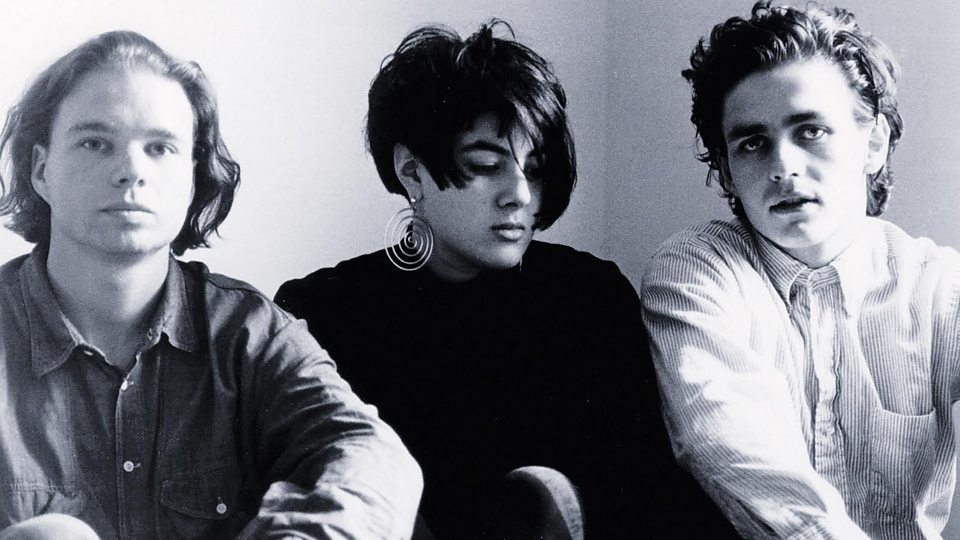
Galaxie 500 were a really well-regarded indie rock band at the time. They signed to a big indie label, they got to tour a lot, to record extensively with the single producer on Earth they were most suited to work with, and they were absolutely adored all over in Europe. Galaxie 500 made three great records that people bought thousands of copies of, Galaxie 500 have later emerged as one of the pivotal underground groups of the post-punk era, dreamy and enigmatic, their minimalist dirges presaged the rise of both the shoegaze and slowcore movements of the 1990s. The group formed in Boston, Massachusetts in 1986 and comprised vocalist/guitarist Dean Wareham (a transplanted New Zealand native), and bassist Naomi Yang and drummer Damon Krukowski, longtime friends who first met in high school in New York City before all three attended Harvard. Wareham and Krukowski initially teamed in the short-lived Speedy & the Castanets, which split after their bass player experienced a religious conversion; upon re-forming, the duo recruited Yang to play bass, although she had no prior musical experience.
Named after a friend’s car, Galaxie 500 began performing live throughout Boston and New York before recording a three-song demo tape which they sent to Shimmy Disc head honcho Kramer, who agreed to become the trio’s producer. After bowing in early 1988 with the singles “Tugboat” and “Oblivious” (the latter track featured on a flexi-disc included in an issue of Chemical Imbalance magazine)
They issued their full-length debut, “Today” in 1988, which highlighted the group’s distinct, evolving sound pitting Wareham’s eerie, plaintive tenor, elliptical songs, and slow-motion guitar textures against Yang’s warm, fluid basslines and Krukowski’s lean drumming.
Damon Krukowski: said ,We had been listening to a Half Japanese record produced at Noise [Music to Strip By]– it sounded very spacious. All the other Boston bands were turning out a very heavy, dense sound. We were looking for something else. We weren’t a heavy band after all. We called to ask the rates– they were cheap! So we booked time. That’s how we came to record the “Tugboat” single at [his studio] Noise, and how we met Kramer. It turned out he was the only employee.
Galaxie 500’s debut doesn’t merely live up to the sweet promise of the band’s debut single “Tugboat,” Today’s final song, but almost without trying becomes its own gently powerful touchstone. While the influences are clear — third album Velvet Underground, early non-dance New Order, psychedelic haze and fuzz thanks to the reverb Kramer piled on as producer. By never feeling the need to conventionally rock out, the Krukowski/Yang rhythm section comes up with its own brand of intensity. Sometimes the two are persistently skipping along without Krukowski having to bash the hell out of the drums (the downright delightful “Oblivious” is a good example), other times they simply play it soft and slow. Meanwhile, Wareham’s low-key chiming and slightly lost, forlorn singing, at places wry and whimsical, often achingly sad, forms the perfect counterpoint to the songs’ paces, feeling like a gauzy dream. When he comes up with his own brand of electric guitar heroics, it’s very much in the Lou Reed and such descendants vein of less being more, setting the moods via strumming and understated but strong soloing. One particular Descendant gets honored with a cover version: Jonathan Richman, whose “Don’t LetOur Youth Go to Waste” is turned into a deceptively calm epic, with marvelous playing by all three members.
Dean’s smallish high voice, subtle accent, and laconic guitar were seated by Damon’s spacious sound– long cymbal splashes, bottom heads on his sparkly Gretsch kit– and Naomi’s unique, wide toned high on the neck melodies made a big, wide, slowly moving cloud.
It’s easier to lose oneself in the flow of the sound rather than worry about any deep meaning, making the stronger images that come to the fore all that more entertaining, like “watching all the people fall to pieces” in “Parking Lot.”“Tugboat” itself, meanwhile, remains as wonderful as ever, a cascading confession of love at the expense of everything else, somehow mournful and triumphant all at once.
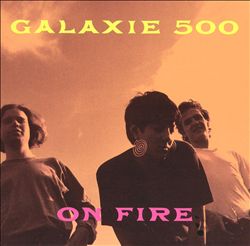
After signing to the U.S. branch of Rough Trade, Galaxie 500 issued its defining moment, 1989’s evocative “On Fire”, a remarkably assured and rich record including the superb singles “Blue Thunder” and “When Will You Come Home.” Having already made a fine account of themselves on “Today”, the three members of Galaxie 500 got even better with “On Fire”, recording another lovely classic of late ’80s rock. As with all the band’s work, Kramer once again handles the production, the perfect person to bring out Galaxie 500’s particular approach. The combination of his continued use of reverb and the sudden, dramatic shifts in the music — never exploding, just delivering enough of a change — makes for fine results.
We were signed to Rough Trade by Robin Hurley, who ran the American label, and Geoff Travis, who was our A&R man and the head of the company back in England– both great people. It’s kind of amazing the list of things he has been involved with: Swell Maps, Jonathan Richman, Shockabilly, the Smiths, the Jesus and Mary Chain, Pulp, the Strokes.
Consider “Snowstorm,” with Krukowski’s soft-then-strong drums and Wareham’s liquid solo and how they’re placed in the mix, leading without dominating. Yang’s vocals became more prominent and her bass work more quietly narcotic than before, while Krukowski adds more heft to his playing without running roughshod over everything, even at the band’s loudest. Wareham in contrast more or less continues along, his glazed, haunting voice simply a joy to hear, while adding subtle touches in the arrangements — acoustic guitar is often prominent — to contrast his beautifully frazzled soloing. Lead off track “Blue Thunder” is the most well-known song and deservedly so, another instance of the trio’s ability to combine subtle uplift with blissed-out melancholia, building to an inspiring ending. There’s more overt variety throughout “On Fire”, from the more direct loner-in-the-crowd sentiments and musical punch of “Strange” to the Yang-sung “Another Day,” a chance for her to shine individually before Wareham joins in at the end. Again, a cover makes a nod to past inspirations, with George Harrison being the songwriter of choice; his “Isn’t It a Pity” closes out the album wonderfully, Kramer adding vocals and “cheap organ.” Inspired guest appearance Ralph Carney, Tom Waits‘ horn player of choice, adding some great tenor sax to the increasing volume and drive of “Decomposing Trees.” CD pressings included the bonus tracks from the BlueThunder EP.
After a limited-edition 7″ release featuring live renditions of the Beatles’ “Rain” and Jonathan Richman’s “Don’t Let Our Youth Go to Waste”.
The group returned in 1990 with This Is Our Music, a diffuse collection spotlighting the wry, sunny single “Fourth of July” and a haunting cover of Yoko Ono’s “Listen, The Snow Is Falling” .
What turned out to be the final Galaxie 500 album was also arguably the band’s most accomplished. Not that the earlier records lacked either charm or ability, but right from the charging, chugging start of “Fourth of July,” the amazing single and lead off song from This Is Our Music (even including a cheeky Velvet Underground reference from “Candy Says”), the trio here sounds like they could take on anyone. Kramer’s production and the use of reverb from past releases all once again contribute to Galaxie 500’s magic, while the individual members continue to sound fantastic. Somehow, though, everyone aims higher, Wareham’s singing among his finest and his guitar going for the truly epic more than once, Krukowski and Yang even more perfectly in sync than before, often being very bold without losing their intrinsic warmth.
From a generally different approach, Galaxie 500 here easily equaled the heights of their U.K. shoegaze contemporaries and often trumped them — “Summertime” in particular is a stunner , while making a lot of contemporary American indie rock seem fairly dull and workaday. The choice of cover version this time out is astonishing Yoko Ono’s “Listen, the Snow Is Falling,” with Yang singing beautifully over, initially, Wareham’s echoed guitar strums, and Krukowski’s barely-there percussion cascade. The switch to a full-band arrangement, far from destroying the song’s spell, makes it even more intense and gripping a listen.
The subtle touches throughout the album add immeasurably to its magic — the soft ringing bells shimmering through “Hearing Voices” quiet synth on “Spook,” and Kramer’s self-described “cheap flute” on “Way up High.” It all concludes with “King of Spain, Part Two,” a reworking of the flip side to “Tugboat” while it wasn’t a planned finale, as an unexpectedly right bookend to a career, it ends both Galaxie 500 and This Is Our Music on a perfect note.
Later CD versions include a cover of the Velvet Underground’s “Here She Comes Now,” originally the B-side from “Fourth of July.”.
Galaxie 500 recorded two sessions for John Peel’s BBC Radio 1 programme, these later released on the Peel Sessions album. Their cover of Jonathan Richman’s “Don’t Let Our Youth Go To Waste” was also voted into number 41 in 1989’s Top Festive 50 by listeners to the show. Dean Wareham: The first Peel Session we did was engineered by Dale “Buffin” Griffin, formerly the drummer in Mott the Hoople. I remember him being impatient. We were amazed at how big the studio was, and this computer they had that could mark the different sections of the song and take the tape machine right to them. My favorite Peel Session recording was our cover of the Sex Pistols’ “Submission”. People always say that’s an unlikely cover but Damon and I had been playing that one since our days in Speedy and the Castanets; it was one of the first songs we learned together.
Following a subsequent tour, Galaxie 500 disbanded after Wareham phoned Yang and Krukowski to say he was quitting the group.
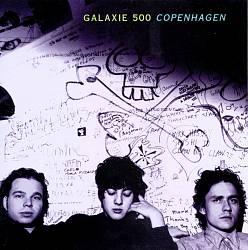
A few months later, after Dean Wareham formed his new band, Luna, Rough Trade went bankrupt, and with the label’s demise went the trio’s three albums, as well as their royalties. In 1991, at an auction of Rough Trade’s assets, Krukowski purchased the master tapes for the group’s music, and five years later the Rykodisc label issued a box set containing Galaxie 500’s complete recorded output. A previously unreleased 1990 live set, dubbed Copenhagen, followed in 1997.
A presumably final punctuation mark on Galaxie 500’s work, “Copenhagen”, released in 1997, is actually a recording from the last date of the band’s late 1990 European tour, captured for radio broadcast in the Danish capital in front of a vocally appreciative crowd. One main reason to listen in is hearing how the band’s studio approach clearly differed from the concert arena — while Kramer handles the live sound, the cocooning web of reverb familiar from the records isn’t present here. As a result, the performances have a more direct approach, Wareham’s voice a little more naked, his thoughts on emotional connection, and the oddities of life easier to capture. Yang’s bass gains in prominence as well, almost more so than Wareham’s guitar at points, while Krukowski as always keeps the beat well, adding subtle flourishes and touches as he goes. All this would be mere technical notation if the performance itself wasn’t worthy, though, and that it is. Touring for “This Is Our Music” as the trio was, the set list is mostly focused on that, though a fine version of “Decomposing Trees” starts things off. Three of the band’s favored covers close the set — Yoko Ono’s “Listen, the Snow Is Falling,” the Velvet Underground’s “Here She Comes Now,” and a version of Jonathan Richman’s “Don’t Let Our Youth Go to Waste” that provides a great final kick. For all the excellence of the show, one can hear a little more than once in Wareham’s soloing what Yang and Krukowski later described as his tendency to play the big rock star toward the end of the band’s life. It’s not bad work, but the cracks were starting to show.
Andrew Bird is back with a new album aptly titled “My Finest Work Yet”. Andrew Bird has put together his creative dream team to bring his new album and campaign to life. Bird has enlisted author Dave Eggers to write his bio (more of a Q&A that will be included in the album packaging), renowned photographer Amanda Demme (Mark Ronson, Die Antwoord) and creative director Matthew Siskin (Beyonce, Father John Misty). The result will be a highly conceptual, creative marketing campaign with strong visuals to match the powerful music that Andrew has crafted for this album.
All tongues and cheeks aside, “My Finest Work Yet” finds Bird grappling with themes of current day dichotomies and how to identify a moral compass amidst such divisive times. “I’m interested in the idea that our enemies are what make us whole—there’s an intimacy one shares with their opponent when locked in such a struggle. If we were to just walk away would our enemies miss us? How did we get to this point and how can we, through awareness of it, maybe pull ourselves out of this death spiral,” says Bird.
Few albums in rock ‘n’ roll history have seen its creator’s obsession veer so close to self-destruction, as Yak’s The Pursuit Of Momentary Happiness. For singer, guitarist and driving force Oli Burslem, making his band’s second album became about pursuing his artistic vision at the expense of all else, including his own financial security, and mental health. Who else these days invests every single penny available to them into recording, to the point where they become homeless, and have to sleep in the back of a Citroën estate? Listening to The Pursuit Of Momentary Happiness, you frequently feel the white-knuckle monomania of Yak’s mission. It’s one of those once-in-a-decade records, whose sheer sense of belief and commitment pulsates through every nanosecond of boundary-breaking sound – like Spiritualized’s Ladies And Gentlemen We Are Floating In Space, and Tame Impala’s Innerspeaker, both of whose creators had a part to play in its genesis.
“I don’t want it to be a boo-hoo story,” says Burslem, of the record’s tortuous gestation. “It was fun doing it. It’s nice to push yourself to the limit, and I can say now that I don’t give a shit what anyone thinks, because it’s a document of that time, and it’s honest and open, and I couldn’t have done or given much more, which is a great feeling.”
The story began after Yak had completed a debut campaign which itself had played out like a dream. After getting snapped up by Rough Trade management, and cutting one of several feral early EP’s for Jack White’s Third ManRecords, the trio of Burslem, bassist Andy Jones (Oli’s childhood friend from Wolverhampton), and drummer Elliot Rawson, set an all-but-moribund UK alt-rock scene alight with 2016’s inaugural long-player, Alas Salvation, but for Oli, that year’s final career-high show at London’s Scala felt like an endgame, rather than an achievement to build upon.
“Andy and I had been friends since we were three years old,” he says, “and he was always gonna get married and move away at some point. We didn’t particularly think the band had a future, but then it took off, and it was ace, and after the Scala, there was an opportunity, and some money, to do another record, and I really wanted to give it a go.”
Jones, indeed, soon upped sticks for Melbourne, but after a chance meeting in a pub in Dalston with Jay Watson from Tame Impala’s touring band, Burslem hatched a hare-brained scheme for the band to convene in Melbourne to rehearse together for ten days, then move across Australia to lay down Album Two, on Watson’s invitation, at Tame mainman Kevin Parker’s place in Perth. “I thought recording would take ten days,” says Oli, sheepishly, “but it didn’t quite work out that way.”
Things started going off the rails before Burslem and Rawson even got to Aus, as Oli decided to go to Tokyo for a month beforehand – “you know, for the isolation, to do all the writing”. Perhaps predictably, the first two or three weeks went by in a drunken blur with nary a note written. Landing ragged in Australia though, things got worse.
“It had become pretty apparent that the three of us in a room bashing chords out, wasn’t really turning me on,” shrugs Oli. “That was just going to sound like the first record. It was an eye-opener, like, what the fuck are we going to?”
On the plane back, Burslem ate and drank to excess, knowing that when he touched down, he had no money, no home, and, worryingly, no album. On arrival, he reduced his possessions down to two hold-alls, and “moved into” his old Citroën, which had no MOT. “It wasn’t ideal,” he admits.
That was February 2017, and he says he has only the sketchiest memories of the ensuing 18 months. Some of the time, fellow musicians would let him crash at their place, like Martin Slattery, once of Joe Strummer’s Mescaleros, and Spiritualized guitarist John Coxon.
On the plus side, after blagging into Glastonbury, he found a new bassist in Vinny Davies. They partied for two days straight, then back in London rehearsed together with Rawson for a few weeks, and “things started to get more focussed.” They booked a cheap demo studio, and in the pub with Coxon a few days beforehand, Burslem got chatting to Spiritualized chief Jason Pierce.
“He was like, how’s your record? And I was like, it’s non-existent. I told him we were demoing around the corner, and he was like, Oh, I’d love to come and help you out. I was like, Okay! Thinking he wasn’t going to turn up.”
On day two, Pierce materialized, and had them rattle through all the band’s songs. “He was really supportive. I’d been thinking, no-one will like this, but he was like, No, you’ve got something good here – you should try and record them properly.” At one point, Burslem was casting around for small change for a tube fare, and seeing Oli’s woeful circumstances, Pierce urged him to get a record deal, and Yak duly landed up with mighty Virgin-EMI.
Says Oli, “Then it became, Right, I can’t fuck this up now. I could’ve tried to house myself, but instead we put it all into recording, and getting a brass section. Then afterwards, I can sort my personal situation out.” He shrugs. “I probably took on a bit too much.”
Another chance meeting at a party brought Burslem together with Marta Salogni, an Italian producer now based in the UK, best known for her mix on Björk’s sonically adventurous Utopia album. Says Oli, “We met a few times, and talked about making a guitar record that wasn’t boring, and didn’t sound like UK indie rubbish. But we still wanted to capture a live element, and in my head, RAK is the best studio in London to do that, so it was, Let’s just do ten days there, and get some really good performances of us three playing together.”
In those ten days, Yak recorded some 29 songs, of which 11 ended up on the record. “The songs that went on are the ones I thought fitted together as a consistent story. Doing the writing, I couldn’t see further than the next day or two, so all the joyous and happier things were momentary, whether it be going out, getting drunk, whatever – no plan of any longevity, so all the songs have that destructive bent. They’re on the edge.”
Opener ‘Bellyache’, with its Tame Impala-esque wah-wah stomp, Oli describes as “angry and fuck-you”, the ensuing ‘Fried’ as simply “I’m fucked”, and the titular third track as “the comedown, like, what’s this all about?” The latter was apparently written, after staying up all night. He describes it as “blunt and to the point”. The song also acquired twinkling celeste, which launches it into the heavens. ‘Bellyache’, meanwhile, boasts crazy flute, and one of a handful of portentous brass arrangements.
After the RAK sessions, Burslem withdrew to a small home studio with Pierce to apply some different vocals, and piece the album together. Pierce also added slide guitar and his own vocals to dazed finale, ‘This House Has No Living Room’, which sails out on Oli’s own field recording of birdsong. The complexity of all the layering in that track led to Burslem’s belief that the album needed a full-scale remix. Everyone involved was advising him to quit while he was ahead, but he flew to New York to mix it. “I just wanted a record with depth, as a piece of audio,” he says, “where you’ll still be finding new bits in 20 years’ time”.
Job done, Burslem’s existential status quo was such that he duly got smashed with a fellow homeless person, and, doing a runner from his hotel, jetted home, pockets totally empty.
A few weeks further on, he says he’s happy the album is now done, but those who’ve read this far may be worried about Oli’s welfare. Has he now, as intended, ‘sorted out his personal situation’, and re-entered normal society? “That’d be nice,” he smirks, a tad unrepentantly. Does he at least have a roof over his head? “Only for two weeks. I got told yesterday, I’ve got to move out of my current place.” He shrugs. “I’ll find somewhere…”
Roll on, that victory lap on the road…
Yak will be live in-store at Rough Trade Nottingham to perform tracks from their new album ‘Pursuit of Momentary Happiness’, released 8th February on via Virgin EMI / Third Man Records.
Quiet Signs, Jessica Pratt’s third album, follows 2015’s On Your Own Love Again. “On some level I considered an audience while making the last record,” Pratt said in a statement. “But my creative world was still very private then and I analyzed the process less. This was the first time I approached writing with the idea of a cohesive record in mind.” The video for “This Time Around” features hazy clips of Pratt walking along various outdoor backdrops and lounging about an ornate mansion, somewhat cryptically gazing at her own reflection.
I’ve poured a lot of myself out making this record, worked carefully to capture the right thing and I’m delighted for you to hear some of it, finally. The single itself principally features Pratt’s melancholic, lonesome vocals as they dance around one single guitar’s simply strummed chords. It’s uncomplicated in construction and just mysterious enough to be perfectly served by the accompanying visual.
The album was produced by both Pratt and Al Carson, who, along with Matt McDermott, also performs on the record. Jessica Pratt – “This Time Around” from the new album ‘Quiet Signs’ Released by Mexican Summer and City Slang.
Melbourne garage-rock quintet The Murlocs are back with new track and video “Noble Soldier”, which comes via Australian indie label Flightless Records. The group are mostly comprised of members from fellow Australian psychedelic rockers King Gizzard And The Lizard Wizard, meaning they’re pretty much two for two with regard to brilliantly ludicrous band names.
“Noble Soldier” garage-guitar amble recalls Shannon And The Clams or even some of the more restrained Reigning Sound stuff, while the brisk crackle of Ambrose Kenny Smith’s vocals allow the track to maintain its casual saunter.
The track also comes with an accompanying video, which features a deeply surreal take on fitness and plastic surgery.