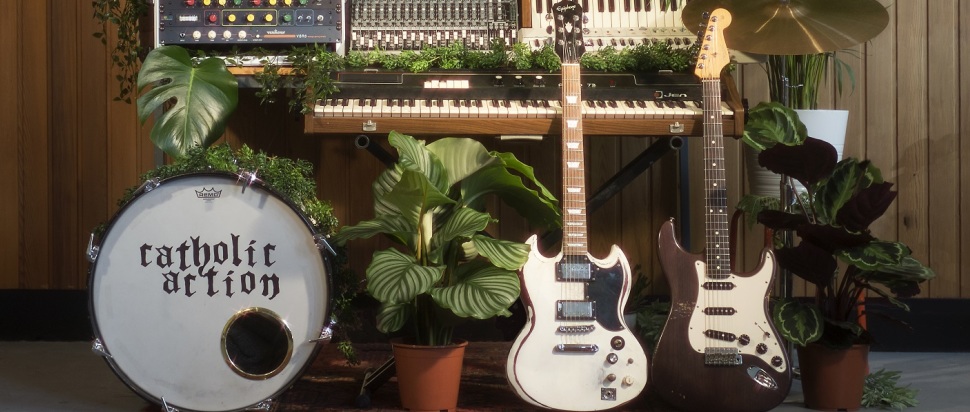
It would be fair to say that Celebrated By Strangers, the second album from Glasgow’s Catholic Action, has had a complex gestation, with recordings sessions for the record dating back to at least 2017. While promoting their debut record In Memory Of, singer and guitarist Chris McCrory told us that he wanted the follow-up “to change what it means to be in a guitar band” and feature My Bloody Valentine’s Kevin Shields on guitar. This is not that record. After all, the biggest change here isn’t sonic but the frontman’s own decision to confront injustice and let rip.
Musically Catholic Action are still deeply indebted to the sound of classic rockers like Status Quo, The Cars and T. Rex with opener Grange Hell’s noisy intro giving way to two minutes of jittery power-pop and several tracks featuring guitar solos worthy of striking a pose to.
Lyrically though they have pushed on a long way from their debut. Almost every track here has some kind of political message. Lead single One of Us is a noisy masses-against-the-classes throw down with McCrory proclaiming himself ‘the welfare son of a welfare son’. It’s a track that the singer describes as “written as a direct response to what I see happening in the UK – a country ravaged by poverty and a disintegrating social fabric of increasingly isolated and intoxicated people.”
Elsewhere from the sprightly indie disco of People Don’t Protest Enough to the closing Four Guitars (For Scottish Independence), McCrory sees the state of the world and decides he’s had enough. While there is a debate to had over whether retro rock is the most progressive or convincing medium with which to sell this message, his commitment and zeal is impressive.
They’ve not forgotten how to write a melody either. Another Name For Loneliness has a swooping vocal and a keyboard line that threatens to resolve into a David Bowie song at any second, while Sign Here is an explosive ballad that seems to address exploitation in the music business.
At times it feels like a strange fusion of medium and message but it’s a triumph that Catholic Action manage to imbue an increasingly staid format with some revolutionary zeal.
It’s been almost an entire year since Stina Tweedale released “In Plain Sight“, her third record as Honeyblood, which saw her working with super producer John Congleton. But lucky for us, especially in these trying times, she’s got a wee treat for us in the form of a music video for the album’s frustration-fuelled track “Gibberish” is the serrated latest single from longtime indie rock mainstays Honeyblood, one taken from In Plain Sight, their most-recent LP. You can order transparent-orange-vinyl, black-vinyl, CD and bundled versions of it from their webstore right now.
“I wrote this song to reflect the absurdity of the current political climate,” Tweedale tells us of the song’s inception. “Now more than ever we are told things daily that are simply not true or are used to manipulate us. How do we know what to believe? Who has our best interests at heart? It’s becoming ever more difficult to navigate these questions.”
The video was shot in a back alley which could only belong to Glasgow, the city Tweedale calls home. Director Gareth Goodlad of Dangerkill Productions tells us: “To me the video is about being taken over by your own self perception.” And this really does come through with the effects and trippy visuals used – Tweedale’s face coming to life as the artwork from In Plain Sight is both super cool and super freaky in equal measures. Tweeddale concludes: “I am exceptionally proud of this video and the stunning job Gareth from Dangerkill Productions has done! We work so well as a creative team and I love seeing his mad ideas spring to life!”
Car Seat Headrest (aka Will Toledo and band) are releasing a new album, Making a Door Less Open on May 1st via Matador Records. Now they have shared another song from it, “Martin,” via a lyric video for the track. Previously Car Seat Headrest shared the album’s first single, “Cool Me Down.”
Car Seat Headrest’s last album, Twin Fantasy, came out in 2018 via Matador. It was a re-imagined version of an album also titled Twin Fantasy that Toledo self-released to Bandcamp in 2011. But his last album of completely new material was 2016’s Teens of Denial. In 2019 the band also released the live album Commit Yourself Completely.
As well as Toledo, the band features Andrew Katz (drums), Ethan Ives (guitar), and Seth Dalby (bass). Making a Door Less Open had a somewhat unique recording process. In a press release it is billed as a collaboration between Car Seat Headrest and 1 Trait Danger, a Car Seat Headrest “electronic side project consisting of drummer Andrew Katz and Toledo’s alternative persona, ‘Trait.’” The album was recorded twice, first with guitars, bass, and drums and then secondly with purely synthesized sounds. Then in the mixing process the two recordings were combined.
Toledo had this to say about the album on the band’s website: “This album was made from January 2015 to December 2019, starting as a collection of vague ideas that eventually turned into songs. I wanted to make something that was different from my previous records, and I struggled to figure out how to do that. I realized that because the way I listened to music had changed, I had to change the way I wrote music, as well. I was listening less and less to albums and more and more to individual songs, songs from all over the place, every few days finding a new one that seemed to have a special energy. I thought that if I could make an album full of songs that had a special energy, each one unique and different in its vision, then that would be a good thing.
“Andrew, Ethan, Seth and I started going into the studio to record songs that had more finished structures and jam on ideas that didn’t. Then I would mess with the recordings until I could see my way to a song. Most of the time on this album was spent shuttling between my house and Andrew’s, who did a lot of the mixing on this. He comes from an EDM school of mixing, so we built up sample-heavy beat-driven songs that could work to both of our strengths.
“Each track is the result of an intense battle to bring out its natural colors and transform it into a complete work. The songs contain elements of EDM, hip hop, futurism, doo-wop, soul, and of course rock and roll. But underneath all these things I think these may be folk songs, because they can be played and sung in many different ways, and they’re about things that are important to a lot of people: anger with society, sickness, loneliness, love…the way this album plays out is just our own interpretation of the tracks, with Andrew, Ethan and I forming a sort of choir of contrasting natures.
“I think my main hope for the world of music is that it will continue to grow by taking from the past, with a consciousness of what still works now. Exciting moments in music always form at a crossroads -a new genre emerges from the pieces of existing ones, an artist strips down a forgotten structure and makes something alien and novel. If there is a new genre emergent in our times, it has not yet been named and identified, but its threads come from new ways of listening to all types of music, of new methods of creating music at an unprecedented level of affordability and personal freedom, of new audiences rising up through the internet to embrace works that would otherwise be lost, and above all from the people whose love of music drives them to create it in the best form they possibly can. Hopefully it will remain nameless for some time, so it can be experienced with that same newness and strangeness that accompanies any and all meaningful encounters with music.”
If I Break Horses’s third album holds you in its grip like a great film, it’s no coincidence. Faced with making the follow-up to 2014’s plush Chiaroscuro, Horses’s Maria Lindén decided to take the time to make something different, with an emphasis on instrumental, cinematic music. As she watched a collection of favourite films on her computer (sound muted) and made her own soundtrack sketches, these sonic workouts gradually evolved into something more: “It wasn’t until I felt an urge to add vocals and lyrics,” says Lindén, “that I realized I was making a new I Break Horses album.”
That album is Warnings, an intimate and sublimely expansive return that, as its recording suggests, sets its own pace with the intuitive power of a much-loved movie. And, as its title suggests, its sumptuous sound worlds – dreamy mellotrons, haunting loops, analogue synths – and layered lyrics crackle with immersive dramatic tensions on many levels. “It’s not a political album,” says Lindén, “though it relates to the alarmist times we live in. Each song is a subtle warning of something not being quite right.”
As Lindén notes, the process of making Warnings involved different kinds of dramas. “It has been some time in the making. About five years, involving several studios, collaborations that didn’t work out, a crashed hard drive with about two years of work, writing new material again instead of trying to repair it. New studio recordings, erasing everything, then recording most of the album myself at home…”
Yet the pay-off for her long-haul immersion is clear from statement-of-intent album opener ‘Turn’, a waltzing kiss-off to an ex swathed in swirling synths over nine emotive minutes. On ‘Silence’, Lindén suggests deeper sorrows in the interplay of serene surface synths, hypnotic loops and elemental images: when she sings “I feel a shiver,” you feel it, too.
Elsewhere, on three instrumental interludes, Lindén’s intent to experiment with sound and structure is clear. Meanwhile, there are art-pop songs here more lush than any she has made. ‘I’ll Be the Death of You’ occupies a middle ground between Screamedelica and early OMD, while ‘Neon Lights’ brings to mind Kraftwerk on Tron’s light grid. ‘I Live At Night’ slow-burns like a song made for night-time LA drives; ‘Baby You Have Travelled for Miles without Love in Your Eyes’ is an electronic lullaby spiked with troubling needle imagery. ‘Death Engine’’s dark-wave dream-pop provides an epic centrepiece, of sorts, before the vocoder hymnal of closer ‘Depression Tourist’ arrives like an epiphany, the clouds parting after a long, absorbing journey.
For Lindén, Warnings is a remarkable re-routing of a journey begun when I Break Horses’s debut album, Hearts (2011), drew praise from Pitchfork, The Guardian, NME, The Independent and others for its luxurious grandeur and pulsing sense of art-pop life. With the electro-tangents of 2014’s Chiaroscuro, Lindén forged a new, more ambitious voice with total confidence. Along the way, I Break Horses have toured with M83 and Sigur Rós; latterly, U2 played Hearts’ ecstatic ‘Winter Beats’ through the PA before their stage entrance on 2018’s ‘Experience + Innocence’ tour. Good choice.
A new friend on Warnings is US producer/mixing engineer Chris Coady, whose graceful way with dense sound (credits include Beach House, TV on the Radio) was not the sole reason Lindén invited him to mix the album. “Before reaching out to Chris I read an interview where he said, ‘I like to slow things down. Almost every time I love the sound of something slowed down by half, but sometimes 500% you can get interesting shapes and textures.’ And I just knew he’d be the right person for this album.”
If making Warnings was a slow process, so be it: that steady gestation was a price worth paying for its lavish accretions of detail and meaning, where secrets aplenty await listeners eager to immerse themselves. “Nowadays, the attention span equals nothing when it comes to how most people consume music,” Lindén says. “And it feels like songs are getting shorter, more ‘efficient’. I felt an urge to go against that and create an album journey from start to finish that takes time and patience to listen to. Like, slow the fuck down!” Happily, Warnings provides all the incentives required.
Bright Eyes (Conor Oberst, Mike Mogis, and Nathaniel Walcott) have shared their first new song in nine years, “Persona Non Grata.” The band previously announced that they had signed to Dead Oceans and had been recording, with intentions to release new music this year. They also previously announced a world tour. In January they also shared a teaser video featuring them recording in the studio with an orchestra. Check out the track “Persona Non Grata” below, followed by a statement from the band and the band’s tour dates (hopefully they won’t be postponed or cancelled due to COVID-19).
While Oberst has kept busy in the last decade with solo and collaborative projects (such as last year’s Better Oblivion Community Center duo with Phoebe Bridgers), the band with which he made his name have not released an album since 2011’s The People’s Key.
In a previous press release Dead Oceans co-founder Phil Waldorf had this to say about signing the band: “Bright Eyes is not just a formative artist for me personally, but for countless people who work at Dead Oceans. To get to work with a band that is part of our own origin stories in falling in love with music is the rarest of privileges. We are thrilled to be part of another great chapter in Bright Eyes enduring legacy.”
Since Bright Eyes went on hiatus, Mogis has kept busy as a producer and Walcott has worked as a film composer. Oberst’s punk band Desaparecidos also reformed for 2015’s album release Payola.
“Persona Non Grata” by Bright Eyes out now on Dead Oceans Records.
Fronted by the ferocious Jenny McKechnie, Cable Ties are a three-piece from Melbourne who have built themselves a reputation as the saviours of contemporary Australian punk.
With a razor-sharp edge, they deconstruct the ragged aggression of stadium rock bands like AC/DC, the minimalism of post-punk pioneers Au Pairs, and synthesise them into bellowing anthems of discontent that are distinctly their own. Jenny screeches like a bogan banshee (or Siouxsie), Shauna pounds the drums like they owe her money (they do), and the Verlaine-thin bassist NickBrown boogies like he’s hearing Blondie for the first time.
This simultaneously bright-eyed and jadedly anti-capitalist approach is the first thing you’ll notice on their new record Far Enough. From the way early single ‘Tell Them Where to Go’ harkens back to the cover of Sonic Youth’s Goo: ‘Are you stuck in your bedroom with your stereo on? Why don’t walk out your bedroom? And steal your brother’s guitar!?’ To the way ‘Sandcastles’ jumps back and forth like a fever dream, Far Enough is a stunning sophomore effort.
‘Sandcastles’ is the most concise song I’ve heard from you guys. Given you’re mainly known for stretching out punk songs beyond their limits, that’s a pretty big deal. How come it’s so much more concise?
Cable Ties are preparing to unleash their towering wall of ’70s hard rock and proto-punk to the world with the release of their second album (and Merge debut!) Far Enough on March 27th. As a final preview to the record, the Melbourne trio recently shared “Hope,” the opening song and lyrical centerpiece of Far Enough.
Singer-guitarist Jenny McKechnie says “Hope” serves as the record’s mission statement of sorts, touching on environmental, feminist, and anti-colonist themes explored in greater depth on “Sandcastles,” “Self-Made Man,” “Tell Them Where to Go,” and the rest of Far Enough.
We wrote that song when we had a weekend away writing, and we spent the whole time doing something which never ended up on the album. It was one of those weekends where it got too convoluted, and we had to start again. And right at the end of the weekend, we had two hours where we wrote ‘Sandcastles’ pretty much in one go. We just had a really good crack at it where… it felt like it was what it needed to be. It was straight to the point. Focussed. Like, when we write a song we start with a riff and if we can’t play that same riff over and over again for like half an hour, and enjoy it and really sink into it, sort of like feel it in our bodies in this cathartic way, we don’t think it’s worth making into a song.
On ‘Pillow’ you sing about feeling like you’ve fucked up and can’t go back. How do you cope with that feeling?
That feeling is something that I struggle with in music a lot, to be honest. Like, I did my undergrad arts degree in politics, and then I tried to go to Law School like, ‘I better do something that’ll get me a job,’ and I dropped out. Then I tried to do honours, and dropped that too. That feeling is me being like, ‘Why do I think that I’m so special that I can spend all my time playing music?’ And really beating myself up about it, which I would never do to anyone else, but for some reason, I still do it to myself. It’s still in my head that art’s a waste of time and that I should do something useful. So, that song was me convincing myself that it’s ok, what I’m doing. And that the voices in my head telling me that I’ve fucked up aren’t actually mine, in a way.
On ‘Tell Them Where to Go’ you sing about the aspirational component of being in a band. Is that your narrative? Are you singing to yourself?
That song was actually written when we were going to play at Girls Rock in Melbourne. It’s this program that gets young girls between 12 and 18 and puts them in bands. And they have to write an original song in one week and then perform it, and we were like ‘that is amazing.’ We were thinking about our own writing process like, it takes us months, we would never be able to do that! So we were like, ‘righto, we’re playing girls rock, let’s write a song for it. If they can do it then we should be able to.’ So that song is written for those kids. And also thinking about myself, and how much I would’ve loved to have something like that when I was growing up.
You sing very unapologetically. Was there any insecurity involved in finding your voice when you first started singing?
I first started playing music in [giggles] folk bands! So the stuff that I used to do was really quiet and sweet and I didn’t think that I could project my voice at all. But then when we started rehearsing we were really loud and I couldn’t get my voice over the sound of the amp. So the way that I’m singing was just a result of me really trying to be heard over the sound of everything. By the time that we were playing in venues where I could actually hear myself, I realised that I was doing this thing with my voice that I’d never thought I could do. Actually projecting and singing loud and high and just going for it. Cutting loose
At the end of ‘Anger’s not enough’ there’s a sound that sounds like a rooster. Is it a rooster?
Ha! I wish it was. But no, it’s not. I’m very glad that you can hear that though. The sound at the end of ‘Anger’s Not Enough’ is me with two guitar amps, and – I hate to get all spinal tap on this – they’re both turned all the way up to 10 and just pushed into overdrive. I also had this pedal from Newcastle called ‘when the sun explodes’—it’s like a reverb pedal where you can also get some really interesting feedback things going on. So its that looped over and over—I guess about three different tracks of me just messing with the guitar making crazy sounds. So if you can hear a rooster in there, I’m happy.
British 90s band TheLongpigs‘ first album “The Sun Is Often Out” is being reissued on vinyl. The band were fronted by Crispin Hunt and featured guitarist Richard Hawley and this 1996 debut delivered four top 40 hit singles. Five singles were released from the album, initially to little success. including “On and On” which peaked at number 16 in the UK chart. The Longpigs debut album The Sun Is Often Out is an ambitious, darkly romantic album that owes quite a bit to the modernized anthem-rock of Radiohead. Although the band doesn’t quite have Radiohead’s talent for making the bombastic seem utterly personal, there are several moments of brilliance on the album — particularly the singles “Far,” “She Said” and “On and On” — suggesting that their appealingly neo-gothic sonic textures will develop into something distinctive on their second album.
This album was issued on U2’s Mother label and with CD the popular format of the day, only ever got a small run on vinyl, meaning it’s incredible hard to get hold of at sensible prices.
This signed coloured vinyl edition appears to now be sold, but the next best thing is the unsigned blue vinyl. It will be released on 8th May 2020. The Sun Is Often Out was declared one of 1996’s 50 best albums by both Q and Melody Maker.
October 18th 2011, New Jersey’s Real Estate released “Days”, their second album and first for Domino. A coming of age moment for childhood friends Martin Courtney (Guitar and Vocals), Matt Mondanile (Guitar) and Alex Bleeker (Bass), “Days” was recorded over the course of five patient months in a remote New Paltz, NY barn-cum-studio with the help of Kevin McMahon (Titus Andronicus, The Walkmen).
A gorgeous suite of guitar-pop songs, Days is a testament to the fact that the sonic formula Real Estate developed and shared with their debut album (Real Estate, Woodsist 2009) heralded the arrival of a new, genuine and enduring group of voices in American independent music. Days sees the band tighten and refine their brand of timeless, melodic and genuine music- consolidating the breezy sketches of their earlier work into considered, graceful pop songs.
The songs are built around deceptively simple, cyclical riffs; caressed and performed with a rhythm and restraint that is atypical for a band Real Estate’s age. The instruments swim together, anchored down by Bleeker’s firm Lesh-esque bass, ebbing and flowing, occasionally enriched with flourishes of country piano, soft synths and slide guitar. Several songs, like the album’s rousing first single “It’s Real” were written by Courtney in the way he wrote some of his first songs…more
On her third album for both Fat Possum and Loose Records, Courtney Marie Andrews has pulled in to one package all the songwriting skill, vocal prowess, and musicianship displayed on previous albums, into one career defining statement. A break-up record for sure, though due to Courtney’s extraordinary storytelling gifts, more of a modern day
coming-of-age tale of love won, love sustained, and unfortunately, love’s inevitable dissolution.
You can’t water old flowers. Yes, you fall in love, you make mistakes, and so do they. You run through blackberry fields in the summer of your youth, dream in passenger seats gazing past towns and fields, imagining a future life where everything works out. I fell head over heels in love at nineteen. The kind of love where you call up your best friend and say, “I think I’ve found my soulmate.” The pull towards that first true love is strong. It consumes you, makes you question your own dreams.
We taught each other, grew up together, we were family. We fit just right, for a time. Then one day, after a long and rocky nine year road, life changed and became a complicated mess too hard to untangle. We couldn’t get our love back, no matter how many dreams that shadowed this hard truth. We grew resentful, selfish, harbouring past mistakes and holding them up like armour from every blow. We grew up and our paths diverted.
On New Year’s Day, 2018, a great horned owl dropped dead at my exes’ feet in my mother’s yard. It felt like a daunting omen, ushering on change for the both of us. We were distraught. We couldn’t afford the taxidermy, so we placed it in a big blue plastic garbage bin. Now it felt so cheap, that mystic creature in a plastic coffin. That’s how love feels sometimes – like we don’t serve it the ending it deserves.
The omen was true. That year, I started to see the woman I could be, the woman I wasn’t yet. Anytime I felt like myself, I was alone and wandering, and I knew that was a sign that it was time for change. New Year’s Day 2019, I said goodbye to my first true love and moved across the country. Losing someone you spend every day for nearly a decade with is intense. We talked in our dreams. I knew where he was, even before I entered a place. He’d always be there if I had a feeling. Humans are connected in unexplainable ways.
I was writing a lot after we broke up as a healing technique, preserving each memory like an emotional archaeologist. Late one night, I woke up from a dream where I was searching for him, my ex, at a carnival. It was so vivid. I woke myself up to write a song on my piano. The next morning, he reached out to me for the first time in months. We went out, had a drink, caught up, and he told me that the hardest part about our separation was a reoccurring nightmare where he searched for me at a carnival. In that moment, I knew, humans have ways of connecting beyond words and touch. I truly believe that. We had the same dream, without seeing each other for months.
Even with all the mystic symbolism that year presented, this is an age-old story I can’t make up. We fall in love, we grow up, we change, and they don’t change with us. ‘Old Flowers’ is about heartbreak. There are a million records and songs about that, but I did not lie when writing these songs. This album is about loving and caring for the person you know you can’t be with. It’s about being afraid to be vulnerable after you’ve been hurt. It’s about a woman who is alone, but okay with that, if it means truth.
This was my truth this year – my nine year relationship ended, and I’m a woman alone in the world, but happy to know herself.
These songs came to me alone, late nights in Bisbee, Lisbon, Nashville, and London. Sometimes I’d just cry and sing, and a song would come out. I drank too much wine while writing this record, lit too many candles. You could say this was my attempt to summon the muse, but that’s bullshit, because she was just standing there naked looking me in the eyes. So I told her the truth.
This is my story of the most heartbreaking, but soul-revealing, year of my life. I drove myself mad. I drove to the smoky mountains just to drive back. I danced with a Portuguese boxer and cried on his shoulder in a Fado cafe. I did everything an artist is “supposed to do.” But at the end of the day, beyond all the romance, these songs are my truth. I think they might be yours too.
With influences of bossa nova and oldies, we create the perfect soundtrack for chillaxin’ by the pool, The group was originally formed around the talents of Matthew Terry (vocalist/guitarist) and Eugene Chung (drummer) during their senior year of high school. Before moving to Austin, Matt and Eugene enjoyed playing intimate shows at small coffee shops, friends living rooms, and local venues around the Dallas and Denton area where they began to work on and craft the musical nature of what is now Summer Salt.
Driving to Hawaii (2014), contains the essence of a never-ending vacation and is rich in guitar pop and silky harmonies that is reminiscent of the Beach Boys. The EP features fan favourites such as Sweet to Me, Rockaway, and of course their title track, Driving to Hawaii, which has iconically represented the basis of all Summer Salt lyrics: trying to slow down and enjoy the ride of chasing what appears to be an unattainable pipe dream.
Their next release, Going Native (2015), was inspired by a trip abroad where Terry began diving into artists such as Joao Gilberto, Antonio Carlos Jobim, and Gilberto Gil which lead to a new writing direction using Latin elements. Succeeding the energetic and live sounds of Going Native, So Polite (2017), was the perfect appetizer for the bands’ debut full-length album, the wildly colorful, Happy Camper (2018) which features a more polished production quality from Sub-Pop stalwart Phil Ek (Fleet Foxes, The Shins).
The infectiously melodic ensemble has cultivated a loyal following with their endless summer, ocean dream music that can be heard in influences such as the Lovin’ Spoonful, Donovan, Frankie Valli, the lovely Lady Day or other musical genres of 1960’s Rocksteady or African Highlife. Moving forward, with the anticipation of their forthcoming release Honeyweed, Summer Salt maintains phonetic components of Brazilian tropicalia and 60’s folk pop while drawing inspiration from seasoned topics of loss and renewal.
Summer Salt’s building success on the road lead to a 31-date sold out North American tour in the Summer of 2018. Featuring the recent addition of guitarist/vocalist, Anthony Barnett, and bassist, Elliot Edmonds, the group is now preparing to embark on their second headlining US tour.