Archive for the ‘CLASSIC ALBUMS’ Category

See the source image

Jack Bruce  was asked “What do you think these days, about the Cream songs you wrote?” the reply: I don’t call them Cream songs. I call them songs that I wrote at that time. OK, tell me about “White Room,” for example. I’m really happy with that song, because it’s paid the rent for a while. It’s quite a daring song in that it starts in 5/4 and was a huge hit. There aren’t many of those—Blondie’s “Heart Of Glass” has bars of 7/8 in it, that was a good song.

I think it’s important that writers take chances and risks. Record companies and a lot of people underestimate the public tremendously, so you end up with a public that doesn’t know. But if you reckon that the people you’re playing for are fairly hip, then they’ll really get into it. “White Room” has some of Ginger’s best drumming—when he brings in that extra bass drum at the end, it’s a whole new dimension.

How about some of the Cream gigs? Or should I say the gigs you played at that time. I think your debut was at the Twisted Wheel in Manchester in 1966. You were still playing your Fender VI, before you got the Gibson EB-3. I don’t know who suggested the Twisted Wheel. It might well have been Ginger. But why not? One of the better clubs in Britain, without any doubt. I think it was a pretty good gig. We had a big American estate car, which blew up on the way to the Twisted Wheel. I don’t remember how we got there in the end.

So then we got our Austin Westminster band car. There’d be the driver and roadie, Ben Palmer, and three in the band, two Marshall stacks, and the drums. That’s what we’d get in with any relative comfort and spliff-rolling capabilities. We’d drive there and come back the same day.

What do you recall about playing the Flamingo in London?:

I did the all-nighters there a lot, that was one of my very early gigs. I played the Flamingo with Alexis, too, a bit, but mainly the all-nighters with pickup bands, usually Ginger on drums, Dick Heckstall-Smith on tenor sax, and Johnny Burch on piano. The band room of the Flamingo in the early ’60s was the centre of the universe, really. It had a pet rat that used to run in the rafters above. Just a fabulous place to hang out. The Marquee was good, the 100 Club was good, but the Flamingo was the hip place. A guy called Ronnie Chambers used to look after the Flamingo. He’d get excited sometimes and rush on stage waving his gun about if the music was particularly good. His line was, “Hey, you want a watch?” And he’d pull up the sleeve of his suit and he’d have all these watches up his arm. Those were really great days, quite innocent really.

I’ve got a copy of a contract here for a 1966 Cream gig in Stockton [northern England] for £75.

Seventy-five quid? Well, that’s pretty good bread for then. I remember the first big-money gig we got with the Graham Bond Organisation, a bit earlier, I think Newcastle or Durham University or something, we got £40. We thought, Wow! We’ve hit the big time! A few of those and we can retire. Bearing in mind that people were probably earning a quarter of that as a decent weekly wage. So I don’t think Cream was making very good money at first from gigs—I think that came much later. I’m afraid I’m very vague about anything financial.

How about the early American gigs, maybe the Fillmore? . The Fillmore was great in San Francisco, and obviously 1967 was the year to be there, really. It would take off some nights, and this was when we first started doing the extended improvisations in Cream. It was new to the band. Up to this series of gigs, we just played little songs live, very short: three, four, five minute versions of the songs. And since there were only three of us, it wasn’t like: “You do a solo, then I’ll do a solo, then you.” It was: “Eric, do a solo.”

“Our albatross was having to do very long solos when you maybe didn’t feel like it. Mixed blessings, really.” We would sometimes strip it down to where Eric would play completely unaccompanied, for quite a long time [laughs]. And I remember him doing some quite incredible stuff, quite amazing. But they weren’t recorded.

The change was, quite simply, that we were fed up with doing that, and the audience was so great at the Fillmore, they were all so out of it, all sort of laidback, and would say, “Just play!” They wouldn’t let us go. So we just started playing, jamming as it were, and that turned into what we became known for. We didn’t sit down and have a big discussion: “Oh, let’s do this.” I think it was the same way that The Who became known for smashing up their equipment and all of that, and that became their albatross.

Is your academic musical background of use to you?

Yes, because if I’m sitting on a plane, say, and I have an idea, I can always write it down. I can write all my own horn parts, as on my new album, I can write my own arrangements. In fact, thinking back to “I Feel Free” and “White Room,” I was much closer to the academic days—which in fact were very shortlived. I did A-level music and then I went to The Royal Scottish Academy of Music, studying composition and cello, part-time and then full-time. And then we sort of threw each other out. They didn’t like me because I was improvising.

When I left the Academy, I was playing acoustic stand-up bass, and I heard about this band in Coventry, guy called Murray Campbell, it was a Mecca dance band. I was playing bass with Andy Park and some local people in Glasgow—he turned me on to Thelonious Monk. I just wanted to go out there, I wanted to be the next Scott LaFaro. Not much hope of that, but when you’re young you’re very ambitious. Ambitious, certainly, and also with some strong jazz roots, it seems.

The roots thing is very important to me. I think the difference between my roots and someone else’s is that I didn’t come from rock ‘n’ roll, I came from jazz, basically. I was playing with Ginger and Graham Bond, we were an alto–acoustic bass–drums trio, very much in the style of what Ornette Coleman was doing in the late ’50s, Charlie Haden and so on. That was my roots.

Anyway, I left home at 17 and went down to audition for this band I’d heard about, because they were playing Maynard Ferguson, Dizzy Gillespie big-band arrangements. The audition piece was Dizzy’s “One Bass Hit.” It’s a very difficult piece, so it was sorting out the men from the boys. And even though I was 17, I got the gig. A very good band.

I travelled around the country playing with jazz bands—I played with Chet Baker, and then with a fairly good cocktail-jazz band on the American Air Force bases, which was great because it introduced me to Mingus. They had these great record collections, and I steeped myself in Mingus records. It completely changed my life, because that introduced me, though I didn’t know it at the time, to the blues. Because really, what Mingus did was to bring country blues to jazz. Then I came to London and joined Alexis Korner.

Well, there was a place in London called “the street,” Archer Street, round the back of Piccadilly Circus. One day a week at lunchtime, all the musicians would go down there and you’d get work. Hundreds of musicians hanging out with their little books, getting their weddings and bar mitzvahs, this whole street would be thronged of musicians. That’s how I got the cocktail-jazz job, and Chet Baker. Then I tried to make it as a jazz bass player in London and had some tough times. I was playing with this band called Jim McHargs & His Scotsville Jazz Band. And Jimmy McHargs was the bass player, so how I got that job I still haven’t worked out.

This was 1961, ’62, and we got a gig at a Cambridge May Ball. And then I hear this amazing sound emanating from a cellar they had there. I went down, and it was Dick Heckstall-Smith on sax, Kathy Stobart singing, forget who was on piano, a guy called Morris on bass, and the guy on drums was called Ginger Baker. I went and asked to sit in, and they said they didn’t encourage that. I think they may have thought I was a student, though how they could have thought I was a student at Cambridge I don’t know. But anyway, I persuaded them, and they did the old trick of what jazzers do when someone sits in, which is to make them look stupid. So first they played something with very difficult changes at an incredible tempo.

So then they played a ballad and said: “You play the tune.” So OK, did that. And then I put the bass down and left. And Dick Heckstall-Smith spent two or three weeks trying to find me, and somehow he managed, and he asked me to join Alexis Korner’s Blues Incorporated. It was a good job he managed to find you.

Yeah. I might still be living in that terrible room in Willesden [north-west London]. You never know. So I joined, and Charlie Watts was on drums. I became good mates with him, often slept on his couch. And Dick Heckstall-Smith I regard as a musical father in many ways. He turned me on to a lot of things. The legendary Cyril Davies was on harmonica. It was very much a rhythm and blues band.

Cyril was a panel beater by trade. He and Alexis used to play interval spots with Chris Barber, playing Lead Belly things. I haven’t heard a harp player like Cyril. OK, Little Walter is obviously the man of all time, James Cotton is good, but Cyril had something. He was so good that when Muddy Waters heard him over here, he asked him to join his band and go back and live in Chicago. Unfortunately, poor old Cyril had leukemia and didn’t have very long to live. But I don’t think he would have given up his panel-beating business anyway. Muddy doesn’t, er, pay well.

I was a terrible musical snob. I thought progressive jazz was all there was—Ornette Coleman, Sonny Rollins, Miles Davis, post-bebop but still with the roots. Very much what you would call modern jazz. Talking ’62, so a lot of interesting stuff was about, Blue Note was happening, Riverside was happening. I remember hearing Tony Williams for the first time around then, he made a record with Eric Dolphy called Out To Lunch which is still something I play once a week. It was Dick that explained to me that it was possible to keep your musical ideals, but apply other things to it. Fusion, in other words. You could have a great country-blues harmonica player playing with a modern jazz tenor sax player, and that it didn’t demean anything, and in fact that it was much more modern than playing an imitation Ornette Coleman. At this time there were some great fusion bands, specially the Miles Davis band, the original Return To Forever, Weather Report in its heyday. Lifetime was the fusion band. Lifetime I consider to be definitely the best musical experience of my life. [Jack played on the 1970 Tony Williams Lifetime album Turn It Over.] Anyone who was lucky enough to hear that band would tend to agree with me. Played some great gigs over here, played the Speakeasy which people still go “wow!” about. That was a great band. We all knew it was very, very special. For me, it was great playing with people up to my standard—and that’s going to sound terribly big-headed.

Lifetime was a three-piece band at that time, Tony Williams [drums], Larry Young [organ], and John McLaughlin [guitar]. John brought Tony along to this gig—Jimi Hendrix was there, we had a great time—and Tony said, “Hey, I’m recording tomorrow, would you like to come down and play on a track or two?” So I went down, and he presented me with this very complicated written part, thinking probably this guy is a rocker. So I sight-read it, because I’m trained in that way. But the thing was, we clicked rhythmically.

Oh, Miles! Miles likes Cyndi Lauper. Miles is a completely open individual, as every musician should be. There’s a lot of people in rock music that I know—I won’t mention their names—who are snobs as well. They think that if it’s not two guitars, bass, and drums, and maybe a keyboard, well, forget it. There’s a sort of inverted snobbery there that I find and that I have suffered from. And there’s a problem with guitar players in the States who all want to play like Yngwie Malmsteen. They all want to play scales very fast up and down the neck of the guitar, and they aren’t interested in finding the roots of the music. They probably go as far back as Van Halen, and think that’s the beginning, instead of where Eric went back to: Robert Johnson, Albert King, and so on.

I’m roughly the same age as Mick Jagger, John Lennon—we were all little boys who were really influenced by the very beginnings of the commercial success of early rock ‘n’ roll music. It was there in our consciousness. So we can now look back as an overview, a lot of people of our generation, and a lot of younger people, too. It’s there. You can get the entire output of Willie Dixon, Chuck Berry, or somebody. In the ’60s when Cream was happening—let’s say in 1967, when we had our first real success in America—we played the Fillmore in the hippie summer and it felt like the whole world was being reborn, and musically I was so excited.

Ginger Baker and myself were really a hot jazz rhythm section, and even when Eric was playing, Cream was basically a jazz band. We never told Eric that, but that’s another story. Well, I don’t mean we were playing jazz. We certainly weren’t. We were playing improvised music, and some of the improvisations were damn good, even the recordings that were released. Which were not the best. You never get the best live stuff recorded, I’m glad to say.

Because it’s almost a pity when it’s recorded. Because live music should be something that happens and disappears, and you go home from the concert going, “Wow, that was great!” And you know you’ll never hear it again. The musicians love that magic that happens every so often. Also, I think if you stick up a microphone and you know it’s being recorded, it’s going to stop the real magic happening anyway. And I think there’s got to be something wrong with the people who go to the trouble of recording every gig.  When I listen to live Cream records now, I’m struck by the sound you got. I think if we were to play now, it would be a lot better. That side of it would be a lot better. Two of the bands that I’ve played with, at least, the great pity was that we were ahead of the technology—they were Cream and Lifetime. They hadn’t invented the real PA system yet. We used to play baseball stadiums with little 200-watt PAs. The problem that Cream had was that none of us were technically minded, in the sense that we knew what to do about it..”

You only have to look at old films of Ginger playing. I saw something recently of him playing with Blind Faith, and he was using two mics for the drums. In Hyde Park! Jimi suffered very badly from equipment, too. In Lifetime, we were playing light-years-ahead music—very fast, very loud—and that was the loudest band I’ve ever played in. Cream wasn’t that loud. Volume is a very relative thing. I think even symphony orchestras are playing louder now. People are going deaf! In those days, if you had 100 watts for the guitar and 100 watts for the bass and 200 watts for the vocals, that was damned loud. In Alexis Korner’s band, we all went through one little amplifier and two speakers either side of the stage—and people thought that was loud! People have got used to louder things. And, of course, we now have more sophisticated sound equipment, which in those days just did not exist. The first time I played electric bass was for Island Records with a guy called Ernest Ranglin, a Jamaican jazz guitar player. We recorded an EP called Ernest Ranglin And The ‘G.Bs’. It was Ernest, Graham Bond on Hammond, Ginger on drums, and me on a bass guitar that I borrowed from some music shop.

I’m a very stolid person. It takes me a long time to change, so I was against bass guitars. But that session was all it took. God, I thought, it’s loud, and I can play so easily. I can play louder than Ginger! He didn’t like it. I was totally convinced, so I went out and bought my first electric bass, which was a Top Ten [he means the Teisco-made Top Twenty brand], a Japanese bass—and “Japanese” didn’t mean very much in those days. It was all I could afford. Sounded pretty good to me. Kept giving me terrible electric shocks, though.

Marvin Gaye came over here. He’d just had his first few hits, must have been ’65. Graham Bond got the job of putting the band together to do a TV show with Marvin, we were playing things like “How Sweet It Is,” and I was going so he asked me to join, but unfortunately—unfortunately? Fortunately, I was getting married and I couldn’t go.

But that did encourage me that I was on the right track, because I was having a lot of problems, specially from Ginger who thought my bass playing was becoming too busy. It was just that he could hear me now. Suddenly there was a bass, and I was playing melody.

I’ve always thought that good music is not a melody and a block and boom-boom. To me good music is all melody—the drums should be playing tunes, the bass should be playing tunes, it should be counterpoint. I like to be able to listen to a lot of things going on, as opposed to one block—unless that’s what you want. I like moving parts, and that’s what a lot of the great Stax and Tamla things are. A lot of great soul music is very contrapuntal. So James Jamerson to me was Tamla Motown, as much as any of the great singers. He’s what made it great, this bass player.

What’s your feeling these days on the way Cream ended? I mean, why did the band break up? The kind of theoretical reason given is that we all wanted to go our separate ways and do different things. The real reason was the greed of the management. They never gave us a minute’s rest, because they drove us into the ground. We were all exhausted, and we hated each other. We were selling more records than The Beatles; the first platinum album; all that stuff. So they thought, let’s get these guys happening, you know?

And so we used to make records, we’d do the recording but wouldn’t be at the mixes. We wouldn’t know what was going to be on the records sometimes. We’d drive past some record shop, go in and buy our record to see what was on it. That’s the way it was in those days. I think most of the Cream songs are alright, there’s just not enough of them, for those reasons.

That final Cream tour in 1968 must have been a weird one. I suppose vaguely I thought it wasn’t our final tour. Mixed feelings. The height of success that we’d had, and we were splitting. Very strange feeling. Some of it was fun, because a lot of the pressure had gone. The Madison Square Garden gig was done in a very joke way, using the house PA, the same one that comes down from the ceiling where they say, “And in the blue corner—” And on a revolving stage. People who saw that gig couldn’t believe it. You’d get a big loud bit of Eric, then a big loud bit of Ginger, then Eric would disappear and I’d arrive, you know.

I remember getting the platinum discs at Madison Square Garden. Robert Stigwood and Ahmet Ertegun got on stage to present us with these in the middle of the set, and the audience just went “Booooo!” Very embarrassing. Very nice to get those, though. I wonder where mine is? I remember bringing it back to England, proudly, and they wanted me to pay duty on it.

The success is nice. But then the feeling is that it’s going to end. I had other things going on in my life. I wanted to have a kid, I wanted to have a house, the different things that people do, as opposed to living out of a suitcase. So there was that to look forward to. It was a good time, really, and I think some of the gigs on that last tour were really, really good, considering. I think we had something slightly better organized sound-wise. I remember one of the first big gigs on that tour, maybe it was Oakland, I remember going with Eric right up to the very furthest-away seats you could go to, and these tiny little dots where we would be, and going, “Fucking hell! We’ve come a long way from the Twisted Wheel.”

No photo description available.

Hello, and welcome to Sunday Series No. 5!
I’ve been reading a lot of Wallace Stevens in the past few days, and I keep coming back to a poem called The House Was Quiet and The World Was Calm (opposite to current experience) and this bit in particular:  “The words were spoken as if there was no book, Except that the reader leaned above the page,

Wanted to lean, wanted much most to be The scholar to whom his book is true, to whom,The summer night is like a perfection of thought. The house was quiet because it had to be.”

I love this image of leaning into something that you know will lead to growth, something true. I won’t wax on about Bob Dylan’s impact on my love for lyrics — endless others have expressed what he’s given to us far more eloquently than I ever could — but the leaning reader in this poem pretty well describes how I have always listened to him. Like reading a great book — that rush of receiving a perfect string of words. I always lean in.

Released May 17th, 2020

“Knockin‘ On Heaven’s Door” (Written by Dylan)

Tanya: vocal, guitar
Russell Chudnofsky: acoustic guitar
Joe McMahon: piano
Dean Fisher: snare, tambourine
Lilia Halpern: vocals, guitar

See the source image
Happy birthday to the great Taj Mahal who turns 78 today. Taj is a singer-songwriter and multi-instrumentalist who has been performing and recording for 50 years. Primarily a Blues singer, he has incorporated elements of world music into his works, including sounds from the Caribbean, Africa, and South Pacific. He formed a group called the Rising Sons in 1964 with Ry Cooder and Jesse Lee Kincaid. A record deal with Columbia Records was unfruitful, perhaps because the group was one of the first interracial bands. Mahal worked with other musicians like Muddy Waters, Howlin’ Wolf, Buddy Guy, and Lightnin’ Hopkins, before beginning his solo career with the eponymous Taj Mahal long-player in 1968. His follow-up “Natch’l Blues,” became a part of my collection in 1969 – loved the playing on “Corrina,” and “The Cuckoo,”, and wore it out. Taj also performed with The Rolling Stones’ Rock and Roll Circus at the end of 1968.

Taj Mahal’s second album, recorded in the spring and fall of 1968, opens with more stripped-down Delta-style blues in the manner of his debut, but adds a little more amplification (partly courtesy of Al Kooper on organ) before moving into wholly bigger sound on numbers like “She Caught the Katy and Left Me a Mule to Ride” and “The Cuckoo” — the latter, in particular, features crunchy electric and acoustic guitars and Gary Gilmore playing his bass almost like a lead instrument, like a bluesman’s answer to John Entwistle most notable, however, may be “You Don’t Miss Your Water (‘Til Your Well Runs Dry)” and “Ain’t That a Lot of Love,” which offer Taj Mahal working in the realm of soul and treading onto This is particularly notable on “You Don’t Miss Your Water,” which achieves the intensity of a gospel performance and comes complete with a Stax/Volt-style horn arrangement Jesse Ed Davis that sounds more like the real thing than the real thing. “Ain’t That a Lot of Love,” by contrast, is driven by a hard electric guitar sound and a relentless bass part that sounds like a more urgent version of the bassline from the Spencer Davis Group’s “Gimme Some Lovin’.”

He recorded 12 albums in all for Columbia during the 70s and 80s, and also recorded three albums for Warner Brothers. His career stalled afterward, and he moved to Hawaii, where he worked throughout the 80s. He released more albums in the 90s. collaborating with both Eric Clapton and Etta James.
In 1997, he won Best Contemporary Blues album for “Senor Blues” at the Grammy Awards, followed by another Grammy in 2000 for “Shoutin’ in Key.” Mahal has continued to record and perform with the likes of Bonnie Raitt, Joe Walsh, and Sheila E. In 2017, he worked with Keb Mo’ on a joint album TajMo.

Taj Mahal is a major artist who has travelled somewhat under the radar all these years. but make no mistake, he is a gifted musician whose albums are well worth searching out.

“The Cuckoo,” From his first Columbia album “The Natch’l Blues,”  comes this laid back gem from our Taj Mahal.
“You know the cuckoo is pretty bird/But she warble as she fly/But baby you never heard a cuckoo/Until the Fourth of July.”

“Good Morning Miss Brown” – Taj is all the way live as he rolls through the streets of the Big Easy. This guy has to be one of the coolest cats alive with a resume that could stretch down Bourbon Street. Originally from his second album on Columbia, “The Natch’l Blues,” in 1969 it was the beginning of a 50+ year career that is still going strong.

Produced by the band members themselves and engineered by the legendary Martin Rushent, “Future Games” was recorded at London’s Advision Studios between June and August 1971, and the fact that it was released on September 3rd of the same year shows just how quick the turnaround was. In addition to Kirwan, the album also stands out as being the first Fleetwood Mac album to include Christine McVie as a full member as well as the first to feature Bob Welch, but it’s also notable for being the band’s first album without Jeremy Spencer.

When Fleetwood Mac turned in Future Games, Reprise Records said that they wouldn’t release it with only seven songs, so the band popped back into the studio and laid down “What a Shame,” doing so as a jam, hence the song writing credits including every member of the band. The album’s lone single, “Sands of Time,” failed to chart in either the U.S. or the U.K., but one tune has managed to find a tremendous audience over the years: the title track, penned by Welch, which is by far the most streamed song on the album.

Future Games was poorly received by the critics of the time. Future Games is a thoroughly unsatisfactory album. It is thin and anemic-sounding and I get the impression that no one involved really put very much into it. If Fleetwood Mac have tried to make the transition from an energetic rocking British blues band to a softer more “contemporary” rock group, they have failed. If they have simply lost interest.

Critic Robert Christgau’s commentary shows how much the man admires what he perceives as his superior ability with wordplay as well as the usual pomposity and factual errors:
These white blues (and hippie rockabilly) veterans shouldn’t have to depend on new recruit Bob Welch’s deftly metallized r&b extrapolation for rock and roll, but unless you count the studio jam, they do. And if the best song on the album isn’t the slowest, that’s only because Welch also has mystagogic tendencies. It’s the simplest in any case: Christine Perfect’s ‘Show Me a Smile.’
Christine was no longer calling herself Perfect but was still good enough to qualify as McVie. Bob Welch actually contributed relatively little to Future Games: he wrote two of the songs (including the title track) and “played mostly rhythm guitar.” And to apply the term “mystagogic” to Bob Welch is completely absurd, for “A mystagogue is a person who initiates others into mystic beliefs, and an educator or person who has knowledge of the sacred mysteries of a belief system.” Neither of Welch’s songs come close to qualifying as a trip into the mystic (though Danny Kirwan’s do).

The expansion of the band’s range is established immediately in the pair of sus2 acoustic guitar chords that form the intro to Kirwan’s “Woman of 1000 Years.” Patterns of sustained and major seventh chords have an elusive, indefinite feel, calling up adjectives like “ethereal,” “dreamy” and “melancholy.” Most songwriters fail to develop chord structures to support them, leading to a vague, uncertain musical statement that lacks a sense of forward movement—songwriter and song remain suspended in a musical vacuum.

Danny Kirwan was not one of those songwriters. “Woman of 1000 Years” has one of the most beautiful and satisfying chord structures I’ve ever heard. When I reproduced the chords on my acoustic guitar, I felt myself moving into a still, reflective space where I was at one with the sheer beauty of the musical progression. I switched to piano and the progression had the same entrancing effect. The sense of movement and wonder is enhanced by subtle changes and additions along the way that keep things challenging and intensely interesting—but not once does a chord feel out-of-place. Chord charts on the Internet are often hit-or-miss (half the contributors couldn’t tell a minor chord from a major to save their lives), but I found one on Ultimate Guitar that gets it right. If you are a musician, I encourage you to head over there and explore the pattern—the improvisational opportunities are limitless.

Back to our story, the “resolution” chord is Asus2, which effectively means there is no resolution at all—the woman of a thousand years remains an indefinable mystery. Although not specifically identified as such in the lyrics, the woman is certainly a manifestation of the muse, but Kirwan doesn’t limit her role to sparking creativity in the artist. Danny Kirwan’s vocal is beautifully restrained and blends marvelously with Christine McVie’s harmonies. The first guitar solo is a gorgeous display of simplicity, completely consistent with the nature of the composition as it seems to end a bar before its time, avoiding definitive resolution; the complementary guitar fade supplies an appropriately gentle exit. While “Woman of 1000 Years” is hardly your typical album opener, it is a compelling experience nonetheless, establishing a mood for the album that asks the listener to shift gears, slow down and take some time to enjoy the magic of music.

Let us correct the record. Future Games balances the impressive song writing talents of Kirwan, Welch and Christine McVie. Each of those artists put a great deal of effort into crafting those songs, a glaring truth that is obvious to anyone who actually takes the time to listen to the record. Danny Kirwan is clearly the dominant presence, contributing the three songs most crucial to establishing the reflective mood of the album. If anything, Future Games increased Fleetwood Mac’s “promise” by extending their playing field beyond straight blues-based rock ‘n’ roll.

Future Games may not have been a gargantuan hit in America, but it did kick off a trend for a few albums where each album did better than one that preceded it, with 1972’s Bare Trees hitting and Penguin so it still furthered Fleetwood Mac’s fanbase in the States.

Even nice albums need some kick, and Future Games certainly delivers on that score. Christine McVie’s “Morning Rain” gives her a chance to warm up her piano fingers in a percussive role dedicated to reinforcing the solid rhythm established by the ever-grounded pair of Fleetwood and McVie. I love the way this song opens, lulling the listener into believing the root chord is F# before making a move to establish F# as the tension chord demanding resolution to B major. The sweet bluesy guitar licks that highlight that transition make me smile at the cleverness of the ruse as they settle into the solid groove. For a rock song, Christine’s vocal in the verses (supported by harmony) is comparatively subdued, but soon we learn that she’s been saving her vocal chords for the more enthusiastic performance in the bridge . The contrast between the two vocal styles adds to the appeal of the song, and even more excitement awaits us in the instrumental passages where the guitarists let loose. I also love the way the piece ends, with Christine and the boys reminding us of the song’s essential melodic nature with a nice round of wordless singing. “Morning Rain” is a tasty little piece promising that Future Games will cover a lot of musical ground.

“What a Shame” was added at the last minute because the album submitted by the band contained only seven tracks and the record company wanted eight. The band responded with a single key jam with heavy bass featuring Christine’s brother John on saxophone. I’m glad John picked up a few bucks in the process, but other than executing the piece with due professionalism, the band doesn’t sound particularly interested. If they had to include it on the album, it might have been better to move it back into the fourth slot to serve as a brief intermission between “Future Games” and “Sands of Time.” It’s sufficiently low-key so as not to disturb the nice album vibes.

(18/9/71) ADVERT 16X12" FLEETWOOD MAC : FUTURE GAMES

Moving onto Bob Welch’s Fleetwood Mac début, “Future Games” makes use of the sustained and major seventh chords we heard in “Woman of a 1000 Years,” in this case producing a slight drone effect with the unifying B-note (Em, Cmaj7, Asus2, B7). However, Welch’s piece features clearer resolution to E minor in the verses and G major in the chorus, hinting at a more definitive theme in the lyrics. Despite the unknowable nature of the future, Welch pulls it off by universalizing the message: playing out future possibilities is something everyone does, whether it’s speculating on the afterlife, the possibility of a relationship with this person or that person, or worrying about disasters that may come our way. “I know I’m not the only one to ever spend my life sitting playing “Future Games”.  Musically, “Future Games” complements Kirwan’s contributions to the album with its pensive mood and restraint. The band passes up the opportunity to go big in the instrumental passage featuring the guitar solo, using that passage to reinforce the melody before easing into the third verse. Though I think they could have shortened the fade a bit, “Future Games” works on multiple levels, and demonstrates Bob Welch’s gift for melody that would later result in “Sentimental Lady.”

The flow of Danny Kirwan’s “Sands of Time” is as gentle and mesmerizing as the flow of a mountain stream. The music here alternates between G major and its E minor complement, spiced with a delightful variety of guitar fills, cascading arpeggios and some nifty cymbal work from Mick Fleetwood. The lyrics involve the interplay of darkness and light, as expressed in the verse that opens and closes the song.

In a stunning turn of events, Danny seems to go full country in the introduction to “Sometimes,” with Christine McVie’s down-home piano and sweetly picked guitar leading the way. Danny inserts a minor chord into the mix and John McVie fills the empty spaces with deep, penetrating bass. Danny then steps into the role of jilted lover, remembering the good times while throwing his aching back into his work to help push the emotional pain to the sidelines. The song straddles the line between classic sad song and defiance of sadness, expressed both in the lyrics and in the surprisingly muscular guitar fills. Although not as deep or complex as his other two contributions, don’t let its subtlety fool you: “Sometimes” is first-rate song writing by a very talented songwriter.

The one contribution on the album I could have done without is Bob Welch’s “Lay It All Down,” a rather pedestrian attempt at blues-influenced gospel with the usual “just like the good book said” crapola. Thematically it’s a weak fit; I suppose one could argue that it maintains the connection with the earlier model of Fleetwood Mac, but that was then, this was now, and this song flat-out sucks.

Fortunately, Future Games ends on a high note with Christine McVie’s “Show Me a Smile.” Songs written by parents for their children generally don’t grab me because of the latent sentimentality, but there’s one verse that lifts this song out of the maudlin and into the reality that a child’s future is likely to result in disappointment. Christine captured that dynamic beautifully, carefully balancing her vocal so that she never goes too soft or over the top. The music is equally supportive of that balance, with luscious arpeggiated guitar, lead guitar fills and splashes of piano guiding us gently through the verses, and John McVie delivering serious punch with his bass during the louder passages. “Show Me a Smile” ends Future Games by underscoring the album’s essential beauty.

See the source image

    • The only constant members are drummer Mick Fleetwood and bassist John McVie. That’s where the band’s name comes from, and they won a lawsuit to prove it.
    • Fleetwood Mac began life as a blues band during the peak years of the British blues movement. Their first album is officially titled Fleetwood Mac, but nearly everyone refers to it as Peter Green’s Fleetwood Mac, referring to the band’s lead guitarist and singer. This début album was a smashing success, and remains one of the most enjoyable blues records of the era. Jeremy Spencer contributed slide guitar and some vocals. As was true for so many British musicians of the era,  Peter Green developed his chops in John Mayall’s band.
    • Peter Green stayed with the band  through the third studio album, Then Play On, the first album with Danny Kirwan. Kirwan would emerge as sort of co-leader with Jeremy Spencer on the fourth album Kiln House. Spencer left the band shortly thereafter. Christine Perfect, aka Christine McVie, who had appeared occasionally on earlier albums, became a full-time member after Kiln House, the name change reflecting her marriage to John McVie.
    • Prior to Future Games, an American musician by the name of Bob Welch joined the band, sharing guitar duties with Kirwan. This relationship ended after the follow-up album Bare Trees when Kirwan’s drinking and temper led to some serious altercations with Welch, which in turn led to Kirwan’s dismissal. Welch contributed to five studio albums, and the period from Future Games to Heroes Are Hard to Find are colloquially referred to as the Bob Welch Era or similar designation.
    • In 1975, Christine McVie pushed hard for a more radio-friendly music to pad her bank account. Welch thought he’d be better off going solo and left the band. Fleetwood Mac replaced him with Americans Stevie Nicks and Lindsey Buckingham.

See the source image

Born out of a union of club bands on the burgeoning Austin, Texas bohemian scene and a pronounced taste for hallucinogens, the 13th Floor Elevators were formed in late 1965 when lyricist Tommy Hall asked a local singer named Roky Erickson to join up with his new rock outfit along with guitarist Stacy Sutherland. Four years, three official albums and countless acid trips later, it was over: the Elevators‘ pioneering first run ended in a dizzying jumble of professional mismanagement, internal arguments, drug busts and forced psychiatric imprisonments. In their short existence, however, the group succeeded in blowing the lid off the budding musical underground, logging early salvos in the countercultural struggle against state authorities, and turning their deeply hallucinogenic take on jug-band garage rock into a new American institution called psychedelic music.

Before the hippies, before the punks, there were the 13th Floor Elevators: an unlikely crew of outcast weirdo geniuses who changed culture. Paul Drummond has spent years documenting every aspect of the history of this amazing band and amassing an unprecedented archive of primary materials, resulting in this comprehensive visual history. The book recounts the story not just of the Elevators as a band–wild and remarkable though it is–but that of the American counterculture itself: the hallucinogens, the rebellion and the truly profound music that resulted. The 13th Floor Elevators: A Visual History places the band finally and undeniably in the pantheon of innovators of American rock music to which they have always belonged. The band was together from 1965 to 1969, and during that period released four albums and seven singles for the International Artists record label who signed the Elevators to a record contract and released the album The Psychedelic Sounds of the 13th Floor Elevators in November 1966, which became popular among the burgeoning counterculture Tommy Hall’s sleeve-notes for the album, which advocated chemical agents (such as LSD) as a gateway to a higher, ‘non-Aristotelian’ state of consciousness, has also contributed to the album’s cult status.

See the source image

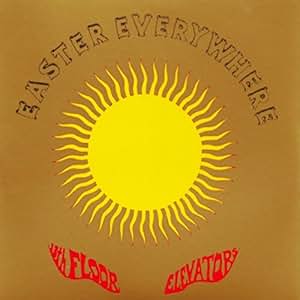
In November 1967, the band released a second album, “Easter Everywhere”. The album featured a cover of Bob Dylan’s “It’s All Over Now, Baby Blue”. However, shortly before work began on Easter Everywhere, Walton and Leatherman left the band and were replaced by Danny Thomas on drums and Dan Galindo on bass, because of disputes over mismanagement of the band’s career by International Artists and a fundamental disagreement between Walton and Hall over the latter’s advocacy of the use of LSD in the pursuit of achieving a higher state of human consciousness. As a result, they were not credited in the Easter Everywhere sleeve-notes, despite having appeared on “(I’ve Got) Levitation” and “She Lives (In a Time of Her Own)”. Despite the lengthy studio work and resources utilized, Easter Everywhere was not the success the band and International Artists had hoped for. Lacking a hit single and released too late in the year, it sold out its original run, but was never reprinted, suggesting somewhat disappointing sales. Record label paperwork indicate that the band’s debut album sold upwards of 40,000 copies during its original run, while Easter Everywhere may have sold around 10,000 copies. As documented in a lengthy interview and article in the Texas underground music magazine Mother No. 3, the band worked all Spring of 1968 on their new album, which at one point was to be called Beauty and the Beast. However, because of an unstable member line-up and the increasingly erratic behaviour of the psychedelicized Tommy Hall and mentally fragile Roky Erickson, little of value came out of these sessions. The live shows had lost their original energy, and often the band would perform without their lead singer Erickson, due to his recurring hospital treatments at the time. The last concert featuring the “real” Elevators occurred in April 1968.

A special aspect of the Elevators’ sound came from Tommy Hall’s innovative electric jug. The jug, a crock-jug with a microphone held up to it while it was being blown, sounded somewhat like a cross between a minimoog and cuica drum. In contrast to traditional musical jug technique, Hall did not blow into the jug to produce a tuba-like sound. Instead, he vocalized musical runs into the mouth of the jug, using the jug to create echo and distortion of his voice. When playing live, he held the microphone up to the mouth of the jug, but when recording the Easter Everywhere album, the recording engineer placed a microphone inside the jug to enhance the sound.

See the source image

At Tommy Hall’s urging, the band often played their live shows and recorded their albums while under the influence of LSD, and built their lifestyle and music around the psychedelic experience. Intellectual and esoteric influences helped shape their work,

Around this time, the original 13th Floor Elevators disbanded, as the nucleus of Erickson-Hall-Sutherland had been reduced to guitarist Stacy Sutherland only. Sutherland brought some of his own songs for a final set of studio sessions, which led to the dark, intense posthumous album Bull of the Woods. Initially disliked by many Elevators fans, it has found a substantial fan-base today, with some even rating it the band’s best LP. These final sessions consisted of Sutherland on guitar, Ronnie Leatherman on bass, and Danny Thomas on drums.

Hall remained the band’s primary lyricist and philosopher, with Sutherland and Erickson both contributing lyrics as well as writing music, and, later, working with Danny Thomas to arrange the group’s more challenging music. In addition to Erickson’s powerful vocals, Hall’s “electric jug” became the band’s signature sound. Later, Ronnie Leatherman returned for the third and final studio album, Bull of the Woods along with Thomas, and Sutherland.

A few live gigs were played around Texas during the second half of 1968, until an article in Rolling Stone magazine in December 1968 declared the band gone. International Artists pulled together the various studio recordings from 1968 and, with the assistance of drummer Danny Thomas, added some horn arrangements, which became the Bull of the Woods album, released in March 1969. Drug overuse and related legal problems left the band in a state of constant turmoil, which took its toll, both physically and mentally, on the members. In 1969, facing a felony marijuana possession charge, Roky Erickson chose to be admitted to a psychiatric hospital rather than serve a prison term, thus signaling the end of the band’s career.

See the source image

Bull of the Woods, was released in 1969, was the 13th Floor Elevators’ last released album on which they worked as a group, and was largely the work of Stacy Sutherland. Erickson, due to health and legal problems, and Tommy Hall were only involved with a few tracks, including “Livin’ On”, “Never Another”, “Dear Doctor Doom”, and “May the Circle Remain Unbroken”.

Today, the 13th Floor Elevators continue to influence new generations of musicians. In 1990, 21 contemporary bands—including R.E.M., Richard Lloyd, David Leonard, the Jesus and Mary Chain, and Primal Scream who all recorded covers of Elevators songs “Slip Inside This House” was covered by Scottish alternative rock band on their album Screamadelica album. 1980s drone/space-rock band Spacemen 3 were influenced by the 13th Floor Elevators, covering “Roller Coaster” twice, for their debut album, Sound of Confusion, and as a 17-minute version for their debut EP Walkin’ With Jesus. Vocalist/guitarist Pete Kember also covered “Thru the Rhythm” with his post-Spacemen 3 project Spectrum. Radio Birdman, features a song titled “Lunatics at the Edge of the World”, which Tek described as “An ode to Syd Barrett and Roky Erickson.”

Studio albums
The Psychedelic Sounds of the 13th Floor Elevators, (October 1966)
Easter Everywhere, (November 1967)
Bull of the Woods, (March 1969)

Noted Hollywood actor/Musician Johnny Depp praised the Elevators in a 2005 magazine interview “Roky Erickson and the 13th Floor Elevators, a band out of Texas. They were basically the first psychedelic-rock band. 1965. And if you listen to old 13th Floor Elevators stuff—Roky Erickson especially, his voice—and then go back and listen to early Led Zeppelin, you know that Robert Plant absolutely copped everything from Roky Erickson. And it’s amazing. And Roky Erickson is sitting in Austin, Texas; he’s just there. And Robert Plant had a huge hit. It always goes back to those guys, you know? I love those guys.”

See the source image

beach-house-bloom-artwork.jpg

If listening to Beach House’s Teen Dream felt like throwing open the shades and letting light into a dusty sunroom, Bloom revisited that same space at twilight, still opulent and opaque but with new scope. Alex Scally’s sparkling guitar leads and Victoria Legrand’s cyclone of a voice are instantly recognizable, but they’re distorted in mystery. Bloom is a seductive album that has little to do with romance or sexual gratification; its characters feel the tug of adventure, of sensations and phenomena they can’t quite describe.

And while Bloom boasts some of the most indelible melodies in Beach House’s discography—the twinkling “Lazuli,” the extended sigh of “Other People”—it’s most notable as a collection of remarkable sounds. “Myth” opens with that plonking bell, cracked like an egg after two stiff shakes; the drums on “Wild” foam and splash like the ocean around your ankles; “The Hours” clocks you with that sneering riff, a slow-motion punk moment. These little moments may not sound like much, but they end up feeling like dashes of spice added to a favourite home-cooked meal. There’s something unexpected lurking in every familiar bite.

Bloom is presented as an album which transcends the boundaries of genre, taste or subjectivity. It is described as a work of religious mission, opening the eyes of any who venture into it. But I’m indifferent to the quality of the music . Many claim that no indie or mainstream music released by the turn of the decade a few months ago was left untouched musically by Bloom’s dream pop, which epitomizes the sound of Beach House it’s synth arpeggios, fuzzy yet discreetly mixed guitars and ethereal, psychedelic vocals layered upon dreamy atmospheric sounds.

Dream pop is not just a genre. It’s an all-encompassing description: Bloom truly sounds like a dream feels. The duo behind the album created a psychedelic, half-conscious atmosphere shoegazed (a production style which tries to merge and effect the instruments until the different instruments on a mix are almost indistinguishable) to the point that the texture feels barely there, and yet impenetrable as a solid wall of sound; an enormous, slow moving, audible cloud. Unusually, the album benefits from each song sounding similar enough that each track fades into another seamlessly, which only adds to the unavoidable dream comparison: as a dream is an ambiguous, surreal montage of faded events and ideas, as is Bloom.

The influence of this album is hard to deny. Just a few tracks in, the poppy, synth arpeggios which are ever present. Then the ethereal, contralto female vocals, The trippy, heavily reverberated instrumentation and vocals the jangly guitars on Wherever You Go.

On the other hand, there are certainly arguments suggesting that the influence of Bloom has been exaggerated. The album cover for Bloom, its prime visual representation, is instantly evocative of that of the self-titled album by The XX, released in 2009, or Turn on the Bright Lightsby Interpol, released 2002.

So, did Beach House simply steal their sound and aesthetic? Of course not. For the most part, Beach House reinvented dream pop for a new generation, with adding a new, even more ethereal touch which has placed its hand on every indie pop or rock record released since. Late 2000s psych-pop may belong in the same category of music as Bloom,but it’s no coincidence that Beach House are immediately distinct from their contemporaries, no matter the similarities.


No photo description available.

The title of “Opening Night,” the introductory song on Quiet Signs, Jessica Pratt’s third album, is a reference to Gena Rowlands‘ harrowing, haunted performance in the John Cassavetes film of the same name. It’s also an emblem of where this spare, mysterious collection of songs falls in the course of Pratt’s career. “On some level I considered an audience while making the last record,” she writes, “but my creative world was still very private then and I analyzed the process less. This was the first time I approached writing with the idea of a cohesive record in mind.”

After a collection of demos and early studio recordings earned her a small, dedicated audience, Pratt moved from San Francisco to Los Angeles and recorded her first intentional album in her bedroom in a matter of months. That album, On Your Own Love Again (Drag City, 2015), would bring her around the world many times, leading many to fall under the spell of Jessica Pratt the performer, the songwriter, the singer with the heavy-lidded voice that feels alien and familiar at the same time.

Her first album fully recorded in a professional studio setting, Pratt’s songwriting and accompanying guitar work are refined on Quiet Signs, more distinct and direct. Songs like “Fare Thee Well” and “Poly Blue” retain glimmers of OYOLA‘s hazy day afternoon spells, yet delicate flute, strings sustained by organ arrangements, and rehearsal room piano now gesture towards the lush chamber pop and longing of The Left Banke. On the album’s first single, “This Time Around,” Pratt hits on a profound, late-night clarity over just a couple of deep chords, evoking Caetano Veloso‘s casual seaside brilliance. And before the curtain drops Quiet Signs, Pratt provides a show-stopping closer, “Aeroplane.”

In the world of Quiet Signs, the black of night usually represents fear, despair, resignation; finally at home descending towards the illuminated city, she sings over black leather drone and tambourine shuffle with a newfound resolve. Quiet Signs is the journey of an artist emerging from the darkened wings, growing comfortable as a solitary figure on a sprawling stage.

The album was written in Los Angeles and recorded at Gary’s Electric in Brooklyn, NY over 2017 and 2018. It was co-produced by Al Carlson. He plays flute, organ and piano on some songs. Matt McDermott also played piano and string synthesizer. It will be released on Mexican Summer in the US and City Slang in Europe .

sea-girls-album-announcement.jpg

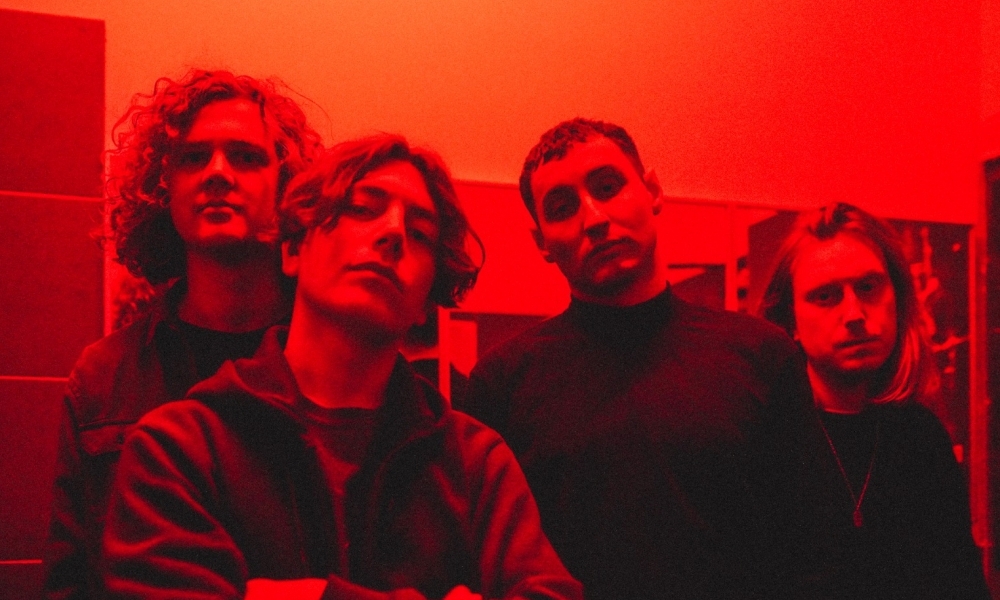
Fresh off the back of their Under Exit Lights EP, Sea Girls are treating us with even more new music, starting with new single Do You Really Wanna Know? The new single arrives alongside the announcement of the band’s debut album, Open Up Your Head, out August 14th via Polydor Records.

With bragging rights as the next generation of British sing-along maestros, Sea Girls seem under no pressure to release another anthemic tune to their repertoire. Do You Really Wanna Know? is a 3 minute bop about spoiling precious moments with questions.

One of their more upbeat tunes, it’s chorus has a firm boyband feel and a rhythm reminiscent of an obscure 90’s TV show credits which I can’t quite place. It doesn’t feel like the instant classic some of their older songs have upon release, yet Caville’s vocals carry enough power that you can already hear this being sung back to them during one of their raucous live shows.

One thing is certain, Sea Girls have found the magic potion for writing feel-good indie pop with incessantly catchy choruses and don’t intend stopping any time soon. For this reason, we’re psyched for the release of their long-awaited debut album Open Up Your Head in August.

Band Members:
Henry Camamile, Rory Young, Andrew Dawson & Oli Khan

husky-loops-press-shot-2020.png

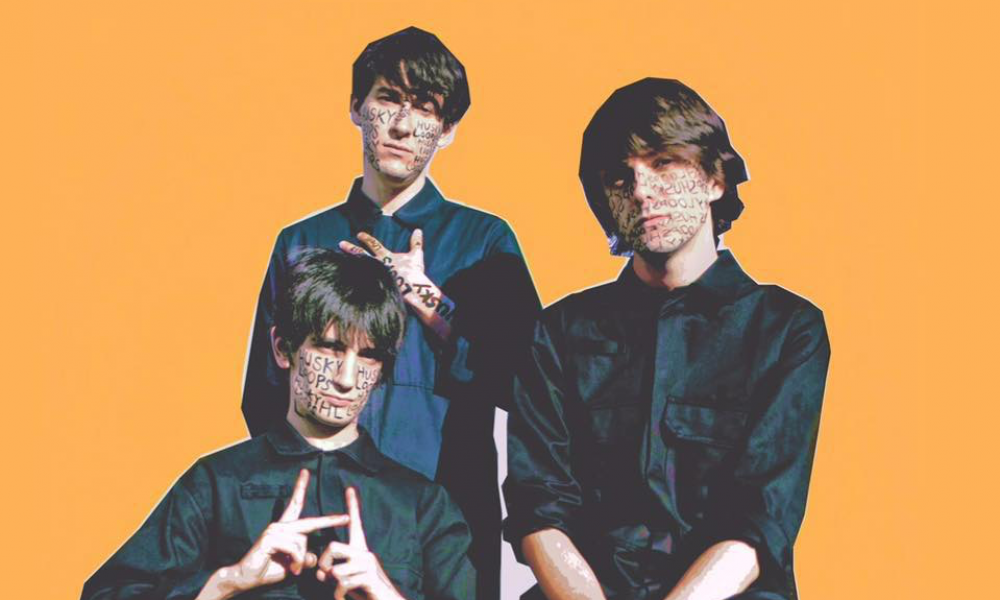
Husky Loops are winning the battle against quarantine with their brand new release “You Bore Me”, which involved the trio altering their music process in order to adapt to our current way of life. The music video that accompanies this track is shot entirely by the band’s bassist Tommaso Medico on his phone, and is a nice reminder that we are all in the same position, as he describes it by saying ‘we can only show our truth, our creepy, bored, weird and simple sides’.

You Bore Me is a track that, despite being recorded for their debut album I Can’t Even Speak English, is completely and utterly relevant to our time as millions of us stay at home. The rock track strikes common to their previous songs in the sense that it is completely innovative and unique. Whilst an edgy guitar plays rough riffs, the track is a hybridity of old rock and newer inventions thanks to the completed sound of experimental synths. The chorus is made up of frontman Danio Forni exclaiming ‘I drink cos you bore me’, making it easy to imagine crowds shouting it back in a live show.

You Bore Me couldn’t have been released at a better time, and will stop us from being bored for the next couple of weeks.

Band Members:
Pier Danio Forni, Pietro Garrone, Tommaso Medica

I Can’t Even Speak English, our debut album out now: 30th Century Records. 


Image may contain: text

My new album ‘Good Bones’ will be out June 19th! Pre-save it at the link below and check out my new store for some sweet pre-order bundles. This album is comprised of stripped down versions of songs off my first two albums and a new tune thrown in there. The first track is out today! Listen to the acoustic version of ‘Mama Said’

Cat Clyde is a new artist out of Stratford, Ontario. A fresh take on the classic sounds of yesteryear. She breathes new life into the velvety vocal, tack-piano, slide-guitar-style that can instantly walk you through the swinging doors of a packed saloon. With influences ranging from Etta James to Kevin Morby to Lead Belly; hers is a mix that goes down smoother than a neat glass of mellow Kentucky bourbon. No longer do you need to reach for your trusty sifting pan and river boots to find gold. You just need to know one name.
Her hit single “Mama Said” has over 9 million streams on Spotify alone. Cat’s debut album, Ivory Castanets, came out May of 2017. Since releasing her debut album, Cat has been on a roll. She just got off a sold out tour with JS Ondara and has also wrapped tours supporting ZZ Ward and Paul Kelly across North America.

‘Mama Said (Acoustic)’ from the new album ‘Good Bones’ – out June 19th