Archive for the ‘CLASSIC ALBUMS’ Category

Laura Marling.

British singer-songwriter Laura Marling has accomplished a lot across seven studio albums and 12 years recording music. She’s garnered Mercury Prize and Grammy nominations, collaborated with Ed O’Brien of Radiohead, Blake Mills and others, and she’s even started teaching online guitar lessons, which she details below. This all to say, she’s a supremely talented artist who moves in dynamic ways within the folk-rock lane. 

Her new album “Song For Our Daughter” was scheduled to come out later this summer but she found an opportunity to connect us all during the COVID crises by releasing it early. Marling said in a statement regarding the change of date, “In light of the change to all our circumstances, I saw no reason to hold back on something that, at the very least, might entertain, and at its best, provide some sense of union.” The album is a nod to Maya Angelou’s collection “Letter To My Daughter.” Marling herself is not a mother but she takes us there through her delicate song writing  writing for a girl who needs confidence and hope.

ALAS, I CANNOT SWIM (2008)

Laura Marling is an alt-folk singer-songwriter from a small village just outside of Reading. The story goes that she came to London with nothing but her guitar and a handful of songs. Still just a teenager, her talents were soon noticed at early Way Out West (who released her debut single) and Blue Flowers gigs. On her debut album for Virgin records she shows astonishing ability to spin heart rending tales of love and loss for someone so young. She has a breathtakingly pure voice that’s equal parts Regina Spektor, Bob Dylan and Joni Mitchell. She is an extraordinary talent – voice, lyrics, music, presence. no wannabe celeb, aspirant popstar-babe. Rather a determined woman with an overwhelming desire to communicate through word and music. If you have a heart you need Laura Marling in your life right now.

Marling’s debut, produced by Noah & The Whale’s Charlie Fink, We had four weeks at Eastcote Studios, two weeks doing my record and then a further two weeks back-to-back doing the Noah & The Whale record. We laid down the bass, drums, guitar and vocal all at once, and then we did overdubs – this is the same for all albums I’ve done, pretty much. My dad ran a recording studio which shut down when I was quite small, but I remember growing up around all of that outboard gear at home. So I guess I was slightly more familiar with the studio than the average 17-year-old, but still it was my first proper session.

These were all my first songs, written from the age of 16-17. There was a batch of songs before that that were on an EP, “London Town” – I didn’t like them very much by the time I got to making this. I haven’t listened to this for a long while, I very rarely play any of those songs live, so it’s a bit of a distant memory to me now. And the production was very much of the time I guess, that ‘new folk’ world – glockenspiels and banjos and whatever – which is good, that’s what it was supposed to be then. I don’t really think of this as part of my catalogue.

I SPEAK BECAUSE I CAN (2010)

UK songstress Laura Marling releases her sophomore album, “I Speak Because I Can”, on Virgin Records. Produced by Ethan Johns (Kings of Leon, Ryan Adams), I Speak Because I Can is the follow up to Marling’s lauded, mercury prize-nominated debut, Alas I Cannot Swim. I Speak Because I Can is Laura Marling’s coming of age album, if such a thing can be said about the brilliant songwriter whose compositions belie her age (for the record, she’ll be twenty this year it was released). Recorded in 2009 at Peter Gabriel’s Real World Studios in outside London, and featuring the talents of her backing band Mumford and Sons, I Speak Because i Can reveals a new side to Laura Marling, whose debut was released when she was only seventeen years old. Its ten songs are imbued with a new richness, ripeness and sophistication, marked by homespun tales and sparse instrumentation. I Speak Because I Can showcases not only Marling’s ability to tell one hell of a story, but her incredible guitar playing, which has grown more intricate since her first album. Marling chose Ethan Johns to produce her new material, as she credits many of his earlier records (among them albums by Ray Lamontagne, Kings of Leon, Emmylou Harris, Sarabeth Tucek and more) with kindling her interest in music. She had long admired his way of working – his use of reels; his quiet, traditional methods of production; the warmth found within the records he produced. he gave her the space to find her own identity; as such, the record reveals a new maturity, and at points, Marling’s voice sounds a little harder, a little world-wearied, while still showcasing her impressive range not heard on previous recordings. and while I Speak Because I Can is, at times, a darker album than its predecessor, it is a brilliant step forward from a young artist who continues to keep us awe-struck at her talent.

A leap forward, with Marling inspired by British folk and The Odyssey, and working with producer Ethan Johns The difference between being 16 and being 19 is quite a shift, isn’t it? Ethan was very intimidating, but I quickly realised it was nothing but a type of shyness. He turned down the first record, but I tried again with the second one – he seemed to be more impressed with the song writing. I went down to meet Ethan at Real World Studios, where he was working at the time. He came and picked me up from the station, and he was wearing triple denim and circular pink sunglasses, like John Lennon, and he had his crazy California hair. I thought he looked completely mental. I was very shy still, I didn’t really say much. As we were walking around Real World, he said, “It’s never really worked out for me, working with female artists, I seem to not do well with it.” So, being in my tomboy/late teenage years, I was like, “Well, I’m not like every girl, it’s going to be a totally different experience”, and it was. We started at Eastcote, but Ethan didn’t like the sound of the room, so we moved to Real World.

I took my band with me, and we all stayed there at probably horrendous expense. We got driven in our splitter van from Glastonbury to Real World, we stayed there for two weeks and it was really magical. I’d read The Odyssey, and I obviously thought I was quite clever because of that, so a lot of it was based around Penelope and Odysseus, and Hera – there’s a lot of Greek mythology and Classics, I was really into it then. I had discovered tunings after the first album too, and a lot of I Speak Because I Can was in major and minor open-D tunings. I was also going through the unbelievable intensity of anybody’s late teenage years, I was so full of fucking hormones and excitement. I remember writing a lot, it was a good time.

A CREATURE I DON’T KNOW (2011)

The follow-up to 2010’s ‘I Speak Because I Can’. like it’s predecessor, the new record was produced by Ethan Johns. the vibe here is looser, the rhythms more adventurous, her vocals are more soulful, more sexual and more assured. marling has found a new intensity on her deeply impressive third album. she has come a long way in a short time, and has undoubtedly got further to travel. The more expansive third record, again produced by Ethan Johns, I went from touring I Speak Because I Can straight into the studio to make this. That was the cycle that I was on then – I made the album, put it out, toured it for a year and then went straight back into the studio with a new crop of songs.

It was a natural progression; the sound of this album was dictated by my touring band at the time, as we had been playing all these songs in soundchecks for the previous six months. We did all the pre-production away from Ethan because everybody was too scared to play in front of him. My drummer and my keyboard player, they’re proper musicians who’ve been playing with me almost since the beginning, they’re proper trained incredible musicians, but everyone else in the band didn’t really consider themselves a musician.

So I had a slightly ragtag band. Of course Ethan’s got the little black book of every musician you might want, but I only wanted people that I loved on the records, that I knew were on my side. Maybe that was a bit paranoid of me, but I was a bit paranoid then of everybody, and I wanted to make sure that ultimately I had control of everything. It was also very important for me to keep my musicians employed, which I did manage to do for those four or five years, which felt like an achievement. So what I was doing was because of a mix of paranoia and economic anxiety!

LIVE FROM YORK MINSTER (2012)

Marling’s only live album, including a cover of Jackson C Frank’s “Blues Run The Game”, There are a lot of churches to play in Europe, but we decided to supersize that to cathedrals. We organised it through some quite intense logistical negotiation, literally talking to the bishops and persuading them it was a good idea, because I don’t think they do it very often, particularly somewhere like York Minster. It was such a spectacularly beautiful venue. We were bringing in our own sound system, and the acoustics in some of the cathedrals were much more tricky than others – Liverpool was completely wild and very hard to tame, but we were in a smaller room in York Minster, not in the main atrium, and luckily it was a good one to record.

A completely stone room with wood on the ground has a particular quality to it. I think Charlie Fink had played “Blues Run The Game” to me, and I figured it was in the same tuning as “Goodbye England…”. I added it to the set because it was such an unusual tuning that there were not many songs I could play in it.

ONCE I WAS AN EAGLE (2013) 

A stunning 16-track folk-rock epic, and Marling’s own favourite, I discovered smoking weed before this album, that’s the reason the first four songs are one. It’s like a nice lull, where you’re off on another planet. I’d had some intense emotional growth since the previous album, and I’d started to feel like I very much wanted to be on my own and not with a band. Though they’re still my band and I love them very much, it felt like I couldn’t get any time on my own, like I was always on tour or in the studio, and it started to feel like people recognised me a little bit, and it all overwhelmed me. So with this album I went back to Ethan on my own. It was a really amazing experience. I think he had wanted to get his hands on my music without all of those people around, so he could do with it what he really wanted. By that point we were friends, and I entrusted him with this really emotionally intense album.

“Once I Was An Eagle” is Laura Marling’s fourth album in five years, and she’s still just 23 years old. It’s been an accelerated artistic growth but Marling hasn’t put a foot wrong yet. Once I Was An Eagle features a reduced cast of – predominantly – Marling and regular producer Ethan Johns. The English Joni ruthlessly dissects her love life on this confessional album. It’s a beautifully melodic collection that hits engaging heights.

I went and recorded everything for him, in order, at his house – just me and a guitar with his engineer Dom Monks, who’s also brilliant – and then I went away for a week. When I came back he’d done most of the instrumentation on it, and he’d started to paint around the tracks.

I still think of it as a magical happening. People were trying to say it could have been shorter, and maybe a couple of songs could have been B-sides, but that was the story I wanted to tell. Ethan was into it too, he wanted to do a double record.

Ruth [de Turberville, cellist] came to play on the record towards the end. There’s a bit in “Pray For Me” where her cello line sounds like it’s rising above me, wrapping itself around my neck and pulling me down – there was some emotional quality to it, just as what Ethan did on it had an emotional quality. There was a sense that something was about to peak, it did feel like that. I felt like it was the best record I’d ever made, and I could sense that it would be harder to carry on from then.

SHORT MOVIE (2015)

Self-produced in London, Marling’s fifth was the quickest she’s ever written and recorded, The funny thing was that the magic from “Eagle” didn’t last, because Ethan and I ended up making a record afterwards that we threw in the bin. It was a big financial mess, and that was quite a shock to me. I don’t have a lot of money to play with, I’m not a multi-million selling artist, so scrapping an album was a big deal. There were a couple of reasons for it, it wasn’t totally the song writing. I was living in Los Angeles, so Ethan had come over to do it, we rented Sunset Sound which was also really expensive. The nice thing is that on that record we had Jim Keltner, so I got to hang out with him for two weeks – he was amazing. It took me a little while to get over the shock of that, and the disappointment that me and Ethan felt.

Laura Marling has released four albums in only seven years – and she’s only just turned 25 now. Working on fresh material, fifth album Short Movie Self-produced, the songwriter worked extensively alongside drummer Matt Ingram and studio engineer Dan Cox during recent sessions. Short Movie has a cinematic wide eyed joy, and Marling’s writing seems freer. False Hope, inspired by the experience of being tapped in a New York airb’n’b during hurricane sandy, swirls round in a sea of electric guitars. Gurdjieff’s Daughter pulls a huge chorus out of its back pocket with the ease of somebody producing a lighter. There’s a strain of playfulness, too. Strange Love sees Marling adopt the kind of stilted, burning delivery that should come free with a bit of wheat to chew on. Short Movie is wonderfully unlike anything Marling has attempted before.

I came back to London and said to my drummer [Matt Ingram], “I need to do an album for cheap.” He said, “Come and do it at my studio.” I ended up producing it with him, and that was an amazing experience. “Short Movie” was a very quickly written batch of songs, because I’d scrapped everything from the album that we threw away. So this was a very concise timespan, just a very short period in my life. I actually don’t really like the album, but I get why I wrote it and why I had to write it. I needed to keep moving or I was going to drown in the sorrow of having failed. It’s the first time I played electric guitar on a record – a friend had a bungalow in Joshua Tree that they weren’t going to be in for a couple of months, so I took all my guitars out there. I had guitar amplifiers all around the house, and there were no neighbours so I could play as loud as I wanted. That’s how that sound arrived.

SEMPER FEMINA (2017)

A return to form, produced by Los Angeles wunderkind Blake Mills, It was so interesting working with a different producer, he couldn’t be more different to Ethan. And I was such a huge fan of Blake’s already, so it was weird to go in and be so in awe of somebody. He’s my age too. The main thing he inspired in me was that if you worked hard enough you could be as good as him – there was no mystical quality as to why he was so good, other than that he worked really fucking hard. Ethan is from an older time where there was more money in the music business, so he works from midday until nine o’clock and he doesn’t work at weekends, which is fine; but Blake works from 10am until it’s done! I took three members of my band with me, because I was a bit worried that Blake would intimidate me to the point where I wouldn’t be able to get my point across. I’m glad I did that because it just about kept it from becoming a Blake Mills record, which it could have easily become.

In those three weeks, I’d come back home at like 3am every night and play guitar in my backyard – I’d practise every night so that the next morning I’d come in and he wouldn’t be able to play my parts better than I could. I just couldn’t believe that someone could work so hard for someone else’s music, it was amazing. He’s quite a force to contend with, though, he doesn’t fuck around and he doesn’t banter, he just works. Blake literally seems bored when you’re playing him a song, when he feels it’s not sonically interesting. On “Soothing”, he started changing the chords so they were more interesting inversions, and then he orchestrally arranged this three-piece bass part for it.

Semper Femina is Laura Marling’s sixth album – an intimate, devoted exploration of femininity and female relationships, and among her finest work to date. Written largely on the tour that followed 2015’s Short Movie and recorded in Los Angeles with production from Blake Mills, it is at once a distinctive and musically compelling collection of songs, run through with Marling’s fierce intelligence; a keen, beautiful and unparalleled take on womanhood.

03_Laura_Marling_DELUXE_LP_Front_and_Back_Cover.jpg

SONG FOR OUR DAUGHTER (2020)

Laura Marling’s exquisite seventh album ‘Song For Our Daughter’ arrives almost without pre-amble or warning in the midst of uncharted global chaos, and yet instantly and tenderly offers a sense of purpose, clarity and calm. As a balm for the soul, this full-blooded new collection could be posited as Laura’s richest to date, but in truth it’s another incredibly fine record by a British artist who rarely strays from delivering incredibly fine records.

Taking much of the production reins herself, alongside long-time collaborators Ethan Johns and Dom Monks, Laura has layered up lush string arrangements and a broad sense of scale to these songs without losing any of the intimacy or reverence we’ve come to anticipate and almost take for granted from her throughout the past decade.

Marling’s classic-sounding latest, returning to her roots with Ethan Johns co-producing, I didn’t enjoy producing Short Movie myself, and I didn’t feel like I wanted to do that again – you can’t get a good enough perspective on your own, being both inside and outside the record at the same time. I thought Dom Monks and Ethan Johns as co-producers would just give me that security, but I think it was challenging for Ethan to change his role. I’d had to do a lot of random admin stuff earlier in 2019, which meant I’d sat on these songs for a while, which was hellish for me. But in that time I’d also moved back to London, set up my own studio, demoed everything extensively, contacted everyone I wanted to play on it… Ethan was the last part of the puzzle actually. He wanted to use this studio in Wales because he likes to record to tape, but I’m not a purist in that way. Dom Monks is the zen master between two nutbags, though, so he held the sessions together.

I wrote the album while I was travelling around Europe for about four months, mainly the south of France and Italy, living in a campervan and staying on farms, very late twenties. It was really nice. I always feel like my albums are on/off – I Speak Because I Can was good, A Creature I Don’t Know was OK, Once I Was An Eagle was good, Short Movie was whatever, Semper Femina was good, and I sort of felt this one might be whatever… I don’t know, though! I never know what people are going to think, but people seem to really like it. I wasn’t expecting it to do so well. I thought I’d lean back into just being a songwriter which is all I really want from Laura Marling, from my solo stuff. And then Lump provides me with this whole other experience.

Laura Marling performs “Song For Our Daughter” at the prestigious Royal Albert Hall in London as part of the Mercury Prize 2020: Album of the Year. 

LUMP – LUMP (2018)

A collaboration with Tunng’s Mike Lindsay created Marling’s “greatest pleasure”. We were doing some Neil Young support shows and at the London one my guitarist Sam said, “Oh, my friend Mike’s coming down after the show, he’s quite weird and he wants to ask you a question.” He is a weird guy, in the best possible way, and he’s got an unusual manner. He said quite bluntly, “I need you to come into my studio in Shoreditch, I have something and only you can do it.” I was recently single at that time, feeling quite free about possibilities, so I said yes. I was renting a flat in Dalston, so I walked down on a very hot day to his basement studio in Shoreditch. It was absolutely boiling, no natural light. After a bit of awkward small talk, he played me 36 minutes of music without stopping. I had just started reading the Surrealist Manifesto and I’d underlined a bunch of words, and I started singing them over the top – Mike had demarcated where he thought songs were, and verses and choruses, and after the first day we’d done “The Curse Of The Contemporary” and “May I Be The Light”, and by the third day we’d almost finished the record.

I knew when we were making it how special it was – there was no buddiness or communication, just like when Ethan worked on Eagle… and I left for a week. Lump had that quality too. Mike and I have now made two albums and toured, but we don’t really know each other too well, and are paranoid about maintaining that distance between the two of us, so we don’t lose that quality. Lump is the greatest pleasure in my life now, because it doesn’t feel like mine. There’s a second album done, it’s probably coming out this year but I don’t know when.

With Short Movie this Hampshire native has, for the fifth consecutive time, made the strongest album of her career, expanding her palette to include electric-guitar-led alt rock (‘False Hope,’ ‘Don’t Let Me Bring You Down’) and percussive drones (‘Strange’, ‘Short Movie’) while retaining the English-rose folk that made her name (‘Walk Alone,’ ‘Easy.’) There’s a clear through-line to her earliest work, yet a clearer progression that points to an evolving artist – which is how it’s supposed to go, of course, but is rarely the case with a Brit-winning major-label star… This is Marling at her finest, but as she’s proved five times in a row, the best is always yet to come.”

Following in the dusty, sun-baked footsteps of 2013’s mesmerizing “Once I Was an Eagle”, Laura Marling’s fifth studio outing feels even more rooted in the California desert, doubling down on the former’s penchant for pairing breezy, American west coast mysticism with bucolic, Sandy Denny-era English folk, but with a subtle shift in architecture. Marling’s gift for gab and deft finger-picking are still front and center, but with the self-produced “Short Movie”, she’s expanded her sonic palette by plugging in.

While by no means a straight-up electric guitar album, Short Movie does bristle with a current of nervy energy, and that coffee-black, post-midnight buzz is the fuel that gives cuts like “False Hope,” “Don’t Let Me Bring You Down,” “Gurdjieff’s Daughter,” and the hypnotic title track their swagger. That said, Marling is an unrepentant folkie, and those late-night blasts of tube-driven self-evaluation and raw verisimilitude eventually give way to bleary-eyed mornings spent assessing the wreckage, and the album’s best moments arrive via the aged wood and steel of her trusty acoustic.

The dreamy, psych-tinged opener “Warrior” invokes Nick Drake’s “Road” with its bluesy, open tuning and refrain of “I can’t be your horse anymore, you’re not the warrior I’m looking for,” while the equally Drake-ian “Feel Your Love” offers up a less defensive, but no less weary stance toward potential suitors, positing “you must let me go before I get old, I need to find someone who really wants to be mine.” Avoiding complacency has always been the light that guides the precocious singer/songwriter (only 25 at the time of release, this is Marling’s fourth album in just five years), and Short Movie does little to temper that restlessness. It may lack the cohesion of her last outing, and her steadfast derision of anything resembling a hook can be taxing, but it makes up for its meandering with a strength of character that eludes many of her contemporaries. An old soul to say the least, Marling continues to evolve as both a musician and a writer, albeit subtly, and we’re all the better for it.

Disposable America Record’s appearance on this list – god, those guys are smashing it right now – comes in the form of Los Angeles quartet Soft Blue Shimmer. On ‘Fruitcake,’ the aptly named group fuse dreamy vocals and spun gold guitars to make a sound that’s quite simply heaven made. Written about not being able to shut off your thoughts, contrastingly ‘Fruitcake’ provides an illusory island of calm where worries are dispelled as soon as your feet hit the beach. 

Seasonal reminder that your average nine-track shoegaze album is cheaper than a new sweater! The debut from Los Angeles Soft Blue Shimmer arrived just in time for the temperatures to drop freakishly late in the year, with Heaven Inches Away providing the audio equivalent to throwing on the biggest top in your closet and spending an unreasonable amount of time just sitting next to your radiator, thinking about getting up to do something productive. Upon early inspection, the album’s climax appears to be the hazy sendoff, recalling the same cosmological space warbled about by Cocteau Twins with the cool, laid-back demeanor of someone who could only be unstuck in time in the frantic year 2020. 

http://

Noisy dream pop from LA, CA. Charlie, Kenzo, & Meredith.

Released November 27th, 2020

“Everybody who grew up with Gang of Four in their lives can remember how mind-blowing and forward-thinking and filled with creative energy it was at the time and guess what? It still is now. It’s art. Art that’s reaching out of this world yet somehow still down to earth. It’s so great be involved with this release and to see and hear a new generation of musicians paying tribute to Andy Gill’s incredible music. My artwork ‘Dog with Bone’, which Andy picked for the cover from a few ideas I had, is from a new series of giant pipe cleaner animals based on little ones made in my studio by kids. I think he wanted this work for the cover because it’s new and unexpected and in your face and hard not to like, they make adults feel like children and Andy always wanted to celebrate that.” – Damien Hirst A new Gang of Four tribute album has been announced. The double album, titled The Problem of Leisure: A Celebration of Andy Gill and Gang of Four, will arrive in May 2021 and feature covers of Gang of Four and Andy Gill songs by a number of artists. The first single will be released on Friday, January 1st, 2021, which would have been Gill’s 65th birthday. It’s a cover of “Natural’s Not in It,” performed by Rage Against the Machine’s Tom Morello and System of a Down’s Serj Tankian. Andy Gill was one of a handful of artists in history who changed the way guitars are played,” Tom Morello said in a statement. “His band Gang of Four were just incendiary and completely groundbreaking with Andy’s confrontational, unnerving and sublime playing at the forefront. His jagged plague-disco raptor-attack industrial-funk deconstructed guitar anti-hero sonics and fierce poetic radical intellect were hugely influential to me.”

“This new version of Natural’s Not In It is the first single from the album The Problem of Leisure: A Celebration of Andy Gill and Gang of Four, set for release in May 2021. It’s a double album of tracks written by Andy Gill and Gang of Four, all newly reinterpreted and recorded by artists whose own unique contributions to music were enriched by listening to Gang of Four. Says Tom Morello: “Andy Gill was one of a handful of artists in history who changed the way guitars are played. His band Gang of Four were just incendiary and completely ground breaking with Andy’s confrontational, unnerving and sublime playing at the forefront. His jagged plague-disco raptor-attack industrial-funk deconstructed guitar anti-hero sonics and fierce poetic radical intellect were hugely influential to me.” Serj Tankian says: “It was a real pleasure to work on this track with Tom and honour the legacy of Andy and Gang of Four at the same time.”

It is with pride, joy, excitement and a measure of sadness that we announce The Problem of Leisure: A Celebration of Andy Gill and Gang of Four, a project Andy worked on right up to his death in February. This double album features tracks written by Andy and Gang of Four, newly reinterpreted and recorded by artists whose own unique contributions to music were enriched by listening to Gang of Four.

The first single has seen Tom Morello (Rage Against The Machine) collaborate with Serj Tankian (System Of A Down) to create an incredible cover of Natural’s Not In It. It will be released on Andy’s birthday, January 1st 2021. All the brilliant artists and bands participating in the album chose which track they wished to cover from across Gang of Four’s 40-plus year history. Details of the contributors and the full track listing will be revealed in January.

We can already tell you this: The Problem of Leisure is the dog’s bollocks. And so is the album artwork, created specially by artist Damien Hirst, a long-term Gang of Four aficionado. The album is available to pre-order now in a variety of different formats exclusively from our merchandise store. It will be released on 14th May 2021.

Andy Gill died in February of this year. According to press materials, he’d been planning the release of The Problem of Leisure to celebrate the 40th anniversary of the release of Entertainment! in 2019. “Andy was massively excited about this project,” Catherine Mayer said. “It wasn’t, of course, conceived as a tribute album, but it’s comforting to me that he lived to see artists he hugely admired enthusiastically agreeing to participate, signalling that the admiration was mutual.”

Damien Hirst made the artwork for The Problem of Leisure

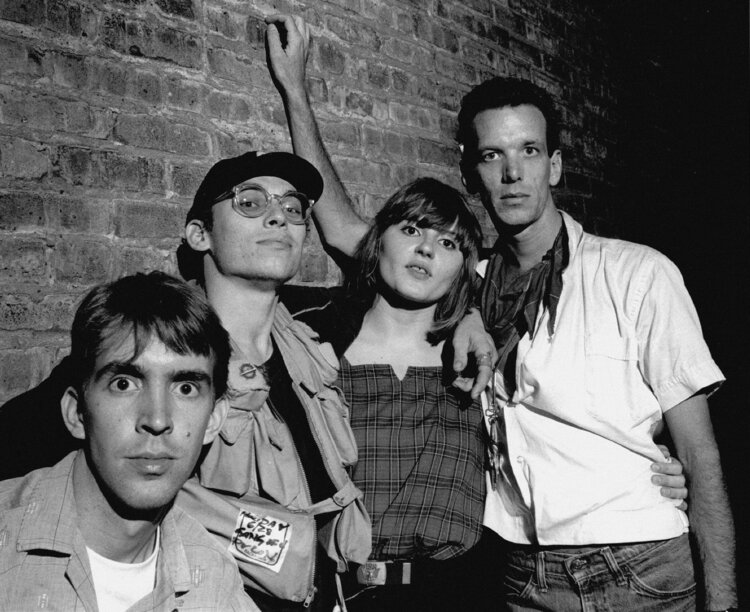
In October 1979, 23-year-old Dacula, Ga., native Vanessa Briscoe was just biding her time in Athens after finishing her art degree at the University of Georgia, waiting for her husband to graduate so they could move to Atlanta or New York or whatever other metropolitan city came calling. She was working one of her two jobs, answering phones in the catalogue department of the downtown JC Penney, when her friend Randy Bewley showed up to ask a question she’d never imagined being asked.

“Would you like to come and audition tonight for our band?”

Four decades and three careers later, she’s never moved away from Athens, though that band, influential post-punk quartet Pylon, provided the chance to spend plenty of time in other cities.

The history of Pylon has been compiled into Pylon Box, a 4-LP set with art book released earlier this month, capturing most of the band’s music, posters and story told by music journalist Stephen Deusner, along with remembrances from many of the musicians who were shaped by those early recordings: members of R.E.M., Sleater-Kinney, The B-52s, Deerhunter, Sonic Youth, Mission of Burma, Gang of Four, The dB’s and others.

The original idea for Pylon was more performance-art project than serious musical ambition. The college town’s first breakout stars The B-52s had just left for New York, leaving a huge hole in the budding music scene. When art students and the more eclectic townies wanted to throw a party, they needed someone to step in and play. Bewley played guitar with his fellow art major Michael Lachowski on bass and upstairs neighbour Curtis Crowe on drums. When Vanessa (now Briscoe Hay) showed up for that first audition, she had no idea what to expect.

“They had a music-stand setup which had an orange vinyl notebook, which was appropriate, and it has some lyrics in it,” she said. “The band didn’t have a name at this point, either. They’d play a song and I’d look at the lyrics. And I was thinking, whoever wrote these lyrics wasn’t really thinking about how this melody went. I just tried to make it fit—I might extend the word or I might shorten it or whatever. All I was trying to do was trying to find my little place inside this machine that they had.”

The next day, Bewley called to tell her she was in and to explain the premise of the band. “What we’re planning to do,” he said, “is to go to New York, get written up in New York Rocker and then disband.” “I was like, ‘Wow, that’s not gonna take up too much time out of my life.”

In a way, she was right. After playing several shows around town—including the second-ever show at Crowe’s new 40 Watt Club—the band travelled to New York at the invitation of The B-52s, even getting a mention in New York Rocker. Pylon burned bright for a few years, touring the U.S. and putting out an EP and two full-length studio albums, 1980’s Gyrate and 1983’s Chomp before the band members surprised everyone but each other by calling it quits soon after getting invited to open for U2. Briscoe Hay has no regrets.

“I was super happy to make that decision at the time,” she says. “You know, we wildly exceeded our expectations. I mean, we didn’t ever have what you hear about all these bands on Behind the Music. I just look at that and go, ‘Gosh, I really got off easy.’ We never had internal stressors and nobody was addicted to heroin. Nobody ran off with somebody else’s wife. We were really good friends. We still are. I think, in retrospect, it was a good life decision.” Instead, she got a job managing a Kinko’s in Athens. She had her first daughter in 1987. And when interest in the band picked up again after R.E.M. covered “Crazy”—and drummer Bill Berry declared Pylon the best rock ’n’ roll band in America—she had another chance to get up on stage and channel the energy of a dozen whirling dervishes with a reunion in 1989, opening a stretch of shows on R.E.M.’s Green tour.

http://

“I think it was Michael [Stipe] that talked with the guys, and they said ‘We think the world might be ready for you now.’ And I was like, ‘I’ve got a toddler. I have a full-time job. So if we’re gonna do this, this is going to have to be done businesslike. We did some really high-profile shows. We attended the last leg of the U.S. tour of Green with R.E.M. and went out there with B-52s and played some festivals.”

I got to see one of those shows at the relocated 40 Watt—maybe the same show that a 17-year-old Corin Tucker watched from just outside. “Vanessa was so lively onstage,” she recalls in the book that accompanies the new box set. “She gave this really visceral, physical performance that was different from anything I’d ever seen before. Music was so terrible at that time, especially hair metal where women were only sex objects and had no agency in the musical world. So seeing this band that was fronted by a woman who was such a protagonist onstage was so exciting to me as a teenager. That’s when Tracy [Sawyer] and I said we’re starting our own band! And we went back and started Heavens to Betsy.”

Briscoe Hay was a master at shifting from a calm, quiet demeanor onstage to all-out thrashing, screaming and amping up the crowd. And Bewley’s guitar served as the perfect complement.

“‘Feast on My Heart’ made it onto a lot of mixtapes I made,” Tucker’s Sleater-Kinney bandmate Carrie Brownstein also wrote in the new book. “It has a bluntness to it, but the metaphor is so vivid. It just seemed like that’s what we were all trying to say. This is a place of rawness and earnestness that we’re all trying to get at. We were all trying to honour these parts of ourselves and share them with each other. With Sleater-Kinney, if I was trying to convey an idea to Corin, sometimes we would just sit around and listen to Pylon and talk about things. And we returned to Pylon again and again for inspiration over the years, both vocally and in terms of playing guitar. There’s an endless supply of great riffs in these songs, because the guitar doesn’t have to get out of the way of the vocals like it does in so much blues and rock music. In Pylon songs the riff repeats as a counterpoint to Vanessa’s vocals, so they’re competing or creating a conversation. It adds tension to the song. That’s what Sleater-Kinney were always trying to do—make the songs sound more dire, more like conversations.”

In 1991, after Briscoe Hay gave up her job to focus on the band, Bewley decided he didn’t want to continue. Pylon operated as a four-way dictatorship, so if one member was done, they all were. Instead she took the opportunity to go back to school.

“I didn’t really like managing a store that much,” she says. “I wanted to do something that maybe has an impact on people’s lives. So I thought about teaching and nursing. We have a lot of both in both sides of my family. And I was like, ‘Well, teaching would be easy.’ I just had to get a teaching certificate because I had a BFA already. But I tried substitute teaching to be sure I could do it, and I failed miserably at it.” Her principal said that was because she smiled too much. But she had cousins and an aunt who were nurses, and she’d helped members of her family recovering from strokes. After some more schooling, in 1994 she became a registered nurse, a job from which she recently retired after 21 years. There were other Pylon shows along the way, and it was Bewley who got things started again in 2004.

“He came and talked to us individually and said, ‘Hey guys, I really miss y’all. Can we get together just for fun?’ And so we did and we played some shows. We flew to New York and California and put out the DFA reissues. And then he passed away in 2009. And that was the end of that.” Without one of its members, there couldn’t be a Pylon. Briscoe Hay has performed periodically since 2014 as the Pylon Reenactment Society with some other Athens musicians, even releasing a couple of singles and playing Primavera Sound in Barcelona.

But the music lives on in Pylon Box, which includes bonus tracks like an untitled instrumental recorded in 1978, before Briscoe Hay had even joined the band, and Razz Tape, which predated the band’s first EP. The band has had a lasting impact on countless musicians, and Briscoe Hay didn’t have to give up all aspects of her life to do it.

And then they quietly called it a night, destined to be an obscure if important footnote at a key moment in music history. A new box preserves the legacy, the rare band that didn’t release a single throwaway. It could be argued that Pylon pulled the plug too soon, but I’m grateful for what they left behind. It’s never too late to fall in love, again, with a great band.

See the source image

I’ll take Manhattan in a garbage bag with Latin written on it that says “It’s hard to give a shit these days…”

Released January 10th in 1989: Lou Reed released his 15th studio album, ‘New York’, on Sire Records..The album received universal critical success upon release, and is widely considered one of Lou’s strongest solo efforts; Lou’s liner notes suggested that the concept album should be auditioned as 57-minute whole, “as though it were a book or a movie”; the single “Dirty Blvd.” was a #1 hit chart for 4 weeks; Velvet Underground drummer Moe Tucker played percussion on 2 tracks; the album’s widespread popularity reignited Lou’s career & helped pave the way for the 1992-93 Velvet Underground reunion tour; ‘New York’ was voted the 3rd best album of 1989.

Indeed, Lou Reed always gave off the vibe of someone who didn’t give a shit – and moreover, someone who didn’t take any shit.  But beneath that hip veneer was an artist who cared deeply, and had the talents to express himself and his keenly-felt beliefs in song.  He was ready for a new start in 1988 when he began recording his first album for Sire Records after his second stint at RCA had concluded. New York would be an album-length reflection on the city that had been his muse, as gritty and grimy and thrilling as the city itself.  Recording with just two guitars, bass, and drums, New York was both an answer to the slick, high-gloss 1980s and an embrace of the primal sound of The Velvet Underground.  Upon its release in 1989, Reed’s high-concept, back-to-basics endeavor paid off.  New York earned him a No. 1 single and is still recognized as one of the finest and most cohesive of all his solo albums.  Rhino has just revisited the album as an expansive 3-CD/2-LP/1-DVD box set with a whopping 26 previously unreleased tracks among its treasures.

The decision was made to primarily record the twin guitars first – singer-songwriter-guitarist-producer Reed on the left channel, Mike Rathke on the right channel – then Reed’s vocals and next, co-producer Fred Maher’s drums.  Rob Wasserman would later overdub his bass parts.  This approach ensured that Reed’s dense words would be front and centre.  The rapid-fire, stream-of-consciousness, near-spoken delivery of “Romeo Had Juliette” set the sonic tone for the album: the backings are tight and spare, and never detract from the lyrics (sometimes in free verse without the expected rhyme scheme) yet are still varied in mood and tempo.  Co-producer Maher remembers in David Fricke’s exemplary liner notes that “people were always trying to talk Lou into singing.  But knowing what was quintessential Lou, I wanted to put that voice in front of everything.”

New York offers snapshots of the Koch-era city at the brink, playing like a movie in miniature at 57 minutes.  That length caused consternation for some Sire executives but hardly seems indulgent in the CD/digital era.  Their trepidation over how the album would sound on two sides of vinyl has been rendered moot here, anyway, as it’s presented on two platters (four sides of vinyl) in addition to CD.

Reed’s language is harsh but his attitude is affectionate on “Halloween Parade,” subtitled “AIDS”: “You won’t hear those voices again…you’ll never see those faces again,” he laments.  Underneath the cool aura and descriptions of boozers and hookers, Reed underscored the tremendous loss felt by New York’s artistic community due to the scourge of AIDS.  His heart-breaking realization that “it makes me mad and mad makes me sad/And then I start to freeze…” epitomizes this haunting reflection.

Reed earned a No. 1 single on the Billboard Modern Rock Tracks chart with “Dirty Blvd.”  The three-chord rocker contrasts the rich and the poor in typically frank, blunt terms (“Give me your tired, your poor, I’ll piss on ’em/That’s what the Statue of Bigotry says…”).  But Reed’s comes to the fore with the song’s affection for young Pedro, a victim of child abuse living on welfare at the Wilshire Hotel: “He’s found a book on magic in a garbage can/He looks at the pictures and stares at the cracked ceiling/’At the count of three,’ he says, ‘I hope I can disappear, and fly, fly away.”  Reed’s pal Dion DiMucci brings a bit of New York verisimilitude as he chimes in on the closing background vocals, touchingly affirming Pedro’s prayer.  “Endless Cycle,” too, touches on child abuse and the ravages of drink and drugs over a gentle yet hypnotic, almost country-style gait.

With the aggressive “There Is No Time,” Reed calls for political action.  It’s one of the most urgent tracks on New York and like “Dirty Blvd.,” one that speaks loudly in 2020.  “This is no time for political speech/This is a time for action/Because the future’s within reach/This is the time,” implores Reed before the song concludes in a barrage of feedback.  He’s similarly pointed in the ecologically-minded “Last Great American Whale,” widening his scope to castigate those who would destroy nature.

The bitingly cynical “Busload of Faith” is seemingly a contradiction in terms; Reed observes that “You need a busload of faith to get by” while excoriating those who would profess to espouse faith (“You can’t depend on any churches/Unless there’s a real estate you want to buy”).  It’s one of his darkest lyrics set to one of the album’s most accessible melodies and catchiest choruses.  To a twangy quasi-country beat, a Dylan-esque flow of words, and a poppy refrain, “Sick of You” is startlingly recognizable today as Reed name-checks the Trumps and then-prosecutor Rudy Giuliani among the characters in its increasingly surreal narrative.

On the back cover of the original LP, Reed urged listeners to play New York in one sitting from start to finish, “as though it were a book or movie” – or a play.  On the tour supporting the album, Reed staged five performances on Broadway at the St. James Theatre, which most recently housed the musical Frozen until the outbreak of COVID-19.  The surroundings of the St. James would almost certainly have heightened the inherent theatricality of the song cycle.  The imagery of the “Statue of Bigotry” recurs in “Hold On,” an encapsulation of the darkness that had enveloped the city and that he had catalogued throughout New York.  “You better hold on – something’s happening here,” he intones over a churning but energetic rock rhythm.  That darkness, alas, hasn’t abated; the lyric mentions Michael Stewart and Eleanor Bumpurs, two African-Americans shot by police in 1983 and 1984, respectively.

It’s hard not to draw comparisons between Reed’s turbulent portrayal of New York circa the late eighties with current events today.  On “Xmas in February,” the artist demands attention to be paid to disenfranchised veterans.  Classic rock riffage abounds on “Strawman,” an anthem decrying racism, hypocrisy, and the “greed is good” mentality (“Does anyone really need another President, or the sins of Swaggart Parts 6, 7, 8 and 9/Does anyone need another politician caught with his pants down, money sticking in his hole?”).  He takes further aim at hypocrisy on the punk-ish inner monologue “Good Evening Mr. Waldheim,” pointing his finger not just at the diplomat Kurt Waldheim (whose career ended in a swirl of revelations about his complicity in Nazi war crimes) but also the Pontiff, Jesse Jackson, and Louis Farrakhan.

Yet it’s not all sturm und drang.  Reed co-wrote “Beginning of a Great Adventure” with Mike Rathke.  Over a jazz-inflected, finger-snapping backing, the singer turns to the personal, ruminating on parenthood with wry humour.  (Reed had no children.)  New York ends on a nostalgic note with “Dime Store Mystery,” subtitled “To Andy-honey.”  The Velvet Underground’s Maureen Tucker dropped in on drums for this elegiac but jagged, pensive salute to their old friend Warhol who had died in 1987 at just 58 years old.  This track was recorded live by Reed, Rathke, and Wasserman with Tucker.

The wealth of supplemental material explores New York from every angle.  The second disc reprises the album’s fourteen tracks in sequence from various live performances again featuring Rathke and Wasserman.  On these dates (Washington, DC; Baltimore; London; Richmond, Virginia; Copenhagen; and Upper Darby (outside Philadelphia), PA) which are assembled in the manner of a single concert, Reed and his band played New York for Act One, and a “greatest hits” encore set for Act Two, but that encore is not represented on this disc.  The live take on “Dime Store Mystery” from the Virginia show has Maureen Tucker guesting.  (She and her band Half Japanese opened one leg of the tour.)

A live show from the same 1989 tour, recorded in Montreal, Canada, is included on DVD but again only has Act One of Reed’s touring show.  (It was previously available only on VHS and Laserdisc as The New York Album.)  Reed clearly believed in these songs, uncompromisingly sharing them from city to city and in doing so, revealing the universal truths that propelled them.  Though his vocals were often detached, there’s no doubt in these visceral and utterly confident audio and video performances that he believed every word and knew how to communicate them to an appreciative audience.  In addition to the concert, the DVD also contains two audio bonuses: the entire album in high-resolution stereo, and a chat with the late artist.

The third CD compiles 14 rarities and previously unreleased tracks including rough mixes, work tapes, alternates, the single remix of “Romeo Had Juliette” and its acoustic B-side version of “Busload of Faith,” the non-LP side “The Room,” and live versions of The Velvet Underground’s “Sweet Jane” and Reed’s solo hit “Walk on the Wild Side” from the Richmond second act encore.  Both “Dirty Blvd.” and “Sick of You” are heard in two versions: first, mainly instrumental demos from August 1st, 1988 and then in rough mixes from late in the month made at NYC’s Mediasound studio.  These tracks – many of which were sourced from cassettes now residing in the Lou Reed Archive at the New York Library for the Performing Arts – collectively illustrate how seriously Reed took the recording and compositional aspects of his music; on the work tape of “Endless Cycle,” he sings the bass and drum parts as he envisions them.  There’s terrific energy even on the simple instrumental take of “Last Great American Whale” from a work tape of Reed and Rathke rehearsing.  The frequently raw rough mixes are equally compelling.  Some lack central elements of the finished mixes such as the drums on “Sick of You,” while others like “Strawman” are strong and seemingly finished in their own right.  (Tantalizingly, the notes and images show that more demos and rehearsals relating to New York exist within the Archive, though it’s difficult to argue with the curated selection here.)

It’s no surprise that New York sounds so good on this deluxe set, as it was recorded and mixed by Jeffrey Lesser whose diverse credits include Rupert Holmes’ Widescreen, Barbra Streisand’s Lazy Afternoon, and Strawbs’ Deep Cuts.  (Lesser even provided some background vocals with Reed.)  The stellar remaster comes courtesy of the set’s co-producer, Bill Inglot, and Dan Hersch.  The 3 CDs, 2 LPs, and 1 DVD are housed in what’s by now a familiar Rhino format, the LP-sized hardcover.  The full-sized 16-page booklet has David Fricke’s essay, archivist Don Fleming’s notes, lyrics, original credits, and copious images.

New York just might be Lou Reed’s most powerful solo statement.  More than 30 years on, it’s more relevant than ever as it captures the energy, drama, violence, tension, excitement, sadness, and passion that still animate the city.  Rhino’s deluxe reissue makes for a worthwhile trip back to that dirty boulevard.

New York is available now 

Goat Girl’s “The Crack” video is a surreal embrace of nature

British indie band Goat Girl will kick off 2021 with a brand new album, “On All Fours”. We have already heard lead single “Sad Cowboy” and today brings the arrival of its follow-up, “The Crack.”

Produced by Dan Carey, “The Crack” is written from the perspective of someone starting a new life on a planet free from the problems and injustices facing the one we currently share. The whirl of synths and buzzing guitars remain a constant from the band’s 2018 debut but there’s a new found space and authority to Goat Girl on “The Crack” as they look increasingly outwards in their songwriting. Naturally, for a song about our close relationship with our climate, the band headed to the shore to film “The Crack” video. All four members of the group, plus a selection of dancers, donned the wild outfits you can see below in an effort to portray a journey through a land lost to time.

Speaking about the new song, lead vocalist L.E.D. told us “‘The Crack’ emerged from an imagined post-apocalyptic world whereby people flee into space for a new life on an unruined planet, as the result of the pillaging of Earth. This song transformed from a simple electronic demo with synth bass and electronic drums, to the embellished version that it is now. For recording, we kept it in the family, enlisting Lottie’s Dad Nic Pendlebury to play viola and our good friend Charlie Loane to play trumpet on the chorus, further expanding the collaborative feel of the track. The music video made by Lottie’s sister, Molly Pendlebury, was filmed over two days at Botany Bay, where we shuffled barefoot across the beautifully rugged landscape. The masks and costumes made by Molly really add a surreal edge and a comical undertone to the video.”

On All Fours is out on January 29th via Rough Trade Records.

Death Valley Girls have again dipped into their sacred well of mystical music, pulling from its murky waters a new incantation with a sweeping title, “The Universe,” and their deliciously droney sound (with some twists). Yes, it still feels as if the L.A. quartet is casting spells as much as making rock ’n’ roll.

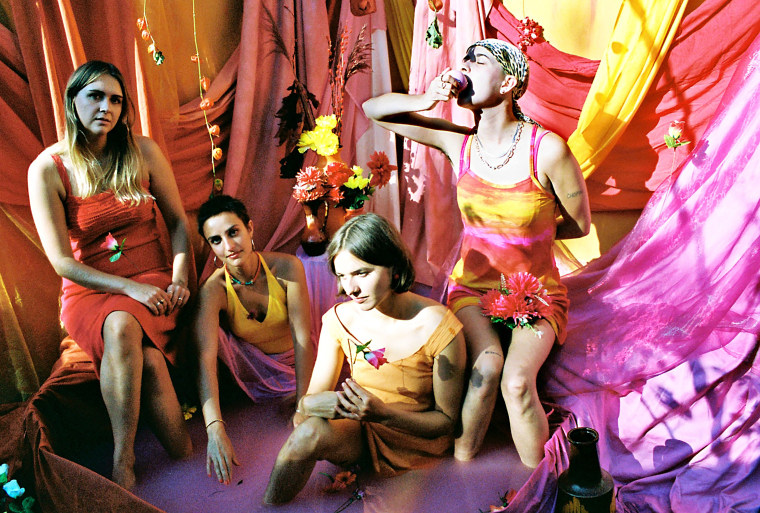
With 2018 album Darkness Rains, Los Angeles garage rockers Death Valley Girls gave us a clever flat-Earther parody and the unforgettable image of Iggy Pop eating a hamburger, Andy Warhol-style. Today they’re back to announce their new album Under the Spell Of Joy. This time there’s no comparable iconic imagery attached to speak of — unless you count their incredible new band photo below — but lead single “The Universe” more than holds its own as a blast of hypnotic, sax-blaring rock ‘n’ roll.

The band’s Bonnie Bloomgarden offered this statement on the new album, which was initially inspired by Ethiopian funk records, and “The Universe” in particular:

Under the Spell of Joy is a space-gospel record. We believe we served as channels for what we think are guides. As we learn what the songs are about we realize they are meant to be sang like chants, hymns, or spells. Most of the songs were recorded with 12 voices, including a kids choir! We are learning that words with intention and energy hold so much power, especially when said or sang with a group. “The Universe” is a song to sing, a space to be, a time to think, remember, and truly feel that not only are we all connected, but we are also being guided.

Death Valley Girls “Under the Spell of Joy” out October 2nd, 2020, on Suicide Squeeze Records

Slow Pulp’s remarkable full-length debut Moveys is a testament to hard-fought personal growth. In the process of making their new record, the Chicago-based indie rock band powered through health challenges, personal upheaval, and a pandemic, all while learning how to be better songwriters and friends. Full of blistering energy and emotional catharsis, this compelling 10-track collection highlights the band’s resourcefulness and resilience to come together even when they were states away.

Slow Pulp’s journey towards their debut album has been an unexpected one for the Chicago band. Through personal tragedies and health issues, “Moveys” became something entirely different from what the band had initially planned. The initial blow being singer Emily Massey receiving a diagnosis of Lyme disease and chronic mono. To add further insult, one week before the pandemic loomed, Massey’s parents were involved in a serious car crash.

But out of this personal upheaval, their debut album was formed through the most difficult of circumstances and as a result is a telling testament towards the collectivism within Slow Pulp. Through these experiences and writing simultaneously Massey was able to find space to process her thoughts and undergo a healing process. That process is transcendent throughout the record and a key crux as to how their music can have such profound effect. With some of the album’s material being recorded and written after lockdown, you would think that there would be a bit of a logistical headache when trying to piece an album together. Although an isolated experience wasn’t too different to their usual process as Emily explains. “We write separately from each other and usually send ideas through a Google Drive link. So, it wasn’t too crazy different, I did end up recording my vocals with my dad, which was really fun, he engineered my vocals”.

Writing with her dad Michael provided a mutual sense of healing between the pair. This is cemented on Whispers (In The Outfield), a wonderful instrumental track that merges piano and synth to create something which sounds texturally ethereal yet manages to maintain a very human level of wonderment and warmth. “That was the first piece of music that he played since the accident. Just the fact that he was able to work on the album with me was pretty special after an event where he almost lost his life” Emily said.

Shoegaze was one particular tag that the band were given after their earlier work, yet Moveys is much more dynamic in the genres it pays homage to. Their evolution was not planned as guitarist/producer Henry explained, “It was kind of an accident. We all kind of projected that it was going to be pretty heavy and blown out and it just didn’t happen like that. It wasn’t a conscious decision; I think we were following our gut”. One of their biggest achievements as a result of following this instinct is that Moveys has a consistent tone throughout yet each track still maintains a sense of individualism.

 Absolutely delicious indie-rock that hits the perfect balance of complexity and straightforward song writing excellence.

http://

Released October 9th, 2020 Slow Pulp is Alexander Leeds, Emily Massey, Theodore Mathews, Henry Stoehr

All songs written and performed by Slow Pulp

Image 1

This isn’t a reject from Raw Power. It came out in 1977 after Raw Power on the demo record released by Iggy Pop and James Williamson. This is actually the original mix of this track from the demo tape of the “Kill City” record that was sent out in the hope of getting them signed. From what I understand they sent this version out to labels, they then remixed the album when it got released as Kill City on the Bomp! label and Williamson released a remaster recently. Of the original mixes, this is one of the only tracks available to us through compilations such as this (Original Punks) and it fucking rules in my opinion.

“Down but not out, Iggy and James record lost treasure in decadent L.A.”
This current remastered edition derives from the rediscovered masters and was prepared for release by James Williamson, who again tours with the Stooges in 2010. Since the Stooges circle has been squared its only fitting that this missing link be finally, beautifully restored for posterity. – KC Press

“The sound is 100% clearer, the levels are pushed and the instruments stretch and slide at higher, bulkier levels. This is a Detroit rawk muscle record as it was meant to be heard 33 years ago. All raucous garage born out of sweat, blood and bad times.” – WNnG

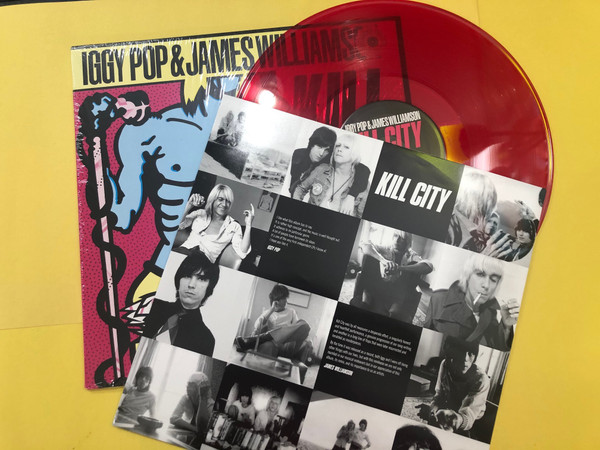
Kill City is Iggy Pop and James Williamson’s often overlooked, yet ultimately essential album. Originally recorded in 1975 and later released by Bomp! in ’77, critics have long lauded the songs and performances but have also regarded the overall sound as “sludgy.” The sound quality of Kill City was compromised from the get-go, as it originally suffered from a bad pressing (on the infamous green vinyl), and over the years the quality of the record itself managed to get even worse. When the original distributor went out of business, the 2-track album production masters vanished and every subsequent pressing of the album – on record, cassette and CD – used a copy of that deficient green vinyl as its master.

Now 33 years later, here is the long overdue restored, re-mixed and remastered version of this historically important record. Producer James Williamson remixed the album with engineer Ed Cherney at Capitol Records in Hollywood, and as the guitarist states, “He just made this record sound, well, like it should have sounded all along. It has finally reached its full potential.”

I like what this album has to say.
It is rather high concept, and the music is well thought out.
It adheres to no particular genre.
A lot of people have borrowed its ideas.
It’s one of the very first independent LPs I know of.
I hope you like it.
IGGY POP

Kill City was by all measures a desperate effort, a singularly honest and heartfelt performance, a genuine progression of our song writing, and another in a long line of flops that were later resurrected and heralded as masterpieces. By the time it was released as a record, both Iggy and I were off doing other things with our lives, but with this re-release we are not only reunited in our musical endeavors but in our appreciation of this album, its remix, and its importance to us as artists.
JAMES WILLIAMSON

RESTORED, RE-MIXED & REMASTERED edition, approved for the first time by both Iggy Pop and James Williamson. New Clear Red Vinyl  Limited Edition of 150