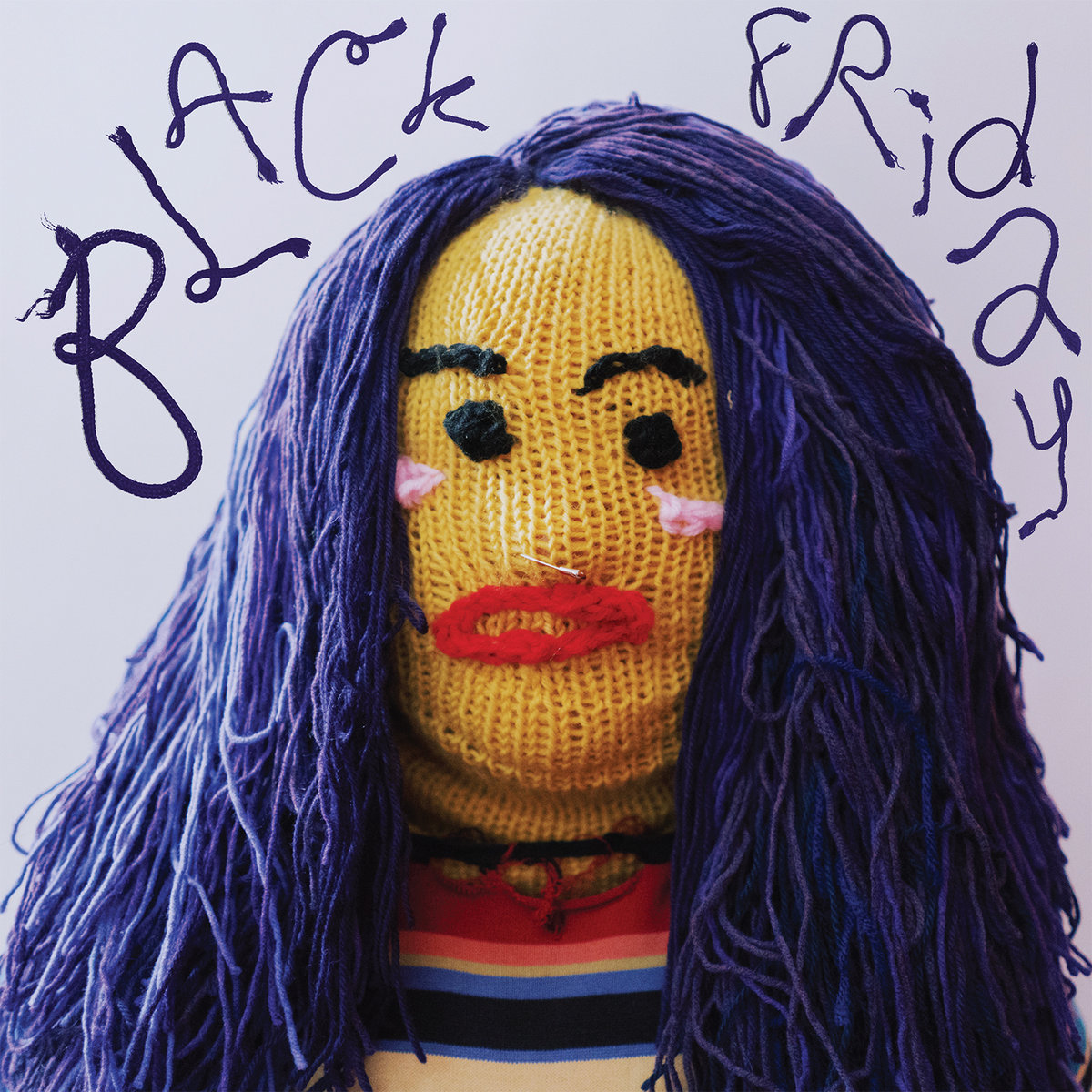
Boston-based trio Palehound have announced their third album, “Black Friday”, marking the occasion with the release of their lead single “Aaron.” The forthcoming record, due out on June 7th via Polyvinyl Record Co., examines love and the many different ways it can take shape in our life. “Aaron,” in particular, explores love of one’s own body, and connects to singer/songwriter Ellen Kempner’s partner.
Kempner says of the track and its music video in a statement:
“Aaron” is a character that represents my partner, who is trans. It’s not specific to his experience though, the song is about change in relation to our bodies in general. It’s about learning to be comfortable in our skins, whether that means changing our bodies or mindsets. Robert Kolodny directed the video and captured this theme perfectly through portraying physical insecurity as living in an unruly, amorphous body and gradually shedding it.
The video for “Aaron” takes Kempner’s gentle, heartfelt storytelling and gives it an artistic texture that is both fitting and unexpected. Kempner sings underneath a knitwear mask, crafted by Gaudmother, as a figure runs around the streets in a ghillie suit made out of yarn. In the end, both figures take off their knit masks and are haloed by light, a visual representation of their own newfound self-love and body empowerment.
On Black Friday, Kempner and bandmates Jesse Weiss (drums) and Larz Brogan (bass) hope that their art will help others who are struggling. She herself knows the therapeutic benefits of music, explaining:
What I always want to do with my songs is to help people heal in some way, or come to some new understanding about whatever it is that they’re going through. Even if it’s just hearing a song and feeling less alone than they were before, that would mean so much to me.
Kempner produced the record with Gabe Wax (Beirut, Soccer Mommy). Palehound recorded their latest project at Panoramic House in Stinson Beach, Calif.
Watch the video for “Aaron” (dir. Kolodny) check out the album art for Black Friday and the band’s national tour dates with Big Thief
Timing is everything, they say. Of course, when you’re ahead of the curve, timing can also throw a wrench in the works. Give enough passage, however, and others eventually catch-up, understand… even emulate.
Such is the case for self-proclaimed micro-legendary weirdoz The Prefab Messiahs. Originally together from 1981-1983, they played basement and club shows fairly often. Armed with borrowed guitars, puny amps and a mission to confound the status quo, the Clark U. undergrads began a unique post-punk musical trajectory through the burgeoning-yet-insular “Wormtown” (Worcester, MA) underground. Aside from the 1983 cassette Flex Your Mind, though, no recorded material was available from them until 1998’sDevolver CD-R – an anthology of their recordings from the early ’80s. Several songs on the album were produced by their friend and outsider psychedelic singer-songwriter Bobb Trimble.
Fast-forward three decades later with the official remastered release of Devolver via Burger Records, followed by a well-received eight-song maxi-EP of new material entitled Keep Your Stupid Dreams Alive (2015), and it seems the stars have finally aligned for this art-damaged psych-pop collective. These two releases witnessed not only a new appreciation from a younger fan base (not much older than the original one the band first started out with over 35 years ago), but also rave reviews from media, who traced the lineage from the Prefab Messiahs to many of today’s garage-psych scuzz-pups, such as Oh Sees, King Tuff, White Fence, Ty Segall, et al.
Now The Prefab Messiahs are set to release their latest full-length platter of new material, PsychsploitationToday. On it, the fuzzed-out foursome of Xerox Feinberg, Trip Thompson, Doc Michaud and Mattyboy Horn have cooked-up, arguably, their most far-out and fantastical effort to date. The new record continues the path of melding timely social commentary with equal measures of jangle, left-field garage-pop and hooks aplenty.
Prefabs’ front dude Xerox Feinberg, a self-described “Lost Generation Wanna-be Spokesperson,” describes the the band’s approach on Psychsploitation Today thusly, “The new album is really a mental and sonic continuation of the things we were obsessed about from the beginning — mashing up the sounds and attitudes of ’60s garage-psychedelia with post-punk ’80s stuff and dragging all that into whatever ‘today’ is — while generally trying to poke people in the ribs and skewer some of the Big Shams behind all the Shiny Facades. We still don’t do songs about girls’ names or feeling good. We’re still trying to toss everything into the mix including the kitchen sink. We’re still bemused and shocked and disgusted with The State of Things — and also in love with the noises in our heads and guitars. We like to think that The Prefab Messiahs’ work is never done.”
Micro-legendary DIY Garage-Pop-Psych provocateurs! Evolutionary genre grinders practicing art-damaged power pop, rock, crunch, jangle and general mind-infiltration.
released January 18, 2019 The Prefab Messiahs:
Xerox Feinberg, Doc Michaud, Trip Thompson, Mattyboi Horn
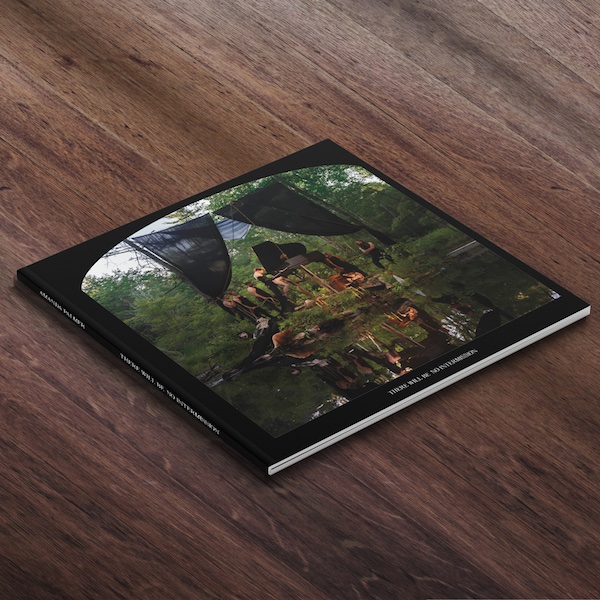
“There Will Be No Intermission” is out Friday, March 8th Amanda Palmer’s third solo effort and first in more than six years, is the multi-faceted artist’s most powerful and personal collection to date, with songs that tackle the big questions: life, death, grief and how we make sense with it all. While the themes may be dark, the album’s overall sonic and lyrical mood is one of triumph in the face of life’s most ineffably shitty circumstances. Beginning with the epic Bill-Hicks-inspired “The Ride”, it sees Palmer revealing her heart in total, turning the coals of fraught experience into musical diamonds. Themes of death and reproduction recur throughout, including “A Mother’s Confession”, a funny, honest, slice-of-life ramble detailing Palmer’s failings as a new mother, and “Machete” written in tribute to her best friend, Anthony following his untimely passing from cancer. “Voicemail For Jill” chronicles a different sort of death as Palmer reaches out to a friend on her way to an abortion clinic. Lead single “Drowning In The Sound” explores hidden connections between political unrest, the impending uncertainty of Hurricane Harvey, climate change, the solar eclipse, internet-hate and, bizarrely, Taylor Swift. One of the more lavishly produced songs on the album, the song combines Palmer’s singular style of piano-taming with a restrained chorus that pays sonic homage to two diverse but connected mentors: Prince and Ani DiFranco.
This album is the most personal and painfully vulnerable thing she has ever made, containing 10 of the most honest, funny, sad, dark songs. THE ALBUM, THE ARTBOOK and tickets for THE TOUR . the beautiful images you’re seeing (which are included in the artbook and are available as prints and select merchandise) were all captured by kahn & selesnick.
Amanda says, I know I say it a lot, but it bears repeating: this album would not have happened without the emotional and financial support of my 14,000 patrons. in so many ways, it just would not have been possible. if you are one of my patrons and reading this, i hope you are as proud today as I am. we did it.
The reviews and critics are weighing in….and the accolades mean a lot, but they don’t mean fuck all compared to what this music means to me and my community, and what it has meant over the past years as i’ve played these piano and ukulele in people’s houses, and in small clubs, and in living rooms, and in theaters for the people I really care about: you. you you you. fuck the critics. you’re my critics, and I listen. sometimes you make the art, and sometimes the art makes you. this record and tour feels more like the latter.
Listen. these songs are the most vulnerable and personal I’ve ever recorded, and they all provided some kind of relief from each life-situation I was facing over the last seven years since I out our my last album (theatre is evil), it was just non-stop, the gamut of human emotion and highs and lows. everything feels inseparable now: my crowdfunding through patreon, the birth of our son, the election of trump, my TED talk, two abortions, the kavanuagh hearing, the death of my best friend, writing a book, being in Ireland for the repeal, the miscarriage i had alone on a christmas day.
i sat in a theater in london and watched hannah gadsby decimate the blurted lines between entertainment and naked truth, i saw the brave women of #metoo standing up against their rapists, and I saw nick cave in concert and on record working through his grief using art as a necessary and generous tourniquet that others could re-use. they all reminded me to try harder and harder still to tell the real, unadorned truth. I love you all so much.
Thank you for coming on this ride with me.
watch this, and you will understand everything. I made this video in our living room (w/ two of my closest friends, Michael Pope & Coco Karol to announce my forthcoming solo album,
Amanda Palmer, performer, writer, giver, taker, listener, love-lover, rule-hater and co-founder of the Brechtian punk cabaret duo, The Dresden Dolls.
Musicians:
jherek bischoff – double bass, guitar, vibraphone, prepared piano, backing vocals
john congleton – drums, synths, sequencing
max henry – synths
amanda palmer – piano, ukulele, organ, synths, vocals
joey waronker – drums
jason webley – accordion
“There Will Be No Intermission is a triumphant return of an uncompromising artist. It is singularly the best piece of work that Palmer has produced in her career.” – popmatters.com
One listen to Springtime And Blind may have you loving the raw sound…quite unpolished indie rock/grunge. Fiddlehead’s debut album is not punk or hardcore in a traditional sense, but it’s played by people from those worlds while translating the spirit of those scenes. Featuring Pat Flynn of Have Heart on vocals, the record sees him stretching his vocal range further than ever, as he sings almost solely about the death of his father in ways that are evocative but never cloying. In a scant 24 minutes, Fiddlehead makes the kind of music that falls somewhere between post-hardcore and indie rock, finding ways to take songs about uniquely personal experiences and transform them into cathartic anthems. And really, that’s what the best hardcore music has always done.
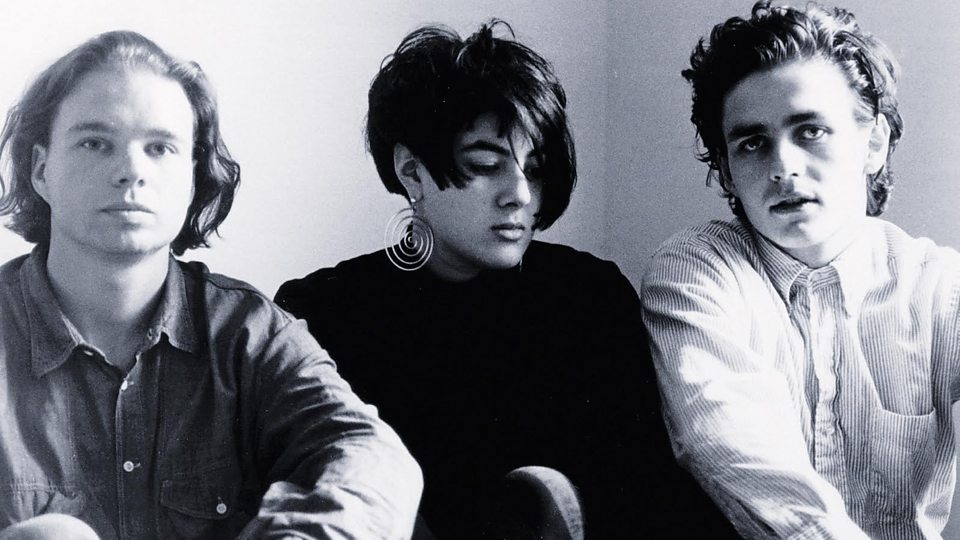
Galaxie 500 were a really well-regarded indie rock band at the time. They signed to a big indie label, they got to tour a lot, to record extensively with the single producer on Earth they were most suited to work with, and they were absolutely adored all over in Europe. Galaxie 500 made three great records that people bought thousands of copies of, Galaxie 500 have later emerged as one of the pivotal underground groups of the post-punk era, dreamy and enigmatic, their minimalist dirges presaged the rise of both the shoegaze and slowcore movements of the 1990s. The group formed in Boston, Massachusetts in 1986 and comprised vocalist/guitarist Dean Wareham (a transplanted New Zealand native), and bassist Naomi Yang and drummer Damon Krukowski, longtime friends who first met in high school in New York City before all three attended Harvard. Wareham and Krukowski initially teamed in the short-lived Speedy & the Castanets, which split after their bass player experienced a religious conversion; upon re-forming, the duo recruited Yang to play bass, although she had no prior musical experience.
Named after a friend’s car, Galaxie 500 began performing live throughout Boston and New York before recording a three-song demo tape which they sent to Shimmy Disc head honcho Kramer, who agreed to become the trio’s producer. After bowing in early 1988 with the singles “Tugboat” and “Oblivious” (the latter track featured on a flexi-disc included in an issue of Chemical Imbalance magazine)
They issued their full-length debut, “Today” in 1988, which highlighted the group’s distinct, evolving sound pitting Wareham’s eerie, plaintive tenor, elliptical songs, and slow-motion guitar textures against Yang’s warm, fluid basslines and Krukowski’s lean drumming.
Damon Krukowski: said ,We had been listening to a Half Japanese record produced at Noise [Music to Strip By]– it sounded very spacious. All the other Boston bands were turning out a very heavy, dense sound. We were looking for something else. We weren’t a heavy band after all. We called to ask the rates– they were cheap! So we booked time. That’s how we came to record the “Tugboat” single at [his studio] Noise, and how we met Kramer. It turned out he was the only employee.
Galaxie 500’s debut doesn’t merely live up to the sweet promise of the band’s debut single “Tugboat,” Today’s final song, but almost without trying becomes its own gently powerful touchstone. While the influences are clear — third album Velvet Underground, early non-dance New Order, psychedelic haze and fuzz thanks to the reverb Kramer piled on as producer. By never feeling the need to conventionally rock out, the Krukowski/Yang rhythm section comes up with its own brand of intensity. Sometimes the two are persistently skipping along without Krukowski having to bash the hell out of the drums (the downright delightful “Oblivious” is a good example), other times they simply play it soft and slow. Meanwhile, Wareham’s low-key chiming and slightly lost, forlorn singing, at places wry and whimsical, often achingly sad, forms the perfect counterpoint to the songs’ paces, feeling like a gauzy dream. When he comes up with his own brand of electric guitar heroics, it’s very much in the Lou Reed and such descendants vein of less being more, setting the moods via strumming and understated but strong soloing. One particular Descendant gets honored with a cover version: Jonathan Richman, whose “Don’t LetOur Youth Go to Waste” is turned into a deceptively calm epic, with marvelous playing by all three members.
Dean’s smallish high voice, subtle accent, and laconic guitar were seated by Damon’s spacious sound– long cymbal splashes, bottom heads on his sparkly Gretsch kit– and Naomi’s unique, wide toned high on the neck melodies made a big, wide, slowly moving cloud.
It’s easier to lose oneself in the flow of the sound rather than worry about any deep meaning, making the stronger images that come to the fore all that more entertaining, like “watching all the people fall to pieces” in “Parking Lot.”“Tugboat” itself, meanwhile, remains as wonderful as ever, a cascading confession of love at the expense of everything else, somehow mournful and triumphant all at once.
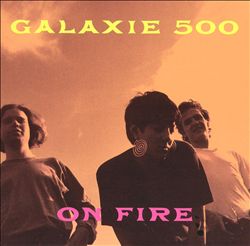
After signing to the U.S. branch of Rough Trade, Galaxie 500 issued its defining moment, 1989’s evocative “On Fire”, a remarkably assured and rich record including the superb singles “Blue Thunder” and “When Will You Come Home.” Having already made a fine account of themselves on “Today”, the three members of Galaxie 500 got even better with “On Fire”, recording another lovely classic of late ’80s rock. As with all the band’s work, Kramer once again handles the production, the perfect person to bring out Galaxie 500’s particular approach. The combination of his continued use of reverb and the sudden, dramatic shifts in the music — never exploding, just delivering enough of a change — makes for fine results.
We were signed to Rough Trade by Robin Hurley, who ran the American label, and Geoff Travis, who was our A&R man and the head of the company back in England– both great people. It’s kind of amazing the list of things he has been involved with: Swell Maps, Jonathan Richman, Shockabilly, the Smiths, the Jesus and Mary Chain, Pulp, the Strokes.
Consider “Snowstorm,” with Krukowski’s soft-then-strong drums and Wareham’s liquid solo and how they’re placed in the mix, leading without dominating. Yang’s vocals became more prominent and her bass work more quietly narcotic than before, while Krukowski adds more heft to his playing without running roughshod over everything, even at the band’s loudest. Wareham in contrast more or less continues along, his glazed, haunting voice simply a joy to hear, while adding subtle touches in the arrangements — acoustic guitar is often prominent — to contrast his beautifully frazzled soloing. Lead off track “Blue Thunder” is the most well-known song and deservedly so, another instance of the trio’s ability to combine subtle uplift with blissed-out melancholia, building to an inspiring ending. There’s more overt variety throughout “On Fire”, from the more direct loner-in-the-crowd sentiments and musical punch of “Strange” to the Yang-sung “Another Day,” a chance for her to shine individually before Wareham joins in at the end. Again, a cover makes a nod to past inspirations, with George Harrison being the songwriter of choice; his “Isn’t It a Pity” closes out the album wonderfully, Kramer adding vocals and “cheap organ.” Inspired guest appearance Ralph Carney, Tom Waits‘ horn player of choice, adding some great tenor sax to the increasing volume and drive of “Decomposing Trees.” CD pressings included the bonus tracks from the BlueThunder EP.
After a limited-edition 7″ release featuring live renditions of the Beatles’ “Rain” and Jonathan Richman’s “Don’t Let Our Youth Go to Waste”.
The group returned in 1990 with This Is Our Music, a diffuse collection spotlighting the wry, sunny single “Fourth of July” and a haunting cover of Yoko Ono’s “Listen, The Snow Is Falling” .
What turned out to be the final Galaxie 500 album was also arguably the band’s most accomplished. Not that the earlier records lacked either charm or ability, but right from the charging, chugging start of “Fourth of July,” the amazing single and lead off song from This Is Our Music (even including a cheeky Velvet Underground reference from “Candy Says”), the trio here sounds like they could take on anyone. Kramer’s production and the use of reverb from past releases all once again contribute to Galaxie 500’s magic, while the individual members continue to sound fantastic. Somehow, though, everyone aims higher, Wareham’s singing among his finest and his guitar going for the truly epic more than once, Krukowski and Yang even more perfectly in sync than before, often being very bold without losing their intrinsic warmth.
From a generally different approach, Galaxie 500 here easily equaled the heights of their U.K. shoegaze contemporaries and often trumped them — “Summertime” in particular is a stunner , while making a lot of contemporary American indie rock seem fairly dull and workaday. The choice of cover version this time out is astonishing Yoko Ono’s “Listen, the Snow Is Falling,” with Yang singing beautifully over, initially, Wareham’s echoed guitar strums, and Krukowski’s barely-there percussion cascade. The switch to a full-band arrangement, far from destroying the song’s spell, makes it even more intense and gripping a listen.
The subtle touches throughout the album add immeasurably to its magic — the soft ringing bells shimmering through “Hearing Voices” quiet synth on “Spook,” and Kramer’s self-described “cheap flute” on “Way up High.” It all concludes with “King of Spain, Part Two,” a reworking of the flip side to “Tugboat” while it wasn’t a planned finale, as an unexpectedly right bookend to a career, it ends both Galaxie 500 and This Is Our Music on a perfect note.
Later CD versions include a cover of the Velvet Underground’s “Here She Comes Now,” originally the B-side from “Fourth of July.”.
Galaxie 500 recorded two sessions for John Peel’s BBC Radio 1 programme, these later released on the Peel Sessions album. Their cover of Jonathan Richman’s “Don’t Let Our Youth Go To Waste” was also voted into number 41 in 1989’s Top Festive 50 by listeners to the show. Dean Wareham: The first Peel Session we did was engineered by Dale “Buffin” Griffin, formerly the drummer in Mott the Hoople. I remember him being impatient. We were amazed at how big the studio was, and this computer they had that could mark the different sections of the song and take the tape machine right to them. My favorite Peel Session recording was our cover of the Sex Pistols’ “Submission”. People always say that’s an unlikely cover but Damon and I had been playing that one since our days in Speedy and the Castanets; it was one of the first songs we learned together.
Following a subsequent tour, Galaxie 500 disbanded after Wareham phoned Yang and Krukowski to say he was quitting the group.
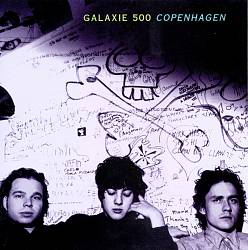
A few months later, after Dean Wareham formed his new band, Luna, Rough Trade went bankrupt, and with the label’s demise went the trio’s three albums, as well as their royalties. In 1991, at an auction of Rough Trade’s assets, Krukowski purchased the master tapes for the group’s music, and five years later the Rykodisc label issued a box set containing Galaxie 500’s complete recorded output. A previously unreleased 1990 live set, dubbed Copenhagen, followed in 1997.
A presumably final punctuation mark on Galaxie 500’s work, “Copenhagen”, released in 1997, is actually a recording from the last date of the band’s late 1990 European tour, captured for radio broadcast in the Danish capital in front of a vocally appreciative crowd. One main reason to listen in is hearing how the band’s studio approach clearly differed from the concert arena — while Kramer handles the live sound, the cocooning web of reverb familiar from the records isn’t present here. As a result, the performances have a more direct approach, Wareham’s voice a little more naked, his thoughts on emotional connection, and the oddities of life easier to capture. Yang’s bass gains in prominence as well, almost more so than Wareham’s guitar at points, while Krukowski as always keeps the beat well, adding subtle flourishes and touches as he goes. All this would be mere technical notation if the performance itself wasn’t worthy, though, and that it is. Touring for “This Is Our Music” as the trio was, the set list is mostly focused on that, though a fine version of “Decomposing Trees” starts things off. Three of the band’s favored covers close the set — Yoko Ono’s “Listen, the Snow Is Falling,” the Velvet Underground’s “Here She Comes Now,” and a version of Jonathan Richman’s “Don’t Let Our Youth Go to Waste” that provides a great final kick. For all the excellence of the show, one can hear a little more than once in Wareham’s soloing what Yang and Krukowski later described as his tendency to play the big rock star toward the end of the band’s life. It’s not bad work, but the cracks were starting to show.
The Boston rock veterans of Guster are back after a four-year break with a new album titled Look Alive. The band appears to have been restless in the interim, as this new album incorporates everything from grand, arena-style pop hooks to the whimsical balladry of ‘60s groups like the Kinks.
In case you quit the internet last week, our new album Look Alive comes out on January 18th and you can head on over to www.guster.com this very second to hear a whole third of our new record, check out the full track listing, and pre-order or pre-save how you see fit. The bands 8th studio album is out today. Look Alive is an inspired and fulfilling place to have arrived after 27 years of creativity.
Now, also feast your eyes on the album cover! It was embroidered by a fabulous artist named Nikki Virbitsky.
“Overexcited” is from Guster’s new album, Look Alive, out now on Nettwerk Music Group & Ocho Mule Records.
Interesting that this record was among my list of most-anticipated releases last year. Happily, Quiet and Peace shows that the Buffalo Tom formula works as well as it did 20 years ago, when their music made up a big chunk of the soundtrack . Through incredible cohesiveness as a power-indie-pop trio, thoughtful and emotional lyrics, and rock-solid musicianship, the album’s 11 tracks ooze the energy, catchiness, and timelessness the band’s music is known for—not to mention frontman Bill Janovitz’s unique style and mastery of an SG pushing a Marshall. From the anthemic spirit of the first track, “All Be Gone,” to the band’s beautiful take on Simon & Garfunkel’s “The Only Living Boy in New York” closing it out, Quiet and Peace exceeded my quite high expectations.
Quiet and Peace is a compelling 11-song set that finds the trio—singer-guitarist Bill Janovitz, bassist-vocalist Chris Colbourn and drummer Tom Maginnis—simultaneously mining their best-known sonic elements while breaking new ground on emotionally resonant new tunes such as “All Be Gone,” “Roman Cars,” “Freckles” and “CatVMouse.” Buffalo Tom’s first collection since 2011’s Skins, Quiet and Peace was mixed by John Agnello (Kurt Vile, Sonic Youth, The Hold Steady) and marks the band’s first collaboration with producer and fellow Boston alt-rock legend David Minehan, renowned ex-leader of the Neighborhoods.
Singer-guitarist Bill Janovitz explains more about the video: “The idea came from the song lyric. Rachel wanted to depict a real woman at various points in her life, from childhood into motherhood. She had some of her own Super 8 footage of her mom Susan. When Rachel loaded it with the music, it just seemed to synch up perfectly. There was this footage of her mom from childhood to motherhood, all Super 8, which has to be a fairly rare case for someone of that generation. So it is all real vintage footage of one person’s pivot points, from young childhood to young adulthood.
The video was directed by Rachel Lichtman from Network77.com (an absurdist music-and-comedy sketch web series). It was edited by drummer Tom Maginnis’ daughter Marlena.
Buffalo Tom performing “All Be Gone” live in the KEXP studio. Recorded March 1st, 2018.
Technically, Sidney Gish’s No Dogs Allowedcame out in 2017; the Northeastern student put the album up on Bandcamp on December 31st “mainly due to panic rather than intention,” as she explains it, having intended to finish it sooner, but only finding the proper amount of time to do so during the lull at the end of the year. That’s a fitting entry point into Gish’s state of mind: a distinctly millennial (post-millennial, ) strain of near-constant worry underscores her music, but there’s almost always a joke right there behind it.
“Every other day I’m wondering,” she considers on “Impostor Syndrome”—just one of many songs on No DogsAllowed that you will decide is your “favourite” at one point or another—“What’s a human being gotta be like? / What’s a way to just be competent?” But before she’s even caught her breath after that existential aside, she’s already laughing it off: “I don’t blend in at PetSmart / That truth holds true at the WalMart / In either case they say to me / What the fuck is lost in aisle 3?”
Gish is a triple threat—besides being a crack lyricist able to invite you into her own world while also managing to relate to yours, she’s a stellar guitarist, and has an extremely gentle melodic touch to boot. Also, she managed to mix the whole damn album using just Apple earbuds and a car stereo. Every song on No Dogs Allowed is a joy, even when Gish is singing about the terrors of adulthood—because, god, how could you hear a song like “Where the Sidewalk Ends” and be afraid of anything at all? It’s all going to be OK, even if it isn’t.
Sometime earlier this summer, Juliana Hatfield was shredding alongside waste treatment machinery on Deer Island, and it was freakin’ awesome. Amidst a million subtle shades of pink and surprisingly industrial imagery, Hatfield’s new video, “Lost Ship”, paints her as the take-no-BS Boston woman we’ve always known her to be.
“No one has any power over me,” she sings, which she quickly follows with “I wanna ride on a spaceship in my mind,” both lyrics that recall her steadfast agency and desire to peace the hell out.
The next taste of her forthcoming 2019 record Weird, Hatfield’s video for “Lost Ship” was filmed on Massachusetts’ Deer Island earlier this year. With a little more than a month to go until Weird debuts on American Laundromat Records to be released in January, from the former Blake Babies member .
“Rachel Lichtman of the awesome Network 77 hipped me to this place called Deer Island in Winthrop, Massachusetts and we shot the video there,” she says . “It’s right in my backyard, practically, but I had never been there before. It was such a cool sci-fi setting, with the wind and those gigantic egg-shaped structures which are part of the waste treatment facility out there. Rachel made this a beautiful haunting video.”
Echoing Hatfield’s cut-off-from-the-world’s sentiments of Weird, director Rachel Lichtman honed in on her blissfully alone beauty for the video’s imagery.
“I feel like Juliana and I created something that so beautifully captures the powerful freedom of the chosen isolation described in ‘Lost Ship,’” Lichtman explains. “Juliana seems a futuristic goddess, luxuriously alone, atop what looks like the remnants of the industrialized world; she’s not bothered or indebted or compromised. We shot it just the two of us on the last warm day of summer, and I think that energy translates through and captures the essence of this brilliant song.”
“Lost Ship” by Juliana Hatfield from the album “Weird” out January 18th, 2019 on American Laundromat Records.
Billy Squier‘s 1981 second solo album “Don’t Say No” sold over three million copies because of songs “In the Dark”, “My Kinda Lover”, “Lonely Is the Night” and the big hit “The Stroke”. Billy Squier grew up in the Boston suburbs as an only child (“Life isn’t easy from the singular side” he sings in the opening to “In the Dark”), the son of an executive of the Converse Shoe Company. So in the Squier household growing up, it’s safe to assume that Buddy Holly shared star billing with Bob Cousey, Bill Russell and John Havilcek of the Boston Celtics.
Billy Squier was introduced to John Mayall’s Bluesbreakers at age 14, which introduced Billy to guitarist Eric Clapton, changing everything for the young adolescent American. Squier’s desire got him first to Boston University. Then his talent got him into the prestigious Berklee College of Music, but the first half of the Seventies were spent pretty much shuffling in and out of bands in Boston and New York City.
Then Billy Squier got his first taste of the record business, recording two albums on a major label fronting the band Piper in 1976 and 1977 before splitting up. Undeterred, Squier landed a lucrative solo deal and debuted with 1980’s The Tale of the Tape, containing “The Big Beat” which I played to great response on ROCK 103/ Memphis. So it was with eager anticipation that Don’t Say No was received in April 1981.
Intervention Records is thrilled to present Billy Squier’s 1981 rock anthem, “Don’t Say No” in a brilliantly remastered Artist-Approved Edition. The classic rock staple catapulted Squier’s career to new heights. His live shows became arena rock sensations and four tracks from this album became classic rock radio staples in heavy rotation today: “In the Dark,” “The Stroke,” “My Kind of Lover” and “Lonely is the Night.” The original LP art has been restored by IR’s Tom Vadakan to a beautiful single-pocket gatefold and the Old-Style, “Tip-On” LP jacket is film-laminated and printed by Stoughton.
Don’t Say No is the second album by Billy Squier, Released on April 13th, 1981. It stands as Squier’s biggest career album, including the hits “In the Dark”, “Lonely Is the Night”, “My Kinda Lover” and “The Stroke”. The album hit the Top Five on the Billboard album chart and remained on the chart for over two years (111 weeks)
“The Stroke” was the first single, reaching number 17 and an even bigger hit at rock radio, hitting number 3 on the Mainstream Rock chart. The song even dented the British Pop charts, rising to number 52. The video for “The Stroke” — as most of the music videos from both Don’t Say No and its follow-up, Emotions In Motion is a straight-ahead performance piece, featuring Squier on an arena stage. Billy’s many videos were staples on the then brand-new channel MTV Channel which brought him increased popularity.
The album is a near-perfect example of early-’80s melodic hard rock, and even less enduring (but hardly inferior rockers) such as “You Know What I Like” and “Lonely Is the Night” keep up the intensity. And Squier also finds time for the occasional ballad, like the disarmingly gentle “Nobody Knows.” Completists may want to review his mid-’90s double-disc anthology, but as far as studio albums are concerned, Don’t Say No is undoubtedly his best and a pure classic.
“In The Dark” followed “The Stroke” into the Top 10 of the Album Rock Tracks chart. “Lonely Is The Night” and many other tracks from the album were hugely popular on AOR (Album Oriented Rock) radio stations.
Don’t Say No belatedly received a Triple Platinum award in 1992, certifying sales of over 3 million US copies. In early 2018, Intervention Records reissued Don’t Say No on 180-gram vinyl .The reissue is Artist-Approved and according to Squier “arguably the best-sounding version ever.









 The Fat Angel Sings