Hailing from Berks County, PA, Shannen Moser grew up steeped in folk and country music. Influenced by the historically rich area, stretching farmland, and local folkers, Shannen credits the area with giving her the tools to write the music she does today, influencing her self-taught guitar plucking style and confessional lyricism. She vividly recalls her first encounter with folk music in her dad’s old truck, playing “I’ll Be Here In The Morning” by Townes Van Zandt. Since then, her love for songwriting has continued to grow.
In 2014 Shannen moved to Philadelphia and began pursuing music more earnestly. Her debut LP “Oh, My Heart” was released in January of 2017, and reissued by Lame-O Records later that Spring. Mostly recorded in a barn in Earlville, NY, the record brought a more expansive sound to her small bedroom recordings, moving Moser forward sonically as an artist while preserving the sincerity of her earlier work and showcasing Moser’s folk and country influences.
Shannen Moser’s intimate sophomore album “I’ll Sing” was released on September 7th on Lame-O Records. An evocative and vulnerable storyteller, Shannen Moser’s narrative style makes every song on I’ll Sing like a short story, pulling listeners into the details while tackling big topics like heartbreak, loss, and battles with mental health. Written over a tumultuous year, Moser shows a willingness throughout the album to bear her scars, utilizing vulnerability in a way that feels powerful.
I’ll Sing was produced by Eric Muth and Cameron Konner at the Grey Ferry Warehouse in Philadelphia. Muth, Konner, and cello player and longtime touring band member Julia Peters were Moser’s backing band on the record.
To celebrate the release of their second studio LP, “Is This Real”, The Pinheads are playing a bunch of in stores along the East Coast for your listening pleasure. Born out of friendship, bowling, sci-fi movie marathons and literal brotherhood, The Pinheads formed out of what is now colloquially known as the Leisure Coast Australia, spread out among the northern suburbs of the Illawarra and Wollongong region.
They quickly established themselves as one of the area’s must-see live bands; no mic stand was left unturned, no face left un-melted, no speaker stack was left un-climbed. Is This Real marks a reunion of sorts for the band, after several members took a short sabbatical from The Pinheads, to go explore other musical projects – among them Tropical Strength, Luke Spook and Shining Bird. Reconvening in their home studio, known asThe Shed, the septet set out to once again push out into previously-untouched Pinheads territory.
The songs are longer, often slower and more methodically paced. The wildfire that sparked their initial run remains, albeit in a more contained manner. This is the sound of a band that has been re-calibrated, focused and with a reaffirmed sense of ambition.
When The Pinheads started out, their modus operandirevolved around two straight, simple rules: Never play it safe, and always make it fun. This remains as true now of their recorded material and their live shows as it did when they began in 2015.
‘Is This Real’is The Pinheads second studio LP, the follow up to 2017’s self-titled LP.
The video for ‘For Real,’ the latest previously unreleased single to debut from Tom Petty, is premiering today.The loving video was directed by Tom’s daughter, Adria Petty, and features archival footage and photos as well as intimate, behind-the-scenes moments of Tom and the band.‘For Real’ is off The Best Of Everything, out now via Geffen Records/UMe, the first career-spanning collection of Tom Petty’s hits-including songs with the Heartbreakers, solo projects, and essentials from the reformed Mudcrutch.
Official Music video for “For Real” from Tom Petty And The Heartbreakers. ‘The Best Of Everything’
Over the years, Peter More and his bandmates have called many places home. Originally from Fort Worth, Texas, More joined forces with Spanish flamenco guitarist José Juan Poyatos, Mexican bassist Diego Noyola, and French-American drummer Adrien Faunce in San Miguel de Allende, the colonial arts haven three hours north of Mexico City. There, the band began to record with prolific drummer Rick Shlosser (who played on many Van Morrison and James Taylor classics, among hundreds of other credits). A chance encounter with Steely Dan’s Donald Fagen, who happened to be visiting San Miguel, led to Fagen producing More’s debut album, “Beautiful Disrepair,” and a follow-up EP entitled “Shoulder.”
A sense of wanderlust underscores More’s music, weaving many influences and intersections from the principal songwriter and lead singer’s unconventional journey. These layered stories naturally evolved with the band’s continual movement through recording sessions beyond San Miguel that took place in Fort Worth, New York City, and Woodstock. Three of the songs were held back from the LP release in August 2018 and now appear as an EP with the anthemic single “Shoulder” and two b-sides “What We Used to Be” and “Marlene (Featuring AmyHelm).” At turns contemplative and rousing, the Shoulder EP is a precisely executed work with Fagen’s indelible sound stylings that More’s lyrics and vocals make feel uncomplicated and original, fusing together the many creative and geographic influences that define Peter More.
From Peter More’s latest EP “Shoulder” that was released April 12th, 2019, the video for the title track was shot on location in San Miguel de Allende, Mexico
Philadelphia power pop trio Hurry have just announced “Frustrate You”, a new two-song single out now on Lame-O Records. The new songs “Frustrate You” and “An Element Of Surprise”. What was once a solo project for principal songwriter Matt Scottoline has evolved into Hurry, a power pop trio from Philadelphia, Pennsylvania composed of Scottoline,Rob DeCarolis (Univox), and Joe DeCarolis (Psychic Teens). The DeCarolises are cousins and they are both very talented. “As talented as Matt Scottoline?” Of course. Please don’t attempt to pry the band apart with potentially hurtful questions.
Hurry’s album Every Little Thought was released on February 23rd, 2018 on Lame-O Records. The album, written by Scottoline, is a light and dreamy plunge into life’s crushingly relentless uncertainty and doubt. The album is more pop-driven than Hurry’s previous efforts, focusing on catchy melodies, hooks, and harmonies influenced by Teenage Fan club, Robyn Hitchcock, Yo La Tengo, and Guided By Voices. Of the new album, Scottoline — a natural salesman — says, “I tried even harder this time to make it good.”
Hurry released it’s previous album, Guided Meditation, on Lame-O Records in 2016. It was recorded at Noisy Little Critter with Mike Bardzik. The album was likely critically acclaimed, however Hurry does not place much value on things like “critical acclamation,” nor do they place much value on “awards.” In fact, Hurry did not even pay attention to 2017’s Grammy winners. Ultimately, who knows if Guided Meditation won any (or all) of those awards.
Since Guided Meditation’s release, Hurry has toured and played shows with Yuck, Nada Surf, and Tommy Keene, and have had their music featured on FXX’s Man Seeking Woman. Scottoline, however, is not sure how important any of that information actually is. “I don’t really think it is [important],” he says. Hm. You can judge for yourself. Every Little Thought focuses on the general indecision of existence and how it can affect interpersonal relationships, as well as the frame of mind with which you approach day-to-day life. It is nice to listen to and it will make you smile.
I don’t think that L7’s co-founder Donita Sparks and longtime L7 members Suzi Gardner, Jennifer Finch, and Demetra Plakas have mellowed with age.
Born in Los Angeles in 1985, the crusty quartet raged and raved, on-stage and off, until its 2001 implosion—only to reform for live shows in 2014. Not long after they’d reunited, L7 reignited their socio-political torpor with 2017’s post-election rant, “Dispatch from Mar-a-Lago.” Now, they have their first new studio album since Slap-Happy (1999): the incendiary May release “Scatter the Rats”.
The reunion happened because we felt that there was still interest in us, and that there wasn’t anyone who had our particular spin. We thought that younger people who hadn’t experienced us the first time needed to experience L7.
L7’s brand new full-length album ‘Scatter The Rats’
By the end of the 1960s Neil Young was catching the ear of many influential figures – not least his old band mate Stephen Stills, who was now part of the Grammy-winning folk-rock super group Crosby, Stills & Nash. The band were keen to have him onboard as a sideman, but Young was insistent that he be given a full title credit as a condition for his contributions. Stills frequently found himself fighting with Young for control over the band’s songwriting, and has famously said that the latter “wanted to play folk music in a rock band.”
Young’s dogged self-determination, despite its interpersonal downfalls, was a major artistic virtue that fed directly into what was perhaps his first true masterpiece. After The Gold Rush had its beginnings in an unlikely place. Dean Stockwell, a former child star of the ‘40s and ‘50s, had been encouraged by his friend Dennis Hopper to write a screenplay whilst the pair were in the jungles of Peru producing a film entitled The Last Movie. Hopper assured Stockwell that he had the relevant connections to help get the film made, and once back in the US the latter retreated to his home at Topanga Canyon in the Los Angeles Mountains to commence the writing process.
A fellow resident of the canyon and a close friend of Stockwell’s, Young was suffering through a prolonged period of writer’s block and was under growing pressure from his label to record an album of new material. After learning of the writer’s creative endeavour he was intrigued to learn more and asked Stockwell if he could read a draft of the story. The script, which has since been lost, was an unconventional, non-linear narrative with religious and psychedelic undertones. It loosely detailed an end-of-the-world scenario centred on the local Californian environment, in which a biblical flood threatened to pull the state into the ocean. Captivated by this messy but intriguing tale, Young recalls: “I was writing a lot of songs at the time, and some of them seemed like they would fit right in with the story.”
Ironically Hopper’s proximity to the project scared off any interested executives, and before long the film seemed destined to remain in limbo. Nonetheless, Young was fired up and undeterred, commencing work immediately on what he imagined to be the soundtrack of this deeply counter-cultural Hollywood film. Finding time to write and record was difficult, as large swathes of 1970 were blocked out by Crosby, Stills, Nash & Young’s huge US Tour and further live obligations with Crazy Horse. In the precious gaps between shows, Young made initial recordings at Hollywood’s Sunset Studios, yielding “I Believe In You” and “Oh Lonesome Me” but quickly realised he preferred the atmosphere of the Canyon, continuing the process at the home studio set up in his lead-lined basement. It was here that his ensemble of bassist Greg Reeves, drummer Ralph Molina, and guitarist Nils Lofgren assembled.
The studio was a small and sweaty space, adjoined to a side control room from which producer David Briggs kept an eye on proceedings. The youngest of the ensemble, eighteen year-old Lofgren was brought in to play keyboards despite being a relative novice at the time of recording, highlighting Young’s unconventional laid back approach. Accordingly the musician recalls that “Neil didn’t mind rehearsing a bit” but they “didn’t belabour stuff.” It’s often considered that Young was attempting to merge musicians from both Crosby, Stills & Nash and Crazy Horse on this album, and Stephen Stills even appears on “Only Love Can Break Your Heart” to provide backing vocals.
The basement’s make-shift setup influenced the stark and plaintive sound of After The Gold Rush. Young featured solo on piano throughout the album, most notably on the title track which is often praised as the centrepiece of the album. Charting a surreal and fantastical course through three verses, the song starts in a medieval era of knights and peasants and ends in outer space with the remnants of humanity, after the world has descended into apocalypse.
The song was designed to directly mirror the plot of the proposed film, and Young invited Stockwell to sit in on some of the album’s sessions. The writer was impressed: “If you could calculate the amount of human energy that goes into the making of one of his songs, you would have a really fucking high number, man.”
Explaining his thoughts behind the environmentally conscious song Young recalls: “I recognise in it now this thread that goes through a lotta my songs that’s this time-travel thing… When I look out the window, the first thing that comes to my mind is the way this place looked a hundred years ago.”
But stepping out of the failed film’s shadow, After The Gold Rush as a whole fits neatly into Young’s continued development as one of the finest songwriters of the North American tradition. Young’s ability to convey nuanced emotion through potently simple chord sequences and unvarnished yet poetic lyrics is exemplified on songs such as “Birds” and “Only Love…”, which highlight the often overlooked yet effortless sonic beauty of his music. The fact that the album allows such space for this aspect of Young’s work to blossom reveals why it remains one of the most beloved in his expansive catalogue.
Despite producing no major hits and suffering a ferociously critical review from Rolling Stone, the album truly kicked off Young’s celebrated solo career, preceding game-changing albums, such as 1972’s Harvest, and was quickly re-considered as one of the finest albums of the 1970s by the very publications who had tore it to pieces just a few years prior. It’s a testament to how swiftly Young’s career was ascending – from folk-rock’s resilient underdog to one of the standard-bearers of the great American songbook.
If you’ve ever heard an Angie McMahon song, then you’ve heard just how big her voice can be, and how cleverly she can craft a phrase. In person, though, she’s more soft-spoken, her words carefully chosen—the former due to a compromised immune system thanks to a pretty hectic touring schedule. Not that McMahon’s complaining.
The Australian singer-songwriter is on one of her rare visits to the United States, where she just wrapped her first U.S. tour, which included several headlining gigs, a stop at South by Southwest, and opening for the Pixies in Knoxville. “We had a gig in Nashville that was a headlining show and it was really chill—it was a cool little venue which are the most fun to play,” she said. “And then we drove three hours to Knoxville to open for the Pixies at the Tennessee theater, which is this giant old cinema from the ‘20s. It was amazing. I’ve found the crowds really attentive. The hardest gig that we’ve played was the Australian South By showcase, because Australians are very chatty. That took a lot of energy. But mostly, the crowds have been so nice.
If you didn’t get the chance to check out McMahon or if you’ve never even heard of her at all, that’s soon about to change. Today, she’ll roll out her latest U.S.-released single, the crowd favorite “Slow Mover,” making the States aware of what Australia already knew: McMahon could be the next big thing.
Only in her mid-twenties, McMahon has been playing music since she was a teenager. “I started covering pop songs,” she explained. “I was really obsessed with female single-songwriters, but I would also cover like Maroon 5 or Bon Iver. I started uploading them to the Internet, and thank God they are taken down now, because they were not good. I just really love doing that in school, and I started taking singing lessons which didn’t last very long. After I left school, I joined a soul band and that was really good practice to play gigs and learn how to deal with crowds. I got sick of being around boys and the loudness, so I went back to doing my own thing.”
Over the past few years, she’s released a string of singles in her home country, and toured the area several times over. Soon, she’ll release her first full album, to be named Salt, which by McMahon’s own account, has been a long time in the making. “I wanted to take my time with making a record, so some of those songs are written a year or three ago. I feel like they’ve lived several lives,” she said. “It was probably a good thing, because it gave me time to feel good about my decisions. Because this is my first record, I didn’t want to fuck it up or rush it.”
Fans of the singer are already familiar with some of the songs that will appear on the album, including last year’s “Missing Me” and crowd favorite “Pasta,” which McMahon has taken to introducing by simply saying, “This is a song about pasta.”
“It’s about being tired and being down on yourself, but it’s easier for me to be like, ‘This a song about pasta.’” McMahon clarified with a laugh. “Now it’s a joke, though, so I should probably dial it back and be like, ‘I’m a serious songwriter.’ But it’s good to have humor. Even this industry can be sort of harrowing and I don’t want to lose this sense of humor that I have in my writing.”
She’s also trying to keep her stamina up, as well, thanks to a pretty busy schedule leading up to the album that includes a European tour and a stop at London’s All Points East festival alongside The Strokes and Interpol. “I’m trying not to get too burnt out,” she said. Luckily, there’s nothing like the adrenaline of releasing your first album—and what comes next—to keep you going. “I want to give this one away and have people enjoy it,” she said. “I’m ready to pass it on, so I can wash the slate clean creatively. And I’m excited to write new ones.”
The backlash began before Generation X had even put out their first album. Although the London group played fast and loud, they also had a knack for melody, and some of punk’s bands and fans weren’t certain that Generation X were the real thing. In the British music press, accusations flew that the quartet were “using” the nascent punk genre to become pop stars.
Yet the band had their punk credentials singer Billy Idol had been part of the Sex Pistols-backing “Bromley Contingent” and bassist Tony James had played with the Clash’s Mick Jones in the London S.S. Was it possible to simultaneously love punk rock and the Beatles and the Stones? Apparently such nuance was ill-advised in 1977-78.
Before, and during, the backlash, Generation X had steadily grown a healthy fan base in London, playing gigs opening up for the headline punk bands (including the Ramones) and joining bills with the next wave (such as the Jam and the Police). They signed a deal with Chrysalis Records, put out their debut single in the fall of 1977 and became the first of the punk groups to play the mainstream music TV program Top of the Pops – which both aided Generation X’s popularity and fueled the sell-out notions of the band’s detractors.
But it was clear that the band was made for TV, particularly singer Idol with his high cheekbones, shock of bleach-blond hair and Elvis-like sneer. On Top of the Pops, Idol bounced his way through “Your Generation,” a song that carried the influence of the Who in more than its title. Songwriters Idol and James were unabashed Who fans, as was Generation X’s newly recruited drummer Mark Laff, whose idol was Keith Moon.
“Tony and I increasingly looked to the Who as a guide when attempting to suss out our development,” Idol recalled in his autobiography, Dancing With Myself. “I discovered a Pete Townshend Eel Pie songbook with notations for some incredible chords and progressions. I used this book as a guide, taking off from Townshend’s ideas with some of my own, making it up as I went along. I wanted our songs to ring out as if they were a call to arms.”
In a departure from the typical division of labor, singer Idol wrote the bulk of the music for Generation X songs, while James penned the majority of the lyrics. Drummer Laff and guitarist Bob “Derwood” Andrews brought their spin to the tunes when performing or recording.
After the release of a couple singles, the foursome went into T.W. Studios to spend two weeks making their debut LP with producer Martin Rushent, who had just helmed releases by the Stranglers and the Buzzcocks. T.W. was a small studio, in Fulham in West London, that had been converted from a garage into a recording space. Looking back, Idol thought that was appropriate.
“The first Generation X album was essentially our stage show with a few overdubs,” Idol wrote. “Recording it in a converted garage made it garage-rock, which was perfect for punk and our musical sensibilities at the time.”
Tracks recorded for the album included the melodic charge of “Ready Steady Go” (the LP’s lead single and a reference to a ’60s music show), “One Hundred Punks” (a song about loyal punk fans) and “From the Heart” (which Idol saw as a “punk love song”). “Promises, Promises” had its roots in early ’70s glam rock.
“It was inspired by Mott [the Hoople] and it’s a very Mott-type lyric,” James said in 2010. “Billy wrote a great tune for it. It was very heartfelt, but still played on that generational thing. Listening to it now … well it sounds too fast! But then everything was. It’s a nice tale of the moment.”
A punk band taking lessons from glam acts such as Mott, T. Rex or David Bowie wasn’t particularly unique (these were also references for the Pistols and the Clash, after all). But there probably weren’t too many of Generation X’s contemporaries being inspired by Born to Run.
“Tony played me Bruce Springsteen’s ‘Jungleland,’ which rocked but also had a gripping storyline and several moving parts that led to a crescendo,” Idol recalled. “I dug the idea of a narrative culled from his personal history; it inspired me to dig deep and come up with my own equivalent from the raw materials of my life.”
The result was “Kiss Me Deadly,” perhaps the lead “punk”-sounding song on the album, with its slow build, talk-sung beginning and four-and-a-half-minute length. Idol wrote the music to James’s words, drawing on Springsteen’s widescreen songwriting, as well as the Who’s multi-part story songs.
When Generation X’s self-titled debut arrived on March 17th, 1978, it didn’t convince the naysayers, but it did prove successful – going to No. 29 on the U.K. chart with “Ready Steady Go” topping out at No. 47 on the singles spread. In the U.S., Generation X was issued with a different track listing, substituting some singles and B-sides for album tracks and slapping on the band’s ska-addled cover of John Lennon’s ”Gimme Some Truth” as an opener (which likely didn’t help the band’s punk persona, even if Idol saw the former Beatle as a punk-adjacent figure).
To promote the LP overseas, Chrysalis refused to send the entire band, so only Idol made the trip to New York and California, hanging out with American punk heroes such as Patti Smith and Darby Crash. Although Generation X would stay together for a few more years (and for two more LPs), Idol has claimed that the promotional trek marked the beginning of his notions of being a solo star.
This is the Deluxe Edition of Generation X, the self-titled 1978 debut album of one of the great British punk bands of the late 1970s.
Generation X’s story is deeply rooted in the London punk scene. Brian James who went on to form The Clash and The Damned respectively. Both Idol and Tony James joined punk band Chelsea in early 1976 before leaving to form Generation X.
The Generation X expanded deluxe edition CD set has been newly remastered from the original production tapes and includes 11 previously unreleased recordings. CD1 contains the original UK 11 track album with CD2 including all the A and B-sides of their singles from the period, 11 previously unreleased outtakes, a single mix and a number of mixes made by engineer Alan Winstanley (Madness, Elvis Costello, Morrissey).
This 2CD is an 8-Panel Digipak with O-Card and 12-page booklet, with previously unseen photos and newly commissioned sleeve notes by journalist Adrian Thrills.
The expanded deluxe edition vinyl box set has also been newly remastered and cut from the original production tapes. LP1 contains the original UK 11 track album, LP2 includes all the A and B-sides of their singles from the period and LP3 contains 11 previously unreleased outtakes.
Hello love, I’m a television star. I late-night-debuted on the boob tube. Of course, life is funny. You don’t get to be on Jimmy Kimmel Live! when you’re healthy. You get to play on Jimmy Kimmel Live! when you’re midway through a nine day spell of near-nonstop hiccups, when you’ve got a brutal cough/cold and nearly no voice at all. I did a lot of my go-to “lay on the floor and get mindful AF” thing that day.
In the end, things went pretty great and I can’t believe how lucky we were that we got to go down to Hollywood and do that. Everyone who works at Jimmy Kimmel Live! was just incredible to work with – kind, professional and easy. The culture of any organization flows from the top down, so it’s a credit to Jimmy himself for running such a quality ship. This is my fifth album. I worked with some incredible people who have made many of my favorite albums. It was an important lesson in minimalism, and while their consolidated stamp on the album is vast, it’s a credit to their creative generosity that the result feels more like ‘me’ than ever.
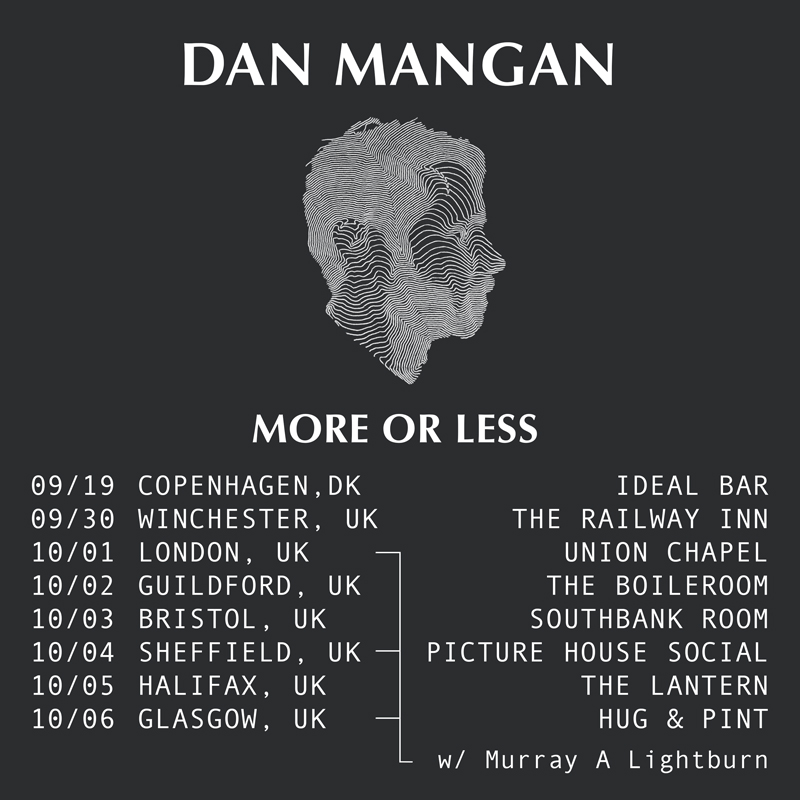
Thrilled to announce more shows in Europe this autumn! Including a show at the absolutely stunning Union Chapel in London – one of the most magical concert venues in the world. And what’s more is that Murray A Lightburn will be supporting some of the shows. His work in The Dears was powerful and informative to me as a young songwriter,
Last week I released the fourth song in a series of cover songs I’ve recorded – it’s John Hiatt’s “Have A Little Faith In Me”. When I was a kid, I’d hear this song waiting at the dentist’s office. Or waiting to get a hair cut. I imagined that there was an entire genre of music from the past that was just there to help people wait for appointments. A few years ago, I was asked to pitch a version of it for a TV show and, in the process of learning it and listening a few times, I was struck at how sweet it is. It’s the kind of earnest I might have scoffed at in my youth, but in the present, the sentiment is working for me.
I also recently released a cover of Lauryn Hill’sEx-Factor. As I wrote on Instagram at the time of release: “One of the best choruses since George Harrison’s ‘Something’. Lauryn Hill is an unfathomable talent, and as such, I tried to find my own angle into the song as there’s no hope in imitating her power.”