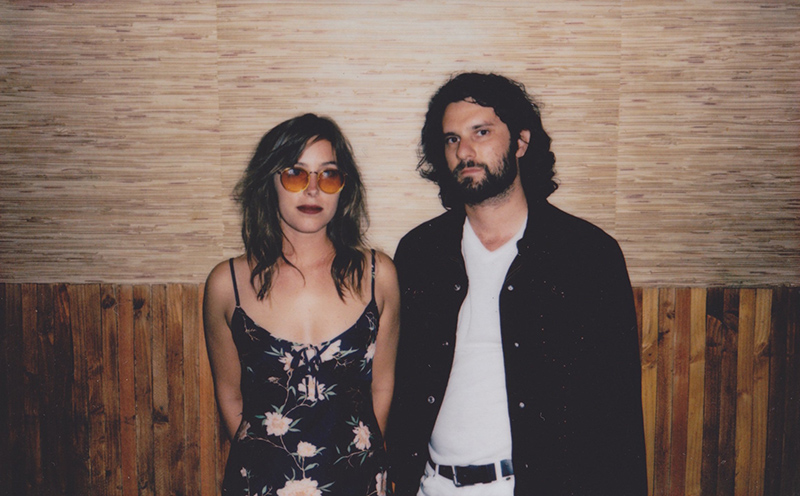
Baybs is the musical project of San Francisco musician Craig Jacobs and on his debut EP with the curious title “Introvertigo” (due to release via Text Me Records on June 11th 2020) the singer- songwriter penned intimate, passionate alt folk songs as a way of dealing with, coping with an anxiety ridden past.
Jacobs recalls, “There were a periods of my life where I didn’t want to leave my house.. soon I couldn’t leave my room.. then I didn’t even feel safe in my own body. The times I felt like literally jumping out of my skin the only thing that helped was picking up a guitar and creating a melody.”
The third and final single is entitled “Drifter”. Jacobs handed the singing reins off to the architect of the song’s inspiration as he explains:
“Drifter was inspired by a poem written by Melissa Russi, a really close friend and collaborator. Pulling together lines that really resonated with me and adding lyrics of my own, ‘Drifter’ tells the story of a free spirited soul conflicted by a constant yearning to move from place to place and the stagnation needed to achieve stability. I remember at the time we wrote it Melissa had her mind set on leaving to travel for an indefinite amount of time and really felt the need to just get away, so I ended up heavily personifying her as the anonymous character. At this point it only made sense for her to sing lead vocals on it.”
with it’s psyche folk electric strums, and hazy drones of sound is a perfect vehicle for Melissa Russi’s vocal aesthetic. Her storytelling sounds grand and refined and while there is a 60’s garden rock sway, there is, especially on the chorus, an elegant chamber pop ascension and Jacobs vocal harmonies embrace Russi’s vox in wonderful ways. When the electric lead jams during the musical break it feels sort of like psychedelic orchestral rock, the thing of 60’s films and Television when musicians in suits and long haired stoner musicians would jam together
As much as people want to dance, or want to mosh their brains out as post punk, surf punk, indie rock festivals (remember festivals?) people also want to chill, to sway to post punk and post rock psychedelia. The music of Reverends is dreamy and the saving grace at any house party.The track “8 Million” is such a song. It is by Atlanta psych rock band Reverends and upon first listen I thought a bit about California indie bands like Allah-Las, Mystic Braves and Cosmonauts (at least the chiller aspects of their surf punk sound) or a combination of all three. On 8 Million, Reverends provide the languid intoxication and chord progs that are classic for this genre and some of those progs have undoubtedly been played by those aforementioned Cali psyche bands. That is no sin, this genre like the blues borrows heavily. The point is how well you do it and Reverends do it so well, they keep the slow burn moving like a buzz when you’re high but provide guitars sounds that shape shift, squeal, turn into bent alien sounds of life and high life and jam nicely too. What else do you need when you just want to drift away?.
Band Members:
Dandy Lee Strickland – Vocals/Guitar/Keys/Etc
Kyle Jones – drums
Andy Watts – guitar/keys
Matt Boehnlein – guitar/bass/keys/vocals
Henry Jack – bass/vocals
“8 Million”, from Reverends’ album The Disappearing Dreams of Yesterday, released on Little Cloud Records.
Skullcrusher is, by all accounts, an exploration of the ways you become yourself when you aren’t looking – and how that feels once you start paying attention. It’s a quiet power; a hushed celebration of the tiny, understated subtleties that culminate into knowing yourself. On her debut EP, songwriter Helen Ballentine offers an airy, intense, and unflinchingly open collection of songs written about – and from – one of life’s in-between gray areas, a stretch of uncertainty and unemployment, and the subsequent search for identity. Here, as Skullcrusher, Ballentine grapples with how to communicate her private self to an audience.
Ballentine has been playing music for most of her life — piano from age five, guitar since high school — but her song writing didn’t emerge until later. After moving from her home in upstate New York to Los Angeles to study studio art in college, Ballentine was working full-time at a Los Angeles gallery, poised to continue onto the trajectory of visual art she had been on since she was a teenager. Instead, it didn’t feel right, and she quit.
Suddenly faced with a peculiar freedom, Ballentine decided, somehow both confidently and tentatively, to seriously pursue music for the first time. While nannying on the side to make ends meet, she wrote “Places/Plans,” her first song for Skullcrusher, a little over a year ago. Despite her extensive background in visual arts, Ballentine suddenly found song writing to be the best avenue for her artistic visions, an easy way for her to organically discover what it as she was trying to say.
“I was feeling very strongly about my lack of a career path, both insecure and confident at the same time,” Ballentine explains. “But there was also a lot of confidence that arose out of that process because I was really able to spend time with myself, and the things I love.”
In music, as in her visual art practices, Ballentine is drawn to conflicting pieces of a puzzle; how hard and soft meet, and the intersection of certainty and ambiguity. Ballentine would tinker on music in pieces, feeling like she wasn’t accomplishing anything day after day, and then suddenly realize she had been assembling songs. That experience felt formative, and the resulting EP, which she worked on alongside producer Noah Weinman, is about what it means to feel like you’re not doing anything, but finding immense meaning and depth within that, too.
The four dark, dreamy songs on her debut EP were influenced by a strange-but-fitting amalgamation of media consumed in the immediate aftermath of quitting her 9-5. There’s Valerie and her Week of Wonders, the Czech new-wave film that went on to inform Skullcrusher’s aesthetic. There’s Ballentine’s love of fantasy and surrealism, her appreciation of the way fantasy novels juxtapose beauty and violence.
Ballentine was also fully immersed in the world of Nick Drake, watching and reading anything she could about his song writing. Another sonic anchor came from ambient electronica, which provided her with a shared vocabulary with her new band. And as Skullcrusher, Ballentine is decisive and immediate with the way she uses a sparse arrangement, fitting minimal sounds together in a way that creates a fuller space.
On the opening “Places/Plans,” Ballentine sighs, “Come in, the window’s open and I’m lying alone,” which feels fitting for the entirety of the EP – Ballentine invites the listener into the depths her personal, intense solitude. “I put so much emphasis on this private self, and all of these things that I love that are my own, and as soon as I let someone else into that, it’s really hard,” Ballentine says. “But I’m also someone who wants to let someone else into that. It’s sort of this back-and-forth about wanting to connect to other people but also being a little bit afraid of that.”
Skullcrusher’s understated energy radiates with the atmosphere of waking up to the quiet terror of shapeless, structureless days, but it finds power in eschewing the pressures of careerism and a vapid culture of productivity. Instead, as Skullcrusher, Ballentine has the audacity to be comfortable enough with herself, and to simply accept the unknown as her life.
“Day of Show” by Skullcrusher, from their upcoming self-titled EP out June 26th on Secretly Canadian.
The Raconteurs have announced a forthcoming documentary and live album to both titled, “Live At Electric Lady”, with both projects scheduled to arrive this Friday, May 29th.
Live At Electric Lady will document The Raconteurs’ clandestine performance at the iconic New York recording studio in support of the band’s most recent album, 2019’s Help Us Stranger. The EP will be released exclusively to Spotify, and will feature like takes on a catalogue-spanning selection of songs, including a cover of Richard Hell & The Voidoids‘ “Blank Generation”. The documentary, directed by filmmaker Jim Jarmusch, will include video of the live performance, along with interviews with the band and behind-the-scenes footage.
A Facebook post announcing Live At Electric Lady arrived with a one-minute video trailer and a pre-save link for the “special enhanced album.” The trailer offered snippets of artist interviews and the live performance as well as a cameo from Jarmusch, who noted that the Electric Lady is “Kind of a magical, mythical place.”
“Everyone who’s a musician on stage is doing something that they love and they’re trying to share it with someone else,” added frontman Jack White in the trailer. “Some people fall in the trap of it being about authenticity, but I don’t think it’s about that. I think it’s about the attitude of what you did was the best part. Not whether you got all the notes right, but your point of what you were trying to accomplish was evidence to us in the crowd.”
In September 2019, The Raconteurs visited legendary New York City recording studio Electric Lady Studios to record a live EP and interview with Jim Jarmusch in honor of the studios’ 50th Anniversary – exclusively for Spotify. ‘The Raconteurs: Live at Electric Lady’ is a documentary and concert film showcasing the day, including their explosive 7-song live performance
Yusuf Islam, known formally simply as “Yusuf” and formerly as Cat Stevens, has announced the forthcoming release of a re-imagined take on his 1970 super-hit studio album, “Tea for theTillerman”.
To be appropriately titled, Tea for the Tillerman 2, the forthcoming project due out on September 18th via UMe will hear the British singer-songwriter explore the 11 songs featured on the original album in a new light, with 50 years added of life experience. Tea for the Tillerman 2 “Upends many of the familiar arrangements, while staying blessedly true to the mission of the album,” according to the original announcement.
“Paul [Samwell-Smith] has got into the mode now where he knows he can criticize me, but he has been very careful about how he does it,” Yusuf said when discussing revisiting his old material. “I’ve trained Paul a little bit and he trained me because I know the kind of thing he likes so I won’t waste my time there, I’ll get straight onto it. We get on so well together. Hand in glove. It’s a perfect relationship and I love the man.”
Yusuf continued in discussing the album’s 50th anniversary arriving at such a turbulent time in the world, “When some people have lost the spiritual link to their lives, music can play an important part. So from that point of view, I think that the sentiments from the album are incredibly important to us today. It shows that there are human beings still around. That’s important.”
Yusuf has been living in Dubai since the start of the pandemic earlier this year. The British-born singer-songwriter also tells readers he’s kept busy finalizing his autobiography, which he’s also illustrating, and likely due out sometime later this year. To recapture the spirit and energy as heard in the Tea for the Tillerman sessions, Yusuf reconnected with the album’s original producer Paul Samwell-Smith for the new album, which was recorded last summer. UMe shared the first track to appear on Tea for the Tillerman 2to go with Thursday’s announcement with the updated take on “Where Do the Children Play”. Listen to the new recording on the old tune below.
50 years after the release of the original era-defining album, T4TT2 sees Yusuf reimagine the same eleven songs for a new age with dramatic results. Enjoy the brand new version of ‘Where Do The Children Play?’.
The Flaming Lips and Kacey Musgraves have teamed up for a collaborative new single, “Flowers of Neptune 6”, which was released this Friday.
The relaxing, dreamy track acts as the first new material from The Flaming Lips since their collaborative album with Deap Vally arrived earlier this year. The song hears the veteran psych-rock outfit softly glide their way through its 4:31-minute runtime with Musgraves’ vocals joining along in harmonic accompaniment. “Flowers of Neptune 6” showcases the band’s trademark space-rock style while singer Wayne Coyne keeps listeners grounded with its heartfelt melodies and lyrics. The song’s video offers the same amount of subtle captivation, as Coyne is seen walking across a field–which later burns–while also wrapping himself in an American flag.
Coyne mentioned about the band’s new single, “Flowers Of Neptune 6” track started off as a very evocative series of melodies that Steven Drozd had woven together.
The first time he played it for me I was stunned by its emotional flow. The 3 sections (well they seem like sections to me) seemed to hint at an older, mature mind reflecting back into a journey from younger innocence then starting to learn and understand and keeps going into the panic of becoming one with the world. The opening lyric ‘Yellow sun is going down so slow…Doing acid and watching the light-bugs glow like tiny spaceships in a row… is the coolest thing I’ll ever know’…and is a combination of blissful, innocent, psychedelic experiences that Steven and KaceyMusgraves (she sings harmony with me on the track) and myself all discussed.
The Flaming Lips had initially announced plans for a run of west coast performances in the spring and early summer months, but those dates have–like most other live events–been postponed
“Run It Again” is 10 – song album that shines a fresh light on a raw sort of garage rock, full of melody, smart lyrics and hooks for days. Recorded at Future Shock studio in LA, produced by Alex Newport (Death Cab For Cutie, Frank Turner, Bloc Party), there’s an artful flow to the collection of songs. Though the band recognizes that for many listeners these days it’s an a la carte world, Sean Erickson (SE) states, “We put a lot of thought into the song order.” And it must be said – these guys really know how to sing. In particular, lead vocalist Michael Fiore seems able to effortlessly cram or stretch syllables at will.
Released March 1st, 2019 , All songs written by Michael Fiore except “Turpentine” written by Michael Hiller.
This record is a small collection of songs that were left off of the original album as well as a reworking of two tracks. When narrowing down the tracks that would comprise “Run It Again”, the band collectively agreed on 10 out of the 16 – 20 songs they had written for the full – length, setting aside the rest that didn’t quite flow within the sequence as well but would certainly see the light of day eventually in some capacity.
“I think these songs on the EP really show the depth and range of the band, ” frontman Michael Fiore said. “Especially the quieter stuff like ‘Mississippi Belle’, which was definitely influenced by Big Star and generally the early ‘70s ballads like early Faces and the like. ”Elsewhere”, the acoustic version of “Rearrange Me ” [“Rearrange Me (Rearranged)”] – a song the band has reimagined a few times over its career and which has taken its rightful place as the band’s ‘signature song’ of sorts due to this fact – came about when Fiore played it at one of his best friend’s weddings last September.
Electric Looking Glass is a baroque pop group from Los Angeles, California. Fresh on the scene, these four far out dandies have been busy working on their debut EP which is bound to impress. Expect flash melodies in full harmony, with jangly guitars, whirling Hammond, delicate Mellotron and a fab thumping back beat. Sounds of yesterday and visions of tomorrow; a new reflection in pop. Get hip now before it’s too late!
“Fresh off of their recent debut single on Hypnotic Bridge Records, here comes the second single from the Electric Looking Glass! This newer Los Angeles quartet serves up a double A-sider with a couple of dandy gems loaded with 60’s-style baroque psychedelic flashes and smothered with sugar coated pop-psych goodness! Both jangly pop songs delivered with all the trimmings, from Mellotron and piano punctuations on to well-crafted vocal harmonies. A confectionery two-sider sure to appease your sweet tooth cravings!” (13 O’Clock Records)
“A wholesome quartet that absolutely nails the baroque and psychedelic pop sounds prevalent on both East and West Coasts during the heady days of 1967-68. Recalls the Left Banke, Curt Boettcher, the Peanut Butter Conspiracy et al and truly captures the sound” – Jon “Mojo” Mills, Shindig! Magazine
“One of the most refreshingly unique acts to appear in California in years” – Record Turnover
Promo film for Electric Looking Glass’ third single “Dream a Dream”. Produced in collaboration with Mat Dunlap who shot & edited the video. Dream a Dream was written and recorded by Electric Looking Glass and released January 3rd, 2020 on a 7″ vinyl 45rpm vinyl single courtesy of 13 O’Clock Records.
8mm promo film for Electric Looking Glass’s first double A-side (Death Of A Season/Someday Soon) out on Hypnotic Bridge Records (August 2019) Electric Looking Glass is a baroque pop group from Los Angeles, California. Expect flash melodies in full harmony, with jangly guitars, whirling Hammond, delicate Mellotron and a fab thumping back beat. Get hip now before it’s too late!
Song written and recorded by Electric Looking Glass .
Band Members:
Brent Randall Bass/Vocals
Arash Mafi Organ/Mellotron/Vocals
Danny Winebarger Guitar/Vocals
Johnny Toomey Drums
Among the slew of iconic late-60s acts who played Woodstock 50 years ago, one name stands out conspicuously for her absence: Joni Mitchell. Was she not invited? Did she decline? Was she double-booked? Mitchell was, of course, invited, and eagerly wanted to be there. The story of her non-appearance involves alarming headlines in The New York Times and an appearance on The Dick Cavett Show the day after the festival that her manager, Elliot Roberts and label head David Geffen, decided she simply couldn’t miss.
Her significant other at the time, Graham Nash, reached the upstate New York festival with CSNY, “by helicopter and a stolen truck hot-wired by Neil Young,”. But Geffen and Mitchell, seeing the headline “400,000 People Sitting in Mud,” and a description of the roads as “so clogged with cars that concert goers were abandoning them and walking,” decided they shouldn’t take the risk. (She described the scene as a “national disaster area.”) Instead, they watched news about the mud-splattered event from Geffen’s New York City apartment (other accounts say they holed up in the Plaza Hotel).
So how is it Mitchell came to write the definitive Woodstock anthem, with its era-defining lyric “we’ve got to get ourselves back to the garden”? In the way of all artists—she watched, listened, and used her imagination to conjure a scene she only knew of second-hand. CSNY’s version of “Woodstock” is the one we tend to hear most and remember, but Mitchell’s—her voice soaring high above her piano—best conveys the song’s sense of youthful hippie idealism, mystical wonder, and just a touch of desperation. She plays the song live in Big Sur in 1969. David Yaffe, author of Reckless Daughter: A Portrait of Joni Mitchell describes the song as “purgation. It is an omen that something very, very bad will happen with the mud dries and the hippies go home.”
Mitchell did make the Cavett Show gig, alongside Stephen Stills, David Crosby, and Jefferson Airplane, all just returning from the festival. But she didn’t have much to say. Instead, the gregarious Crosby did most of the talking, describing Woodstock as “incredible, probably the strangest thing that’s ever happened in the world.” Surveying the scene from a helicopter, he says, was like seeing “an encampment of a Macedonian army on a Greek hill crossed with the biggest batch of gypsies you ever saw.” Later on the show, Mitchell performed “Chelsea Morning” and other songs, after performances by Jefferson Airplane.
“The deprivation of not being able to go,” she remembered, “provided me with an intense angle” on the festival. “Woodstock, for some reason, impressed me as being a modern miracle, like a modern-day fishes-and-loaves story. For a herd of people that large to cooperate so well, it was pretty remarkable and there was tremendous optimism. So I wrote the song ‘Woodstock’ out of these feelings, and the first three times I performed it in public, I burst into tears, because it brought back the intensity of the experience and was so moving.”
Joni Mitchell at A Day in the Garden, August 1998 at Yazgur’s Farm where the original Woodstock event took place. Joni sings her iconic song Woodstock, live.
She did finally get the chance to play “Woodstock” at Woodstock, in 1998 (above, on electric guitar), for an appreciative long-haired, tie-dyed audience—many of them nostalgic for a moment they missed or were too young to have experienced. The performance highlights the “sense of longing that became essential to the song’s impact,” . “Sure, it was the irony of the century”: the song that best captured Woodstock for the people who weren’t there was written by someone who wasn’t there. “But it was also a perfect recipe for Mitchell to do what she did best: draw humans together while remaining completely on the sidelines.”
Jesse Malin had a shit year in 2018. His father, former guitarist, and producer all died. So his new album Sunset Kids, his first in four years, could have been a major bummer. Instead, it’s a celebration of survival that finds the New York City hardcore troubadour reflecting on life’s precious and fleeting moments.
“Shining Down” is inspired by Tom Petty’s final performance at the Hollywood Bowl in 2017, which Malin witnessed firsthand. “I act like nothing hurts/The bar becomes a church/A limousine or hearse and you don’t look back,” he sings over jangly Heartbreakers guitars and a euphoric chorus. In “Strangers and Thieves,” he teams up with Green Day’s Billie Joe Armstrong to memorialize their punk glory days, delivering a blast of power pop that floats along on a curlicue guitar lick. And in “Shane,” Malin salutes the longevity of the hard-drinking Pogues singer Shane MacGowan, blending his nasally whine with that of Americana chanteuse Lucinda Williams.
It’s the presence of Williams, who co-produced the LP with her husband Tom Overby, that ties Sunset Kids together. A master lyricist, she helps Malin refine and focus his own words, especially on the introspective “Room 13” and on their duet “Dead On,” a slashing blues-rocker that evokes Williams’ own kiss-off “Changed the Locks.” The seemingly odd-couple pair — he’s from Queens, she was raised in Arkansas — slap their way through the verses. “You talk like an angel/You spit on the floor,” Williams growls, before Malin answers, “but you look just like the girl next door.”
There’s some repetition on the album, three of the 14 tracks, including “Revelations,” have appeared in various forms on past solo projects, but only fans who’ve followed Malin’s career closely will notice.
“Meet Me at the End of the World Again,” released as a one-off single in 2017, benefits from the redo. Elevated by Catherine Popper’s funky Lower East Side bass groove, it’s a soundtrack to the apocalypse, a command to reconnect before it’s too late, and makes you believe that the P.M.A. (positive mental attitude) that Malin has been preaching for decades just might be enough to save us.
Growing up in Queens, Jesse Malin was all of 10 when he made his first public appearance with a band, performing Kiss’ “Rock and Roll All Nite” at his public school—“I spit ketchup for blood,” he remembers with a laugh. He was a member of the Kiss Army in his teens but eventually graduated to punk, forming a band called Heart Attack—all of whose members were under 16—only to be told that punk had already peaked. “We went to an audition night at CBGB and they told us that we missed it all. Bad Brains had broken up, The Ramones were going power-pop, Blondie [was going] disco. They said, ‘Try something new like rockabilly or New Romantics.’ I said, ‘I’m not dressing up like a pirate.’”
He soon discovered that the genre wasn’t dead. It had simply sped up, grown more outspoken and morphed into hardcore, with bands like the Dead Kennedys, Black Flag and the Circle Jerks taking the music to the next level. Heart Attack stayed together for four years, after which Malin founded the band Hope, which carried on until 1989.
But it wasn’t until he joined D Generation that Malin truly became a force to be reckoned with. The band not only opened shows for Kiss but also those other Queens natives, The Ramones (Joey Ramone became a close friend). They released three full length albums, an EP and numerous singles during their initial eight-year run. It was while making their self-titled debut in 1994 that Malin first connected with Bianco, who produced and engineered it. (The second album, No Lunch, was produced by The Cars’ Ric Ocasek, and the third, Through the Darkness, was produced by David Bowie collaborator Tony Visconti.)
“We wanted to make D Generation into a band that we felt we missed; we felt music had become really safe and funky, with people dressed up like they were farmers from Seattle with no style. We wanted to be in a band that was like a gang,” Malin says. The band was respected but never did cut through commercially. “The people that liked us loved us, but we became more of a cult thing and an artist thing. We had a few bad breaks, but also internally it was so intense. It could be like a five-headed love affair or a five-headed war.”
Malin eventually started growing creatively restless. And punk was also moving in a direction he wasn’t entirely comfortable with. “People thought punk was about swastikas and fascism until the Dead Kennedys said, ‘Nazi punks fuck off.’ Sometimes people misunderstand things,” he says.
After the demise of D Generation, Malin cut an album with a band called Bellvue, To Be Somebody, before making the difficult decision to go the solo troubadour route. “It was kind of nervewracking to call it Jesse Malin,” he says. “I was used to hiding behind four other people and writing for four or five other people. But I think there’s a real connection between punk-rock and folk, from Woody Guthrie to The Clash to Bob Dylan to Crass or the Dead Kennedys. It’s about a message and a couple of chords and an attitude. A lot of my friends that heard me do louder stuff would be kind of surprised when I first did more acoustic-based music. I had people going, ‘What the hell?’ But my real friends knew that I had liked Jim Croce and Elton John since I was eight, and Neil Young and Bruce Springsteen since I was 15. I like songs, whatever they are—the craft.”
His highly regarded solo debut, 2002’s The Fine Art of Self Destruction, was produced by D Generation fan Ryan Adams, whom he’d met in 1996. “It was a very personal first record,” Malin says. He followed it with The Heat (2004) and thenGlitter in the Gutter, which featured a guest vocal by none other than Bruce Springsteen, who took note of Malin’s debut.
“I got into Bruce Springsteen late,” he says. “In the ‘80s, I got into Nebraska, and I was like, ‘This guy’s a millionaire and he’s speaking the truth. It’s real and it’s dark and it’s about people on the street, and it’s believable and it’s haunting and it’s so good. And it’s just him alone.’” Springsteen invited Malin to do some holiday shows with him and agreed to lend backing vocals to Malin’s track “Broken Radio.”
From there, Malin’s next move was an all-covers set, On Your Sleeve, featuring favourite tunes by classic rockers like Lou Reed, The Clash, The Rolling Stones, Elton John and Paul Simon, and a live album, Mercury Retrograde. His next full studio album, Love It to Life, arrived in 2010; that same year, he and the members of Green Day killed time with a short-lived band they called Rodeo Queens, releasing one song, “Depression Times.” His five-year break between solo albums was alleviated when a reunited D Generation released their first new album in 17 years. That band also embarked on a well-received tour with stops in London and the U.S., among them a couple of shows opening for Guns N’ Roses. One observer of the tour was Lucinda Williams, who had never seen D Generation during their heyday.
“It was a whole different side of Jesse,” Williams says, “and he was amazing. He had his shirt off, like Iggy Pop, and his microphone cord was long enough that he was able to go all the way to the bar from the stage and drink a shot of tequila and still make it back to the stage. He was great.”
Now 51, Jesse Malin still lives in Manhattan’s East Village. “I tried living in Los Angeles but, if you walk in LA, they think you’re a male prostitute,” he says. These days, he can often be found, wearing his trademark suspenders and newsboy cap, at one of the bars or clubs he owns a stake in. “We try to keep a little bit of old New York, New York going somehow,” he says about the establishments, which include popular destinations like Bowery Electric, Lola, Niagara and Cabin Down Below. “Going back to Queens and Brooklyn and places that I tried desperately to get out of, it’s strange to me that there’s now art galleries and gluten-free donuts. But I like that stuff, too. I just love making music and talking about music, then having a few drinks and talking even more.”
As Sunset Kids (titled after a children’s shop in LA—he liked the name, which nodded to his recent losses and nocturnal nature) began making its way out to fans, Malin was looking beyond his own neighbourhood, though. “We’re going to do a lot of touring behind this record,” he says. “It’s a privilege to play live after you’ve worked on a record; it’s an exorcism for me to get up there each night over some dirty microphone and spit out whatever it is. So I’ll be doing a bunch of touring around the world—Europe and Japan and the States—and then another record. I want to do something pretty quiet next time and really keep it intimate. And then I want to do a very physical record— something that can be played live. I want to make something that I can move my body to and that’s just completely fun and rhythmic but still aggressive. That’s what I’m thinking now. In between, as Warren Zevon said, I just want to enjoy every sandwich.”