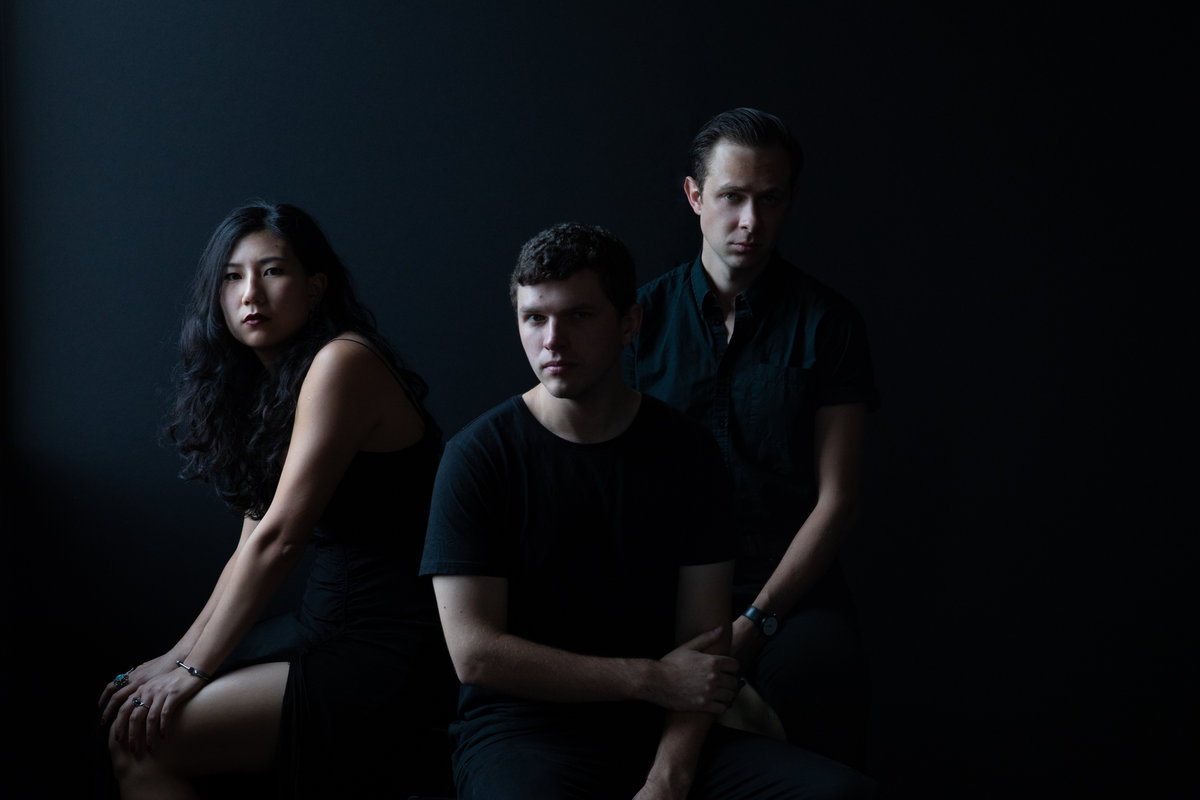
This summer, The London-based Dog Unit release their debut ep, “Barking To Gospel”, containing infectious motorik kosmiche (lab coats, as heard on bbc 6music) blissed-out melancholia (the title track), dub-flecked post-punk (an argument) and, on the eponymous Dog Unit, music for evil faced dancing clowns headbanging in a wind tunnel.
“Barking To Gospel” was recorded live just before the UK went into lockdown. as the world ground to a halt, the band sent the raw files to Kieran Hebden (Four Tet), who mixed the ep while self-isolating in upstate New York. then, the ep was mastered at Invada, the studio run by Geoff Barrow (Portishead, Beak>) in Bristol. “Barking To Gospel” is available now on all major streaming platforms and as a strictly limited edition heavyweight 12-inch vinyl. Dog Unit sound like electronic music played by a rock band, or post-rock you can dance to: driving, insistent, intense and, crucially, fun. do call them: purveyors of entrancing drone, tactile texture, slow-mo polyrhythm and skewiff riff’s. don’t call them: Dogwai. praise for Barking To Gospel: “a different type of musical texture, and a very pretty and moving thing it is too” — Steve Lamacq, BBC 6music “a melodic, foot-tapping but reverb-drenched kosmische… the polyfilla that binds the rooms of rising UK post-rock and electronica.” — loud and quiet magazine “an instrumental version of the strokes on acid…after a few too many space beers” — new music saturdays podcast
Band Members
Henry, James, Lucy and Sam
Barking to Gospel released on Sonic Deterioration Released : 2020-06-19
It is universally agreed that New Zealand’s Wax Chattels are a must-see live act; their hypnotically sinister debut captured this perfectly. Released in 2018 and supported by relentless touring, the eponymous album reached #7 on the Official New Zealand Album Charts, and release week saw the title feature as #1 in Rough Trade’s Top 20 New Releases. Tastemakers like NPR and A.V. Club came on as early champions. The album’s success at home and abroad led to the well-deserved nomination of Best Alternative Artist at the 2018 New Zealand Music Awards, as well as the band’s inclusion in the coveted shortlist of finalists for the Taite Music Prize and Auckland Live Best Independent Debut Award. After a knock-out entrée, the anticipation that surrounds their sophomore album, ‘Clot’, is immense.
Much like ‘Wax Chattels’, the writing process for ‘Clot’ took the best part of a year. While some songs were written on the road, the bulk of the album was workshopped throughout 2019 across bedrooms and storage containers. Demos were fine-tuned before taking them to the studio to be recorded by James Goldsmith (Aldous Harding, Mermaidens). Wax Chattels maintained the use of only the barest of ingredients — bass guitar, keyboard, and a two-piece drum kit — but the group spent more time experimenting with and finding new sounds. They wanted to maintain the same live element as in their debut, but, this time, heavier — for which they enlisted the help of mixing engineer, and fellow noise-maker, Ben Greenberg (Uniform, Destruction Unit, The Men). The keyboard sounds are noticeably thicker and the bass more intense. A marked step-up, this new record keeps the visceral energy of the debut, only this time they dig deeper into cathartic noise.
Clot’s inspiration — or, rather, frustration — came from the doomy, gloomy corners of Auckland’s underbelly, and the theme of confrontation is central. “Mindfulness” is about willingly tricking yourself into band-aid solutions; merely accepting the status quo rather than kicking up a fuss and forcing tangible change. The vitriolic choruses of “Cede” are in Cheng’s native language — Taiwanese Hokkien — and are an indignant confrontation about Cross-Strait relations and self-determination. The experience of being a first generation immigrant and not having a personal relationship with extended family is expressed in the melodic single “No Ties”. The song touches on cultural differences and the parental sacrifice of careers and support systems to provide a “better” future for their children. The explosive arc of “Efficiency” describes knowing when to bide your time, and when to push, in which the band treads a line between the explicit and intuitive. “Less is More” fumes with the frustration caused by the selective memories of others. The violent fantasies in “Spanners & Implements” suggest a more literal interpretation of these themes. This is carried through “An Eye”, in which the band stresses the physical harm and psychological breakdown emanating from the escalating racial and political uproar throughout the world.
Still, though the band seethes and boils throughout, ‘Clot’ concludes with a message of hope. On the final track, “You Were Right”, Ruddell expresses an aspiration toward alternative viewpoints: wading through the noise and chatter, ultimately being able to accept the opinions of others, albeit after careful consideration. Perhaps it’s this capacity for self-awareness that makes Wax Chattels one of New Zealand’s most treasured independent exports.
Randy Tuten is the only poster artist whose work spans five decades of design for The Fillmore. The 23 year-old San Francisco native was hired by Bill Graham in January, 1969, and their mutual taste for traditional, readable design style led to a long-lasting work relationship. Although influenced by the compositions of “Fillmore Five” artists Mouse, Kelley and Griffin, Tuten avoided “… Heavy meaning in my posters.” Tuten’s style reflected his skill as a draftsman, and his designs evolved into an eclectic mix of graphic imagery, lettering and photographs.
Dog Day will release their new album “Present” via Fundog Records on the 14th August. It is their first record in seven years, and ahead of its release, the band have also shared the LP’s debut single, Hell on Earth.
As the opening count in and fuzzed-out bass congeal, Hell on Earth’s chiming guitar hook melds seemlessly with airy synths, setting a summery tone for the track from the jump. But beneath the sheen, the song frames Dog Day’s longstanding penchant for sombre themes and wistful warnings:
Tomorrow morning we’re gonna face hell on earth / Let them do their worst / When tomorrrow dawns it won’t matter where you went wrong / We’ll all share the burn.
The 2020 festival season is cancelled, I recently remembered one of my favourite moments ever which happened back in 2017 when I watched Future Islands at NOTTINGHAM Rock City the smallish venue. They were on the brink of their big breakthrough, the infamous Singles album has just been released and I finally got into their music. It was a triumphant show; I cried, I laughed, I moshed around – they never got better than in this moment and this summer but obviously, although Future Islands are still producing great alternative pop anthems. “For Sure” is such another great anthem and their first new single in three years. It’s catchy, it got that captivating groove, Sam Herrings warm vocal performance, Jenn Wasner from Wye Oak and backing vocals, and also a really great music video, directed by Sam Mason. It might look like a car commercial first but it turns into something more beautiful actually, something that isn’t actually worshipping technology despite the fact that cars are the protagonists here. Well, it’s pop poetry and that’s a an attribute that fits quite well to Future Islands.
Fever Dream play dark, fuzzy, menacing music that blurs the line from noisy shoegaze to angular post-punk. Intense, melodic and expansive,
‘Squid’ asserts itself as a testimony to the band’s voracious appetite for heady, frenetic noise pop and acts as an outlet to showcase their intense skill as musicians. Barbed grunge and shoegaze combines with murky punk riffs to create a 10-track exploration through hedonistic and unrelenting sounds and noise.
It’s clear that Fever Dream’s sound is drawn from a melting pot of inspirations. Tracks like ‘Worms’ and ‘Clear Mind’ can be heard to channel the angst and aggression previously demonstrated by grunge forerunners, Sonic Youth or Smashing Pumpkins. The band successfully distinguish themselves from their labelmates and contemporaries through the use of lead singer Adrian Fleet’s immersive lyricism, which manages to float perfectly amongst the serene chaos the band are so adept at creating.
‘Heads Will Roll’ and ‘Ghost’ fall more in line with the material most Club AC30 fans will be familiar with: oceanic, expansive shoegaze that unquestionably stalks the unsettled territory between MBV and PiL: suffused with melody and discordance.
‘Squid’ is a record that is full of excitement and surprises and is an exhilarating journey through a multitude of genres that Fever Dream manage to merge perfectly together.
Fever Dream are: Adrian Fleet (guitar, vocals), Sarah Lippett (bass) and Cat Loye (drums).
After selling out three shows in just a few days, an extra show has now been added on Saturday August 29th. The show will feature Björk with a 15 piece chamber ensemble from Iceland Symphony Orchestra, performing songs from the albums “Homogenic, Vulnicura” and more.
Please note that no more shows can be added. Newsletter pre-sale will begin this Thursday July 16th at 12:00 noon GMT with general sales starting the day after, Friday July 17th at 12:00 noon GMT.
If you already purchased tickets to all three shows on a 10% discount, you will get an e-mail on Thursday morning at 10:00 AM GMT with a special 10% discount ticket link. (Please note that this discount is linked to the name provided on the tickets that were purchased previously and cannot be transferred to another person.)
Additional information about each show has also been released,
Björk will be performing 4 special matinee performances in association with Iceland Airwaves, which will be live-streamed online and raise money for domestic women’s charities worldwide.
With Iceland now reopening after the COVID-19 pandemic, the shows will take place with a live audience at Reykjavík’s Harpa Hall on the 9th, 15th, 23rd and 29th August 2020.
The performances will act as a celebration of the Icelandic musicians that Björk has worked with over the years, with each concert finding the artist collaborate with over 100 Icelandic musicians, across three groups that have played a part within the creation of her discography. Each concert will have different songs, Björk’s instrumental arrangements played by members of the Icelandic Symphony Orchestra, flute septet Viibra, Hamrahlíð Choir, and special guests without electronics or beats. The concerts will also be raising money and awareness for Kvennaathvarfið – a charity that supports women and immigrants of different origin within Iceland.
Sunday 9th August at 17:00 – S0LD OUT Björk the Hamrahlíð Choir,
Conductor Þorgerður Ingólfsdóttir,
Organ – Bergur Þórisson
Songs from Medulla, Biophilia, Utopia and more
Saturday 15th August at 17:00 – SOLD OUT Björk Strings from Iceland Symphony Orchestra,
Conductor Bjarni Frímann Bjarnason
Songs from Post, Vespertine,
Dancer in the Dark and more
Sunday 23rd August at 17:00 – SOLD OUT Björk Brass from the Iceland Symphony Orchestra
Flute septet Viibra
Harp – Katie Buckley
Piano – Jónas Sen
Songs from Vespertine, Volta, Utopia and more
Saturday 29th August at 17:00 – NEW SHOW Björk 15 piece chamber ensemble from Iceland Symphony Orchestra
In case you weren’t aware already, here’s a friendly reminder that The Beatles‘ legendary Melbourne concert from the ’60s will be on TV across Australia tonight.
Starting at 9.30pm on Nine, One Night Only – The Beatles In Oz “is a stunning broadcast of the concert, completely remastered, that also includes never-before-seen footage of the Beatles’ tumultuous and only visit to Australia“.
Channel Nine was given access to film The Beatles‘ final sold out Melbourne concert in 1964 which took place at Festival Hall. “When they touched down here in 1964 on their first world tour Australia went into hysterical Beatlemania,” a statement from Nine reads.
“They captivated the nation for 13 amazing and unforgettable days. Wherever they went, tens of thousands of screaming fans lined the streets hoping to catch a glimpse of John, Paul and George, as well as Jimmie Nicol, the drummer filling in for Ringo, who missed some dates of the tour due to illness.” Beatlemania was at fever pitch in the summer of 1964 as the band prepared for its first tour to Denmark, the Netherlands, Hong Kong, Australia and New Zealand. But on June 3rd, the day before the Beatles were to leave, Ringo Starr collapsed at a photo shoot and was hospitalized with tonsillitis.
With hotels and concert halls booked and thousands of tickets sold, manager Brian Epstein understood that cancelling the tour would have been a financial disaster. A scramble began to find a replacement for Starr.
Epstein had to convince the other three Beatles to accept a substitute drummer. And where would he find a musician competent enough to back the biggest group in the world – and fit into Starr’s stage clothes? John Lennon and Paul McCartney accepted that hiring a replacement was necessary but George Harrison balked at the idea. Enter Jimmie Nicol, a 24-year-old London drummer whose studio work had impressed Epstein. McCartney also knew Nicol; the Beatle had recently caught a performance by Nicol with Georgie Fame and the Blue Flames.
After a six-song audition, Nicol was hired, given a Beatle haircut and told to pack for the flight to Denmark the next day. In the hospital, Starr recalled that he’d replaced Pete Best as the Beatles’ drummer two years earlier. “It was very strange, them going off without me,” Starr said in Anthology. “They’d taken Jimmie Nicol and I thought they didn’t love me any more – all that stuff went through my head.”
Jimmie Nicol became a Beatle for 13 days, participating in press conferences and enjoying the adulation of fans. Nicol played eight concerts and taped a TV show as the Beatles’ drummer. Ringo Starr was released from the hospital and rejoined the Beatles in Melbourne, where he performed on June 14th. The next day, Jimmie Nicol did his final television interview as a Beatle and went to the airport for the lonely trip home. Before he left, Epstein presented Nicol with a gold watch inscribed, “From the Beatles and Brian Epstein to Jimmie – with appreciation and gratitude.”.
It was over 50 years ago that The Beatles made their one and only tour of Australia. The Beatles touched down in Sydney on June 11, 1964 and for an amazing 13 days they captivated the nation. Hundreds of thousands lined the streets everywhere, Beatlemania was more intense here than anywhere else in the world. It was a time of massive musical and cultural change and a time for teenagers to challenge and defy authority. Over 300,000 people turned out in Adelaide – it was the biggest crowd anywhere in the world, anytime! The Beatles performed 20 shows across Adelaide, Melbourne, Sydney and Brisbane leaving in their wake a trail of euphoric, captivated youth. Australia was never the same following The Beatles 1964 tour. This montage captures the highlights of their tour and the euphoria that followed.
The Stooges are releasing a previously-unheard, “high-quality soundboard recording” of their original lineup’s final performance, which was recorded on August 8th, 1970, shortly before the release of their classic sophomore album Fun House, which they performed in full at this show. The new live album is called The Stooges’ Live At Goose Lake: August 8, 1970, and it comes out almost exactly 50 years after the show was performed, August 7th via Third Man Records.
The audio was “lovingly restored” by Vance Powell (The White Stripes, Chris Stapleton) and mastered by Bill Skibbe at Third Man Mastering, and the liner notes were written by Jaan Uhelzski (Creem Magazine). There’s a Rough Trade limited-edition colored vinyl variant with purple-colored vinyl and a standard LP jacket, and an indie exclusive version on cream-colored vinyl with a purple-colored vinyl and a standard LP jacket, and an indie exclusive version on cream-colored vinyl with a screen-printed LP jacket.
A press release reads:
The apocryphal tale of the Stooges performance at the Goose Lake Festival has been told countless times over the past five decades. Bassist Dave Alexander, due to nerves or overindulgence or whatever you choose to fill in the blank, absolutely spaces in front of 200,000 attendees. He does not play a single note on stage. He is summarily fired by Iggy Pop immediately following the gig. Here starts the beginning of the end of the Stooges.
But what if that simply… wasn’t the case? What if you could prove otherwise? Well, it’d be the
proto-punk equivalent of having an immediate, on-the-scene, man on the street report of all those folkies booing Dylan’s electric set at Newport in ‘65. Irrefutable evidence of what ACTUALLY went down. Found buried in the basement of a Michigan farmhouse amongst other tasty analog artifacts of the same era, the 1/4” stereo two-track tape of the Stooges complete performance at Goose Lake on August 8th, 1970 is the Rosetta Stone for fans of this seminal band.
Not only is this the last ever performance of the original godhead Stooges line-up, but it is the ONLY known soundboard recording of said line-up. Playing the entirety of their canonical 1970 masterpiece Fun House, the sound, the performance, everything about this record is revelatory.
Would you believe that… Alexander actually DID play bass on this occasion? Or that, despite grievous failures on some songs, Alexander is damn solid on others? Especially on the bass-led songs “Dirt” and “Fun House”? Does Iggy provoke the crowd to tear down festival barriers? Did the powers that be pull the plug on the Stooges? So many questions are answered only to have more arise.
Released to coincide with the 50th anniversary of the performance, Live at Goose Lake: August 8th 1970, is the rare release that literally rewrites the history of these Rock and Roll Hall of Fame inductees.
“T.V. Eye (Radio Edit)” (Live) 2020 Third Man Records, Released on: 2020-06-10
It must be frustrating to have planned to roll out your new album and a massive months-long tour at what turned out to be the exact beginning of Lockdown 2020. But even if this disaster of a year stymied Ratboys’ hopes to conquer the open road, the band can take solace in knowing their new album is one of the year’s best, a barnburner that builds their appealing, folksy Americana into arena-ready anthems. Expanding their sound without losing the sweet, exposed heart of Julia Steiner’s humanistic vocals, tracks like “I Go Out At Night” expertly straddle the line between bombast and beauty, suggesting a group on the verge of something enormous. If only this damn virus would go away so they could get in front of everyone and prove it.
Ratboys’ Julia Steiner had a fairly different experience with the record, citing a lyric from the track “Life Is Long” as a direct inspiration on the vaguely emo Chicago band’s third and latest LP, “Printer’s Devil”. “I’m lost but I’m not afraid” has become the unofficial mantra for the record, summing up the uneasy transitions occurring in Steiner’s life during the album’s inception period. Paralleling these changes was a shift in the band’s chemistry—once a two-piece comprised of Steiner and Dave Sagan, “Printer’s Devil”is the first Ratboys album to feature a full band, adding touring members Sean Neumann and Marcus Nuccio to the mix.
The result is something deeply personal, while injected with something of a Wikipedia-wormhole curiosity (several tracks seem to explore bizarre histories detailed on the free online encyclopedia) and a tinge of science fiction.
Printer’s Devil is streaming now, and will be officially released tomorrow via Topshelf Records. Listen below, and read on to hear what Steiner had to say about the history of each track.
1. “Alien with a Sleep Mask On”
This was the first song that we recorded when we got into the studio. We took a couple hours to get drum sounds and make the guitars sound good, and then we just went for it. I started writing this song while we were on tour—after we had sound checked one day I was feeling pretty exhausted mentally and needed to get some space. I walked to our car and just played guitar for a while. The bones of the song came out right away, and they felt really fresh and urgent. The melody and hook had kind of been stewing in my mind for a while, which helped me just let it out I think.
I kept workshopping the song during sound checks throughout the rest of the tour, just singing and playing the parts I had so far and improvising them in that small amount of time. I always like doing that with new ideas on tour. Eventually Dave and I demoed out the song and nailed down the structure in Kentucky a few weeks later, and then we built it out even more with Sean and Marcus from there. For me, the song is about the disorienting reality of life on the road. And just about being inside your own head all the time, to the point where you start to question how you come off to others. It’s kind of a heavy topic, but I wanted it to be light hearted too, because that’s kind of how tour feels a lot of the time—heavy, but so fun.
2. “Look To”
This song rocks, and we had so much fun recording it. I remember it took us a while to find the right tempo, but once we got it I feel like we just locked in 100 percent as a band. The lyrics of this one deal with family relationships getting more complicated as you grow older. When we were demoing at the house where I grew up, I kind of found myself taking stock of the bonds I share with my family, specifically with my parents, and just thinking about how they’ve changed over time. The idea of helping your mom or dad through a hard time is so powerful to me, so that became the central image of the song in my eyes.
And then confessing a bit of frustration in the chorus, that things aren’t as simple as they seemed before. This song is very, very fun to play, we like to go absolutely wild with it. Then finally we tacked on a bit at the end—we wanted it to sound like you were walking into a sing-along at a party. That bit is an idea I woke up singing in the middle of the night. I recorded it right then in a little voice memo, which you can hear at the very end of the song.
3. “My Hands Grow”
This song is one of two on the record (the other being “Printer’s Devil,” the title track) that was based around a series of drum loops and overdubs, rather than using a live band performance as the base of the track. This one was really fun to put together, it almost felt like doing a puzzle. I love how clean everything sounds—I remember Erik (Rasmussen, who recorded the album) had to run an errand at one point, but he left a minute-long instrumental loop of the song going while he was gone. It must have been going for, like, thirty minutes, but all of us were just reading and chilling, we didn’t even notice the time passing or the song looping.
We realized after he got back that the music must be pretty nice if we could just listen to it for that long without stirring. The lyrics are based around some memories I have of spending time with two of my best friends from high school, driving down the back roads in Kentucky and hanging out by the river during the summer. I wanted to write lyrics that sort of reassure them that I’ll always be there to love them and protect them, even if I don’t say that out loud nearly enough. It’s a song about friendship and spending time outside in the sun.
4. “A Vision”
This song came together very quickly—I think I wrote it in less than an hour, all at once. I remember I was in my bedroom in my old apartment, and we had some friends over, but I got sucked into this moment where I had to write the song. That happens very rarely, so when it does and you know you’re 100 percent onto something, you have to follow it, no matter what else is going on. I had known for a few months that I wanted to write a song about a specific rainy morning that I had experienced on the road. It felt almost like a fantasy or a dream, so the song had to be that too. I didn’t realize it at the time, but I was able to connect some rhymes across the length of the song, which doesn’t often happen naturally for me. I think that makes it really pleasing to sing.
I’m also really proud of how the studio recording turned out, because we were somehow able to capture the essence of the song while all playing together in the same room. I remember Ian (Paine-Jesam, our friend who played drums on this song) had to play extremely quietly, so that the drums didn’t drown out my acoustic guitar. We had a lot of fun adding some strange little overdubs. Lots of noises and textures, things that I can’t even remember now what we used.
5. “Anj”
This was the first song that Dave and I wrote for the new record. As soon as we unloaded and set up all of our gear for the first demo session, the riff for this song is the first thing I played, the first thing that came out. It felt natural right away, and we had so much fun just jamming on the progression because it’s so simple. For me, the lyrics are drawn from my life, specifically from my relationship with the woman who watched my siblings and me throughout my childhood. The time and effort she put into raising us while my parents worked is something I’m just now starting to really appreciate, so I wanted to write a song for her, to try to tell her how much I care for her and how I want to be there for her, to give some of that nurturing love back in some way. I think the song has that same mixture of heaviness and lightness that I find so appealing. Marcus’ drumming makes the whole song sound so huge and poppy—it was the final element we needed to really go full force and drive home the hook.
6. “I Go Out at Night”
This song is actually the oldest one of the bunch in the sense that it’s the only one that uses an older idea that we re-discovered and re-purposed for the album. I wrote the first verse and main guitar riff when I was nineteen or twenty, sometime around 2011. I always hoped that we would build the right little world for this song, and luckily the time was right and it happened. To me this song is about feeling a little restless, about figuring out the world in the midst of big change or creeping anxiety. Just kind of floating above everything.
We knew we wanted this song to feel different from the rest, something like a daydream. I ended up writing the bridge during our time demoing in Kentucky, and the lyrics deal directly with moving out of your home and saying goodbye to the places that shaped you. That physical sensation of the sun waking you up, of the day breaking and pushing you onto the next phase. I experienced that during the end of our stay in KY, and it was powerful. I had to acknowledge and honour that sunlight. As silly as that sounds, it moved me.
7. “Victorian Slumhouse”
OK so this song is pretty ridiculous, and it’s one of my favourites on the album. I think it’s the first time we’ve ever just said “fuck it, let’s have some fun” and gotten really loose with our ideas. I remember that the inspiration for this song came about when Dave and I were visiting his parents and watching PBS after dinner. This British reality TV show called Victorian Slum House came on. If you’ve never seen the show, it’s based around a historical re-enactment, where all of the participants volunteered to be on the show because they have ancestral ties to the slums of Victorian England. It’s hard to explain, but the show is so entertaining—all of the participants constantly dwell on how much they miss the conveniences of modern life, and there’s a ton of drama.
We were kind of just sitting there mystified watching this and having so much fun, so I remember I started strumming the guitar and came up with the little opening vocal tag and guitar riff to make Dave laugh. Eventually we kept jamming on it because it was too much fun. I decided that I wanted the song to be about reality TV, and how it’s so voyeuristic and strange. I spent a lot of time imagining what it must have been like to be on that set, in the carefully recreated Victorian-era slum, but also surrounded by tons of high-end film production equipment and the whole crew, trying to tease content out of you at all hours of the day and night. I find I’m often drawn to crazy contrasts, and that’s this show for me. The song is a rocker, and we absolutely love playing it, especially the outro riff that just circles on and on.
8. “Clever Hans”
This song is based on a true story that I came across while reading Wikipedia one day. It’s told from the perspective of a horse named Clever Hans, who became famous in the 1800s because his owner claimed he could do math and tell the days of the week and stuff like that. Huge crowds would come and watch the horse, and eventually, teams of psychologists came to study Clever Hans. They realized rather quickly that the horse couldn’t, in fact, do math—but they noticed that Hans always picked the right answer out of a multiple choice set, because he perceived tiny, subconscious cues in his owner’s face when the correct answer was read.
Long story short, it turns out that Clever Hans was, in fact, extremely intelligent, just not in the ways everybody expected. He was emotionally intelligent. After reading that story, it made me wonder about all of the ways that animals feel and perceive the world around them, ways that we may never fully understand. So I wanted to write the song from Clever Hans’ perspective, to write poetry as a horse. Something tells me that horses are capable of writing poetry, in their own ways. So that’s really what this one is about.
9. “Listening”
I wrote this song one morning during the KY demo session immediately after I learned of the passing of Anthony Bourdain. This is the only song we didn’t demo—we finished arranging it in the studio.
10. “Printer’s Devil”
This is the title track, and my personal favourite song on the album. It feels like an artist statement to me. Dave and I sort of stumbled into this jam while we were demoing, and it had this meditative, almost addictive quality to it, like we couldn’t stop playing it. Eventually I started improvising vocal phrases on top of the guitar, which loops over and over again for the whole song. I wrote a ton of lyrics and ended up whitling them down to what’s on the recording.
The lyrics were inspired by some stories I had read about the poet Walt Whitman, about how he worked as a “printer’s devil” (or printer’s apprentice) as a young boy. I read about how Whitman’s boss in the print shop was obsessed with this radical Quaker theologian named Elias Hicks—so obsessed that he dragged Whitman and another employee to the cemetery in the middle of the night, to dig up Hicks’ grave. They were caught, and Whitman moved on to a different print shop, where he kept learning the trade.
I also read about how Whitman would test the ink in the shop by putting down lines of “little sentimental bits,” which made me think that maybe this job was the place where he started experimenting with poetry or just pondering language in general. That idea of just putting down lines, combined with reading about the teachings of Elias Hicks, fueled me to write and write and write, as if I were testing out the ink in the shop. The song felt right immediately, and we were able to record it and find the right sounds very quickly in the studio. It was a joy to make.
Guitar, vocals, lyrics – Julia Steiner
Guitar, bass (Tracks 3, 8, 9) – Dave Sagan
Bass – Sean Neumann
Drums, synths – Marcus Nuccio
Drums (Tracks 3, 4, 8, 10), Vibes – Ian Paine-Jesam