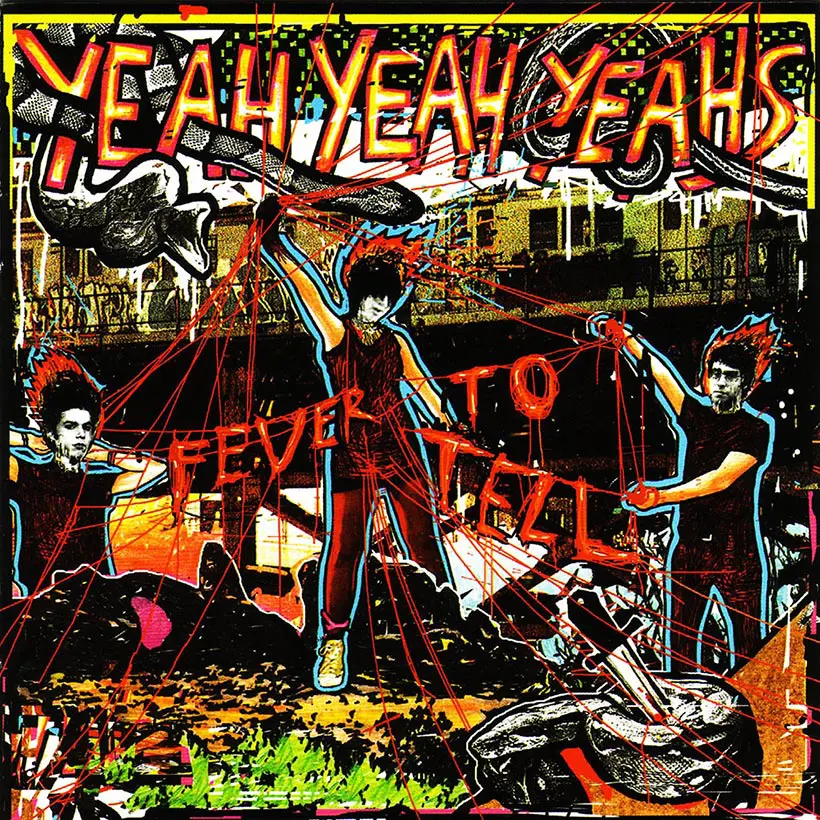
Yeah Yeah Yeah’s announced details of a vinyl reissue of their seminal, ground-breaking debut, “Fever To Tell”, through Interscope Records / UMe. Of all the bands that emerged from the beer-soaked basements of New York City’s music scene at the turn of the 21st Century, Yeah Yeah Yeahs were by far the most compelling. A trio of art school misfits, Karen O, Nick Zinner and Brian Chase flouted the conventions of indie rock and, with their debut album, “Fever To Tell”, brought a sense of fun and urgency to the quickly calcifying garage-rock revival.
Speaking about the release, the New York trio said, “A friend of a friend kept asking if we were ever gonna put Fever To Tell out on vinyl as it hasn’t been on vinyl in 10 years. That’s not right. So here it is on vinyl for the first time in 10 years plus a time capsule of photos, demos (1st ever recorded,) a mini film documenting our near downfall and other fun memorabilia, from the turn of the century NYC, made with love + the usual blood, sweat + tears of Yeah Yeah Yeahs.”
One of the finest debut albums of recent times, “Fever To Tell” was released in 2003 and was influential in shaping the sound of the early aughts and beyond. Prior to its release, Karen O, Nick Zinner and Brian Chase had already established themselves as a ferocious live force; Fever To Tell introduced a band who could play thrilling and frenetic rock’n’roll one minute and captivating, hushed ballads the next. Its meld of scuzzy riffs, angular grooves and hypnotic hooks set a template that was often imitated over the next decade but the album’s rare chemistry isn’t easily replicated. It’s a snapshot of an era that sounds just as mesmerizing as it enters its 15th anniversary in 2018.
Both the band and album were a product of a specific time and place. Rising out of the ashes of a post-9/11 New York, Yeah Yeah Yeahs embodied the hedonism and debauchery of the nightlife scene, when people were looking for release. Riding a wave of critical buzz from their first two EPs, the group set about shedding the “garage-rock” label and channelling the energy of their live shows into a fully-formed, genre-defying debut album that more than lived up to the hype. Released on 29 April 2003, Fever To Tell signalled what the future of rock would sound like.
Much of Yeah Yeah Yeahs’ outsider status came from their art school sensibilities. Karen O and Brian Chase met at Oberlin college, while Nick Zinner matriculated at Bard before they all decamped to New York and enmeshed themselves in the mythologised Brooklyn underground scene, playing warehouses and crumbling lofts before opening for likes of The White Stripes. But while Yeah Yeah Yeahs are a product of New York, they got their first brush with fame overseas, playing headlining shows in the UK and creating pandemonium wherever they went, before even releasing their debut album in the States.
At the time of the album’s release, Brooklyn was a just a blip on the radar as far as the mainstream was concerned, and Yeah Yeah Yeahs were battling Clear Channel’s chokehold of the charts, dominated by Linkin Park, Creed, Nickelback and the rest of their ilk. As its title suggests, Fever To Tell has a wild sense of urgency to it; it burns red-hot and rarely lets up – who knows if there will even be tomorrow? For now, you have a date with the night.
Fever To Tell opens with the No Wave punch of ‘Rich’, a blast of snares, thrashing guitars and Karen’s guttural shrieks, making it clear they weren’t messing around. There’s also a layer of synths, so the track “could in no way be mistaken for a garage track”, said Karen.
Outside the album’s sonic outlier, ‘Maps’, ‘Date With The Night’ is Fever To Tell’s most brilliant cut, a stomping rocker that morphs from punk anthem to a sweaty dancefloor number, punctuated by Karen’s orgasmic trills. By the time it’s over, it feels like you’ve survived a bender with the band.
Birthed in the New York tradition, Yeah Yeah Yeahs represented a sum of the city’s musical parts, from No Wave to art-rock, post-punk to brash pop. Fever To Tell also predicted the next wave to come out of NYC: dance-rock, something their groove-laden debut helped set into motion. You can’t listen to the scuzzy, wailing guitars, bouncy percussion and enticing synth line of ‘Y Control’ without walk-walk-walking your butt to the dancefloor, the city’s cabaret laws be damned. At centre of all this hype was the band’s fearless leader, Karen O. Dubbed the female Iggy Pop, for her wild stage antics and lack of self-preservation, Karen O is the album’s emotional lightning rod.
Along with inspiring a generation of rock frontwomen Karen O is also to blame for every girl in Brooklyn with a Beatles bowl cut. That said, she was untouchable on stage, and she brings her beer-swelling, world-conquering swagger to the album. From her man-eating grin on ‘Man’ to her lusty “uh-huhs’ on ‘Black Tongue’ and frenzied shrieks on ‘Tick’, Karen O doesn’t do the detached, post-punk flat vocal delivery; she works every word, demanding you listen.
Sometimes, however, her punk tendencies ran the risk of overshadowing her actual vocal performances. She only drops her guard towards the end of Fever To Tell, with ‘Modern Romance’, the Velvet Underground-inspired ‘Poor Song’ and Maps’.
Fever To Tell wasn’t all just piss and vinegar, though. It also birthed the band’s most beautiful song: ‘Maps’, a vulnerable, lovelorn ballad that’s as devasting as the rest of the album is frenetic.
The intro to ‘Maps’ has become one of the most recognisable in rock music history. It starts out spare and sweet, before Zinner fully unleashes his guitar at the end, creating an immortal, indie-rock ballad for the hipster generation.
“Those f__king weird art-project kids wrote a beautiful hit, and it went global,” said Vice Media co-founder Suroosh Alvi in Lizzie Goodman’s excellent oral history of the scene, Meet Me In The Bathroom. ‘Maps’ not only put Yeah Yeah Yeahs on the map, but planted a flag for the Brooklyn scene they came from.
What also set Yeah Yeah Yeahs apart from their Pabst-drinking peers and the punk revivalists is the dynamic guitar work of Nick Zinner and the percussive assault of Brian Chase. Zinner’s idiosyncratic technique and his producer’s ear more than made up for the fact the band had no bassist: listen to the thrashing fervour and guitar stabs of ‘Pin’, the monster blues riffs on ‘Black Tongue’ and the crashing cymbals of ‘Cold Light’, and Fever To Tell makes one thing abundantly clear: Yeah Yeah Yeahs are their own power trio.
1969 was a roller-coaster year for Folk Rock band Fairport Convention. In January of that year they released their second album “What We Did On Our Holidays”, the first one to feature singer Sandy Denny. In May they hit rock bottom with a tragedy that killed two people including one of its members. Miraculously they recovered and released the album that defines Fairport at that time, “Unhalfbricking” was released in July of 1969, several weeks after the fatal accident on the M1 that killed drummer Martin Lamble and Jeannie Franklin (“Genie the Tailor”, who designed clothes for west-coast pop and rock elites), Richard Thompson’s recent girlfriend. The event questioned the band’s resiliency, and was followed by an amazing period of recovery that gave birth to Liege and Lief. Franklin was immortalized a month later when Jack Bruce dedicated his debut solo album Songs for a Tailor to her, and Elton John’s Tiny Dancer is likely about her as well with the telling lyrics “Blue Jean Baby, L. A. lady/Seamstress for the band”.
Even more uncool is the back cover with a picture of the band engaged in the domestic task of having a meal. The whole package smells of looking back at days of yore, keeping a distance from current trends. A&M Records, who distributed the band’s albums in the US, found the album cover’s concept abnormal and instead decided in a curious creative burst that the average American consumer’s palate might appreciate a photo of three dancing circus elephants with a girl dancing (balancing?) on top. Underestimating the American record buyer’s tolerance for the unknown, the band and album titles were slapped on the US album cover.
The band was going through a Bob Dylan phase at the time, resulting with three covers of his songs on the album. Dylan’s version of Million Dollar Bash, later to appear on the Basement Tapes album but at that point not yet released, The song came to the band through producer Joe Boyd’s song publishing company which had access to Dylan’s new recorded materials. The great mandolin accompaniment is courtesy of Dave Swarbrick, who made a number of excellent recordings with Martin Carthy between 1965 and 1968, and was called by Joe Boyd to guest on a number of songs on “Unhalfbricking”.
Another Dylan cover was for a relatively unknown song, If You Gotta Go, Go Now. Dylan had recorded it in 1965 for his Bringing It All Back Home album but decided not to include it in the album, instead releasing it as a single in the Netherlands in 1967. Manfred Mann covered the song soon after Dylan recorded it in 1965. Fairport Convention gave it an interesting twist by singing it in French, translated to Si Tu Dois Partir.
Fairport Convention was playing a gig at the Middle Earth and thought it would be amusing to do Dylan’s song in French Cajun style, so the band called for volunteers from the audience to help with the translation. Richard Thompson: “About three people turned up, so it was really written by committee, and consequently ended up not very Cajun, French or Dylan.” The studio version is a better attempt at the Cajun style, featuring Dave Swarbrick on fiddle, Richard Thompson on accordion and Trevor Lucas, who later formed Fotheringay with Denny, on triangle. The band was quite inventive when it came to producing interesting sounds in the studio. Joe Boyd, in his book White Bicycles: Making Music in the 1960s recalls: “Martin created the Cajun washboard sound for ‘Si Tu Dois Partir’ by stacking some plastic Eames chairs and running his drumsticks along them. The percussion break was supposed to feature an empty milk bottle lying on the topmost chair, but when the time came it fell and smashed on the floor. I signalled frantically to keep playing. The crash of broken glass was absolutely in time and worked perfectly, a good omen for the session.” The song was released as a single, reaching the UK singles chart, and got the band its first appearance at Top of the Pops on August 14th, 1969.
The third of the Dylan cover’s is Percy’s Song, recorded by Dylan in 1963 for his third album The Times They Are a-Changin‘. The song did not make it into the album and was released some twenty years later on the Biograph collection. The song lyrics are a futile plea to a judge to reconsider a harsh sentence given to a driver in a fatal car accident. Sandy Denny sings a beautiful harmony with Ian Matthews who had left the group after their previous album, and her interpretation is the best I know for this lesser known Dylan tune. Guitar player Simon Nicol said this of Denny’s vocal on the song: “It needs a voice like Sandy’s to get the shades of emotion across, from moodiness to compassion to outright fury. There’s not many singers can do that.”
One song on Unhalfbricking points to the direction the band would take on their next album. A Sailor’s Life is a traditional song brought to the band by Sandy Denny. The song, indexed as Roud 237 in the English Folk Dance and Song Society, was previously covered by Judy Collins on her album A Maid of Constant Sorrow in 1961 and by Martin Carthy on his second album from 1966.
Fairport Convention’s version is a milestone in British folk rock, maybe the first time a serious rock interpretation was given to an old ballad. Sheila Chandra, who was inspired by Sandy Denny’s delivery of the song and later covered it herself, found similarities to Indian music in Fairport Convention’s version: “The track is actually a microcosm of 2,000 years of Indian music – it goes from Vedic chanting on two or three notes right through to full improvisations on a fixed note scale. All in one take. The band have realized that all folk music is based upon a drone, and shares a common root. For instance, the way the violin comes in with an insistent repeat of the drone note is reminiscent of the Indian wind instrument the Shenai, and its distant relative the shawm in Irish music. It all connects.” That violin is played by Dave Swarbrick, his finest contribution to this album.
John Wood, who was the principal sound engineer in the studio, recalls the recording of the song: “Richard and Sandy came in and said ‘we really think we can only do this once’. They already got Dave Swarbrick in to play on it. We put Sandy in a vocal booth (she had an awful cold that day too) and everybody else in a big semicircle. When you want to cut that sort of track, its not easy for people to work if its all sectioned off, so it was very open and that was it, one take, done. No overdubs.” Dave Swarbrick was given no specific instructions as to what to play on the song other than to just come in when the singing stops. He had fond memories from the session as well: “Sandy had a great band to soar over and a great bunch of musicians who were sympathetic. Richard and Sandy worked closely together. Richard was awesome, of course. That should be his middle name. But the band was cohesive and so special, the chemistry worked and the line-up was sensational.”
I have two favourite songs on this album, and one of them is Sandy Denny’s “Who Knows Where the Time Goes?” Denny wrote the song early in her career with the original title The Ballad Of Time. She was not yet 20 years of age when she wrote the mature lyrics about the passage of time. She sang it during her short stint with the Strawbs in 1967. Judy Collins gave the song an interpretation in 1968 on her album of the same name and as a B-side on her single Both Sides Now. The song became one of Denny’s most enduring and beloved songs, and in 2007 it was voted by BBC Radio 2 listeners as their favourite folk rock track of all time. It was the last song to be recorded for Unhalfbricking, and the last drummer Martin Lamble would ever record with the band.
The album was recorded in the early months of 1969 at Sound Techniques and Olympic Studios in London. Sound Techniques was a go-to studio for many great psychedelic, rock and folk British acts of the time, including Nick Drake (Five Leaves Left, Bryter Layter), Incredible String Band (The 5000 Spirits Or The Layers Of The Onion), Jethro Tull (This Was), John Martyn (Solid Air), Pentangle (Cruel Sister), Pink Floyd (Arnold Layne), Steeleye Span (Parcel Of Rogues) and Fairport alumni Richard Thompson and Sandy Denny. John Wood assembled a roster of first-class musicians who acted as the house band for a great variety of recording sessions. Not surprisingly, many of them were associated with Fairport Convention, including Dave Mattacks and Gerry Conway on drums, Danny Thompson, Dave Pegg and Pat Donaldson on bass, Richard Thompson, Jerry Donahue and Simon Nicol on guitars.
I often found Bob Dylan songs that no-one else had, like “Percy’s Song”, which is a fabulous song. Fairport Convention got a reputation for doing unreleased Dylan songs, but we never knew if Dylan heard about us. The years rolled by – and then, unbeknownst to me, a friend who does some work over here for Bob’s management sent me a quote he’d got for my website from Bob: “Ashley Hutchings is the single most important figure in English folk-rock. Before that, his group Fairport Convention recorded some of the best versions of my unreleased songs.” What I now discover is, he’s known about us right from the beginning! He loved “Liege & Lief”, he thought Sandy Denny was the best singer he’d heard. He turns out to be lovely, very considerate, very funny and very, very knowledgeable about all kinds of things» – Ashley Hutchings, 2022
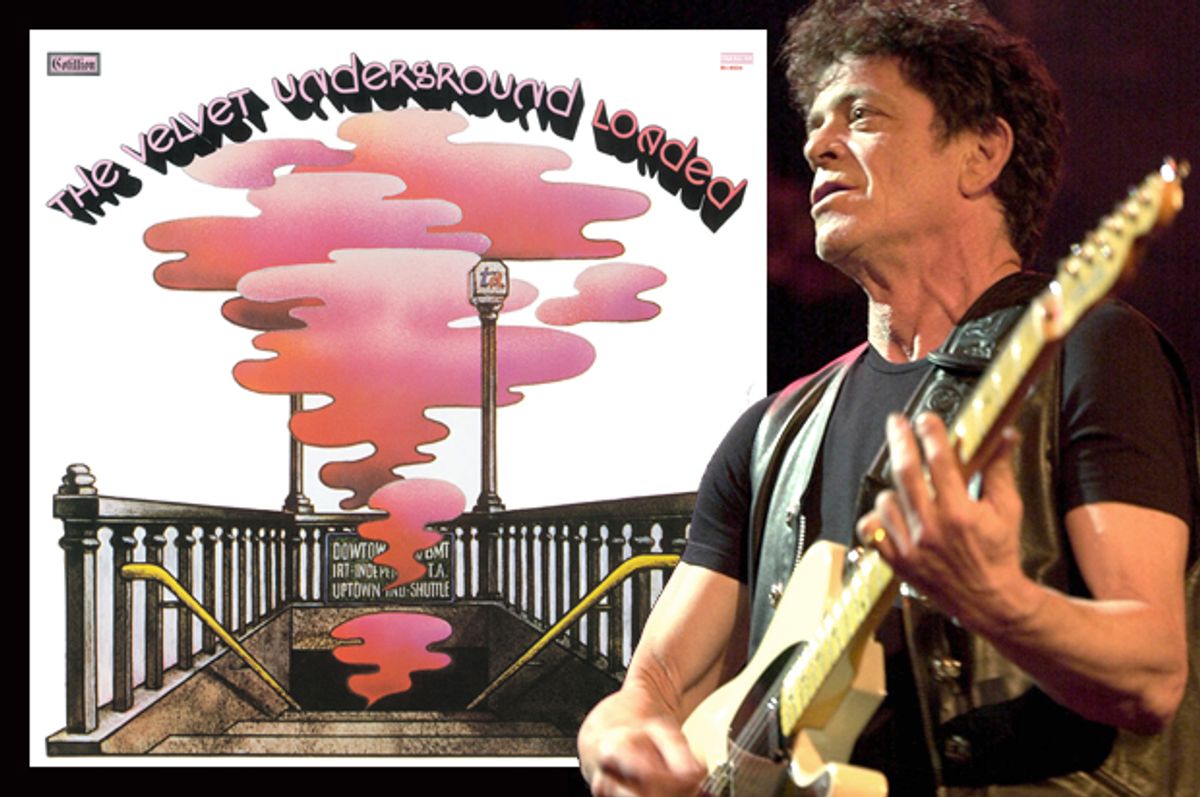
“Loaded,” the Velvet Underground’s fourth album, released in November of 1970 and getting the grand box set treatment soon to mark its 45th anniversary, was the last to feature Lou Reed. It was also the last Velvet Underground album I bought and listened to on my quest to own every note this band every recorded. For some reason, “Loaded” was the hardest one to track down.
I knew as I scoured the bins that “Loaded” was the original home for a pair of Velvet Underground songs that had already taken on legendary status by the ’80s, “Sweet Jane” and “Rock and Roll.” But the only version of “Sweet Jane” I’d heard at that point was the one off Lou Reed’s live album “Rock n’ Roll Animal,” which was widely acknowledged as a way to place the irascible star back on the charts after he chose to follow up his breakthrough “Transformer” — which David Bowie and his late guitarist Mick Ronson crafted into a glitter-era sensation — with the dour, Bob Ezrin-produced “Berlin.”
That live version of “Sweet Jane” comes with an extended intro — if you happened to turn in before those chords smashed down, you might think you were listening to Yes. But then there’s a wave of applause and Reed strolls onstage, and begins to sing in his tough monotone. He’s got bleached blonde hair and never takes off his extra dark aviators:
“Loaded” was a fitting end for the mighty Velvet Underground. Lou Reed had penned an album seemingly loaded with hits, but by now, four LPs into the Velvets’ career, a sad few record buyers appreciated the band. After recording the album, Reed called it quits and disapeared to his parents’ home in the suburbs – the ultimate anti-rock statement. Resignation permeates the album. Reed’s voice is noticeably ragged, and bassist Doug Yule ended up recording many of the vocals for the final mix. Drummer Moe Tucker was pregnant, and Yule’s brother Billy sat in on drums for most of the “Loaded” sessions, further alienating Reed from the already disintegrating band.
I’d heard Jane’s Addiction’s slurry, meandering, percussive version of “Rock n’ Roll” before I ever heard the Velvets. “Rock n’Roll” was clear-eyed and true. But it was almost immediately clear to me what I had been truly missing all these years. “Sweet Jane” is the second song on the album, after the bubblegum sweet “Who Loves the Sun” (a showcase for Doug Yule, who replaced the more avant John Cale), and it begins with a guitar squiggle followed by those steady, wave-like chords (unmistakable in any version), and just like in the live “Rock n’ Roll Animal” version, Lou sings: “Standin’ on the corner, suitcase in my hand. Jack’s in his corset, Jane is in her vest and me I’m in a rock and roll band.
What makes the “Loaded” version life-changing and revelatory the fact that “standin’ on the corner” is cooler than anything you are doing, even if the suitcase is full of used books to sell at the Strand on Broadway.
Lou was “a monster,” a bad man, a crank, a grouch, a sharp tongued, cranky, short-fused bastard, There is also an utterly batshit version of “Sweet Jane” on the live “Take No Prisoners” album, in which Lou rails against rock critics and the hipster scene and just about everything else: The album is more of a stand-up routine than a live document,
This was no longer the art-rock Velvet Underground, but a far more accessible version, relying on Reed’s songwriting over the band’s overall musicality. accordingly, the songs are either retreats into the faux innocence of parental ideals (“Head Held High“), or autobiographical pieces of teenage rebellion (“Sweet Jane”).
“Rock and Roll”, for instance, reads like text-book angst, where everything your parents do is, well, “it ain’t happening at all”. The album appropriately sounds like Reed’s final bit of energy for the band. there’s the saddened tone of “Oh! Sweet Nuthin'”, in which the heroes walk with their “head[s] down”, and “New Age”, in which they mingle with “over the hill” movie stars.
Pink Floyd‘s eighth album, more or less, was a symbolic break from their past — the moment where their long, drawn-out prog tendencies gave way to tighter, shorter and more focused “song”-oriented tracks. And they marked the occasion with their best concept album, a ‘2001’-like mind-expanding look at the fragility of life, time and sanity through the lens of their own experiences. They’d go on to explore some of ‘Moon”s themes — music-business greed, Syd Barrett‘s mental breakdown on later records.released four concept albums during the 1970s; The Dark Side of the Moon (1973), Wish You Were Here (1975), Animals(1977), and The Wall (1979). The most notable of these is “The Dark Side of the Moon”, which achieved a level of commercial success far beyond that of any other progressive rock album before or since.
Roger Waters, who was the dominant – though not yet dominating – force in the band when they recorded Dark Side Of The Moon, has his own theory. “The music’s quite compelling but I think there’s something more. Maybe it’s the simplicity of the ideas that appeal to a generation going though puberty and trying to make sense of it all. There’s certainly something in Roger’s theory, particularly if you accept (as most women do) that most men never get much further than puberty. And like porn, men can go back to Dark Side Of The Moon over and over again. Released in March 1973, over a year after the band had previewed most of the tracks at London’s Rainbow Theatre, Dark Side Of The Moon caught the prevailing feeling perfectly. For a while Pink Floyd called their planned album Eclipse, but when Medicine Head’s album failed to make any impact they reverted to Plan A. The recording was long – they spent six months in the studio in between tours of Europe, America and Japan – but it wasn’t laborious. David Gilmour reckons that playing the songs live beforehand made a big difference. “You couldn’t do that now of course. You’d be bootlegged out of existence. But when we went into the studio we all knew the material. The playing was very good. It had a natural feel.”
Pink Floyd’s 1973 album The Dark Side of the Moon has become legendary for a lot of reasons, including the 741 weeks it spent on the album chart, the iconic cover art and the urban-legend connection to The Wizard of Oz. But this track-by-track approach to the LP centres on the music – the sounds, creation and concept behind one of the most successful, popular and celebrated albums in rock history. Over four decades have passed since Pink Floyd’s Dark Side Of The Moon was released, and it remains far and away the most successful concept album ever made. Its 45 million claimed sales dwarf all other contenders as well as later Pink Floyd albums including Wish You Were Here, Animals and The Wall– which many fans might argue are better concept albums. But the rest of the world does not agree.
It was also headphone heaven. You could lie back and hear the heartbeat gradually getting louder, mingled with a disembodied Scottish voice saying ‘I’ve been mad for fucking years’ and a maniacal laugh before being blotted out by a helicopter noise whirring from one ear to another. That in turn collides with a screaming female voice before subsiding into the slow, deliberate beat and soothing guitars of Breathe. Just as you’ve relaxed into the song, however, it suddenly shifts gears and you are being carried long by a rapid hi-hat rhythm and electronic riff while atmospherics, voices, footsteps, airplanes and bits of feedback fly by on either side of your head. It all ends in a dull explosion and more running footsteps. As it dies away there’s the reassuring tick of a clock which just has time to lull you again before a cacophony of alarm clocks shatters your senses and leads into the heavy ponderous guitar chimes of Time.
You are now eight minutes into the album, and there’s another 35 to go. The sonic experience of the album is as vivid now as it was then.
“Speak to Me”
The line on Dark Side isn’t just that it’s a masterpiece, but that it’s a masterpiece because the album displays Pink Floyd at the apex of the members’ collaboration. After former frontman Syd Barrett left the psychedelic rockers rudderless, they gradually found a collective focus by 1972, with bassist Roger Waters handling the concepts (and lyrics), guitarist David Gilmour and Rick Wright contributing musical ideas and vocals and drummer Nick Mason maintaining a steady beat while messing with brain-tickling sound effects.
Each of Floyd’s four members received writing credits on Dark Side, although Mason was listed as the sole composer of album opener “Speak to Me.” It was a decision that proved controversial in the later, more acrimonious days of the band .
Devoid of lyrics, the one-plus-minute track isn’t much of a song. Conceived in the later stages of the album’s recording sessions at London’s Abbey Road Studios, “Speak to Me” was created as a starting point for this grand, contemplative LP.
“It’s kind of a classical overture, a standard device used for hundreds of years,” Waters said in 2003, “put some elements of the work together at the beginning, as a taster.”
“Speak to Me” might have been classical in concept, but it was more experimental in execution, with layers of fragmented sonic references to Dark Side’s forthcoming songs. You can hear ticking clocks (“Time”), a cash register (“Money”), crazy laughter (“Brain Damage”) and a woman’s scream (“The Great Gig in the Sky”), all interwoven with the sound of a pulsing heartbeat – created by futzing with the recording of a kick drum. The same pulse is heard at the album’s end, suggesting a continuous cycle.
When Pink Floyd debuted Dark Side’s suite of songs at live concerts (more than a year before the album’s release), the heartbeat sound stood alone as a long introduction that would transition from a venue filled with loud crowd talk to the band’s first proper tune, “Breathe.” For the recorded version, the so-called overture became shorter, but denser – not just featuring elements of other songs, but also snippets of spoken word.
Waters had the idea of recording interviews with people who worked with the band or at Abbey Road Studios, and seeing if the answers might dovetail with some of the weighty lyrical themes of Dark Side. The questions would begin easy (“What’s your favorite colour?”) and progress to more difficult subject matter (such as violence or mental instability). The voices on “Speak to Me” belong to the band’s road manager Chris Adamson admitting, “I’ve been mad for fucking years … ,” and Abbey Road doorman Gerry O’Driscoll saying, “I’ve always been mad … ”
In fact, the track’s title came as a result of these interviews. Every time he tested the sound levels to record each interview, audio engineer Alan Parsons would say, “Speak to me” into the talk-back microphone. The phrase stuck. Although Parsons named the piece, Floyd’s drummer was credited for the sonic wizardry on the Dark Side sleeve.
“It was an assembly that I did with existing music,” Mason said, years later. “You could say there’s no original material there, or you could say it’s an entirely original assembly. Yet Waters, Gilmour and Wright disagreed with Mason’s memory, instead suggesting that the writing credit was a gift between bandmates – a token of publishing generosity from Pink Floyd’s bassist to the band’s drummer. After Waters split with the band in the ’80s, he didn’t only stop speaking to his former mates, he didn’t want Mason to get any creative recognition for “Speak to Me.”
“I went through many years when I really regretted having given away half the writing credits, particularly ‘Speak to Me’,” Waters said. “I gave it to [Mason]. Nobody else had anything to do with it at all.”
“Breathe”
Because the whooshing backwards chord segues from “Speak to Me” right into “Breathe,” the two compositions were most often combined into one track on digital era re-releases. But these are separate pieces, treated as such on the original vinyl release (on which “Breathe” was listed as “Breathe in the Air”). While “Speak” began the album, “Breathe” set the tone for Dark Side.
The first true song on the LP had its roots in a tune, also titled “Breathe,” that Waters had written for a documentary called The Body. Although the two songs don’t have much in common, their lyricist did reuse the title and the opening line for Dark Side. It was a suitable beginning for an album about the universal elements (and impediments) of existence. The first line appears to mark the first breath of life: “Breathe, breathe in the air … ”
“I think we all thought – and Roger definitely thought – that a lot of the lyrics we had been using were a little too indirect,” Gilmour said. “There was definitely a feeling that the words were going to be very clear and specific. That was a leap forward. Things would mean what they meant. That was a distinct step away from what we had done before.”
Waters would later sort of cringe at the naked simplicity of some of his Dark Side lyrics, particularly “Breathe,” which follows its first line with “Don’t be afraid to care.” But if the naivete of those words rankled the musician in hindsight, their universality may have helped so many listeners connect deeply with this music. In a matter of a few lines, “Breathe” describes birth, offers parental advice (with a pointed caveat) then helplessly sinks into the infinite loop of the rat race – or is it the rabbit race?
“The lyrics … are an exhortation directed mainly at myself, but also at anybody else who cares to listen,” Waters told Mojo. “It’s about trying to be true to one’s path.”
Waters wrote the words, but Gilmour’s voice contained the delicate power to deliver them – double-tracking his vocal takes to strengthen his breathy cries. His guitar work might be “Breathe’s” defining characteristic – a combination of Stratocaster and lap steel that plants itself in blues structure while zooming to the outer reaches of the universe. The spacey approach was a refined version of what Floyd had done with “Echoes” on 1971’s Meddle.
Wright, who shared musical credit with Waters and Gilmour on the song, added textures of keyboard, namely twinkles of Fender Rhodes electric piano and erupting swells of Hammond organ. He also brought in a hint of jazz, via his choice of a minor chord on the way from G to E, right before the verse begins.
“I came from jazz basically … that’s my favourite, that’s my inspiration,” Wright said on the Classic Albums documentary series about “The Dark Side of the Moon”. “The interesting thing about this song … that is totally down to a chord I had heard on, actually, Miles Davis’ album Kind of Blue. … That chord, I just loved.”
“Breathe” would also contribute to Dark Side being looked at as an album-length work. Just as there were sonic and lyrical references to other songs in the LP’s first and last tracks, “Breathe” made a second appearance as a reprise following “Time” with a slightly different musical approach, a weary word about work and a sneer in the direction of organized religion.
The repeating musical theme “was a bit avant-garde,” according to Mason. “And it was a bloody good device not to have to write anything else.”
“On the Run”
Before “On the Run” existed as one of Dark Side’s most experimental tracks existed as a less exceptional guitar-driven jam. When Pink Floyd performed the Dark Side song cycle before they recorded it, the band played something called “The Travel Sequence,” after “Breathe” and before “Time.” It was a kind of interlude to connect two of the major songs.
As Waters was coming up with the lyrical ideas for what would become Pink Floyd’s most famous album, he thought of a list of the things that he thought prevented humanity from progressing. Some of these became the focus (and even the titles) of songs: money, time, morality, violence, etc. One of the more personal themes on Waters’ list was travel, because as a constantly gigging band, the members of Pink Floyd were often on the road, in the air or “On the Run,” so to speak. Recording technology was evolving rapidly around the band. They used the new VCS3 – the latest synthesiser on the market, albeit still quite primitive – to generate the helicopter noises and Rick Wright used it inventively on On The Run. Half-way through making the album they switched to the new Dolby sound reduction system to give the music greater clarity and separation. But the real masterstroke came late on when Roger decided to link the tracks with bits of speech.
“It’s about fear of flying, which we all developed at some time,” Waters said in 2003. Wright had a slightly different take: “I was exhausted by the treadmill, the grind of traveling. For me, it expressed that rather than the fear of crashing in an aircraft.”
Perhaps because it was so personal, Waters didn’t compose lyrics about this particular fear, and the song remained an instrumental. When the Floyd members entered Abbey Road Studios to begin recording Dark Side, “The Travel Sequence” turned into something more bizarre, futuristic, frightening and alien. As that stage jam became “On the Run,” the track found its backbone in a synthesizer, the EMS Synthi AKS.
“I put an eight-note sequence into the Synthi and sped it up,” Gilmour recalled. “Roger thought it wasn’t quite right. He put in another, quite like mine. I hate to say, it was marginally better.”
If the constantly oscillating, ever-repeating sci-fi sound of the Synthi AKS didn’t fully represent what Wright called “the grind of traveling,” extra effects hammered the idea home. Along with heavily manipulated guitar and organ, folded into the track were an airport announcement (“Have your baggage and passport ready …“), other synthesized noises (which sounded like a vehicle swooping past) and a little more everyman philosophy (“Live for today, gone tomorrow. That’s me,” as said by Floyd road manager Roger “The Hat” Manifold).
Engineer Parsons has claimed it was his idea to add the sound of a man’s running footsteps and gasps of heavy breathing. “Often I’d carry on experimenting after they had gone,” he recalled. “The footsteps were done by Peter James, the assistant engineer, running around Studio 2, breathing heavily and panting. They loved it when they heard it the next day.”
Going out with a, quite literal, bang, “On the Run” ends with the sound of a plane crash – leaving little interpretation to how a traveling band felt about their concert schedule. The track’s finale became even more dramatic when performed on the tour to promote Dark Side, as Pink Floyd arranged for a huge model airplane to “fly” across arenas and “crash” in a rigged explosion. The stagecraft, although intense, seemed to lighten the band’s dark thoughts on the subject of air travel.
“We’ve had all sorts of things over the years, so I don’t think it put any of us off,” Gilmour remembered about the special effect. “It was jolly entertaining.”
“Time”
Like many tracks on our list of the Top 10 Pink Floyd Songs, ‘Time’ works better as part of a bigger album concept than as a standalone cut. But it’s ‘The Dark Side of the Moon”s linchpin and features the album’s best performances, especially Nick Mason’s drum solo near the beginning of the song and David Gilmour’s ripping guitar solo in the middle.
Everyone in Pink Floyd gets their shot at the spotlight in “Time.” Mason does his drum solo on the rototoms in the big build-up, Wright came up with some of the epic chord changes and offers his gentle lead vocal (for the last time on record until the ’90s) on the bridges, Gilmour’s snarling singing on the verses is only outdone by his blistering guitar solo and Waters (as throughout Dark Side) came up with the idea and wrote all the lyrics.
“Time” is the only song on the album on which all four members receive a writing credit – making it the zenith of collaboration on what the Floyd guys have always claimed was their most cohesive LP as co-workers. And it’s only appropriate that each gets his moment on a track that focuses on living in the moment.
Waters has said the words for “Time” came from a eureka moment he experienced as he approached the age of 30 and Floyd were putting together Dark Side. He had spent his adolescence and young adulthood waiting for life to begin, only to discover that he was already living it. The notion is reflected in the lyric, “And then one day you find 10 years have got behind you / No one told you when to run, you missed the starting gun.”
“I suddenly thought at 29, ‘Hang on, it’s happening’,” Waters told Mojo. “It has been right from the beginning, and there isn’t suddenly a line when the training stops and life starts. … To be here now, this is it. Make the most of it.”
When the band began to record “Time” in the studio and audio engineer Parsons learned of the song’s title, he offered his own contribution. Not long before Floyd started sessions for Dark Side,Parsons had gone to a watchmaker’s shop to record a range of clocks going off. He planned to use the sounds on a release that would demonstrate the capabilities of quadraphonic sound. Instead, the tolling clocks became a memorable part of “Time,” presaging the song’s slow climb.
“We were doing the song ‘Time,’ and he said, ‘Listen, I just did all these things, I did all these clocks’,” Gilmour remembered in 1984, “and so we wheeled out his tape and listened to it and said, ‘Great! Stick it on!’ And that, actually, is Alan Parsons’s idea.”
The engineer wasn’t the only outsider to make a key contribution to “Time.” Dark Side’s most dynamic track featured vocal backing by four female singers – Doris Troy, Leslie Duncan, Liza Strike and Barry St. John. Recordings of the women’s voices were fed through a pioneering pitch-shifting device invented at Abbey Road Studios. The Frequency Translator wasn’t employed as suggested; instead Floyd members and Parsons manipulated the vocals to bring a greater “swishing” sweep to the soulful “oohs” and “aahs.”
Everything about “Time” was big: its cacophony of clocks, its sonic range from hushed tick-tocking to full-throated rock exuberance, its notions about the hourglass of life, its seven-minute length. It also might be Dark Side’s hardest-rocking moment with Waters’ bass digging deep into the song’s funky gait and Gilmour burning through everything with his blazing arrow of a guitar solo coated in space echo.
“Some punch, some rock guitar,” is how the guitarist described the approach in 2011. “You know, once you’ve had that guitar up so loud on the stage, where you can lean back and volume will stop you from falling backward, that’s a hard drug to kick.” In “Time’s closing moments, Pink Floyd break the fourth wall. Wright’s lamenting vocals deliver Waters’s lyrics: “The time is gone, the song is over / Thought I’d something more to say … ” The album’s lyricist isn’t just using the song to write about the human perception of time, he’s using the creative process as a metaphor for life and how the clock will inevitably run out on everyone.
“Maybe we all suffer from the feeling of lost opportunities, or you could have done better, or done more,” Waters told us. “Maybe it’s comforting to hear that feeling expressed in a piece of work that’s been as successful as this one. People often think, ‘If only … I could write the hit song, or have the success, everything would be okay.’ It’s very nice, but it doesn’t solve any of the problems you might feel about yourself.”
Then, via a dissonant chord, “Time” transitions to a one-verse reprise of “Breathe” (same melody, but new words). The reprise – all but exhaled by Gilmour – gets a lot done in a mere eight lines. It reiterates the “stop and smell the roses” idea of “Breathe” proper, connects to the chimes of “Time” (“the tolling of the iron bell”) and introduces some old-time religion (“hear the softly spoken magic spells”). All of it just in time for Dark Side to move on to mortality
“The Great Gig in the Sky”
Because of her singing on “The Great Gig in the Sky,” Clare Torry’s name is inextricably linked to Pink Floyd. And she wasn’t even a fan of the band.
The idea to bring in a singer to “wail” on the track happened late in the recording sessions for Dark Side (mid-January 1973, only about a month-and-a-half before the album’s release). When Pink Floyd had performed the Dark Side material live in 1972, before recording it, this spot in the song cycle had been taken by something termed “The Mortality Sequence.” The theme was religion and death, exemplified by Wright playing an organ with taped snippets of recorded prayers and Christian commentary playing over the live performance.
When the band got into Abbey Road Studios, Wright refined the piece and crafted something more delicate, playing piano as the tune’s lead instrument. Gilmour contributed pedal steel, Waters played bass and Mason handled the drums. Everyone seemed to love the instrumental (Waters later praised it as “really beautiful” and one of “the best things that Rick did”), yet some of the members felt it needed something more.
The idea of keeping the prayers and Bible verses from the live edition was quickly dispatched and the band moved on to trying to use recordings of astronauts communicating in space (which didn’t gel) as well as subjects from Waters’ interview idea (two of whom ended up on the completed track). But the quotes from Abbey Road doorman Gerry O’Driscoll – “And I am not frightened of dying … ” – and Patricia “Puddie” Watts, wife of road manager Peter Watts – “I never said I was frightened of dying” – weren’t quite enough to capture the emotion of a song about death.
No one remembers whose idea it was but eventually the guys in Floyd decided that a female singer might do the trick. Engineer Parsons suggested a young singer-songwriter named Clare Torry, because he had been impressed by the power of her voice on a cover of the Doors’ “Light My Fire.” The 25-year-old singer initially was reluctant to take part. Torry wasn’t into progressive rock and had tickets to a Chuck Berry concert on the Saturday night proposed for the session, but she eventually agreed when the date was set for a Sunday.
“I think one has to give Clare credit — she was just told to go in and ‘do your thing,’ so effectively she wrote what she did,” Parsons said in 1998. “She wailed over a nice chord sequence. There was no melodic guidance at all apart from ‘a bit more wailly here’ or ‘more sombre there.’ The vocal was done in one session – three hours – no time at all, then a couple of tracks were compiled for the final version.”
The members of Pink Floyd had been at a loss at how to direct someone to sing a completely wordless part for a song that was serious yet carried the playful title of “The Great Gig in the Sky.” Although they came away impressed with Torry’s hair-raising, even terrifying, vocal takes, the guys’ stone-faced manner belied their approval. “The only thing I could think of was to make myself sound like an instrument, a guitar or whatever, and not to think like a vocalist,” Torry recalled. “I did three or four takes very quickly, it was left totally up to me, and they said, ‘Thank you very much.’ In fact, other than Dave Gilmour, I had the impression they were infinitely bored with the whole thing, and when I left I remember thinking to myself, ‘That will never see the light of day’.”
Torry didn’t know she had become part of Pink Floyd’s hit album – and, eventually, one of the most beloved LPs of all time – until she spotted Dark Side in a record shop one day and saw that she was credited on the sleeve. Although Wright was listed as the song’s sole writer, that changed after a retired Torry sued the band and EMI in 2004, resulting in a settlement that gave the singer-songwriting credit on subsequent reissues of the album.
“I get so excited when I hear Clare singing,” Wright said in 2003. “For me, it’s not necessarily death. I hear terror and fear and huge emotion, in the middle bit especially, and the way the voice blends with the band.”
“Money”
Once the band started to receive some attention, the concept of fame and its trappings became an obsession for Waters . Ironically, ‘Money’ — an anti-greed rant — became the group’s first hit single and set ‘The Dark Side of the Moon’ on its path to one of the bestselling albums ever made. Its massive popularity only added to Waters’ list of complaints.
It’s one of the most famous intros in music and one of the most famous riffs on a centrepiece to one of the most famous albums with one of the most famous covers of all time. But before ‘Money’ was the track your dad used as an example of “real music” when he came into your room while you were listening to Deadmau5, it was just a crude demo that Roger Waters had toyed around with.
What’s rather remarkable though is not only the way the rather short demo expanded into a six-minute epic, but the way the themes of the song and most of the lyrics were already in Waters’ head.
Pink Floyd hadn’t had a hit single since 1967. That was back when they were a psychedelic outfit led by Syd Barrett. By the mid-’70s, the singles chart just wasn’t the kinetic playground for progressive rock bands. Groups of Floyd’s ilk gravitated toward longer artistic statements: albums with big concepts, extended tracks and lots of room for listeners’ minds to wander. This wasn’t Top 40 stuff.
Yet, suddenly in 1973, it was. A couple months after the release of Dark Side, Pink Floyd put out an edited-down version of “Money” as a single in the U.S. and it soared to No. 13 on the chart, helping to take the British band from an underground act to a popular sensation in North America. Sure the song was catchy with its distinctive, rubber-band bass line and blistering solo breaks – yet it was still a surprise that a song written in the decidedly un-pop time signature of 7/4, with a sound effects loop, an unsung chorus and a subversive attitude toward capitalism would become a Top 20 single on American radio.
As with all of the Dark Side material, Waters was responsible for those sarcastic lyrics, which were written to a strange rhythm as the bassist was considering the elements that could prove dangerous to a thriving society. As a rock musician who was working to be rich and famous, but also had notions of socialism, Waters decided to go the “funny and clever” route. In addition to the off-kilter time signature, Waters came up with the idea of creating a sound effects loop that would insert into the track the literal sounds of money (coins, bags of cash, registers, etc.). Drummer Mason helped Waters begin collecting this rhythmic loop in the song’s home demo stage.
“I had drilled holes in old pennies and then threaded them on to strings,” Mason explained in his autobiography Inside Out. “They gave one sound on the loop of seven. Roger had recorded coins swirling around in the mixing bowl [his then-wife] Judy used for her pottery. Each sound was measured out on the tape with a ruler before being cut to the same length and then carefully spliced together.” The final version of the seven jangling, ripping, clinking and ringing sounds was used by Dark Side engineer Parsons as a click-track, to which the members of Pink Floyd played when recording “Money” at Abbey Road Studios. Because Parsons slowly faded out the effects in the band’s headphones, the song begins to move faster after the guys were untethered from their weird metronome.
Wright and Gilmour initially weren’t thrilled with the Waters composition. The keyboardist later claimed it was the one song that didn’t fit with the rest of Dark Side and also disagreed with the political nature of the lyrics at the time (after all, he was the one who agreed for “The Great Gig in the Sky” to be used in a commercial for headache medicine). Gilmour was, at first, unsure about singing and playing to the awkward 7/4 time. Although he came around to the idea, he made sure that “Money” switched to a more standard 4/4 time for his series of guitar solos.
He didn’t merely dash off the solos, which include some of the heaviest rock on the entire album and, essentially, take the place of the choruses in a typical song structure. Gilmour treated each iteration differently, changing the guitar he played (a Fender Stratocaster on the first two solos, a customized Lewis guitar capable of achieving higher notes on the last one). He also planned the contrast of a “wet” sound – reverb and delay effects on the first solo – with a “dry” approach in the middle, then returning to a fuller aesthetic for the final, more chaotic turn. Much of his driving approach on guitar was a tribute to the Memphis sound.
“I was a big Booker T. fan,” Gilmour later revealed, in reference to Stax Records house band, Booker T. and the M.G.’s. “I had the Green Onions album when I was a teenager. … It was something I thought we could incorporate into our sound without anyone spotting where the influence had come from. And to me, it worked. Nice white English architecture students getting funky is a bit of an odd thought.” Another R&B element was added with the addition of Dick Parry’s blurting and squealing saxophone. The story goes that Gilmour told his former bandmate to play like the saxophonist in a cartoon ad that ran before movies in Britain.
“I played with him. He was a jazz player. You’d be in two or three different groups at a time sometimes. My group in Cambridge very rarely had a gig on a Sunday night, and Dick had a regular spot in a ballroom on a Sunday night. We got this jazz trio thing going on,” Gilmour said in 2003. “Pink Floyd … really didn’t know how to get hold of a sax player or anything. We wanted to try a sax on ‘Money’ and ‘Us and Them,’ so we got Dick in.”
In addition to Parry’s sax work, Pink Floyd filtered in more of spoken-word snippets, of the same variety that had appeared on other tracks. A run of a variety of voices (including Wings member Henry McCullough) close out the song, not responding to financial questions, but matters of conflict, perhaps as a preview of Dark Side’s next track.
Looking back decades later, the irony was not lost on the band regarding “Money” being, in many ways, responsible for the vast material success of Pink Floyd. It was practically a prophecy, given the lyric that Waters wrote and Gilmour sang “Money, it’s a hit.” .“We were by no means rich at that time. ‘Money’ is the single that helped to really break us in America,” Gilmour said. “It was the track that made us guilty of what it propounds, funnily enough.”
“Us and Them”
The oldest song in Dark Side, “Us and Them” dates from four years before the album’s release, when Pink Floyd had been commissioned by film director Michelangelo Antonioni to create soundtrack music for Zabriskie Point. Wright, the band’s keyboardist, had written this subdued, melancholy piece to work as a contrast to a scene that depicted a campus riot. As such, it had the working title of “The Violence Sequence.”
“It has quite a simple chord sequence, except for the rather strange third chord, influenced by jazz,” Wright told Uncut, referencing the D minor chord with a major seventh. “It was an augmented chord, hardly ever used in pop music then.” It proved unusual for pop music and, as it turned out, a bit too unusual for Antonioni as well. While the Italian director loved Floyd material such as “Careful With That Axe, Eugene,” he wasn’t thrilled with Wright’s slow, piano tune. Waters recalled the filmmaker’s reaction: “It’s beautiful, but is it too sad, you know? It makes me think of church.” Antonioni chose not to use “The Violence Sequence” for his movie.
A few years later, Pink Floyd were starting to assemble material for what would become Dark Side and Wright was still kicking around this chord progression in his brain. The song ended up underscoring a different sort of conflict: warfare, prejudice and inequality as depicted in lyrics written by Waters. The bandmates worked on the song, now called “Us and Them” together, adding a new musical section and words that paid heed to the forces that prevent human beings from connecting.
“We needed a middle-eight. I came up with the chords for that,” Wright said. “It’s very flowing and sweet if you look at the verse, then there’s the contrast, this big, harder chorus. With the lyrics about the war and the general sitting back – it worked so well. Wright and Waters were so pleased with “Us and Them,” which Pink Floyd performed while on tour before making Dark Side, that the deceptively serene song became the first one recorded for the album when the band entered Abbey Road Studios in June 1972. Gilmour sings the lead part, his voice processed with an echo effect to enhance the dichotomy of certain lines (i.e. “Us … us … us … us … us … us … us … and them … them … them … them … them … them … them …”).
Wright’s vocals come in to harmonize in the crescendo of the choruses, as do the voices of Doris Troy, Leslie Duncan, Liza Strike and Barry St. John, who sing backup on other tracks (“Time,”“Brain Damage” and “Eclipse”).
“All our vocals are perfectly balanced – for instance, on ‘Us and Them’,” Gilmour noticed. “I did I don’t know how many harmony vocals, then the girls on top. It’s really great, really uplifting. You can move one element a fraction and the whole thing falls to pieces.”
As with “Money” it was Pink Floyd’s guitarist who brought in old pal Dick Parry to play saxophone on the track. The jazzman delivers two solos, each breathy and moody, in stark contrast to the honking assignment on his other Dark Side appearance. Just before his second solo on “Us and Them” listeners hear yet another of the album’s spoken-word snippets, with roadie Roger “The Hat” Manifold holding forth on the theme of violence (“So if you give ’em a quick short, sharp, shock, they won’t do it again”).
Wright and Waters, the song’s co-writers who would so often find themselves at odds in the post-Dark Side era, would eventually look back fondly on “Us and Them.” Even in the years in which they were not talking to one another, they each considered their collaboration a highlight, if not the all-out centerpiece, of Pink Floyd’s most legendary album.
“It’s a great example of the music and the lyrics combining to create emotion,” Wright said in 2003. A few years earlier, Waters had offered, “The whole idea, the political idea of humanism and whether it could or should have any effect on any of us, that’s what the record is about really – conflict, our failure to connect with one another.”
“Any Colour You Like”
Isolation, paranoia and mental breakdown are the unrelenting themes of the last three tracks,Any Colour You Like, Brain Damage and Eclipse. Roger would pursue these themes with a vengeance on later Pink Floyd albums, driven by his hatred of authoritarian leaders and their bureaucratic henchmen, and his rage at the death of his father right at the end of World War II.
When the Dark Side collection of songs existed as merely a concert set – before Pink Floyd went into the studio to record the album – the material included two instrumental jams that both served as connective tissue for the entire cycle. There was one jam in between “Breathe” and “Time” (which was radically altered for the album to become “On the Run”) and there was another between “Us and Them” and “Brain Damage.” Because Floyd had deep-sixed the first jam, the members were content with keeping the second one for the LP, although it still got the full studio treatment. Segueing from “Us and Them,” the instrumental is led by a heavily addled EMS VCS 3 synthesizer played by Wright, which eventually yields the floor to Gilmour’s guitar playing, including a harmonized solo. Wright also contributes organ and another synth, while Waters plays bass and Mason is on drums.
The funky instrumental has been occasionally referred to as the second reprise of “Breathe” because it has the same rhythm (albeit more up-tempo) and boasts a similar chord sequence to that song (although stepped down from E minor to D minor). So even if “Any Colour You Like” doesn’t have an obvious impact on the overall themes of Dark Side, it does play into a repeated musical element of the LP.
“It’s not a vital part of the narrative,” Gilmour said in 2003, “but there are moments when it’s nice to get off the leash and just play.” Yet Waters, who is the only Floyd member not credited with writing the song, has claimed that “Any Colour You Like” does contain an underlying message to match some of the other impediments to progress explored in the lyrics and music of Dark Side.
Although it has been suggested that the title is an in-joke, referencing Floyd roadie Chris Adamson’s catchphrase, Waters told author Phil Rose that the phrase originated with his memory of salesmen hawking cheap items out of a van. “If they had sets of china, and they were all the same colour, they would say, ‘You can ’ave ’em, 10 bob to you, love. Any colour you like, they’re all blue’,” Waters recalled in Which One’s Pink? “And that was just part of that patter. So, metaphorically, ‘Any Colour You Like’ is interesting, in that sense, because it denotes offering a choice where there is none.”
“Brain Damage”
‘The Dark Side of the Moon’s penultimate track is more or less the theme song of Pink Floyd’s most popular album. More than any other cut on the record, ‘Brain Damage’ surveys the mental scars left on both the band and Syd Barrett after their former bandmate’s mental illness forced his departure (first from the group and eventually from reality). This centerpiece segues into the closing ‘Eclipse,’ so feel free to tag it on.
This track gave the entire album its title. When Waters was first working on it, around the time that 1971’s Meddle was being recorded, “The Dark Side of the Moon” was the name given to the song. Before it arrived at its final name, “Brain Damage,” it had the working title “The Lunatic Song” – named as such for the lyrics’ frequent use of the term.
The song’s first line is “The lunatic is on the grass,” a general reference to “keep off the grass” signs and a specific memory of a beautiful lawn in Waters’ hometown of Cambridge on which he desperately wanted to run around. The songwriter would later remark that the real lunatics are the ones trying to prevent people from lazing on a nice patch of grass.
But the larger inspiration for Waters’ acoustic-based tune was his former bandmate, and Pink Floyd’s first frontman, Syd Barrett. His relationship with, and proximity to, someone with destabilizing mental illness would greatly impact Waters’ work in Pink Floyd, including parts of Wish You Were Here and The Wall. In “Brain Damage,” the lyric “And if the band you’re in starts playing different tunes” is a nod to concerts in which Barrett would be performing a completely different song to the one that the band had agreed to play.
“It was a huge shock to me to see the ravages of schizophrenia at those close quarters,” Waters said in 2003. “There’s no way to deal with it. Certainly there wasn’t with Syd.”
So “Brain Damage” was, in part, Waters’ way of dealing with this. It wasn’t just references to Barrett, grass and lobotomies, but a display of empathy for the folks on the fringes – “defending the notion of being different,” as the songwriter put it on the Classic Albums documentary. The song’s lyrical hook, after all, is “I’ll see you on the dark side of the moon,” as if to say that there isn’t that much different between Barrett and Waters. “It’s also to suggest that there’s a camaraderie involved in the idea of people who are prepared to walk the dark places alone,” Waters said. “You’re not alone! A number of us are prepared to open ourselves up to all those possibilities.”
At the time Pink Floyd were making Dark Side, Waters was still self-conscious about his singing voice, especially in contrast the expressiveness of Gilmour’s vocals. But it was the guitarist who convinced Waters to sing on “Brain Damage,” possibly because of how personal the lyrics were.
Besides, it’s not like the recording did a disservice to the apprehensive singer. Waters stands alone on the quieter verses, but is joined by Gilmour and the backing contingent of Doris Troy, LeslieDuncan, Liza Strike and Barry St. John on the operatic choruses, which blast out of the simple, folky tune.
Gilmour’s sighing space guitar, Wright’s bum-rushing Hammond organ and Mason’s thunderous drums make “Brain Damage” suitable for Dark Side’s widescreen canvas, while clips of road manager Peter Watts laughing like a maniac maintain the conceptual connections.
“It’s very simple, and also it has the mini-Moog,” said Wright, who wasn’t thrilled, originally, with the recording. “It’s got a hotel orchestra kind of sound. I love the chorus, and the girls blended in so beautifully.” “Brain Damage” also blended in so well with Dark Side’s final track, “Eclipse,” that the pair are usually performed in concert or played on the radio in tandem, causing many fans to consider them one piece – even though they were written as separate songs.
“Eclipse”
Pink Floyd were already in the process of a 1972 road-test of the material that would turn into Dark Side when lyricist and bassist Waters realized the suite of songs was missing something. Sure, the band had big, dramatic think-pieces such as “Time” and “Money” and “Us and Them,” but not a song that tied all of the themes together.
“I suggested it all needed an ending,” Waters told Uncut. “I wrote ‘Eclipse’ and brought it into a gig in Colston Hall in Bristol [the eighth of the tour on which the Dark Side songs were being played], on a piece of lined paper with the lyrics written out.”
But it wasn’t titled “Eclipse” at the time; it was called “End.” That’s because Pink Floyd were considering calling the entire piece Eclipse, scared off of the original Dark Side of the Moon moniker because another British band, Medicine Head, was releasing an LP with that title. That album proved unsuccessful, Pink Floyd reverted to their plan and “Eclipse” became the name of the record’s final track.
Lyrically, the conclusion does what Waters set out to achieve, forging bonds between many of the other songs on Dark Side. In the first line, Waters practically repeats a lyric from “Breathe” (“All that you touch / And all that you see”), while other phrases in this litany of themes bring to mind “Money” (“And all that you buy, beg, borrow or steal”), “Time” (“And all that is now / And all that is gone / And all that’s to come”) and “Us and Them” (“And all that you fight / And everyone you slight”).
If Waters met his goal as a lyricist, it would require the entire band to take this short, repetitive song into (interstellar) overdrive. Shooting straight out of “Brain Damage,” a giant wave of Wright’s Hammond heralds this musical and thematic climax, punctuated by Mason’s drums and surrounded by Gilmour’s twinkling guitars.
“I remember working hard on making it build and adding harmonies that join in as you go through the song,” Gilmour about recording the song. “Because there’s nothing to it – there’s no chorus, there’s no middle eight, there’s just a straight list. So, every four lines we’ll do something different.”
A big part of that build was the addition of the same female vocalists – Doris Troy, Leslie Duncan, Liza Strike and Barry St. John – who had appeared elsewhere on Dark Side. It provided consistency, in terms of the album, and emotion, in terms of the song. Where they did a lot of ooh-ing and ahh-ing on other tracks, the women are less restrained on “Eclipse.” Troy, in particular, goes all-out with her wailing, providing a tie to Clare Torry’s turn on “The Great Gig in the Sky” while also underscoring the universality Waters was trying to get across in this conclusion. One of the lyrics she echoes in her soulful howl is “Everyone you meet.” Meanwhile, nearly every line that Waters sings contains the word “all,” “everyone” or “everything.”
The song, and album, culminates in the final lines: “And everything under the sun is in tune / But the sun is eclipsed by the moon.” It isn’t merely a reference to the album’s title or the lyric in “Brain Damage,” but a crystallization of everything Waters intended Dark Side to be about.
“It isn’t very positive, but it’s very true,” he admitted in 2003. “Saying that there’s the potential to express the positive side of everything, but that all the stuff that we have talked about on the rest of the record has the potential to get in the way, and it’s up to us to make a change. We all get to choose to some extent … ”
Then the organ fades into the darkness and listeners hear one last interview snippet, a final thought from Abbey Road Studios doorman Gerry O’Driscoll, “There is no dark side of the moon, really. Matter of fact, it’s all dark.” And Dark Side retreats to Mason’s drumbeat pulse, the same steady sound of life heard at the album’s start.
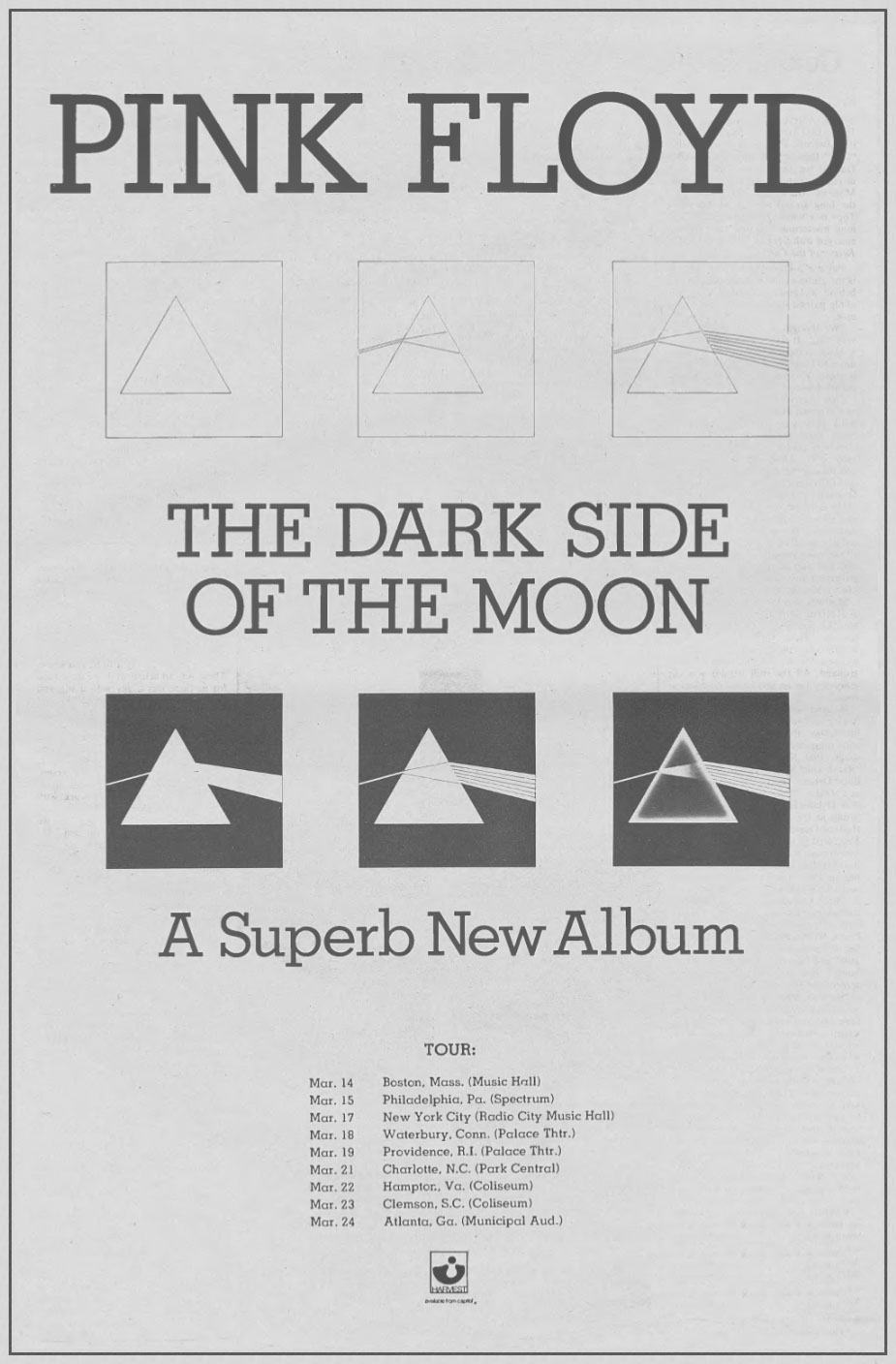
Album cover designers Hipgnosis, who’d worked with the band since 1968’s Saucerful Of Secrets, were coming up with various ideas. Storm Thorgerson remembers they had seven or eight but the one the band picked was sparked off by Rick Wright, “who wanted something simple, clinical and precise”.
Hipgnosis deliberately missed out one colour of the spectrum as the light passed through the prism – purple – as they didn’t think it would show up against the black background. The gatefold sleeve was designed so that the light rays on the inner sleeve joined up precisely with the outer sleeve. But nowhere on the front cover, back cover or the spine did it say “Pink Floyd” or “Dark Side Of The Moon” And even on the inner sleeve the only reference you could find was “Produced by Pink Floyd” in the credits.
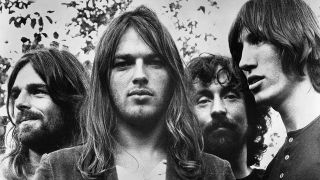
The title didn’t appear until you got to the record label, unless you happened to scan the lyrics on the inner sleeve and came across the last line of Brain Damage, ‘I’ll see you on the dark side of the moon’. Stuck inside the record sleeve were two posters: a grainy, green-filtered picture of the pyramids and one featuring the band, with an attempt to make the Pink Floyd name as difficult to read as possible.
Three years in the making, and A.O. Gerber’s debut album, “Another Place to Need”, could not have come along at a better time. It’s a collection of songs that envelop and surround the listener, but there’s an ethereality at play that suggests a haunting or, even, haunted presence – dreams and fantasy over cold, hard immediacy.
For all the explosive news and fanfare this year brought us, it’s funny that much of our days were pushed into a more muted, understated version of existence. Expansive and warm-toned, Another Place To Need is an album that balances these two oppositional poles with a lot of grace and insight. “What is there left to do but fall into the labyrinth of my mind?” her honey voice asks on “Every Time,” and we just get to sit there and be lucky she let us fall with her for a bit. A.O. Gerber is a singer-songwriter based in Los Angeles, CA.
released May 22nd, 2020
Produced by A.O. Gerber and Madeline Kenney
The Band:
A.O. Gerber – bass, guitar, piano, synth, vocals, wurlitzer,Alex Oñate – drums and percussion Madison Megna – bass, guitar, synth GG – guitar, vocals Chris Pucher – guitar Madeline Kenney – bass, guitar, percussion, synth, vocals, wurlitzer Noah Weinman – trumpet Sasami Ashworth – french horn Haisem Khalfani – saxophone Marina Allen – vocals on “Strangers” Phil Hartunian – clarinet on “Full Bloom” Philippe Bronchtein – pedal steel on “In the Morning” Jacob Goldman – guitar, piano, synth, vocals on “All I’ve Known” Scott Brown – bass on “Every Time” and “Old Blue”
A.O. Gerber’s debut album ‘Another Place to Need’ out now on Hand In Hive/Copper Mouth Records
Punk/rock three piece fronted by charismatic frontwoman Becky Blomfield release their second album on the Music For Nations label. Milk Teeth returned this year with their second and final album, ‘Milk Teeth’. The eleven-track LP is a ripper. It is aggressive as it is uplifting and fresh as it is nostalgic with its 90’s alternative feel. The vocal stylings of lead singer Becky Blomfield hark back to the 90’s Riot Grrrl movement as does the song structure and overall guitar tones, which is no bad thing. We started recording our self titled album ‘Milk Teeth’ last year with Neil Kennedy at the Ranch. We hope you enjoy it as much as we do. Most of the songs started off on the piano including ‘Sharks’,
Unfortunately, Milk Teeth would be the band’s swan song as they announced in September that they were disbanding. After battling with the decision for over a year, the time has come for me to move on to a new part of my life – today marks the bittersweet end of Milk Teeth.
A huge thank you to anyone who has supported us and myself over the past 8 years and thank you for all the incredible memories, conversations and backing through both the good and bad.
I won’t ever forget where it all started – four kids from Stroud making the music they loved in college. We did more than
we’d have ever imagined possible and I will be forever proud of how much was achieved.
The Band: Bass, Vocal, Composer, Lyricist: Becky Blomfield Guitar, Composer, Lyricist: Em Foster Drums: Oli Holbrook
Released through Music For Nations Released self-titled record is released on the 27th of March 2020,
The self-produced debut album from indie-rock four-piece Slow Pulp—Emily Massey (vocals/guitar), Henry Stoehr (guitar), Alex Leeds (bass) and Teddy Mathews (drums)—may as well have been written and recorded in another lifetime. The Madison-bred, Chicago-based band began work on their first full-length last spring, and they redirected their efforts after Massey was diagnosed with Lyme’s disease and chronic Mono; her newfound focus on self-care dovetailed with Slow Pulp fine-tuning their approach to song writing, parallel processes each rooted in accountability and communication.
Vulnerable yet defiant, ‘Moveys’ is ten moving tracks that are guitar driven with a real anthemic quality. Included is the powerful single ‘Idaho’ which is Massey’s account of overcoming her health struggles and finding self-acceptance when being constantly rejected by others:
“The diagnosis validated a lot of what I was feeling. I got tools for how to take care of myself better. The way that I internalize trauma is I will hold it in and not process it for a very long time, but writing songs is the one place where I can’t hide from myself. It just comes out whether or not I want it to or if I’m ready for it to. Figuring out how to write together, as a band, was like me learning how to take care of myself and learning how to communicate better.”
All kinds of bad things prefaced the making of Slow Pulp’s debut album Moveys: frontwoman Emily Massey parents endured a car crash—and then a global pandemic unfolded. Yet the songs that were birthed from these circumstances reverberate with sonic serenity and clarity. Lead single “Idaho” depicts a band reflecting and moving from darkness toward light; Massey’s voice is weightless while she sings the line “I’m losing all the while.” This sprawling ballad fuses indie rock with folk, which a lot of the albums seems to do. “At It Again” leans into indie rock, electrified and spinning from the beginning, and sticks out among the abundance of tamer songs it’s a burst of unrestrained frustration, and it’s refreshing.
Slow Pulp were often been categorized as “shoegaze,” and Moveys exhibits the Chicago band showing off their abilities in other realms. “Falling Apart” proves that they can create gorgeous, slow tracks that resemble Hovvdy or Lomelda; “Movey” showcases their desire for idiosyncrasy with upbeat keyboard effects celebrating the ending of a sad record. It can’t quite be summed up into a single genre, but it can be summed up as an evocative collection of songs that convey the ups and downs of being human.
These new songs came together in earnest during the band’s fall 2019 tour alongside Alex G, but in March 2020, as they were finishing the album, Massey’s parents were injured in a serious car accident, requiring her to return home to Madison to care for them—soon after, the COVID-19 pandemic’s Stateside spread required her to stay there. The ensuing seven months of lockdown have distorted time almost beyond recognition. The band finished “Moveys” (its title, in part, a nod to the upheaval of its making) from afar, and it’s better than it has any right to be, a vividly realized debut with the bold, exploratory confidence of a mid-career release.
Many bands find it a struggle to gain attention and simply continue to exist in an environment that is so hostile to anyone other than acts with mainstream appeal and huge commercial backing. Indie rock quartet from Slow Pulp were facing these familiar problems the adjustments in Massey’s life led to a radical change in direction for the band and the sound of what has become their debut album ‘Moveys’.
Catch Slow Pulp playing UK shows during February 2021!
There are two ways of remembering the late Mick Ronson. One is as the immortal guitarist/pianist/arranger for David Bowie, before (or after) sprinkling magic across everyone from Ian Hunter to Bob Dylan, from Elton John to Ellen Foley, and so many more that there’s no room to list them.And the other is as the purveyor of two of the most amazing albums that the 1970s ever birthed, before he decided he really didn’t want to be the star of his own show, and got back to making other people sound astonishing. In 1970, Mick Ronson changed the career of David Bowie and went on to work with Lou Reed, Bob Dylan, John Mellencamp, Morrissey and more.
Although Ronson’s career was defined by his time with Bowie, there was a significant before and after. In the 1960s he played in various Hull groups, including The Mariners, who were advised by Rolling Stone Bill Wyman to change their name to the King Bees at around the time Bowie was also fronting a group called Davie Jones And The King Bees; and The Rats, whose main claim to fame was a 1967 single called The Rise And Fall Of Bernie Gripplestone.
Benny Marshall was The Rats’ lead singer and a close friend of Ronson. “Mick was the best guitarist in Hull, so when he left to head down south and join Bowie, I was pretty upset,” he says. “John Cambridge, our drummer, had played with Bowie on [the album] Space Oddity. He was the bloke who went back to Hull in January 1970 with the brief to find Ronson and bring him to London. He found Mick marking out the lines on the municipal football pitch.”
Cambridge did as instructed and the pair were introduced at the Marquee club, where Bowie was playing on February 3rd, 1970. Two days later Ronson had learned the riffs and song structures well enough to back Bowie, Cambridge and Tony Visconti for a John Peel Radio 1 show live in concert at the Paris Theatre in Lower Regent Street in London. They did 15 songs, including a new number, Width Of A Circle, and plenty of material from Bowie’s recently released self-titled second album. Reaction was positive. This was better than Bowie’s regular gig at the Three Tuns pub in Beckenham. Ronson moved into Bowie’s Haddon Hall apartment on Southend Road in Beckenham and became part of the family.
Having tired of the hippie collectivism, Bowie wanted to make a hard rock album. As Visconti said later: “We respected groups like Cream, but we didn’t have that in us. We needed someone to be [that] important element, and that somebody was Mick Ronson.” Everyone loved Ronson’s laconic Northern humour too, especially Bowie, whose father and mother came from Yorkshire and Lancashire respectively. He’d send Ronson up and get just as good back.
Before this auspicious occasion, bass player Rick Kemp had also scouted Ronno to play on fellow Yorkshireman Michael Chapman’s second album, Fully Qualified Survivor. “Michael said his producer Gus Dudgeon didn’t want him to play electric guitar,” says Kemp, “and asked me did I know anybody? I mentioned Ronson, which wasn’t a good career move for me, letting this little runt in. Gus told me to find him. I was driving a Morris 1000 with the wings flapping off and I spotted him working, mowing lawns. I put the question: ‘Do you want to play on an album?’ He replied: ‘What do you mean? One that’s in the shops for sale, like? And I get paid?’ I took him down to London, and within minutes of arriving he’d got the runs for glory.”
Tony Visconti insists that Ronson came to Trident Studio in September 1969, when the David Bowie album was being finalised: “Mick came to the mix of Wild-Eyed Boy From Freecloud, and was persuaded to play a little guitar line in the middle part and joined in the handclaps on the same section.”
In April, sessions began for The Man Who Sold The World. It was a brilliant album, but another commercial flop. It was so badly received that Bowie was convinced to ditch the band, and Ronson, Visconti, ex-Rat Woody Woodmansey and Marshall took the collective name Ronno and released a single, 4th Hour Of My Sleep/Powers Of Darkness, a freestyle rock-metal affair that showcases Ronno’s blistering Les Paul playing. It sank without trace, although Vertigo Records later included both sides on their Superheavy Vol 1 and 2 compilations.
Later on, Ronson’s crunching heavy metal attack, allied to arcane Wagnerian, dystopian, mind-fuck lyrics, was hailed as a masterpiece. Certainly Ronson’s contributions to Bowie tracks such as She Shook Me Cold, Running Gun Blues and the epic Width Of A Circle cemented his place, leading Bowie to call him, with a smug smile, “my Jeff Beck”.
Bowie’s 1970 album “The Man Who Sold The World” had not been a commercial breakthrough, but it added to Ronson’s confidence. Visconti and Ronson had masterminded the sound, dashing off arrangements in the Minstrel Gallery or the basement at Hedonism Hall while Bowie canoodled with Angie elsewhere, chucking out lyrical fragments in between romps. She Shook Me Cold, the dirtiest song he ever wrote, was directly about Mrs Bowie, but it was Ronson who provided the Jimi Hendrix-style intro and the power trio setting à la Cream. Later, Angie lamented the fact that Ronson didn’t receive the publishing he deserved: “In terms of kudos and feeling that one is valued, it would have been nice for Mick Ronson to have had publishing credits.”
Ronson had already written a mini-score for four recorders, used in the break in All The Madmen. It was a start. “I thought: ‘Well, if you can do that then so can I.’ I went out for dinner with Dana Gillespie, who had tracks that needed strings, and David said: ‘Oh, Mick’ll do that!’ I never had, but it was great. It was all done in your head and then straight to piano and guitar. David pushed me forward. That was his thing. He made stuff happen.”
Bowie was now heavily reliant on Ronson. On Hunky Dory the guitarist finally got his credit, as the arranger of Changes, Life On Mars?, Kooks, Quicksand and Biff Rose’s Fill Your Heart, virtually copied note for note. In retrospect many have noticed how similar the sound of Hunky Dory is to Michael Chapman’s Fully Qualified Survivor, including Chapman himself.
Ronson wasn’t fazed by his burgeoning role, giving the Royal College Of Music-trained Rick Wakeman instruction for the now iconic piano parts on Life On Mars?. On the Ziggy Stardust epic Five Years, his string section whipped up the hysteria. On Suffragette City, it was Ronno who came up with the funky, lurching ARP synthesiser sound that many mistake for saxophones. All those years studying piano and violin and listening to string quartets in Hull paid off.
After the rise comes the fall. On October 20th,1973, Mick Ronson played with David Bowie on stage for the last time in that decade. Only 200 people saw the appearance in the flesh, shot for NBC’s The Midnight Special. Dubbed The 1980 Floor Show, it was a strange day. Bowie serenaded supposed transsexual Amanda Lear on Sorrow, and he and Marianne Faithfull duetted on Sonny & Cher’s I Got You Babe. Marianne was wearing a nun’s habit with the back cut out and no knickers, so everyone in the band could see the most sought-after arse of swinging London, although the audience couldn’t.
Bowie hated the end results: “shot abysmally”. This was the night Ziggy Stardust truly left the building, which may explain why a smiling Bowie ended each song with an affectionate pat on Ronson’s white satin-clad back. The two men wouldn’t appear on the same stage together again until 1983, when they reunited for a song at a show in Canada on Bowie’s Serious Moonlight tour. In 1970, Mick Ronson changed the musical fortunes of David Bowie, a struggling singer-songwriter with two novelty hits behind him. Together, and with their band the Spiders From Mars, they reinvented Bowie musically and created some of rock’s best-loved albums: Hunky Dory, The Rise And Fall Of Ziggy Stardust And The Spiders From Mars, Aladdin Sane. Afterwards, Ronson struggled to match that initial success,
If the Ziggy album was a Ronson tour de force, the follow-up, “Aladdin Sane”, was a mixed blessing for him. His contributions were immense, but so were those of recently arrived pianist Mike Garson, whom Ronson had auditioned, later advising him to “make yourself indispensable. That’s what David likes. Don’t just be a session man.”
His work on Lou Reed’s Transformer effectively rescued Reed’s career after his debut solo album had bombed. “It was a good experience for me,” said Ronno. “Lou’s guitar was always out of tune, so I’d kneel in front of him and tune it properly. He didn’t care, cos he was so laid-back.” And without his contribution, Transformer might never have got off the ground. “It came out pretty well,” Ronson said. “Though I didn’t know what the hell [Lou] was talking about half the time. He’d say stuff like: ‘Can you make it sound a bit more grey?’”
Fortunately the album was a roaring success. “Transformer” is easily my best-produced album,” Reed said. “That has a lot to do with Mick Ronson. His influence was stronger than David’s, but together, as a team, they’re terrific.”
In the summer of ’73, having finished his sessions for Bowie’s covers album “Pin Ups”, most of which he’d arranged as usual, Ronson returned to the Château d’Hérouville studios outside Paris and made his solo debut album, “Slaughter On 10th Avenue”. Bowie chipped in from a distance, gifting the songs Growing Up And I’m Fine, Pleasure Man/Hey Ma, Get Papa and a rough translation of Lucio Battisti’s ‘Io vorrei, non vorrei, ma se vuoi’, now christened Music Is Lethal. RCA weren’t overjoyed with what they heard, and the album’s release date was put back more than six months to 1974.
This box set focuses on the latter, rounding up 1974’s “Slaughter on 10th Avenue” and the following year’s “Play Don’t Worry”, and then adding two further discs of sessions, out-takes, and live tracks that trace Ronson through 1976… no longer interested in making a new LP, but curious what it might sound like. A lot of these have leaked out over sundry past collections, and once past the thrill of hearing that voice, that guitar. But the two albums that preceded these tapes, the two that were releasedin the wake of his departure from Bowie’s band, at a time when it seemed inevitable that Ronno would be rock’s next stellar superstar… they are a different matter entirely.
Slaughter was especially delicious, a combination of covers (Elvis, Annette Peacock, Richard Rodgers), Bowie originals (“Growing Up and I’m Fine” and the co-penned “Hey Ma, Get Papa”), and Ronson’s own work with former SRC frontman Scott Richardson, it stood – and still stands – as perhaps the ultimate statement on glam rock, a collection of songs that could journey from early rock to modern jazz, from dark Europa to vivid glitter, and make the whole lot hang together.
Other bands on the circuit were playing with each of these elements individually… listen to “Hey Ma,” and there’s the blueprint for what Cockney Rebel would do next. “Only After Dark” was scything rock, “Growing Up and I’m Fine” would have suited Roxy Music.
But the opening “Love Me Tender” and the closing “Slaughter” itself do more than bookend the party. They offer up their own interpretations of what music could be made to do, the first building slowly until the vocal breaks your heart; the last lifting you so high that nothing could bring you down after hearing it. And live, it was even more stirring.
In 1976, at the height of his cocaine addiction, Bowie had washed his hands of the good old days. “I gave them [his band the Spiders From Mars] more life than I intended,” he said. “And I was also getting honestly bored. There’s only so much you can do with that kind of band. I wanted no more to do with that loud thing. Hurt my ears. Wasn’t pleasing my mind too much either. Since then, poor Mick has completely missed his vocation. From his faulty solo career right on down. I’ve been disappointed. He could have been amazing. I just don’t know. Christ, I haven’t spoken properly with him in years.
Evidently Bowie’s cage was rattled by Ronson’s comment: “David needs someone around him to say: ‘Fuck off, you’re stupid.’ He needs one person who won’t bow to him.” Bowie’s reply was: “I’ve got God. Who’s Mick got?”. “There was certainly a time when David relied on Mick,” says singer Dana Gillespie, a fellow MainMan artist and mutual friend, “but he’d drop all communication with you. Mick was badly hurt when David never returned his phone calls.”
In fairness, Bowie became more charitable later. “Mick was the perfect foil for the Ziggy character,” he said. “He was very much a salt-of-the-earth type, the blunt northerner with a defiantly masculine personality, so what you got was the old-fashioned yin and yang thing. As a rock duo I thought we were as good as Mick and Keith.”
Within months Ronson was back in another band, joining Mott The Hoople for what would be their final single, Saturday Gigs. Ronson and frontman Ian Hunter had bonded back when Mick had knocked up a string arrangement for Mott’s Sea Diver, but the other Mott guys resented the arrival of this ‘rock star’ in their midst, with MainMan and RCA sending limos for their boy while Mott travelled together in a bus. Tired of the conflict, Hunter split the band.
Ronson went back to his solo career. Bowie didn’t take part in follow-up album Play Don’t Worry either, but allowed Ronson to use the backing track from the cover of the Velvet Underground’s White Light White Heat considered for the American attempt at a Pin Ups album but soon discarded.
Play Don’t Worry was excellent in parts. Not a natural songwriter, Ronson did himself proud on the opening Billy Porter, his take on Claudio Baglioni’s ‘Io me ne Andrei’, translated into Empty Bed, and versions of two songs by Pure Prairie League, whose 1972 album Bustin’ Out featured his guitar and strings.
“Play Don’t Worry” was a more straightforward collection… the opening “Billy Porter” could have made it onto Slaughter without disturbing that album’s perfect equilibrium, but “Angel #9” looked back to Ronson’s work with the Pure Prairie League in the early Bowie days; “Girl Can’t Help It” was an excuse for him and Ian Hunter to go full-bore Little Richard on our ears; and “White Light White Heat” was an out-take from Bowie’s Pin Ups sessions, with Ronno’s vocal instead of the other guy’s.
It’s still a great album, hanging together with consummate ease, and hitting all the right spots – the solo that dominates “Angel #9” is one of his finest ever, and the self-penned title track shows whatcracking songwriter he was, just as“This Is For You” illustrates what a great, and expressive, voice he had.Still it’s a shame that one of the finest performances on the session, a gentle piano-led cover of another Annette Peacock number, “Seven Days,” only made it out as a b-side, but it’s also one of nine bonus tracks appended to the album, so that’s alright then. (Eight join Slaughter.)
Ronson returned to the studio with Bowie to create demos for future Diamond Dogs tracks 1984 and Dodo. His work wouldn’t appear on the finished album, a creepy, avant-garde affair, but his trademark guitar style did in the shape of Rebel Rebel, almost a Spiders From Mars pastiche riff, played now by Bowie, Ronno’s platinum-coated spectre was fading into the background.
After Bowie and Lou, where do you go? Ronson produced and played on Ian Hunter’s magnificent debut solo album, with that signature opening flash of epic genius, “Once Bitten Twice Shy”, and Hunter inspiring one of Ronson’s most fearsome solos by showing him a bad review for Play Don’t Worry before he went in to lay down a guitar part on The Truth, The Whole Truth, Nuthin’ But The Truth.
In 1975 Ronson moved to New York, rented a place on Hudson Street near the Meatpacking District and enjoyed the city with his best friend Hunter, who had provided safe haven via Mott The Hoople, Mott and the Hunter Ronson Band.
This is where they met Bob Dylan, who invited Ronson to join his band of gypsies, the Rolling Thunder Revue, after a meet engineered by Dylan’s main fixer, Bob Neuwirth. That evening began at the Bitter End on Bleecker Street. “We weren’t Dylan fans at all,” .“Mick thought he sounded like Yogi Bear. But Ian took us anyway. And Dylan played the Desire album and he was mesmerising, Ronno was soon back with Hunter, appearing on You’re Never Alone With A Schizophrenic and Welcome To The Club. With his solo career on hold, he became a full-time producer. He worked with Van Morrison, John Mellencamp and Roger McGuinn, and there was production work with artists as varied as David Cassidy, Slaughter And The Dogs and the Rich Kids.
Again, there’s nothing here that hasn’t seen the light of day before, but having them all in the same place is definitely a bonus, and there are some glorious inclusions, including a cover of Bowie’s “Soul Love” that Ronson retitles “Stone Love,” and decidedly NOT a cover of “Life on Mars,” which is the song he performed during his solo spot on the Rolling Thunder Revue.
A handful of tracks from a projected Ronson live album include another b-side, “Leave My Heart Alone,” which is also another Pure Prairie League track;there’s some jams and alternate versions, and even an interview recorded for Teen magazine in 1974, and given away free as a flexidisc.Oddly, and completely out of place, there are also two numbers recorded on the 1979 Hunter-Ronson tour, but both fit in perfectly… a tremendous version “Angel #9,” and the show’s traditional opening number, the Shadows’ “FBI.”
The accompanying booklet tells Ronson’s story well, and pulls some great images from the archive, and with his own seventies catalogue now neatly corralled, maybe we can start to dream about the other box set Ronson deserves, documenting his life as a sideman. Morrissey has the fondest memories. “Everyone who worked with Mick expresses devotional love for him, whereas people who worked with Bowie express admiration. Mick told me that he alone wrote the main guitar hooks for Starman, The Man Who Sold The World and others – not just hooks, really, but grand choruses in themselves.
Ronson played guitar on Your Arsenal but didn’t want a credit. “Again this was Mick’s unaffected Cinderella aspect, which I later saw in Jeff Beck when I worked with him on my Years Of Refusal album,” Morrissey recalls. “Jeff and Mick were identical in the way that they would quietly pick up their guitars without fanfare, and as they sat in the corner they’d plug into the desk and a tingling earthquake would erupt without any discourse. And they both made their guitars sound like grand pianos.”
In the late 1980s, Ronson’s health began to cause concern. He was diagnosed with liver cancer, something he neither made a secret of nor chose to acknowledge as a threat. Instead he threw himself into projects such as Morrissey’s Your Arsenal and Bowie’s Black Tie White Noise. He also kicked off a fine version of All The Young Dudes with Bowie and Hunter at the Freddie Mercury Tribute Concert at Wembley Stadium on Easter Monday, 1992, which was the last time his fans saw him on stage.
On Ronson’s posthumously released Heaven And Hull, he wrenched out some of his finest ever work, particularly on Dylan’s Like A Rolling Stone, with Bowie’s astounding vocal inspiring the guitarist to take the song to another planet. And he still had enough time to play on The Wildhearts’ My Baby Is A Headfuck, recorded weeks before his death on April 29th, 1993. He spent his last hours in the company of Hunter, Suzi and sister Maggi at Tony Defries’s house on Hasker Street in West London.
The Song is Coming From Inside the House is a 24-track COVID-19 charity compilation of B sides, demos, and unreleased songs from some of the country’s best underground acts. All proceeds will benefit Groundswell’s Rapid Response Fund, an organization working to address the deep problems and injustices that underlie our economy, political system and our communities.
The Groundswell Rapid Response Fund provides fast funding to grassroots organizations led by women of color, trans people of colour, and low-income women and trans people in critical, but unexpected, fights to protect and advance reproductive and social justice, including mutual aid societies, rent moratoriums, and digital organizing. You can read more here about how they are adapting their approach to meet the demands of the COVID-19 pandemic: groundswellfund.org/rapid-response-fund/#covidrapid
We are supporting Groundswell because this is a way for us to invest in organizations working to address some of the severe inequities in our society that this pandemic is highlighting. Victims of COVID-19 are disproportionately people of colour, and the crisis has already been used as an excuse by lawmakers to deny abortion access. We feel that issues like these have been unreported relative to the general media conversation surrounding COVID-19, and as a result they are likely to be underrepresented in charitable efforts.
Arlo McKinley has washed his songs in the blood of street soul, country, punk and gospel – and tattooed them onto theunderground. Filled with an honest weight and gritty-hope from rustbelt city life, McKinley rolled downriver to Memphis’ Sun Studio where Grammy Award-winning producer Matt Ross-Spang gathered a working man’s all-star band to record his Oh Boy Records debut,
Look, an album about Midwestern ennui delivered by a guy in his 30s was almost focus-grouped to appeal to me, a Midwesterner with ennui in his 30s, but Arlo McKinley’s Oh Boy Records debut belongs on this list for the greatness of its song writing, and the way that it captures the various stages of Midwestern Grief in all its forms. John Prine left us this year, but at least his label has artists who can fill the sizable gap in our lives.
Had Jody Prine not played his late father singer songwriter John Prine a couple of McKinley’s songs, there’s every chance 40-year-old Cincinnati singer songwriter Arlo McKinley would have given up on music entirely and still be delivering tuxedos. However, John was particularly taken with Bag Of Pills and, as a result, McKinley became the last artist Prine and his son signed to their label before the former’s death.
The solo debut (he previously released a 2014 live album as frontman with The Lonesome Sound) opens with the understated strum of We Were Alright, a number that starts out as an upbeat road song about driving with his girl and how “for the first time in a long time we were alright”, only to play the dream within a dream card as he wakes to realise they’ve broken up and tries to get back to the dream to be close to her again.
McKinley’s 10 original songs bleed truth from a heart scarred by wild nights and redeemed by Sunday morning confessions. “She’s Always Around,” “Suicidal Saturday Night,” “Bag of Pills” and “Ghost” are all carved out in the key of life.
Drums & Percussion: Ken Coomer Bass Guitar: Dave Smith Keys: Rick Steff Electric Guitar: Will Sexton Acoustic Guitars: Matt Ross-Spang Fiddle: Jessie Munson BGVS: Reba Russell Acoustic Guitar/Vocals: Arlo McKinley Released August 14th, 2020