With one of the best debut releases of the year ,please check out The Drink the trio arebased in London, Imagine the instrumental prowess of now defunct North London outfit Fighting Kites teamed with a Sleater-Kinney like attitude and you basically have The Drink. In 2012 Dublin native lead vocalist and guitarist extraordinary with her jerky African styled rhythm guitar sounds Dearbhla Minogue joined forces with erstwhile Fighting Kites members David Stewart and Daniel Fordham and began creating beguiling, dark pop music delivered by a sweet tongue. It’s this darkness, paired with trio’s knack for folding juddering guitar led melodies underneath surreal lyrics, that saw their first full length Company held up by The Guardian, NME and the Independent alike as one of the debuts of the year. After recent performance at Green Man festival The band followed it up with a blistering performance at End Of The Road Festival, Lets hope for more provincial dates this is a band you need to see. Thier first album release Company sees the London trio collate the 12 songs which comprised their first three EPs (all now out of print), shuffle the running orders and repackage them as one release.
Tracklisting:
1. Microsleep
2. Bantamweight
3. Playground
4. Dead Ringers
5. Fever
6. Wicklow
7. At The Weekend
8. Beasts Are Sleeping
9. Demo Love
10. Desert
11. Junkyard
12. Haunted Place
“A fascinating first shot, packed with potential” – UNCUT
“As unique as it is beguiling … one to watch” – Independent
“Straddles the dream pop of Warpaint and the roaming melodies of British folk” – Observer
“Gloriously weird indie folk pop … flashes of blackness and oddity” – The Line Of Best Fit
“Up there with the best indie-pop songs of 2014” – Drowned In Sound
“4½ / 5” – Independent on Sunday
“4 / 5” – The Times
“4 / 5” – MOJO
What a great track “Ooh La La” is a song from The Faces. The song was written by Ronnie Lane and Ronnie Wood and sung by RonnieWood. That is strange because The Faces had one of the best lead singers around at the time…Rod Stewart. Stewart by this time was soaring as a solo artist and his interest in the Faces was waning. He claimed the song was not in his key to sing. He did do vocals for it then and Lane but Wood ended up singing the released version. Rod Stewart and the Faces seem to sound better with each passing year. You realise there’ll never be another band quite like them. It’s almost as if they were so busy having a good time that they didn’t even realise just how great and lasting their music really was. There was nothing intellectual about the Faces, but they sure knew how to play it from the heart. There’s something so English about them and yet a lot of their influences were so obviously American, especially Rod’s love of Soul legend Sam Cooke. Ron Wood’s guitar playing from ths period is so unique, just listen to his work on a track like “Just Another Honky” from Ooh La La. There’s so much great music on the Faces and early Rod albums (which usually feature most if not all of the band). The title song of “Ooh La La” actually has Ron Wood handling the lead vocal and has been one of my favourite songs for a long time. There’s something so down home and relaxed (but not laid back) about it. Try finding some bootlegs of Faces live shows. They overflow with good times. May their music live on forever.
The Faces had one big hit…”Stay With Me” but this song is their greatest song to me. Rod Stewart finally covered the song in 1998 for a tribute to Ronnie Lane. Ronnie Lane did his own version with his band Slim Chance. Ronnie Wood also does it live in solo shows. A song between Granddad and Son about the ways of love. The song never ages because the subject matter never changes and it is continually passed along. The song creates an atmosphere and Wood not known for his singing ability did a great job on this one.
This week in 1973: The Faces scored their first UK #1 album with their final studio release, ‘Ooh La La’, released on Warner Bros. Records; with his career in the stratosphere due to the success of his solo albums, Rod Stewart had became increasingly distanced from his bandmates by the time of this recording; produced by Glyn Johns, highlights included “Silicone Grown”, “Cindy Incidentally” & the raucous yet bittersweet album closer “Ooh La La”, featuring the only-ever Faces lead vocal from guitarist Ronnie Wood; the album cover is a photo of Gastone’, a stage character of 1920s Italian comedian Ettore Petrolini, originally designed in such a way that when the top edge was pressed down Gastone’s eyes would discolour & move to the side, while his jaw dropped into a leering smile…
1. Silicone Grown 0:00
2. Cindy Incidentally 3:06
3. Flags And Banners 5:43
4. My Fault 7:45
5. Borstal Boys 10:54
6. Fly In The Onitment 13:48
7. If I’m On The Late Side 17:39
8. Glad And 20:19
9. Just Another Honky 23:23
10. Ooh La La 27:00
The complete Faces album released in 1973 including many of their best songs. I would say it’s their best studio album.
Recorded during their American tour in late 1969, and centered around live versions of material from the Beggars Banquet-Let It Bleed era. Often acclaimed as one of the top live rock albums of all time, its appeal has dimmed a little today… it’s certainly the Stones’ best official live recording.
Released 4th September 1970. Recorded 26th November 1969, at Baltimore,Maryland, United States and 27th–28th November 1969, New York City, New York, United States. Having not toured since April 1967, The Rolling Stones were eager to hit the road by 1969. With their two most recent albums, Beggars Banquet and Through the Past, Darkly (Big Hits Vol. 2) being highly praised, audiences were anticipating their live return. Their 1969 American Tour’s trek during November into December, with Terry Reid, B.B. King (replaced on some dates by Chuck Berry) and Ike and Tina Turner as supporting acts, played to packed houses. The tour was the first for Mick Taylor with the Stones, having replaced Brian Jones shortly before Jones’ death in July; the performances prominently showcased the guitar interplay of Taylor with Keith Richards. The title of the album was adapted from the song “Get Yer Yas Yas Out” by Blind Boy Fuller. The phrase used in Fuller’s song was “get your yas yas out the door”.
“Charlie’s good tonight, in’int he?” observes Mick Jagger just before the Stones kick into “Honky TonkWoman” like a mighty locomotive hauling the country-blues tradition into the future that was rapidly unfolding in November of 1969, when they recorded (most all of) this live album at Madison Square Garden. Hell yeah he’s good. As were Mick, Keith, Bill and the newly installed other Mick (Taylor) plus original Stone turned minder/musical conscience Ian Stewart on keys here, there and about.
Sailing on the peak of their powers as a recording act in the potent wake of “Beggars Banquet” and with “Let It Bleed” in the chute to arrive the next month, onstage the Stones played it down ‘n’ dirty, a tad raw and a wee bit loose-limbed and slushy, but to effect that sounds in some ways today even more compelling than when this smoker of a disc first came out. It was the signal that they were indeed The World’s Greatest Rock ‘n’ Roll Band on any given night they played in this era and well into the next decade, nailing down with casually assured aplomb what the notion means. And on “Get Yer Ya-Ya’s Out”, in the pre-professional era of rock concerts, sans any stage set (much less giant inflatable penises), they were there not to simply perform but really play.
Like a genuine band they’re locked in with one another – the Richards/Taylor six-string dynamo trading rhythm and lead like ambidextrous Siamese twins – and roaming together like a pack within the grooves, tunes and spirits of the songs. The moments with the most snap for me (most of the time) may be the two Chuck Berry numbers (“Carol” and “Little Queenie”) and “Live With Me” that deeply plough the eternally irresistible uptempo rock ‘n’ roll groove (in addition to all their other thrills and charms, such as Stewart’s Johnnie Johnson-style boogie-woogie piano counterpoints on “Queenie,” to cite one of many).
January–February 1970 Many, The Rolling Stones, consider this their first official full-length live release, despite the appearance of the US-only “Got Live If You Want It!” in 1966 as a contractual obligation product. The performances captured for this release were recorded on 27th –28th November 1969 at New York City’s MadisonSquare Garden, while “Love in Vain” was recorded in Baltimore, Maryland on 26th November 1969. Overdubbing was undertaken during January and February 1970 in London’s Olympic Studios. No instruments were overdubbed, although on bootlegs, examples are known of Richards trying out different guitar parts (e.g. a guitar solo on “Jumpin’ Jack Flash”). The finished product featured new lead vocals on half the tracks, and added backing vocals by Richards on several others.
Since its September 4th, 1970 release followed “Let It Bleed” (from which four Ya-Ya’s songs came) and the “Through The Past Darkly” hits collection (with hit singles “Jumpin’ Jack Flash” and “Honky TonkWomen”), some at the time would A/B compare the live and studio versions, which kind of misses the point. And even doing so now, I remain more fond of “Midnight Rambler” and “Love In Vain” here (respectively, the former’s tempo and groove and the latter’s crackle feeling closer to the spirit of its writer Robert Johnson). The studio majesty of “Jumpin’ Jack Flash” and its stripped-down live verve on this set is to me simply the flip-side of the same precious coin. But again, this was before many concerts tried to deliver replications of studio recordings; the Stones were instead about ass-kicking those songs live as a kick-ass band.
One reason for releasing a live album was to counter the release of the Live’r Than You’ll Ever Be bootleg recording of an Oakland (9th November 1969) performance on the same tour, a recording which was even reviewed in Rolling Stone magazine.
Ya-Ya’s never fails to not just satisfy but renew my love for real rock ‘n’ roll. And I still continue to hear it almost anew and finally key into yet another of the disc’s abundance of way cool moments and touches of a live rock band at their very best and realest. Decades later, it remains my all-time most-beloved concert album, and none of the live Stones albums to follow even comes close. “Live’r Than You’ll Ever Be”.
The bootleg Stones album, made up of performances from the second show at the Oakland Coliseum.
00:00 Intro
00:51 Jumping Jack Flash
04:48 Carol
08:30 Sympathy For The Devil
14:53 Stray Cat Blues
19:10 Prodigal Son
23:03 You Gotta Move
26:13 Love In Vain
31:37 I’m Free
37:01 Under My Thumb
40:24 Midnight Rambler
48:05 Live With Me
51:22 Gimme Shelter
55:59 Little Queenie
1:00:12 Satisfaction
1:06:13 Honky Tonk Women
1:10:11 Street Fighting Man
Truckdriver, Gladiator, Mule,’ is the complete Neko Case vinyl collection on 180 gram vinyl, remastered from the original analog tapes. If you’ve ever wanted to own everything Neko Case has released in one, neatly-put-together package, your chance awaits. Anti-Records will be releasing the vinyl box set Truckdriver, Gladiator, Mule on Nov. 13th. The box set will include all eight of Neko Case’s albums, many of which have been out of print for years, as well as a photography book, a Case-illustrated vinyl slipmat, and a storage box.
An impossible dream has become reality. “Smile”, the great lost Beach Boys album, Finally received an official release on Capitol Records in 2011. The musical jigsaw that Brian Wilson couldn’t quite piece together in 1967, has, thanks to the wonders of digital editing, been assembled 44 years behind schedule. It may only be a version of Smile – using the 2004 album Brian Wilson Presents Smile as a template – but that’s good enough for Wilson. “Yes, Smile is now a finished piece of work,
Pet Sounds (1966) had been a symphonic, heart-tugging album about adolescent love and the coming of age. The intention with Smile – briefly called “Dumb Angel”, a title soon jettisoned – was to explore America’s landscape and history in a theatrical (but also cinematic) style, executed in a spirit of gaiety and fun. “Brian was consumed with humour at the time and the importance of humour,” his friend David Anderle later recalled. “He was fascinated with the idea of getting humour onto a disc and how to get that disc out to the people.”
“We wanted to try something different with music,” says Brian today. “We wanted to do something a little more advanced. We wanted to try and top Pet Sounds.” Brian Wilson and his lyricist Van Dyke Parks conceived Smile as a journey across America from east to west; a movie in widescreen Surreal-O-Vision, featuring pioneers and frontiers, cantinas and log cabins, railroads and “waves of wheat”. Wilson began recording Smile in earnest in October 1966, a week before the release of the spectacular No 1“Good Vibrations”. As Wilson and his musicians – some of LA’s leading session players – worked on the new songs (tackling them in individual sections to be linked together later), his fellow Beach Boys embarked on their second European tour. On October 27th, to pick a date at random, Brian was in Western Studio at 6000 Sunset. Directing and organising sessions for “Heroes And Villains” and “I’m In Great Shape”, while his stripey-shirted comrades performed on a bill with Peter & Gordon in Ludwigshafen, oblivious to their leader’s visionary activities back home.
Smile was given a catalogue number (T-2580) by Capitol and scheduled for release in December 1966. In mid-December, its release date was put back to January 1967. Artwork depicting a Smile ‘shop’ was created, and Capitol printed around 400,000 booklets for the album. Smile missed its January release, but Brian told the NME’s Keith Altham, in an article published on April 29, that the 12-song album was at last ready. Brian was filmed singing “Surf’s Up”, a particularly poignant moment on the LP, for a CBS TV doc, Inside Pop: The Rock Revolution, which aired on April 26th. However, on May 6th, Beach Boys’ publicist Derek Taylor broke the news that Smile had been “scrapped”. Though Wilson continued to record until May 18th, he formally abandoned work on the album later that month. “We junked it,” he says now, curiously adopting the royal ‘we’. “We didn’t like where we were coming from. It was too advanced. We were taking drugs. We just decided not to do it any more.”
Various problems had combined and conspired to send the Smile project and Brian Wilson as a human being – off the rails. He was smoking hashish and ingesting uppers on a regular basis, and had started experimenting with LSD. An enormous musical backlog had built up as he attempted to edit down more than 30 hours of music into the 36-minute confines of a vinyl LP. In a classic case of a man under stress, he worked obsessively on details (“Heroes And Villains”, a proposed single, ran to some nine sections), losing sight of the overall picture. He became paranoid that tapes of Smile had fallen into the hands of The Beatles. He daily faced the implacable opposition of his father, Murry, and he’d seen Van Dyke Parks quit the sessions twice (in March 1967, and again in April), offended by Mike Love’s mockery of his lyrics.
Some months later, in September, a new Beach Boys album, Smiley Smile, emerged. Consisting of re-recordings of tracks intended for Smile, it was a vastly reduced, whimsically simple outline of Brian’s grand vision. Sessions for Smiley Smile had begun, tellingly, on June 3rd – two days after the release of Sgt Pepper, the conclusive proof that Brian’s race with The Beatles for artistic supremacy had been lost. Despite the presence of “Good Vibrations” and “Heroes And Villains”, Smiley Smile was savaged by critics for being hopelessly anti-climactic. “There was no purpose to it,” says Brian. “We just wanted to make something peaceful. Like ‘aaaaah… peace of mind’.”
For some years afterwards, The Beach Boys excavated elements of Smile periodically. “Cabinessence” and “Our Prayer” featured on their 1969 album 20/20. “Cool Cool Water” (previously known as “Love To Say DaDa”) appeared on Sunflower (1970). “Surf’s Up”, combining original Smile recordings with a new lead vocal from Carl Wilson and new ensemble vocals at the end, was the finale of the 1971 album Surf’s Up. Indeed, as their record sales declined, plans were even concocted for The Beach Boys to finish Smile as a matter of urgency. Capitol circulated an internal memo in late 1967 promising a forthcoming album of 10 unheard Smile tunes (and, for good measure, the release of the 400,000 booklets). The insurmountable obstacle, though, was that Brian was in no fit state to revisit the tapes. The Beach Boys released Wild Honey instead, and the Smile booklets were pulped.
A second attempt to revive Smile was made in 1972. The Beach Boys had left Capitol and were now signed to Reprise. Their contract, intriguingly, demanded that they deliver a master tape of Smile to the record company by May 1st, 1973. “When The Beach Boys started courting underground radio in the early ’70s, it was almost like they had to pull Smile out of the hat,” says Domenic Priore, author of Smile: The Story Of Brian Wilson’s Lost Masterpiece. “It was as if Smile gave them legitimacy in the eyes of the counterculture.” Carl Wilson, along with the group’s manager Jack Rieley and recording engineer Stephen Desper, sifted through the tapes – and quickly realised that, sans Brian’s input, they were lost. The tapes were returned to the vaults.
In the summer of 1975, a three-part article was published in NME, written by Nick Kent. Armed with bizarre stories of ‘meditation tents’ and pianos in sandboxes, Kent delved deep into the genius and insanity of Brian, the dysfunction of The Beach Boys and the enigma of Smile. He revealed that, following a hashish-fuelled recording session for a song called “Fire”, Brian had flown into a panic on hearing that a fire had broken out in another part of LA at the same time. He was convinced his music had become witchcraft.
There was a further twist that proved crucial to Smile’s mystique. When Kent wrote his story, Smile was so rare, so forgotten, that people couldn’t even find it on bootleg. “The first tape that started circulating of Smile – in very limited circles – was in about 1979, 1980,” explains Andrew G Doe, curator of the online Beach Boys archive Bellagio 10452, “when an official biography of the band was written by Byron Preiss. He was given Smile tapes by a member of Brian’s household, and they got into the hands of collectors. Those tapes circulated for two or three years before we began to see, in 1983, the first vinyl bootlegs that you could go into a shop and buy.”
In ’85 came a second bootleg, with improved sound quality. Evidently, a Beach Boys insider had obtained access to the vaults and, as Doe puts it, “liberated very good cassette copies”. In the late ’80s, Smile bootlegs began to creep out on CD. One of the most popular, believed to have emanated in Japan, bore the album’s original Capitol catalogue number (T-2580) and opened with a 15-minute “Good Vibrations”. The reason it sounded so good. Reputedly is because first-generation Smile tapes had been given to a collaborator on Brian Wilson’s 1988 solo album, who made copies and passed them to a DJ, who distributed them among friends. After that, the vaults opened wide. “Bootlegs of Smile came out left, right and centre,” says Doe. A 20-volume series of high-quality Beach Boys CD boots (Unsurpassed Masters) was made available in the late ’90s by the Sea Of Tunes label, which took its name from the publishing company founded by Murry Wilson.
Volumes 16 and 17 were dedicated to Smile sessions copied directly from original tapes. Other CD bootlegs included a 5CD set (Archaeology – The Lost Smile Sessions 1966-1967) on a German label, Picaresque; HeroesAnd Villains Sessions One & Two, on Wilson Records; and a 2CD edition of Smile on the renowned bootleg label Vigotone, in 1993. Vigotone released a follow-up, Heroes And Vibrations, in 1998, examining the sessions for “Heroes And Villains” and “Good Vibrations” in detail, and planned a multi-disc Smile box set before being raided by the authorities and closed down in 2001.
Bootlegs of Smile, as a rule, contain familiar Beach Boys songs (“Good Vibrations”, “Heroes And Villains”, “Surf’s Up”, “Cabinessence”) performed in rather haunting, and at times halting, fragments. Some tracks have vocals, some don’t. As it became clear that Wilson had been working on up to 20 songs, fans speculated about which ones he’d earmarked for the LP – and in what versions, and in which order, they might have appeared. Nobody has ever been able to ascertain the truth. But one thing was inescapable. The music on the bootlegs lived up to the description of Smile as something exceptionally ambitious. How does Wilson feel today, Uncut wonders, about people first hearing Smile on bootlegs? “Well, I don’t know if they liked them or not,” he replies uneasily. “I mean, do you think they did?” Oh, absolutely! “Are you sure? Really?” Yes, really – they loved them. “OK, then.” Besides, didn’t the bootlegs help to establish Smile’s ‘specialness’, creating the romantic notion of a long-lost masterpiece that would blow people’s minds if it ever came out? “No!” he guffaws, and pauses. “But I guess it did, though, right?”
From the mid-’80s onwards, there have been occasional tantalising glimpses of Smile in an official capacity. Excerpts were used in a 1985 documentary, The Beach Boys: An American Band, including the notorious “Fire”. In 1990, edited highlights of sessions for “Good Vibrations” and “Heroes And Villains” were issued as bonus tracks on Smiley Smile/Wild Honey, a Capitol twofer CD. As interest in The Beach Boys’ legacy grew, a 5CD box set in 1993, Good Vibrations: Thirty Years Of The Beach Boys, found room for almost 40 minutes of music from Smile. Finally , on the 1998 anthology Endless Harmony Soundtrack, fans were treated to a recording of Brian and Van Dyke running through three Smile songs for an LA-based radio presenter in November 1966.
In the meantime, there had been another attempt (in 1988-’89) to prepare the Smile tapes for an official release, but things went awry when a cassette compiled for Capitol executives leaked into the public domain, causing Brian to lose interest.
In the mid-’90s, yet another attempt was made. Capitol announced plans for a Pet Sounds boxset (The Pet Sounds Sessions), to be followed by a 3CD Smile box. But the latter failed to materialise. An 18-month delay in the release of The Pet Sounds Sessions – allegedly due to Mike Love’s unhappiness about the way he was portrayed in the sleeve notes – made the relevant parties unwilling to risk a repeat performance.
A few years passed. Brian made a recovery and was persuaded by his wife Melinda to perform live again. His PetSounds tour played to packed houses in 2000-2002. Then, in 2003-’04, aided by Van Dyke Parks and musician Darian Sahanaja, work began on Brian Wilson Presents Smile, a modern-day recreation of Smile. “I will be honest with you,” Sahanaja told interviewer Lindsay Planer, “at first he was not into doing it at all. Remember, this was emotionally taxing for him back in 1967. So much so, he abandoned it. Bringing it all back to him was unsettling to say the least.” Brian Wilson Presents Smile was received warmly on its release in September 2004. Seven months earlier, amid scenes of extraordinary praise (the Evening Standard compared it to the comeback of King Lear), Wilson performed Smile live for the first time at London’s Royal Festival Hall.
Even so, few people expected an official release of the original 1966-’67 recordings. Al Jardine let the cat out the bag in February 2011: “Smile is the Holy Grail for Beach Boys fans… I’m happy to see it finally come out. Brian’s changed his mind about releasing the material, but it was inevitable, wasn’t it?” True to form, Smile still missed its scheduled release date (July 12), then its next one (August 9), then the one after that (October 4). It seems amazing it came out at all. Domenic Priore: “When Smile ended, it wasn’t pretty. All of them had their hearts broken in 1967. But I always believed this day would come. I always thought the music on Smile would overcome the inhibitions and the inertia about releasing it.”
Within days of being listed on Amazon, it was the fifth best-selling music title on pre-orders alone. Not bad for a bunch of 44-year-old songs recorded in mono.
Uncut broke the happy news to Brian Wilson. “Are you sure, man?” he says, uncertainly. “Really? It’s gonna sell? What market, though? Who’s going to buy it?” Bless him.
But don’t assume that the release of Smile has rendered the bootlegs obsolete. Collectors don’t think like that. “Bootlegs will still have a place,” remarks Andrew G Doe. “People will look at the Smile box and say, ‘It hasn’t got this 30-second snatch of “Cabinessence”, or it hasn’t got the 1967 Capitol promo disc.’ It’s extensive, but it won’t make the bootlegs redundant. I’m sure there’s stuff to be unearthed. New tapes will turn up.”
This version of “Smile” was made in 2000 and has some of the most interesting arrangements of the usual smile songs. I especially like the extended Heroes and Villains, the foxtrot version of Wonderful with the Rock with me Henry ending and The powerful Elemental suite. This version has great dynamics and originality but also uses some clips with too much static without any effort to remove it, but thankfully this doesn’t happen very often.
Our Prayer: Real stereo version and the last verse remixed with break out into laughter.
Heroes and Villains (The Barnyard Suite): This is not “Heroes and Villains”. This track is new-salvage remix called “Heroes and Villains” suite made with lots of fragments. This stereo remixed version contains “I’m In Great Shape” demo verse. Constitution is different from ever make-up another suite.
Child is Father of the Man: This track contains a lot of pieces from “Child is father of The man” sessions. The first verse is the same as “Look”. The second verse diverted to last verse of “Surf’s Up”. Break in as “Vega-Tables” tag, track move on last verse like a Jazz flavor (sic) sound.
Wonderful: Harpsichord version with “ma ma ma” chorus and “rock with me henry” verse. Ending part is smiley smile’s laughing dialogue tag.
With Me Tonight: An acappella (sic) version is smiley smile sessions, but this track’s end verse is never heard fast chorus on album version.
Do You Like Worms?: Real stereo version you never heard on other disc. Complete last mix with stereo sounds. And also this song is one part of “Heroes and Villains” suite.
The Old Master Painter: Real stereo version with “Barnyard part 2”. This song might be included among “Heroes and Villains” suite, too.
Cabin Essence: This a long version with instrumental introduction. After “Grand coolle (sic) dam-Over the crow cries” verse, “Who run the iron horse” arrival again as ending verse.
Good Vibrations: Incredible Stereo sound! First Time On C.D.! Try to hear each channel. Maybe you can find secret of this miracle number.
Vega-Tables: Incredible arrival at first time on this C.D. Real stereo sound! Again try to hear each channel.
Wind Chimes: Beautiful marimba version with stereo sound.
The Elemental Suite: The “Elements” is still in mysteriousness. Maybe Brian construct with “Good Vibrations” ” Vega-Tables” “Wind Chimes” “Look” “Holidays” “Mrs. O’leary’s (sic) Cow” “I Love to say Da-da” “I wanna be around” “Friday Night” … and other fragment from SMILE sessions. This is a puzzling suite made with lots of fragments that previously we heard.
Vega-tables reprise: Reprise with a incredible session track! This is take-2 of the session. Maybe this take is Brian’s original idea for “SMILE”. Because he filled up the track with a burst of laughter.
Surf’s Up: Luckily you can hear heavenly sound in this version presented by Brian. This version contains four parts. The First verse is instrumental introduction as prelude for Brian’s singing. Second one is incledible (sic) with Brian’s lead vocal and perfect track. Third one is solo performance from “Inside Pop”. Fourth one is as known as “Child is father of the man”.
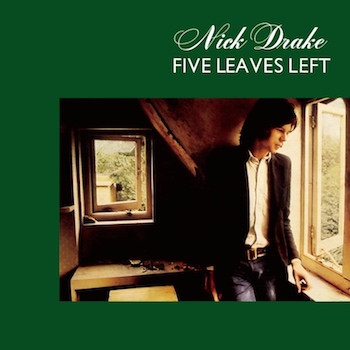
46 years ago this week, Nick Drake released his debut album ‘Five Leaves Left.’ Don’t go looking for extensive chart statistics to map the career of Nick Drake, because there aren’t any. That’s to say that, however much we now rightly revere the quintessential sensitive singer-songwriter, his tragically short life was painfully unrepresented by any commercial rewards on either the UK or US charts while he was alive. A far cry from today, when you hear his music playing everywhere, from album-oriented radio stations to supermarkets.
Drake’s all-too-brief recording span and his debut album Five Leaves Left. Produced by the great acoustic music frontiersman Joe Boyd and released by Island Records on 1st September 1969, the LP featured such timelessly haunting pieces as ‘Time Has Told Me,’ ‘River Man’ and ‘Way To Blue.’
Often depicted as the archetypal doomed young singer songwriter of his generation Nick Drake remains almost impossible to pin down in any such flippant way. Even nearly forty years after his death the songs of Drake find a resonance with new audiences and artists not born when he was recording the three albums that appeared in his lifetime Five Leaves Left, Bryter Layter and Pink Moon.
Although these recordings sold relatively poorly on initial release such is their drawing power for those who love introverted, folk tinged verse and melody that Nick’s songs have sound bedded adverts, featured in successful movies and been reinterpreted by a host of admirers on larger stages than he ever inhabited. The usual irony of such matters persists Drake couldn’t contemplate long tours and loathed interviews but didn’t entirely shy away from limelight. He could be reclusive yet maintained separate circles of friends who rarely came into contact with each other but felt a bond because of their kinship with Drake himself.
Don’t go looking for extensive chart statistics to map the tragically short career of Nick Drake, because there aren’t any. That’s to say that, however much we rightly revered the quintessential sensitive singer-songwriter today, his short life was painfully unrepresented by any commercial rewards on either the UK or US charts while he was alive. A far cry from today, when you hear his music playing everywhere, from album-oriented radio stations to supermarkets.
Five Leaves Left,’ which took its title from a message near the end of a packet of Rizla cigarette papers, was recorded between the summer of 1968 and a year later. It featured contributions from Richard Thompson, then of Fairport Convention, on guitar, Danny Thompson on bass and others, as well as the beautiful string arrangements of Robert Kirby.
‘Five Leaves Left’ has come to be a classic album , In 1975, the NME’s Nick Kent described it as “one of those albums that seem tied to exhorting and then playing on a particular mood in the listener, like ‘Astral Weeks’ and ‘Forever Changes.’ Indeed, the public’s apparent indifference to Drake’s singular talents was not for lack of some critical approval. Mark Williams ‘Five Leaves Left’ as a new release for the International Times, made the point that the newcomer’s voice would be compared with Donovan’s.
The stranger, the search, the illusion, the myth have all deepened over the years but there is no question that Nick Drake today is more popular than ever. His second album,Bryter Layter, was placed a cool first in The Guardian’s list of ‘Alternative top 100 albums ever.’ Not second, fourteenth or ninety-ninth but number one. We’ll never know whether Nick Drake would have appreciated the attention his albums receive now but one hopes he would have sorted his personal demons out and banished them while sadly accepting that without them he may never have created his greatest work.
By the turn of the 1970s, the world was a very different place from the utopian image of endless Californian surfing, cars and girls, as represented by the Beach Boys. But once again, the group rose magnificently to the challenge of making music that was both socially relevant and evocative of their initial glory. On August 30th, 44 years ago, they unveiled their new surfing sound of the ‘70s with the classic album ‘Surf’s Up.’
One of the great landmarks in the Beach Boys’ canon, the record was released on August 30th, 1971 at a point when their commercial fortunes had been at a low ebb. Their album of 12 months earlier, ‘Sunflower,’ had only reached No. 151 in a meagre four-week run on the American charts, and the group hadn’t had a top 20 single in the US since ‘Do It Again’ (which topped the British bestsellers) hit No. 20 in 1968.
The new project, produced by the band themselves for their Brother label, got the Beach Boys’ ship moving in the right direction again. They were now working with a new manager, Jack Rieley, and with his encouragement, they became a multi-faceted songwriting force.
‘Surf’s Up’ is rightly remembered for Brian Wilson’s brilliant double-header that closes the album, ‘’Til I Die’ and the title track collaboration with Van Dyke Parks, filled with its enigmatic lyrics and stirring harmonies. But just as remarkably, the album showcased a group with multiple writing teams, all bringing excellent work to the table.
Mike Love and Al Jardine contributed an opening song with an anti-pollution lyric that was really ahead of its time, ‘Don’t Go Near The Water.’ Carl Wilson and Rieley completed ‘Long Promised Road,’ and Carl’s sweet voice led his own ‘Feel Flows.’ Al and Gary Winfrey added the short, equally relevant ‘Lookin’ At Tomorrow (A Welfare Song),’ the pair working with Brian on ‘Take A Load Off Your Feet.’
Bruce Johnston’s writing contribution was the magnificent ‘Disney Girls (1957),’ while Brian and Rieley composed the plaintive ‘A Day In The Life Of A Tree,’ on which the group’s manager also sang. There was even room for Mike Love to sing his adaptation of Jerry Leiber and Mike Stoller’s ‘Riot In Cell Block No. 9,’ renamed ‘Student Demonstration Time’ for the social situation of the day.
Dennis Wilson’s reduced role on the project was partly because he was working on solo material, and partly that the songs he contributed were omitted to avoid in-fighting within the group, and the album being dominated by only Wilsonbrothers compositions.
‘Surf’s Up’ was perhaps the Beach Boys’ most ecologically prescient work, and the press voiced their approval. “’Don’t Go Near The Water’ is probably the best song yet to emerge from rock’s current ecology kick,” wrote Time magazine. Richard Williams added in Melody Maker that “suddenly, the Beach Boys are back in fashionable favour and they’ve produced an album that fully backs up all that’s been recently written and said about them.”
The album climbed to No. 29 in the US, their best showing since 1967’s ‘Wild Honey,’ and No. 15 in the UK. It’s since won its rightful place in Rolling Stone’s ‘500 Greatest Albums Of All Time.’ Even if not all of the Beach Boys themselves regard it as a true classic, the album moved the magazine Time reviewer to say that Brian’s music for it “has a high, soaring, quasi-religious vocal and instrumental character that even the Beatles of ‘Abbey Road’ could envy.”
We change Ear To Ear records with Raphalite Records (Shauna & Marc) in “REVOLUTION – The ShoegazeRevival” Compilation for some reason. Raphalite Records is a Trans-Atlantic boutique label, based in Wales, UK and Ontario, Canada. Carrying on the tradition ofCreation Records and early 4AD, we look beyond the borders that most labels are limited to, uncovering hidden gems and bringing them to the world. We invite you to gaze into our world and dream with us you can listen the compilation, here:
“Revolution – The Shoegaze Revival” is an epic, truly international 30-track compilation comprised of outstanding original material. Such bands have set the stage for shoegaze pioneers’ return to today’s scene by upholding their wall of sound and painting it with breathtaking colour. Some of these bands are also ‘first wave’ but have remained underground, while some are newbies – the ‘second wave’ of shoegaze.
Curated by UK label Raphalite Records and Indonesian label Gerpfast Kolektif, this compilation features 30 bands from 16 countries, covering 5 of the 6 inhabited continents. Each was selected purely on the basis of their dynamic sound, without any consideration of geographic preference, label affiliation, popularity ranking or hype. Without even one throwaway or filler track, these are all ‘keepers’.
This is not a shoegaze tribute album to MBV or Slowdive, or even The Beatles. There is simply so much greatness to the new wave of shoegaze that we’re focusing on original tracks, which showcase the immense talent of the featured bands. For some, this album may be the best shoegaze soundtrack they’ll encounter in 2015. At minimum, this will serve as a fantastic introduction to these new sounds and happily tide existing shoegaze fans over for quite some time.
Creation Records co-founder Joe Foster (also noted for producing My Bloody Valentine, Primal Scream, and Jesus & Mary Chain) is also throwing his support behing this initiative, stating “This is a new comp with the best of the world shoegaze/magical psychpoppy’s REBIRTH…. Why do I refer to rebirth instead of revival? In contrast, a *rebirth* in the same period gave us such bands as The Cramps, Primal Scream and Cocteau Twins – what a range!! And such a huge and wide world of music…this is exactly what is happening again in a new and unexpected way! 30 bands from 16 countries worldwide…an unprecedented spread of hope and art”.
Members of Swervedriver, Slowdive, The Brian Jonestown Massacre, Swallow [4AD], Strata Florida [Saint Marie Records] and The Telescopes [Creation Records] have also expressed their support, as well as renowned British producer Fran Ashcroft (Damon Albarn, Lords of Acid). We are hopeful that this compilation will help move this genre beyond being “The Scene That Celebrates Itself” to one that is also celebrated by others…
releases 10th September 2015
Released by both Raphalite Records (UK) and Gerpfast Kolektif (Indonesia). Curated by Shauna McLarnon and Marc Joy for Raphalite Records, as well as Aditya Pandu Wijaya (Pandu) and Mochamad Romadhon Febriarianto (Ari) for Gerpfast Kolektif.
When Harvey Brooks got a call from his longtime friend Al Kooper about sitting in on a studio session in the summer of 1965, he took it. Work was work, and Brooks, who was playing six nights a week in and around New York City, wasn’t inclined to pass on the paycheck. He stopped by Columbia Studios, where behind the console stood a skinny, short, frizzy-haired man he had never met. This was nothing new, he recalled. After all, studio musicians typically walk into sessions without knowing much about what they are walking into.
But even by that loosely defined caveat, this was different. As he entered the studio, he overheard the playback of “Like a Rolling Stone”, the lead track on the classic-in-waiting Highway 61 Revisited. The impact on the young bass player was forceful and immediate. It was all Brooks needed to figure out he was about to step in and be a part of something special.
“It was an intro to those kinds of lyrics that I had never heard before,” Harvey Brooks said, referring to the literal, stream of consciousness lyrics that would quickly become a Bob Dylan hallmark. “I felt like, ‘You know what? I’m in the right place. This is a good place to be.’ I knew something was working.”
There’s not much that can be said about Highway 61 Revisitedthat hasn’t already been said over the last 50 years. The talking points have been exhausted, whether it be Bob Dylan’s supposed spurning of his folk roots in favor of scarcely navigated rock and roll throughways, the record’s surrealist lyrical lean, or the way it seemed to effortlessly wrap its arms around the social upheaval that came to define the ’60s. The same can be said about the individual tracks therein. “Like a Rolling Stone” could quite possibly be the single most psychoanalyzed song in the history of popular music, while others like “Ballad of a Thin Man”, “Desolation Row”, and the record’s title track aren’t very far behind it.
Even today, everything about Highway 61 feels like a riddle, this curious musical vessel overstuffed with great songs and wiser-than-thou pearls of boho wisdom. It’s also the rare record that not only succeeded, but excelled in the face of unprecedented controversy. Just months after being publicly assailed for going electric onBringing It All Back Home, it seemed like Dylan had made his bed. Instead he dove even further into rock and roll only to come out the other side with the best record of his career. That was saying something in 1965, but it says a whole lot more that Highway 61 still earns the title five decades later.
We know all this though, right? It’s easy to extol the virtues of the record decades after the fact, but Brooks knew none of this in 1965, even if he knew he was stepping into uncharted territory. Bob Dylan assembled a collection of players with all levels of experience for the sessions, which kicked off in June and ran through the beginning of August 1965. Piano players Paul Griffin and Frank Owens and drummers Bobby Gregg and Sam Lay were seasoned studio vets, Brooks recalled, while he, Kooper, and guitarist Mike Bloomfield were only beginning to climb the ladder as session players. Brooks, for one, came into the sessions knowing little at all about Dylan’s music.
“Highway 61was all news to me,” he said. “But you know, there was an electric feeling to it all. It was the excitement of getting a job that was just a couple of notches higher, being surrounded by real professionals. Then there was the excitement of the music, because it was different. It wasn’t standard stuff.”
Brooks was brought in to replace Russ Savakus, the original bassist for the Highway 61 sessions. After a quick introduction, Brooks and the rest of the band plugged in and got to work. Kooper had recommended Brooks in part because he was a quick study, a trait that proved vital to fit in with Bob Dylan’s highly intuitive songwriting approach. Dylan wasn’t a task master in the studio, Brooks recalled. Less concerned with striving for perfection, the singer honed in on the band’s performance. The songs took shape as the band played. When he heard something he liked, they rolled tape.
“He’s writing by instinct,” Brooks said. “It all came out of his mind. As he was receiving it, he transferred it right into his chords. That’s why the changes aren’t so locked in. It’s kind of the same way old blues singers used to do it. They do things by the phrasing, and Dylan’s a great phraser. That’s really what we were doing subconsciously.
“There’s all different kinds of ways to play,” he said. “You can play on the beat, in front of the beat, behind the beat, playing in the pocket, a little out of the pocket. Highway 61 was the beginning of me thinking about all those kinds of things.”
By August, the majority of the record had been wrapped and recorded, but there was one glaring omission. Bob Johnston, who produced the Highway 61sessions, needed a guitarist for the record’s last track. He wanted to get Dylan to come to Nashville to record, which the singer refused to do. Not to be deterred, Johnston brought a little bit of Nashville to New York. He called up Charlie McCoy, a young, budding session player he met in Nashville while pitching songs for Elvis Presley films. When he got his break as a producer and moved to New York, Johnston offered McCoy tickets to Broadway if he ever found his way East. McCoy quickly took him up on the offer when he visited town for the World’s Fair. That’s when Johnston made his pitch.
“He said, ‘Oh, and by the way, I’m having a session with Dylan in the studio this afternoon. Why don’t you come by and meet him?’” McCoy recalled. “I went over to Columbia Studios, and Dylan said, ‘I’m getting ready to record a song. Why don’t you play along?’”
The song was “Desolation Row”, which at an almost unprecedented 11 minutes far exceeded the neat and tidy singles McCoy was accustomed to playing on. The offer came with a certain amount of self-induced pressure, McCoy said. He could play, but he was a harmonica player first and foremost, not a guitarist. The song is sparse, leaning on little more than Dylan’s vocals, Savakus on acoustic bass, and McCoy’s guitar, and McCoy only had two takes to knock the song out.
“Back then, it was 2:30, cut the music,” McCoy said. “Two verses, a bridge, a chorus, and you’re done. If there was pressure, it was me putting it on myself. I learned a long, long time ago that the most important session you’ll ever do is the one you’re on right now. The one that’s tomorrow is tomorrow. Don’t worry about it.
“You’re trying to do something interesting without getting into a rut and doing the same old thing, over and over again,” he added. “I haven’t struggled a whole lot in my career. I’ve been pretty fortunate. But I was struggling that day, no doubt about it.”
For all the consternation and worry, the song, and the record as a whole, resonated with a whole generation of fans and bands upon its release on August 30, 1965. McCoy’s part, in particular, earned acclaim for the way it filled out Dylan’s dense, peculiar lyrical imagery. But looking back on the record, McCoy doesn’t think about its influence on his career as much as he does the ripple effect it created throughout the musical world, one that reverberated all the way out to Nashville. He credits the success of Highway 61 and future Dylan records such as Blonde on Blondewith helping the city crossover to more rock-oriented audiences. The city that was once solely the province of the likes of Patti Page and George Jones was now welcoming acts as varied as Joan Baez, The Byrds, and Leonard Cohen.
“We’ve always cut music here that crossed over, but none of those folk-rock people ever came here before,” he said. “Nashville, as a recording center, was a recipient of that good fortune.”
Highway 61 helped open up doors for both musicians. McCoy, now 74, went on to work with Johnny Cash , Chet Atkins, and even pop rock satirists Ween in addition to undertaking a successful solo career of his own. Brooks, meanwhile, followed up Highway 61 by lending his bass to Miles Davis, The Doors, and Seals and Crofts, among others. But even with those hefty credits, both admit that there are few substitutes for sitting in with Dylan during the formidable stages of their musical careers. A trip to New York for a Broadway show, the ring of a telephone. Little did they know then how those simple triggers would be their entry into pop music history.
“The fact that so many people across the world relate to that record the way they do, that’s special,” Brooks said.
It’s been just over a year since Ben Semeta moved to Boston. In that time, the Black Beach bassist has become both familiar with and a fixture in the city’s underground music scene. The longer he stuck around, however, the more he realized that it suffers from a disconnect. Boston residents are generally clueless when it comes to the deep pool of talent in our boroughs – and it’s not just the North End couples or Financial District bros. People who actively go out to explore Boston’s local music, both as fans and musicians, aren’t fully aware of the grunge, rock, and psych bubbles. There’s a weird disconnect between genre-split scenes here, so a week before Christmas last year, Semeta figured out a way to help solve that: compile some of Boston’s best garage, rock, and psych music onto a compilation album.
“Matt [Garlick] from Nice Guys and I were hanging out one night and I turned to him and said, ‘Dude, it would be great if we could get a compilation together to highlight what’s happening in Boston,’” He recalls. Thus, House of the Rising Fuzz was born. “I like to think I like to get things done. A lot of bands were skeptical at first. They’ve been asked to be on compilations before, but it always falls through. I knew this would happen. I wanted to make sure it did. I wanted to show people what everyone’s been doing in our city.”
After leaving the hardcore scene of the south shore for Boston, Semeta was impressed by how much talent surrounded him. Everyone worked hard, but few focused on weaving music scenes together. “I remember seeing Creaturos open up for FUZZ a year ago and having my mind blown,” he recalls. “Anyone who’s listened to Creaturos will pick up the record and maybe hear Midriffs for the first time. Kids who go to college with Midriffs will pick it up and be like, ‘Oh, who’s New Highway Hymnal.’ It’s a great way to do these informal introductions.” Even Semeta discovered new music in the process. Garlick suggested he include The Monsieurs in the compilation, an add that rounds out the sound with edgier punk rock.
In January, Semeta reached out to 10 bands—The New Highway Hymnal, The Monsieurs, Black Beach, Midriffs, Miami Doritos, Nice Guys, Dinoczar, The Barbazons, The TeleVibes, and Creaturos—with three requirements: write a song, fork over a piece of artwork, and give their sworn commitment. “Getting my band together for band practice once a week is hard enough, let alone getting ten bands in the same room,” he laughs. But sure enough, all 10 bands stuck with it, their original skepticism swept aside.
Don’t expect crummy recordings. House of the Rising Fuzz is start to finish high quality energy, personality, and spirit. “When you’re sitting in a basement and everything is loud and distorted and overdriven and in your face, all these bands sound similar,” he says. “When you hear them recorded and produced, every track is actually really different from one another. Not one song on here was produced by the same person. That’s huge.” Especially so given the compilation is entirely independent. Semeta isn’t a label. He’s never pressed a record. Figuring out how to handle artwork mishaps and company lingo was new turf, but the polished sound and packaging of the album looks like the work of a major label.
House of the Rising Fuzz benefits from the phenomenally cartoonish, spooky, bizarre artwork of Clark Jackson. The cover—a painting of a romping, furry giant waddling through a colorful field—recalls the detailed line-work of Thee Oh Sees‘ Master’s Bedroom or the cuddly creatures of Hayao Miyazaki’s films. “I’m a huge fan and knew right away I wanted him to draw the artwork,” Semeta says. “I asked him to listen to these 10 bands and draw whatever he environed an album for these 10 bands looking like, especially if it could be like Ty Segall or John Dwyer. It’s our spin on a west coast grunge.”
It doesn’t take more effort to understand why Segall and Dwyer are Semeta’s role models. The two pretty much run modern day garage rock in San Francisco and Los Angeles, a takeover started and, to some degree, still run through purely cult-following dedication and relentless DIY hype. In Massachusetts, we have yet to form our own equivalent. “It’s hard to find out about some of these bands because they don’t have the major representation from PR or buzz like Ty Segall,” he explains. “One of the goals for this compilation is to give this scene that we’re involved in some representation.”
At the same time, a lot of that is changing. On July 17th, Pile, Creaturos, Vundabar, IAN, and Milk sold out the Middle East Downstairs, a 600-cap room. It’s impressive when the Middle East Upstairs sells out with an all-local bill. Now it’s impressive when a place three times the size of that does because it’s more than friends at that point. It’s straight up fans. “It’s neat to go out to a packed venue where you know so many people and you look at each other like, ‘Holy shit, we’re doing this,’” says Semeta. “I’ve seen Brand New play down there and it sold out in seconds. Here I am, showing up late to this Pile show, and there’s a line just like that around the corner with all these kids I’ve never even seen. It wasn’t like, ‘Sweet, these bands and their friends are here to see them.’ It was fans of the local scene. Boston’s at a weird point where we’re on the upswing, and I think a lot of people may feel discouragement because they aren’t blowing up as fast as they think they should be, but they need to hold out. It takes a lot for a local bill to sell out the Middle East Downstairs. A lot of things are going unlooked, but that might change… and soon.”
House of the Rising Fuzz is Semeta’s chance to keep the momentum going. Getting to share this music with people who are unfamiliar is more than a goal; it’s a pleasure. “These are the artists I started playing with when I moved to Boston and they’re killed it every time I saw them,” he says. “Now it’s so cool to get to work with them.”
But pressing the record was just the beginning. Semeta expanded his original vision of targeting record stores in Chicago and Los Angeles to now hitting up radio stations, press outlets, and more with help from friends. “I’m winging it and hoping for the best,” he says. “A lot of people in this community are giving their support. They’re throwing suggestions out that help so much. They see the potential in the project and its good goals and they feel inclined to help. It seems really genuine and I’m so grateful for it. To everyone: thank you.”
On August 6th through the 8th, physical copies will be available to purchase at Boston Fuzzstival 2015. Pick up a copy and scan the list of artists; it’s a doozy. While those included are some of Semeta’s favorites, there’s just as more unlisted acts that he hopes to work with soon. “I’m already thinking about doing a second LP next year, probably with 12 bands: Idiot Genes, Zip-Tie Handcuffs, Vundabar, Wakes, St. Nothing, Brazil, and all these other bands I love,” he says, tacking on Grave Ideas and Rick Maguire of Pile moments later. He may be eager to distribute the original compilation, but the thought of a follow-up excites him just as much.
By the end of our conversation, Semeta’s enthusiasm and devotion to Boston’s garage rock scene detaches itself from his time here as a resident. It’s hard to believe he’s lived here for only one year. At this point, the thought of separating his life from these bands is laughable. It can’t be done.
“If nothing comes from this release, it’s a cool time capsule,” he says. “Do you think the DC punk kids in the ’80s knew they would be famous? Do you think Fugazi knew they would be one of the most influential bands of all time? Do you think Minor Threat knew they would be one of the most influential bands of all time? No. They were just doing their thing and they left behind a legacy that’s really independent, underground, and interesting.”
Semeta is sitting on a gem of a compilation. To some extent, it doesn’t actually matter how far its songs echo across the United States. Boston’s psych, garage, and rock scenes have a chance to spread their arms here, and to make themselves heard beyond the basement of their own backyard is a thrill. We’re proud to present the album premiere. So grab your friends, a six pack, and the best speakers you have. You’ll want to turn this one all the way up so the folks over in Northampton can hear it.