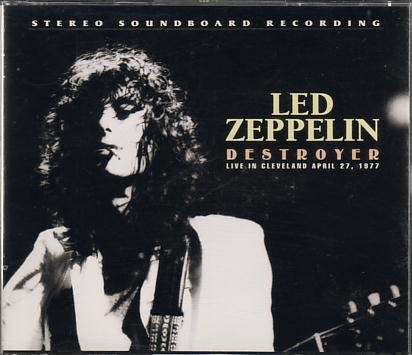
Despite being part of a tour that eventually evolved into violence and heartbreak, Led Zeppelin put it all together during their April 27th, 1977, stop at the Richfield Coliseum near Cleveland .
“Zeppelin-ologists claim this was one of Led Zeppelin’s best shows on the tour, And much like the 10th anniversary Springsteen concert at the Agora , this 1977 Coliseum show was one of the most bootlegged of LedZeppelin’s career.”
The best of those bootlegs remains the three-disc set “Destroyer”, which included the entire 18-song performance from the opening “The Song Remains the Same” through to a two-song encore of “Rock and Roll” and “Trampled Under Foot” that arrived more than three hours later. Better still, unlike lo-fi fare such as the fan-made bootleg Listen to This Eddie from later on during the same tour, “Destroyer” offered remarkably clear audio. The exceptional sound quality throughout the performance is described by some sources as “almost perfect”.] It was the first, and for many years the only, professionally recorded mixing desk tape to escape from the band’s possession
Led Zeppelin ended up running through an impressive setlist of fan favorites that night in Cleveland, including “Since I’ve Been Loving You,” “Stairway to Heaven” and “Kashmir,” while sprinkling in newer fare like “Achilles Last Stand” from their latest album “Presence”. A standout moment arrived courtesy of John Paul Jones . who led an improvisational run through “No Quarter” that stretched to 20 minutes in length.
“Working from both electric and acoustic pianos, John Paul Jones again impressed with his general versatility,” It was one of the best rock jams I’ve ever witnessed.”
The liner notes for “Destroyer”, issued by the Shout to the Top label, actually thank John Bonham for use of the tapes, though initial vinyl pressings incorrectly placed the concert at Seattle. Later, a bootleg of the bootleg appeared; it was edited down to two discs by omitting Led Zeppelin’s lengthy take on “Moby Dick.”
Together, these bootlegs seem to celebrate a band at the top of its game. A show held three days after this Cleveland stop went on to draw more than 76,000 fans to Detroit’s Pontiac Silverdome setting a record for an indoor arena at that time. In actuality, however, Destroyer documented the beginning of the end.
Dates in support of Presence, Led Zeppelin’s seventh studio record, had kicked off on April 1st, 1977, in Dallas, with 51 concerts scheduled. They’d never get there.
When Led Zeppelin reached the Riverfront Coliseum in Cincinnati on April 19th, 1977, more than 2,000 fans without tickets attempted to crash the gates – resulting in around 70 arrests. Later, on June 3rd, a riot broke out in Tampa after an open-air concert was cut short by a thunderstorm, leaving behind scores of injured fans. Moving forward in a tense, drug-fueled environment, Led Zeppelin’s performances were criticized as increasingly overblown and inconsistent.
Then Robert Plant’s son Karac died on July 26th, 1977, after a a severe stomach virus . Already fearful that things were going off the rails, Plant took an extended period of time away to grieve. A tour originally intended to last through August. 13th abruptly ended.
“By 1977, I was 29, just prior to Karac’s passing, and that sort of wild energy that was there in the beginning had come to the point where we were showboating a bit,” Plant told Uncut magazine in 2008. “Unfortunately, we had no choice. We were on tours where places were going ape s—. There was no way of containing the energy in those buildings. It was insane. And we became more and more victims of our own success. And the whole deal about the goldfish bowl and living in it, that kicked in.”
Led Zeppelin eventually rallied to produce 1979’s album “In Through The Out Door” but by September. 24th, 1980, Bonham was dead aged just 32, and Led Zeppelin were no more. Already scheduled North American concerts, including a return to Cleveland on October. 25th-26, 1980, were cancelled.
That left a July 24th, 1977, date in Oakland, less than three months after Led Zeppelin’s heralded stop at the Richfield Coliseum, as their last-ever concert in the U.S.
Led Zeppelin, Cleveland, April 27th, 1977 Set List
“The Song Remains the Same”
“Sick Again”
“Nobody’s Fault but Mine”
“In My Time of Dying”
“Since I’ve Been Loving You”
“No Quarter”
“Ten Years Gone”
“Battle of Evermore”
“Going to California”
“Black Country Woman”
“Bron-Y-Aur Stomp”
“White Summer/Black Mountain Side”
“Kashmir”
“Moby Dick”
[Guitar Solo]
“Achilles Last Stand”
“Stairway to Heaven”
Encore:
“Rock and Roll”
“Trampled Under Foot”
Blondie have unveiled a sprawling and exhilarating rendition of “Fragments,” the closing track from their forthcoming new album release “Pollinator” due out May 5th. Vancouver Indie artist “Unkindness” the musical project of Adam Johnston – released “Fragments” in 2010.
On their version, Blondie flip Johnston’s folk ballad into a prog-tinged epic that begins with a spaced-out intro and morphs suddenly into a driving rocker. While a rollicking piano recalls the stripped-down instrumentals of Johnston’s original, Blondie inject their rendition of “Fragments” with delirious synths, roaring guitar and gritty bass while Debbie Harry unleashes a vocal performance packed with plenty of potent theatricality.
“Fragments” follows previously other released Pollinator tracks “Fun” a collaboration with TV On The Radio’sDave Sitek, and the track “Long Time” which was co written with Blood Orange Dev Hynes.
Pollinator will also feature contributions from Sia, Charli XCX, Laurie Anderson, Joan Jett, former Smiths/Modest Mouse guitarist Johnny Marr and the Strokes’ Nick Valensi.
Blondie are to embark on a Co-Headlining Tour with Garbage.
Official audio for “Fragments” from the upcoming album “Pollinator” out 5/5/17
After a winter of recording new music and a party last weekend at Old Settler’s Music Festival, I’ve got a new/old…limited double EP coming out as well as a tour later this summer.
First off, thank you all so much for participating in Shakey Graves Day each and every year. Due to your requests and the need to give some of my songs the life they deserve, I am releasing two of my previous albums out into the world for good and I chose the shortest title I could think of…Shakey Graves And The Horse He Rode In On (Nobody’s Fool & The Donor Blues EP). Yes, this is a double EP and only a limited amount will be pressed on a clear 180-gram double vinyl, first come, first serve. You can head over to shakeygraves.com or my bandcamp page right now to pre-order the double EP on physical or digi. Orders will begin shipping one week prior to release date (June 30, 2017).
Secondly, me and the boys are headed back on the road this August for a quick mission as we continue to write and record new music in between. We’ll be inside you Missouri, Iowa, Montana, Wisconsin, North Dakota, Canada, Minneapolis, St. Louis, Birmingham, Georgia and more…full dates are below and at shakeygraves.com. On this August run we are going to be accompanied by my homie and brilliant friend, David Ramirez!
When bands play at Third Man Records in Nashville, the shows are usually recorded to be released on vinyl as part of their Live at Third Man series. If you are fortunate enough to be in attendance, then at the show you can preorder a special Black & Blue split vinyl attendee version of the night’s performance.
Right now on Third Man Record’s site you can order the Black & Blue version of the recent performance by the great Brooklyn band Woods. The order page lists it as in stock, but the performance was just earlier this month and the usual turnaround on the Black & Blues is months and months. So, be forewarned that this may actually be more of a preorder.
As far as I know this is the first time that Third Man Records has sold the Black & Blues online outside of the refresh-athon sale they held a few years back.
Certain bands in this supersaturated, hyper-fragmented, temperamental internet era that rise above ephemeral popularity not because they perpetually reinvent themselves or stay ahead of trends or make headlines with crazy antics or write a mega hit or have a super dreamy frontperson… there are certain bands that rise above because of one characteristic that trumps all others: consistency. Woods is one of those bands, and their wheelhouse is a decidedly mellow blend of folk, psych, soul, and funk that’s wise beyond its years in timbre and lyric. It’s a comforting kind of music Woods makes. It doesn’t take you anywhere you don’t want to go, even if they world they depict is less and less hospitable with every passing day. It’s a soundscape reflective of the world it was created in, and its lack of call-it-action and angst makes it endlessly listenable for those of us with regrettably overactive minds. With over ten years and nine studio records under their belt, this Brooklyn band also runs their own label and 2-day festival at Big Sur, and has carved out a loyal legion of appreciators who extol their steadfast artistry and work ethic. We got to see the Nashville Chapter of this legion, as well as a whole slew of new members, at their live taping in our Nashville Blue room, Monday May 2nd. All captured on their Live at Third Man Records LP.
The transformation began and sprouted its roots on his previous album, 1983’s Uh-Huh , in which the artist, having finally scored big the year before with American Fool, won the right to credit his real surname on the cover. He had to settle for a compromise — that ridiculous “Cougar” stage name wasn’t going anywhere yet — but the victory was big enough to matter.
Uh-Huh also included his first fully formed shot at breaking the hard-ass rocker image the record company had shaped for him on his first Top 40 hit, 1979’s “I Need a Lover,” “Pink Houses” (though American Fool‘s “Jack & Diane” came close). But Scarecrow was (mostly) a full album of smart, heartland-inspired and Americana roots-pulling rock ‘n’ roll. And the compromises this time were few. Scarecrow is the moment where his past became a distant memory and he finally found his voice. Happy 35th Anniversary to John Mellencamp’s eighth studio album “Scarecrow”, originally released August 5, 1985.
When John Mellencamp’s “Small Town” was released on his “Scarecrow” album in September 1985, the song helped launch a form of heartland rock that celebrated family farms and blue-collar workers.
Originally written by Mellencamp as a valentine to his hometown of Seymour, Ind., “Small Town” reached No. 6 on pop charts in early ’86 while “Scarecrow” climbed to No. 2 on the album chart.
He was an artist in transition from Cougar to Mellencamp and “Scarecrow” was the album through which he truly came into his own. An album where he decided to bet on being the artist he wanted to be, not the one the label would try to cultivate. And it is a powerful album.
“Scarecrow” was reissued this month on the extra-thick 180-gram vinyl format by Mercury/UMe in advance of Mellencamp’s tour . Recently, John Mellencamp, 64, looked back on the song’s evolution. Edited from an interview: I was 12 when I first picked up a guitar. My family lived in Seymour, Ind., and my older brother, Joe, was the star of our high school musicals. In one show, he had to play some guitar chords, so my parents bought him a nylon-stringed model.
Once the musical was over, the guitar sat in the corner of the bedroom we shared. One day I grabbed it. My goal was to learn enough chords to play along with the songs I was listening to on the radio.
I never had a guitar lesson in my life and I still can’t read music. But I had a good ear and a feel for it. By 1965, I was in a soul band that played parties, dances and proms at local high schools and colleges.
I was 14 and the youngest kid in the seven-member band. The older musicians all knew American soul music inside and out. We covered obscure pop and soul songs by big stars, which exposed me to music that most people never get to hear. I also learned about racism. Three of us in the band were white and the rest of the guys were black. The audience loved us when we played. Offstage, the black guys in the band were often met with racial slurs. I was offended at their treatment, not to mention my great-great grandmother was black.
After junior college, I went to New York hoping to get a record deal or be admitted to the Art Students League to study painting. After dropping off a demo tape at Main Man, the management agency signed me and cut a deal with MCA Records. They also insisted I use “Cougar” as my middle name. I hated that.
I had no songwriting skills, so my first few albums were awful. They featured mostly cover songs and early originals. Critics didn’t like me, so I knew that to make it, I’d have to write songs and convince radio to play them.
I began carrying a pad around and jotting down lyrics for songs I was working on. By 1984, I had written and recorded quite a few top-10 hits, including “Jack & Diane,” “Hurts So Good,” “Crumblin’ Down” and “Pink Houses.”
At the time, my label, Mercury/Riva, wanted an album from me every 18 months. In between I was on tour, so I was rarely home. But one day in ’84 when I was home in Bloomington, Ind., Vicky, my wife then, called me down to our basement laundry room. When I got there, a big box was on our clothes-folding counter.
I’m the worst speller in the world, so Vicky had ordered an electric typewriter with a built-in spell-check system. I tried to make sense of the owner’s manual, but I couldn’t figure it out. I’d put a sheet of paper in and start typing, but the words I misspelled weren’t being corrected.
Frustrated, I said to myself, “Well, I guess I’m just a stupid hillbilly. What do I know? I was born in a small town.” After a few more minutes with the typewriter, I began to realize it didn’t automatically correct misspelled words. It had a dictionary on a computer chip that identified words you misspelled and beeped to alert you to fix them.
I had my Gibson Dove, so I put the guitar strap around my neck and started playing and typing lyrics [he sings softly], “Well, I was born in a small town / And I live in a small town.” But as I typed my lyrics fast, the machine let off beeps to flag spelling errors: “All my friends—beep!— are so—beep!—small town / My parents—beep!—live in the same small—beep!—town.” Upstairs, I could hear Vicky and my Aunt Tootes, who was also our nanny, dying of laughter over the beeps. Finally I yelled out, “Would you guys shut up!”
Once the song started to come, it came fast. I’d sing some lyrics, type them out and play the music on my guitar. Then I’d start at the beginning to sing what I had to inspire additional lines.
Eventually I went upstairs, looked at Vicky and Aunt Tootes, and said, “I’m glad you guys think this is so funny.” They started laughing again. I said, “OK, now laugh at this.” I played them “Small Town,” and they went dead quiet. When you play what you’ve done for a family member and you get that kind of reaction, you know you have something.
For some time, my friends and I had been talking about how small towns and the people who lived there were getting screwed economically as America changed. Soon I realized that “Small Town” was more than a phrase of my own frustration. It was a song that felt as though Woody Guthrie had sent it to me from the grave.
That’s when I started working with Willie Nelson and Neil Young to organize Farm Aid. We planned a concert like Live Aid for September ’85 in Champaign, Ill. The purpose was to raise money for families trying to save their family farms from new laws that favored corporate farms.
From the opening narrative of generational famers sold out to corporate greed and seasonal change in “Rain On The Scarecrow,” there was a gritty, earthy realism to Mellencamp’s writing. Musically, it’s foreboding, murky bass and guitar lay the bed and the drums pound like impending doom making its way to your door. Reflecting on the plight of farmers, the backbone and lifeblood of a nation and the failing of the American dream, lines like “This land fed a nation / This land made me so proud / Son, I’m just sorry there’s no legacy for you now” hits you in the gut. And there’s no happy ending. There’s no promise of change. It’s just how it is.
This stark, unwavering honesty continues throughout the album, where change is a constant theme, and not always welcomed. “Minutes To Midnight” conveys the urgency of life advice passed down between elder to young buck that doesn’t resonate until age proves its truth, while the rocking strut of “Face Of A Nation” laments the loss or abandonment of founding ideals.
It’s there in the bittersweet moments of “Between A Laugh And A Tear” featuring Rickie Lee Jones on vocals and the momentary punch for hope in the metaphoric “Justice And Independence ‘85” that is still tinged with lament.
The album’s breakout hit, “R.O.C.K. in the U.S.A. (A Salute to ‘60s Rock)” that calls out musical heroes gives the album extra oomph with a catchy sing-a-long chorus and shakes with energy. And the bar-rock appeal of “Lonely Ol’ Night” still holds up with its joyous sense of rebellion against loneliness, and is sure to get people singing along while swigging their beers still.
The next step for “Small Town” was to arrange and rehearse it with my band. I had a second house a few minutes outside of Bloomington that operated as an office. I had added a recording studio and turned the two-car garage into rehearsal space.
In April ’85, the band and I went into the garage to arrange “Small Town.” I sat there like a conductor with the band facing me. There was no writing out parts. We had it all in our heads. I just told my drummer, Kenny Aronoff, what I wanted—a pounding beat—and we went to work.
“Small Town’s” opener was already written in my chord progressions. That was the hook line. The trick going forward was to keep the song simple and not over-arrange it. But we had a problem.
The song was verse-chorus, verse-chorus, verse chorus—it felt too same-samey. The solution was to add a bridge. In the garage, I took one of the verses [he sings softly]—“No, I cannot forget where it is that I come from / I cannot forget the people who love me / Yeah, I can be myself here in this small town / And people let me be just what I want to be”—and rewrote the melody to make it a bridge. This broke up the song’s sameness.
“Small Town’s” arrangement was critical. I knew there was no way I could walk out on stage and sing and play it acoustically. The audience would tune out. We also had to arrange the song in a higher key. Back then, I tended to write songs in a lower key and transpose them to a higher key later so I could belt them out on stage.
When the arrangement was done, we walked into the studio inside the house to record. I only sang on the record, I didn’t play. Larry Crane was on lead guitar. We finished the song in just two or three takes.
The only instrument we added later was John Cascella’s organ. For some reason, he wasn’t there when we had recorded. He came in later that night, and we overdubbed his part. At first, John kept trying to play complex stuff that didn’t work. Finally I said, “John, damn it, stop noodling around. Just go to those big chords.” What he played next was beautiful.
Before the single was released in November ’85, we needed something for MTV. In Bloomington and Seymour, we took out ads asking for snapshots and home movies. We were flooded with material.
The video was good, but I always felt it ruined the song. Songs are meant for dreaming, and the video gave my lyrics a literal context. The focus was all on me instead of letting listeners imagine their own small-town experiences.
I never used that tan typewriter again. Now I have no idea where it is—probably gathering dust in one of my storage units. Three-and-a-half decades on, Scarecrow holds up. It holds up well. The no-frills production still packs a punch. It still stirs the emotions, rouses the spirits, and grounds you to the earth. The authenticity remains. What more can you ask for?
Philadelphia band The Districts have announced a new full-length album entitled, “Popular Manipulations”. The follow-up to their 2015 excellent breakthrough effort, “A Florish and A Spoil ” due out August 11th via Fat Possum Records.
Four of the 11 tracks on the LP were recorded with producer John Congleton, who’d previously worked with the band on Flourish. The other songs were all self-recorded by The Districts themselves alongside Pine Barons member Keith Abrams. “Both sessions were great,” said frontman Robby Grote “We just have fun working with John. There’s a dialogue between us when we are working with him where he has suggestions or we’ll just talk stuff out, but it was definitely refreshing recording just a neighborhood away from where we live and doing it all ourselves with Keith. We viewed it as more of a challenge.”
In addition to the album announcement, the band released the single and video for lead single“Ordinary Day”, On Record Store Day 2017 7-inch vinyl. Directed by Out of Town Films, the clip is a brooding visual that Grote said “deals with ideas of loneliness, alienation and going through the motions in life.” It tackles those concepts by having the black-garbed band deliver a lifeless performance for a bunch of people in creepy white masks drinking milk.
Ty Segall has released a new music video for “Break a Guitar,” and it’s pretty wild stuff.
Directed by Matt Yoka, the never-ending barrage of spinning images starts off relatively normal and gets progressively weirder. We think it’s safe to assume that any music video that opens with Fred Armisen karate-kicking a guitar is going to be a trip. After that, we watch an increasingly bizarre kaleidoscope of Segall and his Freedom Band (Emmett Kelly,Mikal Cronin, Charles Moothart and Ben Boye) tumbling through space while Segall “elucidates on the universal absurdity of the rock and roll dream.”
According to a press release, the video aims to “distill the warped desires from Ty Segall’s twisted brain, providing true catharsis for performer and viewer alike.” We suggest waiting until you’ve had a cup of coffee or two at least to dive into Segall’s mind.
A clean flow; something real for a world that doesn’t know what it’s holding. Ty keeps us guessing while splashing our collective face with no shortage of astringent tunes of all colors.
Song from LP/CS/CD “Ty Segall”, released January 27th, 2017 on Drag City Records.
In the meantime, revisit Segall and his band’s recent live TV performance of “Break aGuitar” on Late Night With Seth Meyers, Ty Segall and his Freedom Band, made up of Mikal Cronin , Charles Moothart, Emmett Kelly and Ben Boye, performed on Late Night with Seth Meyers . They played “Break a Guitar,” the opener off of Segall’s recently released selt titled.
These last few years have seen a prolific amount of releases from the man Ty Segall’s from “Goodbye Bread” , Ty Segall has his finger on it. digging into your vinyl, since 2008. Ty plays the show one-man-band style and goes home and plans the rest: the records you got, tunes in your head, the unpretentious display of rock wealth. It’s 2011. Ty is 23.
Twins, It ain’t two records, but it is called Twins. Ty‘s new mind-blow won’t just make you see double, it’ll make you be double! Fold in on yourself endlessly, hold your own hand, and leap towards the mega-Segall-meteor of 2012, Twins.
Sleeper, Ty as Warrior of Mars, here to save Earth’s soul with naught but his six-string resonating axe and freedom-inducing sleeping technique. Sleep with the Segall, dream your dreams!
Manipulator, The clarion call/siren sound of his guitar….the helium-steamed ride of the vocals….track after track, releasing the thought that have been holding us down, all in the name of getting higher on pop songs. Why have one when you can have two? It’s a big world, and Manipulator has only begun to fight.
Emotional Mugger guitars sliced with scribble graffiti sprawled across the hemispheres;
stuttered, stunted, dual-mono machine dreams flashing sudden stereophobic and back again / two screens alone together squeezing shaking oozing metallic pool like brain blood, slowly draining away
all mental life. shaking ass / nihility at most corrodes candy’s gone no more fun.
Drag City Records are making these available to you and your pals on sale for this limited time
Released on LP vinyl (opaque white) limited to 1000 copies. Priests’ “Early Recordings” combines the band’s first two cassette-only tape releases, originally recorded in 2011 and 2013. The small run cassette releases were originally intended to be for purchase only at the band’s live shows. “We didn’t want everybody to hear it,” said drummer Daniele Daniele. “We were still learning our instruments, so these tapes were not intended to impress the world, just document where we were for our own sake.” Daniele met vocalist Katie Alice Greer the same week she arrived in Washington, DC to complete a fellowship at Georgetown University, and the two decided to start a band. Guitarist GL Jaguar joined soon after, and bassist Taylor Mulitz completed the lineup the following year. Tape 1 was recorded by Jaguar in his parent’s basement in Maryland. The band had existed for one week, and the trio had written four songs. “I was very eager to have evidence of the band exist for myself, because I didn’t know how long it would last, and I wanted to make music more than anything, said Greer. “Diet Coke”, the band’s first song, is a hundred second blast of pummeling energy and what would become Jaguar’s signature riffage.