Dregen has serious form with punk and garage rock through various groups – most prominently Backyard Babies and The Hellacopters, though fans will also recall stints with Michael Monroe and Tyla (of Dogs D’Amour) as well as highly charged supergroup (with Ginger Wildheart) Supershit 666. Now the busy Swede has teamed up with countrymen Grande Royale for this jet-packed blast of shouty, in-yer-face (yet deceptively sweet) garage rock’n’roll, fresh out of 90s Scandinavia with a twist of 70s London. Grande Royale has a history of working together with prominent names of the Swedish rock scene. The band has previously worked with Nicke Andersson (The Hellacopters, Imperial State Electric) and Ola Ersfjord (Dead Lord, Honeymoon Disease, Lucifer). For the release of the band’s fifth studio album “Carry On” they teamed up with Dregen, who adds vocals to the third single ”Just As bad As You”.
Grande Royale’s upcoming album ”Carry On” contains 11 tracks of high energy rock n roll. The Band has applied a rawer and more back to basics- approach for the album, keeping production simple while focusing on strong and catchy material. Orange fuelled electric guitars, crushing bass tones and thundering drums inspired by 90’s rock. Vocalist Gustav Wremer sings with more grit than on previous albums, adding a ton of attitude to the new songs. All put together, ”Carry On” offers an energetic and straight forward take on garage rock. Produced by the band members themselves, and mixed by Robert Pehrsson .
”On our previous record ’Take it Easy’ we experimented a lot with different instruments and sounds to challenge ourselves. To make something that, to us, is a bit unusual and that stands out from our other albums. On ’Carry On’ we’re focusing on what we’re best at – dirty garage rock n roll. We’ve basically recorded and produced the entire record ourselves. I think it ended up great. No fuzz, no muss, just rock!” – Gustav Wremer (guitars/vocals)
Dregen (The Hellacopters, Backyard Babies) has joined forces with Grande Royale for the release of the single and music video “Just as Bad as You”. The single is released on Friday, January 22 on The Sign Records, and is the third single leading up to Grande Royale’s upcoming album “Carry On”. With special guest Dregen on vocals, the band has created a highly energetic piece, delivering garage rock to a new generation.
Official music video for Grande Royale’s single “Just as Bad as You”. The track is featured on the band’s fifth studio album “Carry On”, released On The Sign Records
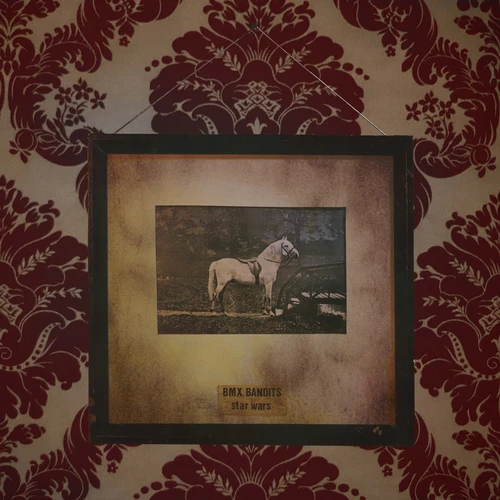
To celebrate the 30th Anniversary of BMX Bandits seminal sophomore LP Star Wars, Past Night From Glasgow will release the remastered album on Vinyl on May 4th (Star Wars Day)
Featuring the classic BMX Bandits line up: Stuart, McAlinden, Blake, Kelly, Keen and MacDonald the album is jam packed full of chiming guitars and catchy choruses not to mention the odd spectacular ballad. The sleeve has been updated (new wallpaper no less) and now features a die cut photo frame with an inner printed horse, how’s that for classy updates?, Rock & roll is not a game for those with innocent hearts. Fortunately, there have been a few people with innocent hearts who have slipped through the cracks and brought a real sense of joy to the music scene. One of them is Jonathan Richman and the other is Duglas Stewart and his BMX Bandits cohorts (including Francis MacDonald, Norman Blake, and Joe McAlinden, amongst others).
Perhaps these artists are not literally innocent, but the music they bring to the table is passive, pure, and carefree, not aggressive or mean spirited in nature. The Bandits, of course, are one of Scotland’s great unsung bands, sharing members with Teenage Fanclub, the Soup Dragons, Superstar, and others, yet steering a clear path of their own with captain Stewart and co-pilot MacDonald at the helm. Stewart’s voice is a strange mix of Mike Love, Lou Reed, and Richman, but works perfectly within the context of the Bandits’ music. With the sweet-voiced McAlinden (later of Superstar) handling lead vocals on a few tracks (and backing vocals throughout), there is a nice balance that saves the album from certain monotony.
Loaded with pop songs galore and beautifully produced by Duncan Cameron and the band, Star Wars is the first in a line of great Bandits albums. From the joyful “Come Clean,” “Students of Life,” “Life Goes On,” and “Do You Really Love Me?” to the heart-tugging “Extraordinary,” there is hardly a wasted moment within earshot. If you can imagine the sheer pop genius of Teenage Fanclub with Mike Love singing lead, then you may have an idea of what you’re in for. And if you could put wide-eyed innocent pop back onto the charts, then BMX Bandits would be superstars.
Joey Molland’s first solo record in close to a decade is a collaboration with the talented/wacky producer Mark Hudson, and a very pleasant listen from front to back. It finds Molland (who co-wrote the ten tunes with Hudson) playing up the pop-oriented strengths he first exhibited with Badfinger, and Hudson (who also plays and sings throughout) once again embracing the “Beatlesque mad wizard” guise he displayed during his tenure as Ringo Starr’s producer and musical director. Truth be told, it’s not much of a stretch to imagine Starr singing many of the tunes on “Be True to Yourself”, particularly the inspirational title track (with its oh-so-Beatles ’67 end bit), “This Time,” or the sunny-sounding “Rainy Day Man.” Hudson does a good job of masking some of Molland’s slightly gruff vocalizing by utilizing guests such as Julian Lennon, Jason Scheff and Micky Dolenz to lend some vocal support, while former Wings drummer Steve Holley mans the kit.
The Pete Ham-like vocal affectations on “I Don’t Wanna Be Done With You” and the cute little wink to “No Matter What” at the close of “All I Want to Do” should make the listener smile, as will most of the rest of Be True to Yourself.
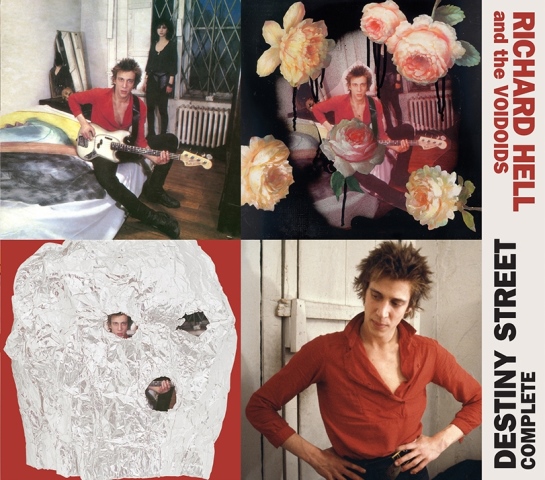
Three plus versions of the same album. It’s ridiculous, but I’m glad.” The first paragraph of Richard Hell’s text in the booklet accompanying “Destiny Street Complete” lays it out. There are, indeed, three versions of his and his band The Voidoids’s album released originally in July 1982 album “Destiny Street” on this double-CD set. It seems excessive but this is a major release of a classic in the making .
Reviews of “Destiny Street” at the time of its release were positive. Creem Magazine said “Hell himself has hit on a style – part Nuggets-era basement rock ‘n roll, part speed-balling protest (not in content, but in attitude) rock, part confrontational CBGB psychodrama – that gives the album its pungent reverberations.” When considering the album, the New York Times frothed “Mr. Hell is the most soulful, emotionally compelling singer to have emerged from punk rock, and his lyrics are in the tradition of Rimbaud and Lautremont.”
Really though, Destiny Street was scrappy, overly short and bulked-out with cover versions and reworked old tracks. There was Dylan’s “Going Going Gone”, The Kinks’s “I Gotta Move” and Them’s “I Can Only Give You Everything”. There were also remakes of “The Kid With the Replaceable Head”, first heard on a single three years earlier, and of “Time”, which had been on an April 1980 EP. New inspiration appeared to be lacking. Destiny Street sounded messy too. Its trebliness was counterbalanced by muddiness. In his text for Destiny Street CompleteHell says “The final mix [of the album] was a morass of trebly multi-guitar sludge.”
Even so and despite its flaws, the original Destiny Street has some power-packed moments. The version of “Going Going Gone” is poignant. “Downtown at Dawn”, “Lowest Common Dominator”,“Staring in Her Eyes” and “Time” are all superb songs, however scrambled they come across.
What’s collected for Destiny Street Complete is the original album and a version titled Destiny Street Repaired, which was issued in 2009. This was created from a cassette of the album’s rhythm tracks which were overdubbed with new guitar solos (by Bill Frisell, Marc Ribot and former Voidoid Ivan Julian) and vocals.
These are on Disc One. On Disc Two is Destiny Street Remixed: a new mix of most the original album fashioned from the three of the four original multi-track master reels (one reel has been lost). The gaps in Destiny Street Remixed are plugged by three tracks from Destiny Street Repaired.
Destiny Street Repaired is a curio, an exercise in post-fact bricolage which is neither a new album or a remake – a half-way house. The new Destiny Street Remixed is aurally more up-front and punchier than the original album but doesn’t alter perceptions about the source album’s creative shortcomings.
Another inescapable problem with the original Destiny Street is that it was released close to five years after the debut Richard Hell & The Voidoids album, October 1977’s Blank Generation. It came too late. The moment had passed. Hell was integral to the New York scene, had been in Television, then The Heartbreakers and first played live with The Voidoids in November 1976. But the forward motion of 1976 and 1977 dissipated, and momentum was lost. Thereafter – fits and starts. Hell should have made a second album in 1978 or 1979, rather than 1982 (Destiny Street was recorded in 1981).
A broad hint at what could have been a more timely second album comes with what follows Destiny Street Remixed on Disc Two. There’s the careening January 1979 UK-only “The Kid With the Replaceable Head” / “I’m Your Man” single , nine demos from July 1979 (three of which are previously unreleased) and a live track from 2004.
The demos open a window into Hell’s pre-Destiny Street world, when he was still being facilitated by former Dr Feelgood road manager and Stiff Records co-founder Jake Riviera. A Hell supporter, Riviera had seen The Heartbreakers in 1976, tried to get the newly band-less Hell to play August 1976’s Mont-de-Marsan punk rock festival with Nick Lowe, issued the “Blank Generation” single on Stiff Records and organised support slots for Hell with Elvis Costello. “The Kid With the Replaceable Head” single was on Riviera’s post-Stiff label Radar. The 1979 demos heard here were made for Riviera and could have become the ground floor of an album, but in his essay Hell says “It was clear by the end of the summer that I wasn’t going to be dependable enough to warrant Jake investing in a full-scale album. So that plan was scrapped.”
Of these nine tracks from 1979 (misleadingly credited as “Destiny Street Demos”), six have been out before: “Don’t Die” and “Time” were on the 1980 Shake label EP mentioned above; “Crack of Dawn”, “Going Going Gone”, “I Lived my Life” and “Ignore That Door” were on the 1984 cassette album R.I.P. In full, the 1979 recordings sound terrific. Coherent, kinetic and spikey, this is wonderful stuff. The previously unheard “Smitten” brings in a Gang Of Four slant. But there was no immediately ensuing album, and Destiny Street arrived three years later.
Anyone with a passing interest in this ever-intriguing figure will need the 1979 demos. They’re as essential as the “The Kid With the Replaceable Head” single. But overall, the thought-provoking Destiny Street Complete says more about Richard Hell’s urge to wrestle with his past than it does about the original Destiny Street album itself.
Hell may have saved the best for last. Disc two of this set also includes Destiny Street Demos, an essential collection of raw early recordings and singles spanning from 1978 to 1980. This stuff smokes, plain and simple; it might even be the best argument for the Voidoids as one of the finest bands to emerge out of NYC during this period. Almost all of Demos has shown up on various collections in the past, but presented as a whole here, it’s as powerful a statement as Hell and co. ever made. Worth the price of admission alone.
Richard Hell, under exclusive license to Omnivore Recordings. Released on: 22nd January 2021
Taking a break from his gig as the drummer for The Posies, multi-talented musician/producer/studio owner Frankie Siragusa “covers and rediscovers” 14 tunes that the Beatles wrote for other artists but never officially released themselves. A similar tack has been taken by numerous combos over the years—Apple Jam, Revolver, Sgt. Pepper’s Band and The Beatnix are a few of ’em—but there is still room for talented, Beatle-loving musicians to put their stamp on these songs.
Siragusa sings lead on six of the songs, including the gorgeous, McCartney-penned rarity “Penina” and a version of “A World Without Love” that glides along with a distinct “I’m Only Sleeping” vibe. Keith Slettedahl (The 88) sings the bulk of the rest and particularly shines on “Goodbye” and “Woman.” (He’s credited with “McCartney vocals.”) Taking one lead vocal each are the Posies’ Ken Stringfellow (on George Harrison’s funky “Sour Milk Sea”) and Roger Joseph Manning Jr. (on the boppy, poppy “I’ll Keep You Satisfied”).
The whole deal was recorded on four tracks and the thing that distinguishes it from other releases of the same ilk is that some modern-sounding instrumental touches are seamlessly incorporated into several of the songs. It’s all just Wonderful.
Royal Blood have today shared “Trouble’s Coming”, the rock duo’s first new track since releasing their 2017 album “How Did We Get So Dark?”.
Serving as a sample of the Brighton band’s forthcoming third LP, “Trouble’s Coming” adds a bit of glitz to their grit. It pulls in influences from Daft Punk and Justice, turning Royal Blood’s usually hammering sound into something much groovier. According to the band, the muscular dance floor style of the song set the groundwork for the rest of their new LP.
Said vocalist/bassist Mike Kerr in a statement,
“It was the moment something started to click — where we started playing over those much more rigid dance beats. The breakthrough was realizing that there was real common ground between that and what we’d done before. It’s that AC/DC aspect: where the quality that makes the riffs seem so cutting is because of that beat. Although on the surface we were stepping outside what we’d done before, it didn’t feel at all unnatural; it felt like we were returning to music we’d loved from the very beginning: Daft Punk, Justice, things that were really groove-orientated. It was all about the beat. It felt like familiar territory, but something we’d censored in ourselves.”
blues-rocking sons continue to stoke the fires of anticipation for their new album (due on sale 30th April) – this time with a strutting, boot-stomping groove so addictive it can’t possibly be good for you. Expect fuzz and sass by the caseload. If Josh Homme and Muse got stuck in a disco together, they’d have come up with something like this. How tasty does that sound?
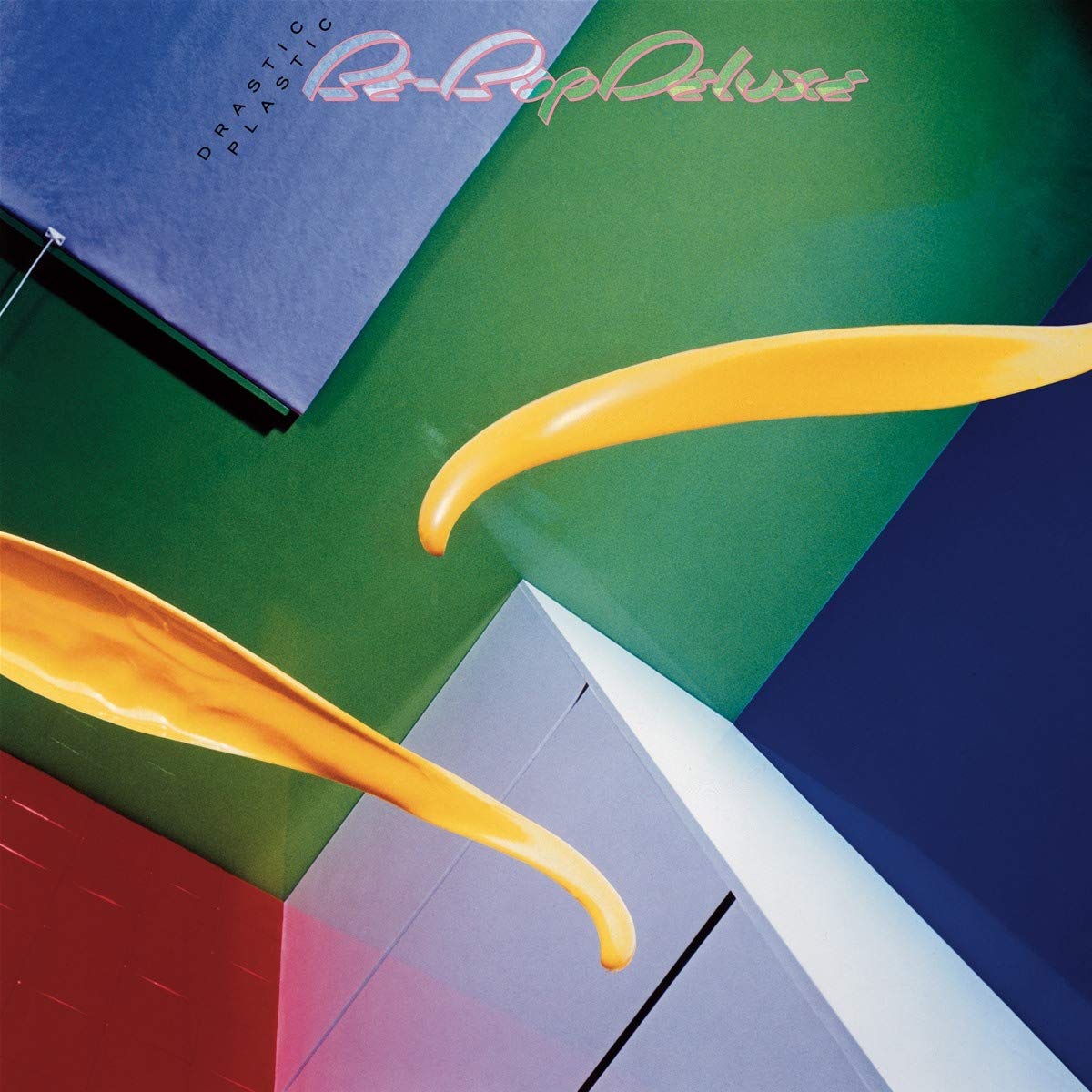
The final album from Be-Bop Deluxe, “Drastic Plastic”, is getting an expanded release. The 1978 recording is receiving a newly re-mastered, limited edition, 6-disc deluxe (naturally) boxed set (comprising four CDs and two NTSC – Region Free DVDs), including 43 previously unreleased tracks. The set arrives March 5th, 2021, via Cherry Red Records.
“Drastic Plastic” was recorded in the summer of 1978 in the south of France utilizing the Rolling Stones’ mobile studio, with final sessions taking place at The Manor Studio and Abbey Road Studios. The record saw Bill Nelson (vocals, guitars, keyboards), Charles Tumahai (bass, vocals), Andy Clark (keyboards) and Simon Fox (drums) venture into new musical styles, with the album being ground-breaking in its move to more art rock and new wave influences.
Co-produced by Nelson and John Leckie, the English progressive rock band’s Drastic Plastic featured such songs as “Electrical Language,” “Panic in the World,” “New Mysteries,” “Islands of the Dead” and “Surreal Estate.” The recording sessions produced many more tracks which would appear as singles and others that were originally planned for release as an EP set, all of which eventually appeared on the retrospective compilation The Best of & the Rest of, later that year.
This expanded deluxe reissue has been newly re-mastered from the original master tapes and features an additional 88 tracks, drawn from new 5.1 surround sound and stereo mixes from the original multi-track tapes by award winning engineer Stephen W. Tayler, previously unreleased out-takes from the album sessions, a BBC Radio John Peel Show session from January 1978, along with a CD of Nelson’s previously unreleased demos for the album, A Feeling of Playing.
Also included is an additional DVD featuring Be-Bop Deluxe in the south of France, (a collection of Bill Nelson’s 8mm home movies shot while recording Drastic Plastic) and the band’s “Sight & Sound in Concert” performance for BBC TV from 1978.
“Drastic Plastic” (1978 album; remastered four-CD, two-DVD box set, featuring an additional 88 tracks, 43 of which are previously unreleased, drawn from new 5.1 surround sound and stereo mixes from the original multi-track tapes by engineer Stephen W. Tayler, etc.; Expanded & Remastered Edition, two CDs; Esoteric Recordings / Cherry Red)
The boxed set includes a lavishly illustrated 68-page book with many previously unseen photographs and an essay of recollections by Nelson. The set includes postcards and a replica poster.
The set arrives March 5th, 2021, via Cherry Red Records.
To call an album a group’s third best would usually be faint praise, but not where The Band is concerned: 1970’s “Stage Fright” arguably ranks slightly behind its two predecessors in their catalogue, but that’s only because those earlier records are their classic Music from Big Pink debut and their even better eponymous sophomore LP. In this group’s discography, third best is still good enough to put an album on a par with the finest releases of its era. It’s worth noting, moreover, that “Stage Fright” actually did better on the charts than either of the two earlier records.
Like those previous LPs, the self-produced Stage Fright sounds rooted in a mythic version of rural southern America (though all but one of the Band’s members were Canadian): if they’d had rock music in the South in the 1800s, it might have sounded a lot like this.
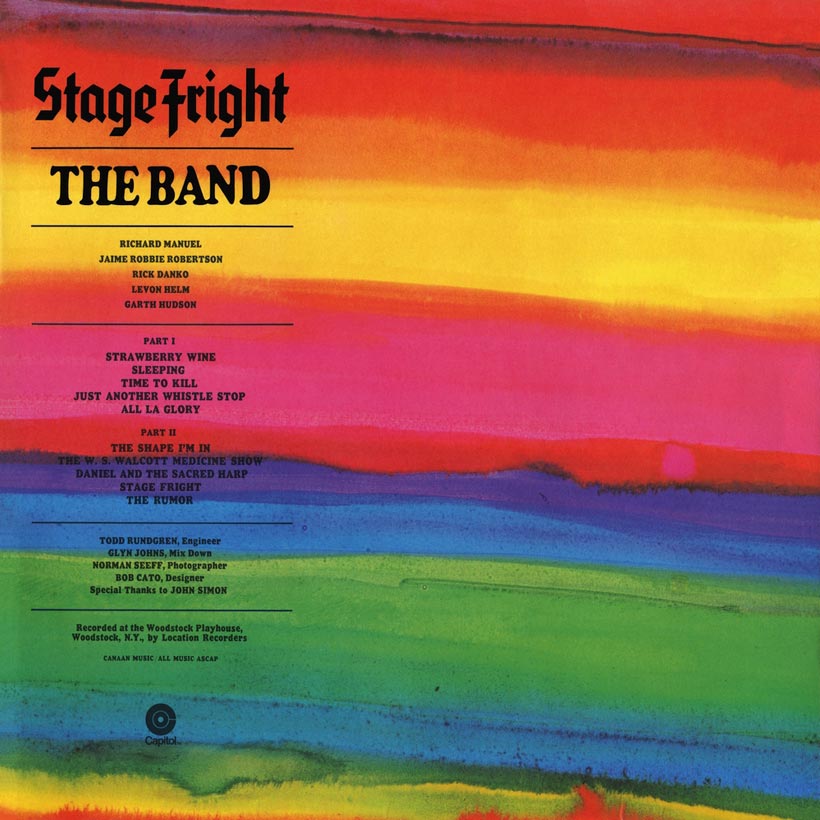
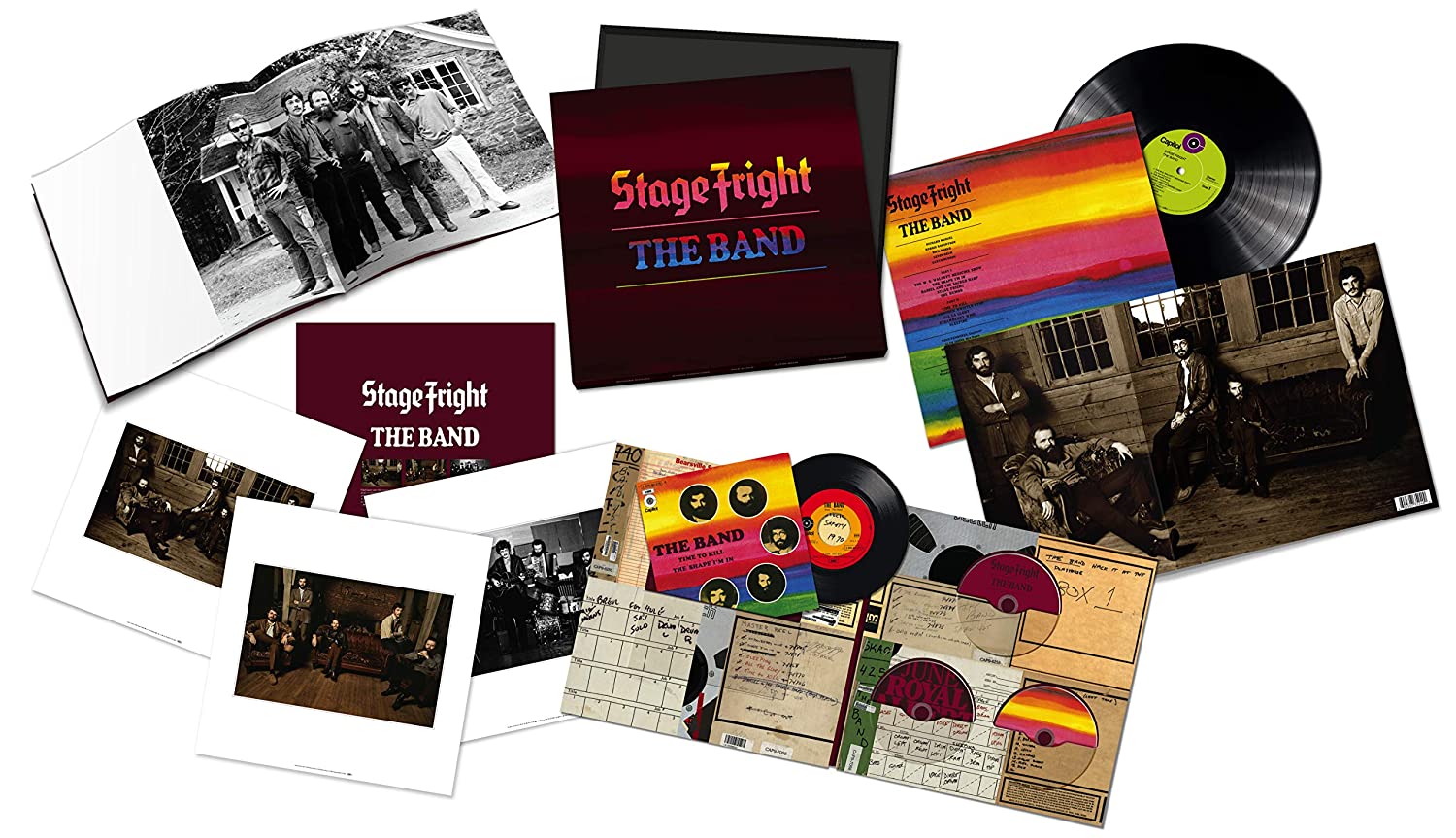
By the time The Band came to record their third album, in May 1970, expectations were high. They had already been Bob Dylan’s backing group and then broken out on their own to play an integral role in changing the direction of American music with their 1968 masterpiece, “Music From Big Pink”, and its self-titled follow-up. Judging by its title, Stage Fright suggested the group knew they’d have even more to prove. On February 12th, 2021, Capitol/UMe Records will celebrate the 50th anniversary of The Band’s classic third album, Stage Fright, with a suite of newly remixed, remastered and expanded 50th Anniversary Edition packages, including a multi-format Super Deluxe 2CD/Blu-ray/1LP/7-inch vinyl box set photo booklet; digital, 2CD, 180-gram black vinyl, and limited edition 180-gram color vinyl packages. All the Anniversary Edition releases were overseen by principal songwriter Robbie Robertson and boast a new stereo mix by Bob Clearmountain from the original multi-track masters.
Released on August 17th, 1970, “Stage Fright” features two of The Band’s best-known songs, “The Shape I’m In” and the title track, both of which showcased inspired lead vocal performances by Manuel and Danko, respectively, and became staples in the group’s live shows. Recorded over 12 days on the stage of the Woodstock Playhouse, the album was self-produced by The Band for the first time and engineered and mixed by Todd Rundgren with additional mixing by Glyn Johns.
For the first time, the album is being presented in the originally planned song order. The boxed set, CD and digital configurations feature a bevy of unreleased recordings, including “Live at the Royal Albert Hall, June 1971″, a thrilling full concert captured in the midst of their European tour.
The new set also includes alternate versions of “Strawberry Wine” and “Sleeping”; and seven unearthed field recordings, Calgary Hotel Recordings, 1970, an impromptu late-night hotel jam session between Robbie Robertson, Rick Danko and Richard Manuel of several “Stage Fright” songs recorded while the album was in the mixing stage.
As a gesture to the residents of Woodstock – who had endured some of the problems of living in a town that played home to famous musicians – The Band offered to record “Stage Fright” in a private town concert. The proposal was rejected by the local council and so the group recorded the album at the Woodstock Playhouse, without an audience. Young engineer Todd Rundgren was in charge of the acoustics, and guitarist/vocalist Robbie Robertson said, “It turned out to be an interesting acoustical thing because you could perform with the curtain closed and it would give you this dry sound and if you opened the curtain you got the sound of the house in there.”
Though The Band had privacy to be creative, the anxieties of fame and celebrity are evident in the themes of fear and alienation that permeate Stage Fright, which was released on 17th August 1970.
The songs are more personal than those of their first two albums, and an undoubted highlight is the title track, a candid song about Robertson’s struggle with stage fright. He turns his fears about performing for an audience into a universal lament. Robertson said, “In ‘Stage Fright’ a lot of stuff I was trying to hold in was starting to creep out.” Bassist and fiddle player Rick Danko takes lead vocals on the song and delivers a powerful performance, ably supported by Garth Hudson’s fluent organ playing.
Stage Fright continued to highlight The Band’s virtuosity. Hudson also played electric piano, accordion, and tenor and baritone saxophones on the record, while Levon Helm played drums, guitar and percussion (and sang lead vocals on four songs), and Richard Manuel played piano, organ, drums and clavinet.
All that instrumental talent, together with Manuel’s skill as a singer, came together on ‘Sleeping’, a Robertson-Manuel composition that blends rock and jazz inflections into a ruminative gem.
That pairing also co-wrote ‘Just Another Whistle Stop’, which races along in zestful Band style, while the mood darkens again on ‘The Shape I’m In’ and the catchy ‘The WS Walcott Medicine Show’. The bleak ‘Daniel And The Sacred Harp’ is a parable about a musician selling his soul: “The moment of truth is right at hand/Just one more nightmare you can stand.” Robertson, who wrote the song, said he was trying to convey how helpless and vulnerable things seemed for the musicians at the time.
Helm sings tenderly on Robertson’s poignant lullaby of ‘All La Glory’, which he wrote for his child. Hudson’s graceful accordion playing brings out the best from moving lyrics, while ‘The Rumour’, one of seven songs Robertson is credited with writing solo, is another strong offering.
In their 1970 review, Rolling Stone magazine called the album “elusive”. Indeed, “Stage Fright” has the uncertainty of a record made at a time when the bonds between the band members were being tested by personal and professional frictions. However, as a piece of music it stands the test of time.
“It was a dark album,” Helm admitted later. “And an accurate reflection of our group’s collective psychic weather. We all realised something was wrong, that things were beginning to slide.”
The public loved it, however. Stage Fright reached a career-best position of No.5 in the album charts and went gold after selling more than half a million copies.
Exclusively for the boxed set, Clearmountain has also created a new 5.1 surround mix and a hi-res stereo mix of the album, bonus tracks and the live show, presented on Blu-ray. All the new audio mixes have been mastered by Bob Ludwig at Gateway Mastering. The set also includes an exclusive reproduction of the Spanish pressing of The Band’s 1971 7-inch vinyl single for “Time To Kill” b/w “The Shape I’m In” in their new stereo mixes and a photo booklet with new notes by Robbie Robertson and touring photographer John Scheele, who recorded the Calgary HotelRecordings; plus a reprinting of the original Los Angeles Times album review by critic Robert Hilburn; three classic photo lithographs; and photographs from Scheele and several other photographers.
The new collection includes many previously unreleased live recordings.
The third album from Little Feat saw a subtle move towards a more groove-laden funk style. While Lowell George was still band leader, he was starting to share more in the way of songwriting duties, and the addition of new band members, Paul Barrere and Sam Clayton, saw Little Feat approach Dixie Chicken with a renewed sense of purpose, resulting in perhaps their definitive studio offering. For Little Feat, 1972 brought commercial defeat, then creative rebirth. Formed three years earlier by guitarist Lowell George and keyboard player Bill Payne, the Los Angeles quartet was a Mothers of Invention splinter group featuring alumni George and bassist Roy Estrada, sanctioned by Frank Zappa, who either invited George’s departure or demanded it, depending on conflicting reports. One version holds that the founding Mother objected to a new George song, “Willin’” celebrating “weed, whites and wine,” a sentiment that the famously anti-drug Zappa was anything but willing to have associated with the band.
In addition to new bassist Kenny Gradney, a Baton Rouge native, the band enlisted another Louisiana expat, percussionist Sam Clayton (brother to crack L.A. session vocalist Merry Clayton), along with second guitarist Paul Barrere, who Lowell George had known since both were students at Hollywood High. With that realignment, Little Feat established a more potent and flexible rhythm section that built upon an already powerful four-square foundation laid by Hayward: With Clayton adding conga, djembe and other percussion instruments, Gradney locking into Crescent City syncopations and Barrere answering George’s simmering slide leads with complementary riffs and spare rhythm guitar, Little Feat now cruised on a supple cushion of polyrhythms.
In the studio, Lowell George stepped up as producer, a leadership role strengthened by his emergence on Sailin’ Shoes as the band’s most prolific and distinctive writer. Drawing on his versatile command of blues, country, folk and now R&B, he refined the surrealistic imagery and eccentric (and often cheerfully shady) characters that were proving his stylistic hallmarks. For the third full-length, “Dixie Chicken”, released January 25th, 1973, he would dominate the set list even more than on the prior albums.
Boasting Little Feat classics like the title track, “Roll Um Easy” and “Fat Man in the Bathtub”, “Dixie Chicken” found the band’s reputation take a massive leap forward, while still keeping them on the very fringes of the mainstream. It also pointed to a future were George’s influence over the band would lessen, while Barrere and keyboard player Bill Payne would have a greater impact on the band’s creative direction. While so much Southern rock at the time focused on massed guitars and heavy jams, Little Feat are typically loose-limbed, but never so much that they lose focus, and while they do indulge their tendency to jam, but this never gets so out of hand that they travel so far down a certain groove that they lose sight of the song itself.
“Dixie Chicken” signaled the band’s polyrhythmic swagger with laid-back confidence, bass and conga bumping into a hip-swaying groove punctuated with Payne’s spare, jaunty piano filigree. Lowell George’s hearty drawl established its southern milieu as he set a romantic shaggy dog story against “the bright lights of Memphis and the Commodore Hotel.” The starry-eyed protagonist’s ill-fated courtship of a dubious “southern belle” cast its own spell over the song and the album, mapping a mythic Dixieland in a screwball narrative. On the chorus, Bonnie Bramlett added a lusty, soulful voice to George’s as he serenaded his “dixie chicken,” vowing to be her “Tennessee lamb,” only to find himself seduced and abandoned. The song’s closing verse offered the singer’s encounter with a knowing bartender back at the Commodore Hotel bar that transformed the final chorus into a killer punchline.
“Dixie Chicken” is an album which can prove to be an oddly relaxing experience, almost to the point where if you’re not careful, you can end up zoning out. It’s a comforting listen, one that encourages your thoughts away from whatever day to day rigours you may have in life. It also means that it’s an album that can prove a little elusive from time to time, as sometimes you get to the end of the album and realise that you’ve been so relaxed that you’ve paid precious little attention to anything that’s gone on for its duration, and it’s even weirder if you’re listening to the original vinyl, because at some point you must have turned it over. That said, it’s also an album which sounds much better on vinyl, as the majority of CD editions have sounded oddly thin and even flimsy over the years, which is something that can seriously hamper your enjoyment of Little Feat.
While some would encourage the newcomer to approach Little Feat in a purely chronological manner, however, if you’re not to fussed about hearing their musical evolution, then Dixie Chicken is for many their definitive studio statement. Live, they frequently took things to another level entirely, but if you want to hear them at their best in the studio, then this is probably the best place to start.
The title cut from Little Feat’s 1973 album heralds the sound fans can instantly recognise the cantilevered songs laced with sardonic surrealism; the slinky Nu’Awlins rhythms; the funk touches; the high sustained wail of George’s slide; the offbeat vocal blend and twin-guitar work; Payne’s unfailingly brilliant piano. Barrere went to Hollywood High with the furrier’s son who grew up rich among Tinseltown royalty, but he was also a guitar ace; his nuanced rhythms and fills and fiery solos added new dynamics and colours. Perfect, since onstage George played only slide.
His sonic setup was now fully in place. He explained, “I use an open A tuning, which is an open G moved up a whole step. Instead of moving the first, fifth, and sixth strings down, I leave them alone and move all the other strings up a whole step. There’s a lot more tension on the strings, and it gets a much cleaner and brighter sound.” Those strings were “fairly heavy-gauge” Fender F-50s, his action was set “very high,” and a Craftsman 11/16th-inch socket was his slide; he used both a pick and his fingers. From now on, those super-taut strings will slice and squall through Little Feat’s stuff, tracing George’s exceptional sonic signature “Roll Um Easy” .
“Roll Um Easy” A contemplative take lays bare the accents working in Little Feat’s regenerated sound. Tenderness often lurks in George’s lyrics, but here it’s unusually foregrounded. Even his slide doesn’t howl; it glides with muted celebration. Contrast the intimate, heartfelt feel here with the version LindaRonstadt fronted for L.A. hitmaker Peter Asher.
“Fat Man In The Bathtub” One way George’s circle could tell how he was doing was his weight variations. So you can hear this catchy fun as a bit of self-mockery. This “mosaic” demonstrates how to take an essentially simple musical idea and deconstruct it using syncopations. It’s also one of those complex tunes that Payne helped him get his meters straight on; they worked more closely as a team than George often liked to admit. The double-tracked slide guitars are totally distinctive.
“Two Trains” followed, updating a familiar blues metaphor for sexual rivalry while showcasing bubbling cross-rhythms stitched by Barrere’s rhythm guitar, Payne’s electric piano and the triple-threat interplay of Hayward, Clayton and Gradney with Lowell George hovering above the mix with his signature slide. Where other blues and rock stylists would typically lay out melodic lines that slurred their blue notes upward, George’s slide work carved out angular leads that could dart downward, sustain shimmering single notes or sting with short, fat jabs that were uniquely his.
Sleek grooves and sly story lines weren’t George’s or the band’s only strengths. As they had on earlier ballads (notably the previous album’s definitive take on “Willin’” and the wry but tender “Trouble”), Feat knew when to pull back on firepower and dolly in for intimate close-ups. On “Roll Um Easy,” Lowell George’s voice and acoustic guitar are decorated sparingly with restrained slide accents and raw vocal harmonies by Three Dog Night’s Danny Hutton.
“On Your Way Down” was a seamless fit for Feat in terms of both sound and sinister theme—the Golden Rule translated into karmic paybacks, haunted by serpentine synthesizer lines and moody percussion going bump in the night. Beyond the album’s charms, the sextet’s ensemble chemistry and expanded tool kit would elevate them onstage. Another Dixie Chicken standout, “Fat Man in the Bathtub,” provided percolating Afro-Cuban rhythms as George recounted a sexual standoff for Spotcheck Billy, whose plea to “check your oil” is rebuffed by Juanita, the object of his obsessions and the subject of his refrain.
That track, like the album’s title song and “Two Trains,” would become a fixture in Little Feat’s live sets, frequently anchoring medleys linked to Sailin’ Shoes gems, and their fourth album, Feats Don’t Fail Me Now, doubled down on their L.A./NOLA axis to open up a lane at rock radio and in record stores. With 1975’s The Last Record Album, however, George’s role began to recede as Bill Payne and Paul Barrere added jazz fusion elements.
Bill Payne – keyboards Paul Barrére – guitar Kenny Gradney – bass Richie Hayward – drums, Sam Clayton – percussion Lowell George – slide guitar
Honey Lung have released their first new music since their recent EP “Post Modern Motorcade Music”. The Sweet and slow, ‘Room’ was the first peep from the foursome since May this year. Drawn out and emotional, ‘Room’ is a total Melon Collie era Smashing Pumpkins ode. Feedback heavy and imbued with a guitar-orchestrated sparkle, it’s a lush personal piece that’s pretty ideal for the autumn to winter transition. “’Room’ is quite an intimate, personal song that details a time in my life” frontman Jamie Batten said. “We shot a music video for the track with a friend of ours out in Berlin. The video is essentially me being edgy af for 4 minutes.”
Now the London four-piece Honey Lung have shared a new single “Oh So Real,” out now via Big Scary Monsters. It’s the follow-up to their previous track “Room,” and it also follows last year’s EP Post Modern Motorcade Music. A version of “Oh So Real” originally appeared on a vinyl-only demos and singles collection, “Memory”, which was released by Kanine Records in 2019. “Oh So Real” has both the chunky grit and gentle-hearted nature of Silversun Pickups, with gnarly, rumbling guitars acting as a segue to their sentimental chorus. Their hook-driven guitar noodling is as sharp as ever, and they even delve into a steamy Black Sabbath-esque breakdown before returning to their heartwarming selves.
Honey Lung · Jamie Batten, Harry Chambers , David Sherry, Omri Covo
“Oh So Real” released on Big Scary Monsters Released on: 2021-01-21









 The Fat Angel Sings