Archive for the ‘CLASSIC ALBUMS’ Category

Image may contain: 1 person, text

The new “Good Souls Better Angels!”, which Lucinda Williams recorded in just over 15 days in the fall of 2019, is another landmark release, though it might not do much to further expand her fan base. Largely co-written by Williams and her husband Tom Overby, it’s a challenging album that makes few if any concessions to achieve commercial success. And don’t look to this record for Williams to deliver any “Passionate Kisses” (the title of a popular early number); her mood here is much more often angry and foreboding than romantic.

Three-time Grammy Award winner Lucinda Williams unabashedly takes on some of the human, social and political issues of our day with her boldest and most direct album to date, Good Souls Better Angels.

During the course of her celebrated four-decade, pioneering career Williams has never rested on her laurels as she continues to push herself as a songwriter. On Good Souls Better Angels, she has much she needs to get out. In 2014 and 2015, Williams released two critically acclaimed double albums back to back with Down Where The Spirit Meets The Bone and The Ghosts Of Highway 20, respectively. Both releases found her experimenting with arrangements, vocals, song structure and personal subject matter.

On Good Souls Better Angels, Williams changes course and chooses to forgo the personal and narrative-based song craft that has become synonymous with her name and instead speaks to some of the injustices permeating our society. The new songs cut straight to the core with frank and honest commentary on domestic abuse (Wakin’ Up), the constant barrage of news (Bad News Blues) the dangerous, quick to judge and convict aspects of social media (Shadows and Doubts) and the haunting reality of the Man Without A Soul.

Williams recorded Good Souls Better Angels backed by her remarkable, long time band, featuring Butch Norton (drums), Stuart Mathis (guitar) and David Sutton (bass). The rock-solid unit propels the music with both fire and finesse, particularly on the raw blues number You Can’t Rule Me, which kicks off the album with equal parts attitude and swing.

Good Souls Better Angels also features some of Williams’ most intimate and up front vocals on record. She addresses the pain of depression on the achingly beautiful Big Black Train and tenderly delivers a poignant song of hope with When The Way Gets Dark. She encourages us to push forward on the path of promise and perseverance on the deeply soulful and moving album closer Good Souls. Good Souls Better Angels marks the first time Williams’ husband / manager Tom Overby is credited as a co-writer on many of the new songs. The album was co-produced by Williams, Overby and Ray Kennedy, who last worked with Williams on her 1998 landmark classic album Car Wheels On A Gravel Road.

Williams recorded Good Souls Better Angels backed by her remarkable, long time band, featuring Butch Norton (drums), Stuart Mathis (guitar) and David Sutton (bass). The rock-solid unit propels the music with both fire and finesse, particularly on the raw blues number You Can’t Rule Me, which kicks off the album with equal parts attitude and swing.

Good Souls Better Angels also features some of Williams’ most intimate and up front vocals on record. She addresses the pain of depression on the achingly beautiful Big Black Train and tenderly delivers a poignant song of hope with When The Way Gets Dark. She encourages us to push forward on the path of promise and perseverance on the deeply soulful and moving album closer Good Souls. Good Souls Better Angels marks the first time Williams’ husband / manager Tom Overby is credited as a co-writer on many of the new songs. The album was co-produced by Williams, Overby and Ray Kennedy, who last worked with Williams on her 1998 landmark classic album Car Wheels On A Gravel Road.

The songs on Good Souls, while a perfect snapshot of enlightened anger, aren’t all brand new. The sludgy blues tune “Bone Of Contention” dates back to 2005, just missing the cutoff for the alt-country troubadour’s 2007 album West. “You’re the splinter in my finger / you’re the knife in my back / you’re the bone of contention,” Williams sings in her signature snarl that has made her a legend in the eyes of so many, sounding more furious than she ever has before. That fury is what makes this album, even the songs that were written a few years earlier, so topical. Similar to the way Fiona Apple’s Fetch the Bolt Cutters has resonated so fiercely just a week ahead of Williams’ Good Souls Better Angels, these songs weren’t written about our current state of frenzied pandemic panic, but their arrival during spring 2020 gives them an especially clairvoyant air. A rebellious spirit is certainly seeping out from every angle on Good Souls Better Angels. “You can’t rule me,” Williams declares right out of the gate. She also bemoans the relentless news cycle on “Bad News Blues,” laments the content of those news cycles on “Big Rotator,”

She scorns evil men “of hate, envy and doubt” over a swirling vortex of guitar feedback on “Man Without A Soul.” While there’s one “man” in particular who lyrics like “You bring nothing good to this world / Beyond a web of cheating and stealing / You hide behind your wall of lies” may call to mind, it’s not necessarily a slam of Potus specifically—but it sure does work well as one.

Lucinda Williams is the opposite of every Boomer stereotype. She’s politically enraged, and she’s certainly not worthy of the “out of touch” label slapped on many Boomers.

On this new album Good Souls Better Angels, and during a recent phone call, she sounds just as fed up with everything as millennials are. “It’s pervasive—that feeling that you’re always getting, of being astounded and shocked and pissed off,” Williams, now 67 years of age, says. “I’m mad. I’m frustrated.” The songs on Good Souls, while a perfect snapshot of this enlightened anger, aren’t all brand new. Williams, one of the most decorated songwriters in Americana music, describes this phenomenon as “ironic.”

Image may contain: 3 people, people standing

The Blinders release their new album, “Fantasies Of A Stay At Home Psychopath”, via Modern Sky UK. A dark blues-waltz underpinned by propulsive bass and evocatively prosaic lyricism, the track straddles the lines between ode and lament while addressing life’s confusing crossroads. The track is accompanied by an arresting video, which cuts between the band performing and wandering the atmospherically bleak landscape of the Peak District.

Fantasies Of A Stay At Home Psychopath, was recorded at Manchester’s Eve Studios alongside producer Rob Ellis (PJ Harvey, Anna Calvi), and mixed by Adrian Bushby (Foo Fighters, Muse).

The follow-up to their critically acclaimed debut album, Columbia, released in 2018, the album explores existential despair, mental health and society’s ills in a time of planetary crisis, and is both a riposte to, and commentary on, the rise of populist ideology. Delivering a blistering collection of powerful tracks, Fantasies Of A Stay At Home Psychopath is imbued with the visceral energy of IDLES, the twisted melodies of solo-era Lennon and the darkness of the Bad Seeds.

In the shadow of Brexit and the climate crisis, The Blinders return with their unique brand of outspoken anthemicism and a sensational album to rouse awareness and inject vital energy into a bleak 2020. Combined with their blistering live energy, get ready for The Blinders to accelerate furiously into the limelight.

Due to the ongoing Covid-19 crisis, we have had to take the decision to postpone the album release date. ‘Fantasies of a Stay at Home Psychopath’ will now be released on July 17th.

The global pandemic has meant that, logistically, we cannot currently guarantee the release of the album in May. We also hope that the album will now be released at a time when it can fully be enjoyed and celebrated by everyone in the way we all hoped.

No photo description available.

Based in San Francisco, and active in the mid-to-late 1960s. The band gained interest after one of the Nuggets Vol 12, compilations in the 1980s, Their music was strongly influenced by Yardbirds and Rolling Stones. The Other Half were at their peak when the music scene was at its height in San Francisco and the Flower Power movement in full swing in Haight Ashbury. Their style changed from an earlier vocal based garage band, to the loudest big stage band sound of the time, taken in that direction by former Sons of Adam guitarist Randy Holden. Their sound has been compared to The Yardbirds, and contained elements of blues, hard rock, and Eastern melodic influences

‘Famous’ for their now legendary garage punk killer 45 ‘Mr. Pharmacist’,  later covered by The Fall, this album came a couple of years later in ’68 and shows the move towards psychedelia. Recorded ‘live’ in the studio to sound like a gig, the album showcases some tasty guitarwork from Randy Holden, soon to join heavy duty rockers Blue Cheer.
Also interesting on this mainly self-written album is their lone cover, namely ‘Feathered Fish’, written by Love kingpin Arthur Lee but rather bizarrely credited to Country Joe McDonald!

A collection of their recordings, titled Mr. Pharmacist was issued in 1982. This included their entire 1968 album and several tracks from singles.Two songs, “Bad Day” and “Oz Lee Eaves Drops” appear in the 1968 pilot episode of The Mod Squad.

Image may contain: 5 people

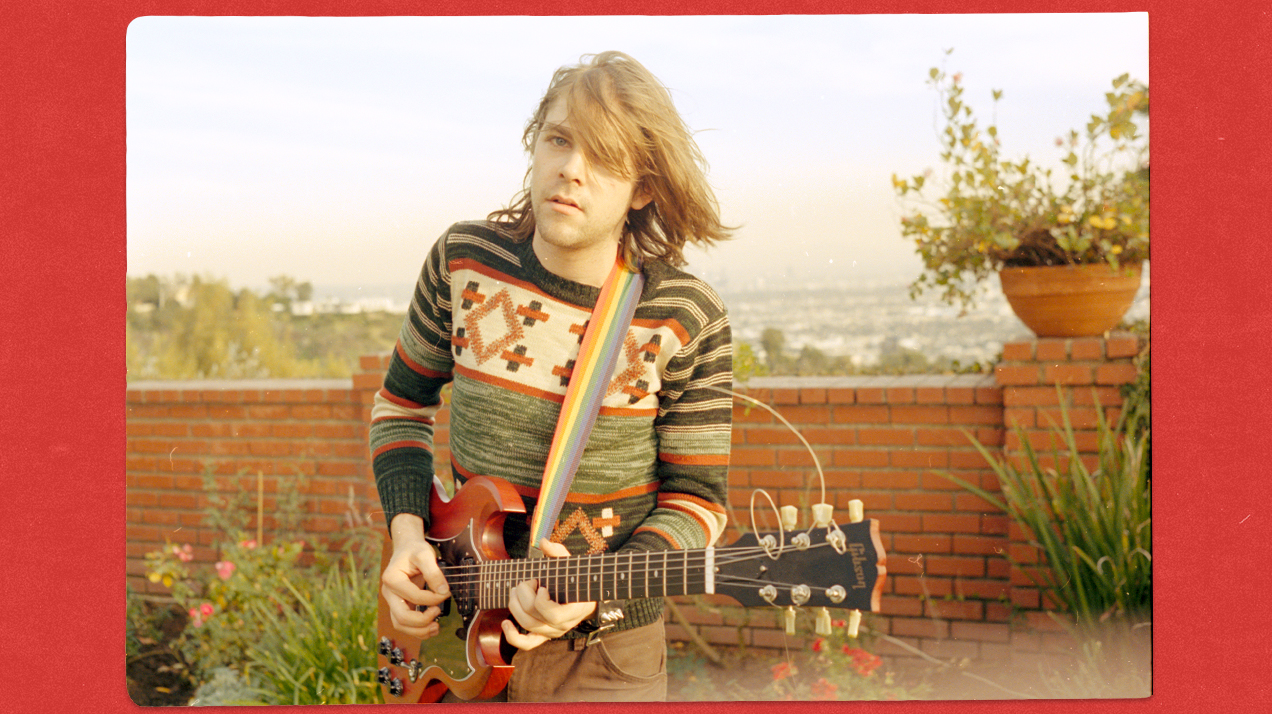
Picture of Ariel Pink

Ariel Rosenberg—a.k.a. the trailblazing lo-fi pop eccentric, Ariel Pink—has released more albums over the past twenty years than many bands do in their entire careers. Some of his most beloved releases, recorded under his Ariel Pink’s Haunted Graffiti moniker, came from the artist’s days on Animal Collective’s now-defunct Paw Tracks label. However, these versions weren’t mixed properly, resulting in a subpar, mono audio transfer.

Now, Pink and the folks at Mexican Summer are making things right with the Ariel Archive Series, an ambitious project of remasters and reissues of the artist’s vast back catalog. The amount of time covered is staggering—starting from Pink’s scrappy debut, 1999’s Underground tape, all the way to a fresh odds-and-ends collection, Oddities Sodomies Vol. 2, which even has new songs from the Dedicated to Bobby Jameson sessions.

This week, the next wave of remasters is here, with some fan-favorite deep cuts—2000’s The Doldrums, 2002’s House Arrest, and 2003’s Worn Copy. There’s even a new experimental film on the way as a part of the series, entitled Dedicated to Boris Karloff, directed by Argentinian artist Salvador Cresta.

With Pink, hunkered down in his Los Angeles home, He talks about the archive series. He reflected on his legacy, praised his collaborators, and scoffed at the notion of giving his younger self advice.

When I originally recorded these things, I built up several generations’ worth of mistakes. There was so much slippage and waste. Remastering the albums was a matter of finding the original mixes I made on those master cassette tapes and using those to remaster to the proper stereo mix. We managed to find a bunch of them. Some of them were lost, but in the case of House Arrest, The Doldrums, and Loverboy, we managed to salvage true stereo mixes. In certain cases we weren’t able to find the originals. In those instances we had to make a mix that was comparable to the original from just straight off the eight-track.

Open uri20200218 26702 2dhtcn?1582031056

House Arrest

Our favourite omnivorous media junkie from LA still has a few tricks left up his sleeve like the left-of-center House Arrest. Sure The Doldrums and Worn Copy had some hits and humdingers on them, but House Arrest never lets up.

It’s hit after hit after hit. Sorta like if you listened to your friend’s boom box mix tape from top 40 radio around 1985.

Open uri20200218 8460 1hoe2fe?1582031324

The Doldrums

After years of recording in relative seclusion in the hills of Los Angeles, Ariel Pink (the first non-Animal Collective member on the Paw Tracks roster) made his official Paw Tracks debut with The Doldrums. Originally a handmade CD-R release a couple years back,

The Doldrums by Ariel Pink’s Haunted Grafitti was discovered by the Animal Collective during one of their west coast tours and became an immediate favourite.

Recording at home with only a guitar, keyboard, and 8-track (the drum sounds are all unbelievably created with his vocals), Ariel Pink blends Lite FM and warped lo-fi pop into something beautiful and confusing, yet highly addictive.

Open uri20191002 15031 inydfo?1570010831

Loverboy

More than just fetish material for Pink completists, the reissues are most notable because Pink’s equally demonized, glorified, and debated lo-fidelity has been officially tampered with. The original master tapes were made available to credible engineers with good intentions. Unlike the flawed Paw Tracks reissues, the squashed mono mixes of both Loverboy and Underground have been cracked open into a wide stereo field. While a thin layer of tape hiss still hangs above each record like freeway smog, the depths unlocked by the remaster clear space for us to participate in Pink’s original fantasy more than ever. The tumbling AM-radio confections “My Molly” and “Doggone (Shegone)” can be imagined, faintly at least, as actual AM-radio hits, lost soft-rock artifacts recovered on a Saturday morning drive pouring out from a busted rear speaker.

Loverboy is a futurist pop cycle. From the spectral, pulsing organs on “Ghosts” and “Don’t Talk to Strangers” to the shuffling mouth drums on “She’s My Girl,” Pink’s bedroom feels palatial, some hyper-baroque synth chamber hovering between this dimension and the next. It’s all very “time out of joint” as the French philosopher Jacques Derrida described his original concept of “hauntology.”

Loverboy and Underground’s newfound fidelity muddies the bigger picture of Pink’s legacy. Specifically, the idea that his work as Haunted Graffiti was a mere prelude to studio budgets, the dismal sonics of these albums an arbitrary choice, a condition of some broke musician recording in a squat. Instead, the precision remastering bolsters the minority opinion of what Fisher described as “anamorphic sonic objects.” The anamorphic being the idea of sounds working on the periphery of comprehension, combining into something radically different.

Ariel Archives revisits Ariel Pink’s historic run of albums as Ariel Pink’s Haunted Graffiti with a series of definitive reissues and new collections. The first installment begins with Underground, the inaugural album in the series, Odditties Sodomies Vol. 2, a long-awaited second volume of outtakes and non-album tracks, and finally Loverboy, an exemplary disc recorded between October 2001 and July 2002, at which time Ariel also recorded House Arrest.


It was fun to do because I had [recording engineer] Paul Millar with me. He’s an amazing, thorough audiophile. He just really knows the technical stuff and fixates on things I didn’t even pay attention to. He’s very, very well-versed in the material. He came with his own notes and questions and curiosities. His energy really kind of carried the process, to tell you the truth. It was a pleasure to have him in my house.

I don’t know if it’s the right time. It’s the easiest time for me because all the rights reverted back to me after the licensing with Paw Tracks. Those were five- seven-year relationships that came and went. Paw Tracks folded, so those records were unavailable for a long time, unless I went on tour and they allowed me the albums for the tour merchandise.

But really, this is almost a perfect twenty-year anniversary. I’m forty-one now and I was twenty years old when I made a lot of these, roughly. It’s half of my life ago. It’s a nice twenty year retrospective. I probably won’t have to do it again for another twenty years, hopefully.

Activity are an avant four-piece featuring Travis Johnson, and drummer Steve Levine, both from the band Grooms, bassist Zoë Browne from Field Mouse, and guitarist Jess Rees from Russian Baths. Produced by engineer Jeff Berner of Psychic TV, their debut forms a casually menacing framework for lyrical themes of paranoia, exposed character flaws, and the broader human capacity for growth when an ugly truth is laid bare.

Lead single “Calls Your Name,” establishes the record’s spectral aura with nauseated electronic bells, and a relentless Geoff Barrow-esque drum beat beneath a half-sung, half-spoken lyrics inspired by C.S. Lewis’s 1945 novel The Great Divorce. In the novel, characters stuck in a grey, joyless conception of hell repeatedly deny opportunities to be taken into heaven, instead making excuses as to why they should remain in their embittered purgatory states. Allegorically, this speaks to the kind of opportunity for metamorphosis and positive change that’s possible when the depths of disillusionment are reached, an idea which permeates much of the album. Despite recurrent aches of discontentment, each track glows with radiant waves of catharsis while elegantly evoking jubilation and anguish within the same breadth, showing that the two are always around the corner from one another.

Experimental, avant-garde art rock from members of Grooms, Field Mouse and Russian Baths.  available March 27th, 2020 on Western Vinyl Records.
Released March 27th, 2020

Swim Team

Austin, Texas-based songwriter Christelle Bofale will be the first to tell you the importance of family roots and mental health, considering how much those things aided her own self-discovery. Being the first American born in her family, the rich heritage of the Congo is deeply rooted in her upbringing and relationship with sounds.From singing and dancing with her mother as a child, to praying to Congolese music with her grandmother, to her father, a soukous guitar player and musical director for the Congregation at his church, Bofale’s journey as a musician has been defined in tiny intervals throughout the course of her life. As a songwriter, she infuses hints of the Congo into various aspects of her music, bridging the musical influences of the diaspora with juxtaposed elements of indie rock, soul and jazz respectively.

Weightless guitar tangents and lush, aquatic soundscapes are a vital part of what embodies Swim Team, her debut EP that serves a powerful introduction to Bofale’s budding artistry. Somewhere between influences like Joni Mitchell and Alex G, Bofale has found a sweet spot for her sound that lives between both harsh and gentle terrain, achieving a relaxing, yet rugged tonality.Each track pictured on Swim Team is brushed vividly with colors that illuminate the fear of being honest and doing that much needed personal work. Bofale’s earnest and bravery is a snapshot of black mental health and the nuance it carries. Being real isn’t easy, but it’s crucial in cultivating spaces for healthy discussion and giving other black women like Bofale a platform to do the same.

http://

released May 31st, 2019

Written by Christelle Miller
Guitars – Christelle Miller, Jake Smith Drums- Billy Hickey, Bass- John Bergin

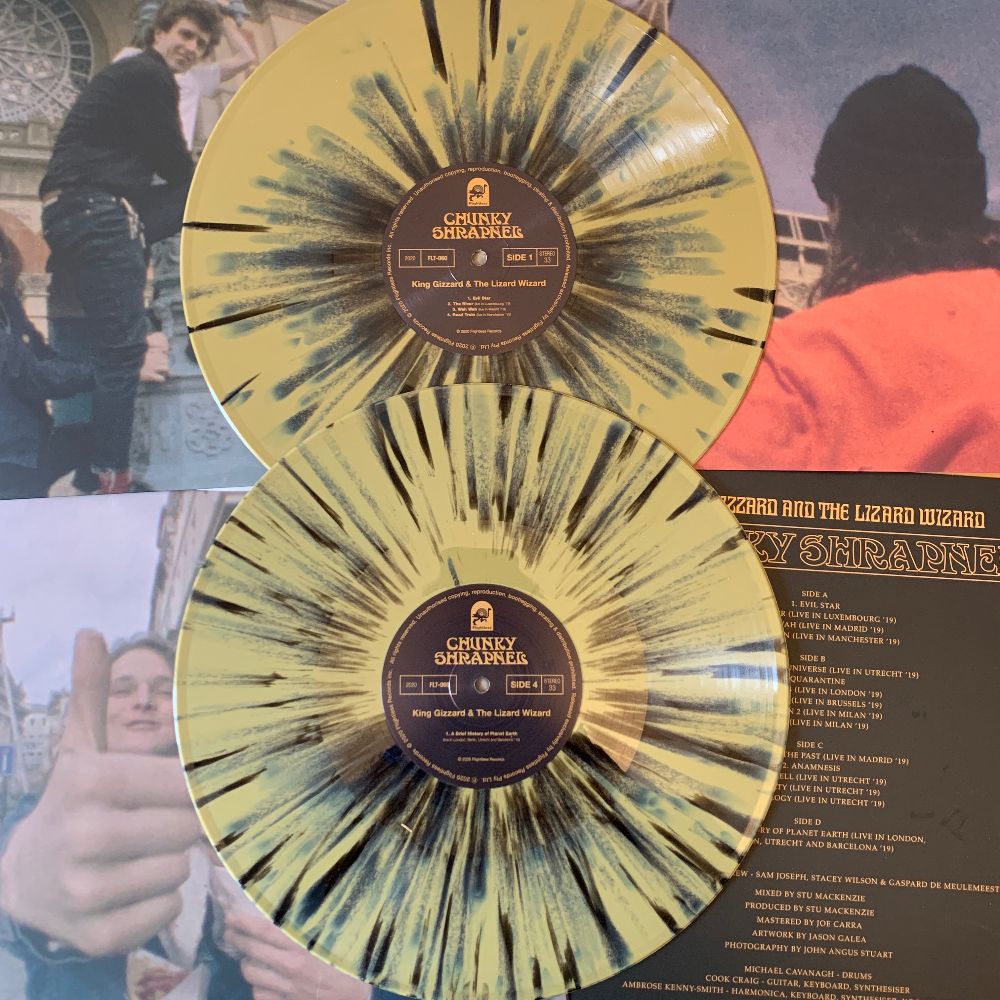
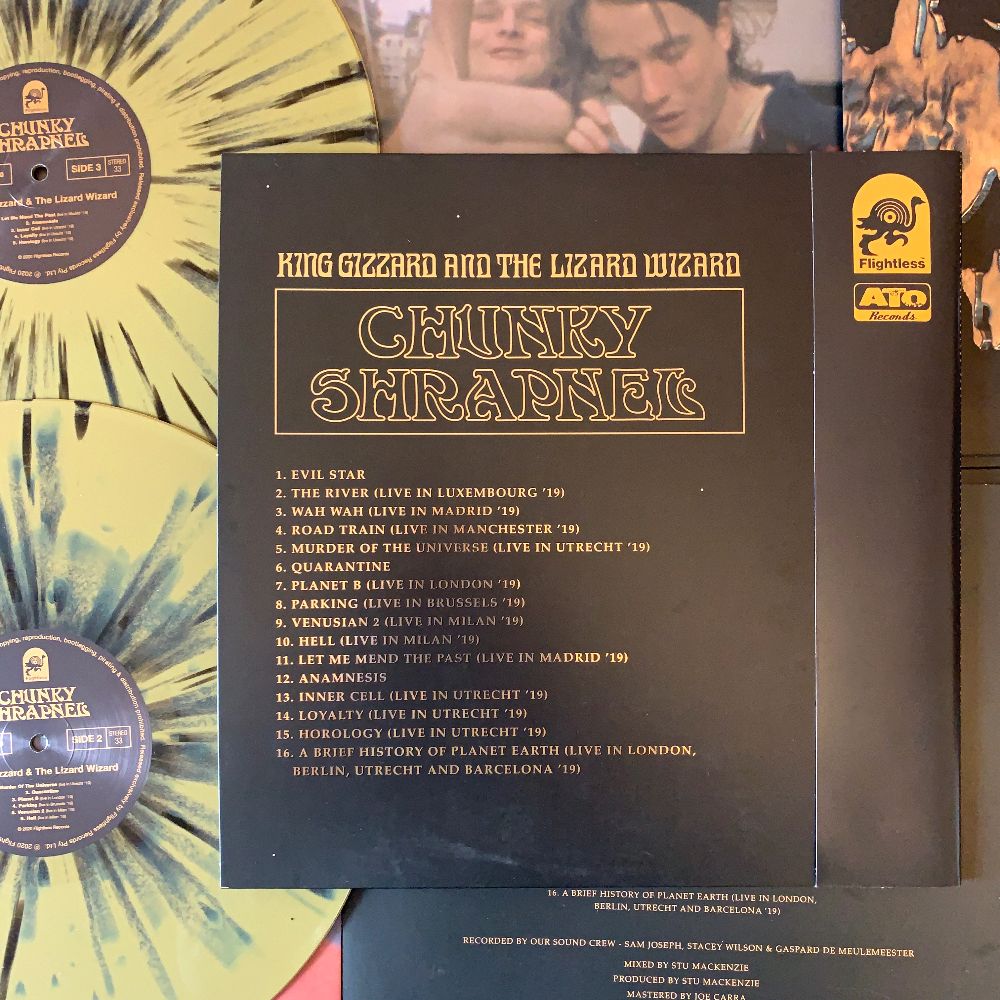
Much to the excitement of myself and ‘Gizzheads’ around the world, King Gizzard and The Lizard Wizard’s first ever feature-length music documentary is finally here. Bought to you by PHC Films and Flightless Records, “Chunky Shrapnal” is a ‘musical road movie dipped in turpentine’ filmed during the band’s 2019 tour across Europe and the UK.
Concerned about the self-congratulatory behaviour around creating a ‘behind the scenes’ film centred on themselves, the band were initially hesitant. Luckily for their humble souls, having their dear friend John Angus Stewart direct Chunky Shrapnal assured the film was authentic Gizz from start to finish. Having worked closely with the band on music videos for ‘Planet B’, ‘Self Immmolate’ and ‘Organ Farmer’, John says the film was a natural evolution of their work together, and I was lucky enough to ask ask him some questions about shooting the film entirely on 16mm, picking perfect moments, and more.

The Movie Chunky Shrapnel, It’s from a lyric from the Gizzard song, ‘Murder of the Universe’. It means vomit.reminded me why I love the band so much; The atmosphere at their concerts. the awesome community and of course the excellent music! . There is nothing quite like 16mm. First of all, I knew I wanted certain types of colours and highlights that are impossible to achieve digitally. Another reason was the practical restrictions. There’s a far better atmosphere backstage when you can’t shoot forever, you gotta pick the right moments. It’s like playing Russian roulette but you want the bullet. And having a single camera was also an import call for us. The normal four-camera set up thing for live music just doesn’t work for Gizz. You have to be on stage with them, it’s the only way. And plus, normal on stage coverage is like watching paint dry.

http://

This album is the phenomenal soundtrack to it. No Paper Maché, sadly, they did record a few songs at the show in Cologne but they’re absent from the album.

released April 24th, 2020

Los Angeles was a much different place when X released its debut album, Los Angeles, named for the city that the band had adopted. Forty years ago, Los Angeles still had a reliably seedy link to its noir roots, which was catnip to people like John Doe, who fled the East Coast for L.A.’s sunny days and debauched nights. Doe found kindred spirits in Exene Cervenka, Billy Zoom and D.J. Bonebrake, and with X they helped establish the West Coast’s punk scene. With 1980’s Los Angeles, they became a nationally recognized leading voice on the scene.

They were a motley bunch. Doe and Cervenka were writers and poets. Zoom was a session guitarist who had trained as an electronics repairman and played a dozen instruments, fluent in both big band jazz and Gene Vincent. Bonebrake had studied classical music and played a mean jazz vibraphone as well as he drummed. All except Bonebrake were from somewhere else.

But in the sordid backwash of Hollywood and the near-nuclear fallout of the Ramones and Sex Pistols, they transformed into X. As we celebrate the 40th birthday of the band’s debut album, Los Angeles has lost none of its power, fury or artfulness, and remains a showcase for how the spirit of punk can be filtered through the familiar lens of rock and roll that had come before.

The heart of “Los Angeles” is clearly punk; Zoom’s lethally precise power chords and Bonebrake’s metronome-on-steroids drums propel the songs at a breakneck pace while Cervenka’s unhinged vocals speak to one of punk’s central tenets: Anyone can do it. But there’s a higher level of musicianship at work here. Zoom is an encyclopedia of roots-rock guitar and he tosses in echoes of Chuck Berry and Scotty Moore. Doe is the Paul McCartney of punk bassists, always finding inventive ways to melodically underpin the songs without losing intensity, and his smoked honey of a voice in harmony with Cervenka’s squall is one of the band’s signature sounds.

Doe and Cervenka filled Los Angeles with lyrics straight out of a poetry workshop — elliptical, evocative, blunt, beautiful and violent, like if Dashiell Hammett did slam poetry — and the combination of bohemia, musicianship and aggression made Los Angeles soar. And if Ray Manzarek seems an unlikely producer, consider that The Doors were legends in L.A. and he had considerable street cred.

X begins with a triple shot of “Your Phone’s Off the Hook, But You’re Not,” “Johny Hit and Run Paulene” and a cover of the Doors’ “Soul Kitchen.” Of the three, “Johny Hit and Run Paulene” is quintessential X, a seamy narrative about drugs, rape and possibly (probably?) murder.

“Sex and Dying in High Society” reads like a film noir treatment about a woman who has sold herself for the security of a connected marriage. Not an incredibly original premise, but the details are what make it work, especially the bit where the woman makes her maid use a curling iron to burn her back just to feel something. Manzarek spices the song with a perfectly placed flourish of synthesizer. “The Unheard Music” is an efficient summation of punk culture, ominously set to a dirge-like metal riff. “Friends warehouse pain/Attack their own kind/A thousand kids bury their parents” conjures the desperate physical release of a mosh pit, teenagers cutting themselves loose from families they don’t want to be with the family that they choose.

“The World’s a Mess; It’s in My Kiss,” besides being a rare example of the proper use of a semi-colon, is also a love song that doesn’t back down from how terror and wonderment walk hand in hand when two people try to make a life together. It comes off as an update of 1950s teeny-bopper love songs with Zoom busting out his best Berry licks behind Cervenka and Doe’s anti-harmonies.

The album’s best-known song is the muscular title track, which is intoxicating in its ferocity and concision. As political correctness has grown into a casual hobby, there have been efforts to paint the song as racist, which is at best a ridiculous argument. It’s clearly about a racist, not to mention a homophobe, and the song’s impact and meaning would be neutered by euphemisms that dance around the truth. That truth is what makes the song so powerful, as well as the sledgehammer authority with which Zoom, Bonebrake and Doe attack every second of the brief 2:25 it lasts.

The album’s overall effect and impact is visceral, literary and uncompromising. X went on to make six more studio albums, embracing more of the band’s folk, country and rockabilly roots as the years passed. The first four albums are considered classics, but “Los Angeles” remains the gold standard.

Clean original Slash pressings of Los Angeles have been climbing in price but the record has been remastered and reissued several times by Rhino, Porterhouse, Music On Vinyl and most recently Fat Possum; other than the acclaimed Porterhouse pressings, the consensus seems to be that they’re all roughly equivalent to an original.

Whichever one you track down, you need to own it — assuming you have a thing for punk, or just good music — as it’s a touchstone of the genre and a keeper for any well-curated collection.

The band recognized the significance of Los Angeles with the surprise release of a new album, Alphabetland, nearly 40 years to the day after their debut. It’s the band’s first studio album since 1985 to feature the original quartet, which was fractured when Zoom left following Ain’t Love Grand. His return brings X full circle as Alphabetland is classic Los Angeles-era X: hard, fast, uncompromising.

It’s 4:20 p.m., Central Time, and Brendan Benson is a little nervous. He’s been practicing and is about to go live for whoever will listen. When the COVID-19 pandemic hit, Benson was preparing to release his seventh album, “Dear Life”. Instead, he’s home in Nashville,  Coincidentally, Benson does feel like he’s trapped in some sort of illusory, encapsulated dream, but “Boy in a Bubble” is the moniker for his Instagram Live series, an essential reprieve from the coronavirus lockdown.

“It’s something to do every day and something to prepare for,” says Benson. “A lot of times, I have to pick the song and learn it, and I get nervous, so it’s a kind of whole arc to my day. It’s a great way to break up the day and the monotony. If I didn’t have this, I think I’d be going fucking crazy.”

Benson, founding guitarist and co-writer for the Jack White–led troupe The Raconteurs, hasn’t gone stir crazy (yet) thanks to IG live—broadcasting with special guests or just going solo—but being home with his seven-year-old daughter Adeline and nine-year-old son Declan has its challenges. He’s living through what most parents are facing during the shut-in. “The rest of my family are going crazy,” says Benson. “Kids need your attention twenty-four hours a day from the second you wake up—like, before you wake up. We’re doing OK, though. It’s a good chance for us to get closer.”

Playing tracks off Dear Life, as well as older songs—even leaving his 1996 debut One Mississippi open for more exploration—Benson is just warming up for when life gets back to normal and he can tour again. His first release since 2013’s You Were Right, Dear Life is Benson’s transfixion on domestic life, relationships, and the realization of his mortality. For nearly five years, Benson was hanging on to Dear Life since he started writing it. Then, The Raconteurs had regrouped, and he stepped back into the band’s third album and first in eleven years Help Us Stranger in 2019. “I stopped, I did The Raconteurs album, but I was really anxious to get this record out,” says Benson. “Then, this fucking virus hits.”

The road leading to the album has had its U-turns and swerves. It was even birthed from a complete upheaval of Benson’s Readymade Studios, which he started in 2012. When he was forced to vacate the studio after the building where it was housed was sold and converted into a parking lot, Benson was forced to pack up all of his equipment and put it in storage. Left without a place to record, he created a makeshift studio in his home, at first experimenting without guitar and drums and more software and drum machines, which all have their place on Dear Life, dusted over sharp riffs and penetrating lyrics on the knowns and unknowns in life.

Sequenced by Jack White, Dear Life drives down a winding road of reflection—good and bad, fear or moments of tranquility—that only Benson could steer, from frenetic opener “I Can If You Want Me To” to the more elevated “Good to Be Alive.”

Reflecting on family life, “Richest Man,” which received an animated video treatment by New York cartoonist Michael Wartella, Benson confronts his fear of dying as matter-of-factly as he can singing “I gave you your name, but you gave me my life … And after I’m gone, you’ll carry on / And then you’ll have a family of your own.” Exploring domesticity and the delicacy of life, Benson covers all corners of emotion, gently crooning the title track through airy “Baby’s Eyes,” the latter the only Dear Life track that features a co-writer and outside musicians, including Dynamites drummer Jon Radford, and on to a more enraged “Freak Out.”

Opening up about family, life, and death is also something new for Benson, but it’s been lingering on his mind more since having children. “I don’t think I ever thought much about my mortality, so it’s kind of come as a shock I guess,” he says. “When my kids were born, I think, is when I started to fear death. I started getting afraid of leaving them. I was just confronted all of a sudden with, ‘Holy shit, I’m not going to be here forever.’ Your kids keep growing up and they keep getting older. I’m seeing it and I’m like, ‘Stop!’”

He jokes that he’s aging slowly, but there’s still a nostalgia as he gets older. It’s something Benson, now 49, just can’t shake. “When you have a family, you start thinking about life and death and what happens when you leave,” he says. “I think it’s something that I’m still thinking about. It’s something that is new to me as well.”

Departing from the core subjects, “Evil Eyes” confronts a plethora of toxic relationships. “Let’s just say it’s a composite,” says Benson. “Maybe it’s different people—not necessarily all female, or a girlfriend, either.” On “I Quit,” Benson borrows from Peggy Lee’s melancholy 1969 hit “Is That All There Is?” “It’s sort of an homage, but otherwise it’s just one of those songs that kind of came out exactly as you hear it,” says Benson. “There are no chord changes. It’s just, like, three chords over and over, and lyrics that are sort of improv or freestyle, and impromptu.” Generally, songs evolve over time for Benson since he says he’s not fully cognizant when he’s writing. “I think I’m half conscious when I’m writing songs,” he says. “It’s not like consciousness. It’s like I’m speaking in tongues. It’s not some sort of, like, meditative state where I’m channeling or tapping into my deepest feelings, and I understand it, and I can sort of transcribe it in this poetic way. It’s mostly meandering thoughts.”

Song meanings tend to come later on. It’s as if he’s unconsciously confessing or revealing things as he goes along. “What’s interesting about this record is that when I look back on it, having been so out of it while writing it, it’s all really kind of focused,” says Benson. “It turns out it’s a lot about life and death and family, you know, so I did it sort of unconsciously.”

Writing for himself is one thing. He’s acclimated to his own, internal cacophony of fragmented words and melodies. Unconscious or not, it’s his own sinuous process. He’s tried working the Nashville co-writing thing but says he’s not that good at it. “I don’t think people are using producers really anymore, so it just doesn’t pay the bills,” says Benson. “I kind of screwed myself, because I left my solo career by the wayside.”

Writing for The Raconteurs is another thing. “We’re meant to write together,” says Benson. “It’s easy. We don’t talk about it. We don’t analyze it. We just know what sounds good, or cool, like, ‘Oh yeah, that sounds like it belongs in the song.’ [Jack] understands when I go meandering, and he gets it.” Now, Benson has a record he wants everyone to hear. “I’m having to start over,” he says. “The Raconteurs helps a little, but it doesn’t help as much as people think, because people don’t know me from The Raconteurs. They know Jack. Brendan Benson is not a household name.”

It’s also Benson’s first album on Third Man Recordings, which he says was a “no-brainer.” He’s not sure why he never worked with White’s label prior to Dear Life, but admits he may have been too proud to ask. “I didn’t want to ride his coattails, but it just makes sense now, because there are no labels left,” says Benson. “And he’s really good at it.”

Benson is ready for Dear Life, and admits that he hasn’t felt this proud of one of his albums since 2002’s Lapalco. “I think I made it for all the right reasons,” he says. “Those reasons were just for the fun of it, and the enjoyment of it, and the therapy of it—not because I had to contractually, or because it was expected, or that it’s been too long since my last record. It just comes straight from the heart.”

In the meantime, as he waits for the world to open back up, he’ll remain a Boy in a Bubble.

“It keeps me sharp,” says Benson of his ongoing IG Live sessions. “Usually when I go on tour I have to learn a bunch of new songs, or ones that I’ve forgotten. This way, I’m kind of just keeping them fresh. When we get out of this, whenever this is over, or when things open up and we get out of jail five years from now, I’ll be ready.”

Image may contain: one or more people

West London’s Will Westerman, who releases music simply under his last name, is releasing his debut full-length album, Your Hero Is Not Dead, on June 5th via Partisan. On Tuesday he shared another song from it, title track “Your Hero Is Not Dead,” which he says is inspired by the 2019 passing of Talk Talk’s Mark Hollis. He has also put out a new SoundCloud mix he calls “freeform communal music” and has titled Huxley. It features Neil Young, Thundercat, George Harrison, Arthur Russell, and others.

Westerman had this to say about “Your Hero Is Not Dead” in a press release: “This was the last song I wrote for the whole record, but I had the title for the album before any of the music was formed. I remember I wrote it on the day that Mark Hollis died. He’s probably as close to a musical hero as I have. The song isn’t about him or Talk Talk necessarily, but when he died I wanted to put myself to task and respond to the sadness I was feeling at that moment.”

Westerman recorded Your Hero Is Not Dead in Southern Portugal and London with his friend and producer Nathan Jenkins (aka Bullion). The album includes tracks “Blue Comanche,” a new song Westerman shared in January. Then when the album was announced he shared another new song from it, “Think I’ll Stay,” and another song from it, “Waiting On Design,” .

“I hope this suspension of life as we know it isn’t too much for you at the moment. I have been thinking a lot about what I can do and what I should do. It’s disorientating when the rug gets pulled on everything, it’s been wonderful to see such a rapid collective response to these times of enforced solitude. It’s helpful for me to think of the different ways music sustains people who are feeling alone. This music comes in response to the feeling of isolation and disconnect, and I hope it finds you and your loved ones alone, together.”

“Your Hero Is Not Dead” is taken from Westerman’s upcoming album of the same name, out 5th June on Play It Again Sam / Partisan Records.