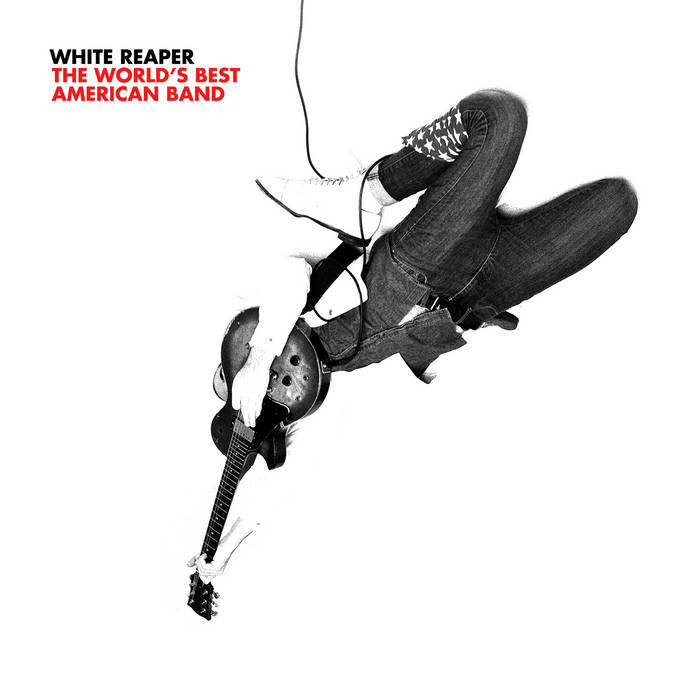
Considering the band called its previous album White Reaper Does It Again, the posturing of White Reaper’s latest, The World’s Best American Band, remains suitably in character for the brash garage-rock group. In case the title is lost on listeners, the album-opening title track begins with the roar of an excited audience ostensibly greeting Kentucky’s self-professed kings of American rock.
Or maybe revival rock, because the 10 tracks on Best American Band nod to the ragged proto-punk of the ’60s and ’70s, heavy on distortion, howled vocals, and attitude. (It also would have fit in the early 2000s heyday of The Hives, The Vines, The Von Bondies, et al., though White Reaper has a distinctly grittier take.) It’s easy to imagine rock fans who complain about the state of current popular music taking a shine to White Reaper.
That’s not to say the band’s charms are limited to rockists who feel pop culture has passed them by, because BestAmerican Band has plenty of charm. It also has a lot of hooks, particularly in standout songs like the title track, “Little Silver Cross,” “Crystal Pistol,” “The Stack,” and “Another Day.” “Little Silver Cross” begins atop a wash of synthesizer and staccato bass that segues into an explosively catchy chorus that recalls The National’s “Abel” with strains of Boys And Girls In America-era Hold Steady. But White Reaper has a serrated edge, made more pronounced by the general difficulty of understanding what singer-guitarist Tony Esposito is howling about. The lyric sheet is helpful, if not especially engrossing. (“Another day / No dope / Another day / No fuckin’ nose drugs,” goes “Another Day.”) But it’s the whole package that matters here, and taken together, The World’s Best American Band has the elements of one of the year’s best rock albums.
“A Place I’ll Always Go” is the follow-up to 2015′s excellent debut “Dry Food” . Led by Ellen Kempner, DryFood was an easy album to become enamored with. Chock full of 90s riffs and Kempner’s spot-on lyrics; it was and is on constant rotation.
A Place I’ll Always Go is a little tougher to connect with initially but no less rewarding. The album was born during a time of loss and new love. Kempner lost not only her grandmother, but a very close friend; tough at any age but especially so at that bullet-proof part of your life known as your 20s. As all this was going on, Kempner began a new relationship. “The album is also about learning how to find love, honestly, after loss,” says Kempner.
“Feeling Fruit” is among the best work Kempner has done. It is a gentle ballad where Kempner emerges into the world after a time of mourning. Supported primarily by her able picking, Kempner’s whispered lyrics really pack a punch.“If You Met Her” is another gut-punch of a tune. Wishing for her deceased friend to meet her new love, Kempner’s lyrics speak to someone wise beyond her years.
Mixed in with the ballads, there are a couple of fuzzy rockers. The lead single Flowing Over is about using sad songs as a coping mechanism. The fact that its a rocking tune really works here (and the video is outstanding as well). Carnations is another winner. Its another rocker but it feels like Kempner is letting is on some secrets as she delivers her vocals in a hushed manner; almost hiding beneath the backing music.
Kempner has the chops to be a force for years to come. If she keeps knocking out efforts like Dry Food and A Place I’ll Always Go, I see no reason that doesn’t come true.
Three years after releasing their three-track Soft Serve EP, Charly Bliss have expanded their crunchy, very ’90s power pop sound into a delectable full-length debut that spans 10 enjoyable tracks. It’s their new album called “Guppy” there’s a big fishy swimming on the front with some smaller fishy pals — but it might as well have been called Sundae LP, as it’s sugary, summery, and doused with all sorts of sweet choclately distortion.
Charly Bliss is having the best time at summer camp. Andrew Costa directs this video for the New York band’s soaringly saccharine power-pop song “Westermarck” — there’s face painting, skateboarding in the dining hall, taking a guitar solo on a ropes course, sparklers. What if we all just lived at camp and the members of Charly Bliss were the camp directors? .
Some may be put off by Eva Hendricks’ vocals, and for good reason: At times, she can sound a little too mawkish, as if she’s just inhaled a tank of helium and rubbed her teeth with the powdery sugar that comes from pixie sticks. But, give the songs a couple of spins — or, you know, just let Guppy swim along and mawkish turns to punchy and punchy turns to addicting and addicting turns to love. And when that happens, poppy ditties like “Percolator”, “BlackHole”, “Ruby”, and “Gatorade” start sounding like all the ’90s college rock you once skipped over for Savage Garden and Everclear. Sigh.
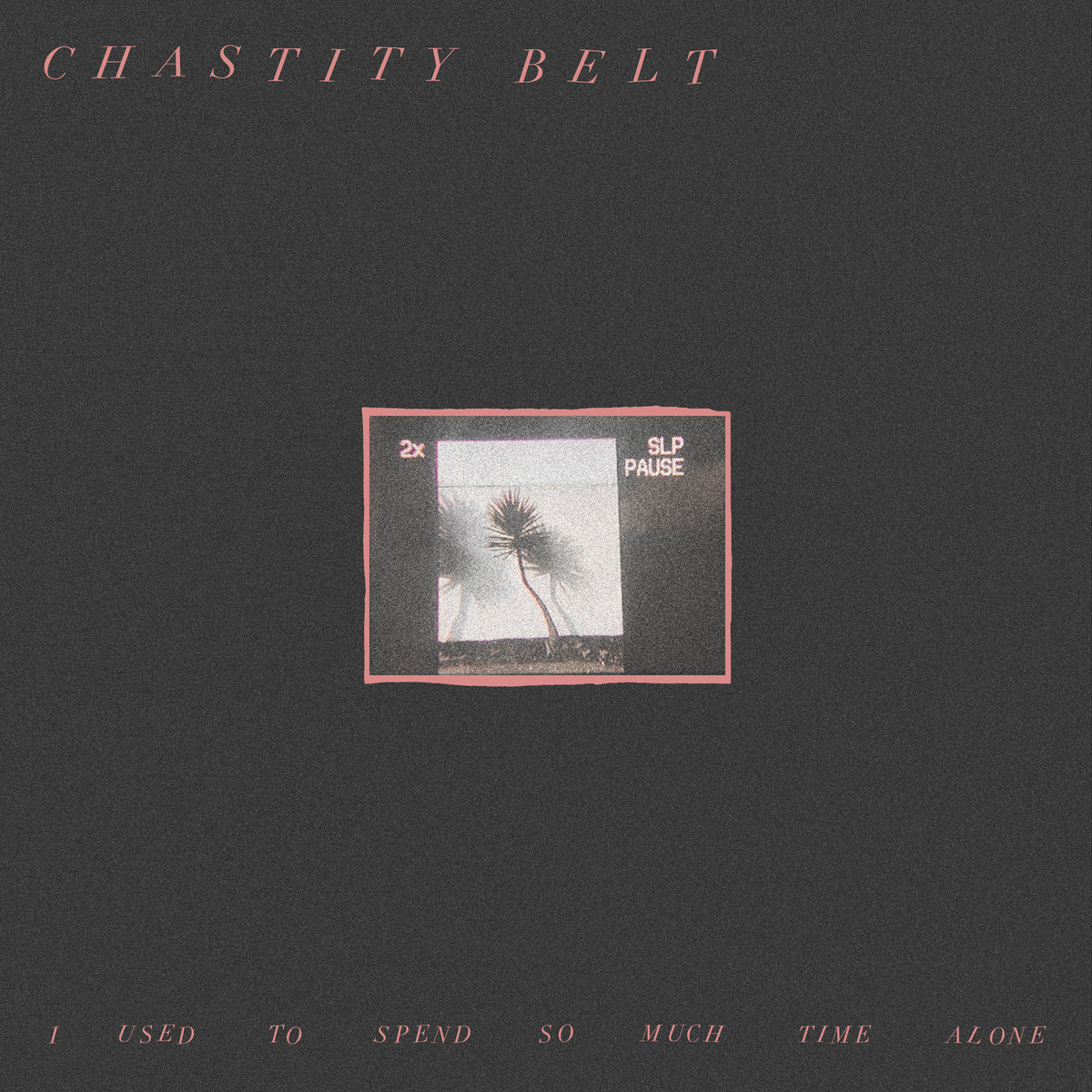
Every band begins with a mission. Some yearn for fame, others for fortune; many are just looking for a way to pay the bills, and a few want to make art for art’s sake. The Seattle band Chastity Belt also grew from a shared purpose; the quartet came together when they were sophomores at Whitman College, in neighboring Walla Walla. The catalyst? An intense desire, fueled largely by pure boredom, to troll Beta Theta Pi, one of four fraternities on campus.
It was 2010, bandleader Julia Shapiro tells me over the phone, and the brothers’ annual “Battle of the Bands”—a bacchanal dominated by Axe, weed, and body odor—was fast approaching. As such, the ladies Shapiro (guitar, vocals), Lydia Lund (guitar), Annie Truscott (bass), and Gretchen Grimm (drums) decided to contest the event.
A short while later, Chastity Belt hit the stage for their first-ever performance, dressed as punks, faces smeared with garish makeup (“I was wearing so much red eyeliner it looked like my eyes were bleeding,” Shapiro recalls). They performed a single song: “Surrender,” a five-minute ode to angst, youth, “stealing your mom’s cigarettes, and wearing dark eyeliner.” To the band’s surprise, the mass of friends gathered to watch the set significantly outnumbered the Betas. Not that Chastity Belt needed to sway anyone; according to Shapiro, some of the group’s friends stole the voting slips intended for partygoers and stuffed the ballot boxes, rigging the competition in the band’s favor. “We didn’t really win anything,” Shapiro says, her deadpan voice dripping with mock disappointment.
Chastity Belt had, in fact, won several things: a serious confidence boost, validation from their peers, and the realization that, beneath all their jangly tomfoolery as underclassmen, there was a rock band waiting to emerge. “When we moved to Seattle,” Shapiro says, “we were like ‘Oh, we can really do this’—and once we felt that, it was kind of like ‘Well, let’s make music that we actually want to make, that’s not just this funny, humorous thing.”.
The foursome weren’t ready to grow up just yet, of course, so when it came time to record and promote 2013’s No Regerts and its 2015 follow-up Time to Go Home, they kept things light-hearted, preaching self-love and sex-positive feminism with smirks on their faces on songs like “Nip Slip,” “Giant (Vagina),” and “Cool Slut.”
Between their nonstop buoyant hooks to garner a reputation as Hardly Art’s goofball darlings, spreading smiles and giggles wherever they went. But eventually, the chortles started to seem like a crutch—especially in the wake of sought-after opening spots for tours with Courtney Barnett and Death Cab For Cutie. “It kind of felt like we were hiding behind humor, in a way,” Truscott says. “It takes a lot more to write genuine songs. It’s just harder.”
With their third album I Used To Spend So Much Time Alone, Chastity Belt are taking off the jester’s mask and buckling down, subjecting their jangle-pop to a heretofore unseen level of discipline. Where the first two albums derived their momentum from fleeting, flippant bursts of energy, I Used To Spend So Much Time Alone sees the band taking a protracted approach to dynamics, venturing through the reverb-laden fog with tentative, well-measured strides. Its songs deal with depression and heartbreak. On “5am,” Shapiro mulls over the existential consequences of a long night out, seething over the realization that in all those hours of empty, inebriated conversations she and her friends have said absolutely nothing. “It’s 5am, and I’m full of hate,” she grumbles, before getting to the root cause in the slinky chorus (“Immediate urge to get everything all straight / Need to express it but it’s not the time or place”).
This is a real-life observation for Shapiro, whose beer buzzes typically manifest as a crushing dose of ennui. “I’m trying to have meaningful conversations with people, or make something happen so that it feels worthwhile that I’m out of my house,” Shapiro sighs. “Sometimes, it’ll end with me going to bed around 5am”—she drops the deadpan for an exaggerated, anguished whisper, poking fun at her own melodrama—”just because I know there’s more, there’s got to be more.”
Nowhere is Chastity Belt’s chemistry more tangible, or their emotional honesty so profound, as on the late-album slow-burner “Something Else,” an ode to the seasonal depression that’s a hallmark of life in the Pacific Northwest. Along with the album’s lead single “Different Now,” the song represents a deviation from the band’s fragmented approach to composition (which typically casts Shapiro’s parts as cornerstones, over which the other members add theirs). Instead, its slack, melancholy arrangement came together organically during a jam session. “It ended up being a train of thought that I was having which I feel like a lot of people, especially in Seattle, can relate to during the winter,” she says, reflecting on the band’s shared headspace. “You’re kind of stuck in a downward spiral of negative thoughts until you leave the house and go for a walk to clear your head, but it’s hard to get out there when the weather’s so shitty.”
They may be more world-weary than they were two years ago, but Shapiro and company haven’t gone full Debbie Downer yet, nor do they intend to. At the end of the day, they just want to be honest. Asked if the band’s sobered sound was a conscious effort, she shrugs, “It’s got more to do with the natural progression of our music, and what kind of music we want to be making at this point. Songs like ‘Giant (Vagina)’ and ‘Pussy Weed Beer’ were written in college, when we weren’t really thinking this band was going anywhere. At the time of writing them, we didn’t have any intention of recording them, or continuing to play music.”
With Untouchable, Kelly has raised the stakes even more than his previous album “Goes Missing”, now fully embracing some of the more outwardly power-pop sensibilities he’d hinted at in previous records.
Kelly has become synonymous with L.A. fuzz-punk contemporaries like Ty Segall and Mikal Cronin, and has played in projects with both men. What’s remarkable about Kelly, though, is his confidence in his voice, and it’s a primary focal point throughout Untouchable. Kelly’s vocals are amped up to the forefront, a move that makes for more memorable, hummable moments, as is evident right out of the gate on LP opener “Broken Record.” The song’s slow-burn guitar progression is just monotonous enough to invite Kelly’s meandering melodies to enchant the vibe, as he sings “I took to making circles round the world/every time I run through/I take to making circles round some girl/Like a broken record I hear myself put it in a tune.”
Continuing onto the fantastic “Real Enough to Believe,” Kelly homes in on a perfectly proportioned ‘60s pop format, fully welcoming the dreaded “derivative” song. Rather than being careful to avoid direct aural influences from his favorite styles of music, Kelly embraces the nuances of decades of rock ‘n’ roll and reinvents it in his own smorgasbord of cool. “Real Enough to Believe,” against all odds, rivals the brilliant standout track “Be What You Are” from Goes Missing, a feat that once seemed near-impossible.
Untouchable revels in a generally lo-fi mix that sits well with the record’s found-sound ambiance, in another nod to Kelly’s nomadic muses. “That’s When It’s Over” writhes in a mid-song homage to “Hey Joe,” with Kelly’s scintillating guitar solos saluting both Hendrix and the wormy noodling of the Dead. Perched in the thick of the album’s more thoughtful tunes, “That’s When It’s Over” is a juggernaut of energy that perfectly splits the record into two parts. The song’s breakneck riffing explodes with a full head of steam, chugging along atop motorik drums and Kelly crooning, hooting and hollering to a repeated refrain of “In the heart of her heart, she don’t care.”
In its more tender moments, Untouchable unloads heavier pseudo-ballads like the titletrack. With little more than a reverb-y acoustic guitar and a plunky bass backing, Kelly lets his gorgeous voice take even more of a central role, stripped of the blistering leads that permeate most of the album. “Will It To Be” follows suit near the end of the record, a twisted ballad that finds Kelly cooing “I’m holding back now/but I’m getting closer/I am pretending I don’t need to know or even care at all.” The song’s moody, Velvet Undergroundian darkness comes through despite its Fleetwood Mac facade, with rhythmic instruments set deep and foreboding under Kelly’s fluttering melodies.
The magic moments found on Untouchable speak to Kelly’s swaggering confidence—as if that weren’t perhaps alluded to enough in the album’s very title. As a result, the ambitiousness of his work seems increasingly more destined to join the canon of timeless pop from which The Cairo Gang’s songs find their roots.
The spiny tingle of excitement, the building anticipation of ritual! Chord progressions in the key of the heart! Star-crossed breakthroughs and guitars cross-talking with a bejeweled ennui throughout interrelationships .
Jesca Hoop’s new album “Memories Are Now” wastes no time in making clear its confidence, confrontation, and craftsmanship. The stark and reverberant title track opens the set with “a fighting spirit,” says Hoop, serving as an anthem to push through any obstacle and put forth your very best work. And she has unequivocally done that here, with an album of stunningly original songs–minimalist yet brimming with energy, emerging from a wealth of life experience, great emotional depth, and years of honing the craft of singing.
As riveting as it is reflective, the album, produced by the gifted Blake Mills (Fiona Apple, Alabama Shakes), is a fresh debut of sorts for Hoop, as the first of her solo records made outside of Tony Berg’s Zeitgeist Studios where she and Mills were mentored and came into their own. “I saw us like young chicks out of the nest,” she says. “Blake is so utterly musical and emotionally intelligent in his expression. I wanted to see what we could do, just he and I out from under Tony’s wing.” Mills pushed her to strip away layers, keeping it as close to the live experience as possible, using whole live takes and working very quickly. “It’s still covered in embryonic fluid, for lack of a better way to put it,” says Hoop. “The recordings are quite raw, human and sparse, even unsettling. What I like to call quick fire recording forces you to work in an incredibly focused and instinctive type of way, no second guessing. ”
Pre-orders are shipping now! Don’t miss out on getting the Robin’s Egg Blue-colored Loser edition vinyl LP while supplies last. Also, if you happened to miss the duets album, Love Letter For Fire , that we released last year with Jesca and Sam Beam of the band Iron and Wine , you might want to check that out too .








 The Fat Angel Sings