Garcia Peoples have been a magnetic north for me since I first saw the name a few years ago, loved the suspected pun in there (I’m old enough to remember the wisecracks on the Beatles’ Christmas fan club singles), then heard the psychedelic mission and improvising nerve on the records, the circulating gig tapes and finally in the first-person high of live performance. But in a season of fear and profound loss with no clear way ahead, Garcia Peoples rolled up that night with an uncanny medicine that shook me forward and keeps this album within reach, in a high rotation of assuring message and serial discovery. First impressions count a lot when you find a new, favourite record. But the ones that stick around don’t give you everything at once. Nightcap at Wits’ End has a lot of what I need right now – then brings something new every time I play it.
It turns out there is a real-life Wit’s End, a tavern of the band’s acquaintance in rural New York, along the state line not far from Black Dirt Studios where Garcia Peoples made their 2018 album, Cosmic Cash, and the epic-title-track adventure, 2019’s One Step Behind. The duality here runs deep: almost 50 minutes of intricately arranged composition and kinetic guitar chorales christened in tribute to both a familiar place of refuge and that ragged state of mind beyond all common sense, when you keep on going even after you’ve run out of rope and road. The music itself is a double image: one album-length side of songs that advance the crisp momentum and tangled jangle of early-2019’s Natural Facts; and a second half that extends the medley action on Cosmic Cash with the long reach of One Step Behind in a suite of dynamic writing and bonded, instrumental charge, connected by live-to-tape jams – the band’s first time exercising that second-nature-on-stage in a studio.
The juxtaposition affirms what I wrote in the opening line when I reviewed Natural Facts for Rolling Stone: “Expect the unexpected.” And expect it right away. The great crash of guitars at the end of “Gliding Through” suddenly turns into “Wasted Time,” a dream state of rippled-water singing that escalates into its own incandescent guitar argument. Halfway into “Painting a Vision That Carries,” the music hovers in a suspense of acoustic strum and fuzz-buster chords – “Way out there on the brink,” as the lyric goes – before the charging, instrumental climax. Over in the suite, “One at a Time” is slippery bass and swimming guitars; one improvisation sounds like treble prayer winging through a Marin County mist; and there is a minute-and-change of wah-wah brutality before the striking finish of “Shadow,” a quiet hymn for rising through wreckage.
Nightcap at Wits’ End was a long time coming: more than nine months in Philadelphia with Jeff Zeigler, who recorded Natural Facts – from the first work in August, 2019 to the final mix, only a few weeks before I heard it in that eerie midnight. But this album has arrived as if absolutely destined for right now. I am tempted to say it is the band’s best record, except Garcia Peoples are too restless to settle for plateaus. Just do as the title says. Raise a glass at your wit’s end, and let the music blow away the night.
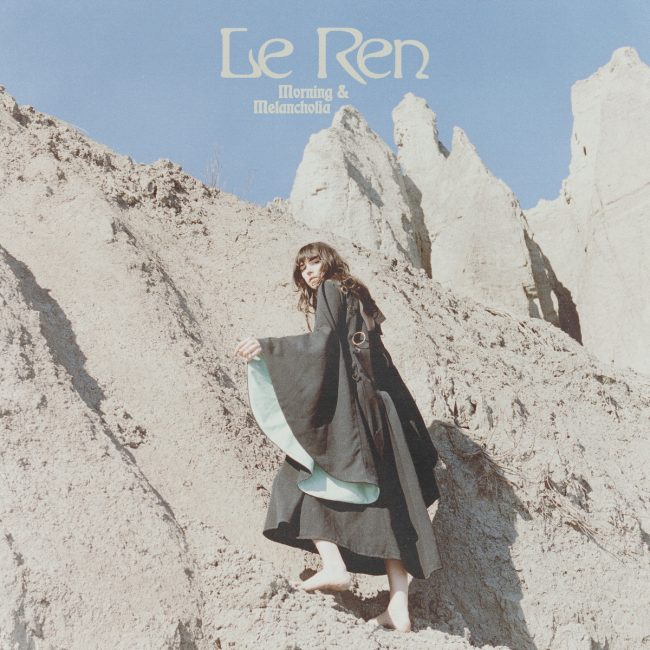
By now, it has been well documented how affecting Le Ren’s Morning & Melancholiais. The powerful emotional response to these four folk songs is in part the result of Lauren Spear’s sharp song writing, which allows her to, at once, fill your heart with love and snap it in half.
A stunning four-song EP that feels like the end of the world is taking place. What actually happened is an ex-boyfriend died in a car crash and these songs are the healing that Le Ren, whose real name is Lauren Spear, needed to get out into the world. The songs are beautiful and heart breaking and a hell of an introduction in the world as this is her debut. “Love Can’t Be The Only Reason To Stay” kicks us off with a lullaby about loving someone so much but ultimately having to leave that person because there is more than just love going on.
The healing process of life after this tragic death begins with “How to Begin to Say Goodbye”. The way she harmonizes with herself is just gorgeous. “If I Had Wings” is Lauren trying to figure out a way to see this person one more time to say goodbye. “The Day I Lose My Mind” sounds like a song you’d hear coming out of a Texas Honky Tonk, not from Montreal. The pain in her voice though can be felt universally though. The four songs go by quickly, but be prepared for a lot of feelings to bubble up, especially with what has happened throughout this year.
This five-song EP completely missed my radar until I began compiling what you’re currently reading. Coming out right before the election, I think it got swallowed up by the news. It kicks off with a scorching take on Hendrix’s “Voodoo Child” where he does all of his tricks of the trade while still honouring the original song and the absolute legend who made it. He then teams with Slash on “Interstate 80” which has the two of them going back and forth ripping solo after solo to see who could outdo who. It’s impossible not to smile as you hear the two of them pushing one another to go for broke. Morello then gives us a tribute to another guitar legend who has just passed with “Secretariat (For EVH)” and even throws some of Van Halen’s “Cathedral” in for good measure. He closes out the EP with “Suburban Guerilla” and “Cato Stedman & Neptune Frost” which again have him showing off his licks that let you know exactly who is playing the instrument. Morello is a singular voice on the instrument and I hope we are all able to enjoy the Rage Against the Machine reunion that was supposed to happen this year as soon as possible.
Tom Morello battles Slash in the guitar duel of the century in the new song “Interstate 80”, from Tom’s new EP “Comandante” out everywhere now
A casual scan of Nels Cline’s dizzying discography echoes this – spanning lead guitar duties in iconic Chicago rock band Wilco, to over 200 recordings across alternative, punk and jazz. While accolades have been plenty (Rolling Stone once hailed him as one of its 20 “new guitar gods”), Nels Cline has hardly had time to rest on his laurels with various projects fuelling his flair for genre-bending.
“Share The Wealth”, his latest Blue Note Records outing with long-time band The Nels Cline Singers, is no exception.
Well Nels Cline does it again. The man just doesn’t miss. This 10-track, almost 80-minute album is a tour de force. Nels brought in a bunch of heavy hitters for this effort: Skerik on saxophone, Brian Marsella on keys, Trevor Dunn on bass, Scott Amendola on drums, and Cyro Baptista on percussion. The talent oozing out of this record is palpable. They never step on one another and each musician is given room to do damage as the music ebbs and flows between quietness and rowdiness. Nels brought this group together as an experiment and decided he liked the jams so much that he didn’t really want to mess with them as originally intended to do by picking pieces of the jams apart to make a different sonic landscape.
So here we have this behemoth of a jazz record that just pulls you in and never lets go. From the opening notes of “Segunda” to the ending of “Passed Down” you just have to strap in and go for the ride. “Beam/Spiral” really sets for taking off into outer space around the five-minute mark. “Stump the Panel” is a 17-minute excursion that will leave your jaw dropped. Each member of the band really goes for it, with Skerik and Brian battling it out in the first half before a dip in the action leads to a beautiful quieter portion until it turns into what sounds like the beginning of a horror movie. “Princess Phone”, “The Pleather Patrol”, and “Headdress” all sound like music from outer space coming to take over the land.
Listening to Nels go from quiet background player to upfront shred fest to psychedelic slides to ambient noises all from the same instrument throughout the record hurts my brain. The man just does so much with one instrument. Please listen to this one on some good headphones.
Blue Note Records; under exclusive license to UMG Recordings, Released on: 13th November 2020.
Having come out with an EP earlier this year, which is also fantastic, Kathleen comes back with another four-song EP. There is a lot of dread as the EP was mostly written during quarantine, but then again who wasn’t filled with dread. “August” kicks us off with a song revolving around how love sometimes doesn’t turn out the way you thought it would. Kathleen’s voice roars with emotion that she couldn’t hold back while thinking of her past love. “Dark Side of the Moon” was written at the beginning of the quarantine as Kathleen packed her car and drove through four states, with many of her belongings to her family’s home. There is some hope in the beautiful folk song with learning to take what you can, including watching the birds sing and the grass grow. The song ends as nature takes over the track, giving us all hope.
“Can’t Sleep” is that feeling that everyone has: that everything currently happening is a dream, but if we can wake up it will all be over. There’s so much uncertainty and while it would be nice to just snap awake, we need to figure out how to come together to defeat everything that is happening. It’s the song off the EP that would find the dancehalls, if we could get there right now. “Glass Piano” closes us out with a song that seems like it could have come from Fiona Apple, with some great piano work and layers of vocals on top of each other. It’s a beautiful track showing what Kathleen is capable of and what could be coming next.
Kathleen is one of Warner Records newest signees. Raised in Steamboat Springs, Colorado but now based in Los Angeles, she draws from her poetry and environmentalist background in her conscious spin on the singer/songwriter formula. On her debut EP, Kathleen I, listeners can hear traces of Joni Mitchell’s down-to-earth folk, Fiona Apple’s idiosyncratic art pop, and touches of contemporary pop production, an engaging combination that showcases the depth of Kathleen’s vocals and her song writing potential.
Make sure to listen to both EP’s if you haven’t yet. Released by Warner Records
On Hachiku’s debut album, Anika Ostendorf and collaborators build on the lo-fi foundations of their earlier material, making atmospheric yet achingly visceral off-kilter pop gems. While the familiar vintage keyboards and minimalist drum machines still punctuate throughout, there’s a gritty dynamism that anchors ‘I’ll Probably Be Asleep’, propulsive rhythms and distorted guitars underscoring its dreamy melodies and Ostendorf’s softly sung vocals.
Loss, long-distance romance, arguments with climate change deniers and bureaucratic immigration processes: On ‘I’ll Probably Be Asleep’, the debut album from dream pop artist Hachiku, even the topics usually relegated to inflammatory newspaper op-eds take on new depth and heart.
The project of 26-year-old Anika Ostendorf, Hachiku emerged onto the local Melbourne scene in 2017 with a suite of minimal electronic songs inspired by the folk artists she aspired to emulate as a teenager. On her 2017 EP and successive singles – all released by Milk! Records, the label whose massive merch operation Ostendorf runs with her partner, photographer Marcelle Bradbeer the now-signature Hachiku sound began to take form: Hopeful keys, occasionally anxious production and Ostendorf’s cynical lyricism, so clear-eyed you felt it had the capacity to permanently change its subject.
But even Ostendorf admits that sometimes the ideas occupying her mind aren’t clear at first. Like sediment in a glass of water, the true meanings need time to settle. Two years after subconsciously processing her grandmother’s death in a song on her EP, she noticed a “lyrically obvious” reference to it that has previously passed her by. The same is true of the territory she covers on ‘I’ll Probably Be Asleep’. “Thematically, what each song [on the album] would be about is so all over the place,” Ostendorf tells NME from her home in Melbourne. Over Zoom, I can see she’s tucked in the corner of what looks like an all-purpose room – there’s a couch next to her and on the other side, instruments she used to record a sizeable chunk of the new album.
That sonic turn pairs perfectly with the album’s themes of loss and grief, the exasperating experience of being a young woman in the world, and displacement (Ostendorf explores the limbo of waiting to be granted permanent residency on album highlight ‘Bridging Visa B’). The album charts a timeline of around four years, but is punctuated less by dates than the places Ostendorf found herself: “Some songs would be [written] while doing long-distance. Some were when I was back in Germany and while my dog was passing away.”
While the sense of place isn’t always noticeable for listeners, it informs Ostendorf’s understanding of not just where she was in her life when writing each song, but where in the world, too. Ostendorf was born in Michigan, grew up in Germany and studied in London before a university exchange gave her the choice to spend a year in either Singapore, Auckland or Melbourne. On the advice of her worldly grandmother, she chose the city with the fewest major cultural differences and most promising music scene.
While ostensibly in Melbourne to continue studying biology, she could already feel herself being pulled in a different direction. “I had already told my parents, ‘I actually don’t really want to do biology. I kind of want to do music instead.’” She recalls, “I think I told my father first, because he’s always good at giving life advice. And, I think growing up, he would have always wanted to become a musician if he hadn’t grown up in Germany in the ’60s and ’70s.”
Ostendorf describes hers as “a Ford family”; grandparents, cousins, aunts and uncles alike all went to work for the company. It’s the reason she moved around so much as a kid, and she thinks that the stability of life with the auto manufacturer left her father with a lingering sense of ‘what if?’, exacerbated by the knowledge that childhood friends found success as professional musicians. “I think there’s always a little bit of like, ‘Ooh, that could have been me, but if I had done that I wouldn’t have met my wife, I wouldn’t have my children, I wouldn’t be financially stable’,” she muses.
Ostendorf’s father was both her greatest encouragement and “probably one of the best guitarists I know, actually”, but her mother wasn’t far behind. She plays the accordion and takes opera singing lessons, and as a teen Ostendorf played in her band, a troupe of IT staff at the Ford factory that performed pop songs they hijacked and rewrote about the inner-workings of the office.
“They play in a duo at friends’ birthdays and sing songs together,” Ostendorf says of her parents. “They always wanted me to start learning an instrument early on and join the choir. Never discouraging, but never pushy.”
The perfect balance, it sounds like. Ostendorf describes her father taking her to a studio when she was 17 so she could record a CD. Influenced by Regina Spektor and Fleet Foxes mostly, but also featuring a cover of a song by hardcore band Fucked Up, the formative record set her on a course as an artist – even if the medium didn’t stick around. “My dad would be happy if you mentioned this, because we still have around 800 of those CDs left that we made,” she tells me. “I don’t know why we made a thousand CDs; for our upcoming album, we only made 500.
Recorded over years spent flitting between focusses and countries, ‘I’ll Probably Be Asleep’ feels nonetheless resolved and settled. The song ‘Busy Being Boring’ is testament to that. Ostendorf wrote it in 2018 while applying for a partner visa to stay in Australia for a further two years. “At the start of being here I’d never really seen myself as being in one place longer than two years. For some reason when I’m not stimulated with a new thing, I get distracted really easily.”
She imagines the life of a professional dabbler: “Ooh, I can do two months of farm work! Ooh, afterwards, maybe I could move to Iceland and just work on a wind farm, or like maybe I could go to the Maldives and become a professional diving instructor!”
‘Busy Being Boring’, Ostendorf says, is her coming to terms with staying still after a lifetime of moving. “Like maybe it’s OK to just be… determined to make something work and stick with something because you think that it is worthwhile and not be so cynical and negative about it.”
She saves the cynicism and negativity for the record’s title track, which is also its opener. In a press release, Ostendorf explained the song: “In essence, it is like an escapist’s testament about the wish to gain sovereignty over your thoughts. Freud’s id vs superego. The thought of wanting to be part of something but the idea of it being way more enticing than the reality.”
The record’s only song recorded with the full Hachiku band – guitarist Georgia Smith, bassist Jessie L. Warren and drummer Simon Reynolds – ‘I’ll Probably Be Asleep’ is murky and cheeky, channelling a beautiful inner brattiness. Like much of the record, its driving motivation is want.
But where tracks like ‘You’ll Probably Think This Song Is About You’ and ‘Dreams Of Galapagos’ project that wanting outwards, here the song wrestles with itself internally. There is a delicious kind of petulance at play, as if having lived a life full of options has left Ostendorf with just one thing left to do: stay in, stay still and sort through her stockpile of confrontational conversations and tough experiences until, in time, she’s ready to have the last word.
I’ll Probably Be Asleep’ is out now on Milk! Records and Marathon Artists. From the forthcoming album ‘I’ll Probably Be Asleep’ released November 13th, 2020.
This is an all-acoustic EP recorded at home during lockdown. Surprised that this has not been mentioned yet, but a couple of months ago Richard Thompson released a new six song EP “Bloody Noses” on download / streaming (no physical release that I know of). Richard Thompson records 6 new acoustic tracks at home during lockdown and fires them straight onto bandcamp. His solo sets streamed from his living room have been most enjoyable for us fans. Here the songs cover topics like confusion, resilience and loneliness which echo in our current times for sure. Richard keeps the songs sparse with just acoustic guitars and mandolin, a little bit of percussion and his partner Zara on harmonies.
I’m especially fond of ‘If I Could Live My Life Again’ a slow blues with a wonderful vocal, ‘Survivor’ and ‘Fortress’ on the other hand shows the new guard of acoustic folkies like William Tyler and Ryley Walker they still have some way to go to get close to him. Not had the requisite six listens yet, but a couple of listens in and its very good – an acoustic EP with help from his partner on backing vocals. He also did a “launch party” on Facebook where it was played in full . I regard Richard Thompson as not only one of the great singer song writers but also the finest guitarists ever. Acoustic or electric, he is simply brilliant. And “Bloody Noses” is an acoustic EP – sounds like Richard has multi – tracked rhythm & lead – at least on the first song “As Soon As You Hear The Bell” which is a terrific opener- the second track “If I Could Live My Live Again” – which rocks along nicely and is of course beautifully played.
“She’s A Hard Girl To Know” is one of Richard’s darker songs – actually for a chap who is so funny live, his songs tend to be dark. And it is quite brilliant. “Survivor” is more folky – I think that is a mandolin as well as guitar beautifully played.
Kicking off with “Tomorrow People” reaching into the future, a future none of us want but seem to be moving towards, and asking how it’s going. The frustration many of us have felt with how the direction the world as a whole has been moving towards is felt in this song and is the mission statement of the record. Jeremy can write quite the sprawling tale as seen on “Paradise Alley” that’s so vivid you can picture it unfolding in front of you as you listen. There’s a Dylan, Petty, Young feel to the whole record with “Hands Down Your Pockets” feeling like an amalgam of all three. This is an angry record pointing directly at everything happening in the world. “White Shadow” is about the current Black Lives Matter movement and how white people’s time in power is over. “Things Could Get Much Worse” is pretty self-explanatory in the title, but it’s the wit of the lyrics that really sells it.
The most scathing take on society as it stands today is “Someone Else’s Problem” and it really nails how many people feel on a day to day basis. There is so much going and so many folks are angry at one another and looking to blame someone else, but in the end “they’re really no such thing as someone else’s problem”. “Loser Town” could have been written by Tom Petty and the Heartbreakers at any time in his career and Ivey along with his band The Extraterrestrials do their best impression of the band on the record and it feels like a love letter to Petty. There’s that guitar riff, everyday man quality, and current storytelling that feels like it could have been written about any era that is so Petty-esque. “How It Has To Be” closes the record out showing off all the tricks lyrically by Jeremy and musically by the band that they’ve displayed on the rest of the album. It’s such a beautiful last track. This is such a great record and deserved far more spins than it got.
I can’t say enough great things about this album and this man. These songs are a very realistic view of our world. The pictures Jeremy paints are both sad and hopeful. He truly is a word smith for our times… I can’t wait for all the great things yet to come his way.
Jeremy Ivey – guitar, vocals, harmonica, piano, synth, The Extraterrestrials are: Evan Donohue – guitar, vocals Coley Hinson – bass, vocals Alex Munoz – guitar, lap steel Josh Minyard – drums, percussion
Special guests: Margo Price – vocals, percussion
Dillion Napier – drums, percussion Micah Hulscher – organ, piano, synth, electric piano Dexter Green – vocals and additional arrangement on Movies
Released October 16th, 2020
Production – Margo Price Co-production – Jeremy Ivey and The Extraterrestrials Arrangements – Margo Price, Jeremy Ivey and The Extraterrestrials
There’s a vague sense of unease that permeates Corey Flood’s debut full-length, “Hanging Garden”, It came out September 4th via Fire Talk. From the surface, the record appears to break through the dark fog of the band’s 2018 EP, Wish You Hadn’t, but just below lay themes of ambivalence, uncertainty, and anxiety, layered elegantly in fuzz. Recorded in Philadelphia by Jackie Milestone, mixed by Natasha Jacobs, and mastered by Sarah Register, Hanging Garden pushes through feelings of discomfort and repressed emotions to discover what truly lies beneath.
Born in Philly circa 2017, Corey Flood began as the post-grad bedroom project of bassist Ivy Gray-Klein (formerly of Littler) and drummer Juliette Rando. A month after their first show with guitarist Em Boltz, the band signed with New York’s Fire Talk Records and turned four planned demos into a full-fledged, delightfully menacing debut EP. Now, after two years of intense growth and collaboration, the trio continues their “whirlwind trajectory” with the long-awaited, nine-track LP, “Hanging Garden”.
Inspired by Throwing Muses, Helium, Pale Saints, and Brix Smith-Start’s work with the Fall, Gray-Klein calls Hanging Garden “a reckoning with internal discord.” Through soft melodies, lush guitars and churning rhythms, the dual vocals of Gray-Klein and Boltz recall relatable experiences with gaslighting, imposter syndrome, and repetitive thoughts. Hanging Garden feels intimate and familiar but is strewn with playful surprises, like 70s krautrock guitar work and samba-influenced drum parts. Hanging Garden is a mature stride forward, and a bewitching amble towards the unknown.
From Corey Flood’s debut album ‘Hanging Garden’ Out September 4th 2020 on Fire Talk. “Blissfully nostalgic and compelling lo-fi guitar-pop.” – Noisey/Vice
“Their abstract, evocative lyrics are deeply contemplative cyclones—just like how their saw-toothed guitars will rattle around your brain, thoughts swirling until they begin to fester, gnawing at one’s psyche.” – Paste
Shamir is Shamir and remains Shamir through and through, no matter what the universe puts him through. This album is so different than anything Shamir has released in their discography. It’s more pop rock than anything before this. I can see myself jamming to this live at a festival. But we can’t do that, so a festival at home while playing this album will have to do. Stand out tracks include On My Own, Pretty When I’m Sad, Diet & In this Hole.
I’m all about albums that move from genre to genre with ease. Shamir has done that with this record, with a few skits thrown in for good measure. We get some country “Other Side”, indie rock “Pretty When I’m Sad” and “Paranoia”, and pop “Running”. Shamir’s voice is very much the hook here as that high pitch singing sounds like no one else. “On My Own” also swings towards pop and feels like an anthem for feeling comfortable in your own skin. “Diet” has such a great groove to it that I found myself dancing around no matter when I listened to it. “I Wonder” is truly a heart breaking song that sounds like Shamir was going through that moment in a relationship where you look at the other person and go, “is this going to work?.” “In This Hole” ends the record as Shamir reaches deep down inside to deliver the lyrics as strings swirl around eventually taking over and fading out. It’s a gorgeous end to the quick album and it leaves you more than satisfied.