Taking their moniker from the notion of ‘Liberation Upon Hearing In The Between’ from the Tibetan Book Of The Dead, Josefin Öhrn + The Liberation’ took little time to make their mark on the wider world, brandishing a radiant sound that stands effortlessly apart from the increasingly staid and often paradoxically predictable world of modern psychedelia.
Having already been nominated for a Swedish Grammy with their debut EP, Diamond Waves, their full-length 2015 debut on Rocket Recordings, Horse Dance marked out a territory in which beguiling repetition could sashay with sweet pop suss, melodic flourishes with experimental intensity, and it was summarily rapturously received on arrival, making new fans like 6 Music’s Lauren Laverne and earning them appearances at Roskilde Festival and Eindhoven Psych Lab.
Yet clearly this was only the beginning of a journey of discovery ,and few would have guessed how the band’s sound would quickly evolve into still more enchanting and enlightening strains. Their second effort Mirage, which follows a mere year after its predecessor, sees the band sculpting sprawling, hypnotic jams into elegant nocturnal serenades with such serendipity that their actual creation remains a little hazy even to themselves. “We agree on not remembering very much about how these tracks came about, that all of them were written on the road and that most of them came fully formed” note the band. “Most were really long to begin with, but we found it relieving to break away a bit from the mandatory psych jams a little bit. We also just realised that none of them were written in daylight, which might be why memory is so elusive.”
Indeed, this hypnagogic approach seems to fit well with the primary inspiration for the five-piece, which centred on ‘the state where dreams, visions and the present are entwined’ – the domain of surrealists and mystics, not to mention cinematic epiphanies such as Morgiana, Daisies and Tarkovsky’s Solaris.
True to form, Mirage see the band taking a chic tradition of avant-pop that extends all the way from Serge Gainsbourg and Françoise Hardy to Broadcast and Saint Etienne, and warping it mercilessly to their own darker ends.
Whilst the brooding yet sultry ‘Sister Green Eyes’ is no less than a sharp slice of velveteen motorik-pop and ‘Looking For You’ reinvents three-chord garage-rock attack with mighty finesse, The Liberation are just as comfortable dealing out the heavy-lidded and electronically-driven ‘In Madrid’ or the dive in the hallucinatory deep end of ‘Circular Motion’, on which they’re aided and abetted by Lay Llamas’ Nicola Guinta.
Fresh excitement for the band lies in wait, courtesy of a UK tour with Goat and an appearance at LiverpoolInternational Festival Of Psychedelia, yet amidst the psychic forces responsible for this kaleidoscopic effort who can say what will follow. “Horse Dance was very much about conjuring the strength needed to cut ties” the band elucidate. “Mirage may be about having left but having no clue what’s next – the power in being completely lost and thriving on it” Yet the seductive splendour of these ten songs åmake manifest a parallel world of disorientation and deliverance in which one would be a fool not to want to languish adrift.
If you’ve been riding the crest of the Aussie psychedelic rock wave for a while, you may already be familiar with down-under wonders, The Babe Rainbow. Their debut EP from Flightless Records in Sept. 2015 (produced by Stu Mackenzie from King Gizzard ) made instant ripples on a label that just keeps delivering the goods. The band returns this summer with their debut full-length LP, and the timing just feels right. Can you say it could be the summer soundtrack?
The Babe Rainbow represents a slightly folkier, stripped-down and sweeter side of the Psych rock scene, and captures everything you loved about the late-60’s movement in the first place. If King Gizzard’s Paper Mâché Dream Balloon was your bag, you simply cannot go wrong with clicking the ‘Buy’ button. The Babe Rainbow’s debut EP went fairly fast and fetches quite a bit on the aftermarket, so don’t wait around too long!
The Babe Rainbow’s self titled debut album due out onFlightless Records on June 2nd 2017
New York indie rock darlings The Pains of Being Pure at Heart made an immediate impact on music culture on their 2008 self-titled debut, reviving twee pop and its various elements with bleeding heart lyrics, straight-to-the-gut candy riffs and Kip Berman’s paper-thin vocal delivery. There’s a Smiths-esque quality in there subtle melancholia, the perfect band to play over the loud speakers as a pink-laced Molly Ringwald walks into the record store with $15 to burn. These guys are the sweaty palms before you ask the girl in your French class to dance, the sketchbook under your bed with all the potential bands names for your fictional new wave band. They’re for the dreamers and the hopeless romantics.
And they’re BACK with album number four, their first endeavor since 2014’s Days of Abandon. The Pains have experimented with heavier sounds and different styles along their path over the last decade, so don’t expect this to sound exactly like their debut. It’s still gonna be f-ing great, though, and there’s only 500 copies on gold wax to go around, so get to the getting.
The National unveiled the title of their forthcoming album, called “Sleep Well Beast”. In addition to announcing the album, they also gave a sneak peek of the new music via single “The System Only Dreams in Total Darkness.”
“The System Only Dreams In Total Darkness” has an eerie accompanying video, directed by software designer Casey Reas. The track is undeniably catchy and offers listeners a throwback to earlier National records. You know them, you love them. Cincinnati-turned-Brooklyn indie rock gurus The National have finally readied album number#7, their first full-length in almost 4 years. Berninger and the boys’ have perfected their knack for channeling our inner melancholy and giving us a cathartic dose of anthemic rock and roll, and given the current sociopolitical landscape around us, The National should have plenty of material to fashion a charging album of glimmering hope.
This is the group’s follow-up record to 2013’s Trouble Will Find Me. In support of their new album, The National will tour worldwide starting in late June.
Sleep Well Beastwill be available September 8th via 4AD Records. 4 AD have slung together two colorways for the album, and indie-exclusive on blue wax and a 4AD-exclusive white vinyl copy. The word ‘limited’ has only been used for the blue vinyl, so if you’re looking for the rarer of the two, that’s most likely the choice for you.
Fiona Apple’s album’s master tapes had been sitting in the vault at Sony without a vinyl release, The release of “Tidal” special vinyl, went into the process of making Tidal and getting it mastered by the guy who mastered the album when it was made in 1996.
”
When I’m strong like music / Slow like honey / Heavy with mood.”
For most men, hurting women isn’t a deliberate project. Often, it’s accidental, or even pure carelessness. Yet, I do not know a single woman who has not been hurt by a man. Neither do you. Insidious or thoughtless, it doesn’t really matter. There’s an ache that goes unspoken among all the women I know; the ache of the first male rejection, the initial understanding and loss of power, the wound that bleeds a lesson: The world does not consider you to be fully human. This goes double or even triple for women of color, queer women, and those coping with disabilities, other marginalized identities, and traumatic experiences. Most of us do not have words for it. Somehow, at just 17-years-old, Fiona Apple did. Her stunning debut album, Tidal diluted that ache and mixed it with moonlight, one part per thousand.
Why you need this classic record in your collection,
A classically trained pianist born in New York City to a family full of professional entertainers, Fiona Apple managed, with a little help from her friends, to get her 3-track demo into the hands of Sony Music executive Andrew Slater. Bowled over by the convergence of her piano prowess, astute song writing skills, emotional depth, and world-weary contralto, all of which belied her seventeen years of age, Slater signed Apple to his Clean Slate label, part of The WORK Group, a subsidiary label of Columbia Records. “I couldn’t believe [the demo] was written and sung by a 17-year-old,” a bemused Slater admitted to Billboard in June 1996. “It sounded like a 30 year-old singer who had written a lifetime’s worth of material. I thought someone was playing a joke on me.”
“Slow Like Honey” is the key for unlocking Tidal. No, it’s not as feisty as the thrilling opener, “Sleep To Dream,” the first song she ever wrote (at 14), and the one that is full of so much swagger that the foremost rapper of our era, Kanye West, cites her as an inspiration upon his own matchless self-confidence. “Honey” is stronger, simmering quiet in the sticky-sweet of seduction. Here, Fiona confidently takes back possession of her own sexuality, even if it’s only in her dreams. She becomes the instigator and seductress, the lingering, fascinating thought, an object of desire whose subjective demands must be followed. “The First Taste” quietly, carefully echoes these appetites: “I lay in an early bed / Thinking late thoughts / Waiting for the black to replace my blue”. Desire becomes so much trickier when it has been subsumed and stolen at such a young age. Trying to construct pleasure outside the undertones of pain requires a massive amount of imagination, an act of grace or God. “Slow Like Honey” is both. Coming just before these two, I hear “Criminal” — the album’s crowning commercial single for a reason — not, as often portrayed, as the confession of a bad slut, but the imagined inversion of her own trauma: What if I was the powerful one? And, what if she was? The world adored this narrative, as it will, embracing any excuse to cast a woman as the perpetrator and not the victim. Top 40 charts favour the temptress, but never “Me and A Gun” Only one of these songs portrays the sexual violence that is actually experienced by over half of the female population “Criminal” is a magnificent fantasy. In some ways, it is comforting to cling to this side of the story. There is strength in mythic re-tellings, especially for survivors. A prevailing criticism of Tidal is that it’s “emotionally indulgent.” I disagree, but also wonder: Which emotions are the one that qualify as indulgences? Fiona’s emotions on Tidal are as tightly-coiled as cobras, they strike and retreat, they lose no ground.
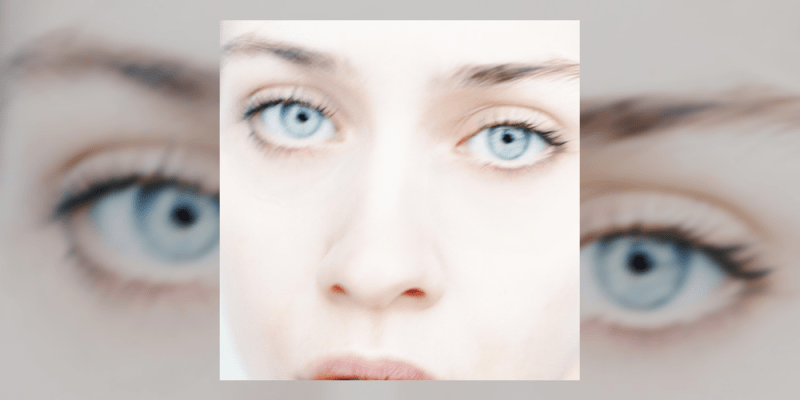
I see pain in the eyes of women I’ve never met, and feel a kinship. There is pain in Fiona’s eyes on the extreme closeup that serves as the artwork of her debut. But she looks unafraid. She looks in control. When “Tidal” came out, I was already well-versed in the ways men would wield their power over me with the rather epic, careless abandon that only masculinity breeds. What I wasn’t familiar with, however, was the steely, determined resolve that Fiona — and many other women before and since had manufactured to process this trauma. Rage can be a weapon of defense when it is calm. One of the most sinister forces behind this seething and majestic record was Fiona’s rape at the age of twelve by a strange man who stalked her all the way inside her New York apartment building. His act of domestic terrorism took calculation, foresight and brutality, but still, he felt empowered to feed her a script of self-blame: “Next time don’t let strangers in,” an adult man told a child after he’d finished sexually assaulting her. Of course, we have no choice; the strangers are already inside, they’re the men and boys we love and trust, fathers and husbands, brothers and uncles. Many of them appear to to care about us. Until they don’t. Until they become strangers again. For every Fiona before and since — it’s not your fault that the child is gone.Even when disturbed and unhappy, Fiona treats her feelings with the utmost respect, delivering solemn disaffection and a languid self-loathing with the kind of reverence usually reserved for romance. Some of these songs were written in minutes, but none of them verge on hysteria. They are calculated summations of years spent aching.
“Rage can be a weapon of defense when it is calm.”
Fiona Apple was a classically-trained pianist from the age of eight, her father and mother, though never married and separated earlier on, were both professional performers. As a teenager, she finagled a three-song demo into the hands of producer Andrew Slater, who signed her almost immediately upon hearing her voice, began to manage her, and even produced Tidal. Her songs are vampy and confessional, heavy with mood, but there is nothing adolescent about the experiences recounted. Between Slater’s shepherding and the expertise of multi-instrumentalist Jon Brion on marimba, harp, vibraphone and more, Tidal pieced together teenage Fiona’s otherworldly song writing into the sleek ten-track album that defined her. Of course, it would also be the men who tied the tracks to an era; these songs would feel ancient if they weren’t occasionally soldered to the ‘90s. (Later on, when she was older, Fiona would mount a massive resistance to the overproduction on the early, leaked version of her 2005 album Extraordinary Machine.) Yet, a thing out of time is never as tender.
“Honestly, I’m not a very skilled pianist,” Apple admitted during a 1997 Keyboard magazine interview. “I can play my own stuff, obviously better than anyone else can, but as far as other music goes, I’m really not very good. It’s hard because…when we were making the album, Andy Slater was always saying, ‘No we have to take it back to what you wrote it on. Back to the roots, that’s the only way it’s going to sound real.’ And the whole time I was saying ‘But I don’t want to play piano on this. I only wrote songs on the piano because it’s the only instrument I know. I don’t want this to be a fuckin’ piano album.’ But Andy kept saying, ‘No, this is how you sound. This is you.’”
In 1996 an interview in billboard that tells the story of Apple and Slater’s meeting and teases her debut, Tori Amos appears as the top of a box office grossing list, having just sold out Madison Square Garden. This was the world that welcomed Fiona with open arms, boosted her to sell three million copies of her debut, and turned her into a star, despite whatever reticence she may have had about celebrity. According to one strain of folklore surrounding the record, Fiona insisted that the name, “Tidal”, was taken in part because of its phonetic proximity to the funny emptiness of “Title.” But given the wild power of the thing that had come out her, she must have known this magnetism needed proper naming. What primeval force is more fitting than the tides to preside over such a magnificent airing out of wounds? Nothing is quite solid on Tidal anyway, and despite the ferocity, it is always a peaceful album, lapping like waves. The hypnotizing pull of these highs and lows make Tidal even easier to sink into; it is a record that swells and rages on an instinctual level. It remains one of the most important artistic distillations of female trauma because of the way she harnesses her pain, transforming it into a quiet source of power.
There’s little unrequited pining in Fiona’s version of the events, no matter how painful; “Shadowboxer” butterfly-floats above a stinging, out-and-out battle of wills, “Never Is A Promise” brooks no bitterness, though it’s disengagement is far from forgiving. Actually, most of the album occurs entirely in Fiona’s head; she is caught up in oblivion but remains focused on turning her hurt into something steadying and beautiful, still concerned with possibilities and potential outcomes. This is not indulgence, but a survival mechanism. On the album’s final two tracks, “Pale September” and “Carrion,” whose respective circumstances occupy very different ends of the emotional spectrum, she again commands and imagines the power she has over her partners. Poised even while candidly discussing most invasive and intimate events, her voice grows husky with rage on “Sullen Girl,” the track that confronts her assault head-on. She gives us the story, however cloaked the details may be, she gives us the full-throated vulnerability of coping, breaking, and mourning, in the process becoming one of the most self-aware female narrators of the ‘90s, or hell, in the entire history of rock.
Following the release of “Tidal”, Fiona Apple won the coveted VMA for Best New Artist, an award she wasn’t expecting. Instead of basking, she couldn’t help but continue to disrupt, urging her fans to ignore whatever picture perfect awards show narrative they’d just seen: “Go with yourself,” she commands, bug-eyed and nervous, entirely positive we don’t need her — or anyone else. Quietness won’t work here, so she screams into the night her infamous pronouncement — “This world is bullsh*t!” — pleading with us to believe her, a teenager in a fancy dress and long, loose curls, unconquered by a red carpet or some accolades. Her pain speaks a different language in public, but the grammar of empathy remains the same.It would be a relief if women did not have to create art out of pain so often, and if the work didn’t resonate so deeply whenever we are allowed to voice it freely. “I’m strong like music,” Fiona sings at the end of “Slow Like Honey” a self-fulfilling prophecy for an audience of one that ended up resonating with millions. “I’m very thrilled that other people can get something out of my songs,”
Fiona Apple’s debut album “Tidal”, originally released July 23rd, 1996.
John Parish (PJ Harvey, Perfume Genius) produced the LP, which was recorded at Geoff Barrow’s Bristol studio Invada; The National’s Aaron Dessner contributes to six of the album’s tracks.
Moonshine Freeze is the follow up to 2015’s “Bashed Out” and sees Kate Stables & Co. making their RoughTrade debut.
“I’m not yet someone who says ‘I want this album to sound like an ’80s French nightclub’,” Stables says. “All I can do is write the songs and then step back from them and see what themes or patterns there are, then bring those patterns out so it’s a coherent piece of work, sonically and in terms of feeling.”
This Is The Kit have announced new record Moonshine Freeze and shared a new performance video of the lead single/title track.
The first 500 physical pre-orders from the Rough Trade webstore will also get a few bonus goodies – a This Is The Kit tea towel and a selection of postcards featuring Stables‘ pinhole camera photography.
Pumarosa’s Isabel Munoz-Newsome, Nick Owen and Jamie Neville sit down to discuss their relief at Aussie road food and how they don’t do things “bite-sized”.
“Getting a little bit overwhelmed is good,” says Isabel Munoz-Newsome, singer/guitarist of London quintet Pumarosa. She’s talking about being on stage, and those moments where things either go wrong or oh so right, and she’s lost in her band’s spectral, psychedelic alt-rock. “I had this really bad jetlag yesterday; this weird feeling like I was in an elevator, like blood was rushing up and down my body. And sometimes, when I dance [on stage], I just spin and spin and spin. And, playing last night, I thought: ‘I really shouldn’t do this, I’m dizzy already.’ But I did it anyway, and I was staggering around. I enjoyed – for a moment – not being in control.”
The day after playing a sold-out show in Melbourne, Pumarosa – Munoz-Newsome, drummer Nick Owen, guitarist Jamie Neville, bassist Henry Brown, keyboardist/saxophonist Tomoya Suzuki . In the studio space, strewn with spotlights, reflectors, and drop-sheets, the outside world is far away. But the highlight of their first Australian tour has been time spent in the outdoors; stepping off an overnight flight and heading for a swim at Coogee Bay.
“It’s been really wonderful,” admits Owen. “Because on a rainy day in North America, where you’re only stopping at service stations, and the only food you can find is totally processed, touring is pretty bleak.”
Pumarosa’s first Australian tour has been a particular tonic for Neville, who, like so many Englishmen before him, came out here as an 18-year-old on a gap year. He ended up collecting money door-to-door in the far-flung Sydney suburbs for “a really fucked up company, just the worst people”. “So,” Neville says, “it’s been so nice coming back, because last time I was here I was just really depressed.”
Suzuki, the band’s “natural adventurer”, is keen to see whatever he can. He’s got a million stories: working in a nature reserve in the Ecuadorian rainforest at 19 (“tracking monkeys for scientists and studying orchids”). Showing up at a UK festival with a “saxophone and a passport”, leading to an odyssey of hitching throughout Europe, from Barcelona to a “psy-trance” rave outside of Budapest. Spontaneously leaving a Romanian festival to travel for two months with “11 crusty hippies” through former Yugoslavia down into Turkey, and driving around Morocco for months “picking up hitch-hikers”.
“Because Australia is such a beautiful place, you must have this next-level colonial guilt; like you’re living in a stolen paradise.”
The band are engaging conversationalists, equally capable of talking about Brexit or Australian colonial identity, “Because Australia is such a beautiful place,” Neville thinks, “you must have this next-level colonial guilt; like you’re living in a stolen paradise.” They touch on the migration of populations to cities and of daily life to social media. They broach Sydney lockout laws: “When you’re touring,” says Suzuki, “what stands out the most are these strange little regulations you have in different places; like, I was so confused by all the rules in Sydney about drinking.” When it comes to talking about their band, though, Pumarosa can find it hard to find the right words.
“When you’re in band – performing music that you’ve made, words that you’ve written – everything feels so on the line. Every word I sing, every gesture I make, it’s all me,” says Munoz-Newsome. “But, just like it can be hard to describe yourself to people, it can be hard to describe your band. I find doing the social media really hard because it’s so self-conscious and self-referential. And for me, the moment of being creative is the opposite of that. When something is coming out, is being imagined, it’s very personal and very pure. [Once] the label asked me if I could take photos or make a video of me working on the album artwork. And I was like, ‘No! No way! I really can’t do that!’ The act of making art, being honest in that moment, that’s quite frightening and quite sacred. To have that just be, like, Snapchatted, it’s just wrong.”
“Making music,” says Neville, “you’re in the middle of a process that is completely freeing. We often have this collective, unspoken idea that we all just instinctively understand, and it will reveal itself to you as you’re doing it… We all just come together, in the one room – there’s no writing on a computer, building things or swapping files – and smash our ideas together, force something out of it. It’s very tactile.”
“We’re reacting to sounds, following them, as much as ideas,” Owen offers. “Like Sonic Youth, I think we’re often working with the energy of the guitar.”
“I think we have a Sonic Youth-esque mentality: make pop music, but do it with a kind of anarchic tonality,” Neville furthers. “I would definitely define it as pop music: we’re not avant-garde, we make songs. But, within that, there’s lots of different perceptions. Some people might just look at us as straight pop, someone else would think our songs are all too long and difficult.”
“I think the fact that our songs are very long, and the words are quite dense, is a kind of response against that [digital] climate,” says Munoz-Newsome. “We’re not providing that instantaneous, bite-sized content. We’d hope people would be happy that we’re offering something that exists outside of that.”
Growing up Munoz-Newsome never saw herself being in this position. Not just as the face of a budding buzz-band, but even making music. “I wasn’t writing songs when I was a kid,” she says. “I didn’t want to be in a band at all. It never even occurred to me. And then it just happened.”
“I think we have a Sonic Youth-esque mentality: make pop music, but do it with a kind of anarchic tonality.”
Of course, Pumarosa didn’t just happen. After studying visual art and painting and thinking that she’d find work as a scenographer, Munoz-Newsome was drawn onto the stage, first as a participant in performance art works. She began writing her first songs eight years ago, and spent years working on them, first just with Owen, then with the band as they slowly came together. Their debut single Priestess finally came out in 2015, and now their debut LP The Witchis here.
The album strings the band’s long songs – none are less than four minutes, four are more than six – together; moving from the “very subdued” opener Dragonfly through to the “really mental, high energy” closer Snake. “Moving from this cinematic opener, that sets the mood, then building up towards this crazy, psychedelic-Hare Krishna climax,” Munoz-Newsome says, “it feels like a journey, more than a set of songs maximising their position for streaming services. We liked the way that felt. But maybe that’s a bad idea, marketing-wise.”
“Finishing an album,” says Owen, “you’ve planted a flag, marked out this territory. After years of work you can finally say: this is a finished work, this represents us.”
As to just how it represents them, Pumarosa still aren’t sure. “We all have particularly different viewpoints, and there can be conflict in that,” says Suzuki. “I like that. If everyone agreed, it would just feel too safe. We’re not a single genre idea or a singular sound. You can listen to techno, or folk music from Africa, and connect those ideas, and draw influence from anywhere along that line. Everything is on the table.”
“Anything goes,” says Munoz-Newsome, “as long as you do it wholeheartedly. The worst thing you can do is fake it.”
Time Is A Riddle’, London based singer-songwriter Luke Sital-Singh’s second full-length, is a heartbreakingly emotive record. At times easy listening due to its graceful melody, at others uncomfortably affecting, this album is up there in the Julien Baker realms of super high-quality solo songwriting.
Opening with the sombre yet catchy groove of ‘Still’, this LP is consistently brilliant throughout. The tenderness of ‘Til The Night Is Done’ is spellbinding, ‘Innocence’ is a wistful, gorgeous listen, and the title-track – complete with a beautiful piano accompaniment – is deeply moving. ‘Time Is A Riddle’ is a record in which it’s easy to lose yourself; perfect for those introspective long drives and late-night walks, Luke Sital-Singh’s words possess a universal appeal, his tales of love and loss sure to strike a chord with anyone willing to give them their time.
Not content to stick to the standard vocal and guitar/piano formula, however, on ‘Time Is A Riddle’, Luke Sital-Singh demonstrates an appetite for the grandiose. This is evident in the build of the album’s midpoint and peak, ‘Cynic’, which develops into a glorious, choir-backed composition of serious class.
Far better than many similar artists who’ve fully infiltrated the mainstream, Luke Sital-Singh is a performer who deserves to enjoy wider recognition; such is the standard of this LP. It’s impossible not to enjoy songwriting this accessible and honestly delivered.
originally from Bristol the singer/songwriter Luke Sital Singh writes for us about each of the songs on newly released second record “Time Is A Riddle”
Still
This song is already known to the world. I released it on my 2015 EPThe Breakneck Speed of Tomorrow. Perhaps a strange choice to place an old song as first track on an important second album, but it was a turning point song for me when I wrote it and recorded the original demo in my flat. There was a lot of doubt and fear in the air after my first label relationship ended and the future felt shaky at best. Finishing this song both in composition and production felt really really good. It basically unlocked something in me and gave me a vision for the sound and the sentiment of what could become a second album.
Also, all that fluff aside, I just think it’s a damn good song and I’m really proud of it and it just feels right as the opening statement on this album
Oh My God
Collaborating or co-writing can be a sticky subject for some. It can be perceived of as being inauthentic at best or as an admission that you can’t write your own songs at worst. There are definitely times I have been put in rooms with ‘hit makers’ and it all felt very contrived and silly, but there have been other times when I’ve wanted to work with actual friends of mine who are amazingly talented, just to see what would happen. That’s how I wrote “Oh My God”, with friend and writer, Paul Steel. The song ended up feeling like a slight oddity for me. In some ways it feels a little angrier, a little more on edge.
With a lot of the writing for this album I tried to let my mind loose and run free when it came to lyrics. I would sing whatever came into my head and try to listen to what my subconscious was coming out with, to see what the music churned up from inside. I was inspired in this by Jeff Tweedy of Wilco who writes most, if not all, of his lyrics this way.
Until The Night Is Done
I’ve always heard that a lot of songwriters carry around notebooks or a note file in their phones etc. to capture thoughts and ideas throughout the day, and even whilst socialising will leave the room when someone says something they think is cool, so they can go write it down or record a voice memo. I’ve never really done this, at least it’s never worked. I carry notebooks but they are all basically empty… but there was something about that method that I liked and I wished my mind worked like that. I was jealous of that method. However, one day I was talking with my Grandmother and she was talking about her late husband and she said ‘I found the letter that he gave to me, 11 hours before we got married,’ and I left the room to write it down. That line became this song. Never done that before. Not done it since.
Rough Diamond Falls
Another first for me. The whole ‘this song came to me in a dream’ thing always felt far-fetched until it happened to me with this one. I dreamt I was in a desert town in America, but it was a kind of Heaven but also a kind of Hell where everything was perfect and nothing could die, but in not dying there was no real life. The town was called Rough Diamond Falls. Very strange. I woke up with the chorus melody and the words ‘Rough Diamond Falls’ repeating over and over in my head.
Nowhere’s Home
This songs all about the recording for me. I had the song on file for a while. I knew I liked it but wasn’t sure the best way to arrange it. Working with Tommy, the producer, we decided it would be cool if it descended into something a little crazy at the end. Started off as a hat tip to “Karma Police” but went a bit more nuts than that in the end! I love it.
Cynic
This is the third time I’ve sat down to specifically write a live set opener song. “Bottled Up Tight” was the first time I did this – initially that song started off very sparse and grew larger towards the end. The second time I did it was “I Have Been A Fire”, which I wanted as a bit of a statement piece. That song has been screeching at the top of my range, which was a ploy to get festival crowds and support slot audiences to shut up and listen to me! Sometimes worked. I wanted a new song that would work for this album cycle. I’ve always wanted to come on stage and sing a completely a cappella song, and “Cynic” started as that but I didn’t have the guts or the talent to go along with it so, although it’s stripped, it’s still got some chords. One day I’ll do that a cappella tune.
Innocence
This song came to me out of thin air. I remember I was watching TV whilst I wrote it. It basically fell out of me fully formed. I would really love to know how that works so I can replicate it everytime!
Time Is A Riddle
This is the song that unlocked the album for me. I go through writer’s block more than I don’t. The block is the default for me. Sometimes I find that stressful, sometimes I manage to just let it be and trust that the songs will happen when they happen. But this specific block was painful and I was really losing all sense of vision and purpose. That said I was writing some things but I had such a lack of confidence that I just shelved them and no one heard them. One of these ideas was “Time Is A Riddle”, it was mostly just the chorus and a vague verse idea. Some residual hint of will inside me wanted to get the song in shape and I got it finished and sent it to my manager. He came back so enthusiastically it was a real shock to the system. Just having someone praise something new I’d written woke me up and the songs came flooding.
Hunger
I wrote “Hunger” in the midst of a rocky label relationship. Things weren’t particularly enjoyable and I could see things slipping away from my control. Whether things were quite as bad as there were in my head is another question. I’m a pessimist through and through, so it was the end of the world as far as I was concerned. This song started as a stream of conscious rant about whatever came into my head and turned into a rallying cry for me about sticking to my guns and fighting for what I cared about. This whole album is a bit of a testament to me finding a way to do just that.
Killing Me
This is one of the most personal and open-handed songs I’ve ever written, whilst at the same time it isn’t about me at all. I wrote it after spending more time with my Grandma who had recently moved in with my parents. Her husband, my Grandfather, died 10 years ago and the idea of anyone living alone without their soulmate is heartbreaking to me, but seeing my Grandma talk about him a lot and also witnessing her in her new surroundings with great-grandchildren running around was very moving to me. Eventually I sat down at my piano and the song came spilling out.
Slow Down
One of my favourite bands is Sigur Rós and one day I will play guitar or drums in an epic post-rock band. But it’s not that day yet, so for now I decided to write this. I told Tommy it needed to sound like the track was breaking apart at the end and he put the whole track through a valve distortion unit and gradually cranked it. So chuffed with how it sounds.
Time Is A Riddle is out now via Raygun/Red Essential.
Los Angeles’ very own pop rock trio Haim returned to TV screens on Saturday night to play two new singles ‘Want You Back’ and ‘Little of Your Love’.
Saturday Night Live, was hosted by Melissa McCarthy, saw the three Haim sisters to perform a couple of tracks from their long-awaited sophomore album. The album, which has been in the works since 2014, is the end result of the the meticulous desire to produce the best work they possibly could.
“All we knew for two years was wake up, soundcheck, play the show, go to sleep and fit in a slice of pizza at some point. We needed to turn our brains from touring brains back to writing brains,” Alana explained “When we came home, we literally got off the bus, took a nap and went right into the studio […] But we were really hard on ourselves […] You get scared. Like, ‘Can we do this again?’”