Lana Del Rey has shared a brand new track ‘Coachella – Woodstock In Mind’. Following on from the launch of the single “Love” and the title track featuring the Weeknd, ‘Coachella – Woodstock In my Mind’ is the latest taster of new material ahead of Lana Del Rey’s upcoming new album “Lust For Life”.
Backed by subtle R&B beats, the track is Del Rey’s signature, brooding pop-noir approach before blooming into a much more three-dimensional, cinematic affair – packed with vivid imagery of her imagination being sent back while enjoying the music and crowds of the California desert.
Describing the new album as ‘more socially aware’, Del Rey said of ‘Lust For Life’: “I started out thinking that the whole record was gonna have a sort of a ’50s-’60s feeling, kind of some kind of Shangri-Las, early Joan Baez influences.” “But I don’t know, as the climate kept on getting more heated politically, I found lyrically everything was just directed towards that. So because of that, the sound just got really updated, and I felt like it was more wanting to talk to the younger side of the audience that I have. I guess it’s a little more socially aware. It’s kind of a global feeling.”
An American Prayer isn’t exactly a Doors record. It’s an album of Morrison reading his poetry, recorded in 1969 and 1970. The remaining Doors reunited in 1978 to record a bunch of music behind the left-behind recordings. For the most part, it’s a totally different listening experience than the other Doors releases, though there are Doors songs, and musical references to Doors songs, throughout. Even though Morrison occasionally delivered lyrics like this amongst Doors music, a sustained album of poetry is kind of its own thing. As an entity in the Doors‘ overall narrative, An American Prayer was controversial. Some argued that Morrison’s work should have been left untouched, and that the remaining trio didn’t represent the material in the way Morrison had intended. This might be a cynical interpretation, but: Over the decades, it was easy to be suspicious of Manzarek, who had a tendency to rely on every last strain of Morrison’s work and legacy to, I don’t know, give himself something to do? You could look at this as the Doors milking Morrison’s work after his death. But whatever the intentions or circumstances were behind An American Prayer, it gave diehard fans another document of Morrison’s work. It’s more related to the essence of the Doors than either Other Voices or Full Circle, making it a more worthwhile thing to explore beyond the original six albums.
Jim Morrison’s girlfriend, Pamela Courson, was found dead of a heroin overdose in her West Hollywood home on April 25th, 1974. Her years without Jim Morrison had not been easy. She tried to establish that she was actually Jim’s widow, but the two had never been legally married. Jim Morrison had named her his soul heir in his will, which resulted in an endless series of legal difficulties for her due to the complexities of his estate. She was forced to close her boutique, Themis; on its closing, she angrily drove her car through the shop’s front window. She lived in the Bay Area for a while, then returned to L.A. To survive, and feed her continuing drug habit, she sold many of her possessions, including also items of Jim’s.
All outstanding suits with the estate were settled by 1974. Pamela received an initial disbursement of $20,000, and at the time of her death was going to receive an additional half million, as well as inheriting a quarter of the Doors’ future earnings. Instead, she was interred at Fairhaven Memorial Park in Santa Ana, California, the marker identifying her as “Pamela Susan Morrison.” A memorial service was held at Forest Lawn’s Hollywood Hill cemetery; Ray Manzarek played “When the Music’s Over,” “Love Street,” and “Crystal Ship” on the church organ. Pamela’s family inherited her estate, and the Morrison family later filed suit for a share of the Doors’ earnings. Jim’s share was ultimately split between the two families.
Three month’s after Pamela’s death, a “Jim Morrison Memorial Disappearance Party” was held on July 3rd at the Whisky a Go Go in Los Angeles. Ray, who was fast becoming the dominant keeper of the Doors’ flame, hosted, and Iggy Pop, who’d been working with Ray, performed a few Doors songs. Whether deliberate or not, the use of the word “disappearance” in the event’s title alluded to a growing perception about Jim Morrison’s ultimate fate; that he hadn’t died, but had simply taken on a new identity to avoid the pressures of being a rock star. The same year of the “Disappearance Party,”Capitol released the album “Phantom’s Divine Comedy Part 1,” with a lead singer who sounded uncannily like Morrison . The record had been recorded by a Detroit group called Walpurgis, who adopted pseudonyms for the album; the singer, Tom Carson, was called “Arthur Pendragon” (Carson was also said to have attended the “Disappearance Party”). In 1975, the book, “The Bank of America of Louisiana,” credited to a “Jim Morrison,” was published, purporting to tell the true story of a rock star who fled the public to start a new life as a banker in Louisiana. It was the beginning of what would become a cottage industry around the possibility that Jim Morrison still walked among us.
The real Jim did return — on record — with the release of “An American Prayer” in 1978. In 1976, Robby Krieger started wondering what happened to the tapes of Jim’s poetry sessions and contacted producer John Haeny. Haeny still had the master tapes, and on listening to them, “I knew that we could do something great with it,” Robby said. The other Doors were quick to agree, and they began working on the album the following year. It was like old times, working with Jim again; Ray recalled that hearing his old bandmate’s voice through his headphones in the recording studio made him look over at the vocal booth, expecting Jim to be there. The album’s five sections — “Awake,” “To Come of Age,” “The Poets Dreams,” “World On Fire,” and “An American Prayer” — traced Jim’s life journey, making the album something of an autobiography. The album also featured a rousing live version of “Roadhouse Blues.”
The album, credited to “Jim Morrison” with “Music by The Doors,” reached No. 54, and sold a quarter of a million on its initial release, respectable figures for a spoken word album; it also received a Grammy nomination. “An American Prayer” even led to a Doors reunion; while promoting the album overseas, the remaining band members gave a brief performance in Paris on what would have been Jim’s 35th birthday, December 8th, 1978.
Not everyone was pleased with the album’s appearance. Doors producer Paul Rothchild indignantly referred to “An American Prayer” as “a rape of Jim Morrison — the same as taking a Picasso and cutting it into postage stamp-sized pieces to spread across a supermarket wall.” His main objection was that Jim wouldn’t have had the other Doors provide the backing music, but with his death there was no way to resolve that issue.
But the album’s greater importance is that it was the first in a series of events that led to full-fledge Doors revival. A big factor in the revival was Ray’s feeling that the Doors’, and particularly Jim’s, contributions to rock were being overlooked. He recalled listening to a DJ on an L.A. radio station talking about rock legends who had died and being surprised that Jim wasn’t mentioned at all: “Where’s Jim? Do the Doors even exist? What about ‘Light My Fire’ and all the rest?” He became determined “to make sure that the world knows Jim Morrison. You can like him or dislike him, but you’re going to know who he is.”
He wouldn’t have long to wait. Frances Ford Coppola’s Vietnam-era war film “Apocalypse Now” featured the Doors’ “The End” in key sequences, reminding people of the nightmarish power of the band (the closing credits even feature a new mix of the track, with Jim’s percussive use of the word “f—k” finally loud enough to hear). The following year, the first major biography of Jim, “No One Here Gets Out Alive” (a line taken from the song “Five to One”), was published and became a worldwide blockbuster. The original manuscript, written by JerryHopkins, had been rejected by over thirty publishers. It was then taken up by Danny Sugerman, who had been hanging out at the Doors’ offices since he was a teenager. Jim hired him to answer his fan mail, and Danny then made it his life’s work to promote the band at every opportunity; he would eventually become the band’s manager.
Danny sent the manuscript to Warner Books, who had already twice rejected it. But this time, a sympathetic editor convinced the company to publish it. Danny, with input from Ray, oversaw an edit of the manuscript. The book was published in June 1980, its release celebrated with a party at the Whisky on June 16, with the remaining Doors playing a short set — the last time they would play together for over a decade. The book, featuring one of Joel Brodsky’s “young lion” pictures of Jim on the cover, topped the “New York Times” bestsellers list and became a huge international bestseller. New releases were quickly put out to take advantage of the Doors’ resurging popularity. The band released their first-ever long form video, “No One Here Gets Out Alive: A Tribute to Jim Morrison,” featuring interviews with the remaining band members and rare footage. A new “best of” collection, simply entitled, “Greatest Hits,” was released in 1980 and hit the Top 20; it would go on to sell over five million copies. In a canny marketing decision, Elektra dropped the list price of “The Doors,” “Waiting for the Sun,” and “The SoftParade” by three dollars; soon, every Doors album doubled its sales over the previous years. “We’ve sold more Doors records this year [1981] than in any year since they were first released,” Elektra publicist Bryn Bridenthal told “Rolling Stone,” which capitalized on interest in the band with a provocative headline on the cover of its September 17th, 1981 issue: “Jim Morrison: He’s hot, he’s sexy and he’s dead,” featuring a picture taken in 1967 by “16” magazine editor Gloria Stavers.
At least “Rolling Stone” forthrightly stated that Jim was deceased. For others, that remained an open question. The Hopkins/Sugerman book fanned that particular flame with its ambiguous ending. Hopkins had originally intended for the book to be published with two different endings; one edition would have Jim dying in Paris, the other suggesting that he faked his death. The publisher vetoed that conceit, so the final chapter discussed both theories, planting the idea that Jim could’ve faked his death at the very end, where it would have more of a dramatic impact. And the book’s final line, “Going on a decade now, there’s still no word from Mr. Mojo Risin’,” implied it was possible the world might one day hear from Jim again.
The genie was out of the bottle; subsequent writings about Jim would nearly all mention the rumor that he might have faked his death. And the Doors now became an on going concern; whatever projects Ray, Robby, and John became involved in, their one-time identity as members of the Doors was never far in the background.
In the 21st century, the remaining Doors managed to come together one more time. The location was the picturesquely named Hen House Studios in, appropriately enough, Venice, California, where the Doors’ story had begun all those years ago. Ray, Robby, and John Densmore provided the musical backing on the album “Look Each Other in the Ears,” by their old friend, Michael C. Ford. Michael had attended UCLA with Jim and Ray, and had also known Robby and John before they’d joined the Doors; Michael had even been considered as a possible bass player for the group. In 1969, Jim invited Michael to read at the Norman Mailer benefit, his first public reading. Now, as they had on “American Prayer,” the three former Doors provided a bed for Michael’s readings — light and upbeat, in contrast to the more mysterious sound of “American Prayer.”
The album, released in 2014, was dedicated to Ray, who died on May 20th, 2013, of bile duct cancer; he died at the RoMed Clinic in Rosenheim, Germany, where he’d gone to seek treatment. Both Robby and John issued statements about his death. “I was deeply saddened to hear about the passing of my friend and bandmate RayManzarek today,” said Robby. “I’m just glad to have been able to have played Doors songs with him for the last decade. Ray was a huge part of my life and I will always miss him.” “There was no keyboard player on the planet more appropriate to support Jim Morrison’s words,” said John, who was on a tour promoting his book, “The Doors Unhinged,” at the time of Ray’s death. “Ray, I felt totally in sync with you musically. It was like we were of one mind, holding down the foundation for Robby and Jim to float on top of. I will miss my musical brother.”
In his memoir, “Light My Fire,” Ray had written about the four Doors being like four points of a diamond, a diamond within “the magic circle of the Doors.” The first time the four had played together, Ray wrote, “The diamond was formed and it was clear and hard and luminous.” Now two of the points were gone, and the circle became smaller. But the loss also helped sweep aside any lingering resentments between the two Doors who remained. On December 5th, 2013, Robby and John appeared together on stage for the first time since the 2000 “VH1 Storytellers” show at “An Evening with The Doors.” held at the Los Angeles County Museum of Art. The night included a screening of the documentary, “Mr. Mojo Risin’: The Making of L.A. Woman,” a Q&A, and a surprise set, with the two performing “People Are Strange,” “Love Me Two Times,” “Spanish Caravan” and “Riders on the Storm.” Robby provided lead vocals, inviting the audience to sing along, because “We’re not great vocalists or anything,” a gentle acknowledgement of who was missing.
And there would be other projects to come. As long as people are drawn to the power of the band’s music, interest in the Doors will live on.
On this album the previous recording to the excellent “Party” album . “The Bearer of Bad News”, Shauf started out with 100 songs and whittled it down to just 11, the cream of the crop—no wonder it turned heads. This time, older, wiser, and with a clearer vision and narrative construct in mind, the self-produced multi-instrumentalist and master of subtlety focused on 15 and cut it to 10.
Recording began with a band in Germany in early 2014, but Shauf—who is endlessly rewriting lyrics and rearranging songs, building them up and then stripping them back to their basics—decided to start anew back home in Regina. There, he set up shop at Studio One, located in an old CBC building, and was left to his own devices. He plays all the instruments, with the exception of the strings, handled by Colin Nealis.
Setting a benchmark for cool, even by New York standards, Overcoats bottled a feelings of connection, tension and the depths of love and trickiness of family relationships on their first album Young. Released on Arts & Crafts Records this year, the record has a tremendous subtlety with Hana Elion and JJ Mitchell drawing strength from vulnerability, lighting up the dark with their timeless, honest songwriting. The two best friends are guaranteed to captivate, bringing their noirish, hushed record beautifully to life.
Wave is an album by the Patti Smith Group, released May 17th, 1979 The title track was a tribute to Pope John Paul I, whose brief papacy coincided with the recording sessions. The first single off the album was “Frederick”, a love song for her husband-to-be Fred “Sonic” Smith with a melody and structure bearing resemblance to “Because the Night”, the group’s biggest hit. The second single, “Dancing Barefoot”, has been covered by many artists.
“Wave” is an album by the Patti Smith Group, released May 17th, 1979 on Arista Records. This album was less commercially successful than its predecessor, “Easter“, although it continued the band’s move towards more radio-friendly mainstream music. It was produced by famed artist/producer Todd Rundgren.
Artists Patti Smith and Robert Mapplethorpe met in New York City in 1967 and were in a love affair until 1974, when Mapplethorpe realised he was homosexual. Their early years together are documented in Mapplethorpe’s intimate black-and-white portraits of Smith, two of which featured on the covers of Horses (1975) an Wave(1979). In 2011, Smith interviewed for Time, “I was his first model, a fact that fills me with pride. The photographs he took of me contain a depth of mutual love and trust inseparable from the image. His work magnifies his love for his subject and his obsession with light.” The pair remained friends, artistic collaborators and soul mates until Mapplethorpe died of Aids in 1989. The photographer also shot album covers for artists including Paul Simon and is famed for his portraits and controversial images of the underground BDSM scene in the late 1960s and 70s.
The title track was a tribute to Pope John Paul I, whose brief papacy coincided with the recording sessions. The first single off the album was “Frederick“, a love song for her husband-to-be Fred Sonic Smith with a melody and structure bearing resemblance to “Because The Night” , the group’s biggest hit. The second single, “DancingBarefoot”, has been covered by many artists.
The band broke up after this album was released, and Smith went on to marry Fred Smith. She spent many years in semi-retirement following the birth of their children, Jesse and Jackson, until her 1988 solo comeback album, “Dream Of Life” . The 1996 remaster of Wave includes Smith’s original version of “Fire of Unknown Origin.”Blue Öyster Cult‘s version was released on their album of the same name in 1981. The back cover of the original LP bore a quote from the Jean Genet poem, “Le Condamné à mort:”
Oh go through the walls; if you must, walk on the ledges
Of roofs, of oceans; cover yourself with light;
Use menace, use prayer…
My sleepers will flee toward another America
Upon its release in 1979, the album garnered mixed reviews, attracting either positive or negative commentary on its polished production and conventionality. Reviewers were not favourable in their reviews of the album, with the former negatively likening it to Radio Ethiopia, Smith’s last album to be critically maligned and the latter concluding her review with “is this the blandest record in the world?”.Melody Maker were more appreciative of the album, praising Rundgren’s hand in the production and considered the songs to represent a newfound focus for Smith and the band.
All songs were written by Patti Smith, except where noted.
Debrah Scarlett saccharine vocals have a slight edge to them, an eldritch edge which lends her pop an otherworldly quality. The 23-year-old Norwegian/Swiss singer’s incredible voice caught the attention of a nation when she joined Mørland to represent Norway in the 2015 Eurovision Song Contest, but it’s her debut solo outing “Cynical Youth” which caught our attention. The track, taken from her latest EP DYS(U)TOPIA, is a stunning ode to an ode to growing up between places and never quite fitting in. She absolutely captivating and not to be missed.
While the official kickoff of A.V. Undercover’s eighth season is still a week away, we thought we’d whet your readers’ proverbial appetites with a special bonus track in advance. In the video above, the lovable scamps in TheRegrettes take on Sweet’s “Fox On The Run,” a song that you might be familiar with . The up-and-comers tackle “Fox On The Run” with a youthful ferocity that would seem a little daunting if you didn’t know the group’s lead singer, Lydia Night, is actually only 16 years old—and thus far more full of energy than the vast majority of us old fuddy-duddies.
The Regrettes’ debut record, Feel Your Feelings Fool!, is out now on Warner Bros. The group kicks off a run of summer tour dates in the USA very soon.
1970: The Complete Fun House Sessions was recorded at Elektra Sound Recorders in Los Angeles and compiled from all thirteen reels of multi-track tape that held every note and snippet of studio dialogue. Twelve reels of tape were used during the original sessions, with the thirteenth reel having the takes that would be used on the studio album. This sprawling set which was originally aimed at the collector market would be challenging and cost prohibitive to reissue as a multi-disc vinyl box set. What is presented here is an attempt to assemble some of the best highlights from the Fun House Sessions on an officially-released 2LP set in high quality packaging with a sequence that hopefully proves to be an easier, and more casual listen. Included are some terrific alternate versions of Down on the Street, Loose, Dirt, Funhouse ,1970 and others, pulled from session reels 1, 4,6, 7, 9 & 11and originally recorded on May 11,12, 15, 18, 21 & 25 of 1970. Also notable is the inclusion of the 17+ minute-version of L.A. Blues, titled as “Freak,” which encompasses the entire fourth side of this set and is the prime example of what makes the Funhouse Sessions both loved and feared simultaneously.
Track Listing:
Side A
1 Studio Dialogue #23 (reel 6) May 18, 1970
2 Down on the Street Take 6 (Reel 6) May 18, 1970
3 Loose Take 16 (reel 4) May 15, 1970
4 T.V. Eye Take 5 (reel 7) May 18, 1970
5 Dirt Take 5 (reel 11) May 25, 1970
Side B
1 Studio Dialogue #3 (reel 1) May 11, 1970
2 1970 Take 3 (reel 1) May 11, 1970
3 Funhouse Take 3 (reel 9) May 21, 1970
Side C
1 Studio Dialogue #7 (reel 2) May 12, 1970
2 See That Cat (T.V. Eye) (reel 2) May 12, 1970
3 1970 Take 2 (reel 1) May 11, 1970
4 Lost in the Future Take 3 (reel 3) May 15, 1970
5 Slide (Slidin’ The Blues) (reel 4) May 15, 1970
Side D
1 Freak (L.A. Blues) Take 1 (reel 12) May 25, 1970
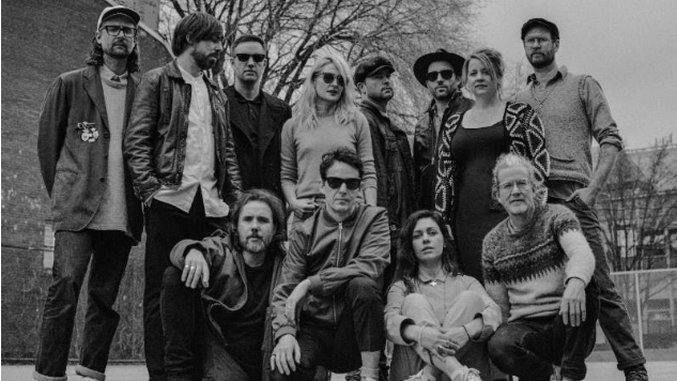
Building up to their first new album in seven years, Broken Social Scene have shared the title track from their forthcoming new album “Hug Of Thunder” , featuring vocals from once-and-future BSS member Leslie Feist . With its unwavering drum-machine, chattering guitar section and Feist’s trademark murmur, it serves as a cool contrast to the untamed jubilance in the band’s first lead-in, “ Halfway Home” Featuring contributions from all fifteen original members as well as new guest vocalist, Ariel Engle, the album is available to pre-order now in digital, CD, and LP. , Broken Social Scene have also announced a full U.S. tour including some UK dates, their first in six years. Frightened Rabbit and The Belle Game are set to open for the group on select dates.
First run LP features beautiful coke bottle clear vinyl (exclusive to pre-order purchases), 140g double-LP, and a 28 page booklet. LP includes the vinyl-only bonus track “Old Dead Young”.
The band’s upcoming UK shows, kicking off next week in Manchester, on May 23rd
Hug of Thunder is out July 7th on Arts & Crafts . See the band’s tour dates—with more to be announced soon.