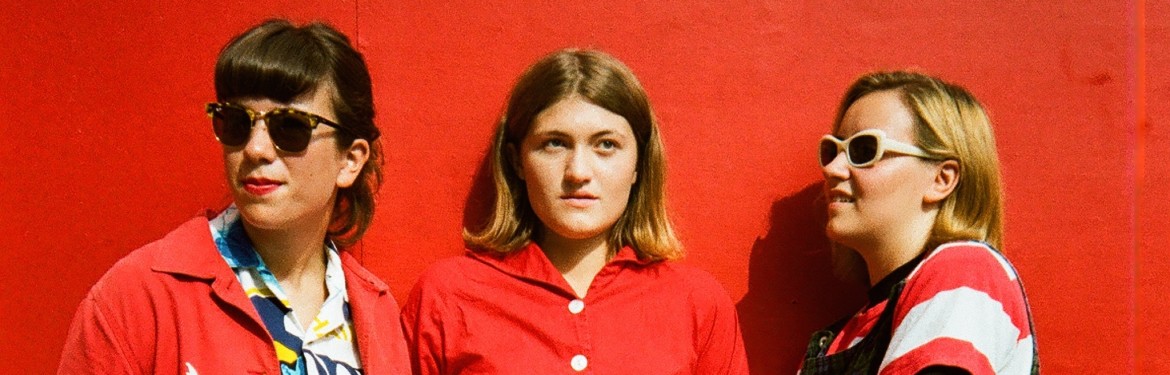
The rollicking guitar pop of Aussie band Rolling Blackouts Coastal Fever captured our attention at SXSW 2017. Now signed to Sub Pop Records and with a full length album Hope Downs on the way this summer,
Fresh off Coachella, Melbourne-based indie rock band Rolling Blackouts Coastal Fever performed live on Morning Becomes Eclectic. With two outstanding Talk Tight and French Press EPs already released and a debut full length album on the way – this quintet bounced around their catchy catalogue with ease (including an unreleased standout track and an Orange Juice cover).
It’s rare that a band’s debut album sounds as confident and self-assured as the Rolling Blackouts Coastal Fever’s“Hope Downs”.
To say that the first full-length from the Melbourne quintet improves on their two buzz-building eps from the last few years would be an understatement: the promise those early releases hinted at is fully realized here, with ten songs of urgent, passionate guitar pop that elicit warm memories of bands past, from the Go-Betweens’ jangle to the charmingly lo-fi trappings of New Zealand’s Flying Nun label. but don’t mistake Rolling Blackouts Coastal Fever for nostalgists
Hope Downs is the sound of a band finding its own collective voice. the hard-hitting debut album is a testament to the band’s tight-knit and hard-working bonafides. prior to forming the band in 2013, singers/guitarists Fran Keaney, Tom Russo, and Joe White had played together in various garage bands, dating back to high school. when Rolling Blackouts Coastal Fever . started, with Joe Russo [Tom’s brother] on bass, MarcelTussie, Joe White’s then-housemate on drums, the chemistry was immediate. after a split ep with You Yangs (another Russo brother’s band), released in the form of a frisbee, they self-released talk tight in 2015, which Sydney-based record label Ivy League gave a wider release the following year. talk tight garnered plaudits from critics, including legendary rock scribe’s. In 2017, Sub Pop released the French Press ep, bringing the band’s chugging and tuneful non-linear indie rock to the rest of the world as they settled into their sound with remarkable ease.
Hope Downs was largely written over the past year in the band’s Melbourne rehearsal room where their previous releases were also written and recorded. the band’s core trio of songwriters hunkered down and wrote as the chaos of the world outside unavoidably seeped into the songwriting process. “we were feeling like we were in a moment where the sands were shifting and the world was getting a lot weirder. there was a general sense that things were coming apart at the seams and people around us were too,” Russo explains. the album title, taken from the name of a vast open cut mine in the middle of Australia, refers to the feeling of “standing at the edge of the void of the big unknown, and finding something to hold on to.” with the help of engineer/producer Liam Judson and his portable setup, the band recorded Hope Downs live, and co-produced ten guitar pop gems over the course of two weeks in northern New South Wales during the winter of 2017. Hope Downs possesses a robust full-band sound that’s all the more impressive considering the band’s avoidance of traditional recording studios. if you loved Talk Tight and the French Press, you certainly won’t be disappointed.
But you might also be surprised at how the band’s sound has grown. there’s a richness and weight to these songs that was previously only hinted at, from the skyscraping chorus of “Sister’s Jeans” to the thrilling climax of album closer “The Hammer.”Hope Downs is as much about the people that populate the world around us—their stories, perspectives, and hopes in the face of disillusionment—as it is about the state of things at large. it’s a record that focuses on finding the bright spots at a time when cynicism all too often feels like the natural state. Rolling Blackouts Coastal Fever are here to remind us to keep our feet on the ground—and Hope Downs is as delicious a taste of terra firma as you’re going to get from a rock band right now.
Sandy Denny is without doubt one of the finest singer-songwriters of her generation, in a few short years Sandy Denny helped shape the direction of British folk-rock legends Fairport Convention, and also embarked on a solo career that saw her write some of her most affecting and timeless material.
I’ve Always Kept A Unicorn: The Acoustic Sandy Denny is as 2CD collection of demos, acoustic recordings and live performances that reveal her music at its most unadorned and personal. As noted by Sandy biographer Mick Houghton, whose superlative study of Sandy’s life and work lends the collection its title, “In the last few years, people have been appreciating Sandy more for her songwriting… If anything, this collection makes it easier to hear the songs themselves because they’re more naked than before.”
With his unique insight into Sandy Denny’s music, Houghton tells us why I’ve Always Kept A Unicorn is an essential addition to Denny’s body of work…
Sandy started out playing around London’s folk clubs in the mid-60s. these demos tap into those roots, To some extent, in her early days she wasn’t really a songwriter at least not a prolific one. She did write the most famous song she’s known for, ‘Who Knows Where The Time Goes?’, when she was 18 or 19, in 1965, which is remarkable in itself. But at that time the folk and pop worlds were so distant from each other. Anyone outside of the folk scene wouldn’t have known who she was.
What was important about the early folk world was that it had the first generation of singer-songwriters, but were all men Bert Jansch, Jackson C Frank, who was her boyfriend for a while; Sandy met Paul Simon, Roy Harper – and I think that probably gave her the confidence to write songs. The unique thing is that she was the only female songwriter at that point. I don’t think she saw herself as a “female songwriter”.
A chance encounter at The Troubadour coffeehouse swung open a gate for Denny’s interest in songwriting. Dave Cousins of London folk outfit The Strawberry Hill Boys asked Denny to join the group after seeing her perform onstage in the club’s cellar. All Our Own Work by Sandy Denny & The Strawbs was recorded over two weeks in Copenhagen. Twelve songs were captured, including Denny’s breakthrough and most enduring composition, “Who Knows Where The Time Goes?,” which showcases her emotive power and palpable solitude simply and immediately in the first verse, over minor-key acoustic guitar:
The folk scene gave her the impetus to start writing her own songs, I think the folk idiom was very much the idiom that singer-songwriters came out of, both in the UK and in America, But the other thing to bear in mind is that, at the point when she joined Fairport Convention, they didn’t know who she was, even though she was quite well known on the folk scene.
Fairport Convention’s excellent third LP, Unhalfbricking. Denny joined Fairport Convention in 1968, they were already the most besainted act of the British folk-rock scene, having magnetized UFO Club owner and noted producer of the period Joe Boyd, who’d helped them secure deals with Polydor Records and then IslandRecords.
Denny won over the group with a cover of Jackson C. Frank’s “You Never Wanted Me” during her audition and replaced singer Judy Dyble, who’d founded the group with bassist Ashley Hutchings, guitarist Simon Nicol, and guitarist Richard Thompson, notable for his later solo works and collaborations with his wife Linda. … Fairport opened an entirely new world for her, after making three albums with them in the space of 18 months, Leige & Lief was a collection of traditional folk songs with no outlet for her own songwriting.
Denny brought a more plaintive, less pop-oriented intensity to the group with her wide vocal register and open-ended songwriting style. Under Denny’s leadership, they became less focused on ape-ing American folk acts, and instead carved out a signature appreciation for British traditional songs and the negative space between notes. The Denny-penned original “Fotheringay,” which opens Fairport’s second album, What We Did on Our Holidays, is the shaky and incongruous LP’s saving grace, a mystical meditation on isolation and death, inspired by the story of Mary, Queen of Scots.
The cover of her second album with the group, Unhalfbricking, released in 1969, features a portrait of Denny’s parents, Neil and Edna, standing outside their family home in Wimbledon—the band barely visible in the background. Though the Unhalfbricking version of “Who Knows…” is notable, and prompted a slew of covers, its full band noodling and subdued vocals temper its fire, making it more pleasant than powerful. Denny stayed on with Fairport through the recording of the heralded album Liege & Lief, their first record comprised mostly of adapted British and Celtic traditional songs, with Denny’s profound delivery front and center. Today, it’s considered the most important record in the British folk-rock movement, a beacon of modernity inspired by antiquity.
Conjecture about Denny’s departure from Fairport Convention abounds to this day. Some cite a new relationship with Australian folk musician Trevor Lucas—others, her increasing thirst for alcohol. Regardless, Denny left the band shortly after the release of their most prestigious album, as unceremoniously as her audition in a humble folk music dive.
Interestingly, after she left Fairport, and after the first Fotheringay album, she only actually recorded one more folk song, ‘Blackwaterside’, on her first solo album. But, at the same time, she never left folk music behind. I think it was still really important to her. She took the language, she took the imagery, but she sort of abandoned folk music stylistically – through the musicians she chose to work with, rather than through anything she was particularly trying to do. I think her music is quite radical, actually. It’s too easy to say, “Oh, she was a folk singer.” But she was a singer-songwriter. She was influenced by early country-rock – The Band, The Flying Burrito Brothers and groups like that. She also had a really strong sense of melody and was grounded in classical music. And I think that comes out in her songs. The big shift when you get to the 70s is: prior to Fotheringay she wrote everything on the guitar – so again that takes you back to folk music. But from 1971 onwards, she wrote everything at the piano, which freed her up a lot more and brought all these other influences into play.
Her 1971 solo debut for Island Records, The North Star Grassman and the Ravens, is no clearer testament . An album comprised of mostly Denny-written songs, the only time it veers off course is when she covers others—Dylan’s “Down in the Flood” and Charles Robins’ “Let’s Jump The Broomstick.” Of the album’s 11 original songs, eight are phenomenal. The title track, a core-rattler. It leaves one to wonder what Denny might have been capable of earlier, if empowered to write and record more originals by her peers in The Strawbs and Fairport Convention.
Her single album with The Strawbs, All Our Own Work, finally saw a release in 1973 via the Hallmark label, a nascent subsidiary of Pickwick International. For the first time, folk-rock fans heard Denny’s masterpiece, “Who Knows Where the Time Goes?,” in its purest and most arresting form. Though Denny would die five years later due to a brain hemorrhage, her compositions on the passing of time, loss, love, and tradition, and her unparalleled voice, live on.
Even though all her fans and fellow musicians would say they wished she’d made an acoustic solo album, if you think about it, it wasn’t particularly the norm at the time. And this is the other thing: there weren’t that many other female singer-songwriters around in the UK. The ones that were weren’t that successful – they’d have one hit and that was it. I guess the most successful female singer-songwriter, was Joan Armatrading. But the difference between Sandy and Joan is that Joan didn’t have that folk background. I think her songs have that emotional, simple, almost Van Morrison-like aspect to them. Sandy’s songs didn’t have that. They were far more complex.
Sandy tended to record her music and vocals first, and everything else was added afterwards. Plus a lot of the versions on this collection are demos, which are just Sandy at the piano or on the guitar. That’s the way she recorded. Even if she went back and redid the vocals, this very unadorned version of just about every song she ever did always existed.
One of the great things about this collection is that it’s effectively – you can’t say it’s her “greatest hits” because she didn’t have any hits but it’s effectively her best-known songs, and most of her best songs, in terms of ‘Who Knows Where The Time Goes?’, ‘Solo’, a lot of material from the Sandy album.
She did have this predilection for over-producing herself, and actually encouraging the people she worked with to lay on the strings on with a trowel, or to embellish too much. A lot of the blame for that gets attached to TrevorLucas, who produced a lot of the albums, or John Wood, who engineered them. She says about her first solo album that the reason it sounded like it did was because John Wood was a “string freak”.
The producer Joe Boyd really wanted Sandy to go truly solo, but whenever she went on tour she would surround herself with a band. So asides from that defence aspect, is there an element of Sandy simply wanting to play with other musicians?.
After the Sandy album [in 1972] she actually spent most of the year performing solo. She did a whole American tour: a month of dates, just her at the piano. And I think that was a pretty awful experience for her, because she was playing stadiums with people like Loggins And Messina or the Steve Miller Band. I think she also toured with Randy Newman, which she enjoyed.
What is interesting is that she did do this famous show at a club called The Howff, in London’s Primrose Hill, at the time that Like An Old Fashioned Waltz was due to come out [1974]. That album is drenched in strings, but she did this show where she previewed all the songs solo and it easily got the best reviews she ever had. Once she’d gotten over her nerves, which would take a couple of songs, she was absolutely captivating. That show was actually taped. John Wood recorded it on Ronnie Lane’s mobile, but the tapes have gone missing. It seems unlikely that these tapes will ever appear, but you never know. If it’s something that’s completely mis-filed and under a completely different name, who knows? What’s interesting is that Andrew Batt, who compiled I’ve Always Kept A Unicorn, did find three unreleased demos from The Bunch’s album. The Bunch was post-Fotheringay: Trevor Lucas produced and it used all the Fotheringay musicians and the Fairport musicians.
Essentially it was folk-rock musicians making a rock’n’roll album. Andrew found these three demos, which are absolutely fantastic. Sandy was a big Buddy Holly fan – had been since she was a kid – and she does two BuddyHolly songs and a version of The Everly Brothers’ ‘When Will I Be Loved’, which she sings with LindaThompson, one of her best friends. And they’re absolutely wonderful. The duet with Linda is one of those things you’d say was worth the price of admission alone. It was probably just done in one take, With Richard playing guitar, and Linda and Sandy singing. I don’t think people should be surprised that she liked rock’n’roll or The Beatles. She was a teenage girl in the early 60s when this whole revolution in music was happening. In a way, you can almost argue that it’s more surprising that she ended up singing folk music… Maybe that separates her from a lot of the other folk singers on the circuit, because I think they were more pure. They liked pure folk music, or they liked blues.
The things that really stands out are the songs from Rendezvous, which was her last album, and the one a lot of people dislike. It is a bit of a mess, but you could argue that it features her best collection of songs, in terms of their structure and some of the things she’s trying out. There are songs on there that are much more soulful than anything she’s done before, and much simpler. It came out in ’77, but didn’t even get released in America, and Sandy died within a year, so people say her career was on the way down. But if you hear those songs in the context of this collection, unadorned, it completely reverses the notion that, creatively, she was in a downward spiral. Anything but. On their own, with just her piano and guitar, all those songs work really well. ‘One Way Donkey Ride’ and ‘I’m A Dreamer’ are fantastic songs.
During her lifetime, people saw Sandy as a singer first and a songwriter second – and, to some extent, people always remember her more as a singer with Fairport Convention. Being a member of Fairport Convention is a really hard thing to shake off; it casts a really long shadow. She never got away from it, and Richard Thompson’s still under it after about 40 albums in almost as many years.
I’ve Always Kept A Unicorn: The Acoustic Sandy Denny
Earlier this month, Swedish psych monoliths Goat released, ‘Let it Burn’, their first offering since 2016’s ‘Requiem’ LP. The track is an enchanting, fuzzed-out workout that sees the masked troupe amp up their lysergic psychedelic motifs tenfold to create a truly mesmerising piece of work that could be their finest to date.
‘Let it Burn’ was written specifically for the climatic scene in the short movie Killing Gävle, a The Guardian produced film (the video above uses footage from the film) directed by the very talented Joe Fletcher about the famous Gävle Goat in Sweden which every year local custodians of Gävle try to protect a giant straw goat that is built for the town every Christmas being burnt down by mischievous pagans. Obviously Goat’s music was the obvious to soundtrack the film – their back catalogue is used throughout the film but up to now it was the only place you could hear a segment of the 6 minute+ fuzz groove of ‘Let it Burn’ but now thanks to Rocket Recordings it can be heard in all its glory.
Full version is taken from the single ‘Let it Burn’ released 25.05.18
The joy of discovering that a love crush feels the same way about you is so pure, so unimpeachable, so fragile that it threatens to swallow itself whole almost immediately. From the upcoming album I’m All Ears,Let’s Eat Grandma crystallizes the high of newfound infatuation into a three-minute pop gem.
“It’s Not Just Me” begins right when the realization finally kicks in. “And just when we discover that we need each other here,” sighs Rosa Walton, “our lives keep pulling us away.” SOPHIE’s production conjures a fun house of shattered mirrors, as per usual, but here with The Horrors’ Faris Badwan, carves chaotic synths into a sleek glass house that’s already beginning to fissure at the base. The feeling is tenuous and uncertain, but Walton and Jenny Hollingworth revel in it for as long as they can.
“It’s not just me, I know you’re feeling the same way,” the two recite in unison on the chorus. There’s equal parts disbelief and pleasure in their repetition of the line. Let’s Eat Grandma gallivant through seaside vistas and abandoned buildings in the video directed by Balan Evans, driving through the uncharted territory of young romance together. Crushes come and go, but, as with everything attached to the Let’s Eat Grandma project, Rosa and Jenny will stick together.
I’m All Ears releasesJune 29th on Transgressive Records
Brooklyn songwriter Nandi Rose Plunkett leads the exquisite folk-pop trio Half Waif, whose new album, Lavender, arrives April 27th. Watch them perform the lovely album opener “Lavender Burning,”
Nandi Rose Plunkett is a seeker. As frontwoman of synth-pop outfit Half Waif, Plunkett writes songs that travel profoundly inward over beds of electronic instrumentation that expand and recede like ocean tides. But there is a darkness that cuts through Half Waif’s songs, hinting at a searching that is often born of loss and struggle. Lavender, the group’s latest album, centers on questions of loneliness and isolation, of the consequences of hard-fought wisdom and self-knowledge.
Half Waif has spent months on the road leading up to the album’s recording, and it shows; many of Lavender’s songs have a narrator who feels adrift, reaching towards an unattainable sense of home. “You used to say / ‘When are you coming back?’ / Then came the day / When you no longer asked,” Plunkett mourns on “Torches.” In an essay about her single “Back In Brooklyn,” a stunning piano ballad from the album, Plunkett describes how returning from tour left her feeling isolated and aching: “I was unmoored and questioning everything — not least of all my decision to forgo the stability and community I had cultivated in New York for something more ephemeral … There is a loneliness about this life that is hard to describe.”
“Back In Brooklyn” is the most unadorned of Lavender’s songs: just Plunkett’s voice and the piano (and a brief sample of a New York subway horn). It’s perhaps the only place on the record where Plunkett’s voice breaks from its classically-trained veneer: For all the impressive clarity and range she demonstrates across the record, there is something nearly heart-stopping about the way her voice cracks as she begs her listener to “listen for me now.” Her formal training shines through, too, in the careful stacks of electronic arrangements in these songs and her layers of vocal harmonies. Bandmates Adan Carlo (bass and guitar) and Zack Levine (live drums) add touches that ground and structure the songs, providing a stable base for Plunkett’s waves of synths and keyboards.
Lavender is, in many ways, an album about isolation, but its inverse threads its way into many songs; themes of connection — specifically, matrilineal connection — appear across the album. The album is named in honor of Plunkett’s grandmother, who had a habit of picking lavender from her garden to boil on the stove — a ritual of beauty, but also one of purification, Plunkett believes. On “Salt Candy,” Plunkett addresses her beloved maternal figures directly: “I was once a thousand other things now I’m not / I don’t understand why / Mother do you recognize your daughter? / Little head so full of big ideas.” There’s an ache to the song, which — like many on the album — pulls gently on the tangled threads of growth, dependency, the self and family, earnestly seeking an answer yet fearful of triggering a total unraveling. But across its 12 tracks, Lavender shows Plunkett coming to terms with the reality that pain is often an important intermediary to wisdom, that a little unraveling can help let the light in.
Half Waif – “Lavender Burning” Recorded Live: 4/16/2018 – Paste Studios – New York, NY
Lavender comes out April 27th through Cascine Records.
Teenage sensations Girl Ray draw heavy influence from the classic indie era of C86 and bring all that lofi goodness bang up to date. The North London indie trio specialising in wan, winsome heartache have ambitions to rival the song writing greats. Having just released their first LP , they now headline their shows giving you the chance to hear the new material live. Catch them live .
This last summer saw the release of their debut album Earl Grey. Released through cult indie label Moshi Moshi, it is receiving widespread critical acclaim and is becoming the underground album of the year.
“The idea that actual teenagers made an album this sharp and sophisticated and interesting is the kind of thing that should make the rest of us feel bad.” – Stereogum
First time reissue on any format of the 1994 album by Spectrum. Spectrum is the project of Sonic Boom (ex-Spacemen 3 as well as Experimental Audio Research) and collaborators. Technically his 3rd album but the 2nd under the name Spectrum. Carrying on the signature sound exemplified on Soul Kiss (Glide Divine) , Highs, Lows, AndHeavenly Blows lulls the listener into a deep trance with it’s droning and hypnotic tracks and treated vocals on top of a myriad of analog synths and Sonic’s recognizable guitar treatments. The first track Undo the Taboo sets the stage for a meditative ride that doesn’t let up until the last track. Absolutely crucial and long awaited reissue.
Working with guitarist and sometime vocalist Scott Riley as well as regular collaborators Pete Bain aka Bassman from Spacemen 3Alf Hardy Sonic led a new version of Spectrum into murkier waters with the low-key but quietly powerful Highs, Lows and Heavenly Blow. There’s nothing like “How You Satisfy Me” and its immediate pop blast here, while the generally lighter and more gently spaced tones of “Soul Kiss” as a whole are mostly absent until the album’s conclusion. There the wistful amble of “Don’t Pass Me By” and the similarly minded “I Know They Say” help set up the great conclusion, “Take Me Away,” as pristine a psych confectionery as there’ll ever be, with the pace and delivery of the best lullaby around. Other inspiration comes in part from the freeform work on the first Experimental Audio Research releases, only here meshed, at least part of the time, with song structures.
Subtle ones, admittedly –– “Undo the Taboo” makes for one heck of a minimal (to the point of almost non existent) melody and understated delivery, and that was the single from the album. “Take Your Time” is almost an anthem in context thanks to the great lead piano/keyboard melody, a drawing on the blues/gospel roots that helped inform some of his best work as much as his old bandmate Jason Pierce’s. Other songs call to mind earlier Sonic highlights — “Then I Just Drifted Away” uses the spoken word/steady pace approach familiar from songs like Spacemen 3’s“Ode to Street Hassle” and his solo single “Angel,” only even more sedated, slurred, and completely floating. Elsewhere, Sonic’s increasing tendency toward freeform exploration comes to the fore, resulting in the instrumental work of tunes like “Feedback” (living up to its name, if very beautifully sculpted and arranged feedback).
Although Johnny Thunders legacy remains underground, there are no end of ‘Best of..’ listed artists who name check the New York Doll / Heartbreaker as a major influence, which has outstripped any empirical chart statistic.
To celebrate the 40th Anniversary of his first solo album which he self proclaimed as the best album he ever made, Remarquable Records is releasing the latest in their Johnny Thunders releases, a previously unreleased special 40th Anniversary mix of his cover of the Shangri-Las ‘(Give Him A) Great Big Kiss’ featuring Steve Jones & Paul Cook (Sex Pistols); Walter Lure & Billy Rath (Heartbreakers); John ‘Irish’ Earle (Thin Lizzy); Chrissie Hynde & Patti Palladin.
Recorded during his stay in London in the Spring of 1978 it was co-produced by Steve Lillywhite. This release also tips a hat to the songs writer George ‘Shadow’ Morton who died five years ago (14Feb13) and who also produced Thunders for the New York Dolls ‘Too Much Too Soon’ album. It is backed with a full length instrumental of the track.