Lily and Madeleine Jurkiewicz create candid music with deep emotional and personal resonance. The sisters, who record under the moniker Lily and Madeleine, boldly explore what it means to be women in the 21st century, and aren’t afraid to use their music to call out injustice or double standards. This fearless approach has permeated their three albums, which are full of insightful lyrics and thoughtful indie-pop. But with their fourth studio album, Canterbury Girls – named after Canterbury Park, located in their hometown of Indianapolis – the sisters are coming into their own as women and musicians.
Using an eclectic playlist of songs as sonic inspirations – soul tunes and waltzes, as well as cuts from Midlake, ABBA and Nancy Wilson – Lily and Madeleine worked quickly, recording Canterbury Girls in just 10 days. Although the record contains plenty of Lily and Madeleine’s usual ornate music—including the languid Analog Love, on which twangy guitars curl around like a kite twisting in the wind – the album also finds the siblings exploring new sonic vistas. Supernatural Sadness is an irresistible slice of bubbly, easy-going disco-pop; the urgent Pachinko Song hews toward interstellar synth-pop with driving rhythms, and Can’t Help The Way I Feel is an effervescent, Motown-inflected number. Vocally, the sisters also take giant leaps forward. The dreamy waltz Self Care is a rich, piano-heavy track on which their voices intertwine for soulful harmonies, while the meticulous Just Do It has a throwback, ‘70s R&B vibe.
From the new album ‘Canterbury Girls,’ available February 22nd, 2019:
R. Stevie moore is the curmudgeonly, misanthropic pioneer of lo-fi and DIY music. His prolificacy puts the likes of Robert Pollard to shame with over 200 self-released albums and 30-odd official releases. He has been working away at his craft, mostly unnoticed, for over 50 years.
Since R Stevie Moore can’t make a decent living on his music, he’s trying to accomplish the task in the Afterlife. This album is an upgrade from the lo-fi, damaged-equipment home recording process for which RSM has become legendary. With a career-long sweep, R Stevie took some of his best home-recorded lo-fi songs and re-recorded them with full-studio sparkle. All recordings were made in the past 15 years, with tracks captured in five U.S. states. Some compositions date from the 1970s to the 1990s, and there’s a few newer tunes. The album lacks one thing: filler. Afterlife is R Stevie’s Loaded—an album full of hits. He’s walking away with a cane, a bum knee, and cataracts.
Afterlife was compiled and produced by Irwin Chusid (who oversees the musical estates of Sun Ra, Raymond Scott, and others). Chusid, a WFMU DJ since 1975, has been a compatriot of RSM since they met in 1978 after R. Stevie relocated to New Jersey from his native Nashville (to which he returned in 2010). It’s often been pointed out that RSM’s daddy Bob played bass with Elvis. But we won’t dwell on that here. Afterlife features sideman work by Ariel Pink, Jason Falkner, Lane Steinberg, and Chusid. It was mastered by veteran producer-musician Kramer (who has previously recorded with RSM).
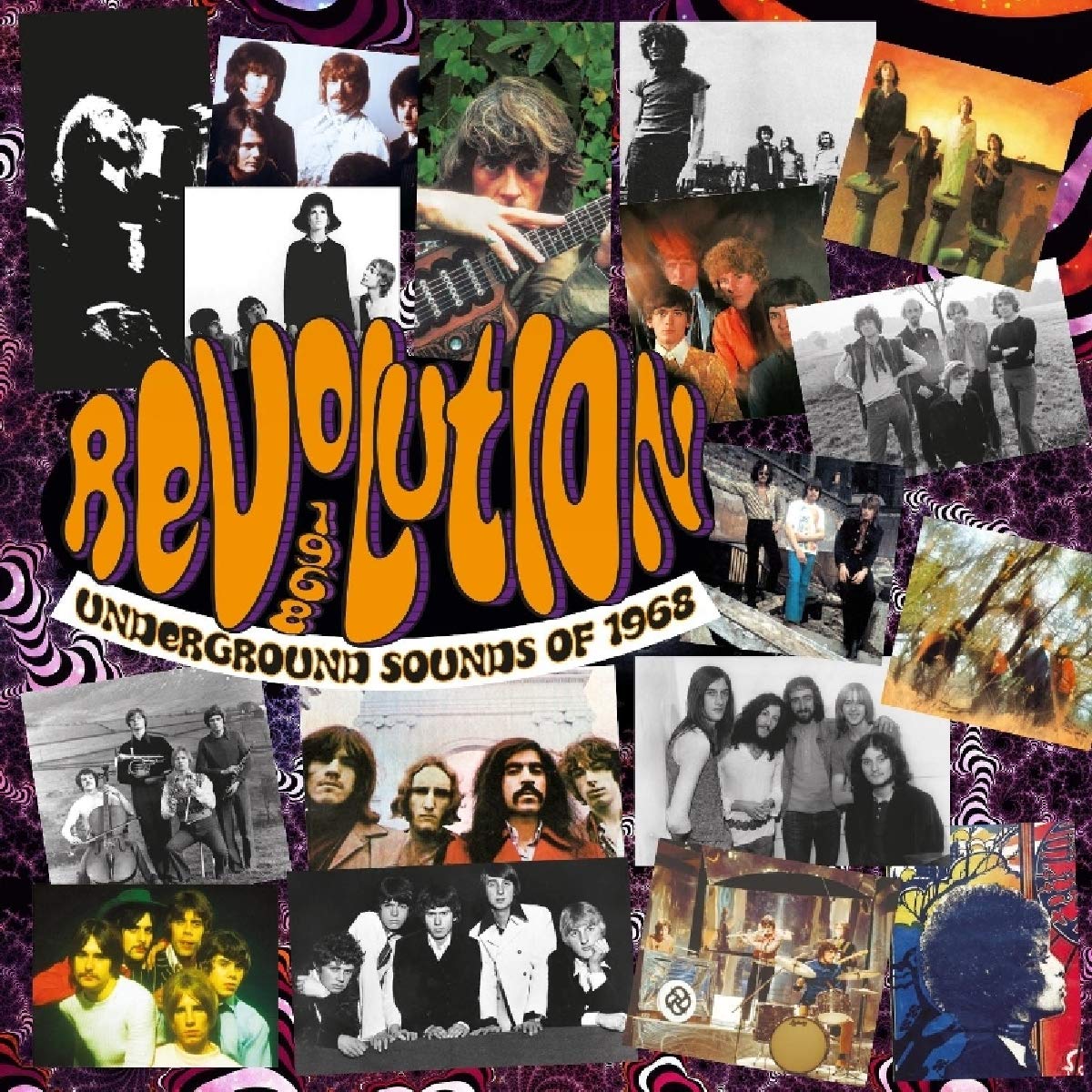
This new 3 CD Re-Mastered Box Set Celebrating The Musical sounds of the so called British “UNDERGROUND” Rock Music Of 1968. featuring tracks by Deep Purple, Jethro Tull, Barclay James Harvest, Julie Driscoll, Brain Auger & The Trinity, Spooky Tooth, Traffic, The Move, Crazy World Of Arthur Brown, Van Der Graaf Generator, Procul Harum, Genesis, Caravan, Jeff Beck, Pretty Things, The Incredible String Band, Tomorrow.
Esoteric Recordings are pleased to announce the release of “Revolution – Underground Sounds of 1968”, a 3CD clamshell boxed set celebrating the so-called “underground” rock music 1968, a year that saw huge changes, both musical and social. 1968 was a pivotal year for creativity in British rock, beginning with some influences of psychedelia still present in work by ground-breaking artists such as Pretty Things, Tomorrow, Incredible String Band, Idle Race, Traffic and The Move, but gradually giving way to styles influenced by jazz, blues, folk and more that would eventually become termed as “progressive”, “folk-rock” and “hard” rock, all of which championed by “underground” figures of the day such as DJ John Peel on his BBC Radio One show Top Gear and by publications such as International Times and Oz.The common thread among all of these artists was an emphasis on experimentation and a desire to push the perceived boundaries of popular music. It was also a year that would see the very first record releases by bands that would go on to achieve success and influence in the 1970s such as Deep Purple, Jethro Tull, Barclay James Harvest, Genesis, Status Quo, Van Der Graaf Generator and Caravan. Aside from featuring better known acts such as Crazy World of Arthur Brown, Procol Harum and Pentangle, this compilation also features lesser known acts.
The common thread among all of these artists was an emphasis on experimentation and a desire to push the perceived boundaries of popular music. It was also a year that would see the very first record releases by bands that would go on to achieve success and influence in the 1970s such as Deep Purple, Jethro Tull, Barclay James Harvest,Genesis, Status Quo, Van Der Graaf Generator and Caravan. Aside from featuring better known acts such as Crazy World of Arthur Brown, Procol Harum and Pentangle, this compilation also features lesser known acts that produced work of a wide breadth such as Eyes of Blue, Love Sculpture, The Action, Dantalian’s Chariot,Elmer Gantry’s Velvet Opera, Gun, Second Hand, The Moles and Blonde on Blonde.
This collection celebrates a creative period when rock music was evolving into something altogether more serious, moving away from the single as medium to give way to the dominance of the album. Feed your head with Revolution – Underground Sounds of 1968.
More stunning live material to come out of the vaults...Ian Curtis, Peter Hook and company recorded this live at the legendary Les Bains Douches in Paris on December 18th, 1979. Containing great versions of Love Will Tear Us Apart, Shadowplay, Atmosphere, Transmission, and more, this is one of the most classic live sets of the group’s storied career.
In January of 1980 Joy Division kicked off a tour of The Netherlands, Belgium, and Germany with a show at the legendary Paradiso Club in Amsterdam. Little did anyone know that in less than 6 months, Ian Curtis would be dead, and the brief, brilliant run of the group would be over. This is a particularly heavy and deep set, with the band performing at their angular best, and Curtis in top form vocally. Essential live broadcast for any fan of Joy Division.
If you are not already acquainted with this gig at Paradiso in Amsterdam in 1980. Here’s some info from a blog. “The local support didn’t want to play so Joy Division stood in for them. They played two completely different sets for the price of one.” And how it was described in a fanzine at the time: ‘When I arrived at the Paradiso, it appeared that most of the regular visitors had decided to stay at home.
So the JOY DIVISION played for a handful of people only, two long sets, together around 70 minutes of excellent music. At that time only the first album and two singles had been released, so they played a lot of new songs that went down well with the small audience. The gig was (along with the PIL-gig in Bruxelles) the best I have ever seen. Fantastic bass playing by Peter Hook and a strained Ian Curtis. The Paradiso management had lowered the ceiling to make things more intimate. It was a good idea. Shame to all the people who stayed at home’ SJC This is the most bootlegged live Joy Division show, but I’m not sure any of the bootlegs have sound this good. If they do, I certainly want to snag a copy.
Check the intensity on the live versions of tracks like “Transmission,” “Digital,” and “Disorder,” plus “A Means To An End,” “These Days,” and the timeless “Love Will Tear Us Apart.”
The British group Joy Division wrote and recorded 43 songs and played over 120 shows in just 29 months between 1978 and 1980.
The Struts are hell bent on becoming the biggest band on the planet the same way The Darkness once were. They have the chops, but neither of their albums have dented the Billboard Top 100 yet (2014’s Everybody Wants). That said, with giant “should be hits” on each platter and a relentless touring schedule opening for the likes of Foo Fighters, I have a feeling they will eventually have the last laugh.
The Struts, hailing from the East Midlands in the UK, have a head start on the revivalist circuit – two years into the game, in 2014, they opened for the Stones in Paris, before even releasing their debut LP Everybody Wants, a flash pot of musical theater shtick, glam-rock camp and pop-punk snot that suggested a band in on the joke but still committed to it. Frontman Luke Spiller – even the name is a punchline — is a mix of Freddie Mercury, Noel Gallagher and Julian Casablancas, has a thing for trilling his Rs, and clearly never met a hand-clap-driven shout-along he didn’t adore. “Kiss This” was the band’s first notable achievement, and their second LP advances the notion that maybe ignoring the last 30 or 40 years of pop trends isn’t the best approach.
After the breakup of Japan, this reluctant star retreated into a series of four albums—including his masterpiece—built on noir balladry, instrumental abstraction, and an abiding sense of distance. The first four solo albums, newly reissued on vinyl, exude an intense but ambiguous loneliness. “I wrestle with an outlook on life that shifts between darkness and shadowy light,” he sings during his most forthright song, “Orpheus.” Throughout these records, he does battle—with his outlook, with his past, with his expectations. As a singer, he seems to avert eye contact, his peculiar baritone formal and serious, classically beautiful but wary of sounding that way. As an arranger, accompanied by masters of ambiance like Ryuichi Sakamoto and Robert Fripp.
Before going solo, Sylvian found himself, like Scott Walker and Brian Wilson, playing the uncomfortable role of young pop icon. Commercially successful and critically loathed, Japan were a New Romantic group in which the inventive fretless bassist Mick Karn often outshone Sylvian, the dashing frontman. Japan formed while its members were classmates in South London, and their trajectory reflects the swiftly evolving taste of precocious teenagers. When they started in 1974, they sounded like the New York Dolls. As they rose to prominence, they sounded like Roxy Music. Eventually, they discovered the avant-garde.
That last touchstone was no phase; it has defined Sylvian’s career ever since. The sound that Sylvian explored as a solo artist—eerie, atmospheric, solitary—came into focus on Japan’s fifth and final album, 1981’s Tin Drum, and its sparse highlight, “Ghosts.” Where Sylvian’s best hooks had once come from pairing oblique phrases to new wave rhythms, he somehow found power now within the two syllables of the word “wilder,” melding them together with swelling vibrato. In a TV performance just before Japan broke up, he strips the song down to just acoustic guitar and voice, leaving long gaps of silence between each verse. “This whole year has been, like, drifting apart,” he tells the interviewer about Japan’s imminent dissolution.
Post-Japan, he began collaborating with Sakamoto on singles like “Forbidden Colours” his lyrical accompaniment to Sakamoto’s exquisite theme for Merry Christmas, Mr. Lawrence. By the time Sylvian released his solo debut Brilliant Trees in 1984, his group of musicians included Sakamoto, members of Can and Pentangle, and atmospheric trumpeters Jon Hassell and Mark Isham. The album remains his most immediate work, featuring some of his most memorable melodies (“Red Guitar,” “The Ink in the Well”) and daring explorations like the nearly nine-minute title track. It’s a remarkable opening statement, indicative of the singular world Sylvian was able to establish, even when surrounded by such rich talent.
David Sylvian’s debut solo album from 1984 is now available for the first time on 180 Gram vinyl. Featuring the singles Red Guitar, The Ink in The Well and Pulling Punches, the album is now housed in a gatefold sleeve with a printed inner bag and comes with a download card. David is joined on his debut album by a stellar cast including Holger Czukay, Jon Hassell, Kenny Wheeler, Mark Isham, Phil Palmer, Ryuichi Sakamoto, and Danny Thompson.
“Brilliant Trees” (Sylvian, Hassell)
The entirely instrumental “Alchemy: An Index of Possibilities”, a strange hodgepodge of collaborations and soundtrack material. Still believing Sylvian’s appearance and cult of personality to be his biggest selling point, a video company asked him to participate in a documentary; Sylvian responded with an abstract collage filmed in Tokyo, soundtracked by new ambient compositions included here. The record is vivid and atmospheric (particularly Side B, the longform piece “Steel Cathedrals”), but it’s more like a blueprint for the collaborative work to come. This new edition—its first complete release on vinyl—makes this reissue series more comprehensive, but it remains an album more interesting in concept than practice.
David Sylvian’s intermediary album, made up of two entirely separate projects from 1985, is now available for the first time on 180 Gram vinyl. Featuring brand new artwork, the album includes rare photographs by Yuka Fujii, design by Chris Bigg, and a download card. David is joined on Alchemy by Holger Czukay, Robert Fripp, Jon Hassell, Steve Jansen, Ryuichi Sakamoto, and Kenny Wheeler.
The cult classic 1991 album featuring David Sylvian, Steve Jansen, Richard Barbieri, and Mick Karn. Also features contributions from Bill Nelson, Phil Palmer, and Michael Brook. The majority of the material on this album was written as a result of group improvisations. There were no pre-rehearsals; the improvisation took place in the recording studio and much of the finished work contains original elements of those initial performances.
“Gone to Earth” is more essential. which featured one record of atmospheric vocal tracks and a second record consisting of ambient instrumentals. The album contained significant contributions from noted guitarists Bill Nelson (formerly of Be-Bop Deluxe) and Robert Fripp (of King Crimson), and a rhythm section comprising SteveJansen of Japan on drums and Ian Maidman of Penguin Cafe Orchestra on bass
Split into an LP of traditional compositions and an instrumental companion, its scope summarizes where Sylvian had been and foreshadows his next moves. “That album was put together piecemeal,” he later reflected. “I ended up with this… incohesive collection of material that I somehow had to make sense of.” It’s a marvel how coherent it feels. Some songs border on noir balladry, like the gorgeous “Silver Moon,” while others are almost gothic, including “Taking the Veil” and “Before the Bullfight” You can sense Sylvian peeling away the dramatic flourishes that made Brilliant Trees so bold. The ambient side, featuring guitar contributions from Fripp and Bill Nelson, offers shadows where once there were songs.
This was David Sylvian’s second solo album proper, a 2LP set from 1986, is now available for the first time on 180 Gram vinyl. Featuring the singles Silver Moon and Taking The Veil, the 2LP set is housed in a gatefold sleeve with brand new artwork, including rare photographs by Yuka Fujii, design by Chris Bigg, and printed inner bags plus a download card. David is joined on his second solo album by Robert Fripp, Bill Nelson, Kenny Wheeler, John Taylor, Phil Palmer, B.J. Cole, Mel Collins, Steve Jansen, and Steve Nye.
If Gone to Earth felt like a labored portrait of the artist, then its follow-up was made on instinct. Released just a year later, Sylvian’s masterpiece, “Secrets of the Beehive”, arrived quickly. “Each track was written in one sitting,” he has noted. Sakamoto’s string arrangements appear mostly just to vanish, and Sylvian sings uncharacteristically from behind acoustic guitar or a piano. He is a kind of live vanishing act, a singer/songwriter dissolving into fog. “September” suggests a jazz standard until it’s abruptly snuffed out in less than two minutes. “The Boy With a Gun” and “The Devil’s Own” take on varied evils but resolve without a hint of redemption. Conceptually heavy but structurally light, Secrets of the Beehive seems to forecast a storm that lingers in the distance.
The album’s quick creation involved abandoning pieces that had once seemed central to the work as a whole, and it does feel like a statement with the core scooped out. This only adds to its mysterious pull. During the brightest moment, “Let the Happiness In,” Sylvian sings over lapping percussion and a brass section that mimics foghorns. Through the dusk, Sylvian prays for the “agony to stop” as the arrangement opens into something that sounds like peace. “As a listener,” he has said, “I prefer to be taken through the stages of doubt before being shown the way out.” Few albums suspend you so completely.
All of this, of course, can seem a bit bleak. This intensity subsequently pushed Sylvian to seek spiritual guidance and shake things up creatively. Following the release of Secrets of the Beehive and his first-ever solo tour, he focused more on collaborative work, from a pair of ambient albums with Holger Czukay and two excellent releases with Fripp to music with artists like Fennesz decades later.
David Sylvian’s third solo album from 1987 is now available for the first time on 180 Gram vinyl. Including the singles Orpheus and Let The Happiness In, the album features new artwork based on Nigel Grierson’s original photographs, redesigned by Chris Bigg, housed in a Gatefold sleeve with a printed inner bag and download card. David is joined on his 3rd solo album by Ryuichi Sakamoto, Mark Isham, Steve Jansen, Danny Thompson, and David Torn.
These four records, then, mark a distinct phase of his career—likely the last time his work would be received by a mass audience, establishing a path toward the reclusive future he dreamed of.
In Martin Power’s biography of “Sylvian, The Last Romantic”, early manager Simon Napier-Bell recalls the young artist confiding, “I want to be a minor rock star.” It’s a humble, self-deprecating remark that rings true so many years later: His music remains a glowing source of solitude, all driven by a desire to be hidden but sought after—a celebration of all things lost and unnamed.
A journey through melodic pop is what’s to be expected from this Stockport five-piece, Fuzzy Sun. The freshly formed line-up, fronted by the lulling vocals of Kyle Ross, sees a distinct and original take on chorus-heavy reveries. Daisy Valentines bold and melancholic synth, coupled with sweet and seductive harmonies is equally complemented by Lewis Jobson and Mitch Bancroft’s strong soothing groove through the rhythm section. Fuzzy Sun bring you contemporary pop, infused with psychedelia, dipped in naughties R’n’B nostalgia, with just a hint of disco flare.
Fuzzy Sun are signed to Blossoms’ own label ‘Very Cleaver Records’, Fuzzy Sun have been causing waves in and around Manchester with their brand of 80s indie but with a modern twist and with more and more high profile gigs coming up (partly due to the aforementioned signing), word is bound to spread, especially as they have some fantastic tunes so far.
A few lines and a guitar lick are all Justin Townes Earle needs on “Ain’t Got No Money,” the shifty roots rocker that will be featured on his just-announced LP The Saint of Lost Causes.
Something of a return to the familiar for Earle, The Saint of Lost Causes sees him reunited with longtime producer Adam Bednarik in Nashville after venturing out to Omaha, Nebraska, to record 2017’s Kids in the Streets with Mike Mogis of Bright Eyes. “Ain’t Got No Money” is lean and wiry, built around a locked-in riff that calls to mind James McMurtry’s “Choctaw Bingo” and never loses step with Earle’s bitten-off, occasionally slurred vocal about trying to find the cash to make it to New Orleans. “Give me some money or just leave me alone,” he sings in the refrain, over a panting harmonica that wails through the song’s middle fifth.
Due to be the second of 12 songs on The Saint of Lost Causes‘ running order, “Ain’t Got No Money” and its pared-down arrangement suggests a different direction from the fleshed-out, full-band approach of Kids in the Street, which centered around more personal tales inspired by Music City, his hometown. Earle and Bednarik cut the album at Sound Emporium in Nashville.
From the new album ‘The Saint Of Lost Causes,’ available May 24th
Lunar Bird are the result of a long artistic journey through various projects and experiments. Influences on the band include The Cure, David Bowie, The Beatles, Beach House, The Strokes, Deerhunter, Björk and Elliott Smith.
Forming in Italy before moving to the Welsh capital, Cardiff’s Lunar Bird emerged from relative local obscurity in August 2018 with their excellent debut EP ‘Daydreamer’. All four songs on this release, particularly the excellent ‘Six Dull Dumb Eyes’, showcase a real talent for composing melodic and memorable space pop. With more releases surely in the offing, it seems only a matter of time before excitement about Lunar Bird spreads beyond South Wales.
Charly Bliss are back with their sophomore album Young Enough. Produced by Joe Chiccarelli (U2, Beck, Alanis, The Strokes, The Killers, My Morning Jacket, Cage The Elephant), the album finds the band exploring both the darker and poppier side of their sound while expanding on what made their debut Guppy a critically acclaimed smash.